Order Tracking
 0800 1422417
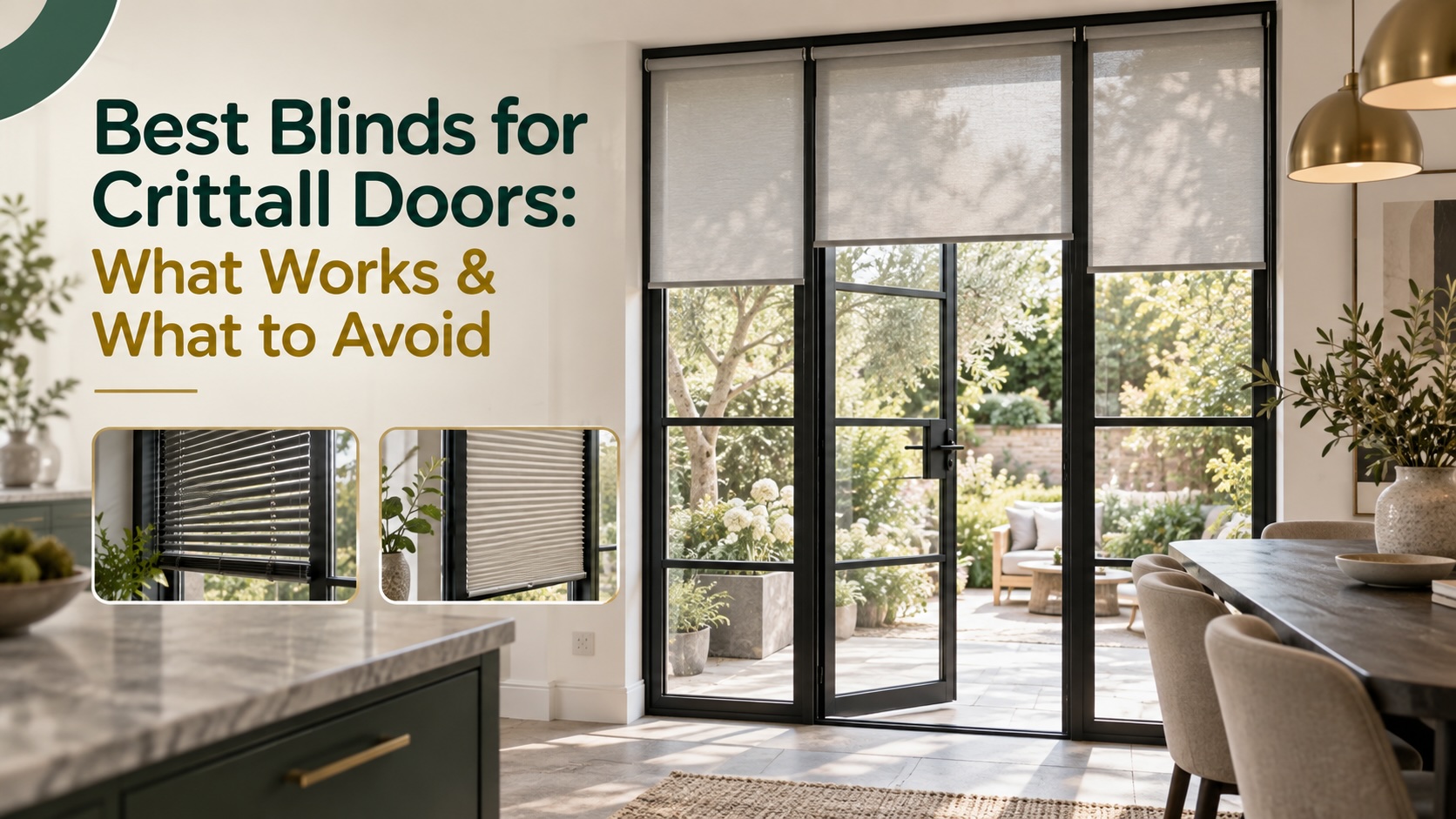
Crittall doors are a strong architectural feature in their own right, so choosing blinds for them is less about simply covering the glass and more about preserving the slim frame, keeping the doors easy to use and avoiding unnecessary visual bulk.
That makes them quite different from ordinary windows or patio doors.
The best blind for Crittall doors needs to work with:
- The width and height of the glazed panels
- Whether the doors open inwards or outwards
- The position of handles, hinges and locks
- The depth of the frame and surrounding recess
- Whether the blind is fitted to the door or above the opening
- The amount of privacy and glare control required
- The strong grid pattern created by the steel or steel-look frame
The wrong blind can hide too much of the glazing, clash with the architectural lines or interfere with the way the doors open.
This is particularly important with genuine steel Crittall doors, where the frame sections are deliberately slim and the visual appeal comes from the balance between narrow sightlines and large panes of glass.
Roller blinds are often the strongest all-round choice because they are simple, compact and can be raised largely clear of the glazing.
Metal Venetian blinds can work particularly well where adjustable privacy and light control are important, while Pleated blinds offer another slim option where low visual bulk matters.
Vertical blinds can also make sense across very wide openings, although they need to be chosen carefully because they can hide more of the distinctive frame pattern.
In this guide, we look at the blind styles that work best for Crittall and Crittall-style doors, how door movement affects compatibility, when individual blinds are better than one wide blind, and which options should be approached with more caution.
Use the sections below to jump directly to the Crittall door advice you need.
Understanding Crittall Doors
Best Blind Types for Crittall Doors
- Roller Blinds: Usually the Best All-Round Choice for Crittall Doors
- Individual Roller Blinds vs One Wide Roller Blind
- Venetian Blinds for Crittall Doors
- Metal Venetian Blinds: A Strong Match for the Industrial Look
- Pleated Blinds for Crittall Doors
- Day & Night Blinds for Crittall Doors
- Vertical Blinds: When They Work and When They Do Not
- Roman Blinds: Usually Better Above the Opening Than on the Door
Best Blinds by Door Configuration
Best Blinds by Room and Requirement
Colour and Design
Clearance, Opening Direction and Fitting
Mistakes and What to Avoid
Quick Answer: What Are the Best Blinds for Crittall Doors?
For most Crittall and Crittall-style doors, the strongest starting point is a Roller blind because it is compact, visually simple and can be raised largely clear of the glazing.
Other good options include:
- Metal Venetian blinds for adjustable privacy and glare control
- Pleated blinds where a slim, lightweight treatment is preferred
- Vertical blinds for very wide openings where side-to-side operation is useful
- Day & Night blinds where daytime privacy matters, provided the cassette and visual weight suit the opening
The best choice depends heavily on the way the doors operate.
If the Doors Open Inwards
An above-opening blind is often the safer approach because a blind mounted too close to the door leaf can interfere with the opening movement.
If the Doors Open Outwards
There is usually more internal clearance for a blind, although handles, hinges and frame depth still need to be considered.
If the Opening Is Very Wide
Multiple Roller blinds can often work better than one extremely wide blind because they:
- Reduce overall blind weight
- Allow individual sections to be controlled
- Can align more naturally with the steel mullions
- Make it easier to access one door without uncovering the entire opening
If Privacy Is the Main Priority
Metal Venetian blinds are particularly strong because the slats can be tilted without fully covering the glazing.
If You Want to Preserve the Crittall Look
Choose a blind with as little visual bulk as possible.
Crittall doors already have a strong architectural grid, so simple Roller, Metal Venetian and Pleated blinds generally complement them better than heavy fabrics or bulky systems.
What to Use More Carefully
Use more caution with:
- Bulky Roman blinds attached directly to door leaves
- Wide Wood Venetian blinds
- Deep cassette systems
- Heavy blinds mounted onto moving doors
- No Drill or Perfect Fit systems that have not been confirmed as compatible with the actual frame profile
For most installations, the key rule is:
preserve the steel sightlines + keep clear of handles and hinges + allow the doors to open fully + avoid unnecessary frame bulk.
Why Crittall Doors Need a Different Blind Approach
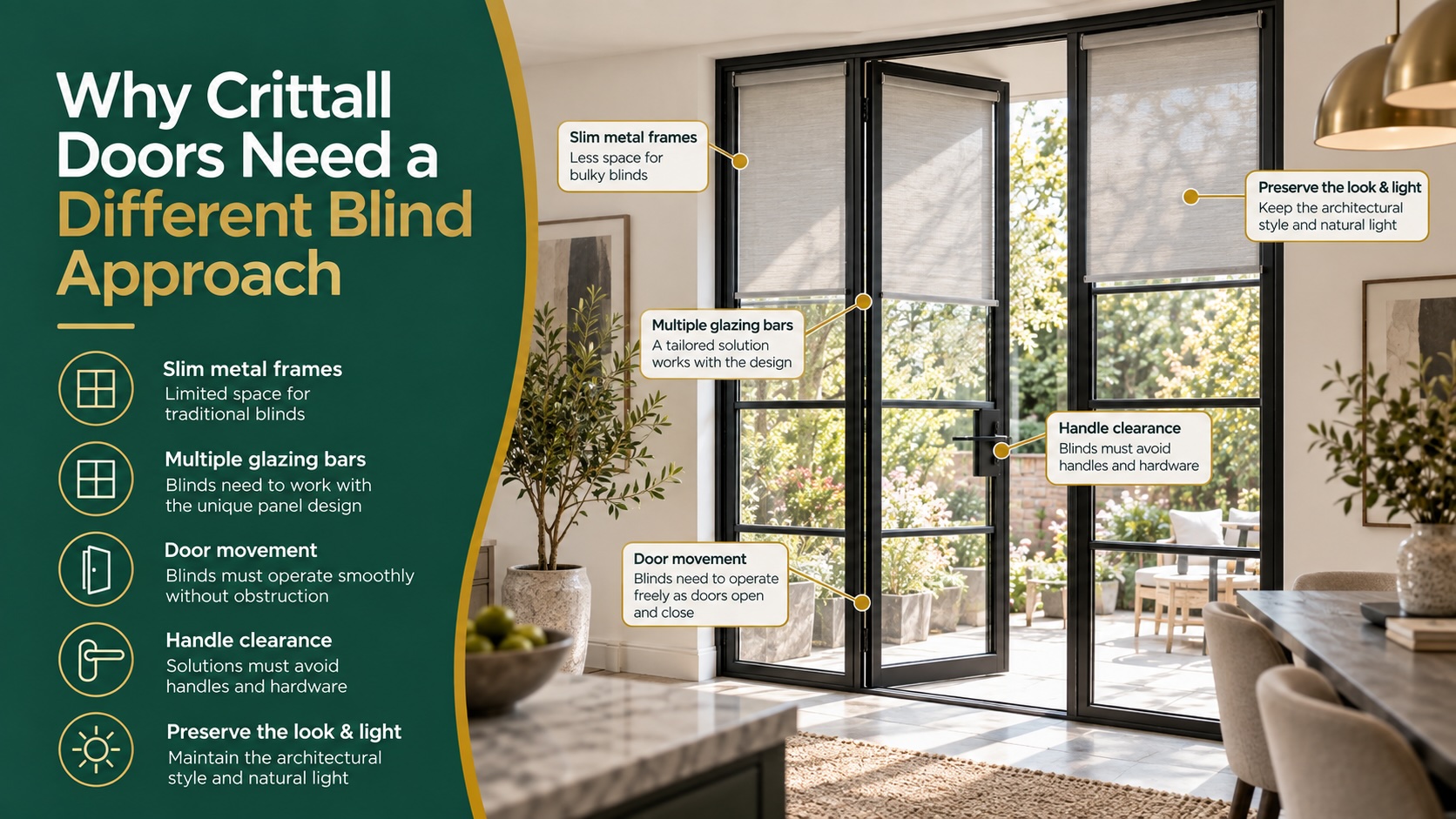
Crittall and Crittall-style doors are defined by slim frames, large areas of glazing and a strong grid-like appearance. Those features are exactly what make them attractive, but they also make blind selection more sensitive than it is for a standard window or patio door.
The wrong blind can quickly overpower the frame or interfere with the door itself.
Slim Frames Leave Less Room for Fixings
Crittall doors often have much narrower frame sections than conventional uPVC or timber doors.
That means there may be less suitable surface area for brackets, especially if the blind is intended to attach directly to the door.
This is one reason why direct frame fixing should never be assumed to be appropriate.
Door Movement Matters More
Unlike a fixed window, a Crittall door needs to open and close freely.
The blind therefore has to remain clear of:
- Handles
- Hinges
- Locks
- Adjacent door leaves
- The surrounding frame
- Any reveal or wall the door swings towards
This becomes especially important with inward-opening doors.
The Steel Grid Is Part of the Design
Crittall doors already create strong horizontal and vertical lines.
A blind that adds too much visual structure can make the opening feel busy.
For that reason, simpler treatments such as Roller or slim Metal Venetian blinds often work well because they complement the architecture rather than compete with it.
Large Glazed Areas Change the Practical Requirements
Crittall doors often bring a significant amount of daylight into a room.
That can be an advantage, but it may also create:
- Glare
- Reduced privacy
- Strong direct sunlight
- Heat build-up in certain rooms
The blind therefore needs to control light without unnecessarily hiding the glazing.
One Opening May Contain Several Different Sections
A Crittall installation may include:
- One opening door
- A pair of doors
- Fixed sidelights
- Multiple glazed panels
- A wider wall of steel-framed glazing
This means the best solution may be several individual blinds rather than one large blind.
The Main Principle
For Crittall doors, blind selection should begin with:
door movement + frame clearance + fixing position + visual proportion + privacy and light requirements
Once those are understood, the blind style becomes much easier to choose.
Crittall vs Crittall-Style Doors: Does It Matter for Blinds?
Yes. It matters because “Crittall” is often used as a general description for slim black-framed glazed doors, but the actual construction can vary considerably.
A genuine steel Crittall door is not the same as every aluminium or steel-look alternative, and that difference can affect how a blind should be fitted.
Genuine Crittall Doors
Authentic Crittall systems use slim steel profiles and are designed around narrow sightlines and large glazed areas.
For blind fitting, that can mean:
- Less obvious space for brackets
- Less tolerance for bulky fittings
- Greater need to preserve the narrow frame appearance
- More caution before drilling directly into the frame
The exact door system should always be identified before deciding how the blind will be fixed.
Aluminium Crittall-Style Doors
Many modern homes use aluminium doors designed to recreate the same industrial appearance.
These can look very similar but may have:
- Different frame depths
- Different glazing beads
- Different internal structures
- Different handle positions
- Different fixing restrictions
A blind solution that works on one aluminium system may not suit another.
Other Steel-Framed Doors
There are also other steel door systems with similar proportions.
Again, the visual appearance alone is not enough to determine blind compatibility.
The fitting method should be based on the actual frame construction.
Internal Crittall-Style Screens
Internal glazed doors and partitions create a slightly different situation.
Because they are not external windows, considerations such as weather seals and thermal performance may be less relevant, but:
- Door movement
- Handle clearance
- Frame width
- Privacy
- Visual proportion
still matter.
Why the Difference Matters
The term “Crittall-style” tells you what the door looks like.
It does not tell you:
- Whether the frame can be drilled
- Whether a No Drill system will fit
- How deep the glazing bead is
- Whether a cassette will clear the door
- Whether the blind can be mounted to the moving leaf
Best Approach
Before choosing a blind, identify:
the door manufacturer + frame material + opening direction + frame depth + glazing arrangement
That information is more useful than relying on the Crittall appearance alone.
A blind should be selected for the actual door system, not just the style it resembles.
Can Blinds Be Fixed Directly to Crittall Door Frames?
Sometimes, but direct fixing should not be assumed to be suitable simply because there appears to be enough frame to take a bracket.
Crittall and Crittall-style doors often use very slim profiles, and the visible frame can contain or sit close to important glazing, structural and thermal components.
Why Direct Frame Fixing Needs Care
Depending on the door system, the frame may include:
- Steel or aluminium sections
- Glazing beads
- Seals and gaskets
- Thermal breaks
- Reinforcement
- Drainage routes
- Locking or hinge components
- Factory-applied finishes
Drilling into the wrong area can therefore cause more than a cosmetic screw hole.
Genuine Steel Crittall Frames
With genuine steel-framed doors, it is especially important to check the manufacturer’s guidance before drilling.
The frame sections are deliberately narrow, so there may be limited suitable space for conventional blind brackets.
Drilling can also damage the protective finish on the steel if it is carried out incorrectly.
Aluminium Crittall-Style Doors
The same principle applies to aluminium alternatives.
Although the frame may look substantial enough from the room side, the profile can contain thermal breaks, drainage features or glazing components that should not be penetrated.
The correct fixing area varies between systems.
Warranty Considerations
If the doors are still under warranty, direct drilling is something worth checking before installation.
A manufacturer or installer may place conditions on:
- Frame alterations
- Drilling
- Mechanical damage
- Damage to coatings
- Third-party installation work
That does not mean fitting blinds automatically voids the warranty, but an unauthorised frame modification can become relevant if a later problem develops.
Fixing Above or Around the Door May Be Easier
In many installations, it may be simpler to mount the blind:
- Above the door opening
- Into the surrounding wall
- Into a suitable reveal
- Onto another appropriate fixing surface
This keeps the slim frame untouched and can also provide more space for the blind mechanism.
Best Approach
If a blind is being attached directly to a Crittall or Crittall-style frame, confirm that:
the fixing area is suitable + the door manufacturer permits it + the bracket clears the glazing and hardware + the blind will not obstruct door movement
Where there is any uncertainty, fitting around the opening rather than into the frame is generally the more cautious approach.
Should Crittall Door Blinds Be Fitted to the Door or Above the Opening?
Both approaches can work, but for many Crittall installations fitting the blind above the opening is the simpler and safer starting point.
The right choice depends mainly on how the doors open, how much frame is available for fixing and whether the blind needs to move with the door.
Fitting the Blind to the Door
A door-mounted blind can work well where each glazed panel needs independent control.
This can be useful if:
- Each door leaf is used separately
- Privacy needs vary between panels
- The blind needs to stay with the door as it opens
- There is enough suitable frame area for the fixing system
However, door-mounted blinds need particularly careful checking around:
- Handles
- Hinges
- Locks
- Adjacent door leaves
- The frame when the door closes
- The amount the blind projects from the door
A blind that adds too much depth can stop the door closing properly or cause one leaf to clash with another.
Fitting the Blind Above the Opening
Mounting the blind above the doors avoids many of those problems.
It can:
- Keep the steel or aluminium frame untouched
- Reduce the risk of interference with door hardware
- Provide more space for the blind mechanism
- Allow one blind to cover several glazed sections
- Keep the treatment clear of moving door leaves
This is often a strong option for Roller and Roman blinds.
The Main Trade-Off
The disadvantage of fitting above the opening is that the blind may need to be raised before the doors can be used comfortably.
That can matter on doors that are opened frequently throughout the day.
One Blind or Several?
Where the opening is wide, several separate blinds may be better than one very large blind.
Individual blinds can:
- Align with the steel mullions
- Make individual door access easier
- Reduce the size and weight of each blind
- Provide more flexible light control
Best Approach
Choose door-mounted blinds where independent panel control is important and the frame provides a suitable fixing arrangement.
Choose above-opening blinds where preserving the frame, maintaining door clearance and simplifying installation are the main priorities.
For most Crittall-style door openings, the blind should be positioned so that door movement takes priority over keeping the blind as close to the glass as possible.
Roller Blinds: Usually the Best All-Round Choice for Crittall Doors
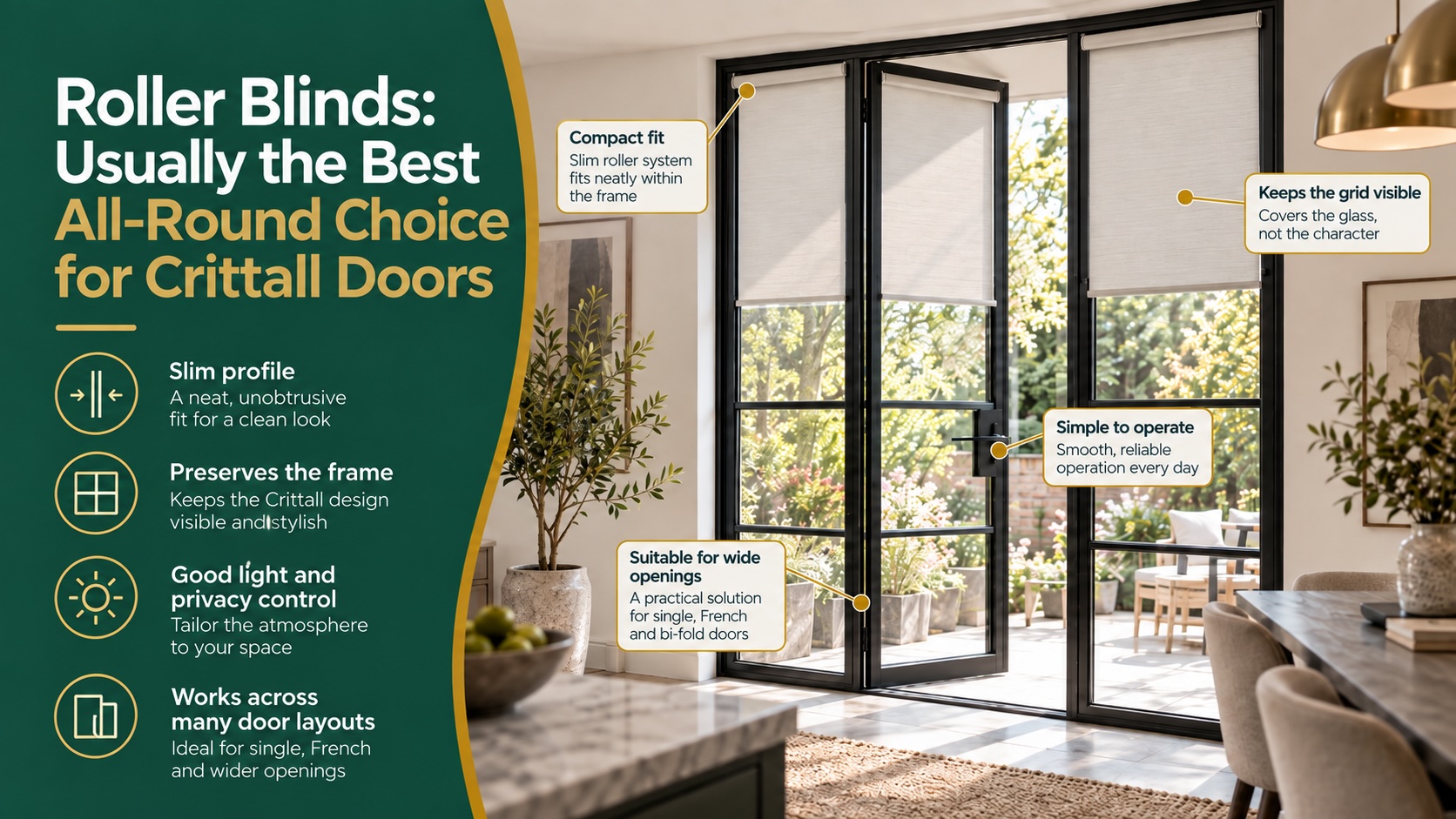
Roller blinds are often the strongest all-round choice for Crittall and Crittall-style doors because they are simple, compact and visually restrained.
That matters on a door system where the frame itself is already a major design feature.
Why Roller Blinds Work So Well
Roller blinds can complement Crittall doors because they:
- Keep the treatment visually simple
- Avoid competing with the steel grid
- Can be raised largely clear of the glazing
- Work well across single doors or wider glazed sections
- Are available in light-filtering, blackout and solar-control fabrics
Their clean lines generally suit both industrial-style interiors and more traditional rooms with black-framed doors.
Good for Preserving the Crittall Look
One of the biggest advantages is that a Roller blind does not add much visual structure of its own.
When raised, most of the glazing and steelwork remains visible.
That is important because the appeal of Crittall doors comes from the contrast between the slim dark frame and large glazed areas.
Suitable for Large Glazed Openings
Roller blinds can also work well across larger door arrangements.
However, a very wide opening does not automatically mean that one very wide blind is the best option.
In many cases, several Roller blinds aligned with the mullions can provide:
- Better control
- Easier door access
- Less weight per blind
- A more balanced appearance
Light and Privacy Options
Different Roller fabrics can solve different problems.
A light-filtering fabric can reduce glare while maintaining daylight.
A more opaque fabric can provide stronger privacy.
Blackout fabrics can be useful where Crittall-style doors are used in bedrooms or rooms where stronger light reduction is needed.
Main Limitation
The main drawback is access.
If a Roller blind is fitted across the whole opening, it may need to be raised before the door can be opened comfortably.
That makes fitting position particularly important on doors that are used frequently.
Best Overall Use
Roller blinds are strongest where the priorities are:
minimal visual bulk + preserved glazing + broad compatibility + simple operation
For most Crittall door installations, they are the safest starting point before considering more specialised options.
Individual Roller Blinds vs One Wide Roller Blind
For wider Crittall door openings, one of the main decisions is whether to use one large Roller blind across the whole opening or several individual blinds aligned with the door panels.
Both approaches can work, but they suit different layouts.
Individual Roller Blinds
Several smaller Roller blinds are often the more practical option where the opening contains multiple doors, sidelights or clearly defined glazed sections.
They can provide:
- Independent control over each section
- Easier access through one door without uncovering the whole opening
- Less weight per blind
- Better alignment with the Crittall grid
- More flexibility where some panels receive more sunlight than others
Visually, this can work particularly well when the blind widths follow the vertical mullions in the door system.
One Wide Roller Blind
A single Roller blind can create a cleaner, simpler appearance across the whole opening.
It may suit layouts where:
- The doors are treated as one large glazed feature
- The blind is mainly used in the evening
- The opening is not used constantly
- A continuous fabric look is preferred
The trade-off is that a very wide blind becomes heavier and may require a larger tube or more substantial mechanism.
It can also be less convenient if only one door needs to be opened.
Door Access Matters
This is often the deciding factor.
If the blind spans several door leaves, the whole blind may need to be raised before one door can be used.
With individual blinds, only the section in front of the active door may need to be adjusted.
That can make a noticeable difference in kitchens, extensions and living spaces where the doors are used regularly.
Visual Alignment
Crittall doors have a strong geometric structure.
Several blinds that align cleanly with the mullions can reinforce that structure rather than interrupt it.
Poorly positioned individual blinds, however, can make the opening look fragmented, so consistent spacing and alignment matter.
Best Overall Approach
Choose individual Roller blinds where flexibility, regular door access and alignment with the Crittall grid are the priorities.
Choose one wide Roller blind where a cleaner continuous appearance matters more and the opening is used less frequently.
For larger multi-panel Crittall installations, individual blinds are often the more practical solution.
Venetian Blinds for Crittall Doors
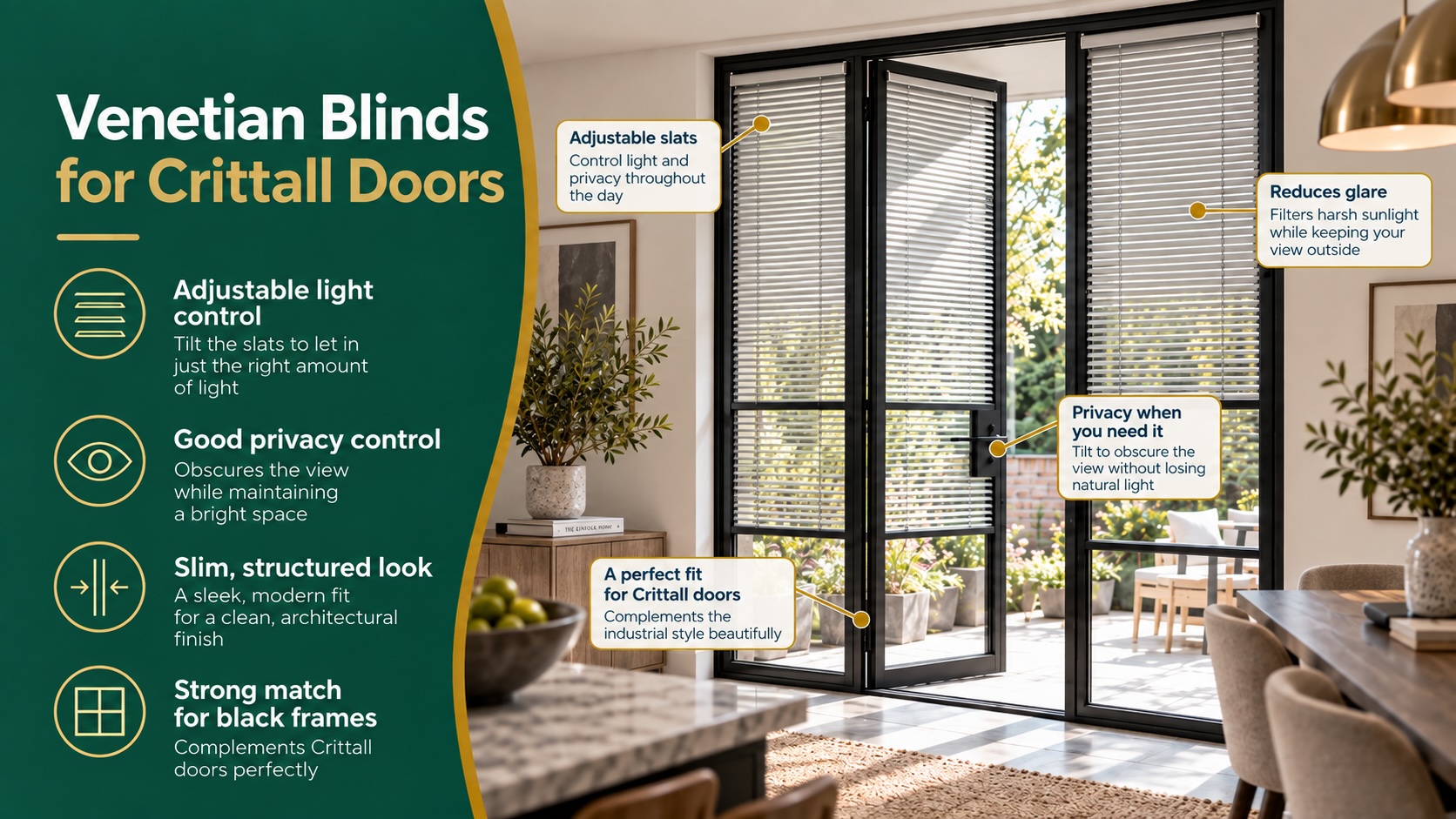
Venetian blinds can work very well with Crittall and Crittall-style doors where the main priorities are adjustable privacy, glare control and precise light management.
They are especially useful where large glazed doors face a street, neighbouring property or strong sunlight.
Why Venetian Blinds Suit Crittall Doors
The biggest advantage is flexibility.
The slats can be tilted to:
- Reduce direct views from outside
- Soften glare
- Redirect sunlight
- Maintain more daylight than a fully closed Roller blind
- Give different levels of privacy during the day
This makes Venetian blinds particularly useful in living rooms, home offices and ground-floor spaces.
Metal Venetian Blinds Usually Suit the Look Best
For most Crittall-style interiors, Metal Venetian blinds are usually the better visual match.
Their slim slats and cleaner profile tend to complement the narrow steel or aluminium frames more naturally than heavier Wood Venetian blinds.
They can also reinforce the industrial character of black-framed doors without making the opening feel overly decorative.
Door-Mounted Venetian Blinds Need Clearance
If Venetian blinds are fitted directly to moving door leaves, they need careful consideration.
The blind must remain clear of:
- Handles
- Hinges
- Locks
- Adjacent doors
- The surrounding frame
The slats and bottom rail also need enough space so that normal door movement does not cause repeated contact.
Wider Venetian Blinds Become Heavier
Across large door openings, Venetian blinds can become substantial.
For this reason, several narrower blinds aligned with individual door panels may be more practical than one very wide blind.
This can also make it easier to control privacy or sunlight independently across different sections.
Main Limitation
Venetian blinds introduce more horizontal lines into an opening that already has a strong steel grid.
That can work well in an industrial interior, but it can also make the glazing appear busier than a simple Roller blind.
Best Overall Use
Venetian blinds are strongest where the priorities are:
adjustable privacy + directional light control + glare reduction + a structured contemporary appearance
For most Crittall door installations, Metal Venetian blinds are generally the stronger option than wider, heavier Wood Venetian blinds.
Metal Venetian Blinds: A Strong Match for the Industrial Look
Metal Venetian blinds are particularly well suited to Crittall and Crittall-style doors because their slim profile and clean horizontal lines complement the industrial character of the frames.
They are one of the strongest alternatives to Roller blinds where privacy and light control are more important.
Why Metal Venetian Blinds Work Well
Compared with heavier blind styles, Metal Venetian blinds are generally:
- Slimmer
- Lighter in appearance
- Better suited to narrow frame proportions
- Easy to coordinate with black or dark-framed doors
- Effective for controlling both privacy and glare
Their structured look can work especially well in contemporary kitchens, extensions and home offices.
Strong Privacy Control
One of their main advantages is that the slats can be tilted rather than simply raised or lowered.
This allows you to reduce direct views into the room while still admitting daylight.
That can be particularly useful where Crittall doors:
- Face neighbouring properties
- Open onto a street-facing courtyard
- Receive strong afternoon sun
- Create glare across a workspace or television area
Good Visual Match With Black Frames
Metal Venetian blinds in black, charcoal, grey or other muted finishes can create a very cohesive look with dark steel or aluminium frames.
Alternatively, lighter finishes can soften the contrast and keep the room visually brighter.
Better for Slim Openings Than Wood Venetian Blinds
Wood Venetian blinds can look attractive, but the thicker slats and larger headrail can feel heavy against slender Crittall frames.
Metal Venetian blinds usually preserve more of the light, precise character of the glazing.
Door-Mounted Installations Need Care
If fitted directly to a moving door leaf, the blind needs enough clearance for:
- Handles
- Locks
- Hinges
- Adjacent panels
- The surrounding frame
The bottom rail should also remain controlled so that it does not repeatedly strike the door or glass when the door is opened.
Best Overall Use
Metal Venetian blinds are strongest where the priorities are:
industrial styling + adjustable privacy + glare control + relatively low visual bulk
For Crittall doors in modern interiors, they are one of the most natural-looking options available.
Pleated Blinds for Crittall Doors
Pleated blinds can be a strong option for Crittall and Crittall-style doors where the priority is low visual bulk, a slim profile and simple light control.
They are especially useful where the glazing is a major architectural feature and the blind should remain relatively discreet.
Why Pleated Blinds Work Well
Pleated blinds are typically lighter and less visually dominant than many other blind types.
That makes them a good match for Crittall doors because they can:
- Preserve more of the frame visually
- Sit neatly against large glazed areas
- Reduce glare without creating a heavy appearance
- Work well in contemporary interiors
- Suit narrower glazed sections
Their softer folded structure also contrasts nicely with the rigid geometry of steel-framed doors.
Good for Minimal Interiors
In modern kitchens, extensions and living spaces, Pleated blinds can work well where the design brief is deliberately restrained.
They are particularly useful where a Roller blind feels too plain but a Venetian blind would introduce too many horizontal lines.
Useful Where Space Is Limited
Because Pleated blinds can be relatively compact, they may suit installations where:
- The frame depth is limited
- The reveal is shallow
- Large cassettes would feel too bulky
- The blind needs to remain visually unobtrusive
As always, the exact blind system and fitting method need to be checked against the door configuration.
Privacy and Light Control
Pleated fabrics can provide different levels of screening depending on the material selected.
They can be useful for:
- Softening strong daylight
- Reducing glare
- Increasing privacy
- Maintaining a lighter feel than a fully opaque blind
They are generally less precise than Venetian blinds for directional light control, but they can offer a more minimal overall appearance.
Door-Mounted Compatibility Still Needs Checking
If the blind is intended to sit directly on a moving door leaf, clearance remains critical.
The blind must not interfere with:
- Handles
- Locks
- Hinges
- Adjacent door panels
- The door closing fully
Best Overall Use
Pleated blinds are strongest where the priorities are:
slim profile + low visual bulk + soft light control + contemporary styling
For Crittall doors where the glazing and frame should remain the main visual feature, they can be an excellent alternative to both Roller and Venetian blinds.
Day & Night Blinds for Crittall Doors
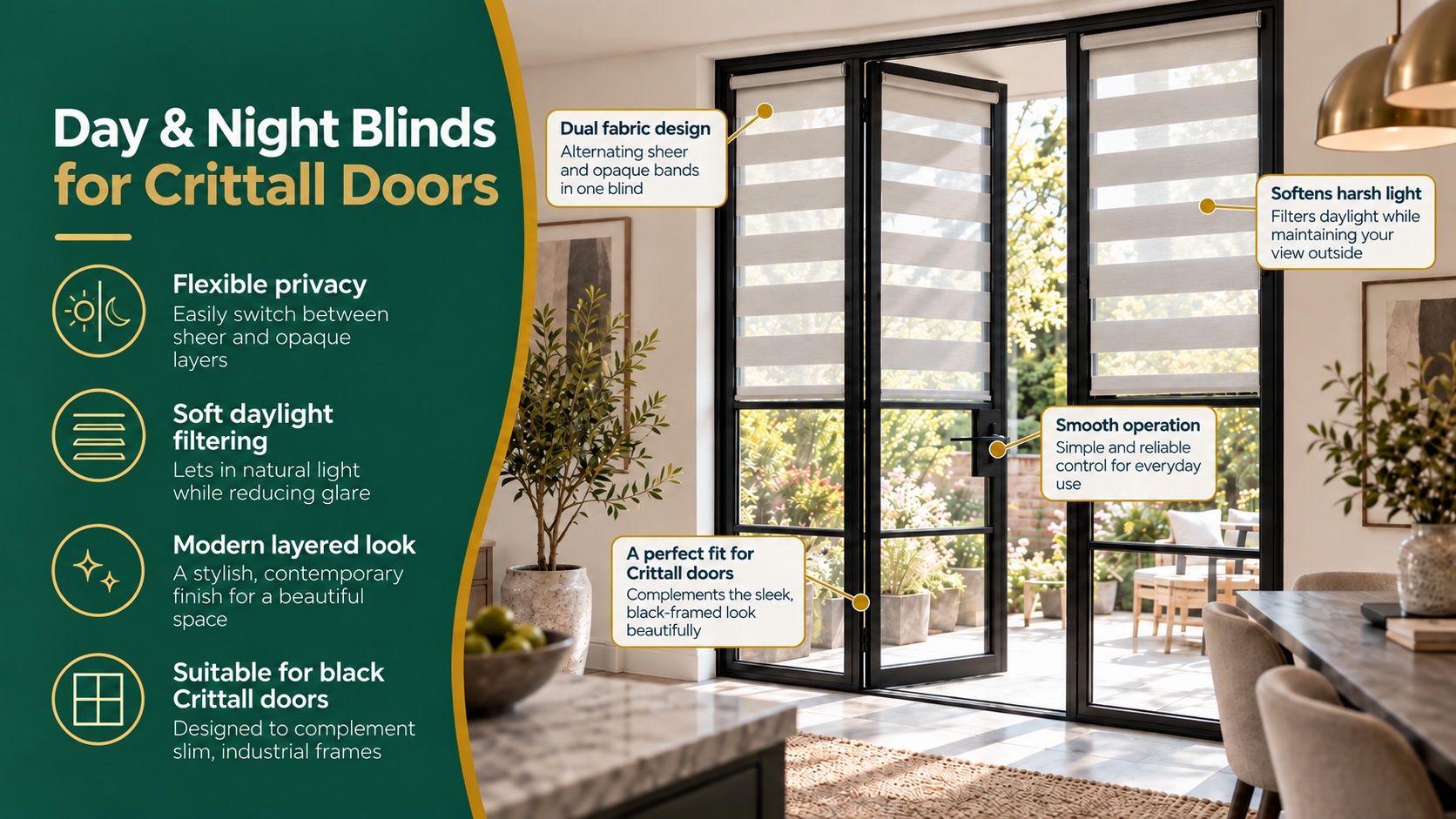
Day & Night blinds can work well with Crittall and Crittall-style doors where the main priority is daytime privacy without giving up too much natural light.
Their alternating sheer and opaque fabric bands make them more flexible than a standard Roller blind, but they also create a stronger visual presence.
Why Day & Night Blinds Can Work
They are particularly useful where the doors:
- Face neighbouring properties
- Overlook a street or courtyard
- Need privacy during the day
- Still need to admit useful natural light
By adjusting the fabric layers, the blind can provide different levels of screening without needing to be fully raised or fully closed.
Best Suited to Contemporary Interiors
Day & Night blinds generally suit modern Crittall-style spaces better than very traditional interiors.
They work particularly well in:
- Contemporary kitchens
- Modern extensions
- Open-plan living areas
- Home offices
- New-build properties
Their clean, structured appearance can complement dark steel or aluminium frames, especially where the wider interior already has a modern look.
The Main Visual Consideration
Crittall doors already have a strong grid formed by the frame.
Day & Night blinds introduce another set of horizontal lines.
This can look intentional in a contemporary room, but it can also make the glazing feel busier than a plain Roller or Pleated blind.
Cassette Depth Matters
Day & Night systems often use a more substantial headrail or cassette than a standard Roller blind.
This needs to be checked carefully where:
- The doors open inwards
- The reveal is shallow
- The blind sits close to the frame
- Handle or hinge clearance is limited
Better Above the Opening Than on Some Door Leaves
On many Crittall door arrangements, Day & Night blinds are likely to work better when mounted above the opening rather than directly onto a slim moving door leaf.
That gives the cassette more space and reduces the risk of interference with the door.
Best Overall Use
Day & Night blinds are strongest where the priorities are:
daytime privacy + filtered light + contemporary styling
They are a good option for modern Crittall-style doors, but where preserving the cleanest possible view of the steel grid is the priority, a standard Roller blind will usually be more visually restrained.
Vertical Blinds: When They Work and When They Do Not
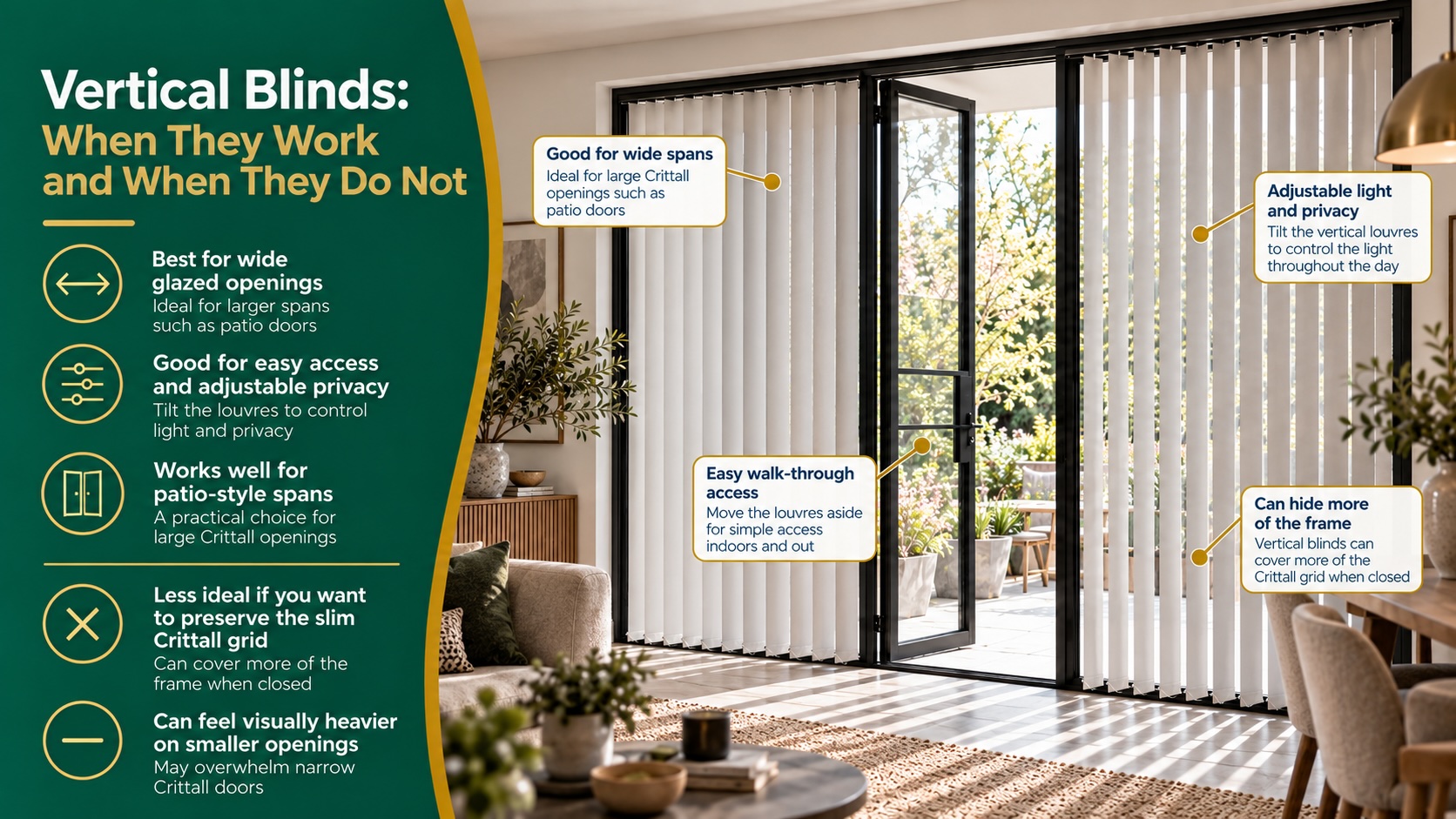
Vertical blinds are more suitable for Crittall doors than they are for many standard windows because they can handle wide glazed openings and frequent door access particularly well.
They are not always the strongest visual match, but functionally they can be very effective.
Why Vertical Blinds Can Work Well
Vertical blinds are particularly useful where:
- The Crittall opening is very wide
- Several door leaves sit side by side
- The doors are used regularly
- Side-to-side opening is more practical than raising a blind
- Adjustable privacy is important
Because the louvres draw sideways, part of the opening can remain accessible without lifting the entire blind.
That can be useful in kitchens, extensions and living rooms with large garden-facing doors.
Good for Large Spans
One of the main strengths of Vertical blinds is that they can cover wide openings without requiring one very large Roller tube or cassette.
This makes them practical where the glazed area spans several Crittall-style panels.
The Main Visual Drawback
Crittall doors are defined by their steel grid.
Vertical blinds introduce another strong set of lines across the opening.
When closed, they can also hide much more of the frame than Roller, Pleated or Venetian blinds.
This is why they are often a stronger functional choice than an aesthetic one.
Better in Contemporary Spaces
Vertical blinds tend to work best in:
- Modern extensions
- Open-plan rooms
- Large glazed elevations
- More minimal interiors
They are usually less sympathetic to highly detailed period interiors where the Crittall doors themselves are intended to remain a prominent design feature.
Individual Panels vs One Vertical Blind
For a very wide opening, one Vertical blind can be simpler than several independent blinds.
However, the stacking position matters.
If the louvres stack over the main access door, they can reduce the usable opening.
The blind should ideally stack where it interferes least with everyday movement.
Best Overall Use
Vertical blinds are strongest where the priorities are:
wide-span coverage + frequent door access + adjustable privacy + practical side-to-side operation
They are less suitable where preserving the full architectural appearance of the Crittall frame is the main goal.
Roman Blinds: Usually Better Above the Opening Than on the Door
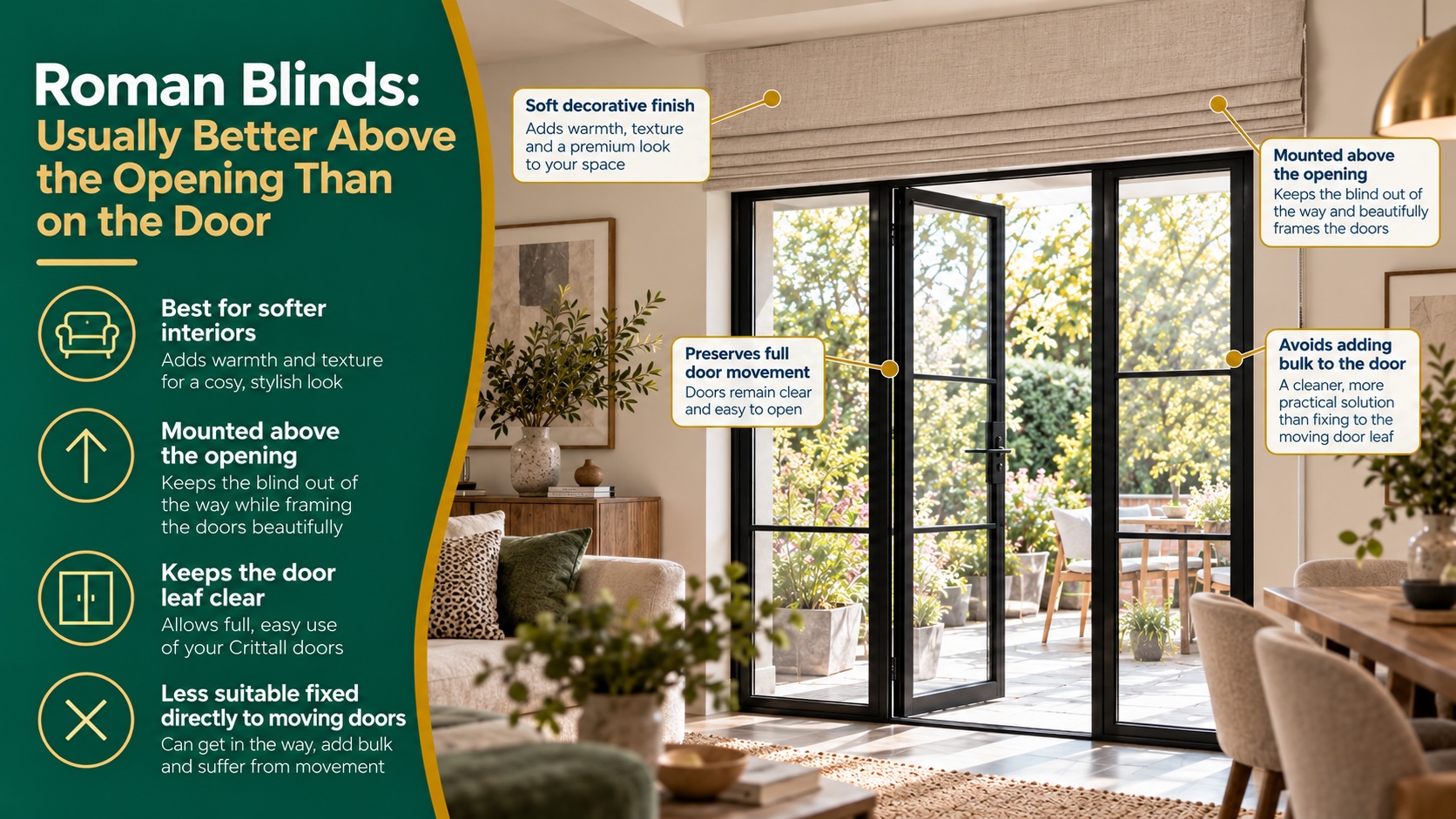
Roman blinds can work with Crittall and Crittall-style doors, but they are generally better suited to being fitted above the opening rather than directly onto individual moving door leaves.
Their main strength is decorative softness, while their main limitation is bulk.
Why Roman Blinds Can Work
Roman blinds can suit Crittall doors where the room combines industrial glazing with a softer interior style.
They can work particularly well in:
- Period properties with Crittall-style doors
- Bedrooms
- Living rooms
- Interiors with curtains, upholstery or other soft furnishings
- Rooms where the blind is intended to become a decorative feature
The contrast between a structured steel frame and soft folded fabric can be very effective.
Why Door-Mounted Roman Blinds Are Less Practical
Roman blinds create a significant fabric stack when raised.
If they are attached directly to a moving door leaf, that extra depth can interfere with:
- Door handles
- Adjacent leaves
- The surrounding frame
- Hinges
- Full door opening
They are also visually heavier than Roller or Pleated blinds, which can overwhelm the slim proportions of a Crittall frame.
Above-Opening Fitting Usually Works Better
Mounting the Roman blind above the entire opening gives the fabric more room and keeps the moving door leaves clear.
This can also create a more balanced appearance, particularly where the doors form one large architectural feature.
The blind can then be lowered when privacy or light control is needed and raised clear when the doors are in use.
Consider the Fabric Stack
Even when mounted above the opening, the raised blind needs somewhere to sit.
If there is enough wall space above the doors, positioning the blind higher can help keep more glazing visible when it is raised.
Best Overall Use
Roman blinds are strongest where the priorities are:
decorative softness + traditional character + a more furnished interior look
For most Crittall door installations, they are better treated as an above-opening window dressing rather than a compact blind attached directly to the door.
Best Blinds for Crittall-Style Bi-Fold Doors
Crittall-style bi-fold doors need more careful blind planning because the door panels fold and stack, rather than simply opening on hinges.
The strongest options are usually:
1. Roller blinds fitted above the opening
2. Vertical blinds for very wide spans
Why Bi-Fold Doors Are More Difficult
Each door leaf needs enough clearance to fold against the next panel.
A blind mounted directly onto the door can add depth and potentially interfere with:
- The folding action
- Adjacent panels
- Handles
- Hinges
- The stacked door leaves
- The frame when the doors are fully opened
For that reason, panel-mounted blinds should only be used where the blind system is specifically compatible with the door design.
Roller Blinds Above the Opening
A Roller blind fitted above the entire opening is often the simplest solution.
It keeps the blind completely separate from the folding panels and preserves the clean appearance of the doors.
This works particularly well where the blind is mainly needed for:
- Evening privacy
- Glare reduction
- Strong sunlight
- Occasional screening
The main limitation is that the blind will normally need to be raised before the doors can be folded open.
Multiple Roller Blinds
On very wide bi-fold installations, several Roller blinds may be better than one extremely wide blind.
Individual blinds can:
- Reduce the size and weight of each blind
- Align with groups of door panels
- Provide more flexible light control
- Avoid the need for one very large mechanism
Vertical Blinds
Vertical blinds can also work well because they draw sideways rather than upwards.
This can be useful where the doors are opened frequently.
The stacking position should be planned carefully so the louvres do not sit across the main access point when open.
Avoid Bulky Door-Mounted Systems
Heavy Roman blinds, wide Wood Venetian blinds and deep cassettes are generally less suitable for attaching directly to folding leaves.
Even if they fit when the doors are closed, they may prevent the panels from stacking correctly when opened.
Best Overall Choice
For Crittall-style bi-fold doors:
Above-opening Roller blinds are usually the safest all-round option.
Vertical blinds are a strong alternative where the opening is very wide and frequent access matters.
The most important rule is to choose a blind that allows the doors to fold and stack fully without the blind, brackets or controls interfering with the movement.
Best Blinds for Crittall Doors With Fixed Side Panels
Crittall doors are often combined with fixed glazed side panels, and this creates more flexibility than a simple pair of opening doors.
The main decision is whether to treat the whole glazed area as one feature or give the fixed and opening sections separate blinds.
Individual Blinds Aligned to Each Section
Using separate blinds for each glazed panel is often the most practical approach.
This can allow you to:
- Control privacy independently
- Leave fixed panels covered while keeping the door clear
- Align blinds with the existing mullions
- Reduce the size and weight of each blind
- Preserve the visual rhythm of the Crittall grid
Roller blinds are particularly well suited to this arrangement because they can follow the proportions of each section without adding much visual bulk.
One Blind Across the Full Opening
A single blind can create a cleaner, more continuous appearance across the whole door and side-panel arrangement.
This may work well where:
- The opening is not extremely wide
- The blind is used mainly in the evening
- A simpler visual treatment is preferred
- The doors are not opened constantly
The main drawback is that the whole blind may need to be raised whenever the door is used.
Treating Fixed Panels Differently
Another option is to give the fixed sidelights their own blinds while leaving the opening door with a separate treatment.
This can be useful where privacy is needed permanently on the fixed glazing but less often on the door itself.
It can also make everyday access easier.
Alignment Matters
With Crittall-style glazing, visual alignment is especially important.
Blind edges should ideally relate to:
- Vertical mullions
- Door edges
- Fixed-panel divisions
Random blind widths can make the opening feel visually fragmented.
Best Overall Choice
For Crittall doors with fixed side panels:
Individual Roller blinds aligned with the door and sidelights are usually the most flexible option.
A single wide blind can still work where a cleaner overall look is more important than independent control.
The key is to let the blind layout follow the existing structure of the steel grid, rather than working against it.
Best Blinds for Internal Crittall-Style Doors and Screens
Internal Crittall-style doors and glazed screens create a different set of priorities because they are usually used to divide rooms rather than separate the home from outdoors.
That means privacy, visual balance and door movement often matter more than weather performance.
Why Internal Crittall Screens Are Different
Internal glazed partitions are commonly used between:
- Kitchens and living rooms
- Hallways and reception rooms
- Home offices and living spaces
- Bedrooms and dressing areas
The glass helps maintain a sense of openness, so a blind should ideally provide privacy when needed without permanently hiding the architectural grid.
Roller Blinds
Roller blinds are often the strongest option because they are simple and can be raised almost completely clear of the glazing.
They work well where privacy is only occasionally required, such as:
- A home office
- A guest room
- A dressing area
- A room used for flexible purposes
A plain fabric usually suits the clean lines of the frame best.
Venetian Blinds
Venetian blinds are useful where privacy needs to be adjusted rather than switched simply between open and closed.
Metal Venetian blinds in particular can work well because they complement the industrial appearance of black-framed screens.
Pleated Blinds
Pleated blinds are another good option where the aim is to keep the treatment lightweight and visually discreet.
They can soften the glass without adding too much bulk.
Think Carefully About Door-Mounted Blinds
If the blind is fitted directly to an internal door leaf, the same clearance rules still apply.
The blind should not interfere with:
- Handles
- Hinges
- Adjacent panels
- Door closing
- The surrounding frame
This matters even more where the door is narrow.
Privacy Without Losing the Architectural Effect
Internal Crittall-style screens are often installed specifically because they allow light to move between rooms.
For that reason, a blind that can be fully retracted or finely adjusted is usually preferable to a permanently heavy treatment.
Best Overall Choice
For internal Crittall-style doors and screens:
Roller blinds are usually best for occasional privacy and minimal visual impact.
Metal Venetian blinds are stronger where privacy needs to be adjusted throughout the day.
Pleated blinds work well where the priority is a softer, lightweight treatment.
Best Crittall Door Blinds for Privacy
Crittall and Crittall-style doors often create large areas of glazing, which can make privacy a bigger consideration than it is with a standard window.
The strongest options are usually:
1. Metal Venetian blinds
2. Day & Night blinds
3. Roller blinds for full screening
Metal Venetian Blinds
Metal Venetian blinds are one of the best options where privacy needs to be adjusted throughout the day.
The slats can be tilted to reduce direct views while still allowing useful daylight into the room.
This makes them particularly suitable for:
- Street-facing rooms
- Ground-floor extensions
- Home offices
- Overlooked garden rooms
- Internal glazed partitions
They also tend to suit the industrial appearance of Crittall-style frames.
Day & Night Blinds
Day & Night blinds can also work well where daytime privacy matters.
Their alternating sheer and opaque sections allow the blind to remain partially open while still reducing visibility through the glass.
They are particularly suited to more contemporary interiors.
The main consideration is visual weight, because the horizontal bands add another strong pattern over the existing Crittall grid.
Roller Blinds
Roller blinds are better where the priority is complete visual screening when the blind is lowered.
They are simple and discreet when raised, making them a strong option where privacy is mainly needed:
- In the evening
- At night
- Occasionally rather than throughout the day
Their limitation is that they offer less fine control than Venetian or Day & Night blinds.
Privacy on Internal Crittall Screens
For internal glazed doors or partitions, privacy may be needed only at certain times.
In these situations, a retractable Roller blind or adjustable Venetian blind can preserve the open feel of the glazing when privacy is not required.
Best Overall Choice
For Crittall doors where privacy is the main concern:
Metal Venetian blinds are usually best for adjustable daytime privacy.
Day & Night blinds are useful where privacy and filtered light need to work together.
Roller blinds are strongest where full screening is the priority.
Best Crittall Door Blinds for Glare and Strong Sunlight
Large glazed Crittall and Crittall-style doors can bring excellent natural light into a room, but they can also create glare and strong direct sunlight, especially on south- and west-facing elevations.
The best blind should reduce discomfort without unnecessarily hiding the glazing.
Roller Blinds With Light-Filtering or Solar-Control Fabrics
Roller blinds are usually the strongest option where glare reduction is the main priority.
Depending on the fabric, they can:
- Soften harsh sunlight
- Reduce glare on screens and televisions
- Maintain more daylight than a fully opaque blind
- Preserve the clean appearance of the Crittall frame
A light-filtering or solar-control fabric can be particularly useful in kitchens, extensions and home offices.
Metal Venetian Blinds
Metal Venetian blinds are another strong option because the slats can be tilted to redirect sunlight rather than simply block it.
This is useful where the angle of the sun changes during the day.
They can help:
- Reduce direct glare
- Preserve useful daylight
- Control sunlight more precisely
- Maintain some visibility through the glazing
Day & Night Blinds
Day & Night blinds can also help where sunlight and privacy need to be managed together.
Their layered fabric allows different levels of filtering, although the stronger horizontal pattern can compete visually with the Crittall grid.
Avoid Assuming Internal Blinds Replace Suitable Glazing
Blinds can help manage glare and direct sunlight, but they are not a substitute for appropriate glazing specification where solar performance is a major concern.
This is particularly relevant in large glazed extensions.
Best Overall Choice
For Crittall doors affected by strong sunlight:
Roller blinds with an appropriate light-filtering or solar-control fabric are usually the best all-round option.
Metal Venetian blinds are better where directional light control is more important than a completely clean visual appearance.
The aim is to reduce glare while still allowing the doors to perform as a major source of natural light.
Best Crittall Door Blinds for Bedrooms
Crittall-style doors in bedrooms often need a different balance from living spaces because privacy and light reduction become much more important at night.
The strongest options are usually:
1. Blackout Roller blinds
2. Roman blinds fitted above the opening
Blackout Roller Blinds
Blackout Roller blinds are usually the most practical choice where stronger light reduction is needed.
They work particularly well because they are:
- Compact
- Visually simple
- Easy to raise clear of the glazing during the day
- Well suited to modern Crittall-style interiors
- Available in fabrics that provide strong screening at night
They are especially useful for bedrooms with Crittall doors leading to a balcony, terrace or garden.
Remember That Blackout Fabric Is Not the Same as Total Darkness
A blackout fabric blocks light through the material itself, but light can still enter around the edges of the blind depending on the fitting position.
This is particularly relevant with wide glazed doors.
If stronger room darkening is important, the relationship between the blind, recess and surrounding wall needs to be considered carefully.
Roman Blinds
Roman blinds can work well where the bedroom has a softer or more traditional interior style.
They are generally better fitted above the whole opening than directly onto individual door leaves.
They can provide:
- Decorative softness
- Strong visual privacy
- Good compatibility with curtains and other fabrics
The main limitation is the larger fabric stack at the top.
Venetian Blinds for Daytime Privacy
Metal Venetian blinds are useful where daytime privacy is important, especially where the bedroom is overlooked.
They allow the slats to be adjusted while still admitting natural light.
However, they are generally less effective than a blackout Roller or lined Roman blind where reducing night-time light is the main priority.
Best Overall Choice
For bedroom Crittall doors:
Blackout Roller blinds are usually the strongest choice for practical light reduction and a clean appearance.
Roman blinds are a good alternative where decorative softness matters more.
Where daytime privacy is the bigger concern, Metal Venetian blinds can also work well.
Best Crittall Door Blinds for Kitchens and Extensions
Kitchens and extensions are some of the most common places for Crittall and Crittall-style doors, especially where large glazed openings connect the room to a garden or terrace.
The strongest options are usually:
1. Roller blinds
2. Metal Venetian blinds
Roller Blinds
Roller blinds are often the best overall choice because they are compact and easy to keep visually understated.
They work particularly well in kitchens and extensions because they can:
- Reduce glare
- Provide evening privacy
- Sit neatly above large glazed openings
- Be raised largely clear of the doors during the day
- Suit both industrial and softer contemporary interiors
For frequently used garden doors, several individual Roller blinds can be more practical than one very wide blind.
Metal Venetian Blinds
Metal Venetian blinds are a strong alternative where more precise light control is needed.
They can be useful in rooms that receive strong direct sunlight because the slats can be tilted to reduce glare while still admitting daylight.
They also suit the clean, architectural character of black steel or aluminium frames.
Think About How Often the Doors Are Used
This is particularly important in kitchens and extensions.
If the doors are opened several times a day, a blind that has to be fully raised each time can become inconvenient.
In these situations, consider:
- Individual blinds aligned with separate door leaves
- Vertical blinds for very wide openings
- A layout that keeps the main access door independent
Keep the Treatment Visually Light
Crittall doors often form the main architectural feature in a modern extension.
Bulky fabric, oversized cassettes or heavy slats can reduce that effect.
Simple treatments usually work better.
Best Overall Choice
For kitchens and extensions:
Roller blinds are usually the strongest choice for compactness, glare control and broad compatibility.
Metal Venetian blinds are better where adjustable sunlight and privacy control matter more.
Where the doors are used very frequently, the blind layout should prioritise easy access as much as appearance.
Best Crittall Door Blinds for Living Rooms
Living rooms with Crittall and Crittall-style doors usually need a balance of daylight, privacy and visual proportion.
Because the doors are often one of the main architectural features in the room, the blind should support the design rather than dominate it.
Roller Blinds
Roller blinds are often the strongest all-round choice.
They work well because they can:
- Sit relatively discreetly above or within the opening
- Be raised largely clear of the glazing
- Provide evening privacy
- Reduce glare when needed
- Keep the Crittall grid visually prominent
A plain or subtly textured fabric usually works particularly well.
Metal Venetian Blinds
Metal Venetian blinds are a strong alternative where adjustable privacy and light control matter more.
They are especially useful in living rooms that:
- Face the street
- Are overlooked
- Receive strong direct sunlight
- Need glare control around televisions or screens
Their slim, structured appearance can also complement black steel or aluminium frames.
Roman Blinds
Roman blinds can work well where the living room has a softer or more decorative interior style.
They are generally better fitted above the opening rather than directly to the doors.
They can help bridge the contrast between industrial-style glazing and more traditional furniture or fabrics.
Day & Night Blinds
Day & Night blinds can also work in contemporary living rooms where daytime privacy is important.
They are more visually prominent than a standard Roller blind, so they suit interiors where the additional horizontal pattern feels intentional.
Best Overall Choice
For living rooms:
Roller blinds are usually the strongest option for preserving the architectural character of the doors.
Metal Venetian blinds are better where adjustable privacy and glare control matter more.
Roman blinds can work well where the room needs a softer, more decorative treatment.
What Blind Colours Work Best With Black Crittall Doors?
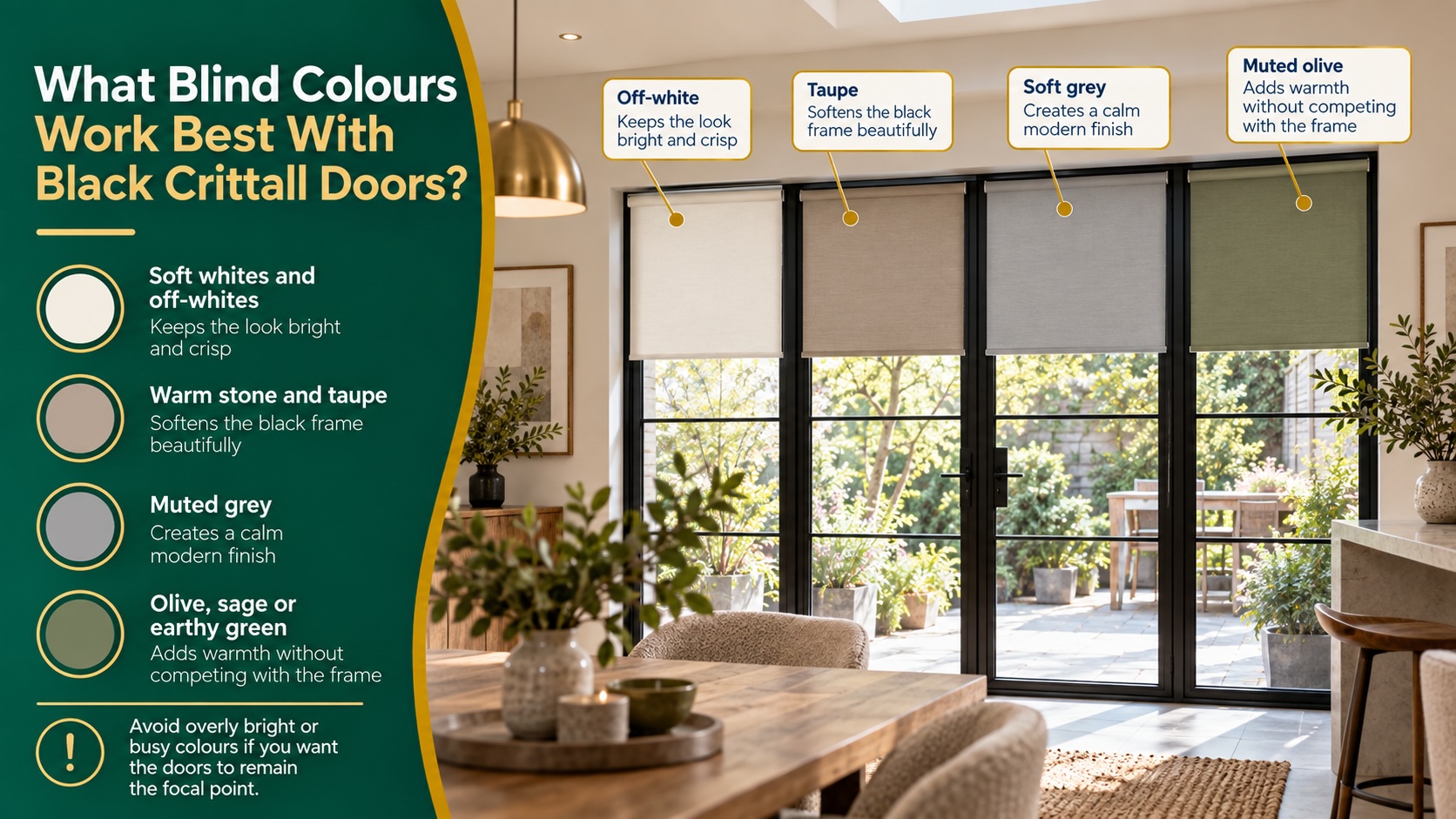
Black Crittall and Crittall-style doors already create a strong visual frame, so blind colour has a noticeable effect on the overall look of the room.
The best choice usually depends on whether you want the blind to blend in, soften the contrast or become a deliberate feature.
Off-White and Cream
Off-white, ivory and soft cream are some of the easiest colours to use.
They can:
- Keep the room feeling bright
- Soften the contrast with black frames
- Preserve the architectural effect of the doors
- Work well in both modern and more traditional interiors
These shades are particularly effective where the walls are light and the aim is to keep the window treatment understated.
Warm Grey and Taupe
Warm grey and taupe work well where a slightly more sophisticated neutral is preferred.
They can bridge the contrast between black metalwork and warmer materials such as:
- Timber flooring
- Natural stone
- Beige upholstery
- Warm-toned cabinetry
These colours often work especially well with Roller and Roman blinds.
Charcoal and Black
A darker blind can create a much more graphic look.
Black or charcoal blinds can work where:
- The room has strong architectural styling
- A monochrome scheme is already established
- The blind is intended to visually merge with the frame
The main trade-off is that dark blinds can make the glazed area feel heavier when lowered.
Muted Green
Muted olive, sage and other soft greens can work particularly well with black-framed doors.
They add colour without fighting the industrial geometry and can connect the glazing visually to garden views outside.
Other Muted Colours
Soft blue, clay, stone and other restrained tones can also work well.
Strong, highly saturated colours can be effective in the right interior, but they become a more dominant feature.
Best Overall Approach
For most black Crittall doors:
Off-white and cream are best for brightness.
Warm grey and taupe are strong neutral choices.
Charcoal and black create a more architectural look.
Muted green works particularly well where the room connects strongly to the outdoors.
The main principle is to choose a colour that supports the black frame rather than competing with it.
Should Blinds Match Black Crittall Frames?
Not necessarily.
Matching the blind to the frame can create a very cohesive look, but contrast often works just as well, especially where the aim is to keep the room lighter.
Matching the Frame
Black or charcoal blinds can visually merge with dark Crittall frames and create a strong architectural effect.
This approach works particularly well in:
- Minimal interiors
- Industrial-style rooms
- Monochrome schemes
- Spaces with other black metal details
Metal Venetian blinds can be especially effective because the blind and frame share a similar structured appearance.
Using a Lighter Blind
A lighter blind creates more contrast and can stop the whole opening from feeling too dark.
Off-white, cream, stone and pale grey can:
- Keep the room brighter
- Make the glazing feel larger
- Soften the black frame
- Work well with light walls and natural materials
This is often the better approach where the Crittall doors already create a strong visual statement.
Matching Other Interior Elements Instead
The blind does not need to match the frame at all.
It can instead coordinate with:
- Wall colour
- Upholstery
- Flooring
- Kitchen cabinetry
- Curtains
- Other soft furnishings
This can help the doors feel integrated with the wider room rather than treated as a separate feature.
Avoid Accidental Near-Matches
A blind that is almost black but noticeably different from the frame can sometimes look less intentional than either a true match or a clear contrast.
Where exact matching is difficult, a complementary neutral can often work better.
Best Overall Approach
Choose black or charcoal where you want the blind to reinforce the strong industrial character of the frame.
Choose lighter neutrals where you want to soften the black steelwork and preserve brightness.
The blind should support the overall room scheme, so matching the frame is an option rather than a rule.
Plain vs Patterned Blinds for Crittall Doors
Crittall doors already have a strong visual pattern created by the dark frame, horizontal bars and vertical mullions.
Because of that, plain blinds are usually the safest choice.
Why Plain Blinds Work Well
Plain fabrics help keep the emphasis on the architecture of the doors.
They are particularly effective where:
- The Crittall grid is already visually dominant
- The room has a minimalist or industrial style
- Other furnishings include pattern or texture
- The blind is intended to disappear when raised
Roller and Pleated blinds often work especially well in plain fabrics because they keep the treatment simple.
Patterned Blinds Can Still Work
Pattern is not automatically wrong.
A patterned Roman or Roller blind can work where the room is deliberately more decorative.
This may suit:
- Period properties with Crittall doors
- Softer traditional interiors
- Bedrooms
- Living rooms with restrained surrounding décor
The important point is that the pattern should not compete too aggressively with the steel grid.
Pattern Scale Matters
Large geometric patterns can be difficult to use because the doors already contain strong geometry.
Smaller-scale or more organic patterns are usually easier to combine with Crittall frames.
Soft botanical designs, subtle stripes or low-contrast motifs can work better than bold, high-contrast patterns.
Think About How the Blind Looks When Lowered
On large glazed doors, a patterned blind can occupy a significant area of the room when closed.
A design that looks subtle on a small fabric sample can become much more dominant across a wide opening.
This is particularly important with one large blind covering several door panels.
Best Overall Approach
For most Crittall doors:
Plain blinds are the strongest choice for preserving the architectural character of the frame.
Patterned blinds can work where the treatment is intentionally decorative, but the scale and contrast should generally remain restrained.
Door Handles, Hinges and Blind Clearance
Crittall and Crittall-style doors can have very little spare space around the frame, so clearance is one of the most important checks before choosing a blind.
A blind can look suitable when the doors are closed but still interfere with the handle, hinge or door movement once the system is used.
Handle Projection
Handles can project significantly from the door face.
If the blind sits too close to the handle, it may:
- Prevent the blind lowering fully
- Cause the fabric or slats to catch
- Restrict handle movement
- Create repeated contact that damages the blind
This is particularly important with Roller, Venetian and Pleated blinds fitted directly to the door.
Hinges and Opening Movement
Hinge position affects how much space the blind can occupy.
On inward-opening doors, even a relatively shallow blind can come close to the reveal or wall when the door is fully opened.
On paired doors, the blind on one leaf may also approach the blind on the other.
Locks and Other Hardware
Crittall doors can include additional locking points or hardware around the frame.
These should remain fully accessible after the blind is fitted.
A blind should never make the door harder to lock or operate.
Bottom Rails and Slats
The lower part of the blind matters too.
A loose bottom rail or Venetian slats can move when the door opens and repeatedly strike the glass or frame.
Where a blind is attached to the moving leaf, the whole system needs to remain stable during normal use.
Cassette and Headrail Depth
Deep cassettes can be especially problematic.
A blind may technically fit within the opening but still project too far to allow the door to open fully.
This is one reason compact Roller, Pleated and Metal Venetian systems are often easier to accommodate.
Best Approach
Before choosing the blind, check:
handle projection + hinge position + locking hardware + door swing + headrail depth + bottom rail clearance
For Crittall doors, successful blind fitting depends just as much on these physical details as on the blind style itself.
What Happens When Crittall Doors Open Inwards?
Inward-opening Crittall and Crittall-style doors create one of the biggest blind-fitting challenges because the door leaf moves into the room and towards any blind mounted above or within the opening.
That means blind depth and positioning become critical.
Why Inward Opening Changes the Fitting Strategy
A blind fitted too close to the door can interfere with:
- The top edge of the door leaf
- Handles
- Hinges
- The surrounding reveal
- The blind cassette or headrail
- The blind fabric or slats when lowered
A system that looks fine with the door closed may prevent the door from opening fully.
Above-Opening Blinds Are Often Easier
For inward-opening doors, fitting the blind higher above the opening can provide more clearance.
This is especially useful for:
- Roller blinds
- Roman blinds
- Day & Night blinds
The aim is to keep the blind mechanism outside the arc of the opening door.
Recess-Mounted Blinds Need More Care
A recess-mounted blind can be problematic if the door leaf swings into the same space.
The deeper the cassette or headrail, the more likely a collision becomes.
This is why the available depth should be measured with the door fully open, not just with it closed.
Door-Mounted Blinds Can Work
A blind fixed directly to the moving leaf avoids some headrail collision issues because it moves with the door.
However, this creates a different set of checks around:
- Frame fixings
- Handle clearance
- Door-to-door clearance
- Added weight
- Whether the blind remains secure during movement
Check the Full Opening Angle
Do not assume that a door only needs to open to 90 degrees.
If the door normally opens wider, the blind needs to remain clear throughout its full intended movement.
Best Approach
For inward-opening Crittall doors:
prioritise headrail clearance + door swing + handle projection + recess depth
In many cases, a compact Roller blind mounted sufficiently high above the opening is the simplest solution.
What About Outward-Opening Crittall Doors?
Outward-opening Crittall and Crittall-style doors are generally easier to accommodate with internal blinds because the door leaf moves away from the room and away from the blind.
That usually gives more freedom for recess-mounted or above-opening blinds.
Why Outward Opening Can Be Easier
Because the door swings outside, an internal blind is less likely to collide with:
- The top of the door leaf
- Hinges
- The surrounding reveal
- The blind cassette or headrail
This can make Roller, Pleated and Venetian blinds easier to specify.
Handle Clearance Still Matters
Even when the door opens outwards, the internal handle still projects into the room.
A blind fitted too close to the frame can still catch on:
- Handles
- Locks
- Control mechanisms
- Projecting hardware
So the door opening direction solves one problem, but not every clearance issue.
Recess-Mounted Blinds Can Work Well
Outward-opening doors can be particularly suitable for blinds fitted within the internal recess because the door leaf does not move into that space.
This can help keep the blind visually compact and close to the glazing.
Door-Mounted Blinds Still Need Checking
A blind attached directly to the door leaf may still be possible, but the same considerations apply around:
- Frame suitability
- Added depth
- Handle clearance
- Door-to-frame clearance
- Whether drilling is permitted
Best Approach
For outward-opening Crittall doors:
internal recess-mounted Roller, Pleated or Venetian blinds are often easier to accommodate than they are on inward-opening doors.
The main checks are still:
handle projection + frame clearance + blind depth + suitable fixing position
Outward opening generally gives the blind more room, but the exact door profile and hardware still determine what will work.
Can No Drill Blinds Work on Crittall Doors?
Sometimes, but No Drill blinds should not be assumed to fit every Crittall or Crittall-style door.
Many no-drill systems are designed around specific window or door profiles, so compatibility depends on the exact frame, glazing bead and available clearance.
Why Compatibility Is More Complicated
Crittall and Crittall-style doors often have very slim frames.
That can mean there is limited space for clip-on or bead-mounted blind systems.
A No Drill blind may depend on:
- The shape of the glazing bead
- The depth of the frame
- The amount of clearance around the glass
- Handle position
- Whether the system is steel or aluminium
- Whether the door leaf needs to fold or open against another surface
If any of these do not match the blind system, a no-drill installation may not be possible.
Genuine Steel Crittall Doors
Genuine steel frames can be particularly restrictive because the profiles are so slim.
A no-drill system developed for standard uPVC glazing may not fit a steel Crittall profile at all.
This is why compatibility needs to be confirmed for the specific door rather than based on appearance alone.
Crittall-Style Aluminium Doors
Some aluminium Crittall-style doors may offer more options, but again, the exact profile matters.
Two doors can look almost identical from the room side but have completely different glazing bead shapes and frame depths.
Why No Drill Can Still Be Attractive
Where compatible, a No Drill blind can be a very useful option because it can:
- Avoid drilling into the frame
- Reduce concern about permanent alterations
- Preserve the clean appearance of the door
- Make removal easier in the future
This can be particularly appealing where the doors are new or still under warranty.
Best Approach
Before choosing a No Drill blind for Crittall doors, confirm:
frame material + glazing bead compatibility + available depth + door movement + handle clearance
No Drill blinds can work very well on the right door, but compatibility should be verified rather than assumed.
Are Perfect Fit Blinds Suitable for Crittall Doors?
Sometimes, but Perfect Fit blinds are not automatically suitable for Crittall or Crittall-style doors.
Perfect Fit systems are typically designed around specific glazing beads and frame profiles, so compatibility depends on the exact door rather than the fact that it has a slim black frame.
Why Perfect Fit Compatibility Varies
A Perfect Fit-style blind usually needs a suitable connection around the glazed area.
That means the system may depend on:
- The shape of the glazing bead
- The space between the glass and frame
- The depth of the profile
- Handle position
- Door movement
- The exact steel or aluminium construction
Slim Crittall-style frames can make this more restrictive.
Genuine Steel Crittall Doors
With genuine steel Crittall doors, Perfect Fit compatibility should be checked very carefully.
The frame geometry may be very different from the uPVC window and door profiles that many Perfect Fit systems are designed around.
A system that works perfectly on a standard glazed door may not have a suitable fixing point on a slim steel section.
Aluminium Crittall-Style Doors
Some aluminium systems may be more compatible, but again, the exact profile matters.
Visual similarity does not mean the glazing bead or frame depth is the same.
Why Perfect Fit Can Be Attractive
Where compatible, Perfect Fit can offer several advantages:
- No conventional drilling into the frame
- A neat integrated appearance
- Independent blind control on each glazed panel
- The blind moves with the door
- Less interference with surrounding walls or reveals
This can be especially useful on doors that are opened frequently.
Main Limitation
The biggest risk is assuming compatibility based on the look of the door.
Crittall-style doors vary too much for that.
Best Approach
Perfect Fit blinds can be a good option where:
the glazing bead is compatible + the frame provides enough clearance + the blind does not interfere with handles or door movement
If those conditions are not met, a Roller, Pleated or other blind mounted above or around the opening may be the better solution.
Common Crittall Door Blind Mistakes
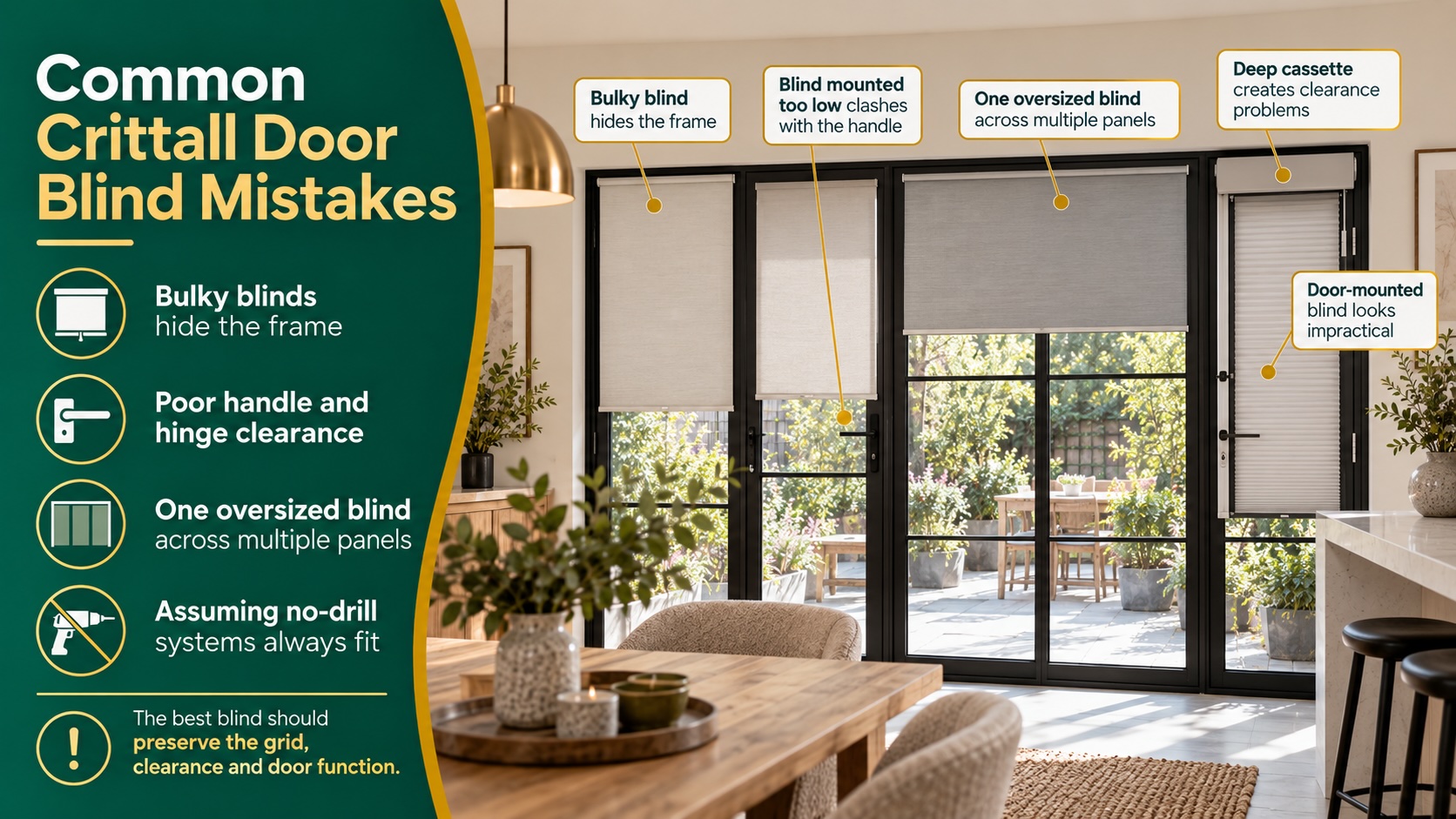
Most problems with blinds on Crittall and Crittall-style doors come from treating them like ordinary windows rather than as moving glazed door systems with very slim frames.
The most common mistakes are usually related to clearance, scale and fixing position.
Hiding Too Much of the Steel Grid
The frame is one of the main reasons people choose Crittall-style doors.
A bulky blind or overly dominant fabric can cover too much of the:
- Mullions
- Glazing
- Slim frame sections
- Architectural grid
This can remove much of the visual character of the doors.
Ignoring Handle Projection
A blind may fit the width of the door perfectly but still clash with a projecting handle.
This can stop the blind from lowering properly or cause repeated contact with the fabric, slats or bottom rail.
Forgetting About Hinges
Hinges can restrict where a blind sits, particularly if it is mounted directly to a moving door leaf.
The full door movement needs to be considered, not just the closed position.
Choosing a Blind That Is Too Deep
Deep cassettes, large headrails and wide slats can create problems where the door frame is slim.
This is particularly important with:
- Inward-opening doors
- Paired French doors
- Bi-fold systems
- Narrow reveals
A blind can fit visually but still prevent the door from opening fully.
Assuming Perfect Fit or No Drill Compatibility
This is one of the biggest mistakes.
Not every slim-framed door can accept a Perfect Fit or No Drill system.
Compatibility depends on the actual:
- Glazing bead
- Frame depth
- Door profile
- Handle position
- Opening arrangement
Using One Huge Blind Where Several Would Work Better
A single wide blind can look clean, but on a multi-panel Crittall opening it can become heavy and inconvenient.
Several blinds aligned with the mullions can often provide better:
- Door access
- Light control
- Visual alignment
- Weight distribution
Ignoring How Often the Doors Are Used
A blind that needs to be raised every time someone goes into the garden can become frustrating if the doors are used constantly.
This is why access should be considered alongside appearance.
Drilling Into the Frame Without Checking
Steel and aluminium frames should not automatically be treated as convenient fixing surfaces.
Before drilling directly into the frame, check:
- Manufacturer guidance
- Warranty conditions
- Frame construction
- Whether a suitable alternative fixing position exists
Best Approach
The biggest Crittall blind mistakes usually come from overlooking:
door movement + handle clearance + frame depth + blind bulk + fixing compatibility
The blind should work around the doors, not force the doors to work around the blind.
What Blind Styles Should You Avoid on Crittall Doors?
Most blind types can work somewhere on a Crittall or Crittall-style installation, but some need more caution because of bulk, weight or interference with the door movement.
Bulky Roman Blinds on Moving Door Leaves
Roman blinds can look attractive, but they are usually better mounted above the opening than directly onto a door.
The folded fabric stack can:
- Project too far from the door
- Interfere with handles
- Clash with adjacent leaves
- Make the slim frame look visually heavy
They are generally better treated as an above-opening window dressing.
Wide Wood Venetian Blinds
Wood Venetian blinds can feel too substantial against narrow steel or aluminium frames.
The thicker slats and larger headrail can:
- Add unnecessary bulk
- Reduce clearance
- Hide more of the frame
- Make narrow door panels look visually crowded
Metal Venetian blinds are usually the better match.
Deep Cassette Systems
A deep cassette can create problems where:
- The doors open inwards
- The reveal is shallow
- There is limited space above the frame
- The blind is mounted close to the door leaf
Even if the blind fits when closed, the door may not open fully.
Heavy Blinds Attached Directly to the Door
Adding a heavy blind to a moving door leaf is rarely the ideal starting point.
The extra weight and projection can affect how practical the door feels in everyday use.
This is particularly important with:
- French doors
- Narrow door leaves
- Bi-fold panels
- Frequently used garden doors
Unverified Perfect Fit or No Drill Systems
No Drill and Perfect Fit systems can be excellent where compatible, but they should not be assumed to fit every Crittall-style frame.
Using the wrong system can lead to poor fit, restricted door movement or pressure on unsuitable parts of the frame.
Any Blind That Hides the Crittall Grid
A blind can be technically compatible but still visually wrong.
Very heavy fabrics, oversized slats or bulky mechanisms can hide too much of the steel framework that gives the doors their character.
Best Approach
Use more caution with:
bulky Roman blinds + wide Wood Venetian blinds + deep cassettes + heavy door-mounted blinds + unverified No Drill systems
The best blind should remain visually secondary to the doors and should never compromise how they open, close or operate.
Best Blind Types for Crittall Doors Compared
Different blind styles suit different Crittall and Crittall-style door layouts, so the best option depends on the opening method, available clearance and how much of the frame you want to keep visible.
| Blind Type | Suitability | Best For | Main Limitation |
|---|---|---|---|
| Roller Blinds | Excellent | Most Crittall doors, minimal styling, glare control | May need to be raised before opening the doors |
| Metal Venetian Blinds | Very Good | Privacy, glare control, industrial-style interiors | Needs sufficient clearance around handles and frames |
| Pleated Blinds | Very Good | Slim profiles, compact installations, subtle styling | Less precise directional light control than Venetian blinds |
| Day & Night Blinds | Good | Daytime privacy and filtered light | More visual bulk and stronger horizontal pattern |
| Vertical Blinds | Good for Wide Openings | Large spans and frequently used doors | Can hide more of the Crittall grid |
| Roman Blinds | Situational | Softer interiors and above-opening installations | Bulky fabric stack and less suitable for door mounting |
| Wood Venetian Blinds | Situational | Warmer interiors with sufficient space | Heavier and visually bulkier than Metal Venetian blinds |
| No Drill / Perfect Fit | Compatibility Dependent | Avoiding conventional frame drilling where the profile is suitable | Not compatible with every steel or aluminium Crittall-style frame |
For most Crittall door installations, Roller blinds offer the strongest overall combination of low visual bulk, simplicity and broad compatibility.
Metal Venetian blinds are usually the better choice where adjustable privacy and glare control matter most, while Vertical blinds become more useful as the overall glazed opening gets wider.
No Drill and Perfect Fit systems can be excellent where compatible, but they should always be checked against the exact frame profile before ordering.
Best Blind by Crittall Door Situation
The best blind for Crittall and Crittall-style doors depends on the door layout, opening direction, privacy needs and how frequently the doors are used.
| Situation | Best Starting Point | Why It Works |
|---|---|---|
| Single Crittall door | Roller Blind | Compact, simple and easy to keep visually secondary to the frame. |
| Pair of Crittall French doors | Individual Roller Blinds | Allows each door leaf to be controlled independently and keeps access more flexible. |
| Very wide glazed opening | Multiple Roller Blinds or Vertical Blinds | Avoids relying on one oversized blind and gives more manageable coverage. |
| Maximum daytime privacy | Metal Venetian Blind | Slats can be tilted to reduce direct views while preserving useful daylight. |
| Maximum natural light | Roller Blind | Can be raised largely clear of the glazing and steel grid. |
| Inward-opening doors | Above-Opening Roller Blind | Keeps the headrail outside the door’s opening path where positioned correctly. |
| Outward-opening doors | Roller, Pleated or Metal Venetian | Internal blind clearance is often easier because the door leaf moves away from the room. |
| Crittall-style bi-fold doors | Above-Opening Roller Blind | Avoids interfering with the folding and stacking door panels. |
| Doors with fixed sidelights | Individual Roller Blinds | Can align neatly with the mullions and provide independent control over each section. |
| Internal Crittall-style screen | Roller or Metal Venetian | Provides occasional or adjustable privacy without permanently hiding the glazing. |
| Strong glare or direct sunlight | Roller with Light-Filtering or Solar-Control Fabric | Helps reduce glare while keeping the treatment simple and compact. |
| Bedroom doors | Blackout Roller Blind | Offers stronger light reduction while remaining visually restrained. |
| Industrial-style interior | Metal Venetian Blind | The slim slats complement the structured appearance of dark steel frames. |
| Softer or more traditional interior | Roman Blind Above the Opening | Adds softness without attaching bulky fabric directly to the moving door leaf. |
| Avoiding drilling into the frame | Suitable Recess Fixing or Compatible No Drill System | Can avoid permanent frame alteration where the door profile allows it. |
For most Crittall door installations, Roller blinds remain the strongest general-purpose starting point.
Where the requirement is more specific, the choice changes. Metal Venetian blinds are stronger for adjustable privacy, Vertical blinds can make sense across very wide openings, and above-opening blinds are often the safer option where door movement creates tight clearance.
Which DotcomBlinds Blinds Work Best for Crittall Doors?
For most Crittall and Crittall-style doors, the strongest DotcomBlinds options are likely to be Roller blinds, Metal Venetian blinds, Pleated blinds and selected No Drill systems where the frame is compatible.
The right choice depends on the way the doors open, the width of the glazed area and how much privacy or glare control is needed.
Roller Blinds
Roller blinds are usually the strongest all-round option.
They work especially well because they are:
- Compact
- Visually simple
- Suitable for individual door panels or wider openings
- Easy to raise clear of the glazing
- Available in different fabric types for privacy, glare control and light reduction
For multi-panel Crittall openings, separate Roller blinds can often be aligned with the door mullions for a cleaner result.
Metal Venetian Blinds
Metal Venetian blinds are a strong choice where adjustable privacy and light control matter.
They suit Crittall-style doors particularly well because their slim slats complement the industrial appearance of steel or aluminium frames.
They can be especially useful in:
- Street-facing rooms
- Home offices
- Living rooms
- Rooms affected by glare
Pleated Blinds
Pleated blinds are a good option where the treatment needs to remain light and unobtrusive.
Their slim profile can work well with narrow frames and modern interiors, especially where preserving the architectural appearance of the glazing is important.
Day & Night Blinds
Day & Night blinds can work where daytime privacy is the main concern.
They provide more flexible screening than a standard Roller blind, although the stronger horizontal pattern and larger cassette can make them visually heavier.
Vertical Blinds
For very wide Crittall-style openings, Vertical blinds can be practical.
They are particularly useful where:
- The doors are opened frequently
- Side-to-side operation is convenient
- The glazed span is very wide
They are more functional than minimal, so they may not suit every interior.
No Drill Options
Where drilling into the frame is undesirable, a compatible No Drill system may be worth considering.
However, Crittall and Crittall-style frames vary significantly, so compatibility should always be checked against the actual frame and glazing profile.
Best DotcomBlinds Choice by Priority
Best all-round: Roller blinds
Best for adjustable privacy: Metal Venetian blinds
Best for minimal visual bulk: Pleated blinds
Best for wide openings: Multiple Roller blinds or Vertical blinds
Best for bedrooms: Blackout Roller blinds
Best for avoiding frame drilling: Compatible No Drill option
For most Crittall door installations, Roller blinds remain the safest starting point, with Metal Venetian and Pleated blinds offering strong alternatives where privacy or a slimmer visual treatment is more important.
Final Verdict: What Works and What to Avoid
Crittall and Crittall-style doors need blinds that respect the architecture of the doors rather than overwhelm it.
The best blind should preserve the slim frame, clear glazing, easy door movement and access to handles and locks.
For most installations, Roller blinds are the strongest all-round option because they are compact, simple and can be raised largely clear of the glazing.
What Works Best
In general:
- Roller blinds are best for simplicity, broad compatibility and preserving the Crittall look.
- Metal Venetian blinds are best for adjustable privacy and glare control.
- Pleated blinds work well where low visual bulk matters.
- Vertical blinds can be practical for very wide openings and frequently used doors.
- Day & Night blinds suit contemporary spaces where daytime privacy is important.
- Roman blinds can work well above the opening where a softer, more decorative treatment is preferred.
- No Drill or Perfect Fit systems can be useful where compatible with the exact frame profile.
What to Avoid
Use more caution with:
- Heavy Roman blinds attached directly to moving door leaves
- Wide Wood Venetian blinds on slim frames
- Deep cassettes where door clearance is limited
- Oversized single blinds where several smaller blinds would work better
- Blind systems that interfere with handles, hinges or locks
- Unverified No Drill systems
- Direct drilling into steel or aluminium frames without checking manufacturer guidance
The Most Important Rule
Do not choose a blind based on appearance alone.
Before ordering, consider:
door opening direction + frame depth + handle projection + hinge position + fixing method + blind bulk + frequency of use
For most Crittall doors, a well-positioned Roller blind remains the safest starting point.
The best alternative depends on the room: Metal Venetian blinds for privacy and glare, Pleated blinds for a slimmer profile, and Vertical blinds where very wide spans and frequent access make side-to-side operation more practical.