Order Tracking
 0800 1422417
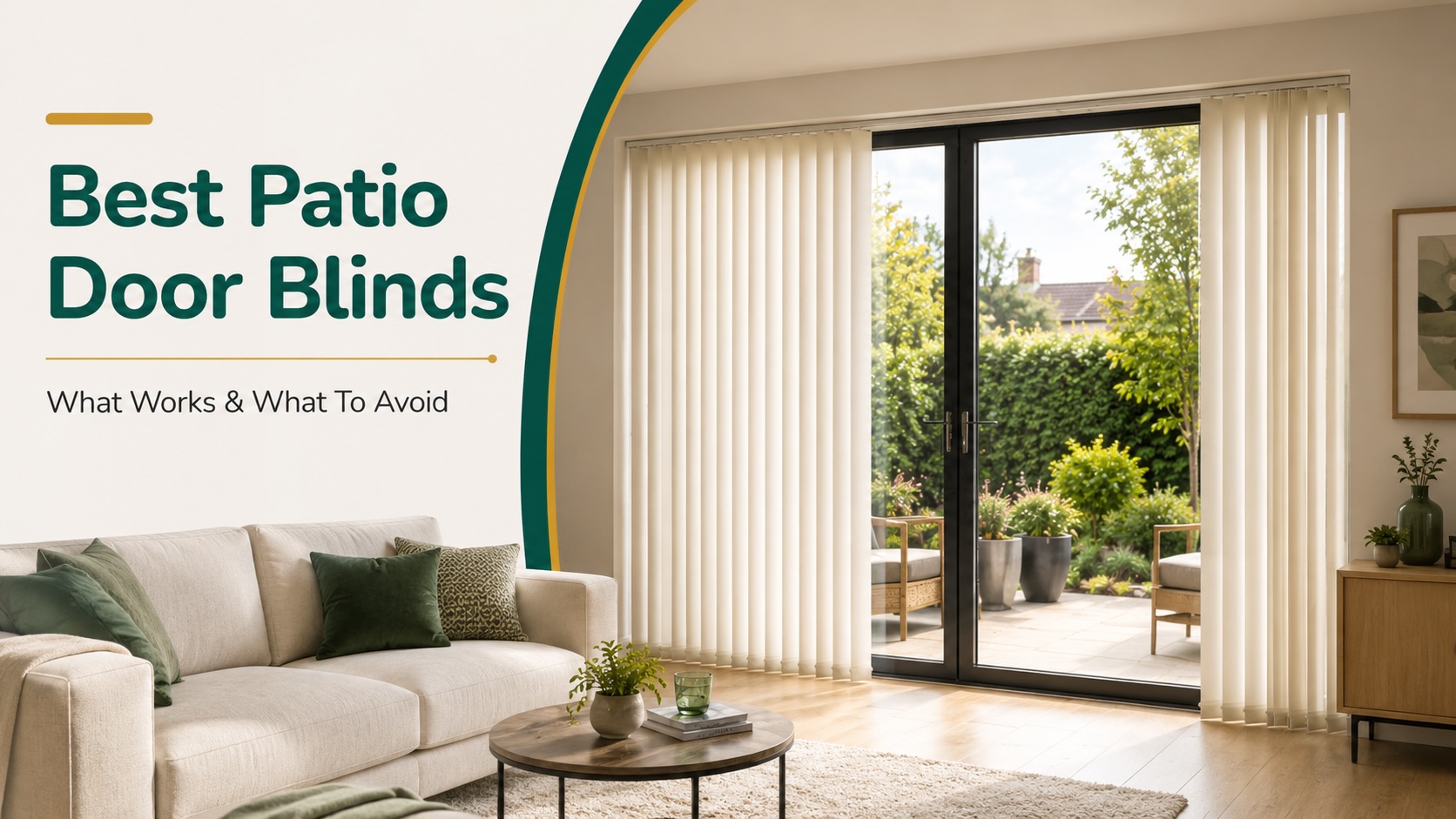
Patio doors are one of the most useful features in a home, bringing in natural light, connecting indoor and outdoor spaces, and creating a more open feel in living rooms, dining areas, kitchens, bedrooms and garden rooms. However, because patio doors are larger, used more frequently and often exposed to stronger sunlight than standard windows, choosing the right blind takes more thought than simply picking a fabric or colour.
The best patio door blinds are not necessarily one specific product. In most cases, the best choice depends on the style of patio door, how often it is used, how much clearance is available, whether the door slides, opens outwards or folds, and how much privacy, glare control or heat management is needed. A blind that works perfectly on a standard window can become awkward, heavy or impractical when fitted across a wide glazed doorway.
This is why patio door blinds should be chosen by suitability rather than appearance alone. The right blind needs to work with the movement of the door, sit neatly around handles and frames, remain easy to operate, and provide the right level of light control without getting in the way of everyday access.
In this guide, we look at the blind styles that work best for patio doors, the technical reasons behind their suitability, and the options that should be used with caution. Whether you have sliding patio doors, French doors, bifold doors or a large glazed opening, the aim is to help you choose a blind style that performs well in real daily use, not just one that looks good in a product image.
Table of Contents
What Makes a Blind Suitable for Patio Doors?
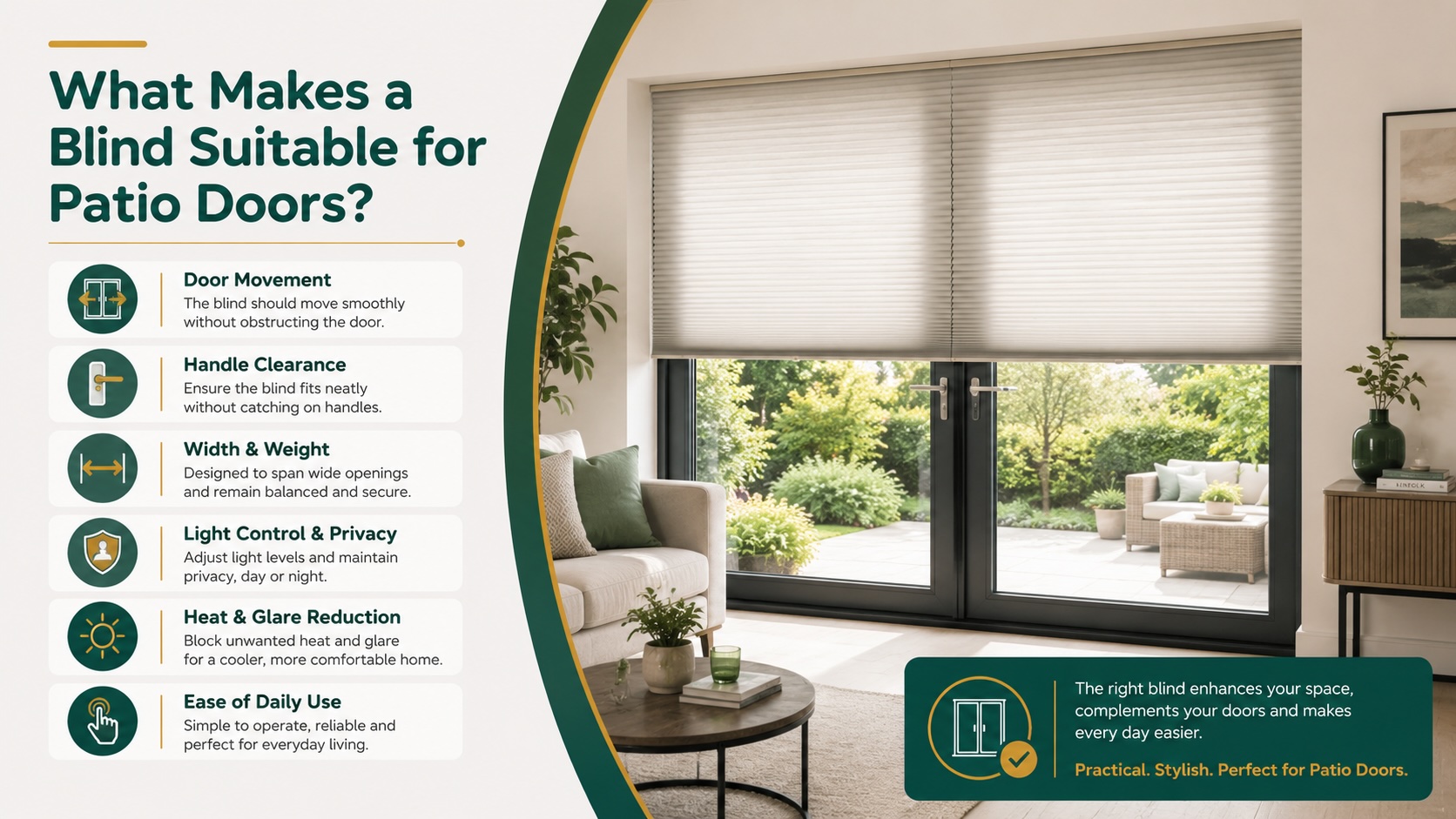
Patio doors place different demands on blinds compared with standard windows. They are usually wider, lower, used as an access point, and more likely to be affected by door handles, draughts, direct sunlight and repeated daily movement. A suitable patio door blind must therefore do more than cover the glass. It needs to work with the door, not against it.
The most important factors are door movement, clearance, blind weight, light control, privacy, heat management and ease of use. If any of these are overlooked, even a high-quality blind can feel inconvenient in practice.
Door Movement and Clearance
The first question is how the patio door opens. Sliding patio doors, French doors and bifold doors all behave differently, so they do not suit the same blind styles equally well.
For example, a sliding patio door usually benefits from a blind that moves sideways or stacks neatly away from the opening. Vertical blinds often work well here because their movement follows the direction of the door. By contrast, a blind that needs to be lifted fully before the door can be used may be less convenient, especially on a doorway that is opened several times a day.
French doors create a different challenge. Because each door leaf opens outwards or inwards, the blind either needs to sit close to the glass and move with the door, or be positioned so it does not swing, catch or obstruct the handle. This is where frame-fitted systems can be more practical than one large blind fitted over the whole opening.
Bifold doors require even more care. Their panels fold and stack, which means any blind fitted too close to the moving panels may interfere with the door operation. The best solution often depends on the frame design, panel configuration and available fixing space.
Width, Drop and Blind Weight
Patio doors usually cover a much larger area than ordinary windows. That extra width and drop affect how the blind operates.
A single large blind may look clean when closed, but it can become heavy, harder to control and less flexible in daily use. Wide roller blinds, large Venetian blinds and heavy Roman blinds can all place more strain on their mechanisms. They may also be slower to open, more awkward to adjust, or more likely to move in draughts when the door is open.
For larger patio doors, it is often better to think in terms of manageable sections. This may mean using vertical blinds that stack sideways, fitting individual blinds to each glazed panel, or splitting roller blinds so one section can be opened while another remains closed.
The aim is not simply to cover the full width. The blind should remain practical to operate every day.
Light Control and Privacy
Patio doors often face gardens, neighbouring properties, public paths or open-plan living spaces, so privacy is a key consideration. However, privacy needs are not the same throughout the day.
During daylight, some fabrics allow natural light in while reducing the view from outside. In the evening, when lights are on indoors, those same fabrics may offer less privacy. This is why the blind style and fabric choice both matter.
Adjustable styles, such as vertical blinds, Venetian blinds and Day and Night blinds, can be useful because they allow the user to fine-tune the balance between daylight and privacy. Blackout roller blinds can work well where room darkening is the priority, but they are less flexible because they are usually either raised, lowered or partly lowered.
For patio doors, the best privacy solution is often one that allows control without constantly blocking the doorway.
Heat, Glare and UV Exposure
Large areas of glass can make a room brighter and more open, but they can also increase glare and heat build-up. South-facing and west-facing patio doors are especially likely to experience strong sunlight, particularly during warmer months or later in the day.
In these situations, fabric choice becomes just as important as blind style. Light-filtering, thermal, dim-out or cellular fabrics may help soften glare and improve comfort around the glazed area. A blind fitted closer to the glass may also perform differently from one set further away, especially where heat and draught control are part of the decision.
Colour can also play a role. Very dark fabrics may create a strong interior look, but they can absorb more heat in direct sunlight. Lighter colours often feel softer and may be more practical in rooms where glare and heat are already an issue.
The key point is that patio door blinds should be chosen with the room’s exposure in mind, not just its décor.
Ease of Daily Use
A patio door is not just a window. It is an entrance, an exit and often one of the most frequently used openings in the home. This makes ease of use one of the most important practical factors.
A blind may be technically suitable when closed, but still frustrating if it has to be fully raised every time someone wants to step into the garden. The same applies to blinds that swing when the door opens, catch on handles, drag along the floor, or make access feel slower than it should.
For busy doorways, the best options are usually those that:
- Open quickly
- Keep the access route clear
- Do not interfere with handles
- Remain stable when the door is used
- Allow partial privacy without fully blocking the opening
Motorised blinds can also be worth considering for larger or harder-to-reach patio doors, particularly where the blind is wide, tall or used multiple times a day. However, motorisation should be seen as an operation upgrade, not a fix for the wrong blind style. A motorised blind still needs to suit the door layout, fixing space and intended use.
Best Blind Styles for Patio Doors
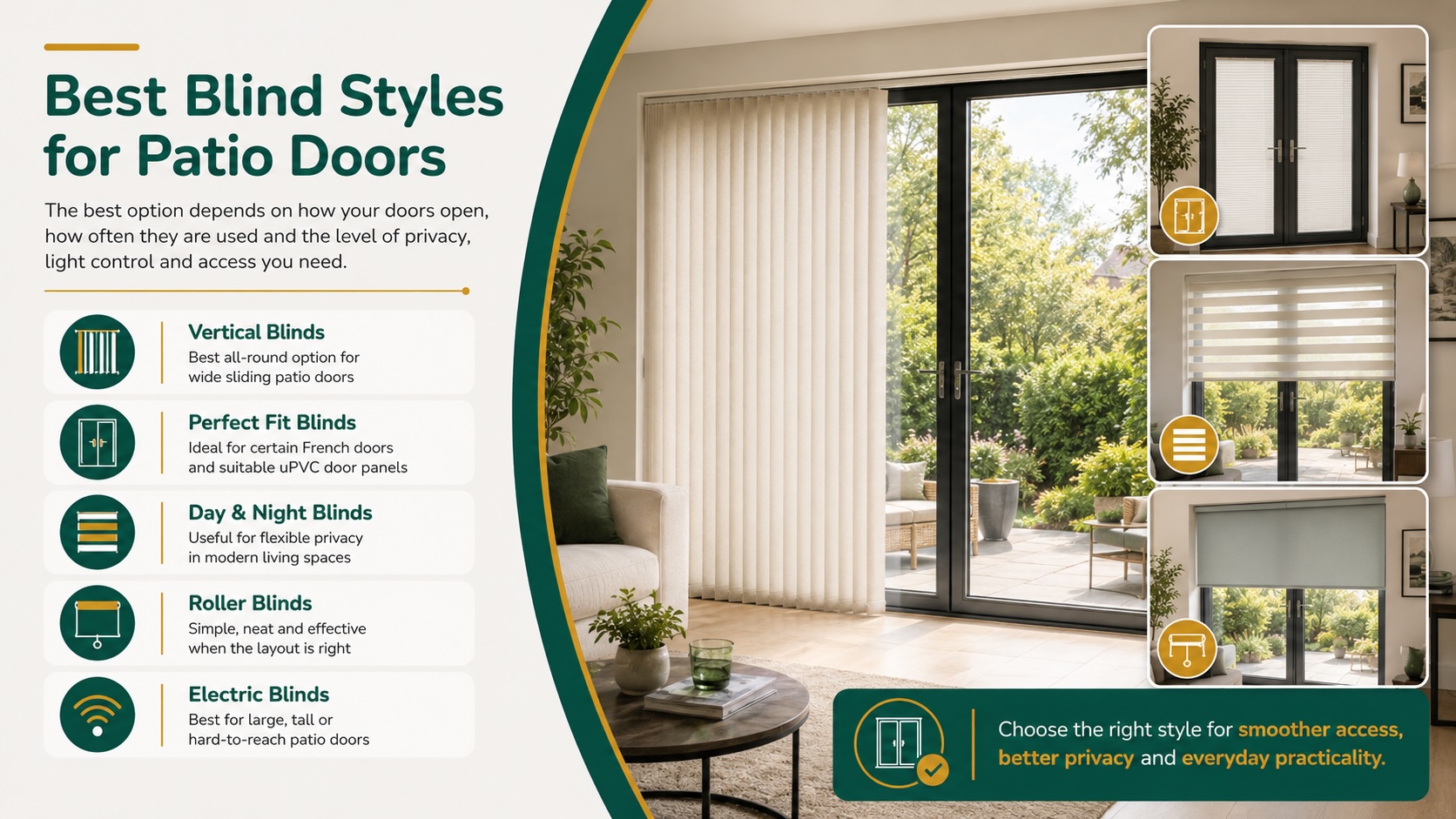
The best patio door blind style depends on how the door is used. A rarely opened patio door in a bedroom has very different requirements from a busy kitchen-diner door leading into the garden. The strongest options are usually those that either move neatly out of the way, sit close to the glass, or allow flexible light control without making access difficult.
Rather than looking for one universal “best” blind, it is better to match the blind style to the door type, room use and level of daily traffic.
Vertical Blinds: Best All-Round Option for Sliding Patio Doors
Vertical blinds remain one of the most practical choices for many patio doors, especially wide sliding doors. Their main advantage is that they move sideways, which naturally suits the way many patio doors are used. Instead of lifting the blind up and down each time the door is opened, the slats can be drawn across, stacked to one side, or tilted to control light and privacy.
This makes vertical blinds particularly suitable for large openings where a single roller, Roman or Venetian blind could become heavy or inconvenient. Because the blind tracks across the width of the doorway, it can cover broad glazed areas while still allowing relatively easy access.
The rotating slats also give strong control over daylight and privacy. The slats can be angled to reduce glare, soften direct sunlight, or limit views into the room without fully closing off the patio door. This is useful for living rooms, dining rooms and garden-facing spaces where the aim is often to keep the room bright while making it feel more private.
Another practical benefit is maintenance. If one slat becomes marked or damaged, it may be easier to address than replacing a whole blind. This can be useful on high-traffic doors where people, pets and furniture frequently pass close to the blind.
However, vertical blinds are not perfect for every setting. They need enough space for the slats to stack when opened. If the stack sits on the same side as the main access route, it can partially block the doorway. Chain-linked bottom weights can also be less suitable in homes with pets or very busy access areas, although chainless options may be available depending on the product.
Vertical blinds work best when the track is measured carefully, the drop is accurate, and the stack side is chosen with the door opening direction in mind.
Best for: sliding patio doors, wide glazed openings, garden-facing living spaces, rooms needing flexible privacy and regular access.
Use with caution where: there is very limited stack-back space, the doorway is extremely narrow, or the slats may be disturbed constantly by pets or heavy foot traffic.
Perfect Fit Blinds: Best for Certain French Doors and uPVC Patio Doors
Perfect Fit blinds can be highly effective on suitable patio doors because they fit neatly within the glazed area rather than hanging in front of the whole doorway. The key benefit is that the blind moves with the door. This can make them especially practical for French doors and some uPVC patio doors where a standard blind might swing, catch or obstruct the handle.
Because the blind sits close to the glass, it creates a tidy, integrated appearance. It also keeps the surrounding wall, recess and door opening clearer. For doors that open inwards or outwards, this can be a major advantage because the blind does not need to be lifted every time the door is used.
Perfect Fit systems can also be useful where drilling is undesirable or where the customer wants a cleaner finish around individual glass panels. Each panel can have its own blind, giving better control than one large blind across both doors. For example, one door panel can remain shaded while the other is opened or left uncovered.
The main limitation is compatibility. Perfect Fit blinds are not suitable for every patio door. The frame, bead depth, gasket, handle position and glass layout all matter. Some doors do not provide the correct conditions for a clip-in frame system. In other cases, projecting handles or unusually shaped frames may restrict suitability.
They are also a panel-specific solution. This is often an advantage, but it does mean that a large patio door set may require multiple individual blinds rather than one blind across the whole opening.
Best for: French doors, suitable uPVC patio doors, glazed door panels, no-drill style installations, doors where the blind needs to move with the panel.
Use with caution where: the door frame is incompatible, the glazing bead is unsuitable, the handle projects too far, or the door system has unusual frame detailing.
Day and Night Blinds: Best for Flexible Privacy on Less Busy Patio Doors
Day and Night blinds can be a strong choice where privacy control is more important than constant doorway access. Their alternating sheer and opaque fabric bands allow the user to adjust the level of visibility and light without fully raising the blind. This makes them useful for patio doors that are overlooked by neighbouring homes, gardens, side passages or streets.
Their main strength is flexibility. When the fabric bands are aligned, more daylight enters the room. When they are offset, the opaque sections provide more privacy while still maintaining a softer look than a fully closed blackout blind. This makes Day and Night blinds a good option for living rooms, dining rooms and modern open-plan spaces where the patio doors contribute strongly to the room’s appearance.
However, they need to be used carefully on high-traffic patio doors. Like roller blinds, Day and Night blinds operate vertically. This means they usually need to be raised, at least partly, when the door is being used. On a door that is opened frequently throughout the day, that can become less convenient than a side-drawing solution such as vertical blinds.
Size is another consideration. On larger patio doors, a wide Day and Night blind may become heavier and less convenient to operate. Fabric alignment also matters. If the blind is poorly sized, frequently handled or fitted where it catches on the door area, it may not perform as smoothly over time.
Best for: overlooked patio doors, living rooms, dining rooms, modern interiors, rooms where adjustable privacy is a priority.
Use with caution where: the door is used constantly, the opening is very wide, or the blind would need to be raised every time someone goes outside.
Roller Blinds: Best for Simple Coverage, But Only in the Right Layout
Roller blinds are a popular option for patio doors because they are simple, neat and available in a wide range of fabrics. They can work well where the door has enough fixing space above the frame and where the blind does not need to be moved constantly throughout the day.
Their strength is fabric choice. Depending on the room, a roller blind can provide light filtering, dim-out, blackout, moisture-resistant or thermal performance. This makes them flexible for different room types. A blackout roller blind may suit a bedroom with patio doors, while a lighter fabric may work better in a kitchen-diner or living room where the goal is to soften glare without making the space feel closed in.
The main issue is access. A roller blind moves up and down, while most patio doors are used sideways or outwards. If one large roller blind is fitted across the whole opening, it may need to be raised every time the door is used. This can be inconvenient, especially in summer when patio doors are opened frequently.
For this reason, roller blinds often work better when split into sections. Fitting separate blinds over each glazed panel can make the setup more flexible. One section can be raised for access while another remains lowered for shade or privacy.
Large roller blinds also need careful consideration. The wider and heavier the blind, the more important the mechanism, bracket position and fabric weight become. Draughts from an open door can also cause fabric movement, particularly on lightweight blinds.
Best for: occasional-use patio doors, bedrooms, rooms needing blackout or thermal fabrics, simple modern interiors, doors with good fixing space above the frame.
Use with caution where: the door is used constantly, the blind would span a very wide opening, or the fabric would obstruct regular access.
Electric Blinds: Best for Large, Tall or Hard-to-Reach Patio Doors
Electric blinds can be a useful upgrade for patio doors, particularly where the blind is large, tall, heavy or difficult to reach. They make operation easier and can encourage more consistent use, which is helpful in rooms affected by glare, heat or privacy at certain times of day.
For large patio doors, motorisation can reduce the effort involved in raising or lowering the blind. This is especially relevant for wide roller blinds, tall glazed openings, or doors behind furniture where manual controls are less convenient. Electric operation can also create a cleaner appearance by reducing the need for visible chains or cords.
Smart or timed operation may also be useful in rooms where sunlight changes throughout the day. For example, blinds can be lowered during periods of strong sun or closed in the evening for privacy, depending on the system and controls selected.
However, electric operation does not automatically make a blind suitable. The underlying blind style must still work with the patio door. A poorly chosen blind will not become practical simply because it has a motor. The fabric weight, blind width, fixing position, door movement and access requirements still need to be correct.
The power source also matters. Battery, mains and solar options each have different practical considerations, including charging, wiring, access and installation planning.
Best for: large patio doors, tall glazed openings, hard-to-reach blinds, rooms with regular glare, users wanting easier daily operation.
Use with caution where: the blind style itself is not suited to the door, the power source has not been planned, or the blind will still obstruct access when lowered.
Blind Styles to Avoid or Use With Caution on Patio Doors
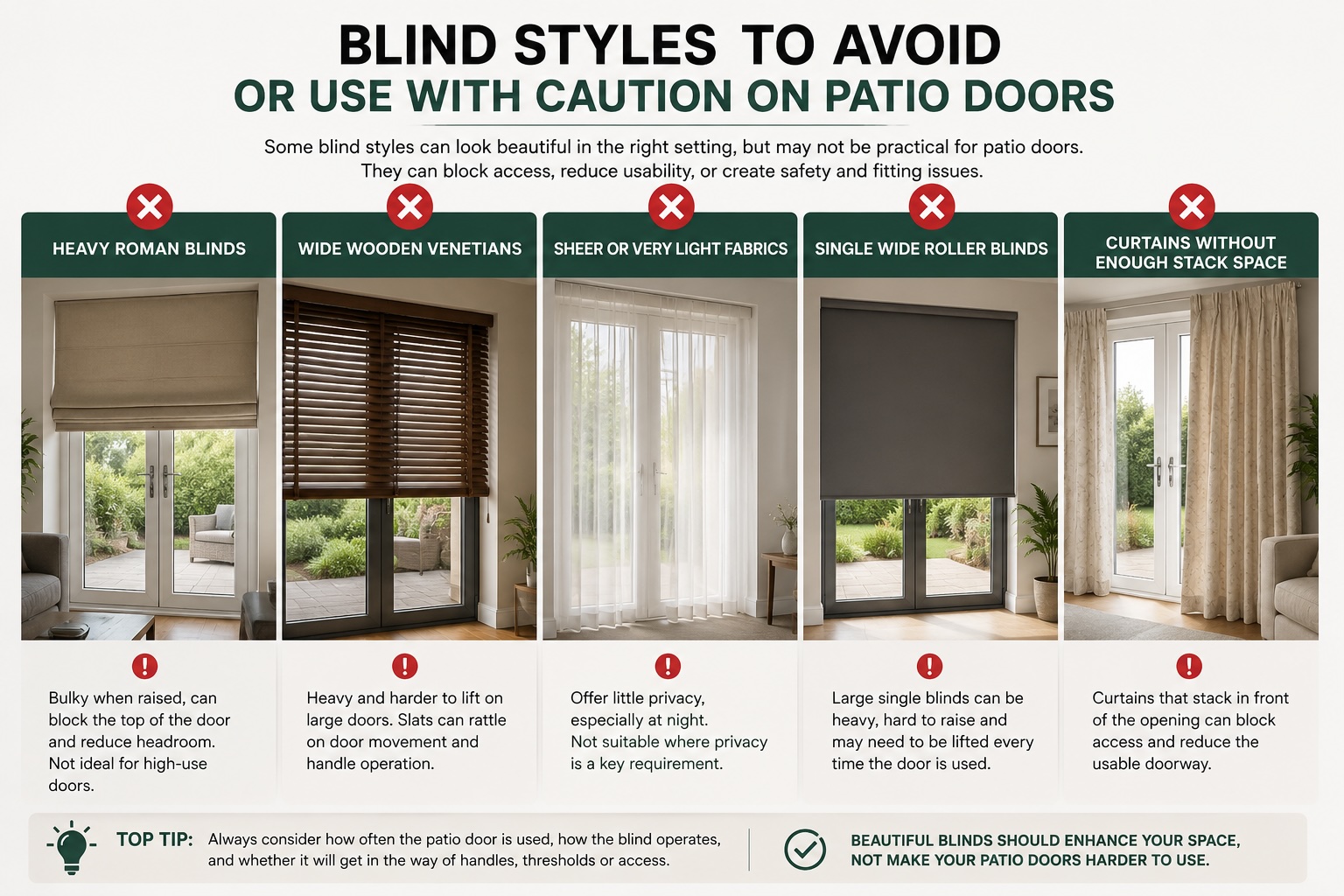
Some blinds can look excellent on standard windows but become less practical when used on patio doors. This does not mean they should never be used, but they need more careful consideration around weight, clearance, daily access and how the door actually opens.
For patio doors, the main issue is usually not whether a blind can physically be fitted. It is whether it remains convenient once the door is being used every day.
Roman Blinds: Decorative, But Often Too Bulky for Patio Doors
Roman blinds can create a soft, elegant finish, but they are not usually the most practical option for patio doors. Their main limitation is the way they stack. When raised, the fabric folds sit in a layered stack at the top of the opening. On a standard window, this can look attractive. Over a patio door, that stack can reduce clearance, block part of the glass, or sit too close to the top of the doorway.
The problem becomes more noticeable on doors that are used regularly. A Roman blind must normally be raised before the door can be used comfortably, especially if it hangs across the full doorway. If the blind is wide, the fabric weight also increases, which can make operation heavier and place more strain on the headrail and controls.
Roman blinds are usually better treated as a decorative window furnishing than a high-use patio door solution. They may still work in certain layouts, especially where there is plenty of wall space above the door and the patio doors are not the main everyday access point. However, for busy garden doors, sliding doors or wide glazed openings, there are usually more practical styles.
Best used where: the patio doors are used occasionally, there is generous fixing space above the frame, and the room needs a softer decorative finish.
Avoid where: the door is used frequently, the blind would be very wide, or the raised fabric stack would obstruct the doorway or glass.
Wooden Blinds: Stylish, But Often Too Heavy for Large Patio Doors
Wooden blinds can give a room a premium, natural look, but they need caution on patio doors because of their weight. Real wood slats are heavier than many fabric or aluminium alternatives, and that weight becomes more significant across a wide opening.
On large patio doors, a wooden Venetian blind may become hard to lift, slower to operate, and less convenient for daily access. The slats may also move or rattle when the door is opened, especially if the blind is fitted close to a frequently used doorway or exposed to draughts.
There is also the question of environmental suitability. Patio doors often sit in rooms with changing temperature and sunlight levels. In kitchens, conservatory-style spaces and garden rooms, there may also be higher humidity or stronger sun exposure. Natural wood is more sensitive to these conditions than some alternative materials, so it may not always be the most stable choice.
This does not mean wood-effect or slatted blinds should be ruled out entirely. In some settings, faux wood or aluminium Venetian blinds may offer a more practical alternative, especially on smaller panels or less frequently used doors. However, for large, busy patio doors, weight and operation should be considered before choosing real wood.
Best used where: the door opening is smaller, the blind will not be lifted constantly, and the priority is interior style rather than frequent access.
Avoid where: the patio door is very wide, exposed to strong heat or humidity, or used as a high-traffic route.
One Large Blind Across Multiple Door Panels
One of the most common mistakes with patio doors is treating the whole glazed opening as one oversized window. While one large blind can look simple in theory, it often creates practical problems in daily use.
The main issue is flexibility. If a single blind covers several door panels, the whole blind usually needs to be raised, drawn or adjusted whenever access is needed. This can make the doorway feel less convenient and may reduce the benefit of having patio doors in the first place.
A large single blind can also be heavier and harder to operate. The wider the blind, the more strain is placed on the mechanism, brackets and fabric. On roller blinds, this can make the blind feel heavy. On Venetian blinds, it can make lifting difficult. On Roman blinds, it can create a bulky stack. Even when the blind works mechanically, it may still feel awkward.
Panel-based thinking is usually better. This may mean individual blinds for each door leaf, split roller blinds, frame-fitted systems where compatible, or vertical blinds that stack to one side. The aim is to preserve access and control, not simply cover the glass in the fewest possible pieces.
Best avoided where: the patio door is used regularly, the opening is wide, or different parts of the door need different levels of shade or privacy.
Better approach: split the blind by panel, use a side-drawing style, or choose a system designed around the door movement.
Heavy Blackout Blinds on High-Traffic Patio Doors
Blackout blinds can be very useful on patio doors in bedrooms, nurseries, cinema rooms or spaces where room darkening is important. The issue is not the blackout fabric itself, but where and how it is used.
On a high-traffic patio door, a heavy blackout blind can become inconvenient. If it is lowered across the full opening, it blocks both the light and the route through the door. If it is wide, it may be heavier to operate. If the door is opened while the blind is lowered, the fabric may move in draughts or sit in the way.
There can also be a gap between expectation and reality. A blackout fabric blocks light through the material itself, but the final result also depends on the fitting position, side gaps, top gaps and bottom clearance. On patio doors, these gaps can be more noticeable because the glazed area is large and the blind may need to clear handles, frames or flooring.
Blackout blinds are often best when the room genuinely needs room darkening and the door is not used constantly while the blind is down. In those cases, they can perform well, especially when fitted carefully and split into manageable sections.
Best used where: the patio doors are in a bedroom, guest room, nursery or media room, and light control is more important than constant access.
Avoid where: the patio door is the main daytime route to the garden, the blind would span a very wide opening, or the customer expects complete darkness without considering fitting gaps.
Curtains: Soft and Flexible, But Not Always the Most Technical Solution
Curtains can work well over patio doors, especially where a softer interior finish is wanted. They can be drawn fully to one or both sides, which makes them practical for some wide openings. They can also add warmth, texture and a more furnished look than blinds.
However, curtains are not always the most precise solution. They need enough wall space for the fabric to stack clear of the glass and doorway. If there is not enough stack-back space, the curtain can permanently cover part of the door, reducing natural light and making the opening feel narrower.
Curtains may also be less suitable where the goal is fine light control. Unlike vertical blinds or Venetian blinds, they do not allow slat adjustment. They are usually either open, closed or partly drawn. For overlooked patio doors, this may offer less flexibility during the day.
Floor-length fabric also needs to be considered carefully around thresholds, pets, children and high-traffic garden access. In kitchen-diners or busy family spaces, curtains may collect dust or be more likely to brush against people, furniture or outdoor traffic.
Best used where: the room needs softness, warmth and a decorative finish, and there is enough wall space for the curtains to stack properly.
Use with caution where: the patio door is narrow, the room needs precise privacy control, or the fabric may interfere with frequent garden access.
Matching Blind Style to Patio Door Type
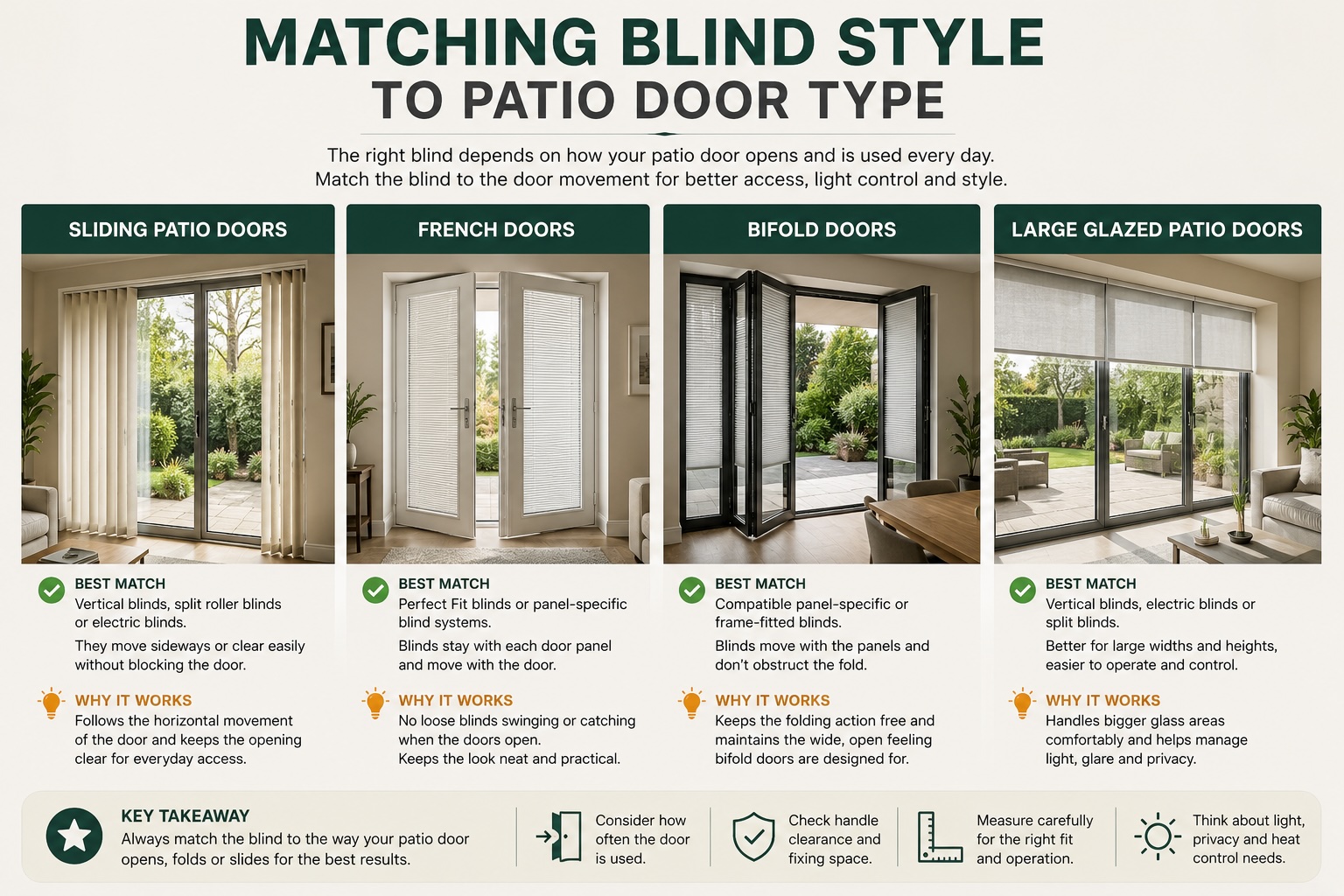
The most reliable way to choose patio door blinds is to start with the door type, not the blind type. Patio doors are not all built or used in the same way. A blind that works neatly on a pair of French doors may be awkward on a sliding door, while a good solution for a wide sliding opening may be completely unsuitable for bifold doors.
The key is to match the blind to the movement of the door, the amount of available fixing space and the way the doorway is used day to day.
Sliding Patio Doors
Sliding patio doors usually suit blinds that move sideways or can be cleared from the opening quickly. Because the door panels slide horizontally, vertical blinds are often one of the most practical choices. They follow the same general direction of movement, can be stacked to one side, and allow the user to tilt the slats for light and privacy without fully uncovering the glass.
Roller blinds can also work, but they need more thought. A single roller blind across the whole width may look simple, but it usually needs to be raised before the door can be used. This can become inconvenient on doors that are opened frequently. Split roller blinds can be more practical because one section can be raised while the rest remains lowered.
Day and Night blinds may suit sliding patio doors where privacy is the main requirement, but they are usually better for doors that are not constantly used. The same applies to Venetian blinds. They can provide excellent light control, but wide versions can become heavy and may need to be lifted fully for access.
French Doors
French doors usually work best with blinds that sit close to the glass and move with each door leaf. This is where Perfect Fit blinds, or other compatible frame-fitted options, can be particularly effective. Because each blind is fitted to the individual glazed panel, the door can still open and close without a separate blind hanging across the whole doorway.
This approach also avoids one of the main problems with French doors: fabric movement. A standard blind fitted above the door can swing, catch or sit awkwardly when the doors are opened. A frame-fitted blind is more controlled because it stays with the door panel.
Roller blinds and Venetian blinds can also work on French doors, but handle clearance and fixing position are important. If the blind projects too far from the door, catches on the handle or moves when the door opens, it may become frustrating in regular use.
A single large blind across both French doors is usually less practical. It removes the benefit of having two independently opening door leaves and can make simple garden access more awkward.
Bifold Doors
Bifold doors need careful consideration because the panels fold and stack. This movement can make standard blinds difficult to fit directly in front of the doors unless there is enough clearance for the panels to operate freely.
Where compatible, panel-specific or frame-fitted systems may be the most practical because they move with the individual door panels. However, suitability depends heavily on the door design, frame structure and available fixing space. Not every bifold system will accept the same blind type.
Standard roller blinds fitted above the opening may work in some rooms, especially if they are used mainly for evening privacy or glare control. However, they need enough space to roll up clear of the door and should not interfere with the folded panel stack.
Heavy Roman blinds, bulky curtain stacks or oversized blinds are usually less suitable for bifold doors because they can obstruct the clean opening that bifold doors are designed to create.
Large Glazed Patio Doors
Large glazed doors need blinds that are manageable, stable and easy to operate. The bigger the glass area, the more important it becomes to avoid unnecessary weight and awkward operation.
Vertical blinds are often suitable because they can cover wide spans without needing to be lifted vertically. Electric blinds may also be a strong option, particularly where the blind is tall, wide or difficult to reach. Motorisation can make regular operation more realistic, especially for rooms affected by glare or privacy at certain times of day.
Thermal and light-filtering fabrics may also be worth considering on large glazed doors, particularly where the room gets strong sun or feels cold near the glass. However, the blind still needs to suit the way the door is used. A thermal fabric on an impractical blind style will not solve access issues.
Large glazed doors are where splitting the blind into sections can be especially useful. It gives more control, reduces weight and allows one area to be shaded while another remains open.
Overlooked Patio Doors
For patio doors that face neighbouring properties, public paths or close garden boundaries, privacy control becomes a priority. The best options are usually those that allow privacy without making the room feel closed off all day.
Vertical blinds are useful because the slats can be angled to restrict views while still letting in daylight. Day and Night blinds can also work well where the door is not used constantly, as they allow a softer balance between visibility and privacy. Venetian blinds provide more precise directional control, although they need caution on large or frequently used doors.
Fully sheer fabrics should be chosen carefully. They may improve daytime privacy, but they often provide less privacy in the evening when the lights are on inside. For overlooked patio doors, it is important to think about both daytime and night-time use.
South-Facing or West-Facing Patio Doors
Patio doors exposed to strong sun need particular attention around glare, heat and fabric choice. South-facing and west-facing rooms can become uncomfortable at certain times of day, especially where the glass area is large.
Thermal, dim-out, light-filtering or cellular-style blinds may help improve comfort and reduce glare. Lighter fabrics can also be a practical choice where direct sunlight is intense. Very dark fabrics may create a strong design statement, but they can feel heavy visually and may absorb more heat.
Blind style still matters. A suitable fabric should be paired with a practical operating system. For example, a thermal roller blind may be useful on a bedroom patio door, while vertical blinds with suitable fabric may work better for a frequently used living room door.
Quick Patio Door Blind Matching Guide
| Patio Door Type or Situation | Usually Works Best | Use With Caution | Often Best Avoided |
|---|---|---|---|
| Sliding patio doors | Vertical blinds, split roller blinds, electric blinds | Day and Night blinds, Venetian blinds | Heavy Roman blinds, one large blind across the full opening |
| French doors | Perfect Fit blinds, panel-specific roller blinds, aluminium Venetian blinds | Standard blinds fitted above the whole doorway | One large blind across both door leaves |
| Bifold doors | Compatible frame-fitted or panel-specific systems, carefully positioned electric blinds | Standard roller blinds above the opening | Bulky blinds that obstruct the folding panels |
| Large glazed patio doors | Vertical blinds, electric blinds, thermal blinds, split blinds | Wide Venetian blinds, wide Day and Night blinds | Oversized heavy manual blinds |
| Overlooked patio doors | Vertical blinds, Day and Night blinds, Venetian blinds | Light-filtering fabrics without evening privacy | Fully sheer fabrics where night-time privacy is needed |
| South-facing or west-facing patio doors | Thermal blinds, cellular-style fabrics, light-filtering blinds, vertical blinds | Very dark fabrics in strong direct sun | Decorative-only blinds with poor glare control |
The table is a useful starting point, but it should not replace proper measuring and compatibility checks. Patio doors often have small details, such as handle projection, frame depth, recess space or threshold height, that can make one blind style much more suitable than another.
Key Measuring and Fitting Considerations
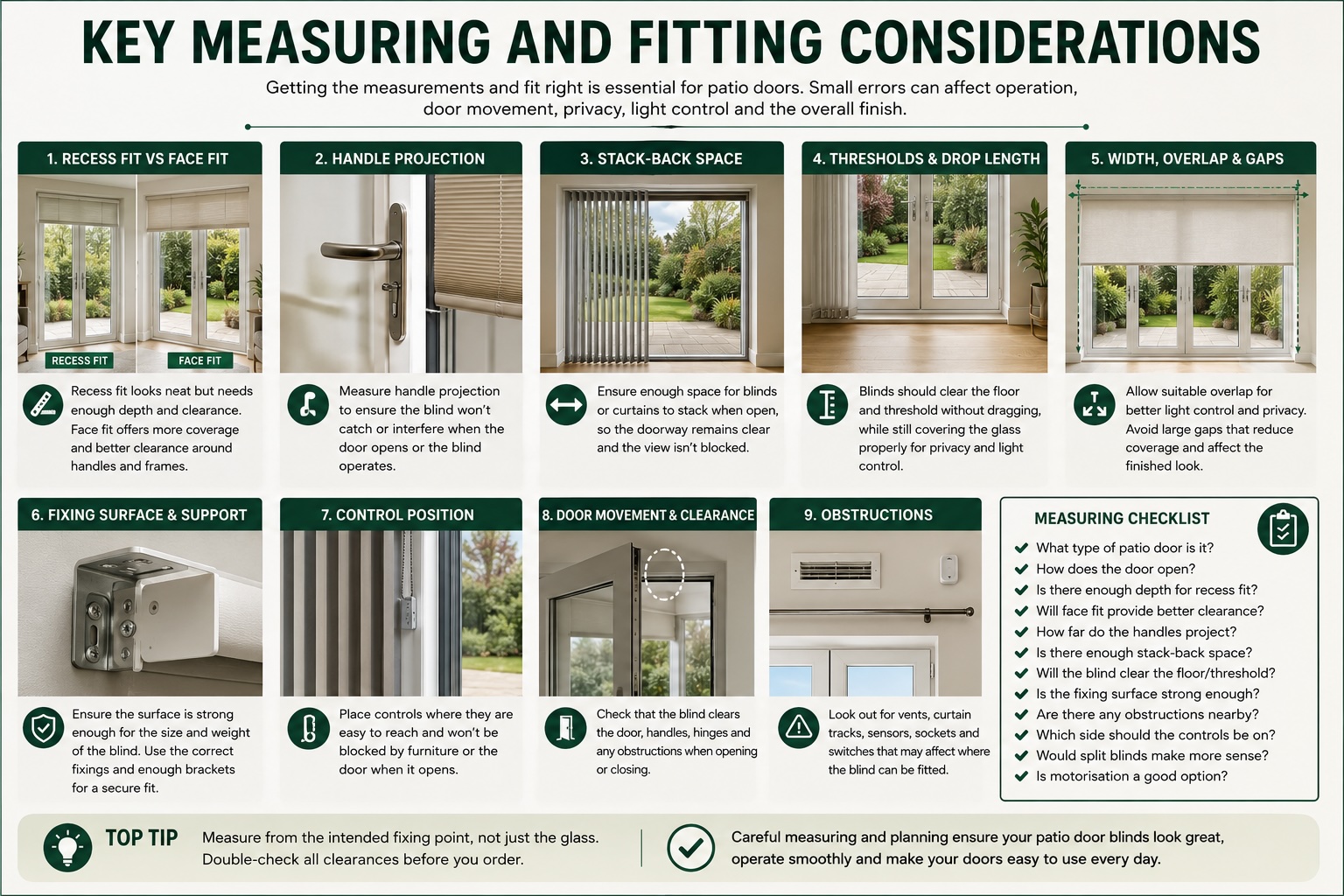
Good patio door blinds depend as much on the measuring and fitting approach as the blind style itself. Patio doors often have larger spans of glass, projecting handles, floor-level thresholds and moving panels, so small measuring errors can quickly become practical problems.
The aim is not only to make the blind fit the opening. It needs to clear the door, avoid the handles, operate smoothly and remain convenient in daily use.
Recess Fit vs Face Fit
One of the first decisions is whether the blind should be fitted inside the recess or outside the recess. Both options can work, but patio doors often need more care than standard windows because the door itself is used as an access point.
A recess fit can create a neat, integrated appearance, especially where the patio door sits within a deep opening. However, it may not be suitable if the recess is shallow, the handles project into the space, or the blind would restrict the door movement. A blind fitted too tightly inside the recess can catch, drag or sit too close to the operating parts of the door.
A face fit is often more forgiving because the blind is fitted outside the recess, usually above and beyond the door frame. This can provide more clearance around handles and allow the blind to cover the full glazed area more effectively. It can also help reduce side gaps, depending on the blind style and how much overlap is used.
However, face fitting also needs enough wall space above and around the patio door. If there is limited space between the top of the door and the ceiling, a bulky headrail or rolled-up fabric may sit too low. This is especially important for roller blinds, Roman blinds and Day and Night blinds, where the blind needs to be raised clear of the doorway.
As a general rule, recess fitting is best when there is enough depth and no obstruction. Face fitting is usually better when clearance, handle projection or full coverage are more important.
Handle Projection and Door Furniture
Patio door handles are one of the most common reasons a blind becomes awkward in practice. A blind may fit the measured opening, but still fail to operate properly if the handle projects into the path of the fabric, slats or frame.
This is particularly important for French doors, bifold doors and uPVC patio doors, where handles may sit proud of the frame. If the blind is too close to the glass or door surface, it can catch on the handle when the door opens, when the blind is lowered, or when the slats are tilted.
For roller blinds and Day and Night blinds, handle projection can affect whether the fabric hangs cleanly. For Venetian blinds, it can interfere with slat tilt or cause rattling. For Perfect Fit-style systems, handle position and frame compatibility both need checking before purchase.
The handle should be measured as part of the blind planning process, not treated as an afterthought. The key question is whether the blind can move freely when the handle is in its normal operating position.
Stack-Back Space
Stack-back space is the area taken up by a blind, curtain or slat system when it is fully open. This is especially important for patio doors because the purpose of the door is to create access and openness.
Vertical blinds need space for the slats to stack to one side, or sometimes split and stack to both sides. If the stack sits in front of the main opening, the door can feel partially blocked even when the blind is open. The same principle applies to curtains, where the fabric stack can cover part of the glass or narrow the usable doorway.
For sliding patio doors, the stack side should be planned around how the door opens. Ideally, the blind should stack away from the most frequently used access side where possible. For wide glazed openings, a split stack may work better than placing all the slats on one side.
Roller blinds, Roman blinds and Day and Night blinds have a different type of stack issue. Instead of stacking to the side, they gather or roll at the top. If there is not enough height above the door, the raised blind may still cover part of the glass or sit too close to the top of the opening.
Stack-back is not only a design detail. It affects how much daylight remains visible, how open the doorway feels, and how easy it is to use the patio door every day.
Thresholds, Flooring and Drop Length
Patio doors often finish close to the floor, which makes drop length particularly important. A blind that is too long may drag on the floor, catch on the threshold or become marked from daily use. A blind that is too short may look unfinished and allow unwanted light or visibility at the bottom.
The correct drop depends on the blind style and fitting position. Vertical blinds usually need to finish just above the floor or sill so the slats hang cleanly without dragging. Roller blinds and Day and Night blinds need enough clearance to avoid the threshold, while still covering the glass properly. Curtains may need to either skim the floor or sit slightly above it, depending on the room and desired finish.
Hard flooring can make small drop errors more visible because there is no carpet pile to disguise the gap. In busy garden-facing rooms, it is also worth considering dirt, moisture and foot traffic. A blind or curtain that sits too close to the floor may be more likely to pick up dust or marks, especially near doors used for outdoor access.
The drop should be measured from the intended fixing point, not simply from the top of the glass. This helps account for headrails, brackets, fabric rolls and floor clearance.
Width, Overlap and Light Gaps
Patio doors have a large glazed area, so gaps around the blind can be more noticeable than they would be on a smaller window. Side gaps may affect privacy, glare control and the overall finish.
For face-fitted blinds, allowing suitable overlap beyond the door frame can help improve coverage. This is particularly relevant for roller blinds, blackout blinds and thermal blinds, where reducing gaps can improve the finished result. However, the overlap should not interfere with nearby walls, switches, furniture, radiators or door movement.
For recess-fitted blinds, the blind must usually be made slightly narrower than the recess so it can operate without scraping the sides. This can create small gaps, which may be acceptable for light-filtering blinds but less ideal where privacy or room darkening is the priority.
With patio doors, the best width is not always the tightest possible fit. It is the width that gives good coverage while still allowing the blind to operate cleanly.
Fixing Surface and Bracket Support
Because patio door blinds can be wider and heavier than standard window blinds, the fixing surface needs to be suitable. A large blind fitted into weak plasterboard, poor masonry or an unsuitable surface may not perform well over time, even if the blind itself is correctly made.
The larger the blind, the more important bracket support becomes. Wide blinds may need additional brackets, a secure headrail and careful fixing into a stable surface. This is particularly relevant for vertical blinds, large roller blinds, Roman blinds and electric blinds.
The fitting position should also be checked for obstructions such as vents, coving, curtain tracks, alarm sensors, sockets, light switches or door sensors. These can affect where the blind can be safely and neatly installed.
For frame-fitted blinds, the focus is different. Instead of the wall surface, the important details are the door frame, glazing bead, rubber gasket and available fixing points. Compatibility should be checked before assuming a no-drill or clip-in system will work.
Control Position and Everyday Access
The control side of the blind should be planned around how the patio door is used. A chain, wand, cord or motor control that sits on the wrong side can make the blind less convenient, especially if furniture or the opening door panel blocks access.
For sliding patio doors, controls are often best placed on the side that remains easiest to reach when the door is partly open. For French doors, controls should not interfere with handles or the opening arc. For large doors, motorisation may be worth considering where manual controls would be awkward or where repeated operation is expected.
Child safety should also be considered when choosing manually operated blinds. Cordless, wand-operated, tensioned or motorised options can create a neater and safer setup, particularly in family homes.
A patio door blind should be simple to adjust without stepping around furniture, stretching across the doorway or moving obstacles. If the control position feels inconvenient, the blind is less likely to be used properly.
Measuring Checklist for Patio Door Blinds
Before choosing a patio door blind, it is worth checking the practical details that influence fit and usability:
- What type of patio door is it: sliding, French, bifold or another style?
- Does the door open inwards, outwards, sideways or fold?
- Is there enough depth for a recess fit?
- Would a face fit give better clearance or coverage?
- How far do the handles project?
- Will the blind catch on the handle, frame or door panel?
- Is there enough stack-back space when the blind is open?
- Will the blind clear the floor, threshold and any skirting?
- Is the fixing surface strong enough for the blind size and weight?
- Are there obstructions such as vents, sockets, sensors or curtain tracks?
- Which side should the controls sit on?
- Would splitting the blind into sections make it easier to use?
- Is motorisation worth considering for size, height or convenience?
Taking these measurements and practical checks seriously helps avoid the most common patio door blind problems: poor clearance, awkward access, dragging fabric, blocked handles, excessive weight and reduced usability.
Best Patio Door Blinds by Room Type
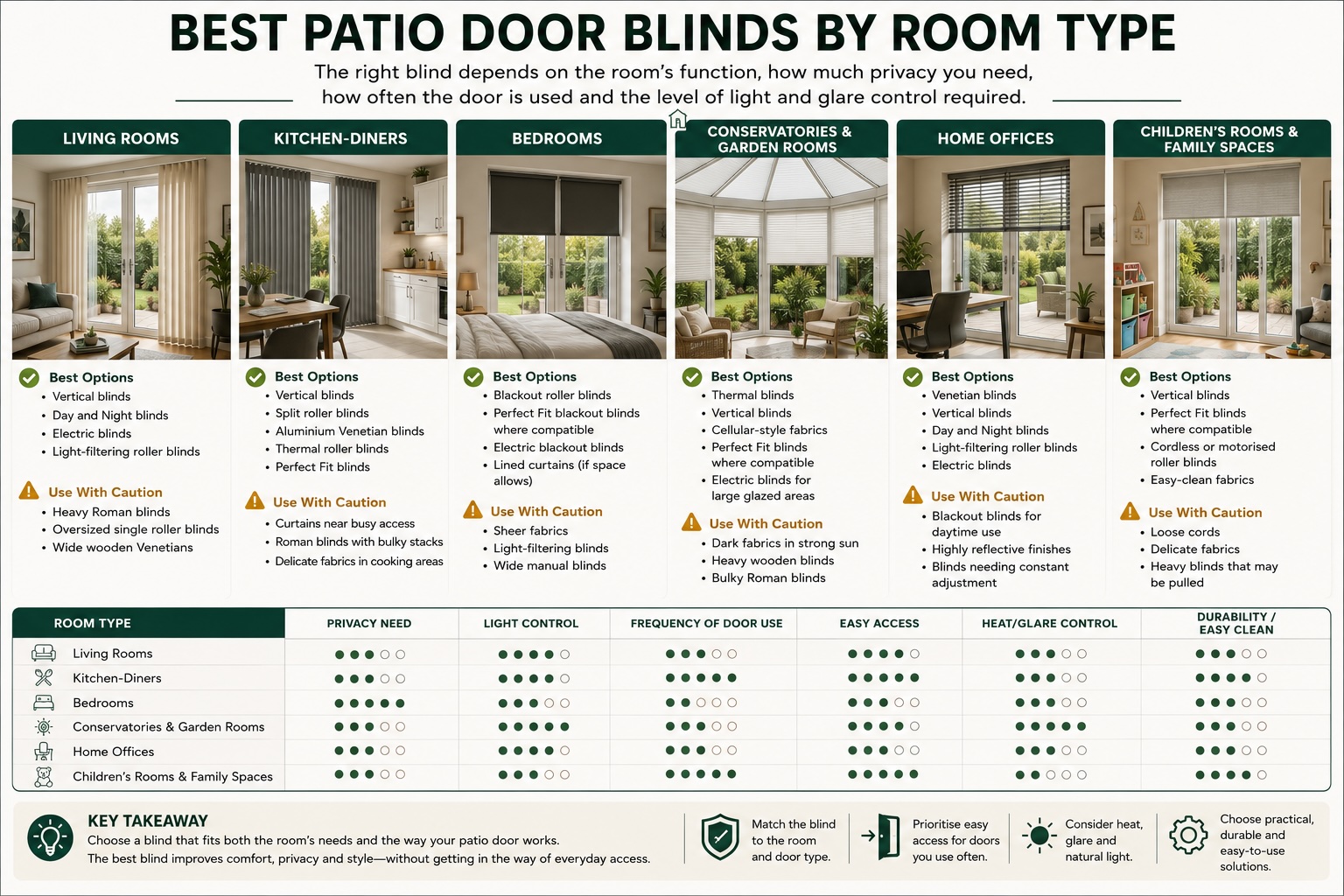
The right patio door blind also depends on the room. A patio door in a living room may need flexible privacy and glare control, while a bedroom patio door may need better room darkening. In a kitchen-diner, easy cleaning and access may matter more than softness or decoration.
This is why patio door blinds should be chosen around both the door type and the room function. The same blind style can be excellent in one room and less suitable in another.
Living Rooms
Living rooms often need a balance of daylight, privacy and appearance. Patio doors usually form a key part of the room, so the blind needs to look considered while still being easy to use.
Vertical blinds are often a strong choice for living room patio doors because they offer flexible control. The slats can be tilted to reduce glare or improve privacy without completely blocking the view to the garden. This is especially useful where the room is overlooked or where sunlight moves across the space during the day.
Day and Night blinds can also work well in living rooms, particularly where the patio doors are not the main route outside. They offer a softer, more contemporary look and allow some control over privacy without fully closing the blind. However, they may be less convenient if the doors are opened repeatedly.
For larger living room patio doors, electric blinds may be worth considering. They can make wide or tall blinds easier to operate and help the customer use the blinds more consistently throughout the day.
Best options: vertical blinds, Day and Night blinds, electric blinds, light-filtering roller blinds.
Use with caution: heavy Roman blinds, oversized single roller blinds, wide wooden Venetians.
Dining Rooms and Kitchen-Diners
Dining rooms and kitchen-diners often have high-use patio doors, especially where they open directly into a garden or outdoor seating area. In these spaces, practical access is usually more important than heavy decorative styling.
Vertical blinds are again one of the most reliable options for sliding patio doors because they can be drawn aside without lifting a full-width blind. Roller blinds can work well too, especially if they are split into sections or used on doors that are not opened constantly.
In kitchen-diners, material choice matters. Blinds may be exposed to cooking moisture, food smells, fingerprints and frequent handling. Smooth, easy-clean fabrics or aluminium Venetian blinds may be more practical than heavy textured fabrics. If the doors receive strong sunlight, thermal or light-filtering fabrics may help make the space more comfortable during mealtimes.
The blind should also avoid creating an obstruction near dining chairs, kitchen islands or walkways. A control chain or curtain stack that sits where people walk or sit can quickly become frustrating.
Best options: vertical blinds, split roller blinds, aluminium Venetian blinds, thermal roller blinds, Perfect Fit blinds where compatible.
Use with caution: curtains that trail near busy access routes, Roman blinds with bulky fabric stacks, delicate fabrics in cooking areas.
Bedrooms with Patio Doors
Bedrooms with patio doors usually have different priorities. Light control and privacy often become more important than daytime access, especially if the doors are not used as frequently as living room or kitchen patio doors.
Blackout roller blinds can be a good option where room darkening is the main requirement. They are simple, neat and available in fabrics designed to reduce incoming light through the material itself. However, the final result still depends on the fitting method and the size of any gaps around the blind.
Perfect Fit blackout blinds may be suitable for certain glazed door panels, especially where the blind needs to sit close to the glass and move with the door. This can be useful on French doors or suitable uPVC patio doors.
Electric blackout blinds can also be practical in bedrooms, particularly for wider doors or where the user wants easier control from the bed. They may also help create a cleaner finish by reducing visible manual controls.
The main caution is not to assume that every blackout setup will create complete darkness. Patio doors have frames, handles and floor-level details that may leave small light gaps. For most bedrooms, the goal should be improved room darkening rather than unrealistic expectations of total darkness from the blind alone.
Best options: blackout roller blinds, Perfect Fit blackout blinds where compatible, electric blackout blinds, lined curtains where enough stack space is available.
Use with caution: sheer fabrics, light-filtering blinds where privacy is needed at night, wide manual blinds that are difficult to operate.
Conservatories and Garden Rooms
Conservatories and garden rooms often have large areas of glass, which makes heat and glare control a major consideration. Patio doors in these spaces may be exposed to direct sunlight for long periods, so the blind needs to help make the room more comfortable as well as more private.
Thermal blinds, cellular-style fabrics and light-filtering blinds can be useful in these areas. They may help soften glare and reduce the intensity of direct sunlight, making the room more usable during bright conditions. Vertical blinds can also work well where the doors are wide and require flexible privacy control.
Because conservatories and garden rooms can experience more noticeable temperature changes, fabric and material choice should be considered carefully. Some materials may be less suitable where the space becomes very warm, very cold or humid at different times of year.
Door access is another factor. These rooms often lead directly into the garden, so the blind should not make the doorway feel restricted. Side-stacking or panel-specific solutions are often more practical than one large blind that has to be lifted every time the door is used.
Best options: thermal blinds, vertical blinds, cellular-style fabrics, Perfect Fit blinds where compatible, electric blinds for larger glazed areas.
Use with caution: dark fabrics in strong sunlight, heavy wooden blinds, bulky Roman blinds.
Home Offices
A home office with patio doors needs careful glare control. The main issue is often not complete darkness, but managing sunlight on screens while keeping the room bright enough to work comfortably.
Venetian blinds can be useful because the slats allow light to be redirected rather than simply blocked. This can help reduce screen glare while maintaining some natural light. Vertical blinds can offer a similar benefit on wider doors, especially where the slats can be angled as the sun moves.
Day and Night blinds can also work well if the patio doors are overlooked or if the room needs a more polished background for video calls. They provide a softer level of privacy control, although they may not be the best option if the patio door is used constantly during the working day.
For strong sun exposure, thermal or light-filtering roller blinds can help make the room more comfortable. Electric blinds may also be useful where the desk position makes manual controls awkward to reach.
Best options: Venetian blinds, vertical blinds, Day and Night blinds, light-filtering roller blinds, electric blinds.
Use with caution: blackout blinds during daytime work, highly reflective finishes, blinds that require constant adjustment to manage glare.
Children’s Rooms and Family Spaces
In family spaces, patio door blinds need to be robust, practical and easy to use. They should also be chosen with safety and everyday wear in mind.
Cordless, wand-operated, tensioned or motorised options may be preferable depending on the blind type and layout. Blinds close to garden doors may be handled frequently, brushed past, or exposed to pets and children moving in and out of the room.
Vertical blinds can work well for larger doors, particularly where individual slats are easier to manage or replace. Perfect Fit blinds may be useful on suitable doors because they sit neatly within the frame and do not hang loosely in front of the opening. Roller blinds can also work, but they should be positioned so they do not obstruct access or drag near the floor.
Durability matters more than delicate styling in these spaces. Simple operation, stable fitting and easy-clean materials are usually more valuable than heavy fabrics or complex decorative finishes.
Best options: vertical blinds, Perfect Fit blinds where compatible, cordless or motorised roller blinds, easy-clean fabrics.
Use with caution: long loose cords, delicate fabrics, heavy blinds that children may pull or handle roughly.
Quick Room-by-Room Patio Door Blind Guide
| Room Type | Best Blind Styles | Main Reason | Use With Caution |
|---|---|---|---|
| Living room | Vertical blinds, Day and Night blinds, electric blinds | Good balance of privacy, daylight and everyday usability | Heavy Roman blinds or oversized single blinds |
| Kitchen-diner | Vertical blinds, split roller blinds, aluminium Venetian blinds, Perfect Fit blinds | Practical access, easy cleaning and glare control | Delicate fabrics or curtains near busy garden access |
| Bedroom | Blackout roller blinds, Perfect Fit blackout blinds, electric blackout blinds | Improved privacy and room darkening | Sheer or light-filtering fabrics where night privacy is needed |
| Conservatory or garden room | Thermal blinds, vertical blinds, cellular-style fabrics, electric blinds | Better control over heat, glare and large glazed areas | Dark fabrics in strong sunlight or heavy wooden blinds |
| Home office | Venetian blinds, vertical blinds, Day and Night blinds, light-filtering roller blinds | Helps manage screen glare while keeping useful daylight | Blackout blinds used as the main daytime solution |
| Children’s room or family space | Vertical blinds, Perfect Fit blinds, cordless roller blinds, motorised blinds | Safer, neater and more practical for frequent use | Loose cords, delicate fabrics or heavy blinds |
Room type should not override the technical requirements of the door itself. A blackout blind may be ideal for a bedroom, but it still needs to clear the handle, suit the opening direction and remain manageable at the required size. The strongest choice is always the blind style that fits both the room and the patio door.
So, What Are the Best Patio Door Blinds?
The best patio door blinds are the ones that match the way the door works. Style, colour and fabric are important, but they should come after the practical questions: how the door opens, how often it is used, whether the blind needs to move with the door, how much clearance is available, and whether privacy, glare or heat control is the main priority.
For most patio doors, the strongest choices are usually vertical blinds, Perfect Fit blinds, roller blinds, Day and Night blinds, thermal blinds and electric blinds. Each one can be the best option in the right setting, but none of them is automatically right for every patio door.
Best for Sliding Patio Doors: Vertical Blinds
Vertical blinds are often the most practical choice for sliding patio doors because they move sideways rather than up and down. This means they work with the natural movement of the door and can be drawn away from the access point when needed.
They are especially useful for wider patio doors because they can cover large glazed areas without creating the same lifting weight as a large roller, Roman or Venetian blind. The slats can also be tilted, giving good control over privacy, daylight and glare.
Vertical blinds are not always the most decorative choice, but from a technical point of view, they are one of the most reliable options for wide sliding doors and frequently used garden access points.
Best for French Doors: Perfect Fit Blinds
Perfect Fit blinds are often the strongest option for suitable French doors and some uPVC patio doors because they sit neatly within the glazed area and move with the door panel. This avoids the problem of a standard blind swinging, catching or hanging across the whole doorway.
They are particularly useful where the door opens inwards or outwards, because each blind stays attached to the individual glazed panel. This keeps the door more usable and helps preserve the clean appearance of the frame.
The important point is compatibility. Perfect Fit blinds are not suitable for every frame, so the glazing bead, frame type, handle position and available clearance need to be checked before ordering.
Best for Large Patio Doors: Electric Blinds
Electric blinds can be a strong choice for large, tall or hard-to-reach patio doors. Their main benefit is ease of operation. A blind that feels heavy or awkward manually may be much easier to use when motorised.
This is particularly useful for wide roller blinds, high glazed doors, or rooms where the blind needs adjusting several times a day to manage glare, privacy or heat. Electric blinds can also give a cleaner finish by reducing the need for manual chains or cords.
However, motorisation should not be seen as a solution on its own. The blind still needs to be the right style for the door. A motorised blind that blocks the doorway, catches on a handle or sits too low above the opening will still be impractical.
Best for Flexible Privacy: Day and Night Blinds
Day and Night blinds are a good option where adjustable privacy is the main requirement. Their alternating fabric bands allow the user to soften daylight, reduce visibility and create privacy without always fully closing the blind.
They are particularly suitable for overlooked patio doors, modern living rooms and dining areas where privacy changes throughout the day. They also create a neater contemporary look than some more functional blind styles.
The main limitation is access. Because Day and Night blinds move vertically, they may need to be raised before the patio door can be used. This makes them better suited to doors that are not being opened constantly.
Best for Glare and Comfort: Thermal or Cellular-Style Blinds
For patio doors that receive strong sun or make the room feel colder near the glass, thermal or cellular-style blinds can be a sensible choice. Large glazed areas can affect comfort, especially in south-facing, west-facing or exposed rooms.
These blinds can help soften glare and improve the feeling of comfort around the door. They are particularly useful in conservatories, garden rooms, bedrooms and open-plan spaces where the glass area is a major feature.
Fit is important. Thermal performance is affected by how closely the blind sits to the glass, how much coverage it provides, and whether there are large gaps around the sides.
Best for Simple Coverage: Roller Blinds
Roller blinds are a good option where the requirement is simple, neat coverage. They are available in a wide range of fabrics, including blackout, dim-out, light-filtering, moisture-resistant and thermal options.
They work best on patio doors where there is enough fixing space above the frame and where the door is not used constantly while the blind is down. For wider doors, splitting roller blinds into sections is often more practical than using one large blind across the whole opening.
The main weakness is that roller blinds operate vertically. On high-use patio doors, they may need to be raised repeatedly to allow access.
| Best For | Recommended Blind Style | Why It Works | Main Limitation |
|---|---|---|---|
| Sliding patio doors | Vertical blinds | Sideways movement suits sliding doors and wide openings | Needs enough stack-back space |
| French doors | Perfect Fit blinds | Moves with the door and sits close to the glass | Frame compatibility must be checked |
| Large glazed doors | Electric blinds | Makes large or hard-to-reach blinds easier to operate | Still needs the right blind style underneath |
| Flexible privacy | Day and Night blinds | Allows softer control over privacy and daylight | Less convenient on very high-use doors |
| Glare and comfort | Thermal or cellular-style blinds | Useful for large glass areas affected by sun, glare or cold | Performance depends heavily on fit and coverage |
| Simple coverage | Roller blinds | Clean, simple and available in many practical fabrics | May need raising for access |
The Practical Answer
If the patio door is used frequently, prioritise access and operation. Vertical blinds, compatible Perfect Fit blinds and well-planned split blinds are usually stronger choices than one large blind across the whole opening.
If the main issue is privacy, consider vertical blinds, Day and Night blinds or Venetian blinds, depending on the door size and how often it is used.
If the main issue is heat, glare or comfort, consider thermal, cellular-style or suitable light-filtering fabrics, but make sure the blind style still suits the door movement.
If the door is large, tall or awkward to reach, electric blinds may improve usability, provided the underlying blind style is appropriate.
The least suitable options are usually those that add weight, bulk or obstruction: oversized single blinds, heavy Roman blinds, large wooden Venetians and decorative treatments that make the doorway harder to use. For patio doors, the best blind is the one that preserves the function of the door while solving the specific problem in the room.