Order Tracking
 0800 1422417

UK homes have traditionally been designed to retain heat, not release it. But with warmer, longer summers becoming more common, this creates a new problem: indoor heat that builds up and struggles to escape.
Curtains play a bigger role in this than most people realise.
Heavy, tightly woven fabrics can trap warm air against the window, making rooms feel stuffy and overheated, even when windows are open. On the other hand, the right curtains can support airflow, reduce heat build-up and improve overall comfort.
The key is understanding breathability. This refers to how well a fabric allows air and moisture to pass through it, helping rooms cool down more effectively.
However, breathability alone is not always enough. In rooms with direct sunlight, reducing heat entering through the glass is just as important.
In this guide, we will compare the best summer curtain fabrics, explain how they perform in real conditions, and show how to use them to keep your home cooler throughout the day.
Contents
- Breathability vs Heat Control: Two Different Jobs
- What Makes a Curtain Breathable?
- Breathability Ratings: UK Curtain Fabrics Compared
- The Day/Night Curtain Strategy: How to Keep Rooms Cooler All Day
- Room-by-Room Recommendations: Choosing the Right Summer Setup
- Installation Strategy: Maximising Airflow and Performance
- Maintenance: Keeping Summer Curtains Fresh and Effective
- Conclusion: Choosing the Right Curtains for a Cooler Summer
Breathability vs Heat Control: Two Different Jobs
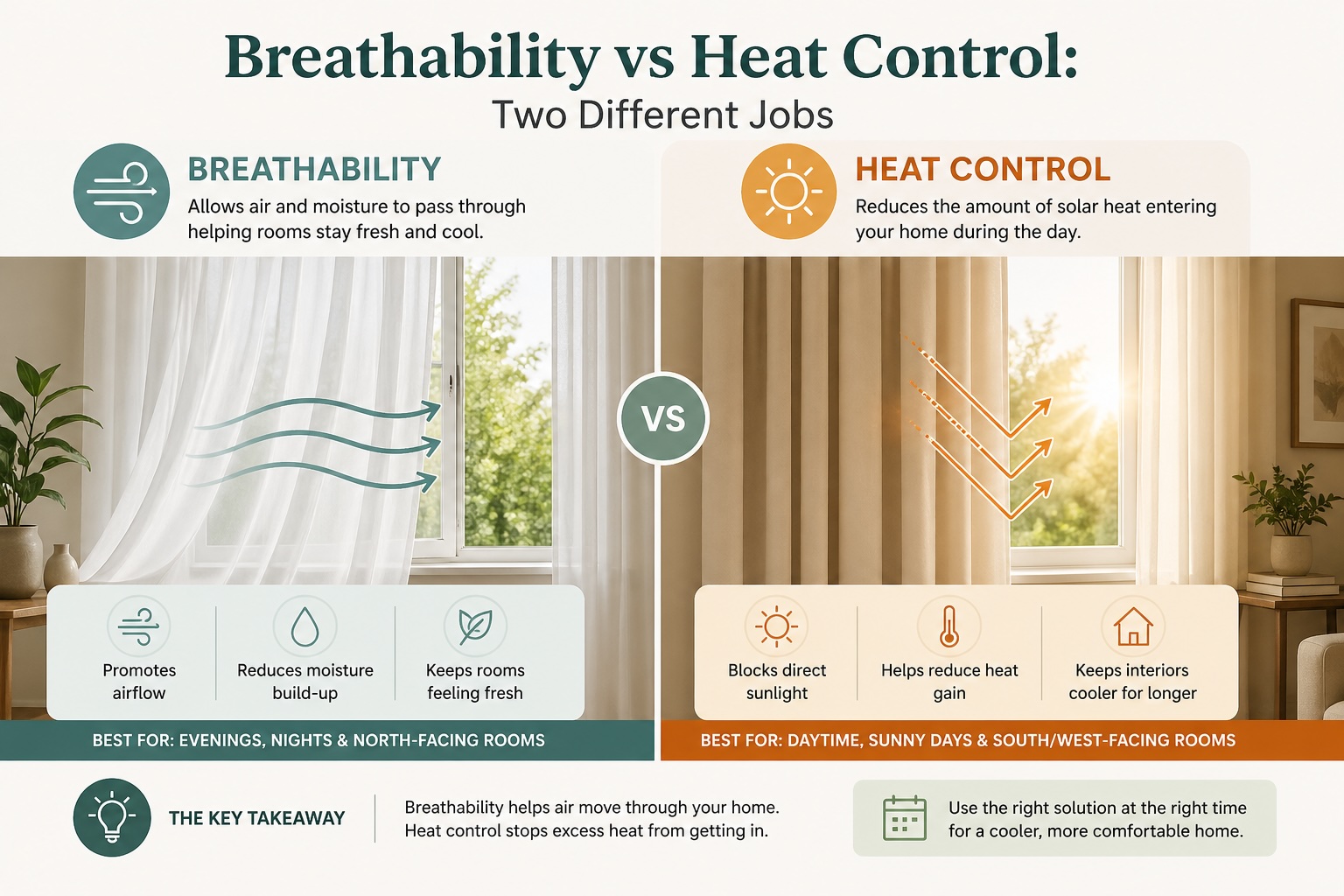
One of the most common mistakes when choosing summer curtains is assuming that one fabric can solve every problem. In reality, keeping a room comfortable in warm weather requires two separate functions working together:
- Breathability (airflow and moisture movement)
- Heat control (reducing solar gain through the glass)
Understanding the difference is critical, particularly in UK homes where both ventilation and sun exposure vary significantly by room.
Breathability: Letting the Room Release Heat
Breathable curtains allow air to circulate rather than trapping it. This becomes especially important in the evening and overnight, when outside temperatures drop and you want to cool the room down naturally.
Key benefits of breathable fabrics:
- Support cross-ventilation when windows are open
- Prevent warm air from becoming trapped behind the curtain
- Reduce that “stuffy” feeling common with heavy drapes
- Help moisture disperse in more humid conditions
Typical breathable options include:
- Linen
- Lightweight cotton
- Voiles and sheers
These fabrics work with airflow, rather than blocking it.
Heat Control: Reducing Solar Gain During the Day
During daylight hours, especially in south- and west-facing rooms, the primary issue is not airflow but direct solar heat entering through the glass.
In this scenario, breathable fabrics alone are often not enough.
Heat control depends on:
- Fabric density
- Colour (lighter colours reflect more heat)
- Linings or coatings that reduce heat transfer
Curtains designed for heat control:
- Block or reflect sunlight before it heats the room
- Reduce glare and UV exposure
- Help maintain a more stable indoor temperature during peak hours
Why You Need Both
A curtain that is highly breathable but offers no solar protection may still allow the room to overheat during the day. Conversely, a thick, lined curtain may block sunlight effectively but trap heat once it enters the room, preventing it from escaping later.
This is why the most effective summer setups follow a dual approach:
- Daytime: Focus on limiting heat gain
- Evening and night: Maximise airflow to release trapped heat
This principle underpins what we refer to as a day/night curtain strategy, which we’ll cover later in the guide.
Practical Takeaway
When choosing summer curtains, avoid asking:
“What is the best fabric?”
Instead, focus on:
“What does this room need at different times of day?”
That shift in thinking leads to better-performing curtain choices and, ultimately, a more comfortable home throughout the summer.
What Makes a Curtain Breathable?
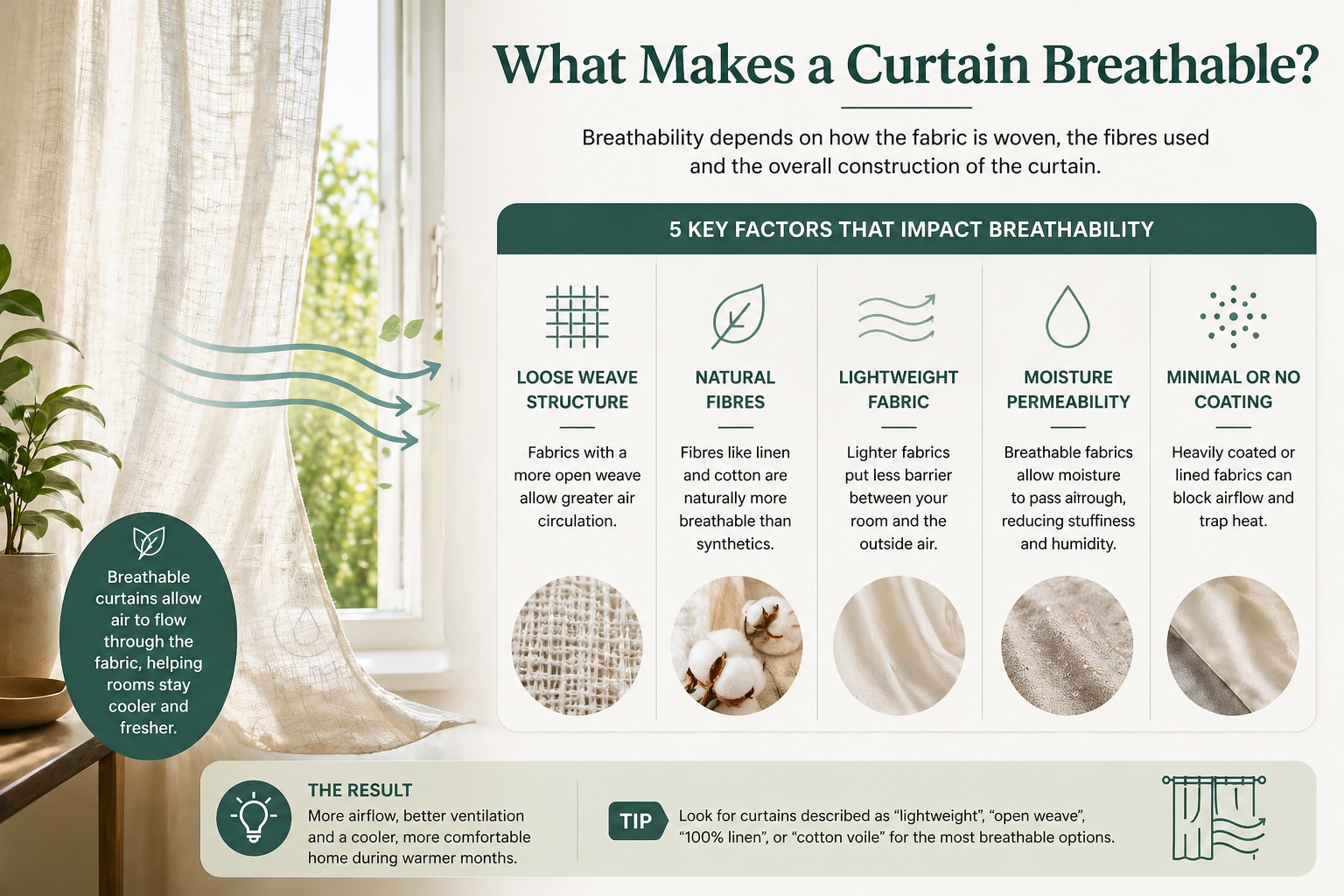
“Breathable” is often used loosely, but in practical terms it comes down to how easily air, heat and moisture can move through a fabric. Several factors influence this, and understanding them helps avoid common selection mistakes, particularly when comparing similar-looking materials.
1. Fabric Structure: The Primary Driver
The weave of a fabric has the biggest impact on breathability.
- Open weaves allow air to pass through more freely
- Tight weaves restrict airflow and trap heat
For example:
- Voiles and loosely woven linens → high airflow
- Dense cotton sateen or heavy polyester → limited airflow
Even within the same material, weave can change performance significantly. A lightweight cotton voile behaves very differently from a tightly woven cotton curtain.
2. Fibre Type: Natural vs Synthetic
The type of fibre affects how a fabric handles moisture and temperature regulation.
Natural fibres (linen, cotton):
- Absorb and release moisture effectively
- Feel cooler to the touch
- Help regulate humidity in the room
Synthetic fibres (polyester, blends):
- Lower moisture absorption
- Can feel warmer and less breathable
- Often prioritise durability over airflow
This is particularly relevant in UK conditions, where humidity can make rooms feel warmer than the actual temperature.
3. Fabric Weight: Often Overlooked
Weight plays a key role but is frequently ignored.
- Lightweight fabrics cool down quickly and allow heat to dissipate
- Heavy fabrics retain heat for longer, even after the sun has gone down
This is why heavy curtains can continue to radiate warmth into a room well into the evening.
4. Linings: The Hidden Factor
In many cases, the lining has more impact than the front fabric.
- Unlined curtains
- Maximum airflow
- Better suited to evening cooling
- Lined curtains
- Reduced breathability
- Improved light and heat blocking
A common issue in UK homes is using fully lined curtains year-round, which works well in winter but can limit airflow in summer.
5. Colour and Finish (Secondary but Relevant)
While not directly affecting airflow, colour influences heat absorption.
- Lighter colours
- Reflect more sunlight
- Reduce heat build-up
- Darker colours
- Absorb heat more readily
This becomes more important in rooms with direct sun exposure.
Practical Takeaway
Breathability is not determined by a single feature. It is the result of:
- Weave openness
- Fibre type
- Fabric weight
- Presence (or absence) of lining
In most cases, improving summer comfort comes down to reducing unnecessary barriers to airflow, particularly in the evening when natural cooling is most effective.
Breathability Ratings: UK Curtain Fabrics Compared
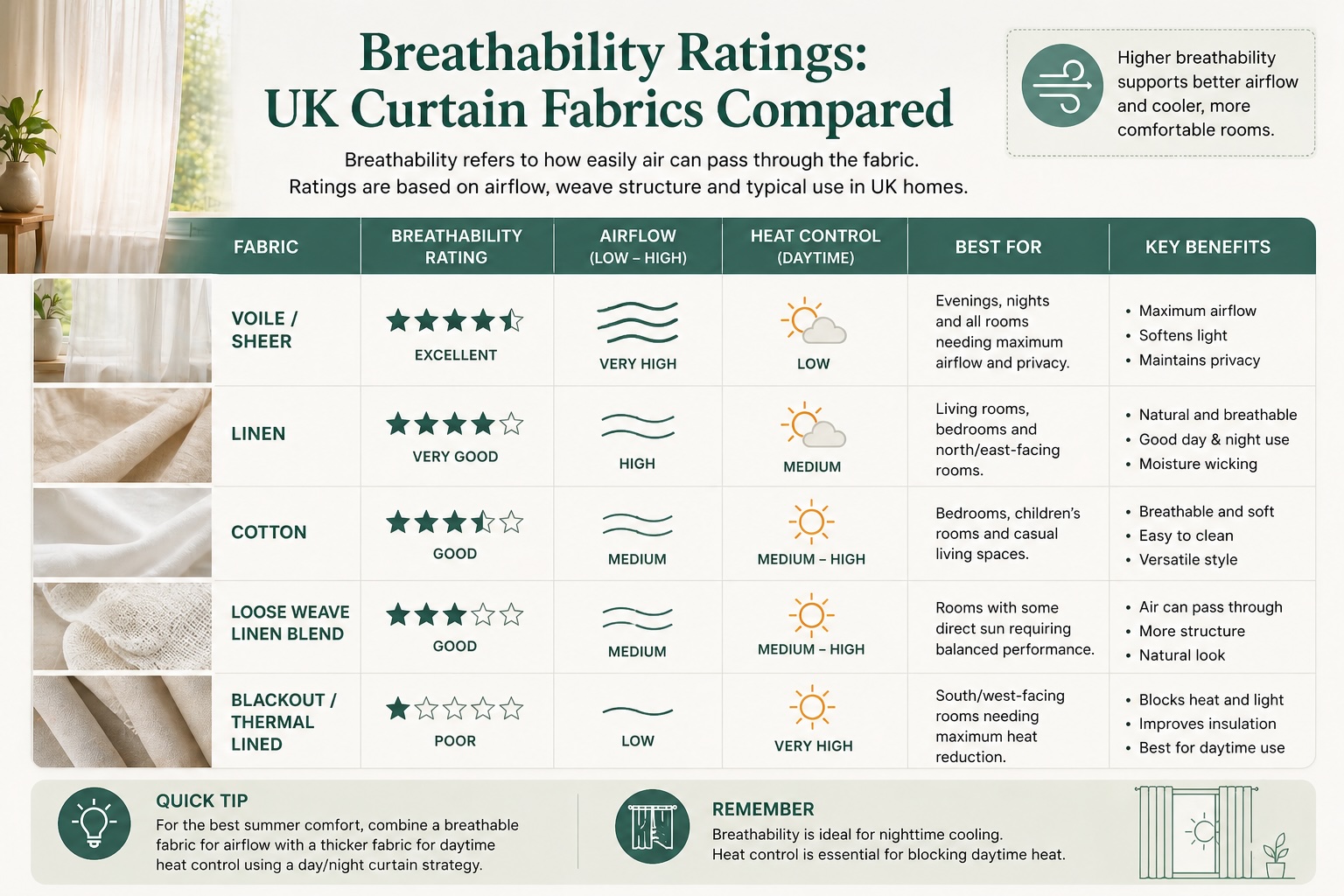
To make fabric selection more practical, it helps to move beyond descriptions and apply a clear performance framework. Below is a simplified DotcomBlinds Breathability Rating (1–10), based on how well each fabric supports airflow, moisture movement and overall summer comfort in typical UK conditions.
This is not just about material type. Ratings consider:
- Weave structure
- Fibre behaviour
- Typical curtain construction (e.g. lining, weight)
Linen — Best Overall for Summer
Breathability: 10/10
Linen sets the benchmark for summer curtains. Made from natural flax fibres, it has a naturally open structure that allows heat and moisture to pass through easily.
Why it performs well:
- Excellent airflow and ventilation
- High moisture-wicking capability
- Stays cool to the touch, even in warmer rooms
Where it works best:
- Bedrooms and living rooms
- Spaces where evening cooling is important
Expert insight:
Linen’s slightly textured weave diffuses light rather than blocking it completely, making it ideal for maintaining brightness without overheating.
Alternative:
- “Linen-look” polyester blends offer a similar appearance at a lower cost, but with noticeably reduced breathability.
Voiles & Sheers — Best for Maximum Airflow
Breathability: 9/10
Voiles and sheer curtains are designed specifically for continuous airflow, making them highly effective during the day when windows are open.
Why they perform well:
- Extremely lightweight, open weave
- Allow constant air movement
- Maintain daytime privacy without blocking ventilation
Where they work best:
- Layered setups (paired with heavier curtains)
- Living spaces and street-facing rooms
Limitation:
- Minimal heat blocking, so they should not be relied on alone in direct sunlight
Cotton — Best Balance of Comfort and Control
Breathability: 8/10
Cotton is a versatile middle ground, offering good airflow with more structure and privacy than linen or voile.
Why it performs well:
- Naturally breathable fibre
- Available in a wide range of weights
- Adaptable for different room types
Where it works best:
- Multi-purpose rooms
- Homes needing a balance between airflow and coverage
Expert insight:
Performance varies significantly depending on weight. Lightweight, unlined cotton is far more breathable than heavier, lined versions.
Polyester Blends — Practical but Less Breathable
Breathability: 5–6/10
Polyester and blended fabrics are widely used due to durability and affordability, but they are less effective for airflow.
Why they perform differently:
- Lower moisture absorption
- Tighter weave structures are common
- Tend to retain heat more than natural fibres
Where they work best:
- Rooms where durability and ease of maintenance are priorities
- Spaces that require more privacy or structure
Practical note:
While not ideal for peak summer airflow, they can still perform well when used as part of a layered setup.
Silk & Faux Silk — Aesthetic First, Performance Second
Breathability: 6/10
Silk curtains prioritise appearance over thermal performance.
Why they are less effective:
- Moderate airflow at best
- Sensitive to prolonged sun exposure
- Can degrade faster in bright, south-facing rooms
Where they work best:
- Low-sun environments
- Decorative spaces rather than functional cooling areas
Key Takeaway
No single fabric solves every summer challenge. The most effective approach is to:
- Use high-breathability fabrics (linen, voile, lightweight cotton) to support airflow
- Combine them with heat-control solutions where needed
This is particularly important in UK homes, where daily temperature swings mean you often need to block heat during the day and release it at night.
The Day/Night Curtain Strategy: How to Keep Rooms Cooler All Day
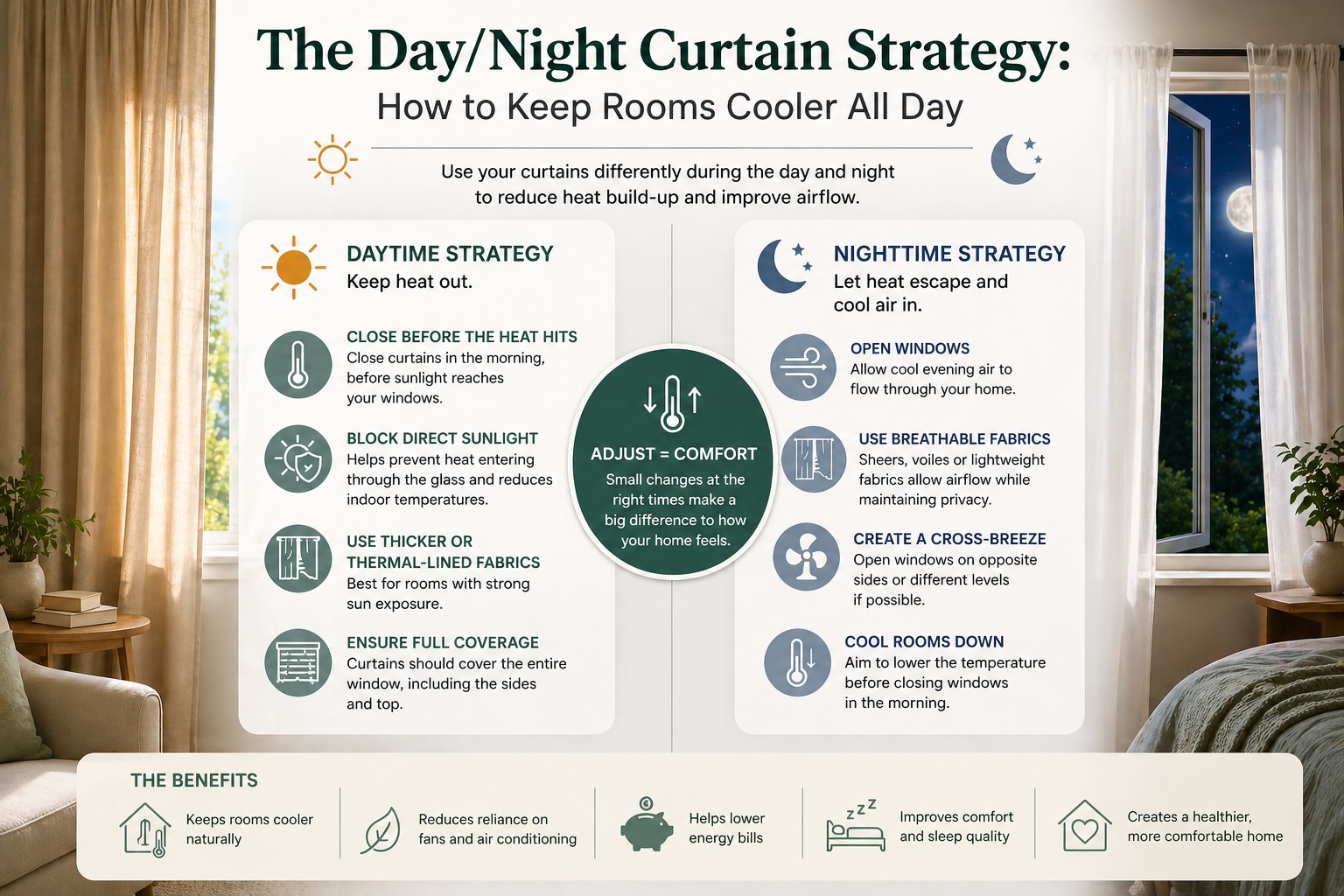
Choosing the right fabric is only part of the solution. In practice, how you use your curtains throughout the day has just as much impact on comfort as what they are made from.
Most UK homes experience two distinct phases in summer:
- Daytime overheating from direct sunlight
- Evening heat retention when trapped warmth struggles to escape
A single, static curtain setup rarely handles both effectively. This is where a day/night strategy becomes the most practical approach.
Daytime: Reduce Heat Gain Before It Builds Up
During the day, especially in south- and west-facing rooms, the priority is to limit how much solar heat enters through the glass.
What to do:
- Keep curtains partially or fully closed during peak sun hours
- Use:
- Light-coloured fabrics (to reflect heat)
- Tighter weaves or lined curtains (to reduce solar gain)
What to avoid:
- Leaving windows fully exposed during direct sunlight
- Relying on sheer or breathable fabrics alone in high-sun rooms
Key insight:
Once heat enters the room, it is much harder to remove. Prevention is more effective than correction.
Evening & Night: Release Trapped Heat
As outdoor temperatures drop, the goal shifts to cooling the room down naturally.
What to do:
- Open main curtains fully
- Allow windows to remain open where possible
- Use:
- Voiles or lightweight breathable fabrics
- Minimal barriers to airflow
This allows:
- Warm air to escape
- Cooler external air to circulate through the space
Key insight:
Curtains that block airflow at night can keep rooms unnecessarily warm, even when outside air is cooler.
The Layered Approach (Recommended Setup)
For most UK homes, the most effective solution is layering two curtain types:
- Voile or sheer layer (closest to the window)
- Provides airflow and daytime privacy
- Can remain closed while windows are open
- Main curtain (linen, cotton or similar)
- Used for heat control during the day
- Opened in the evening to allow ventilation
This setup gives flexibility to adapt throughout the day without changing the installation.
Orientation Matters: Adjust by Room
Not every room needs the same approach.
South-facing rooms:
- Strong sunlight → prioritise daytime heat control
- Use lighter colours and consider linings
- Open fully in the evening
North-facing rooms:
- Minimal direct sun → prioritise airflow
- Breathable fabrics can remain in use throughout the day
Bedrooms:
- Often retain heat overnight
- Benefit from:
- Breathable curtains for airflow
- Separate blackout solution if needed
Practical Takeaway
The most effective summer curtain setup is not a single product, but a flexible system:
- Block heat during the day
- Release it at night
- Adjust based on room orientation
This approach delivers noticeably better comfort than relying on one curtain type to perform every function.
Room-by-Room Recommendations: Choosing the Right Summer Setup
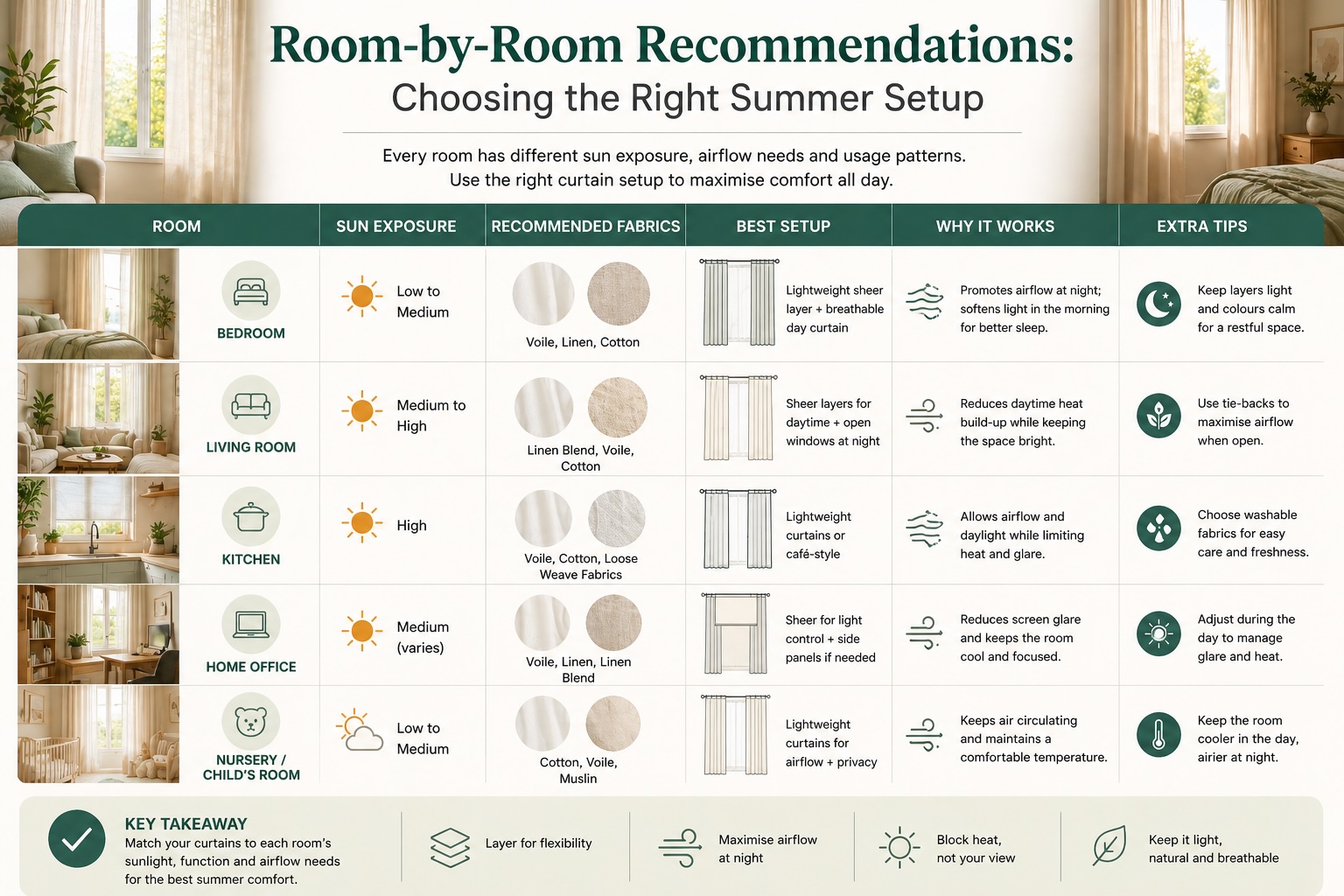
While fabric choice and strategy matter, the most effective curtain setup ultimately depends on the room itself. Orientation, usage and heat patterns all influence what will perform best.
Below is a practical breakdown based on typical UK home layouts.
South-Facing Rooms — Prioritise Heat Control First
South-facing rooms receive the most consistent and intense sunlight, making them the highest risk for overheating.
Key challenge:
- Solar heat gain throughout the day
Recommended approach:
- Use:
- Light-coloured curtains to reflect heat
- Medium to heavier fabrics (linen or cotton)
- Optional thermal or light-filtering lining
- Pair with:
- Voile layer for evening airflow
Important:
Breathability alone is not enough here. Without some level of heat blocking, rooms can quickly become uncomfortable.
West-Facing Rooms — Manage Late-Day Heat Build-Up
West-facing rooms tend to stay cooler earlier in the day but heat up quickly in the afternoon and evening.
Key challenge:
- Heat peaks later, often when rooms are in use
Recommended approach:
- Use:
- Curtains that can block low-angle sunlight
- Flexible layering (voile + main curtain)
- Adjust:
- Close curtains in the late afternoon
- Open fully once outdoor temperatures drop
North-Facing Rooms — Maximise Airflow
North-facing rooms receive minimal direct sunlight, so overheating is less of an issue.
Key priority:
- Ventilation and freshness
Recommended approach:
- Use:
- Highly breathable fabrics (linen, voile, lightweight cotton)
- Avoid:
- Heavy linings that restrict airflow
These rooms benefit most from continuous air movement rather than heat blocking.
Bedrooms — Balance Cooling and Light Control
Bedrooms present a slightly different challenge. They often retain heat overnight, but still require darkness for sleep.
Key challenge:
- Cooling the room while maintaining light control
Recommended approach:
- Use:
- Breathable curtains (linen or cotton)
- Combine with:
- Blackout blinds or secondary layer for darkness
Why this works:
- Curtains handle airflow and comfort
- Blinds manage light without restricting ventilation
Living Rooms — Flexibility Matters Most
Living rooms are used throughout the day, so they need a setup that adapts to changing conditions.
Key priority:
- Versatility
Recommended approach:
- Layered system:
- Voile for daytime privacy and airflow
- Main curtain for heat and light control
This allows quick adjustments without compromising comfort or aesthetics.
Kitchens & Utility Rooms — Keep It Practical
These spaces often generate their own heat and humidity.
Key challenge:
- Managing internal heat alongside external temperature
Recommended approach:
- Use:
- Lightweight, breathable fabrics
- Easy-to-clean materials (cotton or blends)
- Avoid:
- Heavy, heat-retaining curtains
In some cases, blinds may be more practical, but if using curtains, airflow should be prioritised.
Practical Takeaway
The “best” summer curtain is not universal. It depends on:
- Sun exposure (orientation)
- Room function
- When the space is used most
By matching your curtain setup to each room’s conditions, you can achieve far better temperature control and overall comfort without over-relying on cooling devices.
Installation Strategy: Maximising Airflow and Performance
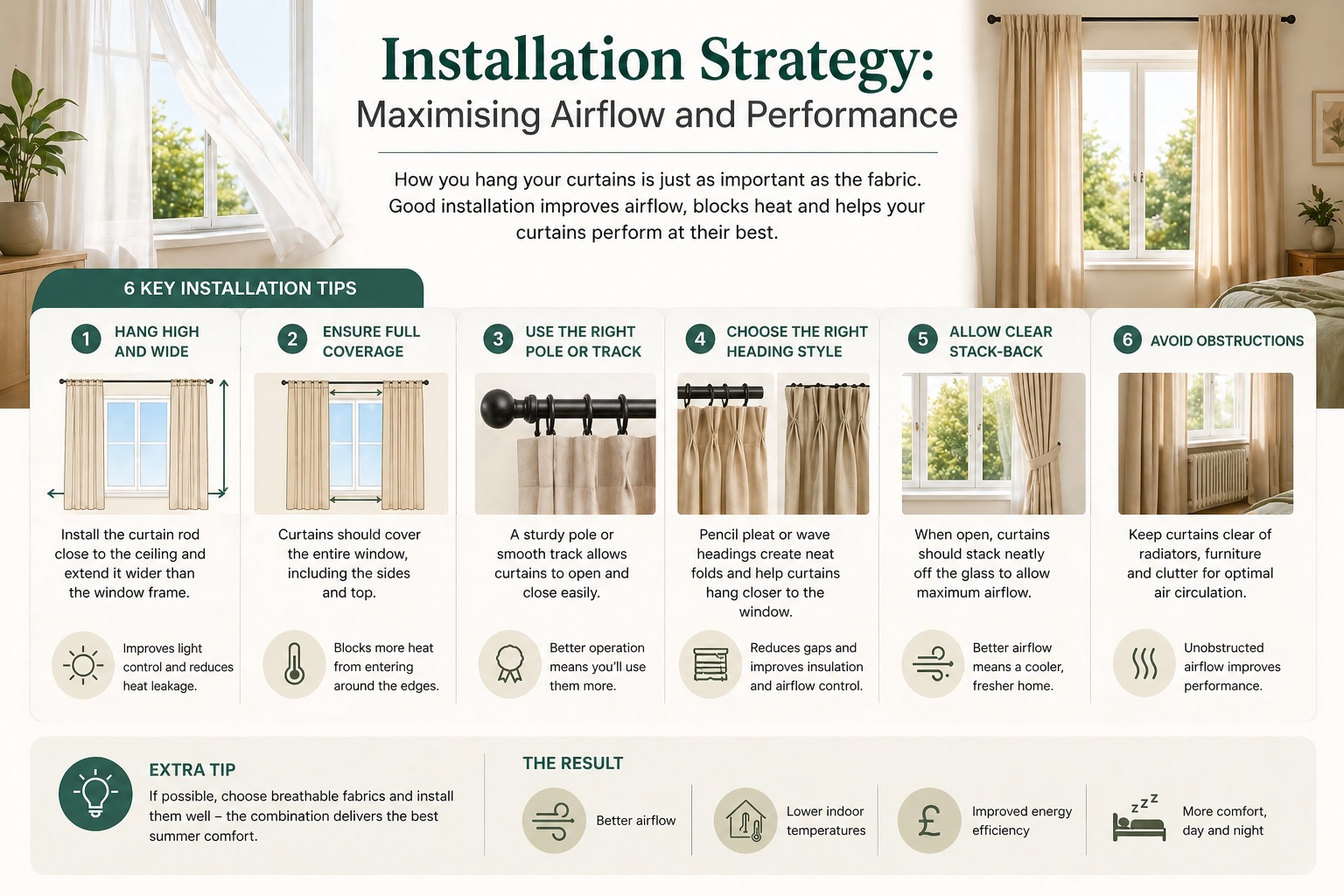
Even the most breathable fabric will underperform if the curtain is poorly fitted. In many cases, installation is the limiting factor, not the material itself.
Small adjustments in how curtains are hung can significantly improve both airflow and heat control.
1. The Stack-Back Principle: Clear the Window Fully
When curtains are open, they should sit completely clear of the window opening.
Why it matters:
- Prevents fabric from blocking incoming airflow
- Allows maximum ventilation when windows are open
- Reduces heat build-up around the glass
Best practice:
- Ensure curtain width allows full stack-back to the sides
- Avoid undersized curtains that sit partially across the glass
A partially covered window can restrict airflow more than expected, even with breathable fabric.
2. Mount Higher for Better Air Circulation
Curtains fitted higher above the window can improve both airflow and overall performance.
Benefits:
- Encourages vertical air movement
- Helps hot air rise and disperse more effectively
- Improves light distribution across the room
Practical tip:
- Install curtain tracks or poles closer to the ceiling where possible
3. Width and Coverage: Reduce Heat Gaps
While airflow is important, so is controlling unwanted heat entry during the day.
Key point:
- Curtains should be wide enough to:
- Fully cover the window when closed
- Minimise gaps at the sides
Why this matters:
- Gaps allow sunlight and heat to bypass the curtain
- Reduces the effectiveness of any heat-control strategy
4. Layer Positioning: Get the Order Right
If using a layered setup (recommended), positioning matters:
- Voile or sheer layer
- Closest to the window
- Handles airflow and daytime privacy
- Main curtain
- Positioned in front
- Used for heat control and insulation when needed
This ensures each layer performs its role without interfering with the other.
5. Track vs Pole: Does It Matter?
From a performance perspective:
- Curtain tracks
- Allow smoother, more consistent movement
- Better for precise positioning (especially layering)
- Curtain poles
- More decorative
- Slightly less precise, but still effective if properly sized
The key is not the system itself, but ensuring full open and full close positions are achievable without obstruction.
Practical Takeaway
To get the most from summer curtains:
- Fully expose the window when curtains are open
- Eliminate gaps when curtains are closed
- Use height and width to improve airflow and coverage
- Position layers correctly
In many homes, improving installation alone can deliver noticeable gains in comfort, even without changing the fabric.
Maintenance: Keeping Summer Curtains Fresh and Effective
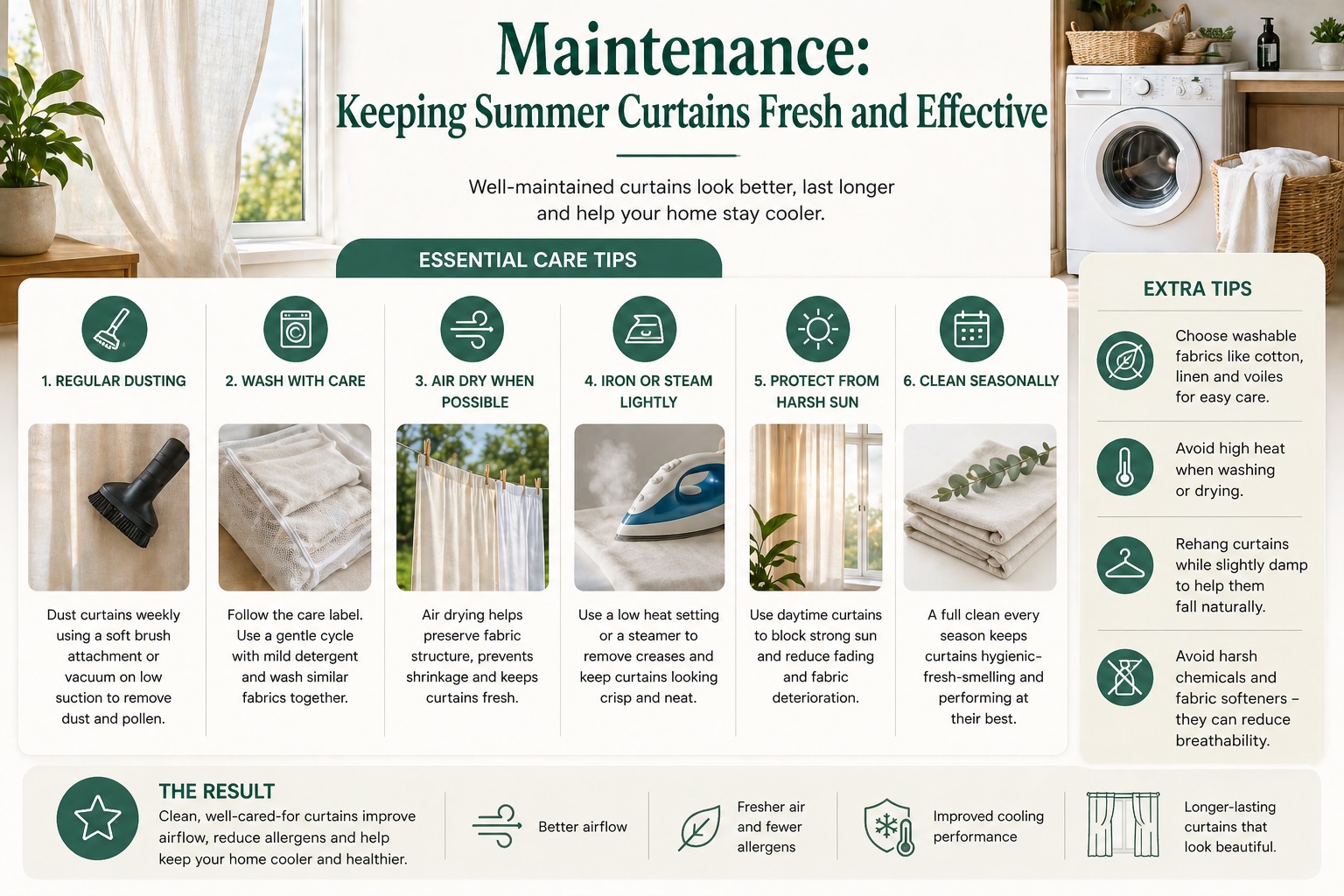
Summer places different demands on curtains compared to the rest of the year. Open windows, higher pollen levels and increased airflow all contribute to faster build-up of dust, allergens and moisture.
Without regular maintenance, even the most breathable fabrics can become less effective over time.
1. Managing Pollen and Dust Build-Up
During warmer months, curtains act as a filter for airborne particles entering through open windows.
Common issues:
- Pollen accumulation (especially late spring and summer)
- Dust settling into fibres
- Reduced airflow as fabric becomes clogged
What to do:
- Lightly vacuum curtains weekly using a soft brush attachment
- Shake out lighter fabrics such as voiles where possible
- Keep windowsills and surrounding areas clean to reduce transfer
Build-up not only affects cleanliness, but can also reduce breathability over time.
2. Washing Frequency: Adjust for Summer Conditions
Curtains typically require more frequent cleaning in summer due to increased exposure.
General guidance:
- Voiles and sheers: every 4–6 weeks
- Lightweight cotton and linen: every 6–8 weeks (depending on exposure)
- Heavier or lined curtains: less frequent, but still monitor for dust
Always check care instructions, as requirements vary by fabric and finish.
3. Washing Natural Fabrics: Avoid Shrinkage
Natural fibres perform well in summer but require careful handling.
Key considerations:
- Linen and cotton can shrink if washed at high temperatures
- Gentle cycles and lower temperatures are recommended
- Air drying is preferable to maintain shape and structure
Practical tip:
Where precision fit is important, even minor shrinkage can affect how curtains hang and perform.
4. Dealing with Moisture and Odours
In humid conditions, especially in kitchens or poorly ventilated rooms, curtains may retain moisture.
Prevention:
- Ensure adequate ventilation where possible
- Avoid leaving curtains closed for extended periods in warm, humid spaces
If needed:
- Spot clean areas prone to moisture
- Allow curtains to fully dry after washing before rehanging
5. When to Consider Professional Cleaning
For:
- Delicate fabrics (e.g. silk)
- Fully lined or structured curtains
- Larger made-to-measure installations
Professional cleaning helps maintain:
- Fabric integrity
- Fit and drape
- Long-term performance
Practical Takeaway
Summer maintenance is less about deep cleaning and more about regular upkeep:
- Keep fabrics free from dust and pollen
- Wash more frequently than in winter
- Handle natural fibres carefully to avoid shrinkage
Maintaining your curtains properly ensures they continue to support airflow and comfort, rather than becoming a barrier to it over time.
Conclusion: Choosing the Right Curtains for a Cooler Summer
There is no single “best” summer curtain. The right choice depends on how your room behaves throughout the day, not just the fabric itself.
The key is understanding that summer comfort comes from balancing two factors:
- Reducing heat gain during the day
- Allowing heat to escape in the evening
Breathable fabrics such as linen, cotton and voiles play an important role in improving airflow, particularly at night. However, in many UK homes, especially those with direct sun exposure, breathability needs to be combined with some level of heat control to be fully effective.
A more practical approach is to think in terms of a system rather than a single product:
- Use layering to adapt to changing conditions
- Adjust curtains throughout the day based on sunlight and temperature
- Match fabric choice to room orientation and usage
Small details also make a measurable difference. Proper installation, full window coverage when closed, and clear stack-back when open all contribute to better overall performance.
Why Made-to-Measure Matters
This is where DotcomBlinds offers a clear advantage.
Off-the-shelf curtains often leave:
- Gaps at the sides or top
- Inconsistent coverage
- Reduced effectiveness for both heat control and airflow
Made-to-measure curtains are designed to fit your windows precisely, helping to:
- Minimise heat entering around the edges
- Improve overall thermal performance
- Ensure smoother operation for day/night adjustments
DotcomBlinds also provides a wide range of curtain fabrics and styles, all tailored to your exact measurements and delivered directly to your door, making it easier to get both performance and appearance right.
Explore the Right Fabric Before You Buy
Choosing the right summer curtain is not just about appearance. Texture, weight and weave all affect how a fabric performs in real conditions.
That is why ordering samples is a practical step.
With DotcomBlinds, you can:
- Compare fabrics in your own lighting conditions
- Assess breathability and light filtering in real time
- Make a more confident, informed decision before ordering
Final Takeaway
If your goal is a cooler, more comfortable home this summer:
- Focus on how curtains perform, not just how they look
- Use a day/night strategy rather than a single solution
- Prioritise fit, fabric and flexibility
To put this into practice, explore the full curtain range and order free samples from DotcomBlinds. It is the most reliable way to find a setup that works for your specific rooms and delivers measurable comfort throughout the warmer months.