Order Tracking
 0800 1422417
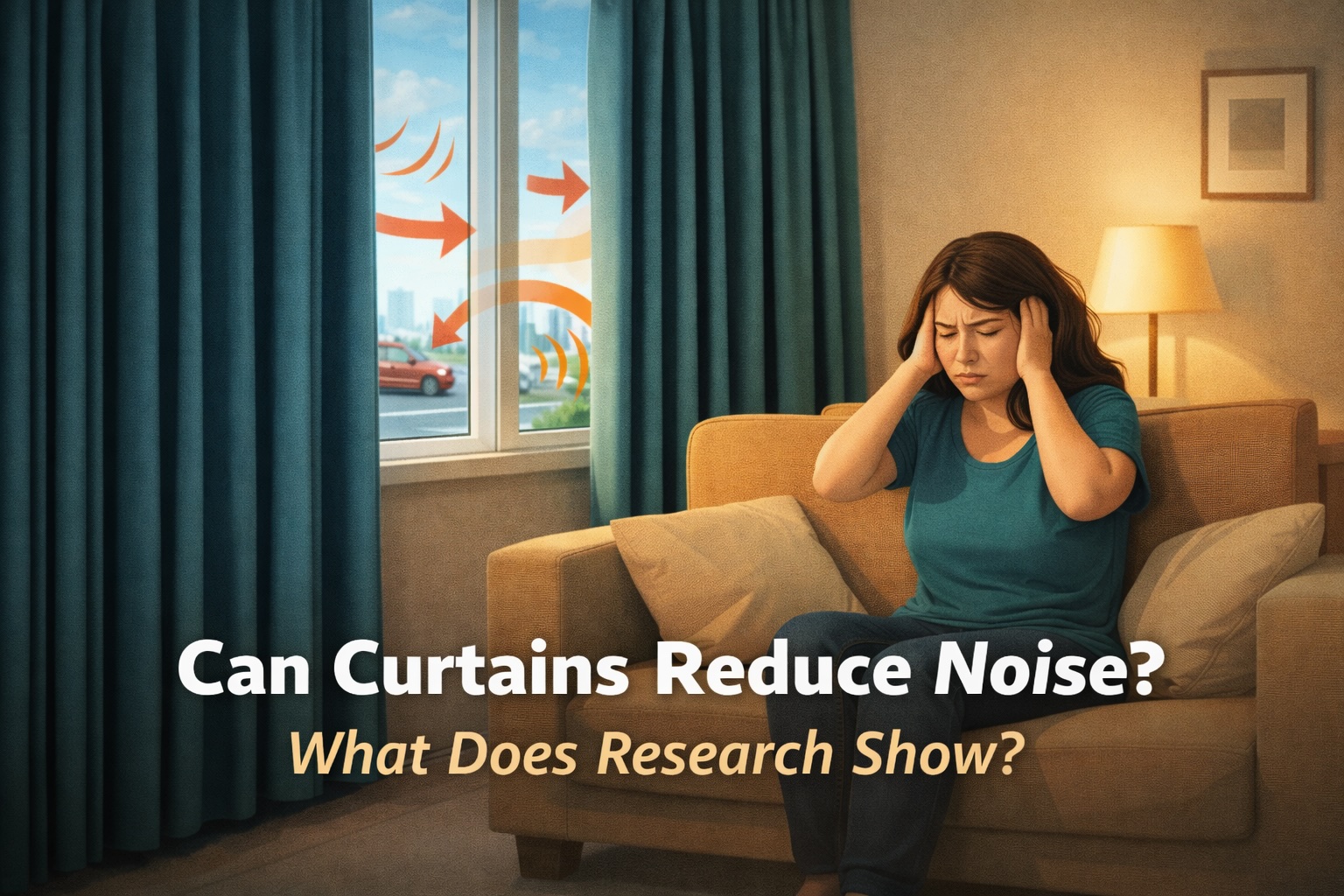
If you live on a busy road, near a school, or simply want a quieter, more comfortable home, it is natural to wonder whether curtains can help reduce noise. The idea is a popular one, and many curtains are marketed using terms such as “sound reducing” or even “soundproof”. But what does research actually show?
The short answer is yes, curtains can reduce noise, but not in the way many people expect. Scientific research makes a clear distinction between reducing echo and harshness inside a room, and blocking external noise from entering through a window. Curtains can do both to a degree, but their effectiveness depends heavily on the type of sound, the fabric used, and how the curtains are made and installed.
Laboratory testing carried out under recognised acoustic standards shows that high quality, well fitted curtains can reduce perceived noise levels by a measurable amount, often in the region of several decibels. However, they do not create silence, and they are far more effective against certain sounds, such as voices or sirens, than low frequency noise like heavy traffic or bass.
In this article, we look at what acoustic research actually says about curtains and noise reduction. We explain how sound travels through windows, the difference between sound absorption and sound blocking, and why some curtains perform better than others. Most importantly, we set realistic, research backed expectations so you can make an informed decision about whether curtains are the right solution for your home.
Table of Contents
How Sound Travels Through Windows and Into Your Home

To understand whether curtains can reduce noise, it helps to first understand how sound enters a room. In most homes, windows are one of the weakest points when it comes to noise control. Even well built walls block sound far more effectively than glass, frames, and the small gaps around them.
Sound travels as waves of energy through the air. When these waves hit a solid surface, such as a wall, some of the energy is reflected, some is absorbed, and some may pass through. Glass and window frames allow far more of this energy to pass through than brick or concrete, which is why outside noise is often most noticeable near windows.
A useful way to think about sound is to imagine it behaving like water. If there is a gap, crack, or weak point, sound will find it. This is known in acoustics as “flanking”, where noise bypasses a barrier by travelling around it rather than directly through it. Even small gaps at the top or sides of a window can significantly reduce the effectiveness of any noise reducing solution.
Not all sounds behave in the same way. Higher frequency sounds, such as speech, birdsong, alarms, and sirens, have shorter sound waves. These are more easily absorbed or disrupted by soft, fibrous materials like fabric. Lower frequency sounds, such as traffic rumble, heavy machinery, or bass music, have much longer and more powerful waves. These tend to pass through lightweight materials with very little resistance.
This difference in sound behaviour is crucial. It explains why curtains can noticeably soften or reduce certain types of noise, while having little effect on others. Understanding this distinction sets the foundation for assessing what curtains can realistically achieve when it comes to noise reduction.
Sound Absorption vs Sound Blocking: Why the Difference Matters
One of the biggest sources of confusion around curtains and noise is the assumption that all noise reduction works in the same way. In reality, acoustic research separates noise control into two very different effects: sound absorption and sound blocking. Understanding the difference is essential for setting realistic expectations.
What Is Sound Absorption?
Sound absorption refers to reducing the amount of sound that reflects around a room. When sound waves hit a hard surface, such as glass, plaster, or wood, they bounce back into the space. This can make a room feel louder, harsher, or more echoey, even if the sound itself is not especially strong.
Soft, fibrous materials like curtains absorb some of this sound energy instead of reflecting it. The sound waves enter the fabric, lose energy as heat, and return to the room at a much lower intensity. This improves acoustic comfort, making voices sound less sharp and reducing echo and reverberation.
Sound absorption is often measured using a rating called the Noise Reduction Coefficient, or NRC. This is a value between 0 and 1, where higher numbers indicate greater sound absorption. Standard lightweight curtains have relatively low NRC values, while heavier, layered curtains absorb significantly more sound.
What Is Sound Blocking?
Sound blocking is about preventing noise from entering a room in the first place. This is usually measured in decibels and reflects how much quieter a sound becomes after passing through a barrier.
Blocking sound is far more challenging than absorbing it. Low frequency noise, in particular, requires mass and density to stop it. This is why solid walls, thick glazing, and secondary glazing are far more effective at blocking noise than fabric alone.
Curtains can contribute to sound blocking to a limited extent, especially when they are heavy, well sealed, and installed correctly. However, they should be seen as reducing the volume of certain noises rather than eliminating them entirely.
By separating these two concepts, it becomes much clearer why curtains can make a room feel quieter and more comfortable, while still allowing some external noise to be heard.
What Does Research Actually Show About Curtains and Noise?

Rather than relying on marketing claims or anecdotal experience, it is important to look at what controlled acoustic research tells us about curtains and noise reduction. Over the years, curtains have been tested in laboratory conditions using recognised international standards, allowing their performance to be measured objectively.
The 7 to 10 Decibel Reality
Empirical testing shows that high quality, purpose designed acoustic curtains can reduce perceived noise levels by approximately 7 to 10 decibels in certain conditions. In acoustic terms, this is a meaningful improvement. A reduction of around 10 decibels is generally perceived by the human ear as roughly halving the loudness of a sound.
However, this figure needs to be understood in context. It does not mean that outside noise disappears. Instead, it means that the overall volume is turned down. In real world environments, this can make traffic noise less intrusive, voices less distracting, and general background noise more manageable, but it will not create silence.
It is also important to note that these results are typically achieved using heavy, multi layered curtains that are properly installed. Lightweight decorative curtains perform far less effectively.
Why Frequency Makes a Big Difference
Research consistently shows that curtains are far more effective at reducing mid to high frequency sounds than low frequency noise. Sounds such as speech, sirens, birds, and general urban activity fall into a frequency range where fabric can absorb and disrupt sound waves reasonably well.
In contrast, low frequency sounds such as traffic rumble, heavy machinery, or bass music are much harder to control. These sounds have long, powerful waves that pass through fabric with minimal resistance. Studies show that curtains often reduce low frequency noise by only a small amount, sometimes just a few decibels, which many people will barely notice.
This frequency dependent behaviour explains why curtains can make a room feel calmer and less harsh, while still allowing deeper background noise to be audible. Understanding this limitation is key to using curtains as part of a realistic noise reduction strategy rather than expecting them to act as full soundproofing.
Why Some Curtains Reduce Noise Better Than Others
Not all curtains perform the same when it comes to noise reduction. Research shows that three main factors determine how effective a curtain is at absorbing and reducing sound: the weight and density of the fabric, the way the curtain is constructed, and how it is installed in relation to the window.
Fabric Weight and Density
One of the most important factors in noise reduction is mass. Heavier curtains generally perform better than lightweight ones because they contain more material to absorb and dampen sound energy. Studies in acoustic engineering suggest that a minimum fabric density is needed before any meaningful reduction in outside noise can be measured.
Standard cotton or polyester curtains are often too light to make a noticeable difference. Heavier fabrics, such as thick velvet or curtains with additional linings or interlinings, are far more effective. Professional acoustic curtains often include dense inner layers specifically designed to add mass without making the curtain stiff.
Pleats, Fullness, and Surface Area
The way a curtain hangs also has a significant impact on its acoustic performance. Curtains that are flat and stretched tightly across a window provide less sound absorption than those with generous folds.
Using greater fullness, typically two to three times the width of the window, creates deep pleats. These folds increase the surface area of the fabric and create small pockets where sound waves can enter, bounce around, and lose energy. This effect is often described as creating acoustic traps within the curtain itself.
The Importance of an Air Gap
How far a curtain is positioned from the window can also influence its effectiveness. Research shows that hanging curtains slightly away from the glass, rather than pressed directly against it, creates an air cavity between the curtain and the window.
This air gap acts as an additional buffer. Sound waves lose energy as they pass through this space before reaching the curtain, improving overall sound absorption. Even a small gap of several centimetres can make a measurable difference, particularly for mid and high frequency sounds.
Together, these factors explain why heavier, well designed, and properly hung curtains consistently outperform lighter, purely decorative options when it comes to reducing noise.
Installation Matters More Than Most People Realise

Even the heaviest and best designed curtain will underperform if it is installed poorly. Acoustic research repeatedly shows that gaps and poor coverage can dramatically reduce the effectiveness of any noise reducing material. In many cases, how a curtain is fitted matters just as much as the fabric itself.
Sealing the Edges and Preventing Sound Leakage
Sound behaves much like water. If there is a gap, it will find a way through. Small gaps at the sides, top, or bottom of a curtain allow sound to bypass the fabric entirely, significantly reducing its impact.
For effective noise reduction, curtains should extend beyond the window frame on all sides and sit as close to the surrounding wall as possible. Overlapping the window opening helps to block flanking noise that would otherwise travel around the edges of the glass. Curtains that stop short of the frame, or are fitted tightly within the recess, are far less effective in this respect.
Mounting Height and Track Position
Mounting position also plays an important role. Curtains fitted higher, ideally closer to the ceiling, reduce the vertical gap above the window where sound can enter the room. Floor length curtains further help by limiting sound leakage at the bottom.
Ceiling mounted tracks or poles that allow the curtain to sit close to the wall often perform better acoustically than standard face fixed rods. Some track designs also allow the curtain to return towards the wall at the ends, further improving edge sealing.
Why Ready Fitted Curtains Often Disappoint
Many people are disappointed with noise reduction because their curtains are installed primarily for appearance rather than performance. Decorative fitting choices, such as narrow poles or minimal fabric coverage, may look neat but leave multiple sound paths open.
When curtains are fitted with acoustic performance in mind, focusing on coverage, overlap, and sealing, the difference can be noticeable. This is why installation should always be considered part of the noise reduction solution, not an afterthought.
Made to Measure vs Ready Made Curtains for Noise Reduction
When it comes to reducing noise, research and practical testing both point to one clear conclusion: fit matters. While the fabric and construction of a curtain are important, how well it covers and seals the window opening often determines how effective it will be in real world conditions.
Why Gaps Undermine Noise Reduction
Sound does not need a large opening to get through. Even small gaps around a window can allow a surprising amount of noise to enter a room. Ready made curtains are produced in standard widths and lengths, which rarely match a window perfectly. This often results in gaps at the sides, above the pole, or at the floor.
Made to measure curtains allow for deliberate overlap beyond the window frame. By extending wider and higher than the opening, the curtain can rest against the wall, helping to reduce flanking noise that would otherwise bypass the fabric entirely.
Coverage From Ceiling to Floor
One of the most effective ways to improve noise reduction is to cover as much of the surrounding area as possible. Ready made curtains frequently leave a gap between the top of the pole and the ceiling, which becomes an easy route for sound to travel.
With made to measure curtains, tracks can be positioned closer to the ceiling, and the curtains can be produced to reach the floor precisely. This creates a more continuous barrier, limiting the paths sound can take into the room.
Control Over Fullness and Lining
Another advantage of made to measure curtains is control over fullness and lining options. Higher fullness creates deeper folds, increasing sound absorption. Additional layers, such as interlining or heavier linings, add mass, which is critical for reducing transmitted noise.
Ready made curtains typically offer limited choice in these areas. Made to measure options allow the curtain to be tailored specifically for improved acoustic performance, rather than relying on appearance alone.
For these reasons, made to measure curtains consistently outperform standard off the shelf options when noise reduction is a priority.
Curtains vs Blinds: Which Is Better for Reducing Noise?
Curtains and blinds are often compared when homeowners are looking for ways to reduce noise, but research shows they work in very different ways. The difference comes down to material, surface area, and how each product interacts with sound waves.
Why Curtains Usually Perform Better
In most scientific and practical comparisons, curtains outperform standard blinds for noise reduction. This is largely due to their mass and their soft, fibrous structure. Fabric absorbs sound energy, reducing both echo within a room and the perceived loudness of noise entering from outside.
Curtains also have a practical advantage in how they are fitted. They are typically installed outside the window recess, allowing them to cover not just the glass but part of the surrounding wall as well. This wider coverage helps to reduce flanking noise, which is sound that travels around the edges of a window rather than straight through it.
Hard surface blinds, such as wooden, metal, or PVC designs, behave very differently. Instead of absorbing sound, they tend to reflect it back into the room. While they may block some direct sound paths, they do little to soften noise or reduce reverberation. In some cases, they can even make a room feel louder by increasing sound reflections.
The Exception: Cellular or Honeycomb Blinds
The main exception to this rule is the cellular, or honeycomb blind. These blinds are engineered with internal air pockets that trap air within the structure of the fabric. In acoustic terms, trapped air acts as an insulator, helping to disrupt sound waves.
High quality, multi cell honeycomb blinds have been shown to absorb a significant amount of sound energy, sometimes approaching the performance of a good curtain for mid to high frequency noise. They are particularly effective when fitted close to the glass, where they can help reduce initial sound transmission.
That said, even cellular blinds typically perform best when used alongside curtains rather than instead of them. A layered approach, using a blind close to the window and curtains covering the opening, offers the most balanced solution for both sound and thermal comfort.
Overall, while some blinds can contribute to noise reduction, curtains remain the more effective option in most homes, particularly when coverage, absorption, and installation are taken into account.