Order Tracking
 0800 1422417
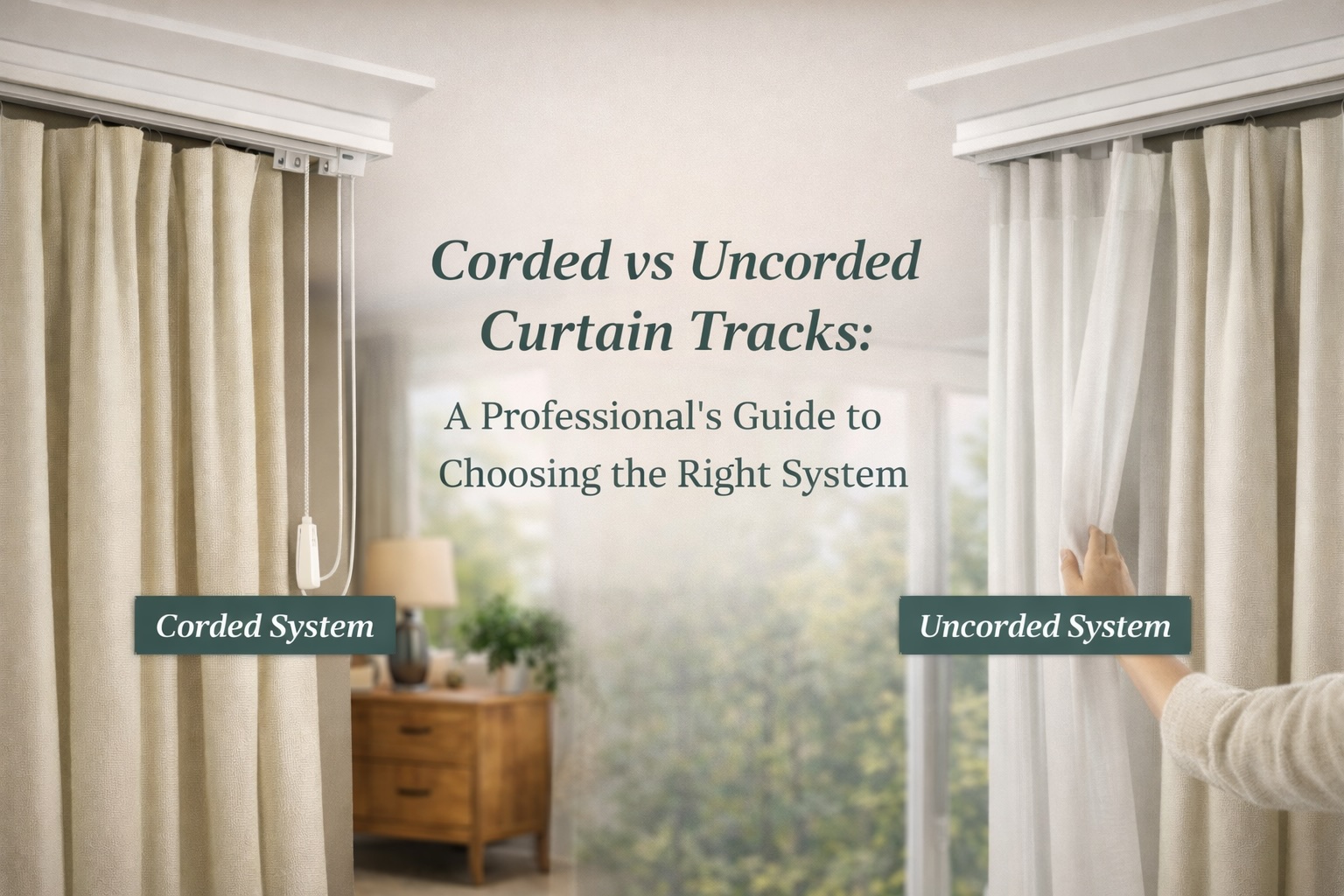
When choosing curtain tracks, most people focus on the style of the curtain itself, the fabric, colour or heading type. However, the track system behind the curtain plays an equally important role in how well your window dressing performs day to day.
One of the most common decisions is whether to opt for a corded or uncorded curtain track. At first glance, the difference may seem straightforward. One uses a cord, the other is operated by hand. In practice, the choice has a direct impact on ease of use, longevity, safety, and how well the system handles your curtains over time.
From an industry perspective, this is not simply a matter of preference. The right option depends on a combination of factors including curtain weight, window size, accessibility, and how frequently the curtains will be used. Choosing incorrectly can lead to unnecessary wear, reduced smoothness in operation, or a setup that feels inconvenient from day one.
This guide takes a practical, experience-led approach to comparing corded and uncorded curtain tracks. Rather than focusing on theory, it breaks down where each system performs best, where it falls short, and how to select the most suitable option for your specific space.
Table of Contents
- What Are Corded and Uncorded Curtain Tracks? (Quick Definitions)
- Corded vs Uncorded Curtain Tracks: Key Differences at a Glance
- Ease of Use and Everyday Convenience
- Control, Access and Practical Handling
- Curtain Weight and Track Performance
- Safety Considerations (Especially for Homes with Children)
- Aesthetics and Visual Impact
- Installation and Setup Complexity
- Durability, Maintenance and Long-Term Reliability
- When to Choose a Corded Curtain Track (Best Use Cases)
- When to Choose an Uncorded Curtain Track
- Common Mistakes to Avoid When Choosing Curtain Tracks
- Final Thoughts: Which Curtain Track System Is Right for You?
What Are Corded and Uncorded Curtain Tracks? (Quick Definitions)

Before comparing performance and suitability, it is worth clearly defining how each system works in practice. While the distinction seems simple, misunderstandings here often lead to poor product choices.
What Is a Corded Curtain Track?
A corded curtain track uses a continuous loop cord system to open and close the curtains. Instead of pulling the fabric directly, the user operates the cord, which runs through an internal pulley mechanism to move the gliders along the track.
This setup allows for controlled, smooth, and consistent movement, regardless of curtain size or weight.
From a practical standpoint, corded tracks are typically used where:
- Curtains are heavy or lined (e.g. blackout or thermal curtains)
- Windows are wide or tall, making manual operation less convenient
- Curtains are opened and closed frequently throughout the day
Because the force is transferred through the mechanism rather than the fabric, corded systems also help to reduce direct handling of the curtain, which can minimise wear over time.
What Is an Uncorded (Hand-Drawn) Curtain Track?
An uncorded curtain track, often referred to as a hand-drawn track, is operated by pulling the curtain itself along the rail. There is no cord, pulley, or additional control mechanism involved.
This makes it a simpler and more minimal system, both in terms of design and installation.
Uncorded tracks are most commonly suited to:
- Lightweight curtains
- Smaller windows or shorter spans
- Rooms where curtains are used less frequently
However, because the curtain is handled directly, there is typically more physical effort required, especially as curtain size or weight increases. Over time, repeated handling can also lead to fabric wear or reduced smoothness if the track is not well maintained.
Corded vs Uncorded Curtain Tracks: Key Differences at a Glance
Before looking at each factor in detail, it is useful to compare both systems side by side. This highlights where each option is naturally better suited and helps narrow down the right choice quickly.
| Feature | Corded Curtain Track | Uncorded (Hand-Drawn) Curtain Track |
|---|---|---|
| Operation Method | Controlled via continuous loop cord | Operated by pulling the curtain by hand |
| Ease of Use | Smooth, low effort, especially for large or heavy curtains | Simple but can require more effort over time |
| Control & Precision | Precise positioning, consistent movement | Less precise, depends on manual handling |
| Curtain Weight | Ideal for medium to heavy curtains | Best suited to lightweight curtains |
| Window Size | Suitable for wide, tall, or hard-to-reach windows | Better for smaller or easily accessible windows |
| Safety | Requires proper cord safety measures, such as cleats or tensioners | No cords, inherently safer in family environments |
| Aesthetics | Visible cord may impact minimal designs | Cleaner, more minimal appearance |
| Installation | Slightly more complex due to the cord system | Simpler and quicker to install |
| Durability | More components, so the cord mechanism may wear over time | Fewer parts, generally lower maintenance |
| Maintenance | Occasional adjustment or cord maintenance may be needed | Minimal maintenance required |
| Typical Use Cases | Living rooms, large windows, and heavy curtains | Bedrooms, smaller windows, and lighter curtain setups |
From a trade perspective, the most common mistake is treating this as a purely aesthetic or budget decision. In reality, the weight of the curtain and the size of the window are the two most important variables.
- If either increases, a corded system quickly becomes the more practical option.
- If both are minimal, an uncorded track is usually sufficient and more straightforward.
Ease of Use and Everyday Convenience
In day-to-day use, the difference between corded and uncorded curtain tracks becomes immediately noticeable. While both systems achieve the same end result, the effort required and consistency of operation can vary significantly depending on the setup.
Corded Curtain Tracks: Designed for Effortless Operation
Corded systems are built with convenience in mind. The pulley mechanism allows curtains to be opened and closed with minimal physical effort, regardless of their size or weight.
In practical terms, this means:
- Smooth, consistent movement across the full width of the track
- No need to reach across wide windows or handle large amounts of fabric
- Reliable operation even with heavier, lined, or blackout curtains
This becomes particularly valuable in rooms where curtains are used multiple times a day, such as living rooms or large patio doors. Over time, the reduced strain makes a noticeable difference in usability.
Uncorded Curtain Tracks: Simple but More Manual
Uncorded tracks offer a more straightforward approach. By removing the cord system entirely, they rely on direct manual operation, with the curtain being pulled along the track by hand.
For smaller or lighter setups, this works well:
- Quick and intuitive to use
- No additional mechanism to manage
- Suitable for occasional use
However, as curtain weight or window width increases, the limitations become clearer:
- More effort is required to move the curtain
- Movement can be less consistent, particularly over longer spans
- Repeated handling can lead to gradual wear on the fabric edges
From an industry perspective, frequency of use is often underestimated when choosing between these systems.
- For high-use areas, a corded track provides a more consistent and user-friendly experience over time.
- For low-use spaces, the simplicity of an uncorded track is often sufficient and avoids unnecessary complexity.
In short, if convenience and ease of operation are priorities, especially with larger or heavier curtains, a corded system will generally deliver a more refined and practical solution.
Control, Access and Practical Handling
Beyond general ease of use, one of the more important distinctions is how much control you have over the curtain, particularly in less straightforward setups. This is where the gap between corded and uncorded systems becomes more pronounced.
Corded Curtain Tracks: Greater Control and Reach
Corded systems allow you to operate the curtain from a fixed position using the cord, rather than needing to physically guide the fabric along the track.
This offers several practical advantages:
- Precise positioning of the curtain, including partial opening and closing
- Consistent movement across the full width of the track
- No need to reach across furniture or awkward spaces
This becomes especially useful in real-world scenarios such as:
- Wide windows or bi-fold doors, where reaching the far end is impractical
- Floor-to-ceiling curtains, where handling large amounts of fabric is inconvenient
- Rooms with furniture placed in front of windows, limiting direct access
In these situations, a corded system provides a level of control that a hand-drawn track simply cannot match.
Uncorded Curtain Tracks: Limited by Physical Access
With uncorded tracks, control is entirely dependent on your ability to reach and move the curtain manually.
For straightforward setups, this is not an issue:
- Easy access to the full track
- Lightweight curtains that glide without resistance
However, limitations become apparent when:
- The window is wide or difficult to reach
- Curtains are long or heavy, making them harder to guide evenly
- Obstacles such as beds, sofas, or desks restrict access
In these cases, users often end up pulling the curtain from one side only, which can lead to:
- Uneven movement
- Increased strain on the track and gliders
- Reduced long-term performance
From a trade perspective, accessibility is one of the most overlooked factors when selecting a curtain track.
It is not just about how the curtain looks, but how easily it can be used in the actual layout of the room.
- If access is restricted or the window span is large, a corded track offers clear functional advantages.
- If the track is fully accessible and the setup is simple, an uncorded system remains a practical option.
Choosing based on access alone often prevents usability issues that only become obvious after installation.
Curtain Weight and Track Performance
Curtain weight is one of the most decisive factors when choosing between corded and uncorded tracks. It directly affects not only how easy the curtains are to operate, but also how well the track performs over time.
Corded Curtain Tracks: Built for Heavier Loads
Corded systems are specifically designed to handle medium to heavy curtains with minimal effort. The internal mechanism distributes the load evenly along the track, reducing the strain placed on any single point.
In practical terms, this means:
- Smooth operation even with lined, blackout, or thermal curtains
- Reduced pulling force required from the user
- More consistent movement across wider spans
This load distribution also helps to:
- Minimise stress on the gliders and brackets
- Maintain alignment over time
- Reduce the risk of uneven wear
For heavier curtain setups, a corded track is not just a convenience. It is often the more mechanically suitable solution.
Uncorded Curtain Tracks: Best for Lightweight Curtains
Uncorded tracks rely entirely on manual force applied directly to the curtain. While this works well with lighter fabrics, performance can decline quickly as weight increases.
They are best suited to:
- Sheer or lightweight curtains
- Shorter track lengths
- Situations where curtains are not opened and closed frequently
As curtain weight increases, common issues include:
- Increased resistance when pulling the curtain
- Less smooth movement, particularly across longer tracks
- Greater strain on both the track components and the fabric itself
Over time, this can lead to reduced efficiency and a less refined user experience.
In practice, underestimating curtain weight is one of the most common specification mistakes.
Heavier curtains do not just require more effort to move. They place ongoing stress on the entire system. If that load is not managed properly:
- Tracks can lose smoothness
- Gliders may wear prematurely
- Curtains may experience unnecessary handling damage
As a general rule:
- Lightweight curtains → Uncorded track is usually sufficient
- Medium to heavy curtains → Corded track becomes the more reliable and durable option
Making the right choice at this stage helps ensure the system performs consistently, rather than becoming harder to use over time.
Safety Considerations (Especially for Homes with Children)
Safety is an important consideration when choosing any window furnishing system, particularly in homes with young children or vulnerable individuals. While both corded and uncorded curtain tracks are widely used, they differ significantly in how safety is managed.
Corded Curtain Tracks: Safe When Properly Installed
Corded tracks introduce a continuous loop cord, which requires appropriate safety measures to minimise risk. In the UK, this is well understood within the industry, and compliant installations include simple but effective solutions.
Key safety considerations include:
- Use of cord tensioners or cleats to keep the cord secured and under tension
- Ensuring cords are positioned out of reach of children
- Correct installation height and fixing points
When installed correctly, corded systems are considered safe for everyday use. However, they do rely on:
- Proper fitting
- Ongoing awareness of cord positioning
This makes them more suited to environments where these factors can be controlled.
Uncorded Curtain Tracks: Inherently Safer by Design
Uncorded tracks remove the cord entirely, which eliminates the primary safety concern associated with traditional curtain operation.
As a result:
- There are no loops or cords to manage
- The system is inherently safer in family homes, nurseries, and schools
- There is no requirement for additional safety devices
This simplicity makes uncorded tracks a straightforward choice where safety is the overriding priority.
From a trade perspective, safety is less about avoiding corded systems entirely and more about choosing the right system for the environment and installing it correctly.
- In family-focused spaces, uncorded tracks offer a simple, low-risk solution
- In other settings, corded tracks remain a viable option when fitted with appropriate safety measures
The key is to ensure that safety is considered at the specification stage, rather than treated as an afterthought during installation.
Aesthetics and Visual Impact
While curtain tracks are primarily functional, their visual impact should not be overlooked. In many interiors, particularly modern or minimalist spaces, even small design details such as visible cords or track profiles can influence the overall finish.
Corded Curtain Tracks: Functional with Visible Elements
Corded systems introduce an additional visual component in the form of the control cord. Depending on the installation, this may be positioned to one side of the window and remain partially visible.
From a design perspective:
- The cord can slightly interrupt a clean, minimal aesthetic
- It may be more noticeable in open or uncluttered spaces
- In some cases, it can be discreetly positioned to reduce visual impact
That said, in many practical settings, especially where curtains are heavier or more prominent, the presence of a cord is often considered a reasonable trade-off for improved usability.
Uncorded Curtain Tracks: Cleaner and More Minimal
Uncorded tracks offer a more streamlined appearance by removing the need for any external control mechanism.
This results in:
- A cleaner, uninterrupted look
- Greater suitability for modern and minimalist interiors
- Less visual distraction around the window area
Because there are fewer visible components, uncorded systems tend to integrate more seamlessly into the overall design, particularly when the focus is on the curtain fabric itself.
In practice, aesthetics rarely sit in isolation. They need to be balanced against performance.
- For design-led spaces, where simplicity and clean lines are a priority, uncorded tracks often align better visually
- For larger or more functional installations, the slight visual trade-off of a corded system is typically outweighed by its practical benefits
The key is to consider whether the track is intended to be seen or discreetly hidden, and how much importance is placed on visual minimalism versus ease of use.
Installation and Setup Complexity
Installation is another factor that can influence the overall suitability of a curtain track system, particularly for those planning a DIY fit. While both corded and uncorded tracks follow similar mounting principles, the presence of a control mechanism introduces some key differences.
Corded Curtain Tracks: More Components to Consider
Corded tracks require additional setup due to the internal pulley system and external cord loop. While not overly complex, they do demand a more careful approach during installation.
Key considerations include:
- Ensuring the cord is correctly tensioned for smooth operation
- Aligning the track properly to avoid resistance or uneven movement
- Securing any safety devices such as cord tensioners
Because of these elements, installation can take slightly longer and may require more attention to detail. For larger or heavier curtain setups, precision during installation is particularly important to ensure long-term performance.
Uncorded Curtain Tracks: Simpler and More Straightforward
Uncorded tracks are generally easier to install due to their simpler design. With no cord mechanism to configure, the process is more direct.
Typically, installation involves:
- Fixing the track to the wall or ceiling
- Inserting gliders and attaching the curtain
- Checking for smooth manual operation
This makes uncorded systems well suited to:
- DIY installations
- Smaller or less complex window setups
- Situations where speed and simplicity are priorities
From a trade perspective, installation quality often has a greater impact than the system itself.
- A well-installed corded track will perform smoothly and reliably for years
- A poorly aligned or incorrectly tensioned system can quickly lead to friction and wear
Similarly:
- An uncorded track installed on an uneven surface can result in inconsistent movement, regardless of its simplicity
In short, while uncorded tracks are easier to install, both systems benefit from accurate measuring, correct fixing, and proper alignment. Taking the time to install the track correctly is essential for achieving consistent performance over time.
Durability, Maintenance and Long-Term Reliability
Curtain tracks are often installed and then largely forgotten about, so long-term reliability is an important consideration. The difference between corded and uncorded systems is not just how they operate on day one, but how they perform after months or years of regular use.
Corded Curtain Tracks: More Components, More to Maintain
Corded systems rely on a series of moving parts, including pulleys, cords, and internal carriers. When manufactured well and correctly installed, these systems are durable, but they do introduce more potential wear points.
Over time, this can result in:
- Gradual wear in the cord mechanism, particularly with frequent use
- The need for occasional re-tensioning or adjustment
- Increased reliance on the overall build quality of the track
That said, in higher-quality systems, these issues are typically minimal and manageable. When paired with the right curtain weight and used as intended, corded tracks can deliver consistent long-term performance.
Uncorded Curtain Tracks: Simpler, Fewer Failure Points
Uncorded tracks have a more straightforward design, with fewer moving components involved. This simplicity naturally reduces the number of elements that can wear or fail over time.
Key advantages include:
- Lower maintenance requirements
- Fewer mechanical parts subject to wear
- Consistent performance when used with suitable curtain weights
However, durability is still influenced by how the track is used. With heavier curtains or frequent handling, uncorded systems can experience:
- Increased friction along the track
- Faster wear of gliders and runners
- More strain on fixing points
From an industry standpoint, durability is less about whether a track is corded or uncorded, and more about matching the system to the application.
- A corded track used with heavy curtains will often outlast an uncorded system under the same conditions
- An uncorded track used within its limits can perform reliably with very little maintenance
In both cases, the quality of the track, installation accuracy, and suitability for the curtain weight are the main drivers of longevity.
Choosing the right system at the outset helps avoid avoidable wear, ensuring the track continues to operate smoothly without the need for frequent adjustments or replacement.
When to Choose a Corded Curtain Track (Best Use Cases)
While both systems have their place, there are clear scenarios where a corded curtain track is the more appropriate choice from both a practical and long-term performance perspective.
Large or Wide Windows
For wider window spans, manually pulling curtains becomes less efficient and more inconsistent. A corded system allows for:
- Smooth movement across the full width
- Even distribution of force
- Easier day-to-day operation without overreaching
This is particularly relevant for:
- Patio doors
- Bi-fold doors
- Wide living room windows
Heavy or Lined Curtains
Curtains with added weight, such as blackout, thermal, or interlined designs, place greater strain on the track.
A corded system helps to:
- Reduce the physical effort required
- Maintain smooth, controlled movement
- Prevent unnecessary stress on the fabric and track components
In these cases, a corded track is often the more mechanically suitable option, rather than just a convenience.
Hard-to-Reach Areas
Where access to the full width of the track is restricted, a corded system provides a clear advantage.
Typical scenarios include:
- Furniture positioned in front of windows
- Floor-to-ceiling curtains
- High-mounted tracks or tall window installations
Operating the curtain via a cord removes the need to physically reach or handle the fabric.
High-Frequency Use Areas
In spaces where curtains are opened and closed regularly, ease of operation becomes more important over time.
Corded tracks are well suited to:
- Living rooms
- Main bedrooms
- Frequently used shared spaces
The reduced effort and consistent movement help maintain usability and minimise wear from repeated handling.
From a trade perspective, corded tracks are typically specified where performance and usability are priorities.
If any of the following apply:
- The curtains are heavy
- The window is wide or difficult to access
- The curtains are used daily
Then a corded system is generally the more reliable and user-friendly choice over the long term.
Selecting a corded track in these scenarios helps avoid common issues such as uneven movement, increased strain, and reduced smoothness as the system ages.
When to Choose an Uncorded Curtain Track
Uncorded curtain tracks remain a practical and effective solution in the right conditions. While they are often seen as the simpler option, they can be the more appropriate choice where the demands on the system are lower.
Lightweight Curtains
Uncorded tracks perform best when paired with lighter fabrics that move easily along the rail.
Suitable curtain types include:
- Sheer or voile curtains
- Lightweight decorative fabrics
- Unlined curtains
In these cases, manual operation remains smooth without requiring additional mechanical assistance.
Smaller or Easily Accessible Windows
Where the full width of the track is easy to reach, the benefits of a corded system are less pronounced.
Typical examples include:
- Standard-sized bedroom windows
- Secondary windows in guest rooms
- Spaces without furniture obstructing access
With full access, hand-drawing the curtain is straightforward and efficient.
Low-Frequency Use Areas
In rooms where curtains are not opened and closed regularly, simplicity becomes more valuable than mechanical convenience.
Uncorded tracks are well suited to:
- Guest bedrooms
- Spare rooms
- Decorative or occasional-use spaces
This avoids introducing unnecessary components for minimal daily benefit.
Safety-Focused Environments
Because uncorded systems remove the need for cords entirely, they are often preferred in spaces where safety is a primary concern.
Common applications include:
- Nurseries and children’s bedrooms
- Schools or childcare environments
- Homes where a minimal-risk setup is preferred
The absence of cords eliminates the need for additional safety fittings or adjustments.
From an industry standpoint, uncorded tracks are most effective when used within their intended limits.
If the following conditions are met:
- Curtains are lightweight
- The window is easy to access
- Usage is infrequent or moderate
Then an uncorded system offers a simple, reliable, and low-maintenance solution.
Choosing an uncorded track in these scenarios avoids unnecessary complexity while still delivering consistent performance.
Common Mistakes to Avoid When Choosing Curtain Tracks
Even with a clear understanding of the differences, there are a few recurring mistakes that tend to lead to poor performance or unnecessary replacements. From an industry perspective, these issues are almost always avoidable with the right initial specification.
Choosing Based on Price Alone
One of the most common pitfalls is selecting a track purely on cost, without considering how it will perform in the intended setting.
Lower-cost options may:
- Struggle with heavier curtains
- Wear more quickly under regular use
- Deliver inconsistent movement over time
A curtain track is a functional component. Prioritising suitability over price typically leads to better long-term value.
Underestimating Curtain Weight
Curtain weight is often overlooked, particularly when choosing between corded and uncorded systems.
Common misjudgements include:
- Assuming standard curtains are lightweight when they are actually lined or interlined
- Not accounting for the combined weight of fabric, lining, and heading
This can result in:
- Increased resistance during operation
- Premature wear on gliders and brackets
- A system that feels difficult to use from the outset
Ignoring Window Size and Access
A track that works well on a small window may not perform effectively across a larger span.
Typical issues arise when:
- Wide windows are fitted with uncorded tracks
- Furniture restricts access to the full width of the curtain
- Curtains are installed in hard-to-reach areas
In these cases, usability is compromised, often leading to uneven handling and increased strain on the system.
Overlooking Safety Requirements
Where corded tracks are used, safety considerations should be addressed at the selection and installation stage.
Mistakes include:
- Not planning for cord tensioners or cleats
- Positioning cords within easy reach of children
These issues are easily resolved with correct specification but are frequently missed during initial planning.
Assuming All Curtain Tracks Perform the Same
Not all curtain tracks are built to the same standard. Differences in materials, glider quality, and internal mechanisms can significantly affect performance.
Choosing a well-designed, made-to-measure system helps ensure:
- Smoother operation
- Better weight handling
- Greater long-term reliability
Most problems with curtain tracks do not stem from the product itself, but from mismatched expectations and incorrect selection.
By focusing on:
- Curtain weight
- Window size and access
- Frequency of use
It becomes much easier to choose a system that performs consistently and avoids the common issues seen in poorly specified setups.
Final Thoughts: Which Curtain Track System Is Right for You?
Choosing between a corded and uncorded curtain track ultimately comes down to how the system will be used in practice, rather than personal preference alone.
Both options are effective when correctly specified, but they serve different purposes.
- Corded curtain tracks are better suited to situations where performance matters most. This includes heavier curtains, wider windows, and spaces where ease of use is a priority. They offer smoother operation, better control, and a more consistent experience over time.
- Uncorded curtain tracks work well in simpler setups. For lightweight curtains, smaller windows, and lower-use rooms, they provide a straightforward, low-maintenance solution without unnecessary complexity.
From a professional perspective, the most reliable approach is to base your decision on three key factors:
- Curtain weight
- Window size and accessibility
- Frequency of use
When these are aligned with the correct system, both corded and uncorded tracks can perform effectively and last for years without issue.
For those looking to achieve the best results, opting for a made-to-measure curtain track ensures a more precise fit, smoother operation, and a system that is tailored to the specific demands of the space.