Order Tracking
 0800 1422417
Choosing blinds for French doors is not quite the same as choosing blinds for a standard window. French doors are part window, part access point. They are opened, closed, locked, walked through and handled every day, so the blind has to do more than simply look good. It needs to work with the movement of the doors, sit clear of the handles, provide the right level of privacy and light control, and remain practical in daily use.
This is where many people make the wrong choice. A blind that works perfectly on a fixed window may be awkward on French doors if it swings when the door opens, catches on the handle, blocks the door from opening fully or feels inconvenient to operate. The best French door blind is not always the most decorative option or even the most familiar one. It is the one that fits the door properly and solves the right problem for the room.
For many homes, that means looking closely at options such as Perfect Fit blinds, no-drill blinds, Click Fit blinds, roller blinds, Venetian blinds, Day & Night blinds, thermal blinds, blackout blinds and curtains. Each can work well in the right situation, but each has practical limits. Door material, glazing bead, handle projection, frame depth, opening direction and how often the doors are used all affect which option is most suitable.
In this expert guide, we’ll explain how to choose blinds for French doors based on fit, function and real-world use. We’ll look at which blind types work best, why they work, where they can fall short, how to measure correctly and how to choose the right fabric or finish for privacy, light control, thermal comfort and room style. The aim is to help you choose French door blinds that look considered, operate smoothly and feel right for the way your home is used.
Expert Summary: How to Choose Blinds for French Doors
French doors need a more considered approach than standard windows because they are both glazed openings and working doors. The blind must provide privacy, light control and style while still allowing the doors to open, close, lock and operate smoothly.
The most important checks are door material, frame depth, glazing bead, handle clearance, opening direction and daily use. A blind that looks suitable for a fixed window may be impractical on French doors if it swings, catches on the handle, blocks access or prevents the door from opening fully.
For many frequently used French doors, Perfect Fit blinds, compatible no-drill blinds and Click Fit blinds are often strong starting points because they can sit close to the glazed panel and, where suitable, move with the door. Roller blinds, Venetian blinds, Day & Night blinds, thermal blinds, blackout blinds and curtains can also work well, but only when the fitting position and room requirements support them.
The best French door blind is not simply the most decorative option. It is the option that fits the door correctly, clears the handles and locks, remains stable during use, and solves the room’s main requirement, whether that is privacy, glare control, blackout shading, thermal comfort or a softer finished look.
Table of Contents
- Why French Doors Need a Different Approach to Blinds
- The Main Questions to Ask Before Choosing French Door Blinds
- Best Blinds for French Doors at a Glance
- Perfect Fit Blinds for French Doors
- No Drill Blinds for French Doors
- Click Fit, Stick Fit and Twist and Fit Blinds for French Doors
- Roller Blinds for French Doors
- Venetian Blinds for French Doors
- Day & Night Blinds for French Doors
- Thermal Blinds and Blackout Blinds for French Doors
- Are Curtains a Better Option for French Doors?
- Which Blinds Should You Avoid on French Doors?
- How to Measure French Doors for Blinds
- Matching French Door Blinds to Room Type
- Privacy, Light and Heat: Choosing the Right Fabric
- Safety and Ease of Use on French Doors
- Expert Verdict: What Are the Best Blinds for French Doors?
Why French Doors Need a Different Approach to Blinds
French doors create a different set of requirements from ordinary windows. A standard window is fixed in place, so the blind only needs to cover the glass, operate smoothly and suit the room. French doors are different because the glass is part of a moving door leaf. Every time the door is opened or closed, the blind may move with it, sit in front of it or need to be pulled clear of it.
That movement changes the way the blind should be assessed. A blind that looks neat when the doors are closed may become inconvenient if it swings, rattles, catches on the handle or prevents the door from opening fully. This is why French door blinds should be chosen around three practical questions before anything else: will it fit, will it move correctly, and will it be easy to use every day?
The first consideration is the door frame. Many French doors are uPVC, aluminium or timber, and each frame type can affect which fitting systems are suitable. Some no-drill and clip-in blinds rely on the shape, depth and condition of the glazing bead, while other blinds may need fixing into the surrounding wall, recess or door frame. A blind should not be selected without first checking whether the door construction can support the intended fitting method.
The second consideration is handle clearance. French door handles often sit close to the glass, and this can restrict the available space for a blind, frame, cassette, side channel or control mechanism. If this is not checked properly, the blind may look right in principle but become awkward in practice. It may catch when raised or lowered, prevent the handle from turning comfortably, or sit too close to the locking mechanism.
The third consideration is door movement. Some French doors open inward, some open outward, and some are used far more often than others. If the doors are a main route into the garden, the blinds need to remain secure during frequent movement. Free-hanging blinds can be less practical in this situation because they may swing when the door is opened, especially if there is airflow through the doorway. Frame-fitted blinds are often better suited to frequently used French doors because they stay attached to the individual door panel.
Privacy and light control also need to be considered differently. French doors often contain a large amount of glass, which can make a room feel bright and open, but it can also leave the space overlooked. In a living room, you may want privacy without losing too much daylight. In a bedroom, stronger shading may be more important. In a kitchen or dining area, easy cleaning and durability may matter more than softness. The right blind type depends on which of these priorities is most important.
A good French door blind should therefore do more than match the décor. It needs to sit securely on or around the door, avoid obstructing handles, locks and hinges, allow the doors to open and close properly, and stay controlled when the door is in use. It should also provide the right level of privacy and light control for the room, whether that means soft daytime filtering, stronger blackout shading or improved thermal comfort.
This is why there is no single “best” blind for every French door. A Perfect Fit blind may be the most practical choice for one set of uPVC doors because it clips neatly into the glazed area and moves with the door. Curtains may be more suitable for a wider living room opening where softness, insulation and full-width coverage matter more than individual door-panel control. A roller blind can work well where the doors are used occasionally, but may feel less convenient on doors that are opened constantly throughout the day.
The expert approach is to start with the door itself, then choose the blind type that works with its frame, handles, opening direction and daily use. Once those practical points are clear, fabric, colour and style become much easier to choose confidently.
The Main Questions to Ask Before Choosing French Door Blinds
Before comparing fabrics, colours or finishes, it is worth checking the practical details of the doors themselves. French doors vary more than many people realise, and small differences in frame shape, handle position or opening direction can affect which blinds will fit and work properly.
A blind that looks suitable online may not be the right choice if the door does not have enough frame depth, if the handle projects too far, or if the blind would sit where the door needs to open. Asking the right questions first helps narrow the options down to the blinds that are genuinely suitable for the door, not just visually appealing.
What Type of French Door Do You Have?
The door material is one of the first things to check. Many modern French doors are uPVC, but timber and aluminium designs are also common. This matters because some blinds are designed to clip into or fit around specific frame and glazing bead arrangements, while others need fixing to the wall, recess or door frame.
For example, frame-fitted blinds can be very practical on compatible uPVC French doors because they sit neatly against the glazed panel and move with the door. On timber French doors, there may be more flexibility for screw-fixed options, but the final choice still depends on the frame depth, handle position and how the door opens.
The important point is that “French door blinds” should not be chosen as a generic category. The door construction should guide the fitting method.
How Do the Doors Open?
French doors may open inward into the room or outward towards the garden or patio. This affects both where the blind can be fitted and how it will behave in daily use.
If the doors open inward, any blind fitted to the room-facing side must sit neatly enough that it does not hit furniture, walls or other objects when the door is opened. If the doors open outward, the internal window dressing may have more clearance, but handle access, blind drop and control position still need to be checked.
This is one reason frame-fitted blinds can work well where compatible. Because they are fitted to each glazed panel, they are less likely to interfere with the door opening than a larger blind covering the full opening.
How Much Clearance Is There Around the Handles?
Handle clearance is one of the most common reasons a blind that seems suitable becomes awkward in practice. French door handles often project into the space where a blind frame, cassette, control chain or fabric edge might sit.
If there is not enough clearance, the blind may catch on the handle, make the handle difficult to use, or sit too far away from the glass. This can affect both appearance and usability.
Before choosing a blind, check:
A good French door blind should feel natural to use. If operating the door becomes awkward, the blind is probably not the right fit.
Do You Need Door-Level Control or Full-Opening Coverage?
Some blinds work at door level, covering each glazed panel separately. Others cover the full opening as one wider treatment.
Door-level control is useful when you want each door leaf to remain independent. This can be practical for everyday access, especially if one door is used more often than the other. Perfect Fit and compatible no-drill systems are often considered for this reason.
Full-opening coverage can be better when the goal is softness, insulation or a more decorative room finish. Curtains are a good example. They do not move with the doors, but they can dress the whole opening, add warmth and create a more complete interior look.
The right approach depends on whether the doors are primarily a high-use access point or a glazed feature within the room.
Best Blinds for French Doors at a Glance
The best blind for French doors is the one that suits the way the doors are built and used. Some blinds are well suited because they sit close to the glass and move with the door. Others can work well in the right setting, but need more care around fitting position, handle clearance and daily access.
As a general rule, frame-fitted and no-drill systems are often the most practical options for frequently used French doors, because they are designed to stay close to the door itself. Free-hanging blinds and curtains can still work, but they need enough space to operate without catching, swinging or blocking access.
| Blind Type | Works Well for French Doors? | Why |
|---|---|---|
| Perfect Fit Blinds | Often one of the best choices | They sit within a fitted frame and move with the door, helping reduce swinging and keeping each glazed panel independently covered. |
| No Drill Blinds | Yes, where compatible | They avoid drilling into the door or frame, which is useful for uPVC doors, newer installations and homes where a less permanent fixing is preferred. |
| Click Fit Blinds | Yes, if suitable for the frame | They offer a neat, no-drill fitting method on suitable doors, but compatibility with the frame and glazing area still needs to be checked. |
| Stick Fit Blinds | Sometimes | They can be useful where drilling is not suitable, but the surface must be clean, stable and compatible with the fitting system. |
| Roller Blinds | Sometimes | They are simple and compact, but free-hanging roller blinds can swing or obstruct the doors if the fitting position is not carefully planned. |
| Venetian Blinds | Sometimes | They offer excellent privacy control through tilting slats, but slat movement, weight and handle clearance need to be considered. |
| Day & Night Blinds | Sometimes | They are useful for flexible privacy and filtered light, but the cassette, roll size and fitting position must work with the door. |
| Thermal Blinds | Yes, depending on product type | They can help improve comfort around larger glazed areas, especially in rooms affected by heat loss, draughts or strong sunlight. |
| Blackout Blinds | Yes, where stronger shading is needed | They are useful for bedrooms, guest rooms and media rooms, although edge gaps may still allow some light depending on the fitting style. |
| Vertical Blinds | Better for wider glazed openings than individual door leaves | They can cover a full opening well, but they do not attach to each door panel and may be less suitable where the doors are used frequently. |
| Roman Blinds | Usually not the first choice for active French doors | They create a soft, decorative finish, but the fabric stack and free-hanging nature can be impractical on doors that open and close often. |
| Curtains | Yes, as a room-level solution | They dress the whole opening, add softness and can improve comfort, but they need enough wall space to stack clear of the doors. |
This table is a useful starting point, but it should not be treated as a final answer on its own. A blind type that works well on one set of French doors may be unsuitable for another if the frame, handle projection or opening direction is different.
For most high-use French doors, the strongest starting point is usually a blind that stays close to the glass and moves with the door, such as a compatible Perfect Fit or no-drill option. For rooms where the doors are more of a glazed feature than a main access route, wider treatments such as curtains, vertical blinds or carefully fitted roller blinds may also be appropriate.
The next step is to look at each option in more detail, starting with one of the most practical choices for many French doors: Perfect Fit blinds.
You’re right. I’m relying too much on lead-in lines followed by list-style content, which can feel incomplete when pasted into the article. Below is a fuller version of the section, with the reasoning written out properly rather than feeling like notes.
Perfect Fit Blinds for French Doors
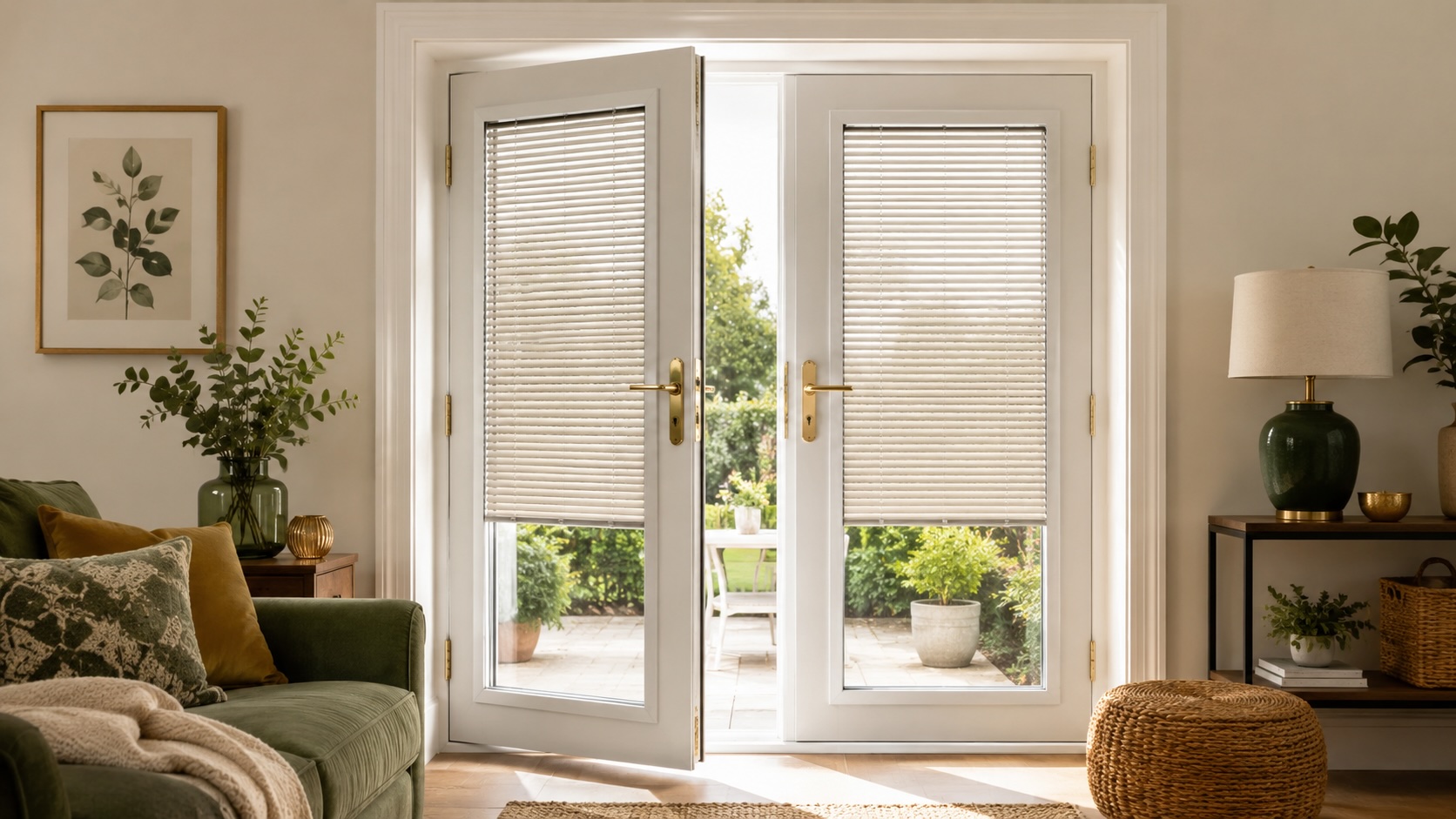
For many French doors, Perfect Fit blinds are one of the most practical options because they are designed to sit neatly within a frame that fits to the glazed section of the door. Instead of hanging freely in front of the whole opening, the blind becomes part of each individual door leaf.
This matters because French doors move. When the door opens, a standard free-hanging blind may swing, shift or need to be moved out of the way. A Perfect Fit blind stays with the door, which makes it a strong choice for doors that are used regularly as access to a garden, patio or conservatory.
Why Perfect Fit Blinds Work Well on French Doors
The main advantage of Perfect Fit blinds is that they are door-specific rather than opening-specific. Each blind is fitted to the glazed area of its own door panel, so the blind moves with the door when it opens and closes. This is important because French doors are not static windows. They are handled, locked, opened and walked through, so any blind fitted to them has to cope with regular movement.
Perfect Fit blinds can solve several common French door problems. Because the blind is held within its own frame, it is less likely to swing around when the door is opened or closed. This makes it more controlled than a standard free-hanging blind, particularly on doors that are used frequently or where airflow from an open doorway might otherwise cause the blind to move.
They also create a neater appearance because the blind sits close to the glass rather than projecting into the room. This can be particularly useful on French doors, where bulky fittings can make the doors feel cluttered or interfere with the clean lines of the frame. A close-fitting blind helps preserve the shape of each glazed panel while still providing privacy, shading or light control.
Another benefit is independent control. Each French door leaf can have its own blind, which is useful if one door is used more often than the other. For example, if one side is opened regularly for access to the garden while the other remains closed, the blinds can still be managed separately. This is more practical than one large blind covering the whole opening, which may need to be raised every time the doors are used.
Perfect Fit blinds also avoid the need to cover the full doorway. Instead of treating the French doors as one large opening, they treat each glazed panel individually. This is useful where the priority is privacy at the glass rather than a full decorative treatment across the wall. It can also help keep the surrounding area clearer, especially where there is limited space above or beside the doors.
When Perfect Fit Blinds Are Most Suitable
Perfect Fit blinds are usually most suitable where the doors have a compatible glazed area and enough clearance around the handles. They work especially well on French doors where the main priority is a clean, practical finish rather than a full-room fabric treatment.
They are often worth considering for uPVC French doors with suitable glazing beads, doors that are used frequently throughout the day, and rooms where each door panel needs to be controlled separately. They can also be a good option where a free-hanging blind would be likely to swing, catch or feel inconvenient during daily use.
For example, if your French doors are the main route into the garden, a blind that moves with each door leaf is usually more practical than a wider blind fitted above the whole opening. It allows the doors to remain usable while still giving control over privacy and light.
Fabric and Style Options for Perfect Fit French Door Blinds
Perfect Fit is a fitting system, not one single blind fabric. This means the frame helps the blind work properly with the door, while the chosen blind style or fabric determines how the product performs in the room.
A roller-style Perfect Fit blind can be a good option where you want a simple fabric finish with privacy, dimout or blackout performance. This is useful in bedrooms, guest rooms or living spaces where the doors need to feel neat and uncluttered.
A Venetian-style Perfect Fit blind may be better where adjustable privacy is the priority. Because the slats can tilt, you can reduce visibility from outside without fully raising the blind. This can be especially useful for French doors that face a neighbouring garden, street or overlooked patio.
A pleated or thermal-style option, where available, may be worth considering for rooms where comfort around the glass is important. French doors often include a large glazed area, so adding a close-fitting layer at the glass can help the room feel more comfortable, particularly in spaces affected by glare, heat gain or heat loss.
The important distinction is that the fitting system and fabric choice solve different problems. The Perfect Fit frame helps the blind stay secure and move with the door. The fabric or blind style then determines whether the blind is best for privacy, glare reduction, stronger shading or thermal comfort.
Limitations to Check Before Choosing Perfect Fit Blinds
Perfect Fit blinds are practical, but they are not automatically suitable for every French door. Compatibility depends on the door design, especially the glazing bead, frame depth and handle position.
The glazing bead needs to be suitable for the frame to fit correctly. If the bead is too shallow, unusually shaped or not compatible with the system, the blind may not sit securely. This is why it is important to check the product measuring guidance carefully before ordering.
Handle clearance is also essential. French door handles often sit close to the glazed area, and the Perfect Fit frame must not obstruct the handle, lock or any other operating parts. If the frame sits too close to the handle, the door may become awkward to use, even if the blind itself fits the glass.
You should also check that the doors can still open fully once the blinds are fitted. This is especially important where the doors open back against a wall, furniture or another fixed surface. Even a relatively slim frame adds some depth to the door, so the full opening movement should be considered before choosing this type of blind.
Older doors, aluminium systems, unusually shaped frames and doors with very shallow glazing beads may need extra care. In those cases, another blind type may be more practical than trying to force a Perfect Fit system onto a door that is not well suited to it.
Expert View
Perfect Fit blinds are often one of the best options for French doors because they address the main technical challenge: the blind needs to work with a moving door. By fitting close to the glass and moving with each door leaf, they reduce many of the problems associated with free-hanging blinds.
However, they should still be chosen based on compatibility, not assumption. If the glazing bead, handle clearance and frame depth are suitable, Perfect Fit blinds can provide one of the neatest and most usable solutions for French doors. If those details are not suitable, it is better to consider another fitting method than choose a product that may become awkward in daily use.
No Drill Blinds for French Doors
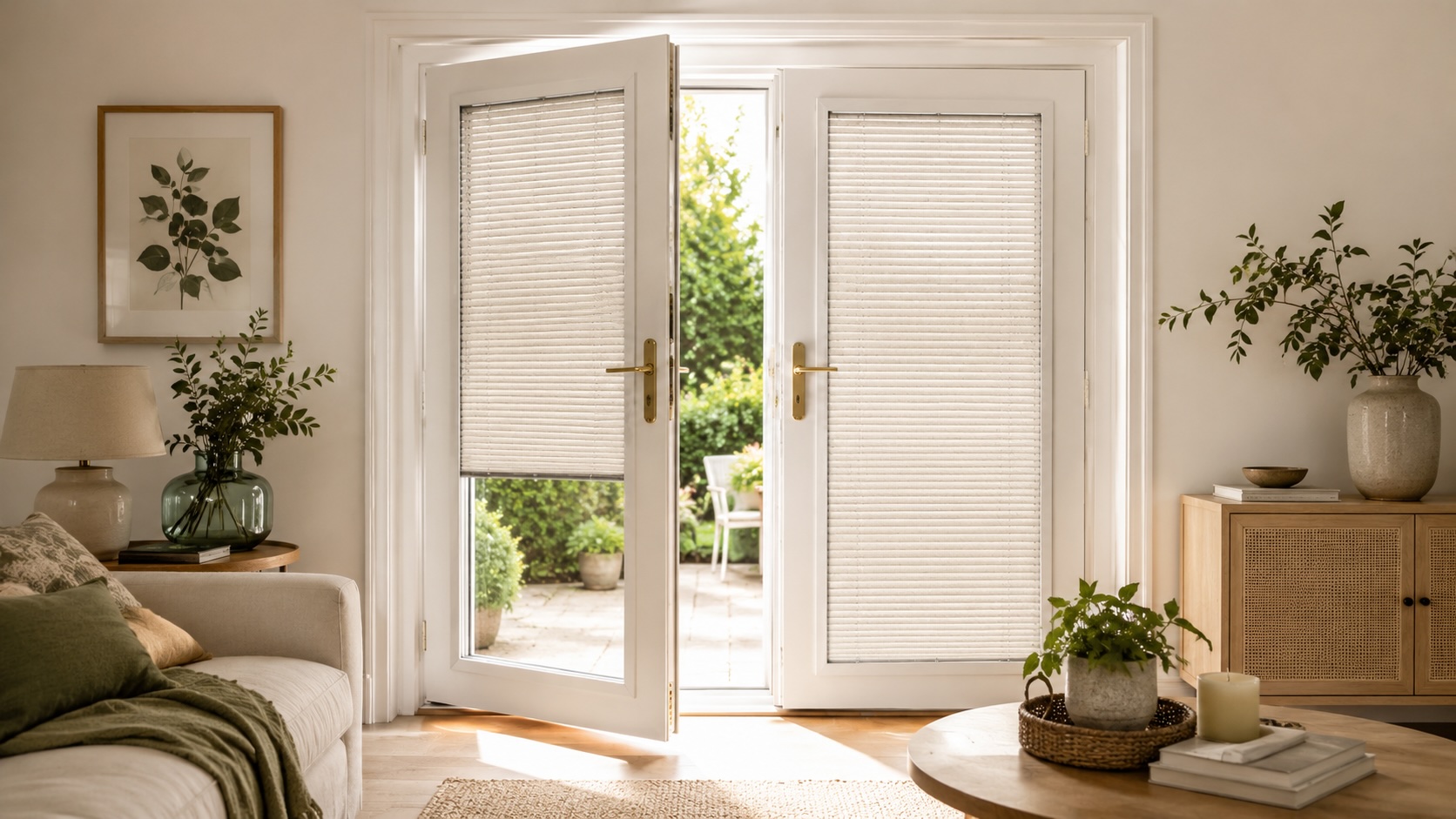
No drill blinds are often a sensible option for French doors because they reduce the need to fix directly into the door frame, surrounding wall or uPVC profile. This is particularly useful where the doors are new, where the frame material is difficult to drill cleanly, or where the homeowner wants a neater fitting method with less disruption.
For French doors, the appeal is not just the lack of drilling. The bigger benefit is that many no drill systems are designed to sit neatly around or close to the glazed area, helping the blind feel more integrated with the door. This matters because French doors are moving parts of the room, so a blind that sits securely and does not swing freely is usually more practical than one that behaves like a standard window blind.
No drill blinds can work especially well where the doors are used regularly, where the frame is suitable, and where the blind needs to look tidy from both inside the room and through the glass from outside.
Why No Drill Blinds Work Well on French Doors
The main reason no drill blinds work well on French doors is that they can provide a more door-friendly fitting method. Instead of relying on screws fixed into the surrounding wall or door frame, compatible no drill systems are designed to hold the blind in place using alternative fitting methods, depending on the product type.
This is useful on uPVC French doors because many homeowners do not want to drill into the frame. Drilling can be unattractive, difficult to reverse and may not be desirable on newer doors. A no drill blind can avoid visible screw holes while still giving the door a more finished and practical window dressing.
No drill blinds can also be useful in rented homes, provided the product is suitable and the tenant follows any relevant tenancy requirements. In these situations, a less permanent fitting method can be preferable to making holes in the frame or surrounding wall.
From a usability point of view, the best no drill solutions for French doors are those that stay close to the door and remain stable when the door moves. If a blind is fitted securely to the individual door leaf, it is less likely to swing, knock against the glass or need to be moved out of the way every time the door is opened.
No Drill Does Not Mean Universal Fit
It is important to be precise here: “no drill” describes the fitting method, not a guarantee that the blind will suit every French door. Compatibility still depends on the door design, the frame profile, the glazing bead, the rubber seal, the available space around the glass and the handle position.
This is where many buying mistakes happen. A customer may assume that because a blind is no drill, it will automatically work on any uPVC door. In practice, the fitting method still needs something suitable to grip, clip, hold or attach to. If the frame shape is not compatible, or if the handle sits too close to the glazed area, the blind may not fit correctly.
The surface condition can also matter. Some no drill systems depend on a stable, clean and suitable surface. If the door frame is uneven, textured, damaged or difficult for the system to hold onto, the final result may not be as secure as expected.
This does not make no drill blinds unsuitable. It simply means they need to be chosen with the same care as any other French door blind.
When No Drill Blinds Are Most Suitable
No drill blinds are usually most suitable when the homeowner wants a clean finish without making permanent fixing holes, and when the door frame is compatible with the chosen system. They are especially useful for modern uPVC French doors, newly installed doors, rental properties and rooms where the doors are used often enough that a secure, door-level blind is preferable.
They can also be a good option where the surrounding wall space is limited. If there is not enough room above or beside the doors for a traditional blind or curtain treatment, a no drill option fitted closer to the glazed panel can be much more practical.
In rooms such as kitchens, dining areas and garden-facing living rooms, no drill blinds can help keep the overall look clean and functional. They allow the French doors to remain usable while still improving privacy, glare control or shading.
No Drill Blinds and Door Handles
Handle clearance is one of the most important checks with no drill blinds. French door handles often project into the area where the blind frame, cassette, side profile or operating mechanism may sit. Even if the blind itself fits the glass, it still needs to leave enough space for the handle to turn and the door to lock properly.
A well-chosen no drill blind should not make the door feel awkward to use. If the handle rubs against the blind, if the locking mechanism becomes harder to operate, or if the blind frame sits too close to the handle, the product may not be the right fit for that particular door.
This is especially important on pairs of French doors where one door is used as the main access leaf. The blind on that door will need to cope with more frequent handling, so clearance and stability matter even more.
Choosing the Right No Drill Blind for the Room
The best no drill blind for a French door depends on what the room needs.
For privacy, a blind that sits close to the glass can be very effective because it covers the glazed area without needing a full-width treatment across the wall. This is useful for overlooked gardens, patio doors and rooms facing neighbouring properties.
For light control, the fabric or blind style becomes more important. A light filtering or dimout fabric can soften daylight in a living room or dining area, while a blackout fabric is more suitable where the French doors are in a bedroom or guest room. If the room is affected by heat loss, draughts or strong sunlight, a thermal option may be worth considering where compatible.
For style, no drill blinds can be a good choice when you want the doors to look neat rather than heavily dressed. They usually create a more minimal finish than curtains and can help preserve the clean lines of the doors.
Expert View
No drill blinds can be an excellent choice for French doors, but they should be treated as a compatibility-led solution rather than a shortcut. Their main strength is that they can provide a neat, practical fitting method without drilling into the door or frame, which is particularly useful on suitable uPVC French doors.
The key is to check the frame, glazing bead, handle clearance and product guidance before deciding. When the door is compatible, no drill blinds can offer a clean, secure and practical result. When the door is not compatible, a different blind type or a room-level solution such as curtains may be more reliable.
Click Fit, Stick Fit and Twist and Fit Blinds for French Doors
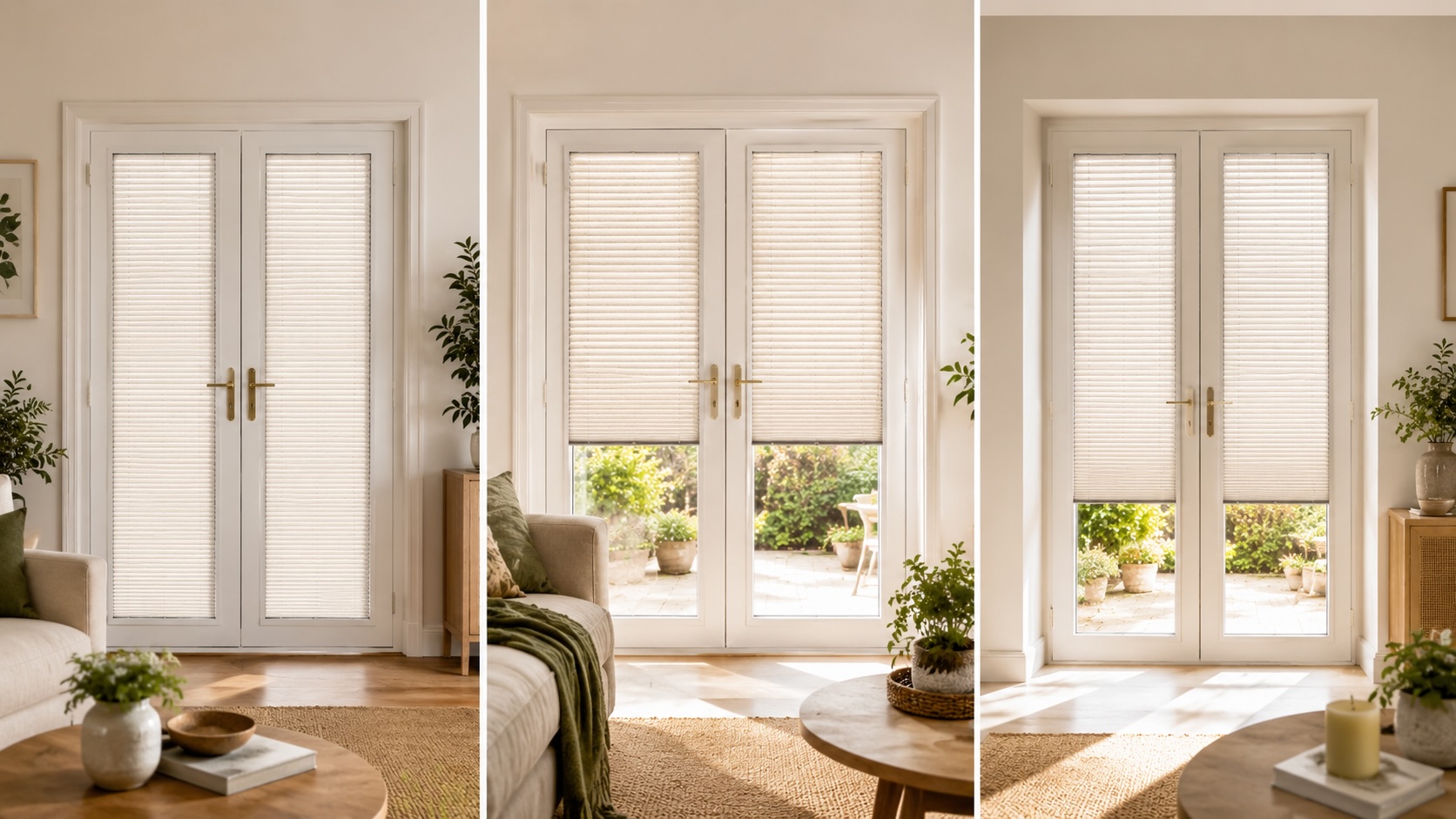
Not all no-drill blinds use the same fitting method, and this distinction matters when choosing blinds for French doors. A product may be described as easy-fit or no-drill, but the way it attaches to the door, frame or surrounding recess can vary significantly. For French doors, the fitting method should be judged by whether it suits the door construction, clears the handle and remains stable when the door is opened and closed.
DotcomBlinds offers several fitting styles, including Click Fit, Stick Fit and Twist and Fit blinds. Each can be useful in the right setting, but they should not be treated as interchangeable. French doors have moving panels, handles, locks and glazed sections, so the best fitting method is the one that works with those physical details rather than simply the one that sounds easiest to install.
Click Fit Blinds for French Doors
Click Fit blinds are designed to provide a neat, simple fitting method without traditional drilling, where the door or window is compatible. On suitable French doors, this can be useful because the blind can sit more closely to the glazed area rather than projecting far into the room.
The practical benefit is control. A blind that sits close to the door is less likely to feel loose, bulky or awkward during everyday use. This is particularly important if the French doors are used as a regular route into the garden or patio. The less the blind projects from the door, the less likely it is to interfere with movement around the doorway.
Click Fit blinds can also suit customers who want a clean finish on uPVC or modern glazed doors. They avoid the look of a more traditional blind bracket fitted into the surrounding wall, and they can make the door feel more streamlined.
However, compatibility is still essential. The door must have the right frame or glazing arrangement for the system to fit correctly. Handle projection also needs to be checked carefully. If the blind sits too close to the handle, it may make the door awkward to lock, unlock or open fully. For this reason, Click Fit blinds should be considered a strong option only when the door measurements and product guidance confirm suitability.
Stick Fit Blinds for French Doors
Stick Fit blinds use an adhesive-based fitting method, which can be useful where drilling is not suitable or where a less permanent installation is preferred. For French doors, this can be appealing because it avoids fixing holes and can create a tidy, discreet appearance.
The main advantage of a Stick Fit system is that it can work where the surface is suitable, clean and stable. This makes preparation important. The area where the blind attaches must be in good condition, free from dust, grease or texture issues, and suitable for the adhesive method used by the product. If the surface is not right, the blind may not perform as intended.
On French doors, this matters because the door is used regularly. The blind is not sitting on a static wall; it is attached to a moving surface. That means the fixing method needs to cope with the natural movement of the door, repeated opening and closing, and changes in temperature near the glass.
Stick Fit blinds can be a useful option for lighter-duty situations, decorative rooms or doors where the blind is not likely to be knocked, pulled or handled heavily. They may be less suitable where the doors are used constantly, where the surface is uneven, or where the blind needs to withstand frequent movement.
Twist and Fit Blinds for French Doors
Twist and Fit blinds are designed around a tension-style or pressure-fit approach, usually where there is a suitable recess or surrounding structure for the blind to sit within. For standard windows, this can be a very useful no-drill solution. For French doors, it needs to be considered more carefully.
The reason is simple: many French doors do not provide the same type of fixed recess that a standard window does. The glazed part of the door moves, and the surrounding opening may need to remain clear so the doors can open properly. If there is no suitable recess or stable area for the blind to tension into, a Twist and Fit blind may not be the right choice for the doors themselves.
That does not mean Twist and Fit blinds have no role near French doors. In some layouts, there may be a surrounding recess or opening where a tension-fit blind can be used above or around the door area. However, this should be assessed carefully because the blind must not block access, interfere with the door swing or become inconvenient when the doors are in use.
For active French doors, a frame-fitted or door-level solution is often more practical than a recess-based fitting method. Twist and Fit may be better suited to nearby windows or specific openings where the structure supports the fitting method properly.
How to Choose Between These Fitting Types
The right choice depends on the door, not just the product name. If the blind needs to sit on the door and move with it, a system designed for the glazed panel or compatible door frame will usually be the strongest starting point. If the blind is being fitted into a surrounding recess, the opening must be stable, square and deep enough for the product to work correctly.
A useful way to approach the decision is to ask what the fitting method needs to achieve. If the main aim is to avoid drilling into uPVC French doors, Click Fit or another compatible no-drill door-level system may be most suitable. If the surface is appropriate and the blind is relatively light-duty, Stick Fit may be an option. If there is a proper recess and the blind will not obstruct the doors, Twist and Fit may be worth considering, but it is not usually the first solution for the moving door leaves themselves.
The practical checks are the same in each case: the blind must clear the handle, avoid the locking mechanism, remain stable when the door moves and allow the French doors to open as intended. If any of those points are uncertain, it is better to pause and check the measuring and fitting guidance than choose a product based only on convenience.
Expert View
Click Fit, Stick Fit and Twist and Fit blinds can all be useful, but they solve different fitting problems. For French doors, the most reliable choice is usually the one that stays close to the glazed panel, avoids drilling where needed and remains stable during door movement.
Click Fit blinds are often the most relevant of the three for compatible French doors because they can provide a neat, no-drill finish at door level. Stick Fit blinds can work where the surface and usage are suitable, but the adhesive method needs the right conditions. Twist and Fit blinds are valuable in the right recess, but they are not automatically suited to the moving panels of French doors.
The expert approach is to match the fitting system to the door structure first. Once the fitting method is suitable, the blind style, fabric and colour can be chosen with far more confidence.
Roller Blinds for French Doors
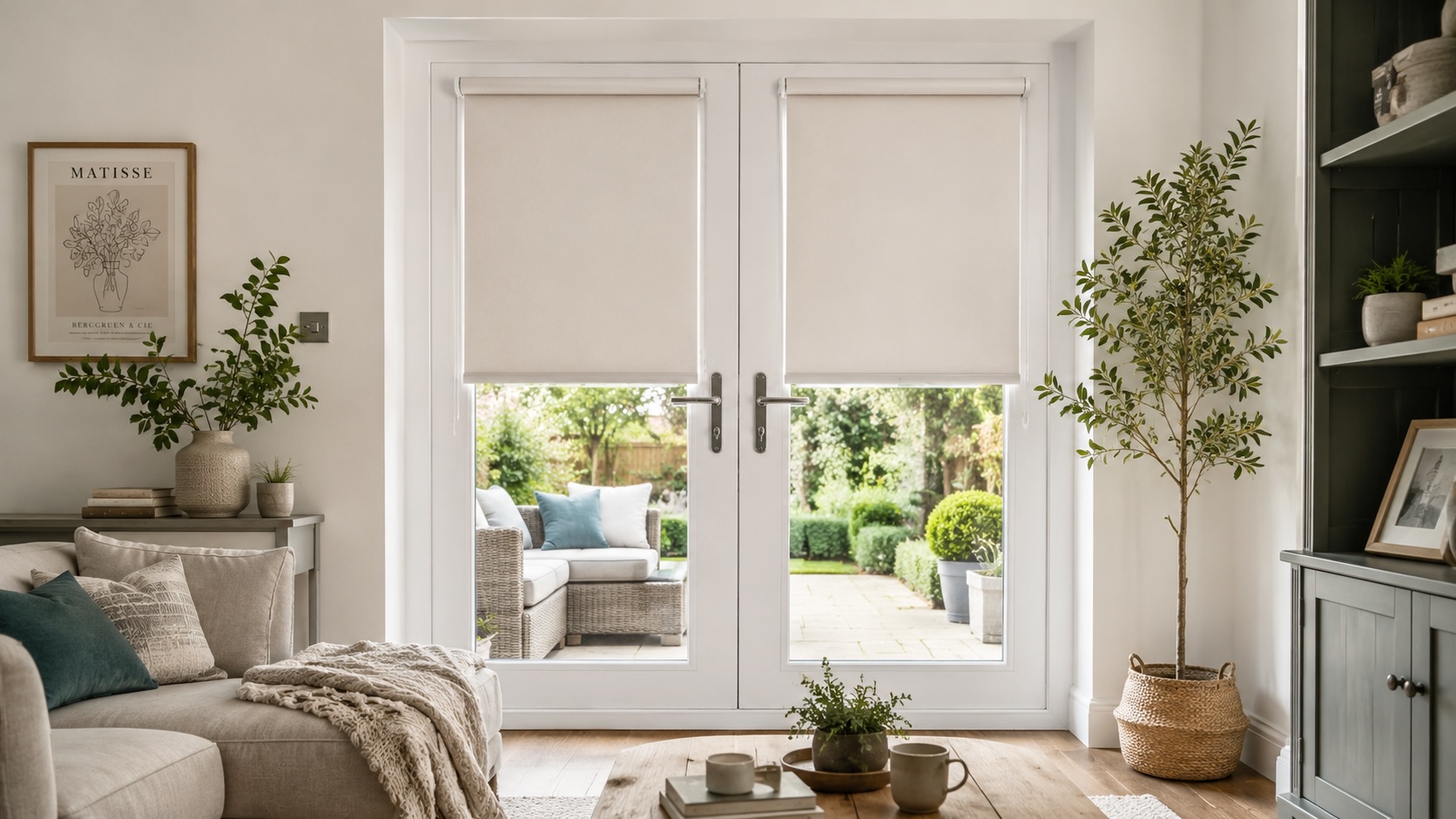
Roller blinds can work on French doors, but they need more careful planning than they would on a standard window. The appeal is clear: roller blinds are neat, simple, compact and available in a wide choice of fabrics, including light filtering, dimout, blackout, thermal and patterned designs. However, French doors move, and that movement changes how suitable a roller blind will be.
The key question is not simply whether a roller blind will cover the glass. It is whether the blind will remain practical when the door is opened, closed, locked and used every day. A roller blind can be a good solution in the right setting, but it can also become inconvenient if it swings, catches on the handle or blocks access through the doorway.
Why Roller Blinds Can Work on French Doors
Roller blinds are one of the most straightforward blind types. The fabric rolls neatly around a tube, so the blind has a relatively compact profile compared with fuller fabric styles. This can make roller blinds appealing for French doors where the aim is to add privacy or shading without making the door area feel too heavily dressed.
They also offer strong fabric flexibility. A light filtering roller blind can soften daylight in a living room or dining area, while a blackout roller blind may be more suitable for French doors in a bedroom or guest room. Thermal fabrics may be worth considering where the doors form a large glazed area and the room is affected by heat loss, glare or strong sunlight.
From a design point of view, roller blinds can also keep the overall look clean. This is useful in modern homes where the French doors already have a strong frame shape and the blind should not dominate the room. A plain roller blind can feel discreet, while a patterned fabric can make the doors more decorative without introducing the fullness of curtains.
The Main Limitation: Movement
The main limitation with roller blinds on French doors is movement. A standard roller blind is usually free-hanging, which means the fabric is not held tightly against the glass unless it is part of a guided or frame-fitted system. On a moving door, this can become an issue.
If a roller blind is fitted directly to a French door without suitable control or support, it may swing when the door opens. It may also move in a draught, tap against the glass or become awkward when someone walks through the doorway. This is especially noticeable on doors that are used frequently as access to a garden or patio.
If a roller blind is fitted above the full French door opening, the problem is different. It may look neat when the doors are closed, but when lowered it can block access through the doors. In that setup, the blind usually needs to be raised before the doors are opened, which may be inconvenient if the doors are used regularly.
This is why roller blinds are often better suited to French doors that are used occasionally, or to situations where the fitting method keeps the blind stable and clear of the handles.
Fitting Roller Blinds Above French Doors
A roller blind can sometimes be fitted above the full French door opening, especially where the doors sit within a wider recess or where the main goal is to shade the room rather than control each door panel independently.
This approach can work well when the French doors are mostly treated like a large glazed window. For example, in a dining room or occasional-use garden room, a single wider roller blind may provide simple privacy and shading when the doors are closed.
However, this setup has clear limitations. When the blind is lowered, the doors may not be usable without raising the blind first. The fabric may also sit in front of the handles or door opening, depending on the depth and position of the blind. If the doors are used several times a day, this can quickly become frustrating.
A full-opening roller blind should therefore only be chosen when it will not compromise normal access. It works best where the doors are not the main route in and out of the home, or where the blind is mainly lowered in the evening after the doors are no longer being used.
Fitting Roller Blinds to Each Door Leaf
Another option is to fit a roller blind to each individual door leaf. In principle, this gives better door-level control because each pane of glass has its own blind. It can also avoid the issue of one large blind blocking the full opening.
However, this approach depends heavily on the door design. There must be enough space for the blind brackets, tube, fabric roll and control mechanism without obstructing the handle, lock or hinges. The blind also needs to sit securely enough that it does not swing excessively when the door moves.
For this reason, door-mounted roller blinds need careful measuring. They are more likely to work where the door has suitable flat fixing space, good handle clearance and is not opened constantly throughout the day. Where the doors are high-use, a frame-fitted option is often more stable and practical.
When Roller Blinds Are Most Suitable for French Doors
Roller blinds are most suitable for French doors when the doors are not the main high-traffic access point, or when the fitting arrangement keeps the blind stable and easy to use. They can also work well where the customer wants a simple fabric finish rather than a more structured or framed blind.
They are worth considering when the priority is:
- A clean, minimal appearance
- A wide choice of fabric colours and patterns
- Privacy or shading when the doors are closed
- A simple blind for occasional-use French doors
- Blackout, dimout or thermal fabric performance
- A lower-profile alternative to curtains
In a bedroom, a blackout roller blind can be useful where stronger light reduction is needed, but the fitting must be planned carefully because edge gaps and door movement can affect the final result. In a living room or dining room, a dimout or light filtering roller blind may be enough to soften daylight and improve privacy without making the space feel too enclosed.
When Roller Blinds May Not Be the Best Choice
Roller blinds may be less suitable where the French doors are used constantly, where the handles sit close to the glass, or where there is not enough fixing space on each door leaf. They may also be awkward if the doors open inward and the blind projects into the room, especially if the door opens back against a wall or furniture.
A standard free-hanging roller blind can also feel less controlled than a frame-fitted blind. If the main concern is movement, swinging or daily access, Perfect Fit or compatible no-drill systems are usually a stronger starting point.
This does not mean roller blinds should be avoided altogether. It means they should be chosen for the right type of French door and the right pattern of use.
Expert View
Roller blinds can be a good choice for French doors where simplicity, fabric choice and compact styling are the priorities. They are especially useful in rooms where the doors are used occasionally, or where the blind is mainly needed for privacy and shading when the doors are closed.
However, roller blinds are not automatically the most practical choice for frequently used French doors. The fitting position, handle clearance, door swing and level of daily use all need to be checked before ordering. If the blind can sit securely, operate easily and avoid obstructing the door, a roller blind can work well. If movement and access are the main concerns, a frame-fitted blind will often be the more practical solution.
Venetian Blinds for French Doors
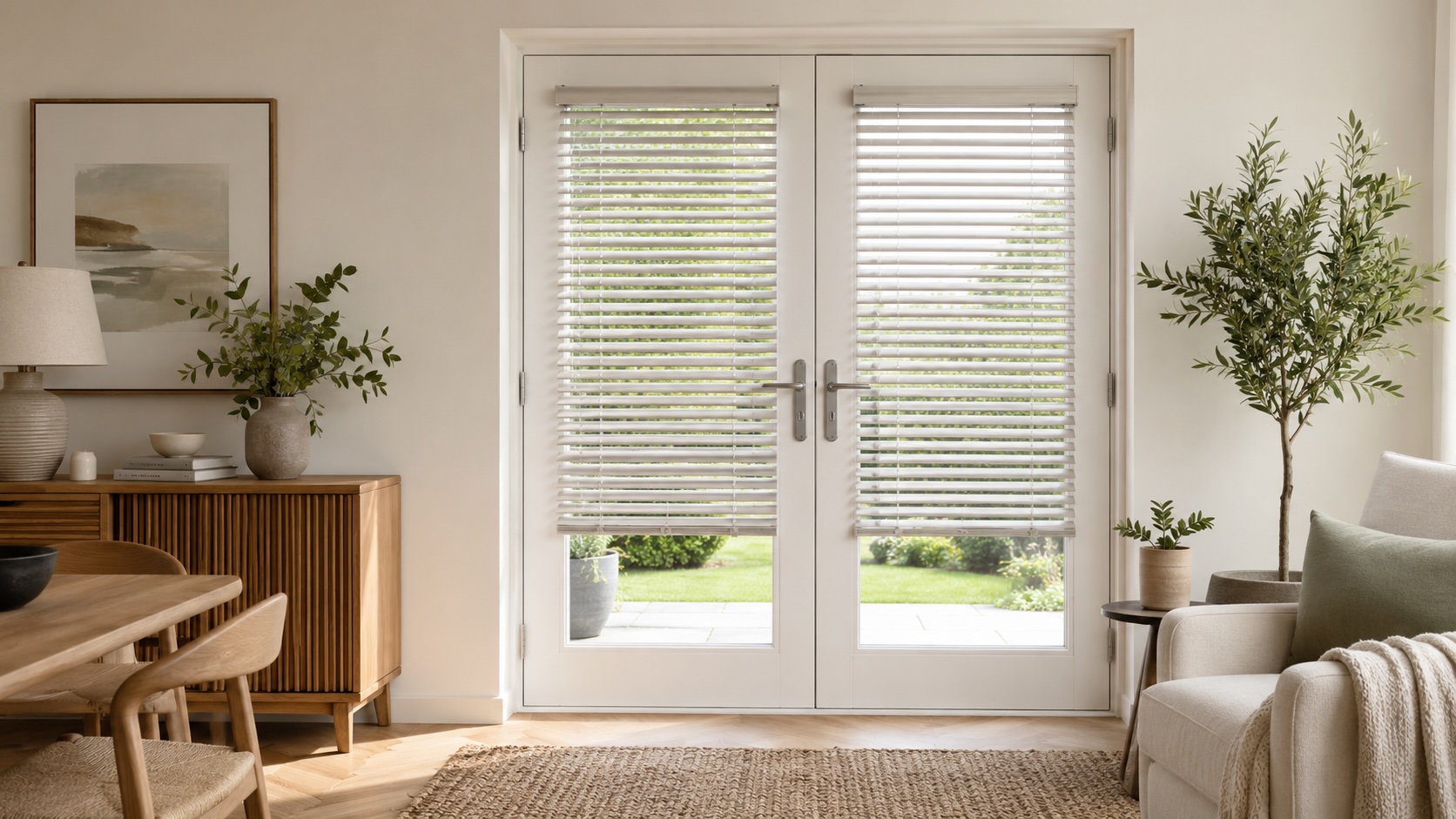
Venetian blinds can be a good option for French doors when privacy control is the main priority. Unlike a standard fabric blind, which is usually either raised, lowered or partly lowered, Venetian blinds use horizontal slats that can be tilted. This gives more precise control over how much light enters the room and how much can be seen from outside.
That makes Venetian blinds particularly useful for French doors that are overlooked by neighbouring gardens, footpaths, patios or nearby homes. They allow you to obscure the view into the room without necessarily blocking all daylight. However, because French doors move, Venetian blinds need to be chosen and fitted carefully. Slats, controls, brackets and handle clearance all affect whether the blind will feel practical in daily use.
Why Venetian Blinds Can Work on French Doors
The main advantage of Venetian blinds is adjustable privacy. By tilting the slats, you can reduce direct visibility into the room while still allowing natural light through. This is useful on French doors because the glazed area is often large and can leave a living room, kitchen or dining space feeling exposed.
Venetian blinds are also useful where the light changes throughout the day. For example, if the doors face a bright garden or receive low afternoon sun, the slats can be angled to reduce glare without making the whole room dark. This gives them a level of flexibility that a standard roller blind does not provide in quite the same way.
They can also suit more practical rooms. Metal Venetian blinds, in particular, can work well in kitchens, utility rooms and contemporary spaces because they have a clean, structured look and are easier to wipe than many fabric-based alternatives. Where French doors are close to cooking areas, sinks or high-use family spaces, this can be an important practical advantage.
The Practical Challenge: Slat Movement
The main issue with Venetian blinds on French doors is that the slats can move when the door is used. If the blind is free-hanging and the door opens or closes frequently, the slats may rattle, swing or tap against the glass. This can make the blind feel less stable than a frame-fitted option.
This is less of a concern on doors that are used occasionally, or where the blind is fitted in a way that keeps it controlled. It becomes more important where the French doors are a main access route to the garden. In that situation, any blind fitted to the door needs to be stable enough to cope with regular movement.
Weight is another consideration. Venetian blinds can be heavier than some simple fabric blinds, especially in wider sizes or heavier materials. On French doors, this matters because the blind may be attached to a moving surface. The door, frame and fitting method must all be suitable for the weight and operation of the blind.
Handle and Control Clearance
Venetian blinds need careful planning around handles and controls. French door handles can sit close to the glass, and the blind must not stop the handle from turning or interfere with the locking mechanism.
The slat stack also needs to be considered. When a Venetian blind is raised, the slats gather at the top. If there is limited space above the glazed section, the stack may reduce the visible glass area or sit awkwardly near the top of the door. This is not always a problem, but it should be understood before choosing the blind.
Control position is equally important. The tilt and lift controls should be easy to reach, but they should not hang where they can catch on the handle, get trapped between the doors or interfere with people walking through the doorway. On high-use doors, a neat and safe control arrangement is especially important.
When Venetian Blinds Are Most Suitable for French Doors
Venetian blinds are most suitable when the room needs flexible privacy and light control, and the doors have enough clearance for the blind to operate comfortably. They can be a strong choice for:
- Overlooked French doors
- Living rooms and dining rooms where privacy changes throughout the day
- Kitchens and utility rooms, especially with metal Venetian blinds
- Contemporary interiors where a structured finish is preferred
- Doors that are used moderately rather than constantly
They are particularly useful when you want to maintain daylight while reducing direct views into the home. For example, in a living room facing a neighbouring garden, the slats can be tilted during the day to create privacy without fully closing the room off from natural light.
When Venetian Blinds May Not Be the Best Choice
Venetian blinds may be less suitable for very high-use French doors, especially if the blind is likely to move, rattle or be knocked regularly. They may also be awkward where handles are close to the glass, where the door opens back tightly against a wall, or where there is limited space for the slat stack.
They are not usually the softest decorative option either. If the aim is to create a relaxed, fabric-led finish, curtains or Roman-style treatments may be more appropriate. If the priority is a blind that moves neatly with the door and remains stable, Perfect Fit or another compatible frame-fitted option may be a better starting point.
Expert View
Venetian blinds can work well on French doors when privacy control is the main requirement. Their tilting slats make them particularly useful for overlooked rooms, because they allow you to adjust visibility and daylight without fully raising or lowering the blind.
The trade-off is physical practicality. Slat movement, blind weight, handle clearance and control position all need to be checked carefully. If the doors have enough clearance and are not used constantly, Venetian blinds can be a strong and flexible choice. If the doors are high-use or the blind would sit too close to the handle, a more integrated or frame-fitted blind is usually more practical.
Day & Night Blinds for French Doors
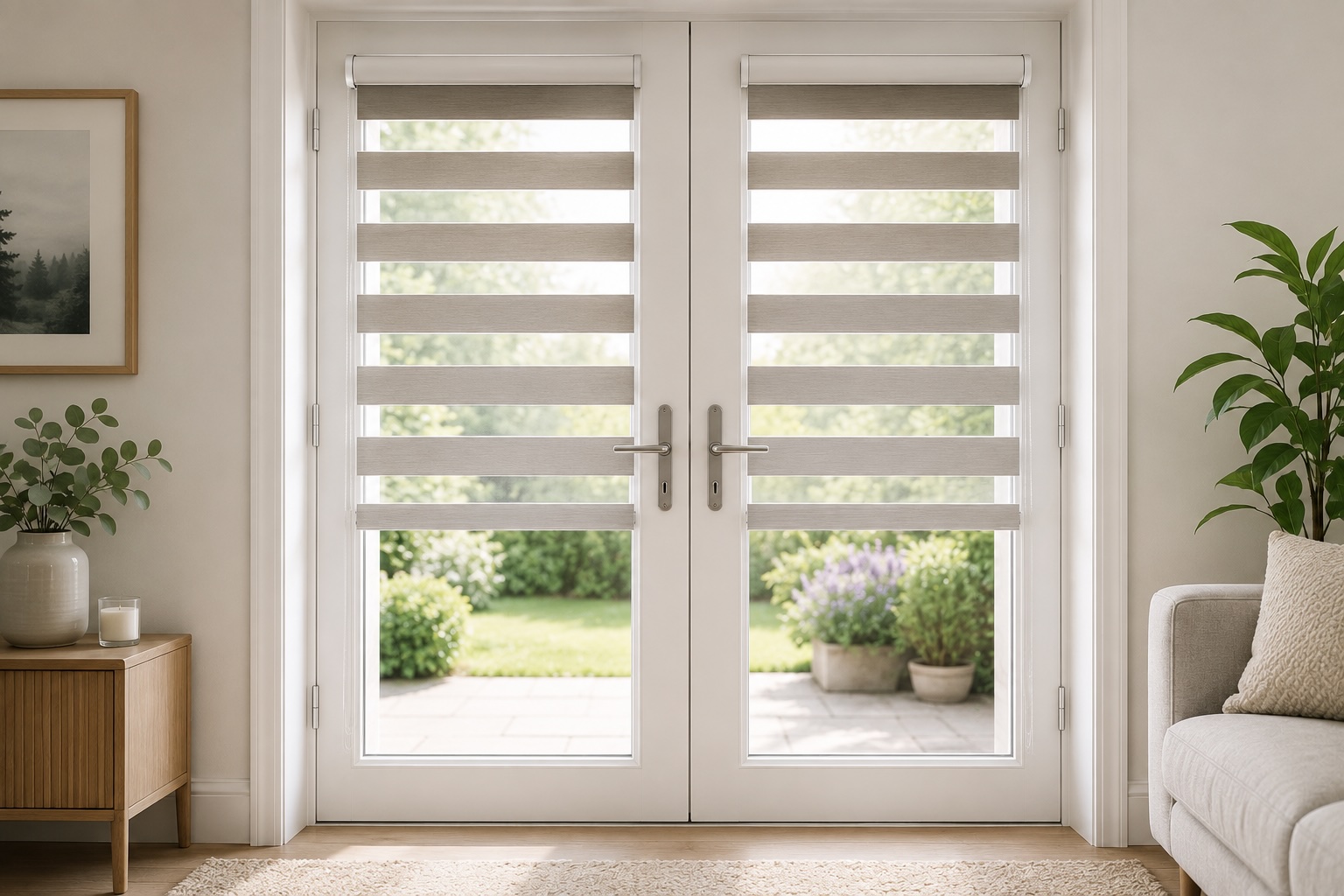
Day & Night blinds can be a useful option for French doors when the room needs flexible privacy without losing all natural light. They use alternating sheer and opaque fabric bands, which can be adjusted to create different levels of visibility, shading and privacy throughout the day.
This makes them particularly relevant for French doors in living rooms, dining rooms, garden rooms and overlooked spaces. They offer more privacy flexibility than a standard roller blind, but with a softer fabric look than Venetian blinds. However, as with any blind for French doors, the fitting position matters. The blind still needs to work with the handles, the door swing and the way the doors are used.
Why Day & Night Blinds Can Work on French Doors
The main strength of Day & Night blinds is adjustable fabric control. When the sheer and opaque bands are aligned, the blind allows filtered daylight through. When the opaque bands overlap, the blind gives more privacy and stronger shading.
This is useful on French doors because the amount of privacy needed often changes during the day. In the morning, you may want daylight while reducing glare. During the evening, when the room is lit from inside, you may want more privacy from outside. Day & Night blinds allow this adjustment without needing the blind to be fully raised or fully lowered every time.
They can also suit modern interiors because they have a clean, layered appearance. Compared with curtains, they feel more compact. Compared with Venetian blinds, they offer a softer fabric finish. For homeowners who want privacy control but do not want the harder look of slats, Day & Night blinds can be a good middle ground.
The Practical Challenge: Cassette, Roll Size and Door Movement
Day & Night blinds need more space than some simple roller blinds because the fabric is doubled and often operates with a cassette or larger roll mechanism. On French doors, this means clearance must be checked carefully.
If the blind is fitted above the whole French door opening, it may work well when the doors are closed, but it can block access when lowered. In that setup, the blind may need to be raised before the doors are opened. This may be acceptable if the doors are used occasionally, but it can become inconvenient where the French doors are a main access route.
If a Day & Night blind is fitted to each door leaf, the blind must sit securely enough to cope with movement. The cassette, fabric roll and controls must also clear the handle, locks and any surrounding frame details. If these details are not checked, the blind may look suitable in theory but feel awkward in daily use.
When Day & Night Blinds Are Most Suitable for French Doors
Day & Night blinds are most suitable where privacy and daylight control are both important, but where full blackout is not the main requirement. They work especially well in rooms where the French doors are overlooked but still need to feel bright and open during the day.
They can be worth considering for living rooms, dining rooms, garden rooms and home offices, particularly where the doors face neighbouring properties, shared gardens, patios or footpaths. In these settings, the ability to filter views without fully closing off the room can be very useful.
They are usually better suited to French doors that are used moderately rather than constantly. If the doors are opened and closed throughout the day, a frame-fitted blind that moves more closely with the door may be more practical.
When Day & Night Blinds May Not Be the Best Choice
Day & Night blinds may not be the best choice where the French doors are used as a very high-traffic access point, especially if the blind would be free-hanging. Like roller blinds, they can move when the door opens, and the extra fabric layers or cassette can make clearance more important.
They are also not usually the strongest option for bedrooms where darkness is the main priority. Although the opaque bands can provide privacy and shading, Day & Night blinds are generally chosen for flexible light control rather than maximum room darkening. If the French doors are in a bedroom, a blackout blind or lined curtain may be more suitable.
In rooms where the doors open inward and sit close to walls, furniture or radiators, projection should also be checked. The blind must not prevent the doors from opening comfortably or create an obstruction in the walking route.
Day & Night Blinds Compared with Roller and Venetian Blinds
Day & Night blinds sit between roller blinds and Venetian blinds in terms of how they perform. A standard roller blind gives a simple fabric panel, but less flexible privacy control. A Venetian blind gives very precise slat adjustment, but has a more structured look and may rattle or move on active doors. A Day & Night blind provides adjustable privacy through fabric bands, giving a softer appearance than slats while still allowing more control than a basic roller blind.
This makes them a good choice where the room needs a balance of privacy, filtered light and a contemporary fabric finish. They are less suitable where the main concerns are maximum blackout, heavy daily door use or very limited clearance around the handles.
Expert View
Day & Night blinds can be a strong option for French doors where privacy needs change throughout the day. They are particularly useful for living rooms and dining spaces that need filtered daylight, reduced visibility and a softer alternative to Venetian slats.
The main point to check is practicality. The cassette, fabric roll, control position and fitting method must all work with the door’s handles and movement. If the doors are used occasionally or moderately, Day & Night blinds can provide an effective balance of privacy and light control. If the doors are used constantly, a more integrated frame-fitted option is likely to be more practical.
Thermal Blinds and Blackout Blinds for French Doors
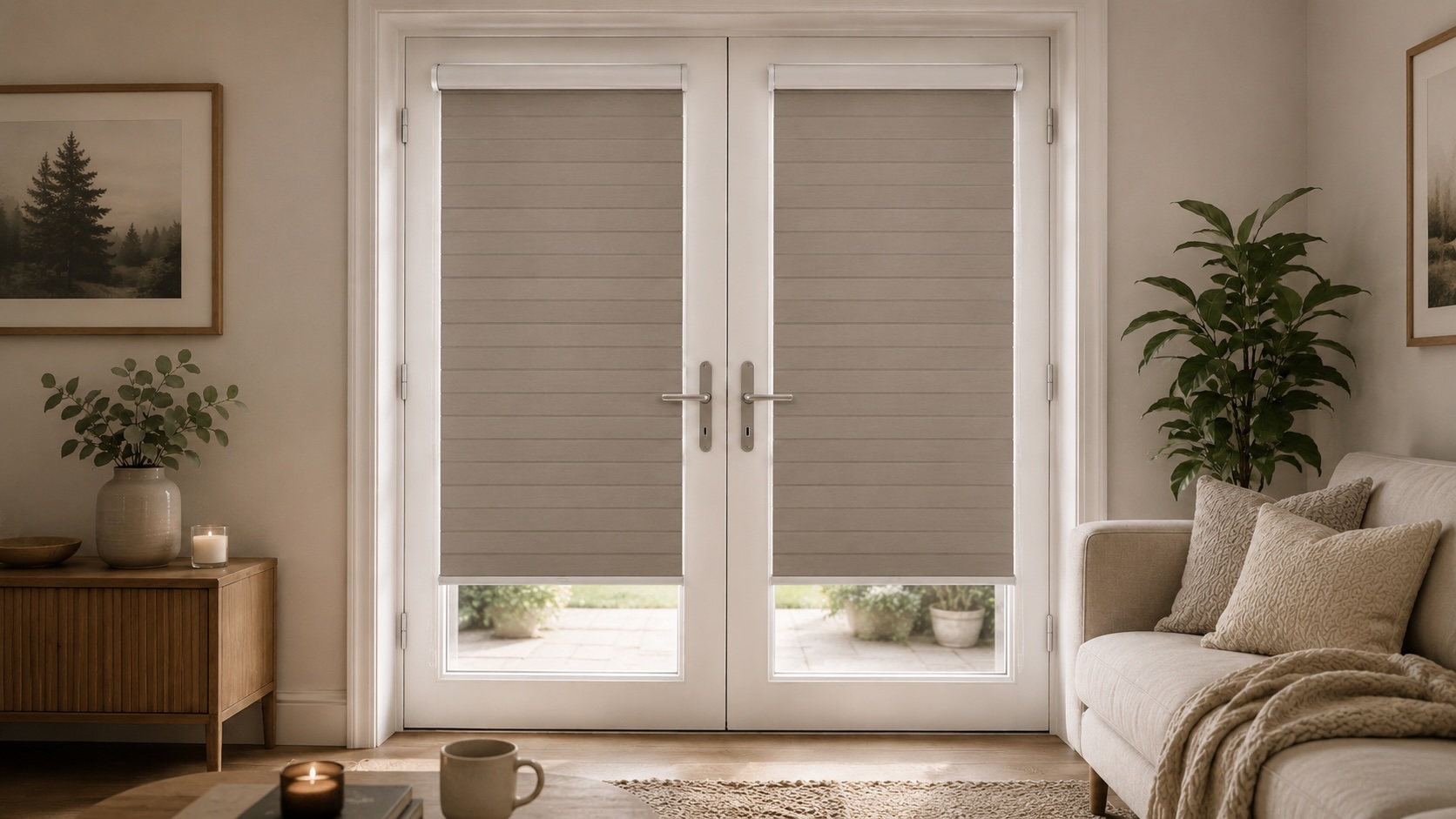
When choosing blinds for French doors, it is useful to separate the blind type from the fabric performance. Terms such as thermal and blackout do not describe one single style of blind. They describe what the blind or lining is designed to help with.
This matters because French doors often contain a large area of glass. That glass can make a room feel bright and open, but it can also create practical issues such as glare, heat loss, heat gain, reduced privacy or too much light in the evening. The right fabric or lining can make the door treatment more useful, provided the blind itself is also suitable for the door.
A thermal blind may be worth considering where comfort around the glazed area is important. A blackout blind is usually more relevant where stronger light reduction and privacy are needed. In some rooms, both may matter.
When to Choose Thermal Blinds for French Doors
Thermal blinds can be useful on French doors because glazed doors can affect how comfortable a room feels. In winter, large glazed areas can feel cooler than surrounding walls. In summer, strong sunlight through French doors can make a room feel warmer or brighter than intended.
A thermal blind adds a practical layer at the glass. It will not replace good glazing, heating, insulation or ventilation, but it can help make the window dressing work harder than a standard decorative blind. This can be particularly useful in older homes, north-facing rooms, garden rooms, conservatories and living spaces where the French doors form a large part of the external wall.
Thermal options are especially worth considering when the French doors are in a room used for long periods of the day. For example, a living room with French doors may benefit from a blind that helps soften glare during the day and adds a more comfortable layer in the evening. A bedroom with glazed doors may benefit from thermal blackout curtains or blinds where both comfort and shading matter.
The fitting style is important. A thermal fabric will usually perform best when it sits close to the glazed area or covers the opening well. Large gaps around the blind may reduce the practical benefit, particularly if cold air or strong sunlight can still pass easily around the edges.
When to Choose Blackout Blinds for French Doors
Blackout blinds are most useful when the room needs stronger shading. This is often the case when French doors are used in bedrooms, guest rooms, children’s rooms or media rooms. In these spaces, a standard light filtering blind may provide privacy, but it may not reduce incoming light enough for the way the room is used.
A blackout fabric can help reduce daylight passing through the blind itself. This makes it a practical choice where sleep, privacy or screen visibility is important. For example, French doors in a bedroom may look attractive during the day, but without the right window dressing they can allow too much early morning light into the room.
It is important, however, to understand the difference between blackout fabric and a fully darkened room. A blind may use blackout material, but some light can still appear around the edges depending on how it is fitted. This is especially relevant on French doors, where handles, frames, gaps and door movement can affect the final result.
For the best blackout effect, the blind should be measured carefully and fitted in a way that reduces unnecessary gaps. Curtains with blackout or thermal blackout lining may also be worth considering where the aim is to cover the full door opening more generously.
Thermal Blackout Options
In some rooms, thermal and blackout performance are both useful. A thermal blackout option is usually most relevant where French doors are in a bedroom, guest room or living room that feels exposed, bright or difficult to keep comfortable.
This type of option can help with two separate issues. The blackout element helps reduce incoming light through the fabric, while the thermal element adds a more performance-led layer at the glazed area. This combination can be especially useful where the doors are large, where the room faces strong sunlight, or where the space feels cooler in the evening.
The same caution still applies: the fitting matters. A thermal blackout fabric will not perform at its best if the blind is poorly measured, leaves excessive side gaps or obstructs the door in daily use. For French doors, the most effective solution is usually the one that balances performance with practical operation.
Choosing Between Light Filtering, Dimout, Blackout and Thermal Fabrics
Not every French door needs blackout or thermal performance. In some rooms, a softer fabric is the better choice.
A light filtering blind or curtain is suitable where you want privacy and softness without making the room feel too enclosed. This can work well in living rooms, dining rooms and garden-facing spaces where natural light is part of the appeal.
A dimout fabric sits between light filtering and blackout. It can help soften daylight and reduce glare, but it is usually not chosen where maximum room darkening is required. This makes it useful for home offices, living areas and rooms where comfort during the day matters more than darkness.
A blackout fabric is better when stronger shading is needed, particularly in bedrooms and media rooms. A thermal or thermal blackout option is more relevant where the doors affect comfort, either through heat loss, heat gain or exposure to strong sunlight.
The right choice should be based on the room’s main problem. If the issue is being overlooked, privacy control may matter most. If the issue is early morning light, blackout performance is more important. If the room feels cold or exposed, a thermal option may be more suitable.
Expert View
Thermal and blackout blinds can be very useful for French doors, but they should be chosen for the right reason. Thermal options are best when comfort around a large glazed area matters. Blackout options are best when stronger light reduction and privacy are needed.
The most important point is that fabric performance does not solve fitting problems. A blackout blind that catches on the handle or a thermal blind that swings every time the door opens will not feel practical, even if the fabric itself is suitable. Choose the fitting method first, then choose the fabric or lining that best matches the room’s needs.
Are Curtains a Better Option for French Doors?
Curtains can be a very good option for French doors, but they solve a different problem from blinds. A blind usually treats the glass or the individual door panel. Curtains treat the full opening and the room around it. That distinction matters because French doors are both a glazed feature and an access point.
If the main priority is neat door-level control, curtains may not be the most precise solution. They do not move with each door leaf, and they need to be drawn clear before the doors are used. However, if the aim is to add softness, improve comfort, dress a large opening or create a more finished interior scheme, curtains can be one of the strongest choices.
This makes curtains particularly relevant for French doors in living rooms, bedrooms, dining rooms and larger spaces where the doors are part of the room’s main design feature rather than only a functional exit.
Why Curtains Can Work Well on French Doors
Curtains work well on French doors because they frame the whole opening rather than trying to attach to each door. This can be useful when the doors are wide, when the frame is not suitable for no-drill or clip-in blinds, or when the room needs a softer and more decorative finish.
They also avoid many of the direct fitting issues that can affect blinds on French doors. Because curtains are usually fitted to a pole or track above the opening, they do not need to attach to the glazed area, clip into the bead or sit close to the handles. This can make them a sensible alternative where the door frame, handle projection or glazing bead makes frame-fitted blinds difficult.
Curtains can also help the room feel more complete. French doors often create a large visual gap in the wall, especially when they lead out to a garden or patio. A well-fitted curtain treatment can soften that area, add height, introduce colour or texture, and make the doors feel more integrated into the overall interior design.
Curtains for Privacy and Comfort
Curtains can be especially useful where French doors make a room feel exposed. When closed, they cover the full opening, which can provide privacy in the evening and help reduce the feeling of being overlooked.
They can also add comfort around a large glazed area. A lined curtain creates an additional layer between the room and the glass, which can be helpful in living rooms, bedrooms or older properties where French doors feel cooler in winter or too bright in summer. Thermal or blackout linings may be worth considering where privacy, shading and comfort are important.
This does not mean curtains will replace good glazing or insulation, but they can make the window dressing more practical than an unlined decorative fabric. The effect will depend on the fabric, lining, curtain size, fullness and how well the curtains cover the opening.
When Curtains Are Most Suitable for French Doors
Curtains are usually most suitable where the room has enough wall space on either side of the French doors for the fabric to stack back properly. This is important because the curtains need to clear the opening when the doors are in use. If there is not enough side space, the curtains may hang partly in front of the doors, making access less convenient.
They are a strong option for living rooms where softness and comfort matter, bedrooms where privacy and shading are priorities, and dining rooms where the French doors are part of the room’s decorative scheme. They can also work well on larger glazed openings where individual blinds might look too fragmented or where the room benefits from a fuller fabric treatment.
Curtains are particularly effective when the French doors are not being opened constantly throughout the day. If the doors are mainly used in warmer months, or if they are opened occasionally rather than repeatedly, curtains can provide an attractive and practical solution.
When Curtains May Not Be the Best Choice
Curtains may be less suitable where the French doors are a very high-use access route and there is limited space for the curtains to stack away from the opening. If the fabric has to be moved constantly, or if it falls into the path of the door, the setup can become inconvenient.
They may also be less suitable where precise door-level control is needed. For example, if one door leaf is opened regularly while the other stays closed, frame-fitted blinds can give more independent control. Curtains cover the full opening, so they are less flexible if each door panel needs to be managed separately.
Another practical point is furniture placement. If there are radiators, shelves, sofas or dining furniture close to the French doors, curtain length and stack-back need to be planned carefully. A curtain that looks right in theory may not work well if it sits behind a sofa, rests on a radiator or blocks a walking route.
Curtains Compared with Blinds for French Doors
Curtains and blinds should not be seen as direct replacements in every situation. They perform different roles.
Blinds are usually better when the goal is close, controlled coverage of the glass. This is especially true for Perfect Fit or compatible no-drill blinds, which can move with the door and provide separate control for each glazed panel.
Curtains are usually better when the goal is full-opening coverage, softness, insulation and a more decorative finish. They are less precise than blinds, but they can create a warmer and more complete room scheme.
In some cases, the best answer may be a layered approach. A practical blind can provide daytime privacy or glare control at the glass, while curtains add evening privacy, softness and comfort across the full opening. This can work particularly well in bedrooms and living rooms, provided there is enough space and the setup does not make the doors awkward to use.
Expert View
Curtains are not always better than blinds for French doors, but they can be better for certain rooms and priorities. They are strongest where the aim is to dress the whole opening, add softness, improve privacy and support comfort around a large glazed area.
They are less suitable where the doors are used constantly, where there is limited stack-back space, or where each door panel needs independent control. In those cases, a frame-fitted blind or compatible no-drill system may be more practical.
The right choice depends on whether the French doors should be treated as moving door panels or as a larger architectural feature in the room. If door-level practicality matters most, start with blinds. If room-level softness and full-width coverage matter more, curtains deserve serious consideration.
Which Blinds Should You Avoid on French Doors?
It is just as important to know which blinds may be less suitable for French doors as it is to know which ones can work well. The issue is rarely that a blind type is “bad”. It is more often that the blind is being used in the wrong place, with the wrong fitting method, or on doors that are used too frequently for that style to remain practical.
French doors are active parts of the room. They open, close, lock and provide access, so any blind that obstructs that movement is likely to become frustrating. A blind may look good in a product image, but if it catches on the handle, swings every time the door moves or has to be raised before the doors can be used, it may not be the right choice for that particular set of doors.
Heavy Free-Hanging Blinds on Frequently Used Doors
Heavy free-hanging blinds are usually worth avoiding on French doors that are used several times a day. The more often the doors move, the more important stability becomes. If the blind is not held close to the glass or fitted within a secure frame, it can swing, knock against the door or feel awkward in use.
This is particularly relevant for doors that lead to a garden, patio or conservatory. These doors are often opened and closed regularly during warmer months, so a blind that moves around too much can quickly become inconvenient. In this situation, a frame-fitted or compatible no-drill blind is usually a more practical starting point because it stays closer to the door and is less likely to interfere with access.
Blinds That Obstruct the Handles or Locks
Any blind that prevents the handle or lock from being used comfortably should be avoided. French door handles often project from the frame and may sit close to the glazed area. If the blind frame, brackets, cassette, slats or controls sit too close to the handle, the door may become awkward to open, close or lock.
This is not just a minor inconvenience. French doors need to remain easy to operate, particularly if they are used as a regular access route. A blind should never make the locking mechanism harder to use or force the customer to move the fabric out of the way every time they want to open the door.
Before choosing any blind, handle clearance should be checked carefully. If there is not enough room for both the blind and the handle to function properly, a different blind type or fitting method is likely to be more suitable.
Blinds That Stop the Doors Opening Properly
A blind may cover the glass well but still be unsuitable if it prevents the doors from opening as intended. This can happen when the blind projects too far into the room, when the door opens back against a wall, or when the blind is fitted across the full opening and needs to be raised before the doors can be used.
This is especially important with inward-opening French doors. If a blind is fitted to the room-facing side of the door, its depth can affect how far the door opens and whether it catches on nearby furniture, walls or other fittings.
For outward-opening doors, there may be more internal clearance, but the blind still needs to avoid handles, locks and the route through the doorway. The door swing should always be considered as part of the blind decision, not checked afterwards.
Roman Blinds on Individual Moving Door Leaves
Roman blinds can look excellent on windows, but they are usually not the first choice for individual French door leaves. The reason is the fabric stack. When a Roman blind is raised, the fabric folds gather at the top. On a moving door, that stack can look bulky, reduce the visible glass area and add extra depth where space is already limited.
Roman blinds are also soft, fabric-led products. On an active door, the movement of the door can make the blind feel less controlled than a frame-fitted blind. They may work in some layouts if fitted above the whole opening, but that then creates the same access issue as other full-width treatments: the blind may need to be raised before the doors can be used.
This does not mean Roman blinds are unsuitable everywhere near French doors. They may work in adjacent windows or in rooms where the doors are treated more like a fixed glazed feature. However, for regularly used French door panels, a neater and more secure blind is usually more practical.
Full-Width Roller Blinds on High-Traffic Doors
A full-width roller blind fitted above French doors can work in some rooms, but it is not always ideal for high-traffic doors. When lowered, the blind covers the whole opening. This can be useful for evening privacy or shading, but it also means the doors cannot be used easily without raising the blind first.
This setup is usually more suitable where the doors are used occasionally, or where the blind is mainly lowered at night. It is less suitable where the French doors are the main route into the garden during the day.
A roller blind should also be assessed for depth and control placement. If the fabric, brackets or chain interfere with the door handles or the opening route, the blind may become inconvenient even if the fabric itself is suitable.
Vertical Blinds on Narrow Individual French Doors
Vertical blinds can be useful for wide glazed openings, patio doors and larger expanses of glass. However, they are not always the best fit for individual French door leaves. They cover the opening as a wider treatment rather than attaching to each door panel, so they do not provide the same door-level control as frame-fitted blinds.
They can also be awkward if the doors are used very frequently. The louvres may need to be drawn clear before access, and they can move in draughts when the doors are open. This does not rule them out, but it means they are usually better suited to wider openings where full-width coverage is more important than individual door operation.
Choosing Style Before Compatibility
The most common mistake is choosing a blind because it looks right, without checking whether it is compatible with the doors. French door blinds should be chosen in this order:
- Does the fitting method suit the door?
- Does the blind clear the handles, locks and hinges?
- Can the doors still open and close properly?
- Will the blind remain practical during daily use?
- Does the fabric, colour or style suit the room?
Style still matters, but it should come after the physical checks. If the blind does not fit or operate properly, the design choice will not compensate for the inconvenience.
Expert View
The blinds to avoid on French doors are usually the ones that ignore movement, clearance and daily use. Heavy free-hanging blinds, poorly positioned full-width blinds, products that obstruct handles and blinds that interfere with the door swing are all likely to cause problems.
A more reliable approach is to start with the practical limits of the door. If the doors are used constantly, choose a blind that stays controlled and close to the glass. If the doors are more of a glazed feature, wider treatments such as curtains or full-opening blinds may be suitable. The right blind is the one that works with the door, not one that forces the door to work around the blind.
How to Measure French Doors for Blinds
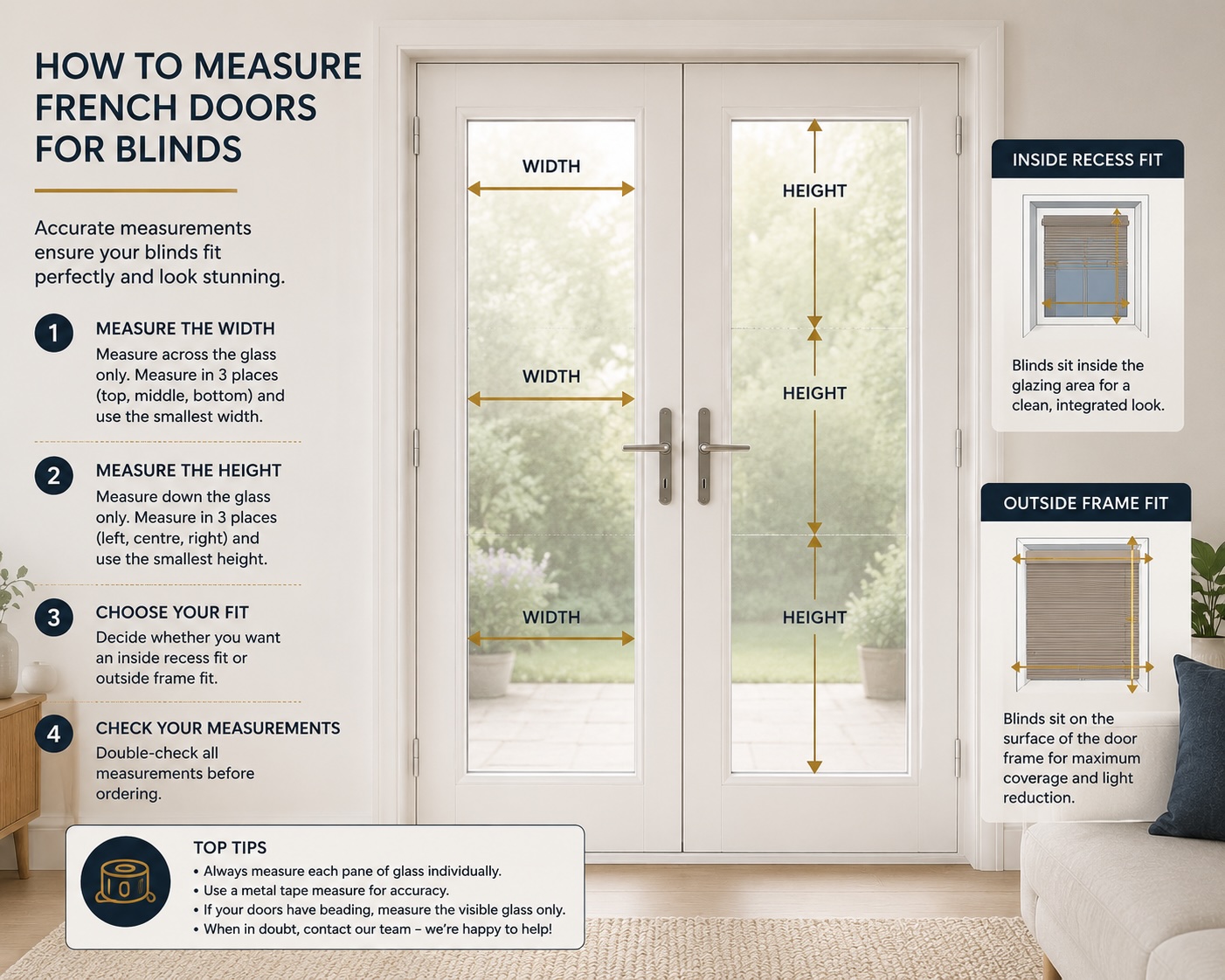
Accurate measuring is essential when choosing blinds for French doors. Unlike a standard window, a French door has moving panels, handles, locks, hinges and often a defined glazed section within each door leaf. These details affect where the blind can sit, how it will operate and whether it will interfere with daily use.
The most important point is to measure the doors as doors, not as one simple window opening. Even if both French doors look identical, each door leaf should be checked separately. Small differences in frame width, glass size or handle position can affect the final fit.
The correct measuring method will depend on the type of blind you choose. A Perfect Fit or other frame-fitted blind usually needs measurements around the glazed panel and bead. A roller blind fitted above the doors may need the full opening width and drop. Curtains require the pole or track width, finished drop and stack-back space. Because of this, always follow the measuring guidance for the specific product type before ordering.
Measure Each Door Panel Separately
French doors are normally supplied as a pair, but the two leaves are not always perfectly identical in practice. One door may be the main opening leaf, while the other may be secondary. There may also be small differences in handle position, locking hardware or available frame space.
Measuring each panel separately helps avoid assuming that one blind size will automatically fit both doors. This is especially important for frame-fitted or door-mounted blinds, where the blind needs to sit neatly on each individual glazed section.
If one door is used more often than the other, it is also worth thinking about how the blind will behave on that active leaf. The main access door needs especially good handle clearance, secure fitting and easy operation.
Measure the Glass Area
For frame-fitted blinds, the glazed area is one of the most important measurements. This is because the blind is usually designed to sit close to the glass rather than cover the full door leaf.
When measuring the glass area, check the visible glass width and drop carefully. Do not assume that the glass is perfectly square or that both panels are exactly the same. Take measurements in more than one place if the product guidance asks for it, and use the correct measurement according to the fitting instructions.
The glass measurement is particularly relevant for Perfect Fit and some no-drill blinds, where the blind frame needs to align properly with the glazed panel. If the measurement is inaccurate, the blind may sit unevenly or fail to cover the glass as intended.
Measure the Available Frame Space
The frame around the glass is just as important as the glass itself. Many no-drill, clip-in or frame-fitted blinds rely on there being enough suitable frame or bead space for the system to attach correctly.
Check the depth and shape of the glazing bead, the condition of the frame and any rubber seals around the glass. Some fitting systems need a compatible bead profile to hold securely. If the bead is too shallow, unusually shaped or obstructed by seals, the blind may not be suitable.
This is one of the reasons French door blinds should not be chosen on product type alone. A Perfect Fit blind may be excellent on one uPVC French door, but unsuitable on another if the bead or frame profile is not compatible.
Measure Handle Clearance
Handle clearance is one of the most important practical checks. A blind may fit the glass perfectly but still be unsuitable if it obstructs the handle, lock or keyway.
Measure how far the handle projects from the door and how close it sits to the glazed area. Also check the movement of the handle when it is turned. Some handles need more operating space than they appear to need when they are static.
The blind, frame, cassette, controls or side profiles should not make the handle difficult to use. The door must remain easy to open, close and lock. If the blind interferes with normal operation, it is not the right fit for that door, even if the measurements look acceptable on paper.
Check the Door Swing
Before choosing a blind, open the French doors fully and check the path they take. This is especially important for inward-opening doors, where any blind fitted on the room-facing side will move into the room with the door.
Look at whether the door opens back against a wall, furniture, radiator, curtain, plant or other obstruction. Even a slim blind frame adds some depth to the door, so the full opening movement needs to be considered.
For outward-opening French doors, internal clearance may be less of an issue, but the blind still needs to clear handles, locks and the walking route through the doorway. If a blind is fitted above the full opening, check whether it will need to be raised every time the doors are used.
Check for Vents, Hinges, Locks and Other Obstructions
French doors often include more than just glass and handles. Vents, locks, hinges, mullions, decorative bars, trickle vents and raised frame details can all affect blind suitability.
These features may reduce the available fitting space or prevent the blind from sitting flat. They may also affect where controls can be positioned. For example, a chain or cord should not hang where it can catch on a handle or get trapped when the doors close.
Before ordering, inspect the doors carefully and note anything that projects, moves or interrupts the frame. It is much better to identify these details before measuring than to discover after fitting that the blind conflicts with part of the door.
Decide Whether the Blind Is Door-Fitted or Opening-Fitted
There are two broad approaches to measuring French doors for blinds: measuring for each door leaf or measuring for the whole opening.
Door-fitted blinds, such as compatible frame-fitted or no-drill options, are measured around each glazed panel or door section. They are usually chosen when the blind needs to move with the door and provide independent control for each leaf.
Opening-fitted blinds, such as a wider roller blind, vertical blind or curtain treatment, are measured across the full opening. These can work well where the aim is to cover the entire glazed area from the room side, but they may need to be raised, drawn or moved clear before the doors are used.
Neither approach is automatically better. The right choice depends on how often the doors are opened, how much wall space is available, and whether you want door-level control or full-opening coverage.
Expert View
Measuring French doors for blinds is not only about width and drop. The best result comes from checking the door as a working part of the room. Glass size, frame profile, bead depth, handle clearance, door swing and daily use all matter.
For frequently used French doors, measuring each door panel separately is usually the safest approach because the blind needs to work with each moving leaf. For wider room-level treatments such as curtains or full-opening blinds, the surrounding wall space, stack-back and access route become just as important as the door size itself.
If there is any uncertainty, order samples where relevant and check the product-specific measuring guide before placing an order. A few careful checks at this stage can prevent the most common French door blind problems later.
Matching French Door Blinds to Room Type
The best blind for French doors depends heavily on the room they sit in. A pair of French doors in a bedroom has different requirements from French doors in a kitchen, conservatory or living room. The door construction still matters first, but once the fitting method is clear, the room’s function should guide the blind style and fabric choice.
The key is to identify what the room needs most. In some rooms, privacy is the priority. In others, the issue is glare, heat, cold, easy cleaning or creating a softer interior finish. A blind that works well in a living room may not be the best choice for a bedroom, and a practical kitchen blind may not give enough softness for a main lounge.
| Room | Best French Door Blind Options | Why They Work |
|---|---|---|
| Living Room | Perfect Fit blinds, Day & Night blinds, curtains | These options balance privacy, light control and appearance, while allowing the doors to remain part of the room’s design. |
| Bedroom | Blackout Perfect Fit blinds, blackout roller blinds, thermal blackout curtains | Bedrooms usually need stronger shading, privacy and comfort, especially where French doors allow early morning light into the room. |
| Kitchen | Metal Venetian blinds, roller blinds, compatible no-drill blinds | Practicality, easy operation and wipeable finishes often matter more than heavy fabric treatments. |
| Dining Room | Day & Night blinds, curtains, carefully fitted roller blinds | Dining rooms often need privacy and atmosphere, particularly in the evening, but the doors should still remain easy to access. |
| Conservatory or Garden Room | Perfect Fit blinds, thermal blinds, no-drill blinds | These rooms often have large glazed areas, so close-fitting blinds can help with glare, privacy and comfort while keeping the doors usable. |
| Rental Property | No-drill blinds, Click Fit blinds, Stick Fit blinds where suitable | No-drill options can avoid unnecessary fixing holes, provided the door is compatible and the tenant follows any relevant tenancy requirements. |
Living Rooms
French doors in living rooms usually need to perform several roles at once. They should let the room feel bright and connected to the garden during the day, but they may also need privacy in the evening. Because living rooms are often used for relaxing, entertaining and watching television, glare control and softness can also matter.
Perfect Fit blinds can work well where the doors are used regularly because they stay close to the glazed panels and move with each door leaf. This keeps the doors practical while still giving control over privacy and light. Day & Night blinds can also be useful where privacy changes throughout the day, because the fabric bands allow filtered light and reduced visibility without fully covering the glass.
Curtains are worth considering if the French doors are a key design feature in the living room. They add softness, texture and a more furnished look, especially where the room has hard flooring, plain walls or large areas of glass. The trade-off is that curtains need space to stack back and do not provide individual door-panel control.
Bedrooms
Bedrooms usually need stronger privacy and light reduction than other rooms. If French doors open from a bedroom onto a balcony, garden or patio, they can allow a significant amount of early morning light into the room. In this setting, a purely decorative or light filtering blind may not be practical enough.
Blackout blinds are often the strongest starting point for bedroom French doors. A blackout Perfect Fit blind can be useful where the door is compatible because it keeps the blind close to the glass and moves with the door. Blackout roller blinds can also work, but the fitting position needs care, especially if the blind is free-hanging or fitted across the full opening.
Thermal blackout curtains may be a better option where the aim is to cover the full opening more generously. They can add softness, improve privacy and help the room feel more comfortable, particularly if the French doors form a large glazed area. However, as with all curtains, there must be enough space for the fabric to draw clear of the doors when access is needed.
Kitchens
French doors in kitchens need a practical approach. Fabric softness may be less important than easy cleaning, moisture resistance, handle clearance and safe operation. The blind should not sit where it can be splashed, knocked or made awkward by regular movement through the doorway.
Metal Venetian blinds can work well in kitchens because the slats provide flexible privacy and light control while offering a more practical surface than many soft fabric treatments. Roller blinds can also be suitable if they are fitted in a way that clears the handles and does not obstruct the door swing.
No-drill options may be useful where the doors are uPVC and the homeowner wants to avoid drilling into the frame. As always, compatibility is essential. In a kitchen, the blind should also be easy to operate and should not interfere with cooking, cleaning or access to the garden.
Dining Rooms
Dining rooms often sit somewhere between practical and decorative. During the day, the French doors may be used for light and garden access. In the evening, privacy and atmosphere usually become more important.
Day & Night blinds can be a good fit for dining rooms because they offer flexible privacy while keeping a softer fabric look than Venetian blinds. Curtains can also work well where the aim is to create a warmer, more finished room, especially for evening use.
A roller blind may be suitable if the doors are used occasionally or if the blind is mainly lowered in the evening. However, if the doors are used frequently during meals, gatherings or garden access, a door-fitted blind may be more convenient.
Conservatories and Garden Rooms
Conservatories and garden rooms often have more glass than other spaces, so French door blinds need to manage light, heat and privacy carefully. Strong sunlight can make the room bright or warm, while cooler months can make the glazed areas feel more exposed.
Perfect Fit blinds are often practical in these spaces because they sit neatly against individual glazed panels and move with the doors. Thermal blinds may also be worth considering where the room is affected by temperature changes. The closer the blind sits to the glass, the more useful it can be as part of a comfort-focused window dressing strategy.
Because conservatories and garden rooms often contain multiple windows and doors, consistency also matters. Using a compatible blind system across both windows and French doors can create a cleaner, more coordinated finish.
Rental Properties
In rental properties, no-drill blinds are often appealing because they can avoid making unnecessary holes in the door frame or surrounding wall. This may be particularly useful for uPVC French doors, provided the door is compatible with the selected fitting system.
However, renters should still check what is allowed under their tenancy agreement before fitting blinds. No-drill does not remove the need to choose carefully. The blind still needs to fit securely, clear the handles and avoid damaging the door surface.
Click Fit, Stick Fit and other compatible no-drill systems may be suitable depending on the frame and product type. The main benefit is that they can provide privacy and shading without turning the doors into a permanent installation project.
Expert View
Room type should influence the blind decision, but it should not override the practical requirements of the door. A bedroom may need blackout performance, but that blackout blind still needs to clear the handle and move correctly. A living room may benefit from curtains, but only if there is enough space for the fabric to stack clear of the opening.
The best approach is to identify the room’s main need first, then choose a blind type that can meet that need without compromising door function. French door blinds should always be judged by both performance and practicality.
Privacy, Light and Heat: Choosing the Right Fabric
Once the fitting method is clear, the next decision is fabric performance. This is where many French door blind choices become more specific. Two blinds may look similar from a distance, but they can behave very differently depending on the fabric, lining and level of opacity.
French doors often contain a large amount of glass, so the fabric needs to be chosen around the room’s real problem. In some homes, the issue is being overlooked. In others, it is glare, heat, cold, strong sunlight, early morning brightness or the need to make the room feel softer in the evening. The right blind fabric should solve the main issue without making the doors harder to use.
Privacy During the Day and Privacy at Night
Privacy is one of the most common reasons for fitting blinds to French doors, but privacy is not the same in every situation.
During the day, a light filtering, dimout, Venetian or Day & Night blind may provide enough screening while still allowing daylight into the room. This can be useful for living rooms, kitchens and dining spaces where you do not want the room to feel closed off.
At night, privacy works differently. When the lights are on inside and it is darker outside, some lighter or sheer fabrics may offer less privacy than expected. In this situation, a more opaque fabric, closed slats, aligned Day & Night fabric bands, blackout blind or curtain treatment may be more suitable.
This is why the direction of the doors matters. French doors facing a private garden may only need soft daytime filtering. French doors facing neighbours, a shared path or a street may need more controlled privacy throughout the day and evening.
Light Filtering Fabrics
Light filtering fabrics are useful where the goal is to soften daylight rather than block it strongly. They can make a room feel more comfortable by reducing harsh brightness while still allowing a pleasant level of natural light.
This type of fabric can work well in living rooms, dining rooms, garden rooms and occasional-use spaces where the French doors are part of the room’s appeal. The doors still feel bright and open, but the glass is dressed in a softer and more considered way.
Light filtering fabrics are less suitable where the room needs strong privacy at night or meaningful room darkening. They are usually chosen for softness, appearance and gentle daylight control, not for blackout performance.
Dimout Fabrics
Dimout fabrics sit between light filtering and blackout options. They are useful where the room needs more shading than a light filtering fabric provides, but where full blackout is not required.
For French doors, dimout fabrics can be a practical choice in living rooms, home offices and dining spaces. They can help reduce glare, soften strong sunlight and improve privacy, while still keeping the room usable during the day.
A dimout fabric is often a good compromise where blackout would feel too heavy or unnecessary. However, it should not be presented as a bedroom blackout solution. If the main aim is to reduce early morning light for sleep, a blackout fabric or lined curtain will usually be more suitable.
Blackout Fabrics
Blackout fabrics are designed to reduce light passing through the fabric itself. They are most useful for French doors in bedrooms, guest rooms, children’s rooms and media rooms, where stronger shading is more important.
However, it is important to be precise. A blackout fabric does not automatically create a completely dark room. Light can still enter around the sides, top or bottom of the blind depending on how it is fitted. This is especially relevant with French doors because handles, frames, bead profiles and door movement can make edge gaps more noticeable.
For better blackout performance, the blind needs to be measured accurately and fitted in a way that reduces unnecessary gaps. Curtains with blackout or thermal blackout lining can also be a strong option where the whole opening needs to be covered more generously.
Thermal Fabrics and Linings
Thermal fabrics and linings are worth considering where French doors affect room comfort. Large glazed areas can make a room feel cooler in winter or warmer in strong summer sun, particularly in older properties, north-facing rooms, conservatories and garden rooms.
A thermal blind or thermal lining adds a useful layer at the glass or across the opening. It will not replace good glazing, insulation or heating control, but it can help the window dressing contribute to comfort as well as privacy and style.
Thermal options usually make the most sense when the doors are in a room used for long periods, such as a living room, bedroom or garden room. They are less essential where the French doors are in a hallway or occasional-use space, unless the area feels noticeably exposed.
Moisture-Resistant and Easy-Clean Fabrics
In kitchens, utility rooms and busy family spaces, fabric practicality can matter as much as appearance. French doors near cooking areas, sinks, pets or garden access may be exposed to moisture, marks and regular handling.
In these spaces, wipeable or more practical blind materials are often preferable to delicate fabrics. Metal Venetian blinds and certain roller blind fabrics can be more suitable than heavy soft furnishings because they are easier to maintain and less likely to absorb everyday marks.
This is not just a cleaning issue. A blind on a busy French door needs to cope with how the room is actually used. If the doors are opened regularly for children, pets, garden access or cooking ventilation, the fabric should be practical enough for that environment.
Patterned or Plain Fabrics
Style still matters, but it should follow the functional decision. Patterned fabrics can make French doors feel more decorative and integrated into the room, especially in living rooms, bedrooms and dining spaces. They can also help turn a large glazed area into a design feature.
Plain fabrics are usually better where the aim is a quieter, more discreet finish. They work well in modern interiors, kitchens, home offices and rooms where the French doors should blend into the background rather than dominate the scheme.
The scale of the room should also guide the decision. A large pair of French doors can usually carry a stronger fabric than a small or narrow glazed panel. If the room already contains patterned wallpaper, bold upholstery or busy flooring, a plainer blind may create a more balanced result.
Expert View
The fabric should be chosen according to the room’s main performance need, not just its colour. A light filtering fabric is suitable for soft daylight. A dimout fabric is better for glare and stronger shading. A blackout fabric is more appropriate for bedrooms and media rooms. A thermal option is worth considering where comfort around a large glazed area matters.
The key point is that fabric performance cannot compensate for a poor fit. A blackout fabric will still disappoint if the blind leaves large gaps or catches on the handle. A thermal fabric will be less useful if the blind swings away from the glass every time the door is opened. Choose the fitting method first, then choose the fabric that solves the right privacy, light or comfort issue.
Safety and Ease of Use on French Doors
French door blinds need to be safe and easy to use because they sit on or around a working doorway. This is different from a blind on a fixed window. The doors may be opened repeatedly, used by children, passed through with shopping or garden items, and operated quickly throughout the day. A blind that feels awkward, catches on the handle or leaves controls hanging in the wrong place will not work well long term, even if it looks suitable at first.
Safety and ease of use should therefore be considered before the final fabric or colour choice. The blind should allow the doors to open, close and lock normally. It should also be easy to adjust without reaching awkwardly across the door or pulling controls into the path of the handle.
Control Position Matters
The control position is one of the most important details on French door blinds. Chains, cords, wands or operating mechanisms need to be easy to reach, but they should not hang where they can catch on the handle, get trapped between the doors or interfere with the locking mechanism.
On a standard window, a control chain hanging at the side may not cause a problem. On French doors, that same chain could sit too close to the handle or fall into the walking route. This is why control side and control length should be checked carefully before ordering.
If one door is used as the main access leaf, the blind on that door needs particular attention. The control should be positioned where it can be used comfortably without making the door awkward to open or close.
Child Safety Around Chains and Cords
Where blinds use cords or chains, child safety is essential. French doors are often fitted in family spaces such as living rooms, kitchens and dining rooms, so controls must be fitted and used in line with the product’s child safety guidance.
This usually means ensuring any chains or cords are secured with the supplied safety device and positioned so they are not left loose. The blind should also be installed at the correct height and operated according to the manufacturer’s guidance.
For homes with young children, cordless, tensioned, enclosed or frame-fitted options may be worth considering where suitable. These can help reduce loose control issues, although the final choice still depends on the door type and product compatibility.
Avoid Controls That Interfere with Handles and Locks
French door handles are used frequently, so the blind must not make them harder to operate. A control chain, slat tilt wand, cassette, frame or side profile that sits too close to the handle can quickly become frustrating.
This is especially important on doors with multi-point locking systems, where the handle may need to be lifted or turned fully to lock the door. The blind should not restrict that movement in any way.
Before ordering, think about how the door is used in real life. If the blind would require you to move a chain out of the way every time you lock the door, it is probably not the right configuration. The safest and most practical result is one where the blind and door can both be operated naturally.
Choose a Blind That Stays Controlled During Door Movement
A blind on or near French doors should remain controlled when the doors are opened and closed. If the blind swings, flaps or hits the glass every time the door moves, it may become annoying and could wear more quickly.
This is one reason frame-fitted blinds can work well on compatible French doors. Because the blind stays close to the glazed panel and moves with the door, it is usually more stable than a free-hanging blind. For high-use doors, this can make a noticeable difference.
Free-hanging blinds can still work in some situations, but they should be chosen carefully. They are generally better where the doors are used occasionally, or where the blind can be positioned so it does not move excessively or obstruct access.
Make Sure the Blind Is Easy to Clean and Maintain
French doors are often high-contact areas. People may touch the glass, handles, frame and surrounding blind more often than they would with a standard window. If the doors lead to a garden, patio or kitchen, the blind may also be exposed to dust, moisture, fingerprints or general everyday marks.
This makes cleaning and maintenance important. In busy rooms, practical materials such as metal Venetian blinds or suitable roller blind fabrics may be easier to care for than delicate fabrics. In softer rooms such as bedrooms and living rooms, fabric blinds or curtains may be appropriate, but they should still suit the level of use.
The easier a blind is to keep clean and operate, the more suitable it is likely to be for an active doorway.
Expert View
Safety and ease of use are not secondary details when choosing French door blinds. They are part of whether the blind is suitable in the first place. The blind should clear the handle, avoid the locking mechanism, keep controls safely positioned and remain stable when the door moves.
A well-chosen French door blind should feel natural to live with. It should not require awkward handling, repeated adjustment or compromises every time the doors are used. If the blind makes the doors harder to operate, a different fitting method, product type or control arrangement is likely to be the better choice.
Expert Verdict: What Are the Best Blinds for French Doors?
The best blinds for French doors are the ones that work with the door first and the room style second. French doors are moving glazed panels, so the strongest solutions usually keep the blind secure, close to the glass and clear of the handles. Once that practical fit is right, fabric, colour and finish can be chosen more confidently.
In most cases, there is no single answer that applies to every home. A pair of uPVC French doors used daily as garden access may need a different blind from timber French doors in a formal dining room. The right choice depends on the door frame, glazing bead, handle position, door swing, room use and the level of privacy or shading required.
Best Overall: Perfect Fit Blinds, Where Compatible
For many French doors, Perfect Fit blinds are one of the strongest all-round choices. Their main advantage is that they fit close to the glazed panel and move with the door. This makes them more practical than many free-hanging blinds on doors that are opened and closed regularly.
They are especially useful where each door leaf needs its own blind. This gives independent control over each glazed panel and avoids having one large blind covering the full opening. Because the blind is held within a frame, it is also less likely to swing or flap when the door moves.
The important condition is compatibility. Perfect Fit blinds need a suitable glazing bead, enough frame depth and adequate handle clearance. Where those details are right, they are often the most practical starting point for French doors.
Best No-Drill Option: Compatible No Drill or Click Fit Blinds
Where drilling into the door or frame is not preferred, no-drill blinds can be a very good option. This is particularly relevant for uPVC French doors, newer installations and rental properties, provided the selected product is compatible with the door.
Click Fit blinds and other no-drill systems can provide a neat finish without traditional screw fixing. Their advantage is not only convenience; it is also that they can help keep the blind closer to the door and reduce the need for bulky wall-mounted brackets.
However, no-drill does not mean universal fit. The door surface, glazing bead, seals, frame profile and handle clearance all need to be checked. If the door is not compatible, a no-drill blind may not sit securely or operate properly.
Best for Privacy Control: Venetian or Day & Night Blinds
If privacy is the main issue, Venetian blinds and Day & Night blinds are often worth considering because they allow more flexible control than a simple fabric panel.
Venetian blinds work well where you want to adjust privacy without losing all daylight. The slats can be tilted to limit visibility from outside while still allowing natural light into the room. This is useful for overlooked French doors in kitchens, living rooms and dining areas.
Day & Night blinds offer a softer fabric alternative. Their alternating sheer and opaque bands make them useful where privacy needs change during the day. They are particularly suited to living rooms and dining rooms where the room needs filtered daylight in the daytime and more privacy in the evening.
Both options still need careful fitting. Venetian blinds can rattle or move if the doors are used constantly, while Day & Night blinds need enough clearance for the cassette, fabric roll and controls.
Best for Bedrooms: Blackout Frame-Fitted Blinds or Blackout Curtains
For bedrooms, the main priorities are usually privacy, light reduction and comfort. Blackout frame-fitted blinds can be a strong choice where the doors are compatible because they keep the blind close to the glass and move with the door. This can be more practical than a free-hanging blind on a moving door leaf.
However, it is important to be realistic about blackout performance. Blackout fabric reduces light passing through the material, but edge gaps may still allow some light into the room depending on the fitting style. For bedrooms where stronger room darkening is required, blackout or thermal blackout curtains may also be worth considering because they cover the full opening more generously.
In some bedrooms, the best result may come from layering. A close-fitting blind can provide practical door-level coverage, while curtains add softness, extra privacy and a fuller finish across the opening.
Best for Softness and Comfort: Curtains
Curtains are often the best choice where the French doors are being treated as a larger architectural feature rather than as two individual glazed panels. They are especially suitable for living rooms, bedrooms and dining rooms where the aim is to add softness, improve comfort and create a more complete room scheme.
Curtains do not move with the doors, so they are less precise than door-fitted blinds. They also need enough wall space to stack back properly. If the fabric cannot clear the opening, the doors may become awkward to use.
Where there is enough space, curtains can be very effective. They dress the full opening, add texture and can provide stronger evening privacy. With suitable lining, they can also help the room feel more comfortable around a large glazed area.
Best for Simple Practicality: Roller Blinds, Where the Fit Works
Roller blinds can be a good choice for French doors where simplicity, fabric choice and a clean appearance are the priorities. They are compact, familiar and available in a wide range of finishes, including light filtering, dimout, blackout and thermal fabrics.
The limitation is movement. A free-hanging roller blind may swing when fitted to a door leaf, and a full-width roller blind fitted above the opening may need to be raised before the doors can be used. For this reason, roller blinds work best where the doors are used occasionally, where there is enough clearance, or where the fitting method keeps the blind controlled.
They should not be dismissed, but they should be chosen carefully. A roller blind that works well on a fixed window may not behave the same way on an active French door.
Expert View
For most frequently used French doors, the best blind is usually one that stays close to the glass and moves with the door. That is why Perfect Fit and compatible no-drill systems are often the strongest starting point.
For rooms where privacy, softness or full-opening coverage matters more than door-level control, Venetian blinds, Day & Night blinds, roller blinds or curtains may be better. The right decision comes from matching the blind to the door’s physical requirements first, then choosing the fabric and style that solve the room’s main problem.
French Door Blinds FAQs
Choosing blinds for French doors depends on the door design, handle clearance, fitting method and how the room is used. These frequently asked questions cover the most important practical points before ordering.