Order Tracking
 0800 1422417
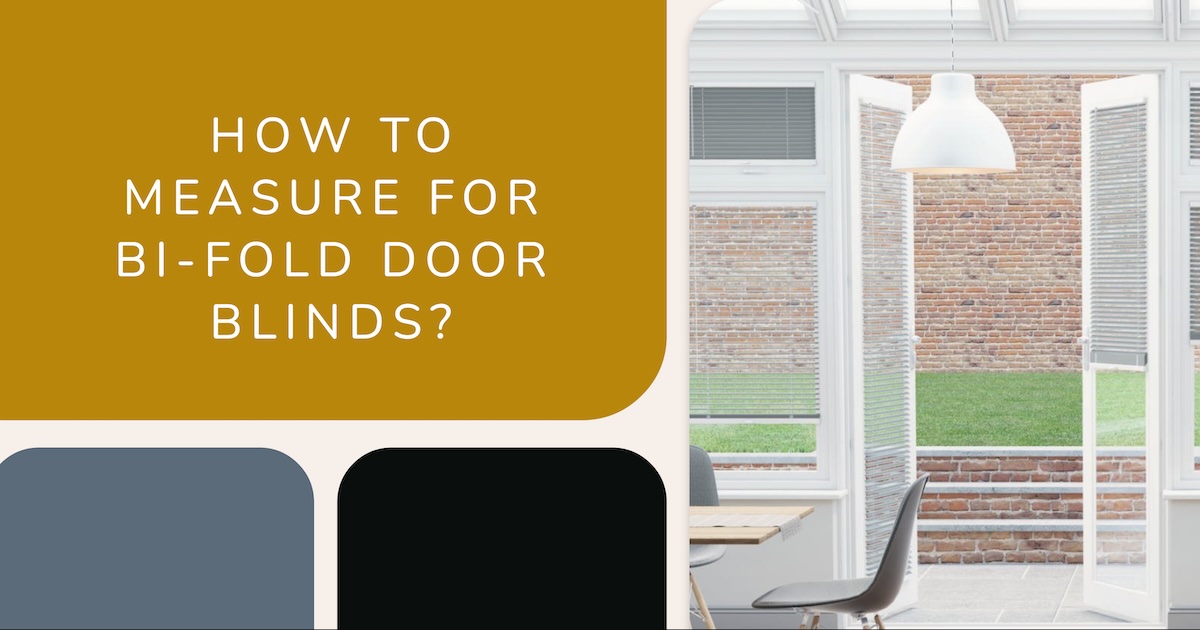
Bi-fold doors have become a hallmark of modern UK homes, beautifully blending indoor and outdoor living while letting natural light flood in. Whether they open up onto a garden patio or extend a contemporary kitchen-diner, fitting blinds to bi-fold doors is the ideal way to maintain privacy in built-up areas, reduce glare on bright summer afternoons, and add an extra layer of insulation against the UK’s famously unpredictable weather.
However, measuring for bi-fold door blinds isn’t always straightforward. Their large glass panels, unique folding operation, and varying frame materials—like the common uPVC and aluminium used in many new builds and home extensions—mean that a one-size-fits-all approach simply won’t work. Get it wrong, and you could be left with blinds that don’t sit right, drag against the frame, or fail to do their job properly.
The good news? This guide is here to help. Tailored for UK homes, it will take you step-by-step through how to measure for bi-fold door blinds with confidence. No guesswork, no stress—just precise measurements that lead to a perfect fit, saving you time, hassle, and costly mistakes.
Table of Contents
- Before You Begin – Essential UK Considerations
- Measuring for Perfect Fit / INTU Blinds (The Most Common & Recommended Method for UK Bi-Folds)
- Measuring for Other Blind Types
- Double-Checking and Common Pitfalls (UK Specific Warnings)
- Ordering Your Blinds
Before You Begin – Essential UK Considerations

1.1 Choosing the Right Blind Type for UK Bi-Fold Doors
Different blinds suit bi-fold doors in different ways. Here’s a breakdown of the most appropriate options for UK homes:
Perfect Fit Blinds (Most recommended for the UK)
These clip directly onto the window or door frame without drilling—perfect for preserving warranties on newly installed bi-folds.
Why they work well in the UK:
- Fit neatly onto uPVC or aluminium frames (the most common in UK homes)
- Move with the door panel—no dangling fabric
- No screws or drilling required
- Excellent light control with minimal gaps
- Compliant with UK child safety standards
INTU Blinds
Very similar to Perfect Fit, but use a slightly different clip-in mechanism. Popular with UK homeowners and available from most made-to-measure blind retailers.
Key benefits:
- Tool-free installation
- Sleek and secure
- Work well on inward or outward folding doors
Pleated Blinds
Often used within Perfect Fit and INTU frames.
Popular for:
- Slim, stacked profile when open
- Thermal performance (great for conservatories or south-facing rooms)
- Soft, diffuse light filtering
Aluminium Venetian Blinds
Another popular option within clip-in systems, especially for contemporary homes.
UK-friendly benefits:
- Excellent privacy and light control
- Minimalist appearance, great for modern interiors
Integral Blinds (Factory-fitted only)
Fitted within the double glazing unit itself, these aren’t measured or installed by the homeowner.
Note for UK buyers: Only available when ordering new bi-fold doors, not suitable for retrofit.
Cassette or Slimline Roller Blinds
Can work on individual panels if installed precisely within a recess.
Limitations:
- Often bulky
- Can interfere with door operation
- Less tidy appearance than clip-in systems
Vertical Blinds / Standard Roller / Outside Mounted Venetians
These are best suited to covering the entire bi-fold opening, like a curtain would.
Drawbacks:
- Don’t move with the door
- Can obstruct door stacking
- May appear bulky or cluttered
✅ Key Takeaway: For UK bi-fold doors, Perfect Fit and INTU blinds remain the most popular and practical panel-by-panel solutions.
1.2 Essential Tools You’ll Need
Gather the following before you begin:
- Metal tape measure – The gold standard for UK DIYers (accurate and won’t stretch)
- Pencil – For jotting down measurements
- Paper or notepad – Keep records panel by panel
- Calculator (optional) – Helpful if converting or checking totals
- Step ladder – Useful for tall doors, common in UK garden rooms and extensions
- Helper – Optional, but recommended for large installations
- Glazing bead depth tool – Or use a thin card/rigid ruler to measure bead depth. Most UK suppliers offer bead measuring tools for free or a nominal fee.
1.3 Understanding Your UK Bi-Fold Door Frame
What Is the Glazing Bead?
The glazing bead is the rubber or plastic trim that holds the glass in place within the frame. For clip-in systems like Perfect Fit or INTU, this bead is the crucial measuring reference.
Common UK Frame Materials:
- uPVC – Widely used, with uniform bead profiles
- Aluminium – Popular in modern builds and extensions
- Timber – Less common but still found in period or bespoke properties
Inward or Outward Folding?
Knowing how your doors open helps determine if your blinds will project too far and cause interference. Outward-folding doors tend to offer more internal clearance.
Watch for Obstructions:
Measure the projection of:
- Door handles
- Keyholes
- Espagnolette bolts
- Locking mechanisms
⚠️ Tip: If the handles stick out significantly, your blind supplier may offer extended or offset brackets.
Measuring for Perfect Fit / INTU Blinds (The Most Common & Recommended Method for UK Bi-Folds)

2.1 General Principles (UK Context)
- Measure only the visible glass area inside the glazing bead
- Do not make deductions – the blind manufacturer will do this
- Always provide measurements in millimetres (mm)
- Measure each panel separately, as sizes can vary
2.2 Step-by-Step Measuring Guide
Step 1: Identify the Glazing Bead
Look for the rubber or plastic edge around the glass inside the frame. This is where your measurement starts and ends.
Step 2: Measure Width
- Measure from inside edge to inside edge of the glazing bead
- Take three measurements: top, middle, and bottom
- Record the smallest measurement (to ensure a snug fit)
📝 Provide the width in mm, with no deductions.
Step 3: Measure Drop (Height)
- Again, measure from inside glazing bead edge to edge
- Measure left, middle, and right
- Use the smallest value
📝 Again, record in mm, exactly as measured.
Step 4: Measure Glazing Bead Depth
This ensures the blind’s clips will fit properly and won’t interfere with door movement.
How to measure:
- From the surface of the glass to the edge of the bead
- Use a glazing bead depth tool or thin card/ruler
💡 Common UK depths:
- 18mm, 20mm, 24mm, 28mm
- Most Perfect Fit systems accept 18mm–30mm
- Some suppliers offer spacers/brackets for shallower (12mm) or deeper (up to 34mm) beads
⚠️ If your bead depth falls outside this range, contact the supplier before ordering.
Step 5: Assess Frame Profile
Slimline or unusually shaped beads may not accept clip-in blinds.
💡 Tip: Take a photo and ask the blind supplier to confirm compatibility.
2.3 Dealing with Obstructions: Handles, Hinges & Locks
Measure how far handles or key cylinders protrude from the frame:
- Use a ruler to get depth in mm
- If they extend too far, it could block blind movement
Solutions:
- Use extended brackets (common in the UK)
- Select shallower blind styles (e.g. pleated vs. Venetian)
- Ask supplier if cut-out options are available
2.4 Measure Each Panel Individually
Even if all panels look the same, measure each one separately. Variations of just a few millimetres are common in UK installations—and enough to affect the blind fit.
Measuring for Other Blind Types

While Perfect Fit and INTU blinds are generally the most practical and popular options for UK bi-fold doors, there are scenarios where alternative blind fitting methods may be considered. This section explains when and how to measure for these less common options and outlines their suitability for UK homes.
3.1 Measuring for Recess Fit Blinds
Typically not recommended for folding bi-fold panels but may suit a single traffic door or recess-mounted applications.
When It Might Be Considered
- If your bi-folds include a single hinged “traffic door” (a regular door within the bi-fold set that opens independently)
- When Perfect Fit or INTU blinds aren’t compatible with your door profile or bead depth
- If you prefer a conventional blind fitting that sits inside the frame recess
How to Measure (UK Method):
- Measure the full recess width: wall to wall, inside the frame
- Measure the full recess drop/height: from the top of the recess to the windowsill or base
- Take measurements in three places (top, middle, bottom for width; left, middle, right for height)
- Use the smallest of each to ensure the blind fits properly
- Note: You provide exact measurements—the blind supplier will deduct around 10–15mm from the width to allow for smooth operation and fitting
Downsides for UK Bi-Folds:
- Blinds do not move with the doors, making them awkward to use on folding panels
- Creates gaps during door operation or when doors are partially open
- May interfere with stacking of the doors when fully open
- Not child-safe unless specific safety devices are fitted
- Can look bulky and interrupt the sleek, minimalist appearance typical of UK bi-fold installations
✅ Best reserved for single traffic doors or recess-mounted roller blinds used to dress the entire aperture.
3.2 Measuring for Face Fit Blinds (Outside the Recess)
Used when the goal is to cover the entire bi-fold door set like a curtain, rather than integrate with individual panels.
When It Might Be Considered
- If your bi-folds open outwards and there’s no suitable recess internally
- When you’re aiming to cover the entire opening for light blocking or privacy
- In rental properties or homes where drilling into frames is not permitted
How to Measure (UK Method):
- Decide your desired overlap: typically 50–100mm beyond the opening on all sides (left, right, and above)
- Width: Measure the width of the opening and add your chosen overlap (e.g., if opening is 2400mm and you want 100mm overlap each side, total width = 2600mm)
- Drop/Height: Measure from where you plan to install the blind (e.g. above the frame) down to where you want the blind to finish (e.g. floor level or just below the doors)
- Check for any obstructions above or to the sides of the opening that may interfere with the blind housing or operation
Considerations:
- Allows the use of standard roller, vertical or Venetian blinds
- Blinds will not move with the doors, so they need to be fully raised or drawn aside before opening the doors
- Light bleed is likely around the edges, unless carefully designed
- Stack-back space (especially with vertical blinds) must be planned for, as it will reduce light and may obstruct access
- Bulky appearance compared to Perfect Fit/INTU blinds
- Can undermine the sleek visual appeal that bi-fold doors are designed to provide
✅ May be suitable where appearance is secondary to full-coverage functionality, such as in utility rooms or for temporary use.
Double-Checking and Common Pitfalls (UK Specific Warnings)

Measuring for bi-fold door blinds is all about precision. Even a few millimetres can make the difference between a perfect fit and a frustrating installation. This section covers the most common mistakes UK homeowners make—and how to avoid them—so you can measure with confidence and order once, not twice.
4.1 The Importance of Measuring Thrice
The old saying “measure twice, cut once” is wise, but for made-to-measure blinds, it’s even better to “measure thrice, order once.”
Why? Bi-fold doors involve multiple panels, varied dimensions, and potentially tricky sightlines. Measuring three times helps catch small inconsistencies and boosts your confidence that you’ve got it right.
4.2 Don’t Make Deductions Yourself
This is one of the biggest pitfalls for UK homeowners.
Never subtract allowances for brackets or fitting space when ordering made-to-measure blinds. Reputable UK manufacturers—like DotcomBlinds—expect exact bead-to-bead measurements, and they make all necessary deductions for a perfect, secure fit.
⚠️ DIY deductions could result in blinds that are too small and leave unsightly gaps.
4.3 Use Consistent Units: Always Millimetres (mm)
In the UK blind industry, millimetres are the standard.
- Avoid mixing inches, feet, or centimetres.
- Always convert your measurements to mm before placing an order.
📏 Example:
Don’t write “2ft 3in” or “69cm”—instead, convert and enter 690mm.
This eliminates confusion and ensures your order is manufactured to UK standards.
4.4 Check All Panels Individually
It’s easy to assume that every panel in your bi-fold set is identical—but this is rarely the case, especially with wider door installations or hand-fitted glazing.
Always measure each glass panel separately, following the same width, height, and depth method.
📌 A 2mm variation might seem small, but it can cause a blind to snag or not sit flush.
4.5 Lighting Conditions Matter
Good visibility is essential for accurate measurements.
💡 If natural light is low or shadows are obscuring your view of the glazing bead, use a torch or measure during daytime hours.
Clear sightlines ensure you’re placing the tape correctly from edge to edge.
4.6 What If My Frame is Uneven?
Uneven frames aren’t uncommon—especially in older extensions or installations where doors have settled.
This is why it’s crucial to:
- Take three measurements across width and drop
- Use the smallest measurement in each set
This approach ensures the blind won’t catch, bow, or sit unevenly once installed.
4.7 Watch for Specific UK Obstructions
Before finalising your measurements, scan the area for common UK-specific obstructions that could interfere with blind installation:
- Patio door runners or tracks – Can affect bottom-up or full-length blinds
- Internal trims or finishing beading – Some installers add decorative trim around bi-fold frames which may prevent blinds from sitting flush
- Hinges, pins, or fold mechanisms – Check these carefully to ensure your chosen blind system won’t foul on moving parts during operation
💡 Top Tip: Open and close your bi-folds while visualising where the blind frame will sit. This can help identify any potential clashes before you order.
4.8 When in Doubt, Ask – Expert Advice Is Readily Available
If you’re uncertain about glazing bead compatibility, obstructions, or even panel movement, don’t hesitate to ask.
DotcomBlinds and other reputable UK blind suppliers offer:
- Expert customer support
- Compatibility checks based on photos
- Advice on frame depth and fitting options
- Guidance on bracket or spacer solutions for tricky frames
✅ A quick call or email could save you a costly re-order.
Ordering Your Blinds
Once you’ve measured your bi-fold doors with care, the final step is placing your order. Whether you’re buying online or visiting a UK showroom, following a clear ordering process will ensure you get blinds that fit beautifully and function as intended.
5.1 How to Submit Your Measurements
Most UK made-to-measure blind suppliers, like DotcomBlinds, will provide a straightforward form on their website or guide you through the process in-store. Here’s what to expect:
Online:
- Navigate to your chosen blind product (e.g. Perfect Fit Venetian, INTU Pleated, etc.)
- Select your blind type, colour/fabric, and control options (if applicable)
- Enter your exact measurements in millimetres (mm)—width and drop, as previously discussed
- Choose your glazing bead depth, if prompted
In-store or over the phone:
- Bring your measurements and any photos of your bi-fold door setup
- A specialist can guide you through compatibility and recommend solutions for unusual frames or obstructions
💡 Tip: Some suppliers allow you to save or print a quote, which can be useful if you’re measuring multiple panels over time.
5.2 Confirming Your Order
Before clicking “confirm” or placing your deposit, take a moment to double-check every detail:
✅ Blind type – Make sure you’ve selected the correct system (e.g. Perfect Fit vs INTU)
✅ Fabric/colour – Ensure consistency across panels, especially if ordering blinds for multiple doors
✅ Measurements – Reconfirm your width, drop, and glazing depth, all in millimetres (mm)
✅ Panel details – Verify you’ve measured and ordered each panel separately, if required
✅ Optional extras – Check options such as spacer brackets, extended clips, or child safety features if applicable
📝 Print or save a copy of your order confirmation for reference.
5.3 Understanding UK Lead Times
Made-to-measure blinds aren’t off-the-shelf products—they’re custom-built to your specifications.
Lead times in the UK can vary depending on the product and manufacturer:
- Typical timeframe: 5 to 15 working days
- Busy periods (spring/summer): May take longer due to higher demand
- Specialty fabrics or large orders: May require additional production time
📦 Most UK suppliers will give you a delivery estimate at checkout or via email.
Frequently Asked Questions
1. Do I really need to measure each bi-fold door panel individually?
Yes. Even if your panels appear identical, it’s common for slight variations to exist—especially in larger or older installations. Measuring each one ensures a snug fit and avoids blinds that catch, drag, or sit unevenly. Always use the smallest measurement across width and drop for each panel.
2. What if my glazing bead depth isn’t a standard size?
Most Perfect Fit and INTU systems are designed to accommodate bead depths between 18mm and 30mm, though some systems can handle as low as 12mm or as high as 34mm with special spacers or brackets. If your bead depth falls outside this range, contact your UK blind supplier—DotcomBlinds offers expert support and may recommend a suitable alternative.
3. Can I use one large blind to cover the full bi-fold opening instead of individual panel blinds?
Yes, you can use roller, vertical, or Venetian blinds mounted outside the recess to cover the full span. However, they won’t move with the doors and can obstruct folding and stacking. This setup is better suited for temporary privacy or utility rooms, not for regular access or sleek aesthetics.
4. Are Perfect Fit and INTU blinds suitable for timber-framed bi-fold doors?
These systems are primarily designed for uPVC and aluminium frames, which are common in UK new builds and extensions. Timber frames often have irregular glazing beads or lack the structure to support clip-in systems. If you have timber bi-folds, consult your supplier before ordering—you may need an alternative fitting style.
5. What’s the most common mistake people make when measuring?
The most common mistakes include:
- Guessing or rounding measurements
- Using inches or centimetres instead of millimetres (mm)
- Measuring only one panel and assuming the rest are the same
- Making deductions themselves instead of submitting exact measurements
Avoid these by measuring three times, writing everything down, and submitting your exact sizes. If unsure, contact a UK specialist like DotcomBlinds for help.
Get the Perfect Fit with DotcomBlinds
Measuring for bi-fold door blinds might seem daunting at first, but with the right guidance, it’s a simple and rewarding process. By following this step-by-step UK-focused guide, you’re well on your way to transforming your bi-fold doors with blinds that offer privacy, insulation, and light control—without compromising on style.
At DotcomBlinds, we specialise in high-quality, made-to-measure blinds that are designed to work beautifully with UK bi-fold doors. From Perfect Fit and INTU blinds to pleated and Venetian options, we offer a wide range of styles tailored to suit your space.
✅ Free fabric samples are available to help you find the perfect colour and texture before you commit.
✅ Our expert UK team is on hand to answer questions, double-check compatibility, and guide you through every step of the measuring and ordering process.
✅ All of our blinds are made in-house in the UK, ensuring excellent quality, service, and fast delivery.
Ready to get started? Visit www.dotcomblinds.com to explore our full range and order your free samples today. With DotcomBlinds, measuring once means getting it right the first time.