Order Tracking
 0800 1422417
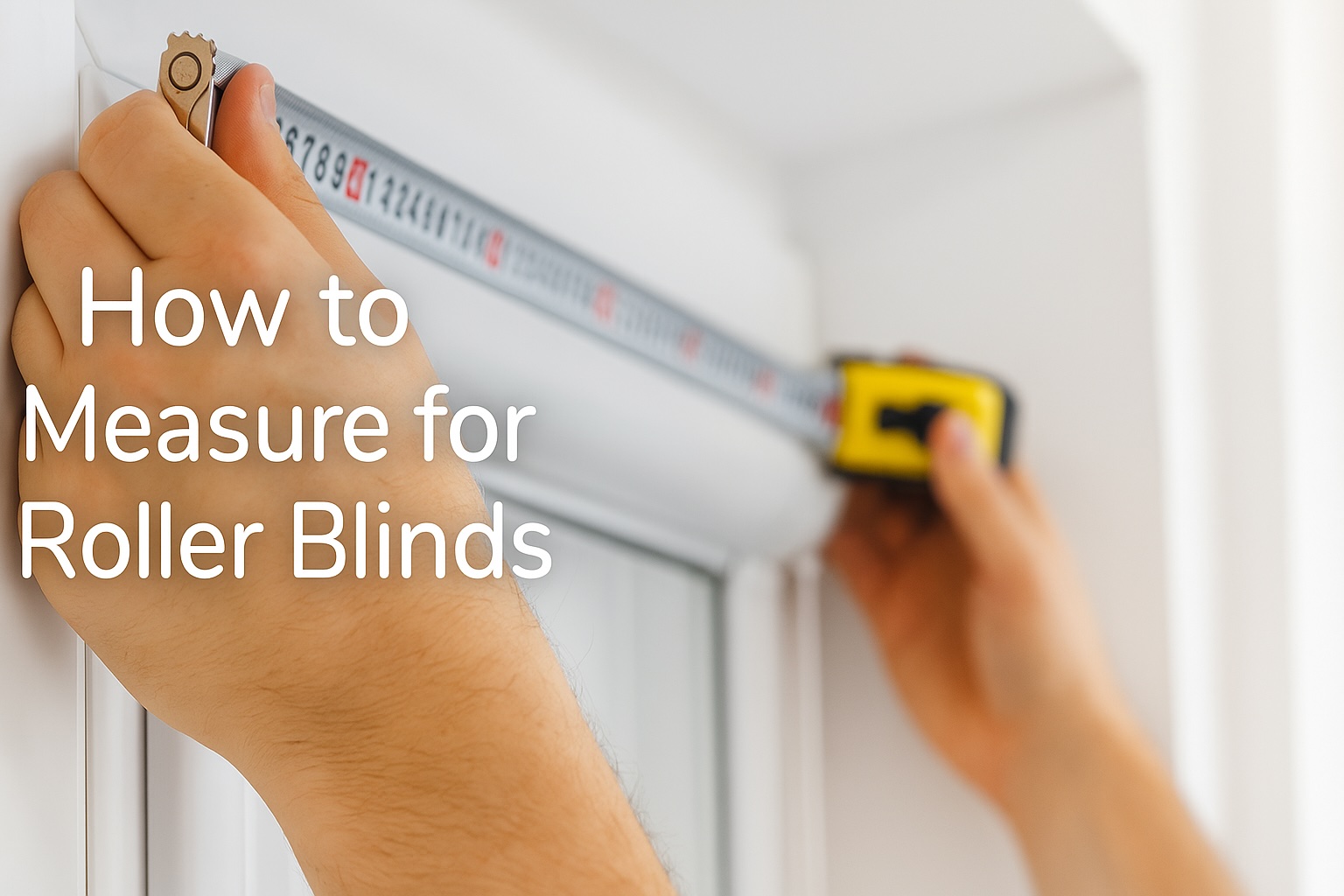
The difference between a perfect fit and a frustrating mess often comes down to one thing: accurate measurement. Get it right, and your roller blinds will look sleek, operate smoothly, and instantly elevate your space. Get it wrong, and you could be stuck with gaps, snags, or blinds that simply don’t fit.
Roller blinds remain one of the UK’s most popular window dressings – and it’s easy to see why. They’re stylish, versatile, space-saving, and available in everything from sheer fabrics to full blackout options. Whether you’re refreshing your kitchen, bathroom, or entire home, roller blinds are a brilliant blend of function and fashion.
In this step-by-step guide, we’ll walk you through everything you need to know to measure for roller blinds like a pro. We’ll cover:
Table of Contents
- Essential Tools You’ll Need Before You Start Measuring
- Understanding Key Terminology
- General Measuring Principles (Crucial for All Methods)
- Method 1: Inside Recess Fitting (Most Common)
- Method 2: Exact Fitting / Outside Recess Fitting (Alternative Option)
- Special Scenarios & Advanced Tips
- Common Mistakes to Avoid
- Frequently Asked Questions (FAQs)
Taking accurate measurements might seem daunting, but don’t worry – with a bit of patience and this guide by your side, it’s simple. Let’s get started and make sure your new blinds are a perfect fit from day one.
Essential Tools You’ll Need Before You Start Measuring
Before you pick up the tape measure and start jotting down numbers, it’s important to ensure you’ve got the right tools to hand. Measuring for roller blinds isn’t complicated, but having the proper equipment makes all the difference – both in terms of accuracy and ease.
Here’s what you’ll need to get the job done right:
Steel Tape Measure
When it comes to measuring for blinds, not all tape measures are created equal. A steel tape measure is your best bet – and here’s why. Unlike soft fabric or plastic versions, a steel tape measure holds its shape, meaning it won’t sag or bend while you’re trying to measure awkward angles or recesses. This rigidity ensures much greater accuracy, which is crucial when you’re dealing with millimetres rather than centimetres. A slight miscalculation can mean your blinds don’t fit snugly – and no one wants that.
Pencil
A trusty pencil is a must-have for making light marks on the wall or frame as reference points. It’s simple but effective – and easily erasable, which is always handy if you make a small mistake or need to adjust.
Notebook or Notepad
While it might be tempting to pop your numbers into a phone, having a physical notepad or sheet of paper nearby helps you quickly jot down your measurements and sketch diagrams if needed. It also reduces the chance of accidentally deleting anything – and makes it easier to cross-check measurements at a glance.
Step Ladder
For those with taller windows or high-mounted frames, a step ladder is invaluable. Not only does it give you better visibility and access, but it also helps ensure your measurements are accurate from top to bottom. Balancing on furniture might seem like a quick fix, but it’s neither safe nor precise. A stable ladder ensures a level, controlled view of your window space.
Spirit Level (Optional, but Highly Recommended)
If your window or recess looks slightly wonky – or you just want to double-check things – a spirit level can be a lifesaver. It helps you assess whether your window frame or sill is perfectly horizontal or vertical, which is important when measuring for a level blind installation. If your window isn’t straight, you might need to make small adjustments to your blind measurements to account for unevenness.
Calculator
A simple calculator (or your phone’s calculator app) will come in handy if you’re converting measurements or working with complex window arrangements like bay windows. Precision is key, and doing the maths ahead of time saves errors and second-guessing later on.
Understanding Key Terminology
Before diving into the measurements themselves, it’s important to get familiar with a few key terms. These are the basics that will pop up throughout this guide and when ordering your blinds – so understanding them now will help you avoid confusion (and costly mistakes!) later on.
Here’s what you need to know:
Recess (also known as Reveal)
The recess refers to the space inside the window frame – the area between the inner edges of the window opening. When you choose a recess fit, the roller blind is installed within this opening, sitting neatly inside the frame. This style is ideal if you want a clean, flush finish and don’t mind a bit of light escaping around the edges. It’s also a popular choice for minimalist interiors where simplicity is key.
Exact Fitting (also known as Outside Recess)
In contrast, exact fitting refers to when the blind is mounted outside the window recess, overlapping the wall or window frame itself. This type of installation is great if you want to block out more light, especially with blackout roller blinds. It’s also ideal when your window recess is shallow or obstructed (think handles, tiles, or window cranks), or if you simply prefer a more dramatic or decorative look.
Width (W)
The width is the horizontal measurement of your window or chosen mounting area. It’s typically the first number noted when ordering blinds and should always be measured from left to right, whether inside or outside the recess. Precision is key here – even a few millimetres can impact how well your blind fits and operates.
Drop (D) / Height (H)
The drop (also referred to as height) is the vertical measurement – from the top to the bottom of where you want your blind to fall. This could be from the top of the recess to the windowsill or from the top of the frame down to the floor, depending on your window type and fitting choice. Getting this right ensures your blind fully covers the window without bunching or falling short.
Control Side
When ordering your roller blind, you’ll be asked to choose a control side – this is the side you want the chain or cord to be placed on. You can opt for either the left or right side, depending on what’s most convenient or unobstructed. Think about ease of access and nearby furniture – it’s a small decision that can make a big difference to day-to-day use.
Roll Direction
This one often catches people out – the roll direction refers to whether your roller blind fabric rolls down behind or in front of the tube.
- A back roll (also called standard roll) means the fabric drops down close to the window, which gives a tighter fit and helps block out more light. It’s perfect when there are no obstructions, such as handles or inward-opening windows.
- A front roll (also called reverse roll) allows the fabric to fall away from the window, clearing protruding features like window handles or tiled surfaces. It also offers a sleeker look in some interior styles, as the fabric hides the roller tube.
Choosing the correct roll direction ensures your blind works smoothly and looks stylish – while avoiding the annoyance of fabric catching on window hardware.
General Measuring Principles (Crucial for All Methods)
Whether you’re measuring inside the recess or planning an exact fit that sits proudly over your window, some golden rules apply to every situation. Stick to these general measuring principles to ensure your roller blinds are made-to-measure with total confidence.
Stick to One Unit – And Be Precise
When it comes to measuring for blinds, accuracy is everything. A few millimetres too much or too little can be the difference between a perfectly fitting blind and one that doesn’t sit right.
We strongly recommend measuring in millimetres (mm) – this gives you the highest level of precision and ensures your blinds are manufactured to fit flawlessly. If you’re more comfortable using centimetres (cm), that’s fine – but be consistent. Never switch between the two partway through, and avoid mixing units across different windows.
Always Measure in Three Places
For both width and drop, never rely on a single measurement. Walls and window frames aren’t always perfectly straight – even if they look it.
- For width: Measure at the top, middle, and bottom of the window or fitting area.
- For drop/height: Measure at the left, centre, and right.
This three-point check gives you a more accurate picture of your space and helps catch any variations caused by slight warps or uneven surfaces.
Use the Smallest Measurement for Recess Fitting
If you’re measuring for a blind that will sit inside the window recess, always use the smallest measurement you took. This is absolutely crucial. Why? Because if there’s any slight narrowing in the recess, your blind needs to fit into that tightest point without getting caught or stuck. Using the smallest width and drop ensures smooth operation and a tidy fit.
Use the Largest Measurement for Exact Fitting
On the flip side, if you’re opting for an exact (outside recess) fitting, go with the largest measurement. This guarantees your blind will provide maximum coverage, hiding the entire window frame and blocking out more light. It’s especially important for blackout roller blinds, where even a few millimetres can let light creep through.
Double-Check Every Measurement
There’s a reason professional fitters live by the old saying: “Measure twice, cut once.” Always take the time to double-check your measurements before placing an order. Rechecking can catch mistakes like swapped width/drop values, incorrect unit conversions, or just plain typos.
Trust us – spending an extra minute now is a lot better than realising later that your beautifully made-to-measure blinds don’t actually fit!
Watch Out for Obstructions
Your window might look straightforward at a glance, but take a closer look. There could be a number of obstructions that impact your measurements or the way your roller blind will sit and operate.
Be on the lookout for:
- Handles – Especially important with back-rolled blinds inside the recess. You may need a front roll to avoid fabric catching.
- Air vents or extractor fans – Can limit where your blind can sit or how far it can drop.
- Tiling or dado rails – Particularly in kitchens and bathrooms; they can protrude from the wall and disrupt an exact fitting.
- Skirting boards – When measuring for floor-length blinds, note the depth of your skirting to avoid blinds bulging outward.
- Sash lifts, locks, or security restrictors – These small details can affect your drop or roll direction.
If any of these apply to your window area, factor them in during your measurement process – they might determine whether you go for a recess or exact fit, or which roll direction is more suitable.
Method 1: Inside Recess Fitting (Most Common)

If you’re after a clean, minimalist look that blends seamlessly with your window frame, an inside recess fit is your go-to option. This method involves installing the roller blind within the window recess, so the blind sits flush inside the opening. It’s one of the most popular choices among homeowners, especially for contemporary and understated interiors.
But to achieve that sleek look, your measurements need to be absolutely spot-on.
When to Use an Inside Recess Fit
Choose this method if:
- You want the blind to sit neatly within the window frame
- You’re aiming for a streamlined finish
- You’re not concerned about a small amount of light bleed around the edges
- The window recess is deep enough to accommodate both the blind and its mechanism (we recommend a minimum depth of 60mm)
Let’s break it down step by step.
📏 Step-by-Step Instructions for Measuring Inside the Recess
Measuring the Width (Horizontally)
-
Use your steel tape measure to take three width measurements:
-
Across the top of the recess
-
Across the middle of the recess
-
Across the bottom of the recess
-
-
Record all three measurements clearly in your notebook.
-
Identify the smallest measurement – this is the one to use when ordering.
This step helps account for slight variations or irregularities in the recess shape, which are more common than you might think.
✅ Important Note from DotcomBlinds:
When you select “Recess Fit” on our website, we will automatically make the necessary deductions to your width measurement. These small adjustments ensure the blind fits perfectly within the recess and operates smoothly, allowing room for the brackets and control mechanisms.Please do not make any deductions yourself – just give us the smallest actual measurement, and we’ll take care of the rest.
Measuring the Drop (Vertically)
- Measure the left-hand side of the recess.
- Then, measure the centre.
- Finally, measure the right-hand side.
- Again, use the smallest measurement.
✅ As with width, DotcomBlinds will make all necessary adjustments for a perfect recess fit, so you don’t need to subtract anything from your measurement.
📐 Visual Aids
Including a simple diagram or illustration is hugely helpful at this stage. A labelled graphic showing where to measure for width and drop (with arrows pointing to top, middle, and bottom of the recess) can help visual learners and prevent common errors.
If you’re adding images to the blog, consider showing:
- A recess with three horizontal arrows (top, middle, bottom) for width
- The same with three vertical arrows (left, centre, right) for drop
- A cross-section showing where the brackets sit and how deductions are made
💡 Pro Tips for Inside Recess Fitting
✅ Check if the Recess is Square
Even a small tilt or slope can affect how your blind looks or operates. Use a spirit level to check that the window recess is square:
- Place it along the top and bottom edges horizontally
- Then run it vertically up the sides
If it’s slightly out of square, you may still be fine – but it’s good to know in advance, especially when deciding on roll direction or fitting type.
✅ Watch Out for Protrusions
Check inside the recess for anything that might stick out and obstruct the blind. This could include:
- Window handles
- Intruder alarms or sensors
- Tiles (especially in bathrooms or kitchens)
- Cranks, locks, or vents
If an obstruction is present:
- Consider switching to a front roll so the fabric clears it
- Or opt for an outside recess fitting instead
Method 2: Exact Fitting / Outside Recess Fitting (Alternative Option)

While inside recess fittings are popular for their clean lines, exact fitting – also known as outside recess fitting – offers several practical and aesthetic advantages. Instead of fitting the blind inside the window frame, this method involves mounting the blind on the wall or surface outside the recess, overlapping the entire window area.
This style provides a bold, decorative finish and is ideal when functionality matters just as much as form.
When to Use an Exact Fit
Choose this method if:
- You want to achieve maximum light control, especially when using blackout roller blinds
- Your window recess is uneven or out of square, making recess fitting difficult or untidy
- There are obstructions inside the recess, such as handles, locks, or tiles
- You prefer a more decorative or layered look, or want the blind to serve as a visual focal point
📏 Step-by-Step Instructions for Measuring Outside the Recess
Measuring the Width (Horizontally)
-
Decide how much you want your blind to overlap the window on each side.
We recommend an overlap of 50–75mm beyond the recess on both the left and right sides. This helps to ensure better light control and complete coverage of the window. -
Take your steel tape measure and measure the total finished width of the blind – this includes:
-
The full width of the window opening
-
Plus your chosen overlap on both sides
-
🔔 Important Note:
The measurement you provide for an exact fit is the total width of the blind, including the brackets and operating mechanism.The fabric itself will be slightly narrower – usually around 30–35mm less than the overall width – so be sure to factor this in if you want to ensure full fabric coverage across the window.
Measuring the Drop (Vertically)
-
Decide how much you want your blind to overlap vertically:
-
We recommend starting the blind 50–75mm above the top of the window
-
And extending it down to the sill – or beyond, depending on your preference
-
-
Measure the total desired drop – from the top of where you want the blind to start, down to the final stopping point (sill, skirting board, or floor).
🔔 As with the width, the drop you provide will be the exact finished drop of the blind – DotcomBlinds will not make any deductions or additions, so give the full measurement.
📐 Diagrams and Visual Aids
A clear visual illustration will really help here. Consider using:
- A graphic showing the blind mounted outside the recess
- Arrows indicating overlap amounts on either side of the window
- Notes explaining the distinction between fabric width and overall blind width
Visuals should highlight:
- Where to measure from
- How to add the recommended overlap
- The difference between total width and fabric width
💡 Pro Tips for Exact Fitting
✅ Decide Where the Blind Will Finish at the Bottom
Will it stop at the window sill, rest on a skirting board, or go all the way down to the floor? Your decision here impacts both the look and functionality. For example, blinds that reach the floor may provide more insulation and light control, especially in draughty rooms.
✅ Ensure Enough Space Above the Window
You’ll need adequate room to install the brackets and roller tube above the window. If there’s limited space due to cornices, ceiling mouldings or shallow reveals, make sure you factor this in – you may need to mount the blind slightly higher or use a different fitting method.
✅ Consider Other Window Dressings
If you already have a curtain pole, pelmet, or valance above the window, make sure your blind won’t clash or compete for space. Outside recess blinds can work beautifully alongside other dressings, but careful planning is key to avoid crowding the wall space.
Special Scenarios & Advanced Tips
Most windows are straightforward to measure, but some spaces call for a little extra care and attention. In this section, we’ll walk through special window types and advanced considerations to help you confidently measure in more complex situations. Whether you’re working with a bay window, a conservatory, or planning to install smart blinds, we’ve got you covered.
🪟 Bay Windows
Bay windows can bring in glorious light and character, but measuring for blinds here is a little more involved.
Why They’re Tricky
- Bay windows are made up of multiple angled panes, and the angles between each window can vary significantly.
- Roller blinds must be measured with millimetre precision to ensure each section fits and functions without clashing with its neighbours.
Our Recommendation
We advise one of two options:
- Contact DotcomBlinds directly – our team can guide you through the process or provide a made-to-measure solution.
- If you’re confident, treat each window section as a separate exact fit blind. Measure each panel as you would for an outside recess fitting, ensuring there’s enough space between blinds to avoid overlapping or catching.
➗ Multiple Blinds in One Recess
Sometimes, especially for wider windows or sliding doors, customers prefer to split a large window into multiple blinds fitted within a single recess. This not only makes operation easier but also allows individual control over light and privacy.
How to Measure Accurately
- Measure the total width of the recess as normal (top, middle, and bottom – and use the smallest).
- Divide the total width by the number of blinds you want.
- Deduct around 10–15mm between each blind to allow for a small gap, so they don’t rub or jam against each other.
⚠️ Always remember: the final width you submit for each blind should be the individual measurement, not just a portion of the total width. DotcomBlinds will still make standard deductions for recess fitting.
🌿 Conservatory Blinds
Conservatories often feature multiple glazed panels, narrow frames, and roof sections – all of which require a very tailored approach.
Specific Blind Types
DotcomBlinds offers Perfect Fit roller blinds, these are ideal for conservatories because:
- They clip into the window frame with no drilling required.
- Each blind fits directly onto the glass, moving with the window or door.
Measuring Tips
- Measure each panel individually, even if multiple windows look the same. Small differences matter with snug-fitting systems like Perfect Fit or Intu.
- Follow the dedicated product-specific measuring guide if applicable, as these blind types use different reference points compared to standard roller blinds.
🚫 Obstructions Within the Recess
Window handles, air vents, sensors, and tiles can all interfere with the smooth operation of a blind – especially if fitted inside the recess.
What to Do
- If obstructions protrude significantly into the recess (more than 20mm), consider switching to an outside recess (exact) fit instead.
- Alternatively, check whether projection brackets are available. These extend the blind further away from the window, allowing it to clear obstacles while maintaining a recess-style look.
📏 Be sure to measure from the furthest obstruction when using projection brackets, not the wall or window frame.
🔌 Measuring for Electric or Smart Roller Blinds
If you’re upgrading to electric or smart blinds, the great news is that the measuring process remains the same – width and drop are measured just like manual blinds.
Extra Considerations:
- Power Source: Make sure there’s a nearby power socket (for mains-powered blinds), or check battery placement if using a rechargeable option.
- Motor Housing: Some electric blinds may have slightly larger cassette or bracket housings – ensure there’s enough depth in the recess (ideally 75mm or more) or go for an outside mount if space is limited.
📦 Measuring for Cassette Roller Blinds
Cassette blinds feature a sleek housing that encases the roller mechanism, offering a neat finish and enhanced light control – especially when paired with side channels or blackout fabric.
What to Know:
- Measuring for cassette blinds still follows the same width and drop principles as standard roller blinds.
- However, the cassette itself adds depth (often around 75–90mm), so make sure your window recess is deep enough if choosing a recess fit.
- For outside fits, double-check there’s space above the window for the cassette housing to sit comfortably.
🎨 Cassette blinds are an excellent choice for a polished, modern look – just ensure you understand the physical dimensions of the cassette when planning your installation.
Common Mistakes to Avoid
Even the most enthusiastic DIYers can fall into a few measurement traps when preparing for made-to-measure roller blinds. Fortunately, these mistakes are easy to dodge once you know what to look out for. Here are the most common measuring errors – and how to steer clear of them.
❌ Using a Cloth Tape Measure
Cloth or flexible plastic tape measures might be fine for sewing projects, but they’re not accurate enough for blind measurements. They tend to sag, bend, or stretch, leading to incorrect readings – especially across wider windows. Always use a rigid steel tape measure for precision and reliability.
❌ Rounding Up or Down
It might seem harmless to round a measurement from 1247mm up to 1250mm for simplicity, but in the world of made-to-measure blinds, every millimetre counts. Rounding can result in blinds that are either too tight or too loose.
👉 Always record the exact measurement – no rounding!
❌ Not Measuring in Multiple Places
Assuming your window is perfectly square and symmetrical can backfire. Skipping the three-point check (top, middle, bottom for width – and left, centre, right for drop) means you might miss subtle variations that affect the blind’s fit.
👉 Take multiple measurements and always use the smallest (for recess) or largest (for exact fit).
❌ Making Your Own Deductions for Recess Fit Blinds
If you’re ordering a blind to fit inside the recess, don’t be tempted to subtract a few millimetres for “wiggle room.”
👉 DotcomBlinds automatically makes professional, precise deductions to ensure a perfect fit. Just supply the raw measurements – we’ll handle the rest.
❌ Confusing Width and Drop
It sounds obvious, but mixing up width (W) and drop (D) is a surprisingly common mistake – and one that can completely throw off your order.
👉 Always double-check which measurement is which when noting them down and placing your order. Consider labelling them as “W” and “D” (or “H” for height) to avoid confusion.
❌ Forgetting About Obstructions
Window handles, vents, tiles, sensors, curtain poles – the list of potential obstructions goes on. Failing to account for these can cause blinds to catch, jam, or roll unevenly.
👉 Always inspect your window space carefully and consider if you need to switch to a front roll, use projection brackets, or choose an outside recess fit.
❌ Writing Down Measurements Incorrectly
Swapping digits, transposing width and drop, or scribbling notes that are hard to read later – it’s all too easy to make a recording error that leads to incorrect ordering.
👉 Take your time, write clearly, and consider using a dedicated measuring checklist or table to stay organised.
❌ Not Double-Checking
It’s the golden rule for a reason: “Measure twice, order once.” Double-checking every measurement helps you catch slips, second-guess anomalies, and gives you the confidence that your blinds will fit first time.
👉 Before you hit ‘order’, take a moment to go back through your notes and confirm everything one more time.
Avoiding these common mistakes helps you get the most out of your made-to-measure experience with DotcomBlinds. Measuring might feel daunting at first, but with the right approach and a little patience, you’ll be well on your way to achieving a professional-looking result – all from the comfort of your own home.
Frequently Asked Questions (FAQs)
Even with a detailed measuring guide at your fingertips, a few common questions still tend to pop up. Below we’ve answered the most frequently asked queries to give you extra confidence before placing your order with DotcomBlinds.
❓ What if my window isn’t perfectly square?
No need to worry – very few windows are perfectly square! That’s exactly why we recommend measuring the width and drop in three places (top, middle, bottom / left, centre, right).
- If you’re opting for a recess fit, always use the smallest measurement so the blind fits the narrowest part of the recess.
- If the difference between the widest and narrowest point is more than 10mm, you might want to consider an outside recess (exact) fit for better coverage and function.
A quick check with a spirit level can help you spot any significant irregularities, but for most cases, this simple three-point method will ensure a snug and accurate fit.
For outside recess fittings, we recommend an overlap of 50–75mm on each side of the window (left and right) to ensure the blind covers the entire window and blocks out as much light as possible.
Vertically, you should also allow for:
- 50–75mm above the window to accommodate the roller mechanism
- Enough drop to either just cover the sill or extend to the floor, depending on your desired look
The overlap helps create a clean look while preventing light leakage around the edges – especially important for blackout roller blinds.
❓ Do I measure the brackets or the fabric?
Great question – and one that trips people up!
- For recess fit blinds, just measure the recess itself – width and drop. DotcomBlinds will take care of the bracket and mechanism deductions for you, so your blind fits neatly inside the space.
- For exact fit blinds, the measurement you provide should be the total width you want the blind to cover – and this includes the brackets. The fabric will be slightly narrower, usually by around 30–35mm, to allow space for the brackets and controls.
So, in short: measure the space, not the fabric – and we’ll handle the rest.
❓ What if I make a mistake?
It happens – and you’re not alone. If you realise after ordering that you’ve made an error, don’t panic. Our friendly customer service team is here to help. While made-to-measure blinds are custom items and therefore not eligible for returns in most cases, we’ll always try to offer solutions, whether that’s advice, a potential discount on a replacement, or adjustments if possible.
📞 If you’re unsure at any point, we recommend reaching out before placing your order – we’re happy to walk you through your measurements or answer any questions.
Check with us to see if we’re currently running a ‘measure protection’ or re-make policy – we occasionally offer support to customers who’ve made genuine measuring mistakes.
❓ Can I use this guide for other blind types?
Yes – in many cases, the core measuring principles remain the same, especially when it comes to recess vs. exact fittings.
However, some blind types may require slight variations:
- Vertical blinds typically need more consideration for how the slats hang and stack.
- Roman blinds and Venetian blinds follow similar measuring rules, though their mechanisms may require a little more depth inside the recess.
- Perfect Fit and Intu blinds (often used for conservatories or doors) have their own unique measuring process based on glass size and frame depth – so we recommend following the product-specific guide provided on those pages.
If in doubt, always refer to the individual product’s measuring guide or get in touch with our expert team.
Ready to Measure with Confidence?
At the heart of every perfectly fitting roller blind is one simple truth: accurate measurement is everything. Taking the time to get it right ensures your blinds look great, function flawlessly, and stand the test of time.
With this guide – and DotcomBlinds’ unwavering commitment to quality and customer service – you’re just a few careful measurements away from transforming your windows with beautifully made-to-measure roller blinds.
And remember, if you’re ever unsure or need a helping hand, don’t hesitate to contact our expert team. We’re always here to offer friendly, personalised advice to make sure you get the perfect fit every time.