Order Tracking
 0800 1422417

No drill blinds have become a popular choice for UK homes because they make fitting quicker, cleaner and less permanent. For renters, new-build owners, tiled bathrooms, conservatories and anyone who would rather avoid drilling into walls or frames, they can be a very practical solution.
That does not mean screw fix blinds are outdated. In many situations, traditional screw-fixed blinds are still the better option. They usually offer more flexibility over where the blind is positioned, a wider choice of blind styles and a stronger fixing route for larger, heavier or more permanent installations.
The real comparison is not simply “modern versus traditional”. It is about suitability. A no drill blind can work extremely well when the window, frame and product system are compatible. A screw fix blind can deliver a neater, stronger and more adaptable result when the surface is suitable and the installation is done properly.
This guide compares no drill and screw fix blinds by strength, installation, appearance, room suitability, window compatibility, blind type and long-term practicality, so you can choose the right fitting method for the way the blind will actually be used.
In This Guide
Use the links below to compare no drill and screw fix blinds by installation, strength, window compatibility, blind type, room suitability, removal and long-term practicality.
No Drill vs Screw Fix Blinds: Quick Answer
No drill blinds are usually the better starting point when you want a quick, clean and less permanent fitting method. They are especially useful for rental homes, compatible uPVC windows, conservatories, selected doors, tiled areas and rooms where you want to avoid making holes.
Screw fix blinds are usually the better starting point when you need maximum fitting flexibility, a wider choice of blind styles or a stronger fixing method for larger, heavier or more permanent installations. They remain a very practical option for many UK homes, particularly where the blind needs to be positioned precisely or fitted outside the window recess.
Neither option is automatically better. The right choice depends on the window, blind type, frame, room conditions and how long the blind needs to stay in place.
| Scenario | Better Starting Point | Why |
|---|---|---|
| Rental property | No drill blinds | They avoid screw holes and are usually easier to remove when moving out. |
| Large or heavy blind | Screw fix blinds | A screw-fixed bracket usually gives more fixing strength and flexibility. |
| Compatible uPVC window | No drill blinds | Many no drill systems are designed around compatible uPVC frames or glazing beads. |
| Awkward recess | Screw fix blinds | Screw fixing usually allows more control over bracket position and clearance. |
| Bathroom with tiles | No drill blinds where compatible | They can avoid drilling into tiles, provided the blind and window system are suitable. |
| Long-term whole-home installation | Screw fix or mixed approach | Screw fix offers broad product choice, while no drill may still suit selected rooms or windows. |
As a simple rule, choose no drill blinds when avoiding holes and fitting quickly are the main priorities. Choose screw fix blinds when strength, positioning flexibility and long-term installation matter more.
What Are No Drill Blinds?
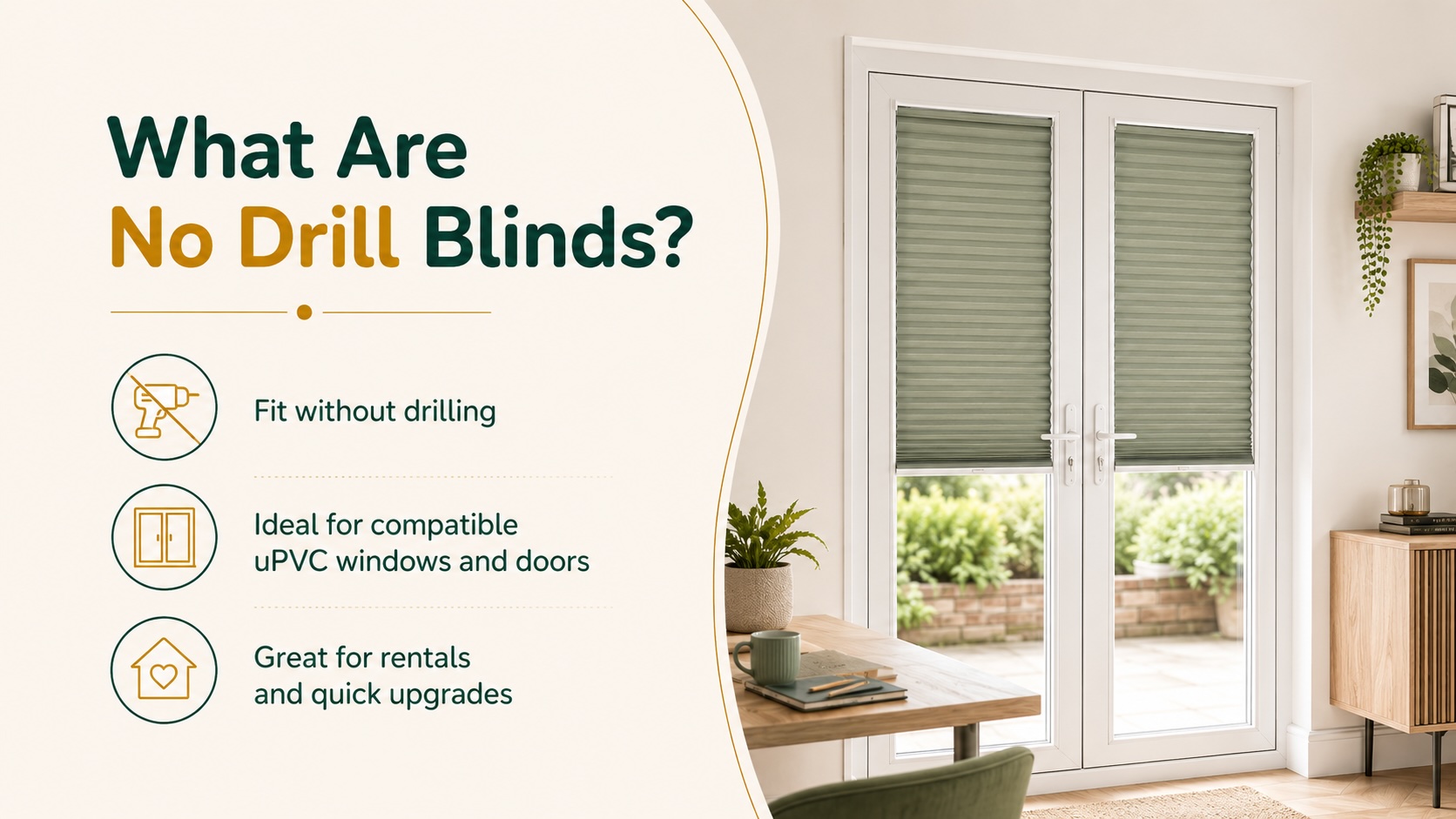
No drill blinds are blinds designed to be fitted without drilling holes into the wall, window frame, ceiling, recess or tiles. Instead of using screw-fixed brackets, they rely on alternative fitting methods such as clips, tension, adhesive pads, push-fit brackets or frame-mounted systems, depending on the blind type.
The important point is that “no drill” describes the fitting method, not one single blind style. A no drill blind could be a roller blind, a Perfect Fit blind, a Click Fit blind, a Stick Fit blind, a Twist and Fit blind, or another system designed to avoid traditional drilling.
This is why no drill blinds should not all be treated as the same product. Some fit directly onto compatible uPVC window frames. Some sit inside the recess using pressure or tension. Some use adhesive or clip-style brackets. Others are designed specifically for doors, conservatories or individual glazed panels.
No drill blinds are popular because they can make installation faster and cleaner. They are especially useful where drilling is inconvenient, restricted or undesirable, such as in rental properties, tiled bathrooms, conservatories, new-build homes or rooms where the customer wants a less permanent option.
They can also be a neat solution for certain doors and uPVC windows, particularly where the blind can sit close to the glass and move with the frame. This can be useful for French doors, conservatory windows and selected tilt-and-turn or opening windows, depending on the system.
However, no drill blinds are not suitable for every window or every blind type. Their performance depends on the product design, the frame shape, the available clearance, the blind size and the weight of the blind. A no drill system works best when the window and blind have been chosen together, rather than treating no drill fitting as a universal replacement for screw fixing.
What Are Screw Fix Blinds?
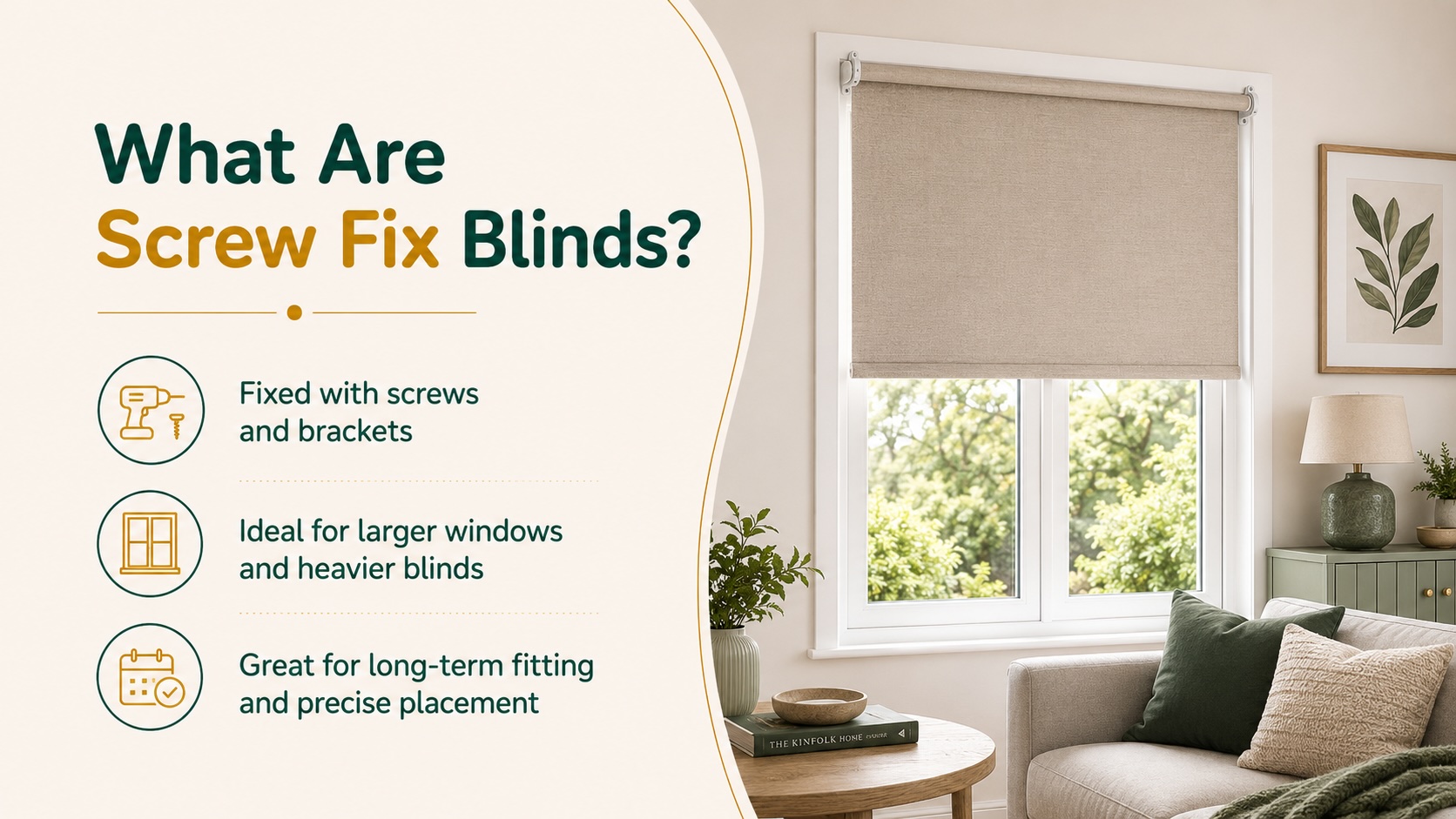
Screw fix blinds are blinds fitted using brackets that are secured with screws. These brackets can usually be fixed into the wall, window recess, ceiling, lintel, wooden frame or another suitable surface, depending on the blind type and fitting position.
This is the traditional fitting method for many made-to-measure blinds, including roller blinds, Roman blinds, Venetian blinds, vertical blinds, wooden blinds, day and night blinds, cassette blinds and many electric blind systems.
The main advantage of screw fixing is flexibility. Because the brackets are fixed into a chosen surface, the blind can often be positioned more precisely. This can be useful when fitting inside a recess, outside a recess, above the window, into a ceiling, or across a wider opening.
Screw fix blinds are often the stronger choice for larger or heavier blinds, provided they are fitted into a suitable surface with the correct fixings. For example, a wide wooden Venetian blind, a Roman blind with lining, or a vertical blind track across a patio door may need the stability that screw-fixed brackets can provide.
The trade-off is that screw fixing is more permanent. It requires drilling, accurate marking, suitable screws or wall plugs, and care around surfaces such as tiles, plasterboard, lintels and uPVC frames. If the blind is removed later, the screw holes may need to be filled or repaired.
Screw fix blinds remain a strong option where long-term fit, strength, exact positioning and wider product choice are more important than avoiding holes. They are not always the quickest option, but when fitted correctly, they can provide a secure and polished finish across a wide range of UK windows.
The Main Difference: Convenience vs Fixing Flexibility
The main difference between no drill and screw fix blinds is not simply how they are installed. It is the balance between convenience and fixing flexibility.
No drill blinds are designed to make fitting easier, cleaner and less permanent. They are especially useful when the aim is to avoid holes, reduce mess or fit blinds in a property where drilling is restricted or unwanted.
Screw fix blinds are designed around a more traditional bracket fixing. They usually offer more freedom over where the blind sits, which surface it fixes into and which blind styles can be used.
No Drill Blinds Prioritise Convenience
No drill blinds are often chosen because they remove one of the biggest barriers to buying made-to-measure blinds: the worry of drilling into the wrong surface.
They can be particularly useful when:
- The customer is renting
- The window frame is compatible
- The room has tiled surfaces
- The blind needs to be removed later
- The customer wants a quicker installation
- The window is part of a conservatory or glazed door system
- Drilling would feel risky or inconvenient
This makes no drill blinds attractive for modern homes, temporary homes and practical upgrades where ease of fitting matters.
However, convenience depends on compatibility. A no drill blind is only the easier option if the window, frame and blind system are suitable. If the system does not match the window properly, installation can become more frustrating than a standard screw fix blind.
Screw Fix Blinds Prioritise Flexibility
Screw fix blinds give more control over the final position of the blind. They can often be fitted inside the recess, outside the recess, above the window, into the ceiling, or across larger openings.
This flexibility is important when the window is awkward, the blind is large, or the room needs a specific finish.
Screw fix blinds are often useful when:
- The blind is wide or heavy
- The recess is shallow or uneven
- The window has awkward handles
- The blind needs to sit outside the recess
- The customer wants a wider product choice
- The installation is intended to be long term
- The fixing point needs to be chosen carefully
This is why screw fixing remains highly relevant. It is not just the older method; it is often the more adaptable method.
Strength Is Only Part of the Decision
It is easy to assume that screw fix blinds are always stronger and no drill blinds are always weaker. In practice, the answer is more nuanced.
A well-fitted no drill blind on a compatible window can be very secure for its intended use. A poorly fitted screw fix blind, fixed into weak plaster or the wrong surface, can still become unreliable.
The fixing method matters, but so do:
- Blind size
- Blind weight
- Window frame type
- Bracket position
- Surface strength
- Frequency of use
- Quality of installation
- Product suitability
The best result comes from matching the fitting method to the window and blind, rather than choosing based on one feature alone.
Which Trade-Off Matters Most?
No drill blinds are best when the priority is avoiding damage, fitting quickly and keeping the installation less permanent.
Screw fix blinds are best when the priority is strength, exact positioning, larger sizes, heavier blind types and long-term flexibility.
In many homes, the right answer may be a mix of both: no drill blinds where the window system suits them, and screw fix blinds where the blind needs more support or positioning control.
Comparison Table: No Drill vs Screw Fix Blinds
No drill and screw fix blinds can both be excellent options, but they are strongest in different situations. No drill blinds are usually about speed, convenience and avoiding holes. Screw fix blinds are usually about flexibility, wider product choice and a more permanent installation.
| Factor | No Drill Blinds | Screw Fix Blinds |
|---|---|---|
| Installation | Usually quicker, cleaner and requires fewer tools. | Requires drilling, marking, screws, plugs and careful alignment. |
| Property impact | Avoids screw holes in walls, frames, tiles or recesses. | Usually leaves holes if the blind is removed later. |
| Rental suitability | Often a strong option for renters, provided the window is compatible. | May require landlord permission, especially if drilling into walls or frames. |
| Blind range | More limited by the specific no drill system and window compatibility. | Usually offers a wider choice of blind types, fabrics, sizes and finishes. |
| Window compatibility | Depends heavily on frame type, recess shape, bead depth, clearance and product system. | More adaptable, as brackets can often be positioned on different suitable surfaces. |
| Strength | Secure when used on a compatible window and within the product’s size limits. | Usually stronger and more flexible for larger or heavier blinds when fitted correctly. |
| Appearance | Can look very neat, especially when fitted close to the glass or frame. | Can look highly polished when positioned correctly inside or outside the recess. |
| Removal | Usually easier to remove with less repair work afterwards. | Requires unscrewing and may leave holes that need filling or touching up. |
| Long-term use | Good in suitable scenarios, especially for compatible uPVC windows, doors and temporary homes. | Strong for permanent installations, whole-home projects and larger window treatments. |
| Best for | Rentals, quick fitting, avoiding damage, compatible frames, conservatories and selected doors. | Large blinds, heavier blind types, awkward windows, long-term homes and broader design choice. |
The main takeaway is that no drill blinds are not simply the “easy” option, and screw fix blinds are not simply the “strong” option. A no drill blind can be highly effective when the system matches the window. A screw fix blind can be the better choice when the installation needs more flexibility, more support or a wider choice of products.
When No Drill Blinds Are the Better Choice
No drill blinds are usually the better choice when the main priority is avoiding holes, keeping installation simple and fitting the blind to a compatible window or door system. They are especially useful in homes where drilling is not allowed, not desirable or not practical.
The key point is compatibility. No drill blinds work best when the window, frame and chosen blind system are designed to work together. They should not be treated as a universal replacement for screw fix blinds in every situation.
Rental Homes and Student Accommodation
No drill blinds are particularly useful in rental homes because they can avoid screw holes in walls, frames, ceilings or tiles. This makes them a strong option for tenants who need privacy, blackout or light control without making permanent changes to the property.
They can also be useful in student accommodation or short-term lets where the customer may not want to invest in a more permanent installation. If the blind can be removed cleanly at the end of the tenancy, it becomes a practical way to improve the room without creating repair work.
Tenants should still check their tenancy agreement before making changes, especially if replacing existing blinds or fitting products to window frames.
Compatible uPVC Windows
Many no drill systems are designed with uPVC windows in mind. Depending on the product, they may clip into the frame, fit around the glazing bead, sit close to the glass or use a pressure-based fitting method.
This can be useful because drilling into uPVC frames is often something homeowners and renters want to avoid. A compatible no drill blind can provide a neat finish while keeping the frame intact.
However, not every uPVC window is suitable. Frame shape, bead depth, gasket position, handle clearance and opening style can all affect whether a no drill blind will work properly.
Conservatories
No drill blinds can be a strong option for conservatories because conservatory windows and doors often have uPVC frames and multiple glazed panels. Frame-fit systems can allow each pane to be covered individually, which is useful for managing glare, privacy and heat.
This is often more practical than trying to fit one large blind across an awkward conservatory window layout. Individual no drill blinds can also help maintain access to opening windows and doors.
French Doors and Glazed Doors
For selected French doors and glazed doors, no drill blinds can be very practical. A frame-fit blind can sit close to the glass and move with the door, rather than hanging loosely in front of it.
This is useful where a screw fix blind might swing, obstruct the handle or feel awkward when the door is used regularly.
The door style still needs to be checked carefully. Handles, frame depth, glazing beads and how the door opens can all affect suitability.
Bathrooms and Tiled Areas
No drill blinds can be helpful in bathrooms, en-suites and kitchens where drilling into tiles is difficult or undesirable. Tiles can crack if drilled incorrectly, and some customers simply prefer to avoid the risk.
A compatible no drill blind may solve this problem, especially where the blind can fit to the window frame rather than the tiled recess.
The blind fabric still matters. In bathrooms and kitchens, the fitting method is only one part of the decision. The selected blind should also be suitable for moisture, condensation and easy cleaning.
Quick Room Updates
No drill blinds are useful when the customer wants a quick room improvement without a more involved installation. They can be a good option for spare rooms, home offices, children’s rooms or temporary living spaces where privacy or light control is needed quickly.
They are also helpful for customers who are less confident with DIY. While accurate measuring and correct fitting are still important, no drill systems usually reduce the need for tools, plugs and drilling into uncertain surfaces.
New-Build Homes
In new-build homes, customers may be reluctant to drill into fresh walls, new tiles or new window frames. No drill blinds can offer a cleaner way to dress selected windows while keeping the property finish intact.
They can also be useful where the homeowner is still deciding on the longer-term interior scheme and wants a practical solution without committing to a permanent fixing straight away.
When No Drill Is the Sensible Starting Point
No drill blinds are often the better choice when:
- The property is rented
- Drilling is not allowed or not preferred
- The window frame is compatible
- The blind is within the system’s size and weight limits
- The room has tiles or surfaces that are difficult to drill
- The blind is being fitted to a conservatory, glazed door or suitable uPVC window
- The customer wants a quicker, cleaner installation
- The blind may need to be removed later
No drill blinds are strongest when convenience and suitability line up. If the window is compatible and the blind is the right size and weight for the system, they can be a very practical alternative to traditional screw fixing.
When Screw Fix Blinds Are the Better Choice
Screw fix blinds are usually the better choice when the blind needs greater support, more precise positioning or a wider range of product options. They remain one of the most reliable fitting methods for long-term installations, especially where the blind is large, heavy or being used frequently.
No drill blinds are very useful in the right setting, but they depend heavily on window compatibility. Screw fix blinds are often more adaptable because the brackets can usually be fitted to a suitable wall, recess, ceiling or frame position.
Large Windows
For larger windows, screw fix blinds are often the safer starting point. Bigger blinds place more demand on the brackets, fixing surface and operating mechanism, especially if they are raised and lowered every day.
A screw-fixed installation can provide more secure support, provided the brackets are fitted into a suitable surface with the correct fixings. This is particularly important for wide roller blinds, large day and night blinds, vertical blind tracks and wider wooden or Venetian blinds.
Heavy Blind Types
Some blind types are naturally heavier than others. Roman blinds, wooden blinds, large Venetian blinds and lined fabric blinds often need a stronger and more stable fixing method.
Screw fixing is usually better suited to these products because the brackets can be anchored more securely. This helps support the weight of the blind and gives more confidence during everyday operation.
Roman Blinds
Roman blinds are usually better suited to screw fixing because of their fabric construction and the way they stack when raised. The blind needs enough support to hold the fabric, lining and headrail securely.
Because Roman blinds are often chosen for bedrooms, lounges and dining rooms, the final positioning also matters. Screw fixing gives more control over whether the blind sits inside the recess, outside the recess or above the window to create a more polished interior finish.
Wooden and Venetian Blinds
Wooden and Venetian blinds can be relatively heavy, especially at wider sizes. Screw fixing usually gives better support and more fitting flexibility than a no drill system.
This is especially relevant where the window is wide, the blind is used frequently, or the customer wants a more permanent installation with a substantial finish.
Vertical Blinds and Patio Door Openings
Vertical blinds are commonly used across wide windows, patio doors and sliding doors. Because they rely on a track system, stability is important.
Screw fixing is usually the better method for vertical blinds because the track needs to sit securely and remain level across the width. This helps the louvres move properly and reduces the risk of the blind feeling unstable during use.
Awkward Recesses
Some window recesses are too shallow, uneven or obstructed for a no drill system. Handles, vents, tiles, inward-opening windows and irregular plasterwork can all make fitting more complicated.
Screw fix blinds often give more control in these situations. The brackets can be positioned to avoid obstructions, improve clearance or move the blind outside the recess where needed.
Long-Term Installations
For homeowners planning a long-term finish, screw fix blinds often make sense. They are well suited to permanent rooms, larger renovation projects and windows where the blind is expected to stay in place for years.
They also provide more choice across fabrics, styles, colours, operating systems and fitting positions. This can be important where the blind is part of the interior design rather than a temporary privacy solution.
Wider Design Choice
Screw fix blinds usually offer the widest product choice. Many blind types, sizes and finishes are designed around bracket fixing, which gives the customer more freedom to choose the look and performance they want.
This is particularly useful in living rooms, main bedrooms, dining rooms and home offices where the blind may need to match a specific design scheme or provide a particular level of light control.
Commercial and High-Use Spaces
In commercial settings, screw fix blinds are often the better option because durability and repeated use matter. Offices, meeting rooms, schools, clinics, rental portfolios and shared spaces usually need blinds that are securely fixed and easy to operate over time.
No drill blinds may still work in selected commercial scenarios, but screw fixing is often the more robust starting point where blinds are used regularly by different people.
When Screw Fix Is the Sensible Starting Point
Screw fix blinds are often the better choice when:
- The blind is large or heavy
- The window is wide or awkward
- The installation is intended to be permanent
- The customer wants the widest choice of blind types
- The blind needs exact positioning
- The recess is shallow, uneven or obstructed
- The surface is suitable for a secure fixing
- The blind is for a commercial or high-use space
- The chosen blind type is not suitable for a no drill system
Screw fix blinds are not simply the traditional option. In many situations, they remain the most practical, flexible and secure way to achieve a reliable made-to-measure finish.
Strength and Durability: Which Holds Better?
Screw fix blinds are usually the stronger and more adaptable option, especially for larger blinds, heavier blind types and long-term installations. Because the brackets are secured into a suitable surface, they can provide a very stable fixing when installed correctly.
No drill blinds can also be secure, but their strength depends more heavily on compatibility. The blind must suit the window frame, fitting system, size limits and operating requirements. When all of those factors line up, a no drill blind can perform very well. When they do not, screw fixing is usually the safer route.
Screw Fix Blinds and Fixing Strength
A screw-fixed blind is only as strong as the surface it is fixed into. A blind fitted into a solid wall, timber frame or suitable lintel can be very secure. A blind fitted into weak plaster, crumbly masonry or an unsuitable fixing point may not perform well, even if the blind itself is good quality.
This is why the correct screws, plugs and bracket positions matter. The weight of the blind, the width of the window and how often the blind will be operated should all be considered before fitting.
Screw fix blinds are usually stronger for:
- Wide roller blinds
- Roman blinds
- Wooden blinds
- Large Venetian blinds
- Vertical blind tracks
- Day and night blinds over wider windows
- Electric blinds
- Commercial blinds
- Blinds that will be used several times a day
For these situations, the extra fixing strength and positioning flexibility of screw-fixed brackets can make a clear difference.
No Drill Blinds and Product Suitability
No drill blinds rely on the design of the fitting system rather than screws. This may involve clips, pressure, adhesive, frame-fit brackets or other no drill mechanisms. These systems can be very effective, but they must be used within the product’s intended limits.
A no drill blind may be secure when:
- The window frame is compatible
- The blind is within the recommended size range
- The blind is not too heavy for the system
- The fixing points have enough grip or support
- The window handles and seals do not interfere
- The blind is fitted exactly as instructed
Problems usually occur when no drill blinds are treated as suitable for every window. They are not. The system needs to match the frame and the blind type.
Blind Weight Matters
The heavier the blind, the more important the fixing method becomes. A small no drill roller blind on a compatible uPVC window may be perfectly practical. A wide wooden blind or large Roman blind is a different matter.
Heavier blinds place more pressure on brackets and fixing points, especially when they are raised and lowered regularly. This is one reason screw fixing is still commonly preferred for heavier blind types and larger window openings.
Width and Daily Use Matter Too
Blind width can be just as important as weight. Wider blinds create more load across the headrail or tube, and they may need stronger support to stay level and operate smoothly.
Daily use also makes a difference. A blind in a guest room may only be adjusted occasionally, while a kitchen, office or child’s bedroom blind may be used every day. The more often a blind is operated, the more important secure fitting becomes.
For frequently used blinds, the fitting should feel stable, level and suitable for repeated movement.
Poor Installation Can Undermine Either Method
It would be too simple to say that screw fix blinds are always secure and no drill blinds are always less secure. Installation quality matters with both.
A poorly measured no drill blind may not grip correctly. A screw fix blind fitted into the wrong surface may loosen over time. A blind that catches on handles or is pulled at an angle may put unnecessary strain on the fitting, regardless of the method.
A good result depends on:
- Accurate measuring
- Suitable blind choice
- Correct fitting method
- Proper surface or frame compatibility
- Following the installation guidance
- Checking for handle and opening clearance
Which Holds Better Overall?
For maximum strength and long-term durability, screw fix blinds usually have the advantage. They are the better starting point for heavy blinds, large windows, wide openings and more permanent installations.
No drill blinds are best judged by suitability rather than by strength alone. When the frame and product system are compatible, they can be secure and practical for everyday use. When there is any doubt over size, weight, frame shape or long-term stability, screw fix blinds are usually the more reliable choice.
Window and Frame Compatibility
Window compatibility is one of the most important differences between no drill and screw fix blinds. A blind can be well made and correctly measured, but if the fitting method does not suit the window, the result may still be disappointing.
No drill blinds are more dependent on the window frame and fitting system. Screw fix blinds are usually more flexible, but they still need a suitable surface to fix into.
uPVC Windows
uPVC windows are one of the most common reasons people consider no drill blinds. Many homeowners and renters prefer not to drill into uPVC frames, either to avoid damage or because they are unsure whether drilling is appropriate.
No drill systems can work very well on compatible uPVC windows, especially where the blind clips, pushes, twists or fits around the frame or glazing area. This can create a neat result without affecting the wall or recess.
However, not every uPVC window is suitable. Suitability can depend on:
- Frame depth
- Glazing bead shape
- Rubber gasket position
- Handle clearance
- Whether the window opens inward
- Available space around the glass
- The specific no drill blind system being used
This is why it is important to check the measuring and fitting guidance for the exact product, not just assume that all no drill blinds fit all uPVC windows.
Wooden Window Frames
Wooden window frames can work well with screw fix blinds because screws can often be fitted into timber, provided the frame is suitable and the fixing position makes sense.
No drill options may be more limited on wooden frames, depending on the product. Some systems are designed mainly for uPVC frames or specific glazing bead profiles, so they may not be suitable for older timber windows, sash windows or painted wooden frames.
For period properties, bay windows and wooden sash windows, screw fix blinds are often the more adaptable option because the brackets can usually be positioned around the window rather than relying on the frame shape itself.
Aluminium Windows
Aluminium windows need careful checking. Some no drill systems may not be suitable because the frame shape, profile depth or surface finish may not provide the correct grip or fixing position.
Screw fixing into aluminium frames is not always desirable and may not be appropriate for every customer. In many cases, it is better to fit the blind to the surrounding recess, wall or ceiling rather than the frame itself, if the blind type and window layout allow it.
For aluminium windows, the safest approach is to choose the blind and fitting method based on the exact frame profile and available fixing space.
Inward-Opening Windows
Inward-opening windows can create issues for both no drill and screw fix blinds. If the blind sits too close to the opening sash, it may prevent the window from opening properly or get caught when the window moves.
No drill systems that fit directly to the moving window panel may work well in some cases, because the blind moves with the window. However, this depends on the product and frame compatibility.
Screw fix blinds may need to be positioned outside the recess or above the frame to allow the window to open freely. This is often where screw fixing provides useful flexibility.
Shallow Recesses
A shallow recess can limit the options available. Some blinds need a minimum recess depth to sit neatly inside the window opening. If there is not enough depth, the blind may protrude, catch on handles or look poorly positioned.
No drill systems may help in some shallow recesses, especially if they fit directly to the frame or glass area. However, if the recess is too shallow or obstructed, the system may still not be suitable.
Screw fix blinds can often be fitted outside the recess, which makes them a useful option when the internal recess does not provide enough space.
Tiled Recesses
Bathrooms and kitchens often have tiled recesses, which can make screw fixing more difficult. Drilling into tiles requires care, suitable tools and confidence, as tiles can crack if drilled incorrectly.
No drill blinds can be useful here if the blind can fit to the window frame rather than the tiled surface. This avoids drilling into the tiles while still providing privacy and light control.
However, the room conditions still matter. In bathrooms and kitchens, the blind fabric should also be suitable for moisture, condensation and regular cleaning.
Doors and Glazed Panels
No drill and frame-fit blinds can be especially useful on selected glazed doors. A blind that sits close to the glass and moves with the door can be more practical than a blind hanging in front of the opening.
This can work well for some French doors, conservatory doors and uPVC glazed panels, provided the frame is compatible.
Screw fix blinds can still work on doors in some cases, but handle clearance and movement need careful consideration. If the blind swings or catches when the door opens, a more integrated no drill or frame-fit system may be better.
Bay Windows
Bay windows can be more complex because of angles, recess depth, handles and the number of individual panes.
Screw fix blinds are often more flexible in bay windows because each blind can be positioned carefully within its own section of the bay. This is useful for roller, Roman, Venetian or wooden blinds where bracket placement matters.
No drill blinds may work in some bay windows if each individual frame is compatible, but this needs checking pane by pane. One unsuitable section can affect the overall result.
Conservatories
Conservatories are one of the strongest use cases for no drill blinds. Many conservatories have uPVC frames and multiple glazed sections, which can suit frame-fit or no drill systems well.
Individual blinds can be fitted to separate panes, helping control glare, privacy and heat without covering the whole structure with one large blind. This can also allow opening windows and doors to remain usable.
Screw fix blinds may still be used in some conservatories, but fixing into frames or roof structures can be more complicated and less desirable.
The Key Compatibility Rule
No drill blinds need the right frame. Screw fix blinds need the right fixing surface.
A no drill blind is often the better option when the window frame has been designed or shaped in a way that works with the system. A screw fix blind is often better when the frame is awkward, the recess needs more flexibility, or the blind needs to be positioned away from the glass.
Before choosing either method, check:
- Window frame material
- Recess depth
- Handle position
- Opening direction
- Surface strength
- Blind size and weight
- Product-specific fitting guidance
- Room conditions, especially moisture and heat
The best fitting method is the one that works with the actual window, not just the one that sounds easiest.
Blind Type Compatibility
The fitting method should always be matched to the blind type. Some blinds are naturally well suited to no drill systems, while others usually need the support and positioning flexibility of screw fixing.
This is where many buying mistakes happen. A customer may decide they want “no drill blinds” before checking whether their preferred blind style is suitable for that type of fitting. In practice, the blind type, size, weight and mechanism all affect the best fixing method.
Roller Blinds
Roller blinds are one of the more flexible categories because they are available in both screw fix and no drill formats, depending on the product.
A no drill roller blind can be a practical option for rental homes, bathrooms, kitchens, home offices and compatible uPVC windows. It can provide a simple, clean finish without drilling into the recess, wall or frame.
A screw fix roller blind usually gives more choice over size, fabric, fitting position and finish. It is often the better option for wider windows, blackout blinds fitted outside the recess, cassette roller blinds or rooms where the blind will be used frequently over the long term.
Choose no drill roller blinds for convenience and compatible windows. Choose screw fix roller blinds for wider choice, larger sizes and more precise positioning.
Roman Blinds
Roman blinds are usually better suited to screw fixing. They use fabric, lining and a headrail, and they stack into folds when raised. This makes them heavier and more structured than many simple roller blinds.
Screw fixing gives the blind the support it needs and allows more control over the final look. This is especially useful when fitting Roman blinds outside the recess or higher above the window to make the room feel more finished.
No drill options for Roman blinds are more limited, and they may not be suitable for larger windows or heavier fabrics.
For most bedrooms, living rooms and dining rooms, screw fix Roman blinds are usually the stronger and more reliable choice.
Venetian Blinds
Venetian blinds can vary in weight depending on the material and size. Aluminium Venetian blinds are generally lighter than wooden Venetian blinds, but both need secure support to sit level and operate properly.
Some no drill Venetian blind options may work on compatible windows, particularly where the blind is designed for a specific frame-fit system. This can be useful for uPVC windows, doors and conservatories.
Screw fixing remains a strong option for Venetian blinds, especially for larger widths, wooden slats or installations where precise placement is needed.
Choose no drill Venetian blinds only where the system and frame are suitable. Choose screw fix Venetian blinds for wider windows, heavier materials and more permanent installations.
Wooden Blinds
Wooden blinds are usually better suited to screw fixing because they are heavier than many other blind types. The wider the blind, the more important secure bracket support becomes.
A screw-fixed wooden blind can provide a strong and polished result when fitted into a suitable surface. This is particularly useful in living rooms, bedrooms, dining rooms and home offices where wooden blinds are chosen for their appearance as well as their function.
No drill wooden blinds are generally more limited and should be approached carefully. The fitting system must be suitable for the weight and size of the blind.
For most wooden blind installations, screw fix is usually the safer starting point.
Vertical Blinds
Vertical blinds are normally better suited to screw fixing, especially across wide windows, patio doors and sliding doors. They rely on a track system, and that track needs to stay level and secure for the louvres to move properly.
Because vertical blinds are often used across larger openings, screw fixing gives the track a more stable base. It also allows the blind to be positioned correctly across the full width of the window or door.
No drill vertical blind options are more limited and are unlikely to be the first choice for larger openings.
For most vertical blinds, screw fix is usually the preferred method.
Perfect Fit Blinds
Perfect Fit blinds are one of the clearest examples of a no drill blind system. They are designed to fit neatly into compatible uPVC windows and doors, usually within a frame that clips into place around the glazed area.
This can create a very tidy result because the blind sits close to the glass and moves with the window or door. Perfect Fit blinds can be especially useful for conservatories, French doors and selected uPVC windows.
The main limitation is compatibility. They are not suitable for every frame, and the measuring requirements are different from standard screw fix blinds.
When the window is compatible, Perfect Fit blinds are a strong no drill option.
Day and Night Blinds
Day and night blinds can be available in both no drill and screw fix formats, depending on the specific product and cassette system.
No drill day and night blinds can work well on compatible windows where the customer wants privacy and flexible light control without drilling. This can be useful in bedrooms, living rooms and home offices.
Screw fix day and night blinds usually offer more flexibility over size, fitting position and finish. They may be the better choice for larger windows or where the blind needs to sit outside the recess.
Choose based on the product system, window compatibility and how much control is needed over the finished position.
Cassette Blinds
Cassette blinds can vary by design. Some cassette systems are screw fixed, while others may be available in selected no drill formats. The cassette adds a more enclosed, finished look around the blind mechanism, but it can also add weight and depth.
For larger cassette blinds, screw fixing is often the more secure and adaptable option. For compatible frame-fit or no drill cassette systems, no drill can provide a very neat result close to the glass.
The main points to check are cassette size, window clearance, fixing method and whether the blind will obstruct handles or openings.
Electric Blinds
Electric blinds need careful consideration because the motor, power source, tube, cassette and blind size can all affect the fitting method.
Screw fixing is often the stronger route for larger electric blinds or more permanent installations because the blind may be heavier and require reliable bracket support.
No drill electric options may exist in selected systems, but suitability should be checked carefully. The fitting method must support the blind properly and still allow access for charging, batteries or maintenance where relevant.
For most larger or design-led electric blind installations, screw fix is usually the more flexible starting point.
The Main Rule by Blind Type
As a simple guide:
- No drill is strongest for Perfect Fit blinds, selected roller blinds, selected day and night blinds, conservatory blinds and compatible uPVC window or door systems.
- Screw fix is strongest for Roman blinds, wooden blinds, vertical blinds, larger Venetian blinds, wider roller blinds, heavier cassette blinds and many electric blind installations.
The best choice is not only about the fitting method. It is about whether the blind type, window and fixing system are genuinely designed to work together.
Room-by-Room Guide
The right fitting method often depends on the room as much as the blind itself. A no drill blind may be ideal in one space and unsuitable in another, while screw fix blinds may be worth the extra installation effort where size, strength or design choice matters more.
Bedrooms
Both no drill and screw fix blinds can work in bedrooms, but the best choice depends on the window and the level of light control required.
No drill blinds can be useful in rental bedrooms, guest rooms and children’s rooms where the customer wants privacy or blackout without drilling into the wall or frame. They can also work well on compatible uPVC windows where a neat, close-to-glass fit is available.
Screw fix blinds are often better for larger bedroom windows, Roman blinds, wooden blinds or blackout roller blinds fitted outside the recess to reduce edge light. They also give more flexibility over fabric choice and positioning, which matters in bedrooms where both style and sleep comfort are important.
For a bedroom, choose no drill when avoiding damage is the priority and the window is compatible. Choose screw fix when blackout coverage, blind size or interior finish matters more.
Kitchens
Kitchens often favour practical blinds that are easy to use and suitable for a busy space. No drill blinds can be a good option where the window is surrounded by tiles or where drilling into the frame or recess is not desirable.
A no drill roller blind or suitable frame-fit blind can work well if the window is compatible and the fabric is appropriate for kitchen conditions. This can be especially useful near sinks or tiled splashbacks, where drilling may be awkward.
Screw fix blinds may be better for larger kitchen windows, awkward recesses or where the customer wants a wider choice of fabrics and finishes. The fixing surface still needs to be suitable, particularly if the recess includes tiles, plasterboard or uneven surfaces.
For kitchens, the fitting method should be considered alongside fabric suitability. Moisture, steam, cooking smells and cleaning are just as important as whether the blind is no drill or screw fix.
Bathrooms and En-Suites
Bathrooms are one of the strongest practical use cases for no drill blinds, provided the window is compatible. Avoiding drilling into tiles can be a major advantage, especially where the customer wants a cleaner and less risky installation.
A no drill blind fitted to a suitable frame can provide privacy and light control without disturbing tiled surfaces. This can work well in bathrooms, en-suites and shower rooms where the window design allows it.
Screw fix blinds can still be suitable, but drilling into tiles, plasterboard or awkward recesses requires more care. If screw fixing is used, the surface must be appropriate and the correct tools and fixings should be used.
In bathrooms, the blind fabric is critical. Choose a fabric designed for moisture-prone spaces, and make sure the room has reasonable ventilation.
Living Rooms
Living rooms often place more emphasis on appearance, fabric choice and the overall interior finish. For this reason, screw fix blinds are frequently the stronger option because they allow a wider choice of styles and more control over positioning.
Roman blinds, wooden blinds, vertical blinds, day and night blinds and larger roller blinds are often fitted using screw-fixed brackets. This can give a more polished finish, especially when the blind is part of a designed room scheme.
No drill blinds can still work well in living rooms with compatible uPVC windows or where the customer wants a simpler, less permanent solution. They may be particularly useful in rental flats or newer homes where drilling is not preferred.
For living rooms, choose screw fix when design choice and long-term finish matter most. Choose no drill when the window system suits it and a cleaner, non-permanent installation is preferred.
Home Offices
Home offices need blinds that manage glare, privacy and daily use. Either fitting method can work, but the decision should be based on window size, operation frequency and how much control is needed over light.
No drill blinds can be useful for quick office setups, rental properties and compatible uPVC windows. They can provide privacy and help manage brightness without a more involved installation.
Screw fix blinds may be better for wider windows, larger roller blinds, day and night blinds or installations where the blind needs to sit outside the recess to improve coverage. If the blind will be adjusted several times a day, fixing stability matters.
For home offices, consider screen position, sun direction, glare, privacy and whether the blind needs to be operated frequently.
Children’s Rooms
Children’s rooms need secure, practical blinds that are easy to manage. No drill blinds can be a useful option where the customer wants a simple installation, especially in rental homes or on compatible uPVC windows.
Screw fix blinds may be better for larger blackout blinds or where the blind needs a more permanent and robust installation. This can be important in children’s bedrooms where blinds may be used daily as part of sleep routines.
Whichever fitting method is chosen, child safety should be central. Blinds should be supplied and used with appropriate safety features, and operating controls should be kept safely out of reach where required.
Conservatories
Conservatories are often well suited to no drill blinds because they commonly have uPVC frames and multiple glazed panels. Frame-fit blinds can cover individual panes neatly, helping manage glare, privacy and heat without needing to drill into the structure.
No drill blinds can also allow windows and doors to remain usable because the blind may move with the frame, depending on the system.
Screw fix blinds can be used in some conservatory settings, but fixing points may be more limited and the installation may be more complicated. For many conservatories, no drill or frame-fit systems are the more practical starting point.
Utility Rooms
Utility rooms usually need simple, practical blinds. No drill blinds can be helpful where there are tiles, moisture-prone areas or windows that need a quick privacy solution.
Screw fix blinds may be better if the window is wider, the recess is awkward, or the blind needs to sit in a precise position. As with kitchens and bathrooms, the selected fabric should be suitable for the room conditions.
Best Fitting Method by Room
| Room | Better Starting Point | Why |
|---|---|---|
| Bedroom | Depends on blind type | No drill can suit rentals and compatible frames; screw fix is often better for Roman blinds and wider blackout blinds. |
| Kitchen | No drill where compatible | Useful for avoiding tiles, but fabric suitability and cleaning are still important. |
| Bathroom | No drill where compatible | Can avoid drilling into tiles and works well with suitable moisture-resistant blinds. |
| Living room | Screw fix or mixed | Screw fix usually gives more design choice and better positioning control. |
| Home office | Depends on glare and window size | No drill can work for quick setups; screw fix may be better for wider blinds and frequent use. |
| Children’s room | Depends on size and use | No drill can suit compatible frames; screw fix may be better for larger blackout blinds. |
| Conservatory | No drill | Frame-fit systems can cover individual panes neatly without drilling into the structure. |
The best approach is to match the fixing method to each room. No drill blinds often make sense in bathrooms, kitchens, conservatories and rental bedrooms, while screw fix blinds are often stronger for living rooms, larger bedrooms, wide windows and more design-led spaces.
No Drill Blinds for Rental Homes
No drill blinds are particularly useful in rental homes because they can improve privacy, light control and comfort without creating permanent screw holes. For tenants, this is often the main attraction. The blind can usually be fitted with less mess and removed more easily at the end of the tenancy.
This makes no drill blinds a strong option for rented flats, student accommodation, short-term lets and homes where the landlord does not allow drilling into walls, window frames, tiles or ceilings.
Why Renters Often Choose No Drill Blinds
In a rental property, even small changes can become an issue when moving out. Drilled holes may need to be filled, painted or repaired, and drilling into uPVC frames, tiles or window surrounds can create more noticeable damage.
No drill blinds help avoid this problem by using alternative fitting methods. Depending on the product, the blind may clip, twist, tension, stick or fit into the window frame without screws.
They are often useful for renters who need:
- More privacy from neighbouring homes or street-facing windows
- Better light control in bedrooms or home offices
- A blackout option without permanent fixing
- A cleaner-looking window treatment than temporary curtains
- A blind that can be removed when moving home
- A practical solution where drilling is not permitted
Still Check the Tenancy Agreement
No drill blinds are less permanent than screw fix blinds, but tenants should still check their tenancy agreement before fitting anything new. This is especially important if the property already has blinds, curtains or curtain poles installed.
If existing fittings are removed, they should usually be stored safely and reinstated before moving out, unless the landlord has agreed otherwise.
No drill fitting reduces the risk of damage, but it does not remove the need to fit the blind carefully and responsibly.
Best Rental Rooms for No Drill Blinds
No drill blinds can work well across several rented rooms, provided the windows are compatible.
In bedrooms, they can provide privacy and help reduce light without drilling into the recess or wall. In home offices, they can help manage glare and create a more comfortable working setup. In bathrooms and kitchens, they may help avoid drilling into tiles, as long as the chosen fabric is suitable for moisture-prone spaces.
They can also be useful on glazed doors or compatible uPVC frames where a frame-fit blind can sit neatly against the glass.
Compatibility Matters More Than the Property Type
A rental home is not automatically suitable for no drill blinds. The window still needs to work with the chosen system.
Before ordering, check:
- Frame material and shape
- Recess depth
- Handle clearance
- Opening direction
- Glass and frame measurements
- Whether the blind system is suitable for the window
- Any size or weight limits for the product
This is particularly important in older rental properties, where windows may be wooden, uneven, shallow or non-standard.
When Screw Fix May Still Be Better in a Rental
Although no drill blinds are often the renter-friendly option, screw fix blinds may still be worth considering if the landlord allows them and the window needs a more robust solution.
This may apply where:
- The blind is very wide
- The customer wants Roman or wooden blinds
- The recess is not compatible with no drill fitting
- The window is awkward or uneven
- A long-term tenancy makes a more permanent fitting worthwhile
- Existing screw holes can be reused safely
In some rental homes, the best answer may be to use no drill blinds in bedrooms, bathrooms or doors, while using existing screw-fixed positions for larger windows if permitted.
The Rental Home Takeaway
No drill blinds are often one of the most practical choices for rental homes because they offer privacy, light control and a made-to-measure finish without the same level of property alteration as screw fixing.
The key is to choose them for the right window. When the frame is compatible and the blind is within the product’s limits, no drill blinds can be a clean, practical and landlord-conscious way to improve a rented space.
Screw Fix Blinds for Long-Term Homes
Screw fix blinds are often the better choice for long-term homes because they offer strength, flexibility and a wider choice of blind styles. If the blind is expected to stay in place for years, the more permanent nature of screw fixing can become an advantage rather than a drawback.
For homeowners, screw fix blinds can provide a polished made-to-measure finish across bedrooms, living rooms, dining rooms, offices and larger windows where design choice and reliable operation matter.
A More Permanent Installation
Screw fix blinds are designed to be fitted securely into a suitable surface using brackets and screws. This makes them well suited to rooms where the customer wants a long-term window covering rather than a temporary or easily removable solution.
Once fitted correctly, screw fix blinds can feel stable, neat and integrated into the room. This is particularly useful for main living spaces, where the blind is part of the wider interior scheme.
A screw-fixed blind is often a good choice when:
- The customer owns the property
- The blind is part of a long-term room design
- The window is wide, heavy or awkward
- The customer wants more choice of styles and fabrics
- The blind needs to sit in an exact position
- The room needs a more finished appearance
Wider Choice of Blind Styles
One of the main benefits of screw fixing is product choice. Many blind types are designed primarily around screw-fixed brackets, especially where the blind is larger, heavier or more decorative.
Screw fix blinds are often the stronger option for:
- Roman blinds
- Wooden blinds
- Wide roller blinds
- Vertical blinds
- Larger Venetian blinds
- Day and night blinds
- Cassette blinds
- Electric blinds
- Blinds fitted outside the recess
This gives homeowners more freedom to choose the blind that suits the room, rather than being limited by what the no drill system can support.
Better Positioning Control
Screw fixing gives more control over where the blind sits. Depending on the window and product, the blind can often be fitted inside the recess, outside the recess, above the window, to the wall or into the ceiling.
This matters in long-term homes because the finished look is often just as important as the basic function. For example, a Roman blind may look better fitted slightly above the window so the fabric stack does not cover too much glass when raised. A blackout roller blind may work better outside the recess if reducing edge light is the priority.
This level of positioning control is one of the reasons screw fix blinds remain relevant, even as no drill options become more popular.
Stronger for Larger and Heavier Blinds
Larger and heavier blinds usually benefit from a more robust fixing method. A wide wooden blind, lined Roman blind or long vertical blind track needs dependable support, especially if it will be used every day.
Screw fixing allows the brackets to be secured into a suitable surface with the correct fixings. This can provide a more stable result than a no drill system where the frame, size or weight limits are not ideal.
The strength still depends on the quality of the installation. The fixing surface, screws, wall plugs and bracket placement all need to be suitable for the blind.
Suitable for Designed Interiors
In long-term homes, blinds are often chosen as part of a room design rather than as a quick privacy fix. Screw fixing can support a more tailored result because there is usually more freedom over blind type, fabric, colour, lining and fitting position.
This is useful in:
- Main bedrooms
- Living rooms
- Dining rooms
- Home offices
- Bay windows
- Period homes
- Larger open-plan rooms
For these spaces, screw fix blinds can help create a more intentional and permanent finish.
When Screw Fix Is Worth the Extra Effort
Screw fix blinds take more effort to install than most no drill options, but that extra effort can be worthwhile where the blind needs to perform well for years.
They are often worth choosing when:
- The blind is part of a long-term interior scheme
- The room needs a premium or more tailored finish
- The window is not compatible with no drill systems
- The blind is large, heavy or used frequently
- The customer wants more product choice
- The blind needs to be positioned outside the recess
- Existing fixing holes can be reused safely
The Long-Term Home Takeaway
For long-term homes, screw fix blinds remain one of the most practical and flexible fitting methods. They are not always as quick to install as no drill blinds, but they usually offer more choice, stronger support and better control over the finished position.
No drill blinds can still be useful in selected rooms, such as bathrooms, conservatories or compatible uPVC windows. For larger windows, heavier blinds and more design-led interiors, screw fix blinds are often the better long-term investment.
Appearance and Finish
The fitting method can change how a blind looks, not just how it is installed. No drill blinds and screw fix blinds can both create a neat made-to-measure finish, but they often sit in different positions and suit different visual priorities.
No drill blinds are usually strongest when the aim is a clean, close-to-glass or frame-integrated look. Screw fix blinds are usually stronger when the blind needs to be positioned more deliberately within the wider room design.
How No Drill Blinds Look
No drill blinds can look very tidy when they are fitted to a compatible window. Many systems are designed to sit close to the glass or within the window frame, which can give a compact, integrated appearance.
This is especially useful for:
- uPVC windows
- Conservatories
- French doors
- Glazed doors
- Bathrooms
- Kitchens
- Rooms where a discreet finish is preferred
Frame-fit no drill systems can be particularly neat because the blind moves with the window or door. This avoids the loose, hanging effect that can happen when a standard blind is fitted in front of an opening door.
The limitation is that no drill blinds are often more controlled by the window frame itself. If the system fits in a specific place, there may be less freedom to adjust the final position for design reasons.
How Screw Fix Blinds Look
Screw fix blinds can also look very neat, especially when measured and installed properly. Their main visual advantage is positioning flexibility.
A screw-fixed blind can often be fitted:
- Inside the window recess for a clean, contained finish
- Outside the recess for better coverage
- Higher above the window to reduce fabric stack blocking the glass
- Wider than the recess for improved privacy and light control
- Into the ceiling where wall fixing is not ideal
This flexibility can be useful in rooms where the blind is part of the interior design. For example, a Roman blind may look more balanced when fitted outside the recess. A roller blind may perform better as a blackout blind if fitted wider than the window opening. A vertical blind may need to sit across the full door opening rather than within a narrow recess.
Close-to-Glass vs Room-Facing Finish
One of the biggest visual differences is whether the blind feels like part of the window frame or part of the room.
No drill blinds often create a close-to-glass finish. This can look clean and modern, especially on doors, conservatories and uPVC windows. It also keeps the surrounding wall or recess visible.
Screw fix blinds often create a more room-facing finish. The blind can be positioned to suit the wall, window proportions, furniture layout or curtain pairing. This can be more suitable for living rooms, bedrooms and design-led spaces.
Neither approach is better in every case. It depends on whether the blind should disappear into the window or become part of the room’s finished look.
Design Freedom
Screw fix blinds usually offer more design freedom because they are available across a wider range of blind styles, fabrics, sizes and fitting positions.
This matters if the customer wants:
- Roman blinds for a softer finish
- Wooden blinds for a more substantial look
- Vertical blinds across patio doors
- Wide roller blinds
- Day and night blinds in a specific position
- A blind fitted outside the recess
- A layered look with curtains
No drill blinds can still look excellent, but the design choice may be more limited by the fitting system and window compatibility.
Which Gives the Better Finish?
No drill blinds often give the best finish when the window itself is the focus and the customer wants a compact, discreet or frame-integrated result.
Screw fix blinds often give the better finish when the room design matters more and the blind needs to be positioned with greater control.
As a simple guide, choose no drill blinds for a neat, practical, close-to-glass look. Choose screw fix blinds when you want more control over the final appearance, especially in bedrooms, living rooms, dining rooms and larger windows.
Installation Difficulty
Installation is one of the main reasons customers compare no drill and screw fix blinds. No drill blinds are usually designed to make fitting quicker and less intimidating, while screw fix blinds require more tools, more care and a suitable surface.
That said, “easier” does not mean “impossible to get wrong”. Both methods still need accurate measuring, careful fitting and a blind that is suitable for the window.
Installing No Drill Blinds
No drill blinds are usually easier for customers who want to avoid using a drill. Depending on the product, the blind may clip into place, twist into the recess, use tension, stick to a surface or fit directly to the window frame.
This can make installation cleaner and faster because there is usually no drilling dust, no wall plugs and no need to commit to a permanent hole in the wall, frame or tiles.
No drill fitting is often easier when:
- The window is compatible with the product system
- The recess or frame is square and even
- The blind is within the recommended size limits
- There is enough clearance around handles and openings
- The customer follows the measuring and fitting instructions carefully
The biggest risk with no drill blinds is assuming they are universal. If the blind system does not suit the window, the installation may be less straightforward than expected. For example, a frame-fit blind may need a specific bead depth, while a tension-fit blind may need a sound, even recess to hold securely.
Installing Screw Fix Blinds
Screw fix blinds usually require more preparation because the brackets need to be fixed into a suitable surface. This normally involves marking the bracket positions, checking the blind is level, drilling pilot holes or fixing holes and using the right screws or wall plugs.
The installation can be straightforward for confident DIY users, but it becomes more complicated when the surface is awkward.
Screw fixing can be more challenging when:
- The recess includes tiles
- The wall is uneven
- The plaster is weak or crumbly
- The lintel is difficult to drill
- The window has awkward handles
- The blind is wide or heavy
- The brackets need to be positioned very precisely
- The blind is being fitted into a ceiling or bay window
The advantage is that screw fixing gives more control. If the recess is shallow, the blind may be fitted outside the recess. If the window handle gets in the way, the brackets may be positioned to improve clearance. This adaptability is one of the reasons screw fix blinds remain popular.
Tools and Confidence
No drill blinds usually require fewer tools. Some systems may only need basic measuring equipment and the supplied fittings, although the exact requirements depend on the product.
Screw fix blinds normally require more DIY confidence. Typical tools may include a tape measure, pencil, drill, screwdriver, spirit level and suitable wall plugs or screws. The installer also needs to understand the surface they are drilling into.
This does not mean screw fix blinds are difficult, but they do ask more from the person fitting them.
Measuring Is Important for Both
A common mistake is thinking no drill blinds are more forgiving. In reality, accurate measuring is just as important.
For no drill blinds, the measurement may need to match the frame, glass area, recess or specific product system. For screw fix blinds, the measurement needs to suit the chosen fitting position, whether inside or outside the recess.
A small measuring error can affect:
- How securely the blind fits
- Whether the blind operates smoothly
- How much light enters around the edges
- Whether handles or vents are obstructed
- Whether the finished blind looks balanced
Which Is Easier to Install?
For most customers, no drill blinds are easier to install when the window is compatible and the product has been measured correctly. They reduce mess, avoid drilling and usually feel less permanent.
Screw fix blinds take more effort, but they are often more adaptable when the window is awkward, the blind is larger or the customer wants more control over the final position.
As a practical rule, choose no drill blinds when installation speed and avoiding tools are the priority. Choose screw fix blinds when the blind needs more precise positioning, stronger fixing or greater flexibility around the window.
Removal, Repair and Moving Home
Removal is one of the clearest practical differences between no drill and screw fix blinds. No drill blinds are usually easier to take down with less visible impact, while screw fix blinds may need some repair work if they are removed later.
This matters most for renters, short-term homes, student accommodation and anyone who expects to move. It also matters for homeowners who may want to change their blinds as interiors, room layouts or window uses change.
Removing No Drill Blinds
No drill blinds are generally designed to be less permanent. Depending on the system, they may be unclipped, untwisted, released from tension, detached from a frame or removed from an adhesive fitting.
This usually makes them a good option when the blind may need to come down later without leaving screw holes behind.
No drill blinds are especially useful when:
- The customer is renting
- The blind is being used as a temporary solution
- The window is in student accommodation or a short-term let
- The customer may move home soon
- The blind is fitted to a compatible uPVC frame or glazed door
- The customer wants to avoid repairs after removal
The exact removal process depends on the product. Some no drill systems may still leave minor marks if adhesive has been used or if the fitting has been left in place for a long time, so the product guidance should always be followed.
Removing Screw Fix Blinds
Screw fix blinds can usually be removed by unscrewing the brackets, but they are more likely to leave visible holes. These may be in the wall, window recess, ceiling, wooden frame or tiles, depending on where the blind was fitted.
In many homes, this is not a major problem. Small holes in plaster can often be filled, sanded and painted. However, repairs can be more awkward on tiles, timber frames, uPVC frames or textured surfaces.
Screw fix removal may involve:
- Unscrewing brackets from the wall or recess
- Filling holes in plaster or masonry
- Touching up paintwork
- Repairing timber if drilled into a wooden frame
- Dealing with tile holes if fitted in a bathroom or kitchen
- Leaving brackets in place if the blind is being replaced with a similar product
This is why screw fix blinds are often better suited to long-term installations where the blind is expected to stay in place.
Moving Home with Blinds
If you are likely to move, no drill blinds may be more practical because they can often be removed with less repair work. This can be helpful if the blinds were bought for privacy, blackout or temporary comfort rather than as part of a permanent room design.
However, moving blinds between homes is not always straightforward. Made-to-measure blinds are produced for specific window sizes, so they may not fit the new property’s windows. No drill blinds are easier to remove, but that does not guarantee they will be reusable elsewhere.
Screw fix blinds are also usually made for a specific window. In many cases, they are best treated as part of the property once fitted, especially if they were chosen for a particular recess, room style or large window.
Replacing Existing Blinds
If a window already has screw-fixed brackets, it may sometimes make sense to reuse the existing fixing position if it is safe, level and suitable for the new blind. This can reduce the need for new holes.
However, the old bracket position may not suit the new blind type. A Roman blind, roller blind, Venetian blind and vertical blind may all need different bracket spacing, clearance or positioning.
For no drill blinds, replacing an existing blind may be simpler if the window frame is compatible and no permanent fittings need to be reused.
Which Is Better for Removal?
No drill blinds usually have the advantage if easy removal and minimal repair are important. They are generally better suited to rental homes, temporary rooms and customers who want to avoid making lasting changes.
Screw fix blinds are better suited to homes where the blind is intended to remain in place for the long term. They may require repair if removed, but they can provide a stronger, more flexible and more permanent installation while in use.
As a simple rule, choose no drill blinds if removal matters. Choose screw fix blinds if long-term stability and positioning matter more.
Common Mistakes to Avoid
No drill and screw fix blinds can both work well, but problems usually happen when the fitting method is chosen before the window, blind type and room conditions have been checked. The best result comes from matching the blind to the actual situation, not simply choosing the option that sounds easiest or strongest.
Assuming All No Drill Blinds Fit All Windows
This is one of the most common mistakes. No drill blinds are not universal. Different systems work in different ways, and each one has its own compatibility requirements.
A no drill blind may depend on:
- The window frame material
- The glazing bead shape
- Recess depth
- Handle position
- Opening direction
- Frame clearance
- Blind width and drop
- Product-specific fitting limits
A no drill blind that works perfectly on one uPVC window may not be suitable for another window in the same home. Always check the product’s measuring and fitting guidance before ordering.
Choosing No Drill for a Blind That Is Too Large or Heavy
No drill blinds are convenient, but they still have limits. A small roller blind or frame-fit blind may be well suited to no drill fitting, while a large wooden blind, wide Roman blind or heavy cassette blind may need screw-fixed brackets.
The larger and heavier the blind, the more important fixing strength becomes. If there is any doubt about size, weight or daily use, screw fixing is often the more sensible starting point.
Drilling Into uPVC Frames Without Considering Alternatives
Some customers assume screw fixing always means drilling into the window frame. In many cases, blinds can be fitted to the surrounding recess, wall or ceiling instead, depending on the window and blind type.
Drilling into uPVC frames is usually something to consider carefully, particularly in rental properties or newer homes. If the window is compatible with a suitable no drill system, that may be a cleaner option.
Drilling Into Tiles Without the Right Tools or Confidence
Bathrooms and kitchens often have tiled recesses, which can make screw fixing more difficult. Tiles can crack if drilled incorrectly, and mistakes are harder to repair than small holes in plaster.
If the blind can be fitted using a suitable no drill system, this may avoid the issue. If screw fixing is required, the correct tools, fixings and technique are important.
Ignoring Handle Clearance
Window and door handles can cause problems with both fitting methods. A blind that sits too close to the handle may catch, rub or stop the window from opening properly.
This is especially important for:
- Inward-opening windows
- French doors
- Tilt-and-turn windows
- Shallow recesses
- Frame-fit systems
- Roller and Venetian blinds fitted close to the glass
Handle clearance should be checked before choosing the blind type and fitting method.
Fitting Into a Weak Surface
Screw fix blinds are only as secure as the surface they are fixed into. Weak plaster, crumbly masonry, unsuitable plasterboard or poor fixing points can make a screw-fixed blind less reliable.
For larger or heavier blinds, the fixing surface is critical. The brackets need to be fitted with appropriate screws and plugs for the surface and blind weight.
Choosing Screw Fix Only Because It Sounds Stronger
Screw fixing is often the stronger option, but it is not always necessary. For compatible uPVC windows, conservatories, doors and rental rooms, a suitable no drill blind may be the more practical choice.
Strength is only one part of the decision. Property impact, removal, frame compatibility, room type and finished appearance also matter.
Measuring the Wrong Area
No drill and screw fix blinds often require different measurements. Some no drill systems need glass or bead measurements. Others need recess or frame measurements. Screw fix blinds may need inside-recess or exact-size measurements depending on how they will be fitted.
Measuring the wrong area can lead to a blind that does not fit, does not grip properly, leaves excessive gaps or catches on handles.
Before measuring, confirm:
- The chosen blind type
- The fitting method
- Whether the blind is recess, exact or frame-fit
- The product-specific measuring instructions
Forgetting Child Safety
Child safety applies to both no drill and screw fix blinds. The fitting method does not remove the need to use the blind safely, especially in bedrooms, nurseries, playrooms and family spaces.
Blinds should be supplied and fitted with appropriate safety features, and operating controls should be kept safely out of reach where required.
Treating the Whole Home the Same
One fitting method does not need to be used across every room. Many homes work better with a mixed approach.
For example:
- No drill blinds for bathrooms, conservatories, rental rooms and compatible uPVC windows
- Screw fix blinds for Roman blinds, wooden blinds, large windows and more permanent living spaces
- Frame-fit blinds for selected doors and glazed panels
- Screw fix roller blinds for wider blackout coverage
The best fitting method is the one that suits each window and room, not the one chosen for consistency alone.
Decision Checklist: No Drill or Screw Fix?
The easiest way to choose between no drill and screw fix blinds is to start with the window, not the fitting method. A no drill blind is not automatically better because it avoids holes, and a screw fix blind is not automatically better because it feels more permanent.
Use the checklist below to decide which route is more suitable.
Choose No Drill Blinds If…
No drill blinds are usually the better starting point when convenience, removal and avoiding damage are the main priorities.
They are worth considering if:
- You are renting and want to avoid screw holes
- You do not want to drill into walls, tiles or window frames
- The window frame is compatible with the no drill system
- The blind is within the product’s size and weight limits
- The room needs a quick privacy or blackout solution
- You are fitting blinds to compatible uPVC windows or doors
- You are dressing a conservatory with individual glazed panels
- You want a cleaner installation with fewer tools
- You may want to remove the blind later
- The blind is for a bathroom, kitchen or tiled area where drilling is awkward
No drill is usually strongest when the blind is relatively compact, the window system is suitable and the customer wants a practical result without making a permanent alteration.
Choose Screw Fix Blinds If…
Screw fix blinds are usually the better starting point when strength, positioning and product choice matter more.
They are worth considering if:
- The blind is large, wide or heavy
- You want Roman blinds, wooden blinds or vertical blinds
- The window recess is shallow, uneven or awkward
- The blind needs to sit outside the recess
- You want more control over light gaps or coverage
- You own the property and want a long-term installation
- You want the widest choice of fabrics, colours and blind styles
- The window is not compatible with a no drill system
- The blind will be used frequently
- The room needs a more polished, designed finish
Screw fix is usually strongest when the blind is part of a more permanent room scheme or when the window needs a more adaptable fitting position.
Check These Before Deciding
Before choosing either method, check the practical details of the window and room.
| Question | Why It Matters |
|---|---|
| What material is the window frame? | No drill systems often depend on the frame type, especially with uPVC windows. |
| Is the window compatible with the no drill product? | No drill blinds are system-specific and do not fit every window. |
| How large or heavy is the blind? | Larger and heavier blinds usually need stronger support. |
| Does the blind need to be fitted inside or outside the recess? | Screw fixing usually gives more control over the finished position. |
| Are there handles, vents or obstructions? | Clearance can affect both no drill and screw fix blinds. |
| Is the room damp or tiled? | No drill may avoid drilling into tiles, but the blind fabric must also suit the room. |
| Is the installation temporary or long term? | No drill is often better for removal; screw fix is often better for permanent fitting. |