Order Tracking
 0800 1422417
Conservatories are among the most rewarding spaces in a home, but they are also among the most difficult to dress well. Large areas of glass, roof glazing, changing sunlight, temperature swings and a lack of solid wall space all mean that a blind which works perfectly in a bedroom or living room may perform poorly in a conservatory.
This is why the idea of the “best conservatory blind” needs to be treated carefully. There is rarely one single best option for every conservatory. A south-facing glass roof has very different requirements from a shaded side window. A set of French doors needs a different solution from a wide run of fixed panes. A modern uPVC conservatory may suit integrated frame blinds, while a traditional garden room may call for a softer, more natural style of shading.
The best conservatory blinds are therefore the ones that solve the right problem in the right part of the room. For some homes, that may mean pleated or cellular blinds fitted to the roof to reduce glare and improve comfort. For others, it may mean Perfect Fit or clip-in blinds on the side windows for a neat, practical finish. In larger conservatories, vertical blinds can still be one of the most effective options for wide glass areas and sliding doors. Aluminium Venetian blinds may also be a strong choice where precise light and privacy control are more important than insulation.
Just as importantly, some popular window dressings are not always well suited to conservatories. Standard roller blinds, heavy curtains and Roman blinds can all look appealing in the right setting, but in a glass-heavy conservatory they may create practical issues around fit, heat, moisture, access and day-to-day usability.
In this guide, we will look at the best conservatory blinds by type, position and purpose, rather than simply naming one overall winner. We will explain what works, what to avoid, and why certain blind styles perform better in specific conservatory conditions. The aim is to help you choose blinds that make your conservatory more comfortable, more usable and better suited to the way you actually live in the space.
Table of Contents
- What Makes a Blind Suitable for a Conservatory?
- Best Conservatory Roof Blinds: Pleated and Cellular Blinds
- Pinoleum Conservatory Roof Blinds: Best for Natural Shading and Traditional Style
- Best Conservatory Side Window Blinds: Perfect Fit and Clip-In Blinds
- Vertical Blinds: Best for Large Conservatory Windows and Sliding Doors
- Aluminium Venetian Blinds: Best for Moisture Resistance and Precise Light Control
- Day and Night Blinds: Useful in Some Conservatories, But Not Always the Best Fit
- Wooden and Faux Wood Blinds: Use With Caution in Conservatories
- Standard Roller Blinds: Why They Are Often Not the Best Conservatory Choice
- Heavy Fabric Curtains: Why They Usually Work Against the Conservatory
- Roman Blinds: Attractive, But Usually Impractical for Conservatories
- Real Wood Blinds in Hot or Humid Conservatories: A Risky Choice
- Blackout Blinds in Conservatories: Useful, But Often Misunderstood
- Best Conservatory Blinds by Area of the Room
- Best Conservatory Blinds by Problem
- The Best Conservatory Blind Is Usually a Combination, Not One Product
- Common Mistakes When Choosing Conservatory Blinds
- Final Verdict: What Are the Best Conservatory Blinds?
What Makes a Blind Suitable for a Conservatory?
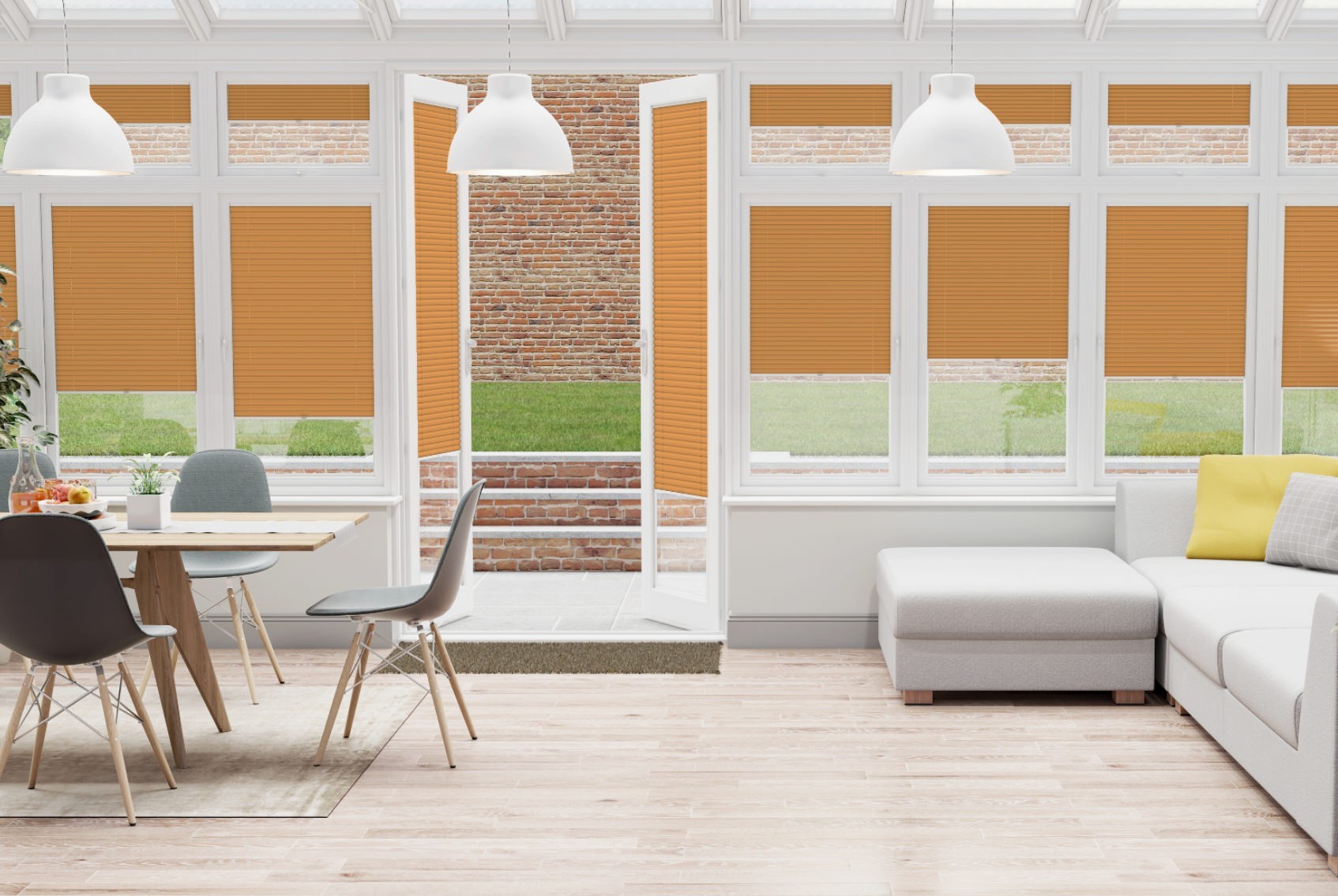
Choosing blinds for a conservatory is not the same as choosing blinds for a standard window. In most rooms, the blind is mainly there to provide privacy, soften daylight or add a decorative finish. In a conservatory, the blind often has to work much harder. It may need to reduce glare from overhead sunlight, help control heat build-up, improve privacy from neighbouring properties and still allow doors and windows to open properly.
A suitable conservatory blind should therefore be judged by performance as much as appearance. The right option needs to suit the glazing, the direction of sunlight, the way the room is used and the type of frames already in place. A blind that looks elegant when closed may still be the wrong choice if it gets in the way of handles, traps moisture against the glass or leaves large gaps where sunlight pours through.
One of the most important considerations is where the blind will be fitted. Roof blinds need to cope with angled or overhead glazing, which immediately rules out many ordinary blind types. Side window blinds, by contrast, need to offer privacy and light control without making the conservatory feel boxed in. Door blinds need to stay practical when the door is opened, closed or used frequently throughout the day.
Thermal performance is another key factor. Conservatories can become uncomfortably warm in summer and noticeably cooler in winter. Blinds cannot turn a poorly insulated conservatory into a fully insulated extension, but the right blind type can help improve comfort by softening solar gain, reducing glare and adding an extra layer between the glass and the room.
Moisture resistance also matters. Conservatories are more prone to condensation than many other areas of the home, especially during colder months. This can make some materials less suitable, particularly heavy fabrics or natural materials that are sensitive to repeated humidity changes. For this reason, practical fabric choice, ventilation and frame compatibility should all be considered alongside style.
Ultimately, the best conservatory blinds are those that balance four things well: light control, temperature comfort, practical fit and daily usability. A blind should make the conservatory easier to live with, not harder to use.
| Suitability Factor | Why It Matters in a Conservatory |
|---|---|
| Solar control | Large areas of glass can allow the room to heat up quickly, especially in south-facing conservatories. |
| Glare reduction | Important for reading, dining, working on a laptop, watching television or simply making the room more comfortable. |
| Thermal performance | The right blind can add a useful layer between the glass and the room, helping to improve comfort in changing temperatures. |
| Moisture resistance | Conservatories can experience condensation, so some fabrics and natural materials may be less suitable. |
| Frame compatibility | The blind needs to suit the frame type, glazing shape, beading depth and position of handles or openings. |
| Door and window access | A conservatory blind should not make it awkward to open windows, French doors, sliding doors or bi-fold doors. |
| Daily usability | If a blind is difficult to operate, reach or adjust, it is less likely to be used properly day to day. |
| Visual balance | Because conservatories contain so much glass, the wrong blind can make the room feel cluttered, heavy or enclosed. |
Best Conservatory Roof Blinds: Pleated and Cellular Blinds
Roof glazing is usually the most challenging part of a conservatory to dress properly. Unlike standard side windows, roof panels are overhead, angled and often exposed to the strongest sunlight of the day. This makes ordinary blind types unsuitable. A roof blind needs to be lightweight, stable, neat when retracted and capable of softening direct sunlight without becoming awkward to use.
This is where pleated and cellular blinds are often among the most practical options. Both are well suited to conservatory roof panels because they can sit close to the glazing, cover individual sections neatly and provide controlled shading without the bulk of heavier window dressings. They also offer a clean finish, which is important in a room where there may be many separate roof panes.
Pleated blinds are a popular choice for conservatory roofs because they provide soft, even light control. They can reduce harsh overhead glare while still allowing the room to feel bright and open. This makes them particularly suitable for conservatories used as dining spaces, reading areas, garden rooms or occasional work areas where daylight is welcome but direct sun is uncomfortable.
Cellular blinds, also known as honeycomb blinds, take this one step further. Their honeycomb structure creates air pockets within the blind, helping to add an insulating layer between the glass and the room. In practical terms, this can help make the conservatory feel more comfortable during both warmer and colder periods. They are not a substitute for proper heating, ventilation or insulation, but they are often a stronger option than standard fabric blinds where year-round comfort is a priority.
The choice between pleated and cellular blinds usually comes down to what the conservatory needs most. If the main issue is glare and soft shading, pleated roof blinds may be perfectly suitable. If the room struggles with heat build-up in summer and heat loss in winter, cellular blinds are often the better-performing option.
Pleated Conservatory Roof Blinds
Pleated roof blinds work particularly well where the aim is to soften sunlight without making the conservatory feel dark. Their slim folded fabric gives a tidy appearance, and because they are relatively lightweight, they are well suited to overhead glazing.
They are best suited to conservatories where glare is the main concern, rather than severe temperature control. They can make the space more comfortable by filtering direct sunlight, but their performance will depend heavily on the fabric chosen. A lighter fabric may preserve brightness, while a more reflective or specialist fabric may offer stronger solar control.
Pleated roof blinds are also a good aesthetic choice when the homeowner wants the blinds to sit quietly in the background. They do not usually dominate the room visually, which is useful in conservatories where too many bulky fittings can make the roofline feel busy.
Cellular / Honeycomb Conservatory Roof Blinds
Cellular blinds are often the more performance-led choice for conservatory roof glazing. The honeycomb construction gives them a clear advantage over a single-layer fabric because the air pockets help create a buffer between the glass and the living space.
This can be especially useful in UK conservatories, where the room may feel too warm in direct summer sun and too cool during winter evenings. Cellular blinds can help reduce some of that exposed-glass feeling by adding a more insulating layer across the roof panels.
They are particularly well suited to conservatories used throughout the year, rather than spaces that are only used occasionally in mild weather. If the conservatory is part dining area, part home office or part everyday living space, the extra comfort benefit can make cellular blinds a more sensible long-term choice.
That said, cellular blinds should still be explained accurately. They can help improve comfort, reduce glare and support better temperature management, but they will not completely solve the underlying limitations of a poorly insulated conservatory.
| Blind Type | Best For | Key Strength | Main Limitation |
|---|---|---|---|
| Pleated roof blinds | Soft shading, glare reduction and a neat roof finish | Lightweight, tidy and well suited to angled roof glazing | Less insulating than cellular blinds |
| Cellular / honeycomb roof blinds | Year-round comfort, improved insulation and glare control | Honeycomb pockets help create an insulating air layer | Will not fully compensate for poor conservatory insulation or ventilation |
Pinoleum Conservatory Roof Blinds: Best for Natural Shading and Traditional Style
Pinoleum blinds are one of the more distinctive options for conservatory roof shading. Where pleated and cellular blinds tend to offer a cleaner, more modern finish, pinoleum blinds bring a softer, more natural look. They are commonly associated with traditional conservatories, timber-framed garden rooms and orangeries where the blind needs to feel like part of the architecture rather than an added technical fitting.
The main strength of pinoleum is the quality of light it creates. Instead of simply blocking the sun, pinoleum gently filters it. This can give a conservatory a warmer, more relaxed atmosphere, reducing harsh glare while still allowing the space to feel connected to the garden. For homeowners who want shading without making the room feel closed in, this can be a strong advantage.
Pinoleum blinds are particularly effective in conservatories where the roof is a major visual feature. The natural woven appearance can soften the structure of the roof and prevent the room from feeling too stark or glass-heavy. This is especially useful in older or more classically styled conservatories, where highly modern blinds may feel slightly out of place.
However, pinoleum should be chosen for the right reasons. It is often more of a natural shading and style-led solution than the most technical performance option. It can reduce glare and soften sunlight very effectively, but it may not offer the same insulating benefit as cellular blinds. For a conservatory where the main issue is year-round temperature comfort, cellular blinds may be the more practical choice. For a conservatory where the goal is filtered light, traditional character and visual warmth, pinoleum can work very well.
Another point to consider is design compatibility. Pinoleum can look excellent in a traditional conservatory, garden-facing room or orangery-style extension, but it may not be the most natural fit for a very minimal, contemporary space. In modern aluminium or uPVC conservatories, the texture may either add welcome warmth or feel visually mismatched, depending on the rest of the interior.
In short, pinoleum blinds are best treated as a specialist conservatory option. They are not the default answer for every roof, but where the room suits them, they can provide a level of natural charm that standard fabric blinds often cannot match.
| Pinoleum Blinds Work Well When… | They May Be Less Suitable When… |
|---|---|
| The conservatory has a traditional, timber or orangery-style design. | The space has a very modern, minimal or highly contemporary finish. |
| The aim is to soften sunlight rather than create a darkened room. | The priority is maximum insulation or stronger thermal performance. |
| The homeowner wants a warmer, more natural look than standard fabric roof blinds. | The room needs a very discreet, almost invisible blind system. |
| The conservatory is mainly used as a garden room, dining area or relaxed sitting space. | The conservatory is used heavily as a home office or screen-based room where stronger glare control is needed. |
Best Conservatory Side Window Blinds: Perfect Fit and Clip-In Blinds
For conservatory side windows and doors, Perfect Fit and clip-in blinds are often among the most practical choices, particularly in modern UK conservatories with uPVC frames. Unlike standard blinds that are fitted above or around the window, these systems are designed to sit neatly within the frame area, creating a more integrated finish.
This matters because conservatories usually have multiple panes, opening windows and glazed doors. A blind that works well on one large bedroom window may become awkward when repeated across several smaller conservatory frames. It may interfere with handles, move around when doors are used or leave the overall space looking cluttered. Perfect Fit and clip-in blinds help reduce these issues by keeping the blind closer to the glass and more closely aligned with each individual pane.
One of their biggest advantages is day-to-day practicality. On suitable doors and windows, the blind can move with the frame, which is especially useful for French doors, tilt-and-turn windows and frequently used openings. This means the blind is less likely to swing, catch or need constant adjustment whenever the window or door is opened.
They are also strong from a design perspective. Because the blind sits neatly within its own frame, it can look more like part of the conservatory rather than an afterthought. In a room with a lot of glazing, this makes a noticeable difference. A cleaner, pane-by-pane finish can help preserve the light, open character of the conservatory while still providing privacy and shade where needed.
However, Perfect Fit and clip-in blinds should not be treated as universally suitable for every conservatory. Their success depends on frame compatibility. Beading depth, handle position, seal condition, frame material and the way the window or door opens can all affect whether this type of blind is appropriate. In older conservatories, unusually shaped frames or non-standard glazing units may make other blind types more suitable.
Fabric and blind type also matter. A Perfect Fit frame may be available with different blind styles, such as pleated, Venetian or roller options, and each one performs differently. For example, a Perfect Fit pleated blind may be better for a softer look, while a Perfect Fit Venetian blind may offer more precise privacy control. The system improves the fit, but the blind type still determines how well it handles light, privacy and comfort.
For many UK conservatories, especially those with uPVC side windows and doors, Perfect Fit and clip-in blinds are one of the strongest options because they solve a key conservatory problem: how to add shading and privacy without disrupting the function of the windows and doors.
| Why Perfect Fit / Clip-In Blinds Work | Why It Matters in a Conservatory |
|---|---|
| Integrated frame fit | Creates a neater finish across multiple panes and avoids the cluttered look of several externally fitted blinds. |
| Moves with the window or door | Useful for French doors, opening windows and frequently used glazed sections. |
| Reduced swinging and movement | Helps prevent the blind from catching, swaying or becoming awkward during everyday use. |
| Pane-by-pane control | Allows different parts of the conservatory to be shaded or opened independently depending on sunlight and privacy needs. |
| Suitable for many uPVC conservatories | A strong match for many modern UK conservatory frames, subject to compatibility with the frame and glazing. |
Vertical Blinds: Best for Large Conservatory Windows and Sliding Doors
Vertical blinds are sometimes seen as a more traditional choice, but in conservatories they remain one of the most practical options for large areas of side glazing. Where a conservatory has wide windows, patio doors or sliding doors, vertical blinds can provide broad coverage without needing several separate blinds fitted side by side.
Their main strength is flexibility. The louvres can be tilted to control sunlight, privacy and visibility without fully closing the blind. This is particularly useful in conservatories that are overlooked by neighbouring gardens or nearby properties. You can soften direct sunlight, reduce glare and maintain some privacy while still allowing natural light into the room.
Vertical blinds also work well where access matters. On sliding doors or wide openings, the blind can usually be drawn neatly to one side, making it easier to move in and out of the conservatory. This makes them a sensible option for conservatories that open onto a patio, decking area or garden.
From a light-control perspective, vertical blinds are especially useful when the sun is lower in the sky. Roof blinds help with overhead sunlight, but side glazing often causes glare earlier or later in the day when the light comes in at an angle. Vertical louvres allow this lower-level light to be managed more precisely than many simple fabric blinds.
There are limitations. Vertical blinds are not suitable for roof glazing, and they may not suit every homeowner’s preferred style. In a draughty conservatory or when doors are left open, the louvres can move slightly. They can also look dated if the wrong fabric, colour or headrail style is chosen. However, when selected carefully, they offer a strong balance of practicality, privacy and coverage.
For wide side windows and sliding doors, vertical blinds remain one of the most useful conservatory blind types because they solve a problem many other blinds struggle with: covering a large glazed span while still allowing easy access and adjustable light control.
| Vertical Blinds Are Best For | Why They Work Well | What to Consider |
|---|---|---|
| Wide conservatory side windows | They can cover broad glazing areas without needing multiple separate blinds. | They need enough space for the louvres to stack neatly when opened. |
| Sliding doors and patio doors | The blind can usually draw to one side, keeping the doorway easier to use. | The stack side should be planned around the direction of door use. |
| Overlooked conservatories | Tilting louvres allow privacy without fully blocking natural daylight. | They may move slightly in draughts if doors or windows are left open. |
| Managing low-angle sunlight | The adjustable louvres help control side glare earlier or later in the day. | They are not suitable for roof glazing or shaped overhead panels. |
Aluminium Venetian Blinds: Best for Moisture Resistance and Precise Light Control
Aluminium Venetian blinds can be a very practical choice for conservatory side windows, particularly where the main priorities are privacy, glare control and low-maintenance use. They are not the warmest or softest-looking option, but they do offer one thing conservatories often need: very precise control over light.
The adjustable slats allow you to fine-tune how much daylight enters the room. This is useful in a conservatory because the light can change dramatically throughout the day. A blind may need to block harsh sun in the morning, reduce glare at lunchtime and provide privacy in the evening. With aluminium Venetian blinds, the slats can be tilted rather than simply opened or closed, giving more control than many fabric blinds.
They are also a good option where moisture resistance is important. Conservatories can be prone to condensation, especially during colder months or where ventilation is limited. Aluminium does not absorb moisture in the same way as natural timber or heavy fabric, making it a more sensible material for side windows in many conservatory settings.
Another advantage is cleaning. Conservatories often sit close to gardens, patios and exterior doors, so dust, pollen and general outdoor debris can be more noticeable. Aluminium Venetian blinds can usually be wiped down more easily than textured fabric blinds, which makes them useful for busy homes or conservatories connected directly to the garden.
However, aluminium Venetian blinds are not the best answer for every conservatory. They are not suitable for roof glazing, and they do not provide the same insulating benefit as cellular blinds. In very sunny spaces, the slats can also become warm when exposed to strong direct sunlight. They are best viewed as a strong side-window solution for control and practicality, rather than a complete thermal solution for the whole conservatory.
They can also be less suitable on frequently used doors if the blind is likely to move, knock or rattle during use. Where doors are involved, an integrated frame system or a better door-specific blind may be preferable.
For modern conservatories, aluminium Venetian blinds can work well when a clean, controlled and practical finish is more important than softness. They are particularly useful where the homeowner wants to manage privacy without making the conservatory feel permanently shaded.
| Strength | Why It Helps in a Conservatory | Limitation to Consider |
|---|---|---|
| Precise slat control | Allows sunlight and privacy to be adjusted throughout the day without fully closing the blind. | Does not create the same soft filtered-light effect as pleated or fabric blinds. |
| Moisture resistance | A practical choice for spaces where condensation may occur. | Still needs regular wiping if condensation, dust or garden debris builds up. |
| Easy cleaning | Useful for conservatories connected to patios, lawns, plants or high-traffic garden access. | Individual slats can take longer to clean than a single flat blind surface. |
| Modern appearance | Works well in contemporary conservatories with clean lines and simple glazing. | May feel too sharp or functional in traditional conservatories. |
| Good privacy control | Slats can be tilted to block views in while still allowing daylight into the room. | Not ideal where complete darkness or strong insulation is the main goal. |
Day and Night Blinds: Useful in Some Conservatories, But Not Always the Best Fit
Day and Night blinds can work well in certain conservatories, but they should be seen as a selective option rather than a universal conservatory blind. Their main advantage is flexible privacy control. The alternating sheer and opaque fabric bands allow the blind to move between a more open, light-filtering position and a more private, closed position without the blind needing to be fully raised or lowered.
This can be useful in a conservatory that is overlooked by neighbouring properties, a pavement, a shared driveway or another part of the garden. During the day, the fabric bands can be aligned to soften views into the room while still allowing daylight through. In the evening, they can be adjusted for stronger privacy, which can make the conservatory feel less exposed.
From a style point of view, Day and Night blinds can also suit conservatories used as sitting rooms, dining spaces or informal living areas. They create a softer look than aluminium Venetian blinds, but with more flexibility than a standard roller blind. This makes them appealing where the homeowner wants something decorative, but still reasonably practical.
However, they are not usually the best option for conservatory roof glazing. Their layered fabric design is better suited to vertical windows than angled or overhead panels. They can also be bulkier than some alternatives, particularly where several blinds are needed across multiple panes. In a small conservatory, this can make the window area look more crowded than intended.
They are also less performance-led than cellular blinds where insulation is the priority. While Day and Night blinds can help with privacy and glare, they do not offer the same thermal benefit as a honeycomb blind. For a conservatory that overheats in summer or feels cold in winter, they may be better used on selected side windows rather than relied upon as the main comfort solution.
For this reason, Day and Night blinds are best suited to side glazing where privacy, filtered daylight and appearance are the main priorities. They can be a good choice in the right setting, but they should not be mistaken for the strongest roof, insulation or heavy-duty solar-control option.
| Day and Night Blinds Work Well When… | They Are Less Suitable When… |
|---|---|
| The conservatory is overlooked and needs flexible daytime privacy. | The blind is needed for roof glazing or angled overhead panels. |
| The room is used as a sitting area, dining space or informal living room. | Thermal insulation is the main priority. |
| A softer look is preferred over metal slats or more technical-looking blinds. | The conservatory has many small panes and several blinds would create too much visual bulk. |
| The main aim is balancing daylight and privacy rather than blocking strong heat. | The space suffers from intense summer heat or severe overhead glare. |
Wooden and Faux Wood Blinds: Use With Caution in Conservatories
Wooden and faux wood blinds are often considered for conservatories because they offer strong privacy control, a familiar Venetian-style appearance and a more substantial finish than aluminium slats. They can look attractive, especially in garden-facing rooms where a natural or warm interior style is preferred. However, conservatories place very different demands on blinds compared with standard rooms, so this category needs to be approached carefully.
The first distinction is between real wood and faux wood. Real wood blinds have natural warmth and texture, but they are generally less suited to conservatories that experience high heat, frequent condensation or sharp temperature changes. A conservatory can become hot during the day, cool quickly in the evening and collect condensation on the glazing in colder months. These conditions are not ideal for natural timber, which can be more sensitive to movement, warping or surface change over time.
Faux wood blinds are usually the more practical option if the homeowner wants a wood-effect look in a conservatory. Because they are made from moisture-resistant materials rather than natural timber, they are better suited to spaces where humidity and condensation may be a concern. They also offer good privacy control, are easier to wipe clean and can provide a solid, structured look on side windows.
That said, faux wood blinds still have limitations. They are heavier than aluminium Venetian blinds, particularly on wider windows. In a conservatory with several large panes, this can make them less convenient to operate and visually heavier than expected. They are also not suitable for roof glazing, and they may feel bulky if used across every side window in a smaller conservatory.
The best way to view faux wood blinds is as a selective side-window solution, not a full conservatory-wide answer. They can work well on individual windows where privacy, durability and a warmer finish are important. They are less suitable where the main challenges are overhead glare, roof shading or year-round thermal comfort.
Real wood blinds, by contrast, should be treated with more caution. They may work in a well-ventilated, lower-humidity garden room or orangery-style space, but they are usually not the most practical blind type for a typical UK conservatory with large amounts of glazing and regular temperature fluctuation.
| Blind Type | Where It Can Work | Main Concern | Expert View |
|---|---|---|---|
| Real wood blinds | Selected side windows in well-ventilated, lower-humidity garden rooms or orangeries. | Natural timber can be affected by heat, humidity and condensation. | Attractive, but usually not the most practical choice for a typical glass-heavy conservatory. |
| Faux wood blinds | Side windows where privacy, wipe-clean practicality and a wood-effect finish are desired. | Heavier than aluminium blinds and unsuitable for roof glazing. | A more practical alternative to real wood, but best used selectively rather than across every pane. |
Standard Roller Blinds: Why They Are Often Not the Best Conservatory Choice
Standard roller blinds are one of the most familiar blind types, but they are not always the strongest choice for a conservatory. This does not mean roller blinds are poor products. In the right room, they can be simple, neat and effective. The issue is that conservatories create conditions that expose the limitations of a standard roller blind very quickly.
The first problem is fit. Conservatories usually have multiple panes, opening windows, glazed doors and sometimes awkward shapes. A standard roller blind is generally designed to cover a straightforward rectangular window. When repeated across several smaller conservatory panes, it can look fragmented, leave visible gaps and become less convenient to use. On doors, the blind may also swing or interfere with handles unless a more suitable fitting system is used.
Roof glazing is another major limitation. Standard roller blinds are not designed for angled or overhead conservatory roof panels. They need gravity to hang correctly, so they are unsuitable for most roof applications. This immediately rules them out as a complete conservatory solution because the roof is often where the strongest heat and glare problems occur.
Light gaps can also be more noticeable in conservatories. Because sunlight can enter from the roof, sides and doors at different angles, small gaps around a roller blind may allow more glare than expected. This is particularly relevant in south-facing conservatories, where the problem is rarely just privacy. The blind needs to manage strong sunlight throughout the day, not simply cover the glass when lowered.
There is also a performance difference between ordinary roller blinds and more specialist conservatory options. A standard fabric roller blind may provide privacy and some shading, but it will not usually offer the same integrated fit as Perfect Fit or clip-in blinds, the same roof suitability as pleated blinds, or the same insulating benefit as cellular blinds. For a conservatory that regularly overheats or feels exposed, this can make roller blinds feel under-specified.
That said, roller blinds should not be dismissed completely. They can still work on a simple side window, especially where the priority is privacy, budget or a clean minimalist look. They may also suit a small conservatory with straightforward glazing and limited heat issues. The key is to avoid treating a standard roller blind as the default answer for every pane, every door and every roof section.
For most conservatories, standard roller blinds are best viewed as a limited side-window option rather than a specialist conservatory solution.
| Where Standard Roller Blinds May Work | Where They Often Fall Short |
|---|---|
| A simple rectangular side window with no awkward handles or openings. | Angled roof glazing, shaped panels or overhead conservatory sections. |
| A small conservatory where privacy is the main requirement. | South-facing conservatories where heat and glare are the main issues. |
| A budget-led project where a basic side-window covering is acceptable. | Doors or frequently used openings where the blind may swing, catch or obstruct access. |
| Minimal interiors where a plain fabric blind suits the overall design. | Conservatories with many separate panes, where multiple rollers can look visually busy. |
Heavy Fabric Curtains: Why They Usually Work Against the Conservatory
Heavy fabric curtains can add warmth and softness to a living room, bedroom or dining room, but they are usually less suitable for a typical conservatory. The main reason is that conservatories are built around glass, light and openness. A window dressing that relies on large amounts of fabric can quickly work against those qualities, making the space feel heavier, darker and more enclosed.
The practical issues are often just as important as the visual ones. Conservatories usually have several glazed sides, multiple window sections and one or more door openings. Fitting curtains neatly around this kind of layout can be difficult, especially where there is limited wall space for tracks or poles. Even where fitting is possible, the fabric stack can interfere with doors, reduce usable space or block part of the glazing when the curtains are open.
Moisture is another important concern. UK conservatories can experience condensation, particularly during colder months when warm indoor air meets cooler glass. Heavy curtains positioned close to the glazing can trap moisture and reduce airflow around the window area. Over time, this may make them less practical than blinds that sit more neatly within or close to each individual frame.
Heavy curtains also lack the precision that conservatories often need. With blinds, it is possible to control specific panes, adjust slats, filter overhead light or manage privacy on one side of the room. Curtains tend to work more broadly: open or closed. This can be too blunt for a conservatory, where one side of the room may be in direct sun while another remains shaded.
There are some exceptions. Curtains may work as a decorative addition in an orangery-style extension, a more substantial garden room or a conservatory with enough wall space and a clear run for a track. They may also be useful across one set of doors if the room is being styled more like a conventional living space. However, as the main shading and privacy solution for a glass-heavy conservatory, heavy fabric curtains are rarely the most practical choice.
For most conservatories, blinds offer better control, a lighter appearance and a more suitable fit for multiple panes, doors and roof glazing.
| Why Heavy Curtains Can Be Problematic | What It Means in a Conservatory |
|---|---|
| Too much visual weight | Large fabric drops can make a glass-heavy room feel darker, smaller and less open. |
| Awkward around doors | Curtain stacks can interfere with French doors, patio doors or sliding access to the garden. |
| Limited fitting space | Many conservatories do not have enough solid wall or frame space for conventional poles or tracks. |
| Moisture and condensation risk | Heavy fabric close to cool glazing can restrict airflow and may be less practical in damp or condensation-prone spaces. |
| Less precise light control | Curtains do not offer the same pane-by-pane adjustment as blinds, which can be important when sunlight enters from several angles. |
Roman Blinds: Attractive, But Usually Impractical for Conservatories
Roman blinds can look elegant in conventional rooms, especially where the aim is to create softness, texture and a more furnished interior feel. In a conservatory, however, the same qualities that make Roman blinds appealing can also make them less practical.
The main issue is fabric bulk. Roman blinds fold into horizontal pleats when raised, creating a fabric stack at the top of the window. In a normal room, this can look decorative. In a conservatory, where window sections are often smaller, taller, narrower or repeated across several panes, that stack can start to block useful daylight and make the glazing feel more crowded.
Roman blinds are also poorly suited to roof glazing. They are designed for vertical windows, not angled or overhead panels. This means they cannot deal with one of the biggest conservatory problems: direct sunlight and glare from above. If the roof is left untreated, Roman blinds on the side windows may improve privacy but still leave the room uncomfortable during bright or warm periods.
Moisture is another concern. Conservatories can experience condensation, particularly in colder UK weather. Because Roman blinds are fabric-based and often use lining, folds and stitching, they can be less practical in spaces where moisture regularly collects around the glass. This does not automatically mean they will fail, but they need a more stable environment than many typical conservatories provide.
They can also be awkward on doors. French doors, patio doors and frequently used glazed openings need window dressings that stay neat during movement. A Roman blind can feel bulky, may get in the way of handles and is generally less convenient than frame-fitted blinds or vertical blinds for door access.
That said, Roman blinds do have a place in some conservatory-style spaces. They may work on a single feature window in an orangery, a well-insulated garden room or a conservatory that is used more like a living room than a high-glare glass room. In those cases, they are mainly a style-led choice rather than a technical conservatory solution.
For most standard conservatories, Roman blinds are best approached with caution. They can look beautiful, but they are rarely the most practical answer for heat, glare, moisture, roof shading or everyday access.
| Roman Blinds May Work When… | They Are Usually Best Avoided When… |
|---|---|
| The conservatory is more like an orangery or garden room with good insulation and ventilation. | The room has a glass roof and needs strong overhead glare control. |
| There is one feature side window where a softer decorative finish is desired. | There are many repeated panes where fabric stacks would make the glazing look crowded. |
| The room is not prone to condensation or major temperature swings. | The conservatory regularly experiences condensation, humidity or sharp temperature changes. |
| The blind is being chosen mainly for interior style rather than technical performance. | The main priorities are heat reduction, practical door access or low-maintenance use. |
Real Wood Blinds in Hot or Humid Conservatories: A Risky Choice
Real wood blinds can bring warmth, texture and a premium finish to many areas of the home, but conservatories are not always the right environment for them. The issue is not the appearance. Real wood blinds can look excellent against garden views, timber furniture and natural interior schemes. The concern is how natural timber responds to the conditions often found in a conservatory.
A typical UK conservatory can experience significant temperature changes throughout the year. It may become very warm in direct sun, cool quickly in the evening and develop condensation when warm indoor air meets cold glazing. These changes can create a demanding environment for natural materials, especially those positioned close to glass.
Because real wood is an organic material, it is more sensitive to moisture and heat than aluminium or many synthetic alternatives. In a conservatory, repeated exposure to humidity, condensation or strong sunlight may increase the risk of movement, warping, bowing or changes to the finish. This is particularly relevant on south-facing elevations or in conservatories that are not well ventilated.
Weight is another factor. Real wood blinds are generally heavier than aluminium Venetian blinds, and this can matter when covering larger conservatory side windows. On wide panes, the blind may become harder to operate and less practical for regular use. When repeated across several windows, the overall look can also become quite heavy, which may work against the light, open feeling many people want from a conservatory.
Real wood blinds are also not suitable for roof glazing. They are designed for vertical windows, so they will not solve the overhead glare and solar gain issues that often make conservatories uncomfortable. At best, they are a side-window option, and even then only in the right setting.
This does not mean real wood blinds can never be used near a conservatory. In a well-ventilated orangery, a more insulated garden room or a conservatory with limited condensation, they may be a suitable style-led choice on selected side windows. However, for a classic glass-heavy conservatory, especially one exposed to strong sun or regular moisture, they are usually a higher-risk choice than faux wood or aluminium alternatives.
A more practical approach is to use faux wood blinds where a timber-style appearance is wanted, or aluminium Venetian blinds where precise light control and moisture resistance are the priorities.
| Concern With Real Wood Blinds | Why It Matters in a Conservatory | Better Alternative |
|---|---|---|
| Heat exposure | Strong sunlight and temperature swings can be demanding for natural timber. | Faux wood or aluminium Venetian blinds. |
| Condensation and humidity | Moisture near the glass may increase the risk of movement, bowing or surface changes. | Faux wood blinds for a more moisture-resistant wood-effect finish. |
| Weight | Larger side windows may become harder to operate with heavier blind materials. | Aluminium Venetian blinds for a lighter slatted option. |
| Not suitable for roofs | Real wood blinds cannot address overhead glare or roof-level solar gain. | Pleated or cellular conservatory roof blinds. |