Order Tracking
 0800 1422417
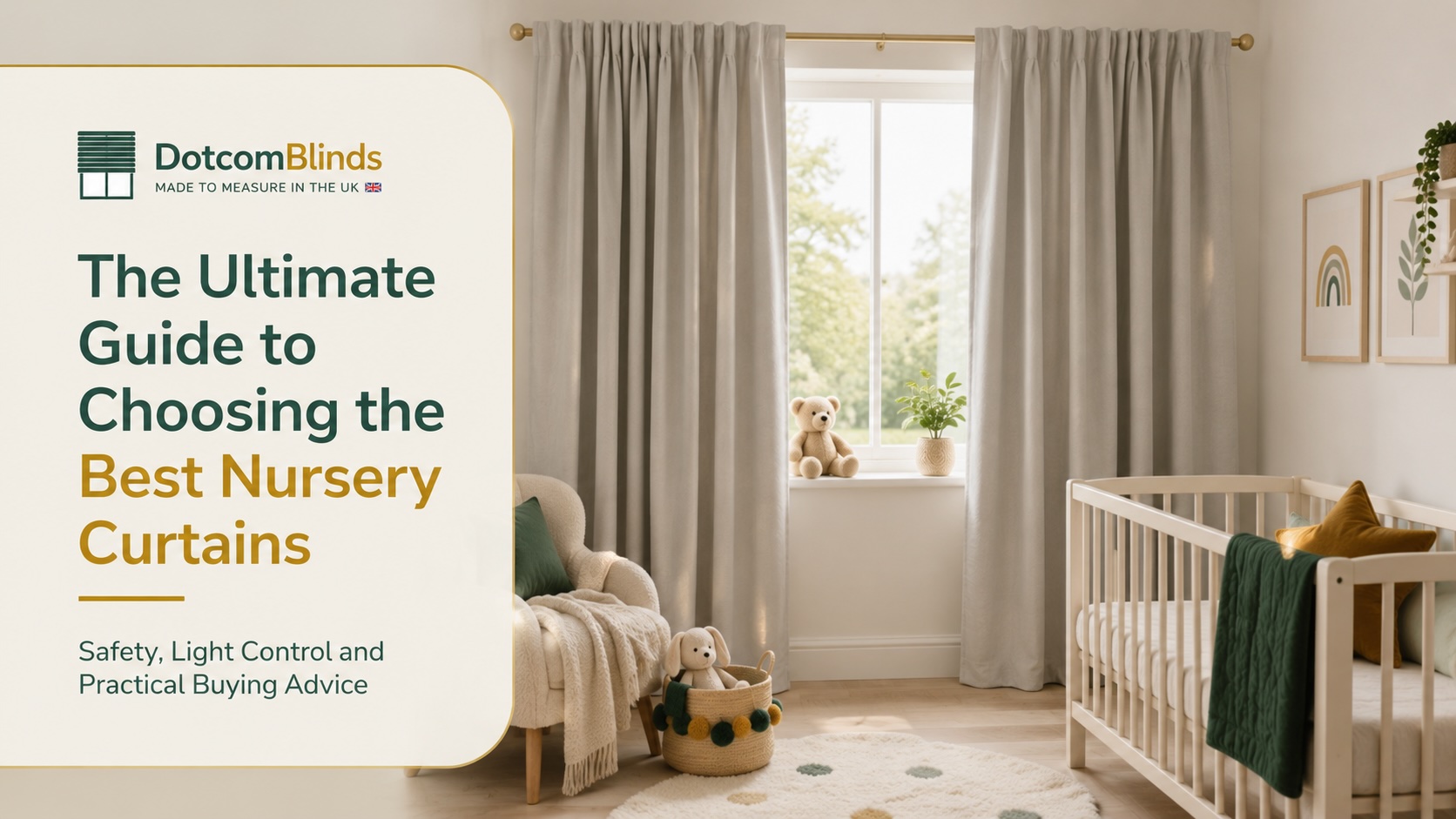
Choosing nursery curtains is not really about finding the prettiest fabric. While colour, pattern and style all matter, they are ultimately subjective. The more important question is whether the curtains help create a safer, darker and more comfortable sleep environment for your baby.
A nursery has different requirements from a standard bedroom. Curtains may need to block early morning summer light, reduce glare during daytime naps, help regulate room temperature and remain practical as your child grows from newborn to crawler to toddler. The wrong setup can look beautiful but still let light pour in around the edges, trap heat behind a radiator or introduce unnecessary safety concerns.
That is why the “best” nursery curtains are not one single product or fabric. The right choice depends on the room, the window, the age of the child and how much light, warmth and privacy control you need. In this guide, we focus less on decorative themes and more on the technical details that make nursery curtains work properly in real UK homes.
As a UK made-to-measure blinds and curtains specialist, DotcomBlinds helps customers choose window dressings based on fit, function and day-to-day practicality, supported by strong customer feedback through its 4.6/5 Feefo rating from over 1,500 verified reviews.
What This Nursery Curtains Guide Covers
Use the links below to jump to the section most relevant to your nursery, whether you are comparing safety, blackout performance, thermal comfort, heading styles or room-specific curtain setups.
Why Nursery Curtains Need to Do More Than Look Nice
Child Safety First: What Parents Need to Know
Light Control: Why Blackout Performance Matters in a Nursery
Reducing Light Leakage Around the Window
Thermal Performance: Keeping the Nursery Comfortable
Acoustic Benefits: Can Curtains Help Reduce Noise?
Fabric Choice: Durability, Cleaning and Practical Use
Curtain Heading Styles Compared for Nursery Performance
When Curtains May Not Be the Best Standalone Option
The Hybrid Solution: Curtains Plus a Blackout Blind
Best Nursery Curtain Setups by Room Scenario
Nursery Curtain Buying Checklist
Final Thoughts: The Best Nursery Curtains Depend on the Room
Why Nursery Curtains Need to Do More Than Look Nice
Most nursery curtain advice focuses on design: soft colours, playful prints, calming patterns and matching accessories. These details are important for creating a pleasant room, but they are not the main performance factors that determine whether curtains actually work well in a nursery.
A nursery is a practical sleep space. The curtains need to support the way the room is used at different times of day, not just how it looks when the room is tidy and styled. For example, a beautiful pair of curtains may still be a poor choice if they allow bright morning light through the fabric, leave large gaps around the window or hang too close to a radiator.
The main technical considerations are:
- Light control: helping to darken the room for daytime naps, early bedtimes and bright summer mornings.
- Safety: avoiding loose cords, low-hanging tie-backs and unnecessary pulling hazards as the child becomes more mobile.
- Temperature control: helping the room feel more stable in winter and reducing excessive glare or heat gain in summer.
- Practicality: choosing fabrics, linings and heading styles that suit everyday nursery use.
- Fit: ensuring the curtain size, track position and overlap work with the window, rather than relying on looks alone.
This is why there is no universal “best” nursery curtain. An east-facing nursery may need stronger blackout control than a shaded north-facing room. A nursery with a radiator beneath the window may need a different curtain length from a room with a clear wall below the sill. A small nursery may benefit from a more compact blind-and-curtain combination, while a larger room may suit heavier lined curtains.
The most effective nursery curtains are therefore chosen as part of a wider room setup. Design still matters, but it should come after the technical requirements: safety, darkness, thermal comfort and correct fitting.
Child Safety First: What Parents Need to Know
Safety should always come before fabric, colour or heading style when choosing nursery curtains. A nursery window dressing may look soft and harmless, but anything that hangs, loops, trails or can be pulled needs to be considered carefully once a baby starts moving around the room.
The first point to check is the operating mechanism. Curtains themselves are usually straightforward when operated by hand, but some curtain tracks, blinds and layered window treatments may involve cords, chains, tie-backs or tensioning devices. In a nursery, any loose or looped cord should be kept completely out of reach of babies and young children. New blinds with looped cords or chains must be supplied with child safety devices, and these should always be fitted and used correctly.
Placement is just as important as the product itself. Cots, changing tables, chairs, toy boxes and other climbable furniture should not be positioned close to curtain cords, blind chains or low-hanging fabric. As children become more mobile, they can reach higher than expected by climbing, pulling or standing on furniture.
Curtain length also deserves careful thought. Full-length curtains can work well in some bedrooms, but they are not always the most practical option for a nursery. Once a child reaches the crawling, pulling-up or toddler stage, long fabric can become tempting to grab. Heavy curtains that pool on the floor may also collect dust and can be easier for a child to tug.
For many nursery windows, a neater and safer approach is to choose curtains that finish at sill level, below the sill or just clear of the floor, depending on the room layout. If there is a radiator beneath the window, keeping the curtains clear of the radiator is also better for heat circulation.
Tie-backs should be treated with caution. Decorative tie-backs can help frame the window, but long cords, tassels or loose fabric loops are not ideal in a young child’s room. If tie-backs are used, they should be fitted securely, positioned out of reach and kept as simple as possible.
A safer nursery curtain setup usually means:
- No accessible looped cords or chains
- No low-hanging tie-backs, tassels or loose fabric loops
- Furniture positioned away from the window
- Curtains sized to reduce grabbing, pooling and pulling risks
- Tracks, poles and brackets fixed securely into a suitable surface
- A window dressing system that remains safe as the child grows
This is one of the main reasons nursery curtains should be chosen as part of the whole room layout, rather than as a decorative finishing touch. The safest option is not always the longest, thickest or most dramatic curtain. It is the one that gives the room the right level of privacy, softness and light control without creating unnecessary risks.
Light Control: Why Blackout Performance Matters in a Nursery
Light control is one of the most important technical factors when choosing nursery curtains. A fabric may look soft, warm and suitable for a baby’s room, but if it allows too much light into the space, it may not perform well during daytime naps, early bedtimes or bright summer mornings.
This is particularly relevant in the UK, where daylight hours change significantly throughout the year. In summer, some rooms can begin to brighten very early in the morning and remain light until late evening. For a nursery, this can make it harder to create a consistent sleep environment, especially if the window faces east, south or west.
The key point is that not all dark curtains are blackout curtains. A dark-coloured fabric may reduce glare, but that does not mean it blocks light effectively. Blackout performance usually comes from the lining or backing, not simply from the face fabric.
There is also an important difference between dim-out and blackout:
- Dim-out fabrics reduce the amount of light entering the room, but they still allow some brightness through.
- Blackout fabrics or linings are designed to block light more effectively, making them more suitable where stronger room darkening is needed.
For nursery use, blackout lining is often the more practical option because it gives greater control across different times of day. It can be especially useful for daytime naps, early summer sunrises and rooms affected by street lights at night.
However, the lining is only part of the solution. Even a high-quality blackout curtain can underperform if the installation allows light to leak around the window. This is one of the most common issues with nursery curtains. Light can enter through:
- the gap between the curtain and the wall
- the top of the track or pole
- the sides of the window
- the space beneath the curtain
- eyelet holes or loose folds in the heading
This is why curtain heading and fitting style matter. Eyelet curtains are easy to use and popular in bedrooms, but they can allow more light through the top because the rings create visible gaps. In some rooms, the “glowing eyelet” effect can be noticeable when strong morning light hits the window.
Pencil pleat or pinch pleat curtains often perform better for blackout because they sit closer to the track and create denser folds. When combined with enough fabric width, good overlap and accurate measuring, they can reduce light leakage more effectively than looser heading styles.
For nurseries where darkness is a priority, curtains may work best as part of a layered setup. A blackout blind fitted inside the recess can handle the main light-blocking role, while curtains fitted outside the recess add softness, warmth and extra coverage around the window. This combination is often more effective than relying on curtains alone, particularly in rooms with awkward windows or strong morning sun.
The aim is not simply to choose “blackout curtains” as a label. The aim is to create a window setup that controls both light through the fabric and light around the fabric. Both matter if the nursery needs to stay darker for longer.
Reducing Light Leakage Around the Window
Blackout performance is not only about the fabric. In many nurseries, the bigger problem is not light coming through the curtain itself, but light escaping around it. This is why two curtains with the same blackout lining can perform very differently once fitted.
Light leakage usually happens in four main areas: the top of the window, both sides, the bottom edge and through gaps created by the curtain heading. Reducing these gaps can make a significant difference to how dark the nursery feels, especially during early summer mornings or daytime naps.
The first area to consider is the top of the window. If a curtain pole sits too close to the window opening, light can spill over the top of the curtains. This is particularly noticeable with eyelet curtains, where the fabric naturally sits below the pole and leaves more space for light to enter. A properly positioned track or pole, fitted higher above the recess where possible, can help reduce this issue.
The sides of the window are another common weak point. Curtains should usually extend beyond the window opening, rather than finishing exactly at the edge of the recess. This extra width helps the fabric overlap the wall and reduces the bright strips of light that can appear down each side. For nursery curtains, generous overlap is often more effective than choosing a darker face fabric.
The bottom edge also matters. Curtains that finish too high above the sill or floor can allow light to shine underneath. However, this needs to be balanced with safety, radiator placement and practicality. In a nursery, the goal is not always to make curtains touch the floor. The better solution is to choose a drop that suits the room while keeping unwanted gaps to a minimum.
Curtain fullness plays an important role as well. Curtains with too little fabric can hang flat, pull away from the wall and leave more exposed gaps. Fuller curtains create deeper folds, which help block light paths and improve the overall sense of darkness. This is one reason made-to-measure curtains can be particularly useful: the width, drop and fullness can be specified around the actual window rather than guessed from standard sizes.
Heading style can also affect light control. Pencil pleat and pinch pleat curtains tend to sit closer to the track and create a more compact top section, making them useful where blackout performance is a priority. Eyelet curtains are simple and attractive, but they often leave more visible gaps near the pole and through the eyelet openings themselves.
For nurseries that need stronger light exclusion, consider these practical steps:
- Fit the pole or track wider than the window opening.
- Position the pole or track higher above the recess where the wall allows.
- Choose enough curtain width to create proper overlap and fullness.
- Avoid heading styles that leave large top gaps if darkness is a priority.
- Consider pencil pleat or pinch pleat headings for better top coverage.
- Keep the curtain drop practical, safe and as close-fitting as the room allows.
- Add a recess-fitted blackout blind behind the curtains if the room needs near-total darkness.
A layered setup is often the strongest option. A blackout blind fitted inside the recess helps block the main window area, while curtains outside the recess soften the room and cover some of the perimeter gaps. This can be more effective than relying on one heavy curtain alone, particularly in rooms with awkward windows, shallow recesses or strong early morning sun.
The aim is to think about the window as a complete system. Fabric, lining, heading style, track position, overlap and drop all work together. When these details are planned properly, nursery curtains are far more likely to deliver the darkness parents expect.
Thermal Performance: Keeping the Nursery Comfortable
Temperature control is another important consideration when choosing nursery curtains. A nursery should feel calm and comfortable, but it should also avoid becoming too hot, too cold or affected by sudden temperature changes around the window.
Windows are often one of the weakest points in a room’s insulation. In winter, heat can escape through the glass and cold air can make the area around the window feel noticeably cooler. In summer, direct sunlight can increase heat and glare, particularly in south-facing and west-facing rooms. Well-chosen curtains can help reduce these extremes by adding an extra layer between the nursery and the window.
Lined curtains are usually more effective than unlined curtains because the lining adds weight, structure and insulation. Blackout lining can help reduce both light and some heat transfer, while thermal lining is designed more specifically to improve temperature control. Interlined curtains add another layer between the face fabric and lining, helping to trap air and create a thicker insulating barrier.
This does not mean the heaviest curtain is automatically the best nursery option. The right choice depends on the room. A draughty period property with older windows may benefit from thicker, lined or interlined curtains. A modern, well-insulated home may not need the same level of fabric weight, especially if the room already retains heat well.
Radiator placement is particularly important in UK homes. Many bedrooms have radiators directly beneath the window. If full-length curtains are drawn over the radiator, much of the heat can become trapped behind the fabric and against the glass, rather than circulating into the room. This can make the heating work less efficiently and may leave the nursery feeling cooler than expected.
Where a radiator sits below the window, sill-length curtains, below-sill curtains or a blackout blind may be more practical than full-length curtains. Another option is to use a recess-fitted blackout blind for light control, then add dress curtains outside the recess for softness and extra insulation without covering the radiator fully.
Thermal performance also matters in summer. A nursery that overheats during the day can be uncomfortable by bedtime, especially if it receives direct afternoon sun. Blackout or thermal-lined curtains can help reduce solar glare and limit some heat gain, but ventilation, room position and wider home insulation will still play a role.
For better thermal performance, consider:
- Lined curtains for improved structure and insulation compared with unlined fabric.
- Blackout lining where light control and some thermal benefit are both needed.
- Thermal lining or interlining for colder rooms, draughtier windows or period properties.
- Sill-length curtains where a radiator sits below the window.
- A blind-and-curtain combination where the room needs both blackout control and flexible heat management.
- Accurate fitting to reduce gaps where cold air and light can pass around the window.
The aim is not to seal the nursery completely, but to create a more stable room environment. Curtains can help reduce heat loss, soften cold window areas and limit harsh sunlight, but they work best when the length, lining and installation are chosen around the actual room layout.
Acoustic Benefits: Can Curtains Help Reduce Noise?
Curtains can help make a nursery feel softer and calmer, but it is important to be realistic about what they can and cannot do. Curtains will not soundproof a room. They will not block traffic noise, aircraft noise or loud neighbours in the same way as specialist acoustic glazing or building-level insulation. However, the right curtains can help reduce echo, soften sharp sounds and make external noise feel less harsh inside the room.
This can be useful in nurseries facing busy roads, shared driveways, school routes, urban streets or gardens where there is regular daytime noise. During naps, even a small reduction in hard, reflective sound can make the room feel more settled.
The acoustic benefit mainly comes from fabric weight, density and fullness. Heavier curtains absorb and disrupt more sound energy than thin, lightweight fabrics. Lined or interlined curtains usually perform better because they add extra layers and mass. Fuller curtains also help because the folds create more surface area, which can soften sound more effectively than a flat piece of fabric.
For better acoustic performance, look at:
- Fabric weight: heavier fabrics generally soften sound better than very light fabrics.
- Lining: blackout, thermal or interlined curtains add useful extra layers.
- Fullness: deeper folds create more fabric surface area to absorb and diffuse sound.
- Coverage: curtains that extend beyond the window opening reduce exposed hard surfaces.
- Fit: wider, well-fitted curtains usually perform better than narrow curtains that barely cover the glass.
This is another reason nursery curtains should be considered as part of the full room setup. Rugs, upholstered furniture, soft bedding, fabric storage and wall coverings can all help reduce echo and make the room feel acoustically softer. Curtains can contribute to this, but they should not be expected to solve serious noise problems on their own.
For nurseries where noise is a concern, a layered window treatment can be helpful. A blackout blind inside the recess can control light, while heavier lined curtains outside the recess can add softness, insulation and some acoustic benefit. This approach is particularly useful where the nursery needs to feel darker, warmer and quieter without relying on one product to do everything.
Fabric Choice: Durability, Cleaning and Practical Use
Fabric choice for nursery curtains should be based on more than appearance. The pattern may set the tone of the room, but the fabric itself affects how the curtains hang, how well they handle daily use and how easy they are to maintain over time.
Nursery curtains are likely to work harder than curtains in many other rooms. They may be opened and closed several times a day, exposed to dust, handled frequently and used alongside heating, ventilation or humidifiers. As the child grows, they may also be pulled, brushed against or touched with less-than-clean hands. This makes durability and care requirements especially important.
Natural fabrics such as cotton and linen are popular because they have a soft, familiar look and suit many nursery styles. However, they can be more absorbent, more prone to creasing and more sensitive to washing conditions. If they are used in a nursery, they usually perform better when properly lined, both for structure and for light control.
Polyester and polyester-blend fabrics are often more practical from a maintenance point of view. They tend to hold their shape well, resist creasing better and are less likely to shrink than many natural fabrics. For blackout nursery curtains, synthetic blends can also work well because they are commonly used with specialist linings and performance backings.
Heavier woven fabrics can be useful where the nursery needs more softness, warmth or acoustic comfort. They can help the room feel more settled and substantial, particularly in older homes or rooms facing busy roads. The trade-off is that heavier curtains need secure fitting, suitable tracks or poles and careful consideration around length, safety and ease of operation.
Cleaning is another important point. Not all nursery curtains will be machine washable, especially if they include blackout lining, thermal lining, interlining or delicate finishes. Some may require professional cleaning, while others may allow gentle spot cleaning. Parents should always check the care instructions before buying, rather than assuming that a nursery curtain can simply be put in the washing machine.
Moisture also needs consideration. Nurseries sometimes use humidifiers, and some rooms may be more prone to condensation around the window. Highly absorbent fabrics can hold moisture and dust more easily, while more stable blends may be easier to manage in rooms where condensation is an issue. Good ventilation remains important, whatever fabric is chosen.
A practical nursery fabric should be assessed against:
- Durability: will it cope with frequent opening, closing and handling?
- Shape retention: will it hang neatly over time?
- Cleaning requirements: can it be spot cleaned, machine washed or professionally cleaned?
- Compatibility with lining: will it work well with blackout or thermal lining?
- Weight: is the fabric suitable for the chosen track, pole and wall fixing?
- Moisture resistance: is it appropriate for a room affected by condensation or humidifier use?
- Texture: will it collect dust easily or be difficult to maintain?
The right fabric is therefore a balance between comfort, performance and upkeep. A beautiful fabric that is difficult to clean, unsuitable for blackout lining or too heavy for the installation may not be the most practical nursery choice. Equally, a more durable fabric may be the better long-term option if the room needs reliable daily use rather than purely decorative impact.
Curtain Heading Styles Compared for Nursery Performance
The heading style affects more than how the curtains look. It changes how closely the fabric sits to the track or pole, how much light escapes around the top of the window, how easy the curtains are to operate and how well the fabric folds when drawn.
For a nursery, this makes heading style a technical decision as much as a design choice. A curtain that looks attractive when open may not perform as well when the room needs to be dark, warm and settled for sleep.
Curtain Heading Styles Compared for Nursery Performance
Curtain heading style affects more than appearance. It can influence blackout performance, ease of use, light leakage and how suitable the curtains are for everyday nursery use.
Pencil Pleat
Light Control
Usually strong, as the curtain can sit close to the track and reduce top light leakage.
Practicality
Flexible, widely used and suitable for tracks or poles.
Nursery Suitability
Often one of the strongest choices for nursery curtains where blackout performance matters.
Pinch Pleat
Light Control
Strong, with structured folds that help the curtain hang neatly and evenly.
Practicality
More formal and usually made to measure.
Nursery Suitability
Good for a polished nursery finish, especially with blackout or thermal lining.
Eyelet
Light Control
Moderate to weak, as light can pass through the eyelet holes and the gap above the fabric.
Practicality
Easy to open and close, with a simple contemporary look.
Nursery Suitability
Practical in some bedrooms, but less ideal where maximum darkness is needed.
Wave
Light Control
Moderate, depending on track position and curtain fullness.
Practicality
Smooth, modern and easy to operate.
Nursery Suitability
Suitable for a neat modern nursery, but may need a blackout blind behind it for stronger light control.
Tab Top or Tie Top
Light Control
Usually weak, as the gaps along the top allow light to enter.
Practicality
Decorative but less performance-focused.
Nursery Suitability
Generally not the best technical choice for nurseries where darkness, insulation and safety are priorities.
For most nursery settings where blackout performance is important, pencil pleat and pinch pleat curtains are usually stronger technical options than eyelet, tab top or tie top curtains. If a more decorative heading is preferred, consider pairing the curtains with a blackout blind inside the recess.
From a performance point of view, pencil pleat and pinch pleat curtains are usually the strongest nursery options. They create a denser, more controlled heading and can sit closer to the track, which helps reduce the light gap above the curtain. When paired with blackout lining and enough width for proper fullness, they can provide a more effective room-darkening result.
Eyelet curtains are popular because they are simple to use and easy to draw, but they have a clear technical weakness in a nursery. The fabric sits below the pole, which leaves a gap at the top, and light can also show through or around the metal rings. In a bright east-facing room, this can be enough to disturb the sense of darkness even when blackout fabric has been used.
Wave curtains can work well in modern spaces, especially where a smooth, minimal look is wanted. However, because the folds are evenly spaced and the track system is more exposed, they may not be the strongest standalone option for blackout performance. If the nursery needs near-total darkness, wave curtains may be better used with a blackout blind fitted inside the recess.
Tab top and tie top curtains are usually the weakest from a technical perspective. The gaps between the tabs or ties allow more light through, and the overall fit is less sealed than other heading styles. They can look soft and decorative, but they are rarely the best choice where sleep, insulation and practical nursery use are the main priorities.
The main point is that heading style should be chosen around the room’s performance needs. If the nursery already has a blackout blind, a more decorative heading may be acceptable. If the curtains are expected to do most of the light-blocking work, a closer-fitting heading such as pencil pleat or pinch pleat will usually be the more practical choice.
When Curtains May Not Be the Best Standalone Option
Curtains can be an excellent choice for a nursery, but they are not always the best solution on their own. In some rooms, relying only on curtains can create issues with light control, space, heating efficiency or everyday practicality.
One common example is a small nursery with limited wall space. Full curtains need room to stack at the sides of the window when open. If the room is compact, this can make the window area feel heavy and reduce the amount of natural light entering during the day. In this situation, a recess-fitted blind may provide more efficient light control without taking up as much visual or physical space.
Curtains can also be less effective where the nursery has a deep window recess. Deep recesses often suit blinds because the blind can sit neatly inside the window opening, close to the glass. Curtains fitted outside the recess may still add softness, but they may not control light as precisely unless they are combined with an inside-recess blackout blind.
Another issue is the over-radiator window, which is very common in UK bedrooms. If full-length curtains are drawn over a radiator, they can trap warm air behind the fabric and against the glass. This may reduce the amount of heat circulating into the nursery and make the heating work less efficiently. Where a radiator sits below the window, sill-length curtains, below-sill curtains or a blind-and-curtain combination may be more practical.
Curtains may also struggle in rooms that need very strong blackout performance. Even with blackout lining, light can still leak from the top, sides and bottom of the window. If the nursery gets strong early morning sun or has street lights directly outside, curtains alone may not create the level of darkness parents expect. A blackout blind fitted inside the recess can help solve this by blocking light closer to the glass.
There are also safety and practicality considerations as the child grows. Long, heavy curtains may become easier for a mobile baby or toddler to grab, especially if furniture is placed near the window. In a nursery where the child can reach the fabric, a shorter curtain drop or a blind-led solution may be more suitable.
Curtains may be less suitable as the only window dressing when:
- the nursery is very small
- the window has a deep recess
- there is a radiator directly below the window
- the room needs near-total darkness
- the window receives strong early morning or evening sun
- there is limited wall space for curtain stacking
- the child may be able to reach or pull the fabric
- the room needs a neater, more compact solution
This does not mean curtains should be avoided. In many nurseries, they are still valuable for softness, warmth, privacy and decorative finish. The key is knowing when curtains should act as the main window dressing and when they are better used as part of a layered system.
For many rooms, the most practical setup is not “curtains or blinds”, but curtains and blinds working together. A blackout blind can provide precise light control inside the recess, while curtains add texture, thermal comfort and a softer nursery finish outside the recess.
The Hybrid Solution: Curtains Plus a Blackout Blind
For many nurseries, the most effective window dressing is not curtains or blinds, but a combination of both. This hybrid setup allows each product to do what it does best: the blackout blind manages precise light control, while the curtains add softness, warmth, privacy and decorative finish.
A blackout blind fitted inside the window recess sits closer to the glass, which helps reduce the amount of light entering through the main window area. This is especially useful for daytime naps, early summer mornings and rooms affected by street lighting. Because the blind sits within the recess, it can often control light more tightly than curtains fitted outside the window opening.
Curtains can then be fitted outside the recess to improve the overall feel and performance of the room. They help soften the space visually, add an extra layer of insulation and reduce the hard edges that can make a nursery feel bare. If the curtains are lined or interlined, they can also contribute to thermal comfort and help soften everyday noise.
This combination is particularly useful where curtains alone would leave too many gaps. Even good blackout curtains can allow light to leak from the top, sides or bottom if the track position, heading style or drop is not ideal. A blackout blind behind the curtains gives an extra layer of protection, so the setup is less dependent on the curtain doing all the work.
A curtain-and-blind combination can work especially well in:
- East-facing nurseries, where early morning light is a problem.
- Rooms with street lights outside, where night-time brightness affects the window.
- Small nurseries, where a blind provides compact light control and curtains add softness.
- Rooms with radiators below the window, where full-length curtains may trap heat.
- Period homes, where older windows may benefit from extra layers.
- Nurseries where design still matters, but blackout performance is the priority.
The hybrid approach also gives parents more flexibility. The blind can be lowered for naps or early bedtime, while the curtains can be used for privacy, warmth and a softer evening feel. During the day, the curtains can remain open so the room still benefits from natural light, while the blind can be adjusted as needed.
This setup is not always necessary. A shaded room with good existing light control may not need both products. However, for nurseries where darkness, comfort and flexibility matter, a blackout blind plus curtains is often one of the most practical solutions. It avoids relying on one window dressing to solve every problem and creates a more complete system around the way the room is actually used.
Best Nursery Curtain Setups by Room Scenario
The right nursery curtain setup depends heavily on the room itself. Window direction, radiator placement, room size and natural light levels can all affect whether curtains should be used alone or combined with another window dressing.
Best Nursery Curtain Setups by Room Scenario
The most suitable nursery curtain setup depends on the room itself. Window direction, radiator placement,
room size, property type and light exposure can all affect whether curtains should be used alone or combined
with a blackout blind.
East-Facing Nursery With Early Morning Sun
Recommended Setup
Blackout blind inside the recess, plus lined pencil pleat curtains outside the recess.
Why It Works
Helps reduce strong dawn light from both the glass area and the window edges.
South or West-Facing Nursery That Gets Hot
Recommended Setup
Blackout or thermal-lined curtains, with the option of a recess-fitted blind.
Why It Works
Helps reduce glare and solar heat gain during brighter parts of the day.
Nursery With a Radiator Beneath the Window
Recommended Setup
Sill-length curtains, below-sill curtains or a blackout blind with decorative dress curtains.
Why It Works
Avoids trapping heat behind full-length curtains and helps warmth circulate into the room.
Small Nursery With Limited Wall Space
Recommended Setup
Recess-fitted blackout blind, with lighter curtains outside the recess if needed.
Why It Works
Provides strong light control without making the room feel smaller or visually crowded.
Nursery in a Period Property
Recommended Setup
Thermal-lined or interlined curtains, ideally with good side overlap.
Why It Works
Adds insulation around older windows and helps soften draught-prone areas.
Nursery Near a Busy Road or Noisy Area
Recommended Setup
Heavier lined curtains, ideally combined with a blackout blind.
Why It Works
Adds fabric density, softness and some acoustic dampening while improving light control.
Room With Street Lights Outside
Recommended Setup
Blackout blind inside the recess plus blackout-lined curtains.
Why It Works
Adds two layers of protection against night-time light entering through the glass and around the window.
Modern, Well-Insulated Nursery
Recommended Setup
Blackout-lined curtains or a blackout blind with lighter curtains.
Why It Works
May not need heavy thermal layers, but still benefits from controlled darkness.
Nursery With a Shallow Window Recess
Recommended Setup
Well-fitted blackout-lined curtains with generous overlap.
Why It Works
A blind may not fit neatly, so curtain width, track position and heading style become more important.
Room Where Design Is Important but Blackout Is Essential
Recommended Setup
Plain or decorative curtains outside the recess, with the blackout blind doing the technical work.
Why It Works
Allows more freedom with curtain fabric while keeping the practical light-control layer in place.
In most nursery settings, the strongest solution is the one that solves the room’s main problem first. For bright
or awkward windows, this often means using a blackout blind for technical light control and curtains for softness,
warmth and style.
In most cases, the strongest setup is the one that separates the technical and decorative roles. The blind can manage the main blackout requirement, while the curtains provide softness, privacy, warmth and style. This is particularly useful in nurseries where parents want a calm, attractive room without compromising on sleep-focused performance.
For lower-light rooms, curtains alone may be enough if they are properly lined, accurately measured and fitted with enough overlap. However, for bright rooms, awkward windows or nurseries affected by street lighting, a layered setup is usually more reliable than expecting one pair of curtains to solve every issue.
Nursery Curtain Buying Checklist
Use this checklist before ordering:
Nursery Curtain Buying Checklist
Before choosing nursery curtains, use this checklist to assess the practical details that affect safety,
blackout performance, warmth, fitting and everyday use.
Are there any accessible cords, chains or loops?
Loose or looped operating cords should be avoided or kept fully out of reach in a nursery.
Will the curtains be safely clear of cots and climbable furniture?
Children can reach higher as they grow, especially if furniture is close to the window.
Is the curtain length suitable for the child’s age and room layout?
Floor-length curtains can be more tempting to pull, while sill-length or below-sill curtains may be more practical in some nurseries.
Is there a radiator beneath the window?
Full-length curtains can trap heat behind the fabric, reducing warmth in the room.
Does the room need true blackout performance?
If the nursery gets early sun, evening light or street lighting, standard lined curtains may not be enough.
Is the fabric blackout-lined or only dim-out?
Dim-out reduces brightness, while blackout lining provides stronger light control.
Will the heading style reduce top light leakage?
Pencil pleat and pinch pleat headings usually sit closer to the track than eyelet curtains.
Is there enough curtain overlap at the sides?
Extra width helps reduce bright strips of light around the window edges.
Is the track or pole fitted high and wide enough?
Better positioning can reduce light leakage and improve the overall finish.
Would a blackout blind behind the curtains improve the setup?
A layered solution is often more reliable for nurseries that need stronger darkness.
Is the fabric easy enough to maintain?
Nursery curtains may be exposed to dust, handling, humidifiers and occasional spills.
Is the track or pole strong enough for the curtain weight?
Heavy lined or interlined curtains need secure fixings and suitable hardware.
Does the room need extra thermal support?
Thermal lining or interlining may help in colder rooms, draughty properties or older windows.
Will the curtains still be practical as the child grows?
A setup that works for a newborn should also be considered for the crawling and toddler stages.
The most suitable nursery curtain setup should be based on the room’s main requirement first, whether that is safety,
blackout performance, warmth, space-saving or long-term practicality.
The best nursery curtain choice is usually the one that answers the room’s main problem first. If the issue is light, prioritise blackout performance and reduce edge leakage. If the issue is heat loss, look at lining, length and radiator position. If the issue is space, consider whether a blind-led setup would work better.
Once the technical requirements are clear, fabric colour, pattern and style become much easier to choose.
Final Thoughts: The Best Nursery Curtains Depend on the Room
The best nursery curtains are not defined by one fabric, heading style or colour scheme. A setup that works well in one nursery may be less suitable in another, depending on the window size, room layout, light exposure, heating position and age of the child.
For some rooms, blackout-lined pencil pleat curtains may provide the right balance of darkness, warmth and softness. For others, especially small nurseries, east-facing windows or rooms with radiators below the sill, a blackout blind with lighter curtains may be the more practical choice.
The main point is to start with the room’s functional needs:
- If the room is too bright, prioritise blackout lining, good overlap and reduced edge leakage.
- If the room is cold or draughty, consider thermal lining, interlining and better window coverage.
- If there is a radiator under the window, avoid curtain lengths that trap heat behind the fabric.
- If the room is small, consider whether a blind-led setup will control light without making the space feel crowded.
- If the child can reach the fabric, review curtain length, furniture placement and any loose accessories.
Once these technical decisions are clear, design becomes much easier. Colour, pattern and texture should complement the nursery, but they should not come before safety, sleep-focused light control, temperature comfort and practical everyday use.
In many UK nurseries, the most reliable solution is a layered window dressing: a blackout blind for precise light control, paired with curtains for warmth, softness and style. This gives parents more flexibility and avoids relying on one product to solve every problem.
As a UK made-to-measure blinds and curtains specialist, DotcomBlinds can help parents choose a setup based on the actual room, rather than a one-size-fits-all recommendation. Whether the nursery needs stronger blackout control, a safer curtain length, better thermal comfort or a more flexible blind-and-curtain combination, the most effective choice is the one that fits the window properly and supports the way the room is used every day.
Ultimately, the right nursery curtains are the ones that work for the room, support daily routines and remain practical as the child grows.
Helpful Resources Used in This Guide
This nursery curtains guide has been informed by trusted third-party sources covering safer sleep guidance,
child safety around window coverings and textile safety standards. These resources are useful for parents who
want to understand the wider safety and performance considerations behind nursery window dressing choices.
The Lullaby Trust: Baby Room Temperature
Guidance on maintaining a comfortable baby sleep environment, including the commonly recommended nursery
room temperature range of 16°C to 20°C.
RoSPA: Blind Cord and Chain Safety
Practical home safety advice on reducing risks from blind cords, chains and looped operating mechanisms
around babies and young children.
GOV.UK: Child Safety and Blind Cords
Official UK guidance on blind cord safety, including advice on keeping cords secured and moving furniture
away from windows.
BBSA: Window Blind Child Safety
Industry guidance from the British Blind and Shutter Association on child safety requirements for window
blinds sold in the UK.
Make It Safe: Blind Safety Campaign
A dedicated child safety campaign supported by the BBSA, with practical advice for checking and improving
blind safety in homes where children are present.
OEKO-TEX® STANDARD 100
Information on textile testing for harmful substances, useful when considering fabric safety, indoor
environments and nursery textile choices.
These external resources are provided for general information only. Product suitability should always be assessed
according to the specific nursery layout, window type, fitting method and the age and mobility of the child.