Order Tracking
 0800 1422417

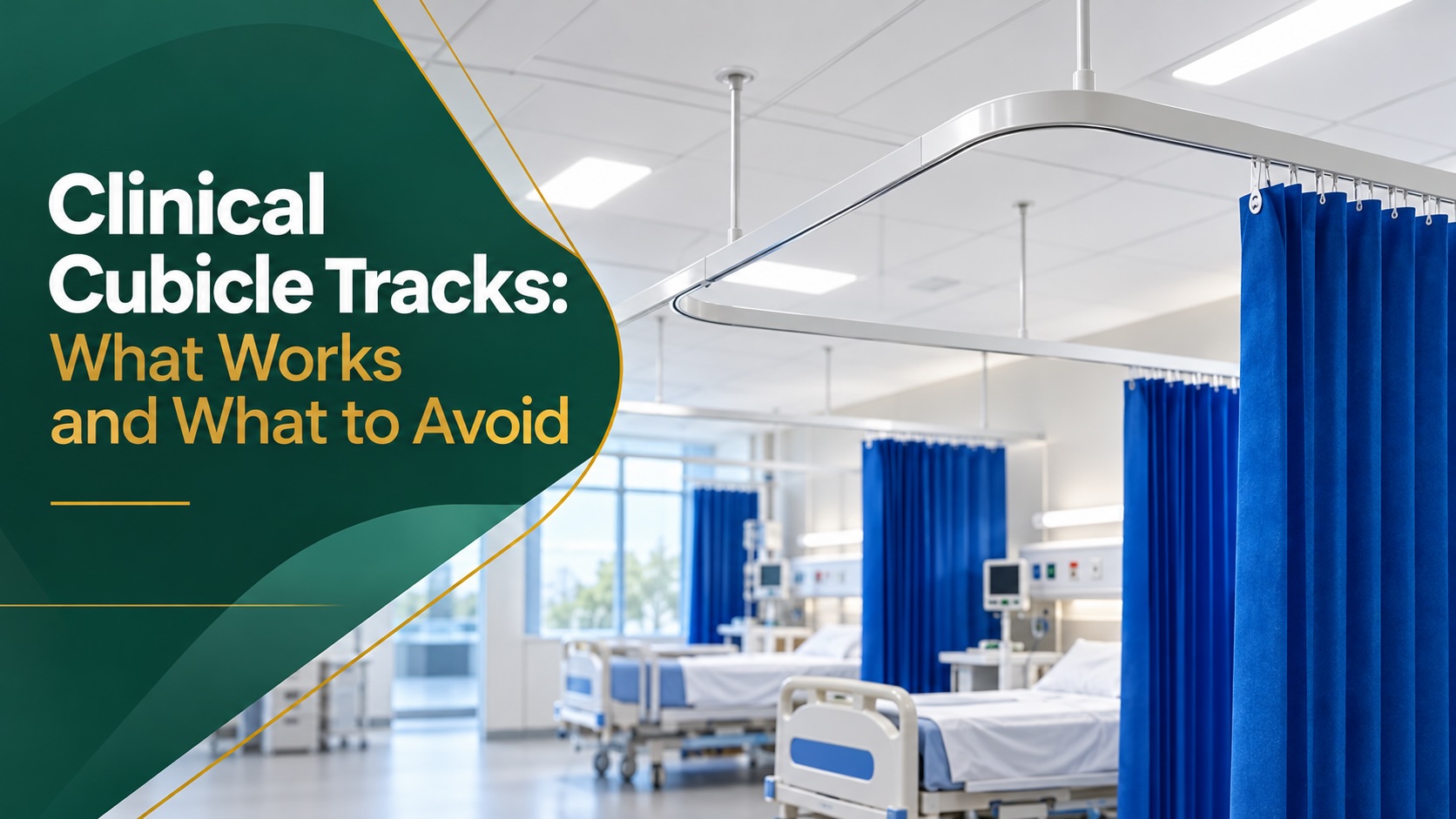
Clinical cubicle tracks are a small but important part of healthcare room design. Their role is straightforward, to support privacy curtains reliably, but the specification needs to account for far more than simply the shape or length of the rail.
In hospitals, GP surgeries, treatment rooms and other clinical environments, the track system needs to work with the room, the curtain, the cleaning regime and the way staff move around the space. Poorly planned layouts, awkward curtain removal, inadequate support or runners that do not move smoothly can all create avoidable operational problems.
Current NHS estates guidance is set out in Health Building Note 00-10 Part E: Curtains and Tracking, which replaced the earlier HTM 66 guidance. It covers areas including track layout, fixing points, curtain support, cleaning, maintenance and the specific requirements of healthcare environments.
A well-specified clinical cubicle track should therefore provide:
- Reliable patient privacy and dignity
- Smooth and quiet curtain movement
- Practical access for curtain removal and replacement
- Suitable support for straight, L-shaped, U-shaped or bespoke layouts
- Durable, corrosion-resistant and cleanable components
- Compatibility with the selected disposable or reusable cubicle curtain
- A fixing and suspension system appropriate to the building structure
- Straightforward inspection and maintenance throughout its service life
The strongest systems are those designed as a complete assembly rather than as a curtain rail in isolation. Track profile, supports, gliders or rollers, curtain hooks, loading points and the curtain itself all need to work together.
This guide looks at the technical and operational factors that matter when specifying clinical cubicle tracks, including current healthcare guidance, infection-control considerations, track layouts, suspension systems, curtain removal points, gliders and rollers, and the common specification mistakes worth avoiding.
Table of Contents
Clinical Track Fundamentals
Infection Control & Curtain Management
Layout, Support & Operation
Specification & Maintenance
Quick Answer: What Makes a Good Clinical Cubicle Track?
A good clinical cubicle track should do more than simply carry a curtain. In a healthcare setting, it needs to support privacy, cleaning, maintenance and reliable day-to-day use without creating unnecessary operational problems.
Key characteristics include:
- Smooth, quiet operation so curtains can be opened and closed easily
- Appropriate strength and support for the track layout and curtain weight
- Cleanable, corrosion-resistant materials suited to clinical environments
- Practical curtain removal points so curtains can be changed without dismantling the system
- Reliable gliders or rollers that move freely, including around bends
- Correct fixing and suspension for the wall, ceiling and room configuration
- A layout that supports privacy and circulation around beds, couches or treatment areas
- Compatibility with the chosen curtain type, whether disposable or reusable
- A specification aligned with current healthcare guidance, including HBN 00-10 Part E
The best clinical cubicle track is therefore not simply the strongest or most expensive system. It is the one that works reliably as part of the complete room, curtain and maintenance setup.
A well-designed track should be straightforward for staff to operate, easy to inspect and maintain, and simple to work with when curtains need to be removed, replaced or cleaned.
HTM 66 vs HBN 00-10 Part E: Which Guidance Applies Now?
For healthcare cubicle tracks in England, the current reference point is Health Building Note 00-10 Part E: Curtains and Tracking.
The earlier HTM 66 guidance is still widely recognised because it covered the design and fitting of cubicle curtain tracking in healthcare environments, but it has been superseded by HBN 00-10 Part E.
For specifiers, estates teams and procurement professionals, that distinction matters.
Why HTM 66 Still Appears in Product Specifications
Many healthcare track systems were originally designed, tested or marketed around HTM 66 requirements, so the term still appears frequently in:
- Existing estates documentation
- Legacy specifications
- Supplier literature
- Refurbishment projects
- Older healthcare buildings
That does not make HTM 66 irrelevant, but it should not be treated as the current standalone standard.
What HBN 00-10 Part E Covers
HBN 00-10 Part E provides guidance on curtain and tracking systems used in healthcare environments.
Relevant areas include:
- Track layout
- Fixing and support
- Curtain height and positioning
- Track components
- Gliders and runners
- Curtain loading and removal
- Cleaning
- Maintenance
- Material suitability
- Healthcare-specific operational requirements
This is why clinical cubicle tracks should be specified as complete systems rather than simply chosen on track profile alone.
What This Means for Procurement
When assessing a clinical cubicle track, buyers should ask:
- Is the system designed around current healthcare guidance?
- Are the track, supports and runners suitable for the intended layout?
- Can curtains be removed and replaced efficiently?
- Are the exposed materials suitable for routine cleaning?
- Is the system appropriate for the specific healthcare setting?
- Does the installation method reflect the building structure and room design?
Be Careful With “HTM 66 Compliant” Claims
A supplier may describe a track as HTM 66 compliant, particularly where the product has a long history in healthcare applications.
For current projects, however, it is more useful to consider how the complete system aligns with the requirements now covered by HBN 00-10 Part E.
The specification should therefore focus on the actual performance and installation requirements rather than relying on an older compliance phrase alone.
Practical Takeaway
HTM 66 remains useful historical terminology, but HBN 00-10 Part E is the current healthcare guidance to work from.
For professional specification, the important question is not simply whether a track carries an HTM 66 label, but whether the complete cubicle-track system meets the operational, cleaning, support and maintenance requirements expected in a modern clinical environment.
A Clinical Cubicle Track Is More Than the Track Profile
A clinical cubicle track should be treated as a complete operating system, not simply as a length of aluminium rail.
Its performance depends on how the individual components work together, particularly in areas where curtains are opened, closed, removed and replaced repeatedly.
The Main Components
A typical clinical cubicle track system may include:
- The track profile
- Wall fixing shoes
- Ceiling suspension rods or supports
- Track bends and junctions
- End stops
- Gliders or roller runners
- Curtain hooks
- Curtain loading or removal points
- Fixings appropriate to the wall or ceiling structure
Each part affects the reliability of the finished installation.
Track Profile
The track itself provides the route along which the curtain moves.
It needs to be:
- Strong enough for the intended span and curtain
- Suitable for straight and curved layouts
- Resistant to corrosion
- Easy to clean
- Smooth internally so runners can move freely
For healthcare use, durability and cleanability are generally more important than decorative appearance.
Wall and Ceiling Supports
The track needs to be supported correctly throughout the layout.
Depending on the room, this may involve:
- Direct wall fixing
- Direct ceiling fixing
- Suspension rods
- A combination of wall and ceiling support
The correct arrangement depends on the ceiling height, span, layout and available structural fixing points.
Gliders and Roller Runners
The runner system has a major effect on day-to-day usability.
Poorly performing runners can make a curtain difficult to draw, particularly around bends.
A suitable system should provide:
- Smooth movement
- Low operating resistance
- Reliable travel around corners
- Consistent support across the curtain width
- Minimal routine maintenance
This is one reason the runner system should be considered as part of the original specification rather than treated as a minor accessory.
Curtain Hooks
The number and spacing of hooks also matters.
Too few support points can allow the curtain to hang poorly, while suitable spacing helps distribute the curtain weight and supports smoother movement.
DotcomBlinds’ Movatrack system is supplied with 10 roller hooks per metre, providing regular support along the curtain.
Curtain Removal and Loading Points
A dedicated removal point allows runners and curtains to be accessed without dismantling the complete track.
This is particularly valuable in healthcare settings where curtains may need to be changed regularly.
The removal point should be:
- Accessible
- Easy for staff to use
- Positioned sensibly within the layout
- Secure during normal operation
Practical Takeaway
The quality of a clinical cubicle track is determined by more than the track profile itself.
A reliable system depends on the track, supports, runners, hooks, removal points and curtain all working together.
That complete-system approach should guide both specification and procurement.
Materials and Surface Finish
In clinical environments, the track material and surface finish should be selected for durability, cleanability and resistance to routine wear rather than appearance alone.
The track will often remain in place for many years, so the finish needs to cope with regular handling, cleaning and the demands of a busy healthcare setting.
Aluminium Is Well Suited to Clinical Track Systems
Aluminium is commonly used for clinical cubicle tracks because it combines:
- Good strength-to-weight performance
- Corrosion resistance
- Long service life
- Compatibility with suspended and wall-supported layouts
- A smooth surface that can be cleaned effectively
For this type of application, the material should be robust enough to support the curtain system without creating unnecessary weight.
Surface Finish Matters
A suitable finish can improve both durability and cleanability.
Depending on the system, this may include:
- Powder-coated aluminium
- Anodised aluminium
- Stain-resistant finishes
- Smooth, non-porous surfaces
The objective is to provide a surface that is straightforward to wipe down and that resists deterioration during normal use.
DotcomBlinds’ Movatrack system uses durable powder-coated aluminium, with a white finish suited to clinical interiors.
Avoid Unnecessary Surface Detail
Clinical track systems should not introduce unnecessary features that make cleaning more difficult.
Complex covers, exposed recesses or decorative detailing can create areas that are harder to access.
A simpler profile is generally preferable because it supports:
- Easier cleaning
- Faster visual inspection
- Fewer inaccessible surfaces
- More straightforward maintenance
Corrosion Resistance Is Important
Track systems may be exposed to regular cleaning products and changing environmental conditions over time.
The selected materials and finishes should therefore be suitable for the intended healthcare setting and resistant to corrosion under normal use.
This is particularly important where the track is installed in areas with higher humidity or more frequent cleaning.
Finish Should Support the Whole System
The same principle applies beyond the main track profile.
Wall shoes, suspension components, runners and other exposed parts should also be suitable for:
- Routine cleaning
- Repeated handling
- Long-term use
- The intended clinical environment
Practical Takeaway
For clinical cubicle tracks, the most useful material characteristics are durability, corrosion resistance and ease of cleaning.
A well-finished aluminium system provides a practical balance of strength, low weight and long-term serviceability without adding unnecessary complexity.
Infection Control Starts With a Track That Is Easy to Manage
A clinical cubicle track does not provide infection control by itself, but its design can make routine curtain changes, cleaning and inspection significantly easier to manage.
For professional healthcare environments, the track should support established infection-prevention procedures rather than create additional handling or maintenance problems.
Easy Curtain Removal Matters
Cubicle curtains may need to be removed for replacement, cleaning or inspection.
A track system should therefore allow staff to access and remove curtains without dismantling large sections of the installation.
Useful features include:
- Dedicated curtain removal or loading points
- Easy access to runners or gliders
- Simple hook removal
- Clear access for replacement curtains
- Minimal need for specialist tools during routine curtain changes
The easier the curtain is to remove and replace, the easier it is for the facility to follow a consistent changeover procedure.
Smooth, Cleanable Surfaces Support Routine Hygiene
Track surfaces should be straightforward to wipe down as part of normal environmental cleaning.
This generally means favouring:
- Smooth finishes
- Corrosion-resistant materials
- Simple profiles
- Accessible surfaces
- Components that do not introduce unnecessary ledges or recesses
The aim is to reduce areas that are difficult to reach during routine cleaning.
The Track Should Not Complicate the Curtain Change Process
Curtain changes can become unnecessarily difficult if:
- The loading point is poorly positioned
- Runners are difficult to access
- The track has awkward junctions
- Curtains snag at bends
- Hooks are difficult to remove
- Support components obstruct access
These issues may not appear significant at installation stage, but they can become operationally important over repeated curtain changes.
Infection Control Depends on the Whole System
The track, curtain and maintenance process should be considered together.
For example:
- Disposable curtains rely on efficient removal and replacement
- Reusable curtains may remain installed for longer and require regular cleaning
- Runners and hooks should support repeated operation
- Removal points should allow changes without unnecessary handling
- Track surfaces should remain accessible for cleaning
This is why specifying the track independently from the curtain can create problems later.
Avoid Overstating the Role of the Track
It is important not to treat the track itself as an infection-control device.
The track should instead be viewed as part of the wider clinical environment, supporting:
- Curtain management
- Cleaning
- Inspection
- Replacement
- Local infection-prevention procedures
Its value lies in making those processes easier to carry out consistently.
Practical Takeaway
A good clinical cubicle track should make curtain removal, replacement, cleaning and inspection straightforward.
The most useful design features are not decorative. They are the practical details that reduce handling, improve access and help staff manage the curtain system efficiently within established infection-control procedures.
Why Curtain Removal Points Matter
Curtain removal points are a small part of the track system, but they can have a significant effect on how efficiently clinical curtains are changed.
In healthcare environments, curtains may need to be removed for replacement, cleaning, inspection or changes in room use. The track should therefore include a practical way to access the runners without dismantling the installation.
Faster Curtain Changes
A dedicated removal or loading point allows staff to:
- Access the runners directly
- Remove curtains without taking down the track
- Feed replacement runners or hooks into the system
- Complete curtain changes with less disruption
This is particularly useful in busy clinical areas where turnaround time matters.
Positioning Is Important
A removal point is most useful when it is located somewhere staff can access easily.
Poor positioning can create problems if the access point is:
- Too close to a corner
- Obstructed by fixed furniture
- Difficult to reach because of ceiling height
- Positioned where changing the curtain interferes with clinical activity
The removal point should therefore be considered during the layout stage rather than added as an afterthought.
It Supports Both Disposable and Reusable Curtains
The same principle applies regardless of curtain type.
For disposable curtains, the removal point helps with:
- Fast changeover
- Replacement scheduling
- Reduced handling
For reusable curtains, it can help when curtains eventually need to be removed for:
- Deeper cleaning
- Inspection
- Repair
- Replacement
Reduced Need to Disturb the Track
A properly designed removal point means routine curtain changes should not require the track itself to be dismantled.
That helps protect:
- Fixings
- Suspension points
- Track alignment
- Wall and ceiling finishes
It also reduces unnecessary maintenance work.
DotcomBlinds Movatrack
The DotcomBlinds Movatrack system includes a curtain removal point as standard.
This gives staff a defined access point for removing and replacing curtains without dismantling the wider track system.
Combined with the roller-runner system, this helps keep curtain changes straightforward.
Practical Takeaway
A curtain removal point is not simply a convenience feature.
In a clinical cubicle track system, it supports faster curtain changes, easier maintenance and less disruption to the installation.
For professional healthcare environments, it should be treated as part of the original track specification rather than an optional extra.
Choosing the Right Clinical Cubicle Track Layout
Clinical cubicle track layout should follow the room and the way the space is used.
The right configuration depends on:
- Bed or treatment position
- Required privacy coverage
- Staff circulation
- Access to equipment
- Wall and ceiling conditions
- Curtain stacking position
- Cleaning access
- Existing services and fixtures
The track should support the clinical workflow rather than forcing the room to work around a standard layout.
Straight Tracks
Straight tracks can work well where the room already provides enclosure on the remaining sides.
Typical applications include:
- Wall-adjacent treatment areas
- Examination spaces
- Simple dividing arrangements
They are usually the least complex option to support and operate.
L-Shaped Tracks
L-shaped layouts are useful where privacy is required around two open sides.
They are commonly considered for:
- Corner bed spaces
- Treatment areas alongside a wall
- Consultation or examination zones
The bend needs to be supported correctly, and the runner system should move freely around the corner.
U-Shaped Tracks
U-shaped systems are useful where privacy is needed around three sides of a bed or treatment area.
They can provide a more complete enclosure, but they also introduce more bends, more track length and potentially more suspension points.
That makes correct support and runner performance particularly important.
Bespoke and Multi-Sided Layouts
Some clinical rooms cannot be served properly by a standard straight, L-shaped or U-shaped arrangement.
Bespoke layouts may be needed where there are:
- Multiple beds
- Irregular wall positions
- Fixed equipment
- Structural constraints
- Existing services
- Complex circulation routes
In these situations, the track should be designed from the room plan rather than adapted from a standard configuration.
Plan Curtain Stacking Position
The layout should also consider where the curtain will sit when open.
Poor stack positioning can:
- Obstruct access
- Reduce visibility
- Interfere with equipment
- Create unnecessary handling
- Make cleaning more difficult
The open position of the curtain is therefore just as important as the closed position.
DotcomBlinds Layout Options
DotcomBlinds’ Movatrack system is available in made-to-measure configurations including:
- Straight runs
- L-shaped layouts
- U-shaped layouts
- More bespoke arrangements
This allows the track to be planned around the room rather than forcing the room to suit a fixed track size.
Practical Takeaway
There is no single best clinical cubicle track layout.
The correct configuration is the one that provides the required privacy while preserving safe circulation, equipment access, smooth curtain movement and straightforward maintenance.
Ceiling-Fixed vs Suspended Clinical Cubicle Tracks
The support method for a clinical cubicle track should be determined by the room, ceiling construction and track layout.
In some spaces, the track can be fixed directly to a suitable ceiling structure. In others, it needs to be suspended below ceiling level using rods or support brackets.
The important point is that the visible ceiling finish should not be assumed to provide the structural fixing.
Ceiling-Fixed Tracks
A ceiling-fixed installation can work well where:
- There is a suitable structural fixing point above
- The required track height aligns with the ceiling
- The room layout allows direct fixing
- Services above the ceiling do not interfere with the installation
Direct fixing can create a clean, compact installation with fewer visible suspension components.
However, the fixing method still needs to reflect the actual ceiling construction and track load.
Suspended Tracks
Suspended clinical cubicle tracks are supported below the ceiling using rods or similar supports.
This can be useful where:
- The ceiling is higher than the required track position
- The track needs to sit at a consistent height across the room
- Direct ceiling fixing is impractical
- The layout includes long spans or bends
- Services or ceiling construction restrict direct fixing
Suspension rods allow the track to be positioned independently of the finished ceiling height.
Suspended Ceilings Need Particular Attention
In many healthcare buildings, the visible ceiling is a suspended ceiling system.
Ceiling tiles and lightweight grid systems should not automatically be treated as structural fixing points for a cubicle track.
The support system should transfer the load to an appropriate structural element above or use a fixing method specifically designed for the building construction.
This should be resolved during specification and installation planning, not after the track layout has already been finalised.
Track Height Should Be Planned Separately From Ceiling Height
The required track position is influenced by:
- Curtain drop
- Privacy requirements
- Floor clearance
- Clinical equipment
- Sightlines
- Room proportions
- Cleaning access
A suspended system can be useful where the ceiling height and ideal track height do not coincide.
DotcomBlinds commonly specifies a 2100 mm fitting height for its Movatrack system, with ceiling support rods that can be cut to length during installation where required.
The correct height should still follow the individual project requirements.
Bends and Longer Runs May Need Additional Support
The more complex the track layout, the more important support planning becomes.
Particular attention may be needed around:
- Corners
- Junctions
- Long unsupported runs
- Changes in direction
- Curtain stacking areas
Support positions should maintain track alignment and allow the runners to move freely throughout the system.
Practical Takeaway
Ceiling-fixed tracks can be appropriate where suitable structural fixing is available at the required height.
Suspended tracks provide greater flexibility where the ceiling is higher, the track needs to sit below ceiling level or the room layout requires additional support.
In both cases, the fixing system should be designed around the actual building structure, track configuration and curtain load rather than the visible ceiling finish alone.
How the Support System Should Be Planned
The support system is what keeps a clinical cubicle track stable, aligned and easy to operate over time.
It should be planned around the track layout, span, fixing substrate and curtain load, rather than added after the track geometry has already been decided.
Support the Track at the Right Points
Support is particularly important at:
- Long straight runs
- Corners and bends
- Junctions
- Curtain stacking areas
- Changes in direction
- Points where the track is suspended below the ceiling
These are the areas where movement or deflection is most likely to affect operation.
Wall Shoes and Ceiling Supports Work Together
Clinical cubicle tracks commonly use a combination of:
- Wall shoes
- Ceiling support rods
- Direct ceiling fixings
- Structural brackets
The exact arrangement depends on the room.
A track that is fixed securely at the wall may still need intermediate support if the span is too long or the layout includes bends.
Likewise, a suspended track needs enough support to maintain alignment without creating unnecessary obstruction.
Fixings Need to Suit the Building Structure
The fixing method should reflect the actual substrate.
That may include:
- Masonry
- Concrete
- Timber
- Structural steel
- Suitable ceiling support systems
The finished ceiling surface alone should not determine the fixing strategy.
Where suspended ceilings are present, the installer needs to understand where the structural support is actually available above the ceiling grid.
Bends Need Careful Support
Corners and bends place different demands on the track compared with straight runs.
Poorly supported bends can lead to:
- Track movement
- Misalignment
- Increased resistance
- Runners catching
- Uneven curtain movement
Support should therefore be planned to maintain the track geometry through the full route.
Avoid Over-Supporting as Well as Under-Supporting
More supports are not automatically better.
Unnecessary support rods can:
- Add visual clutter
- Create more cleaning points
- Complicate installation
- Interfere with ceiling services
- Increase the number of components requiring inspection
The objective is to provide enough structural support for reliable operation without introducing unnecessary complexity.
DotcomBlinds Movatrack Support
DotcomBlinds supplies the Movatrack system with the required fittings for the chosen layout, including:
- Wall shoes
- Ceiling supports where needed
- Suspension rods
- Track-specific hardware
Where ceiling suspension is required, the rods can be cut to the appropriate length during installation.
Practical Takeaway
A well-planned support system should keep the track:
- Stable
- Level
- Correctly aligned
- Smooth to operate
- Easy to inspect
- Appropriate for the building structure
The support arrangement should therefore be designed at the same time as the track layout, not treated as a separate installation detail later.
Why Gliders and Rollers Matter
The runner system has a direct effect on how well a clinical cubicle curtain performs in everyday use.
Even a correctly supported track can be frustrating to operate if the gliders or rollers create too much resistance, catch at bends or wear unevenly over time.
Smooth Movement Reduces Effort
A good runner system should allow the curtain to move with minimal force.
This matters because clinical curtains may be opened and closed many times each day by:
- Nurses
- Doctors
- Healthcare assistants
- Cleaning staff
- Patients
- Visitors
If the curtain requires excessive effort, staff are more likely to pull harder on the fabric or track, increasing wear on the whole system.
Bends Are Where Poor Systems Show Up
Straight track performance is only part of the picture.
L-shaped and U-shaped layouts place greater demands on the runner system because gliders need to move smoothly through changes in direction.
Problems can include:
- Runners sticking
- Curtains bunching at corners
- Uneven movement
- Excessive pulling force
- Additional wear around bends
For this reason, gliders or rollers should be assessed as part of the complete layout, not just on a straight test section.
Hook Spacing Also Affects Operation
The spacing of curtain hooks influences how the curtain hangs and how easily it moves through bends.
Too few hooks can allow excessive sagging between support points.
A more consistent spacing helps:
- Distribute curtain weight
- Keep folds controlled
- Improve movement around corners
- Reduce strain on individual hooks
DotcomBlinds’ Movatrack system is supplied with 10 roller hooks per metre, giving regular support along the curtain width.
Rollers Can Reduce Friction
Roller-based systems can provide smoother movement than basic sliding gliders because the runner rolls through the track rather than relying entirely on surface-to-surface sliding.
This can be useful in clinical applications where:
- Curtains are operated frequently
- Track layouts include bends
- Low operating resistance is desirable
- Long-term smoothness matters
Self-Lubricating Runners Reduce Maintenance
The DotcomBlinds Movatrack uses self-lubricating roller runners.
This removes the need for routine lubrication and helps keep the operating system simple.
That is useful in healthcare environments because adding lubrication as a maintenance task can:
- Create unnecessary servicing
- Introduce additional products into the environment
- Increase maintenance dependency
- Be overlooked over time
A low-maintenance runner system is generally preferable where smooth operation can be maintained without regular intervention.
Quiet Operation Matters Too
Noise is easy to overlook, but it can matter in:
- Patient wards
- Treatment rooms
- Overnight clinical environments
- Recovery areas
A runner that moves smoothly and quietly can improve day-to-day usability compared with one that rattles, catches or requires force.
Practical Takeaway
Gliders and rollers are not minor accessories.
They determine how easily the curtain moves, how well it negotiates bends and how much strain is placed on the track and curtain over time.
For clinical cubicle tracks, the runner system should provide smooth, low-resistance, reliable movement with minimal maintenance, particularly where the layout includes corners or frequent daily use.
Self-Lubricating Rollers vs Basic Gliders
Not all runner systems operate in the same way.
For clinical cubicle tracks, the choice between basic sliding gliders and roller-based runners can affect operating resistance, maintenance requirements and performance around bends.
Basic Gliders
Basic gliders move by sliding through the track.
They can work well in straightforward installations, particularly where:
- Track runs are short
- The layout is mostly straight
- Curtains are relatively lightweight
- Daily operating frequency is modest
However, sliding systems may create more friction, especially where the track includes multiple bends or where runners are subject to frequent use.
Roller Runners
Roller runners are designed to travel through the track on small wheels rather than relying entirely on sliding contact.
This can help provide:
- Smoother movement
- Lower operating resistance
- More consistent travel around bends
- Reduced effort when opening and closing curtains
- Less dependence on lubrication
These characteristics can be useful in clinical environments where curtains are operated frequently.
Why Self-Lubricating Runners Are Useful
The DotcomBlinds Movatrack system uses self-lubricating roller runners.
This means routine lubrication is not required as part of normal track maintenance.
In practical terms, that can reduce:
- Additional maintenance tasks
- Reliance on lubricants
- The risk of runners becoming neglected
- Service interruptions caused by sticking or increased resistance
For healthcare estates teams, a runner system that continues to operate smoothly without regular lubrication is easier to manage over the long term.
Performance Around Bends
The benefit of a roller system becomes particularly noticeable in:
- L-shaped tracks
- U-shaped tracks
- Multi-bend layouts
- Longer curtain runs
A runner that moves freely through corners helps reduce bunching and excessive pulling force.
This can also help protect:
- Curtain hooks
- Track joints
- Suspension points
- The curtain fabric itself
Low Maintenance Does Not Mean No Inspection
Even self-lubricating runners should still be included in routine visual inspection.
Checks should look for:
- Damaged runners
- Missing hooks
- Obstructions within the track
- Unusual resistance
- Wear at bends or junctions
The advantage is that normal operation should not depend on regular lubrication.
Practical Takeaway
Basic gliders can be suitable for simpler installations, but roller-based systems generally provide a stronger option where smooth movement, frequent use and bends are important.
For clinical cubicle tracks, self-lubricating roller runners offer a useful combination of low operating resistance and reduced maintenance demand.
Track Height and Curtain Drop
Track height and curtain drop should be planned together.
The objective is to provide effective privacy while maintaining suitable floor clearance, straightforward cleaning access and compatibility with the room layout.
Track Height Should Follow the Room
There is no single installation height that suits every clinical environment.
The correct height depends on factors such as:
- Ceiling height
- Curtain drop
- Bed or treatment position
- Privacy requirements
- Equipment within the space
- Sightlines
- Floor clearance
- Existing services and fittings
DotcomBlinds commonly works to a 2100 mm track fitting height, but this should be treated as a product and project consideration rather than a universal rule.
Curtain Drop Matters for Privacy
The curtain needs enough drop to provide privacy around the bed, couch or treatment area without creating unnecessary contact with the floor.
A curtain that finishes too high may compromise privacy.
A curtain that hangs too low can:
- Interfere with cleaning
- Drag on the floor
- Collect dirt more easily
- Create unnecessary wear
- Become harder to operate
The finished drop therefore needs to be considered at the same time as the track height.
Floor Clearance Should Be Deliberate
Floor clearance should not be left to chance.
The selected curtain drop should allow:
- Routine floor cleaning
- Easy movement of equipment
- Reduced risk of dragging
- Consistent appearance across the installation
The appropriate clearance will depend on the room, curtain type and project requirements.
Suspended Systems Give More Flexibility
Where the ceiling is higher than the preferred track position, suspension rods allow the track to be installed at a practical height independently of the finished ceiling.
This can be particularly useful in:
- High-ceilinged wards
- Refurbished healthcare buildings
- Rooms with suspended ceilings
- Spaces where services occupy the ceiling zone
The rods can then be cut to the required length during installation.
Consider Sightlines and Privacy
Track height also influences the amount of privacy the curtain can provide.
The system should be positioned so that it provides appropriate visual screening without unnecessarily enclosing the space or interfering with ventilation, equipment or staff observation requirements.
This is one reason the track layout and height should be reviewed together with the clinical use of the room.
Practical Takeaway
Track height should not be selected in isolation.
The correct specification brings together:
track height + curtain drop + floor clearance + privacy + room conditions
When these are planned together, the cubicle curtain system is more likely to operate effectively and remain practical to clean and maintain.
Match the Track to the Curtain
A clinical cubicle track should be specified alongside the curtain it will support.
The two systems affect each other. Curtain weight, hook spacing, runner type, removal method and finished dimensions all influence how well the installation operates.
Disposable and Reusable Curtains Create Different Demands
Disposable cubicle curtains are typically lightweight and designed for relatively easy removal and replacement.
Reusable curtains are generally more substantial and may remain in service for much longer.
The track system therefore needs to be suitable for the specific curtain type being used.
Relevant factors include:
- Curtain weight
- Curtain width
- Finished drop
- Hook or eyelet arrangement
- Number of support points
- Runner type
- Frequency of curtain changes
- Whether the curtain will be cleaned in situ or removed
Curtain Weight Affects the Whole System
Heavier curtains place greater demand on:
- Runners
- Hooks
- Track joints
- Bends
- Suspension points
- Wall fixings
This does not necessarily mean that a heavier curtain requires a completely different track, but it does mean the complete system should be assessed together.
A lightweight disposable curtain and a more substantial reusable curtain may place different loads on the same layout.
Hook Spacing Should Suit the Curtain
The curtain needs enough support points to distribute its weight evenly.
Appropriate spacing helps:
- Prevent excessive sagging
- Maintain consistent folds
- Improve movement around bends
- Reduce strain on individual attachment points
DotcomBlinds’ Movatrack system is supplied with 10 roller hooks per metre, providing regular support along the curtain.
Removal Method Matters
The track should also match the way the curtain will be maintained.
For disposable curtains, this may mean frequent removal and replacement.
For reusable curtains, the curtain may remain installed for longer and be cleaned in position, but it should still be possible to remove it when required.
A dedicated curtain removal point therefore benefits both systems.
Specify the Curtain Width With the Track Layout
Curtain width should allow sufficient coverage when closed while also considering how much material needs to stack when open.
Too little curtain width may compromise privacy.
Excessive width can create unnecessary bunching and increase resistance, especially around bends.
The track layout, curtain width and hook spacing should therefore be planned together.
Disposable and Reusable Curtains Can Use the Same Track Philosophy
The fundamental track requirements remain similar for both curtain types:
- Reliable support
- Smooth movement
- Suitable runners
- Accessible removal points
- Correct fixing
- Appropriate dimensions
The difference lies mainly in how often the curtain is changed and how it is maintained.
Practical Takeaway
The track and curtain should be treated as one operational system.
When specifying clinical cubicle tracks, consider the curtain’s weight, dimensions, attachment method, maintenance model and replacement frequency at the same time as the track layout and support system.
That approach reduces the risk of choosing a track that looks suitable on paper but performs poorly once the curtain is installed.
What Works in a Clinical Cubicle Track System
A well-specified clinical cubicle track system should combine reliable operation, appropriate support, easy curtain management and suitability for the healthcare environment.
The strongest systems tend to share the same practical characteristics.
Healthcare-Specific Track Design
The track should be designed for repeated use in clinical settings rather than adapted from a domestic curtain-track system.
That means considering:
- Frequent opening and closing
- Regular cleaning
- Curtain replacement
- Long service life
- Straight and curved layouts
- Reliable support
- Compatibility with clinical curtains
Alignment With Current Healthcare Guidance
For current healthcare projects, the specification should be considered against HBN 00-10 Part E: Curtains and Tracking.
The aim is not simply to attach a compliance label to the product, but to ensure the complete installation reflects the requirements relevant to:
- Layout
- Materials
- Support
- Curtain operation
- Cleaning
- Maintenance
- Curtain removal
Durable, Cleanable Materials
A good clinical cubicle track should use materials that are:
- Corrosion resistant
- Smooth
- Easy to wipe clean
- Durable under repeated use
- Suitable for the intended healthcare environment
Powder-coated aluminium is well suited to this type of installation because it combines strength, relatively low weight and a practical surface finish.
Correct Structural Support
The track should be supported according to:
- Span
- Layout
- Bends
- Curtain weight
- Ceiling height
- Available structural fixing points
Longer or more complex layouts may require additional suspension, particularly around bends and changes in direction.
Dedicated Curtain Removal Points
Curtains should be removable without dismantling the complete track.
A dedicated access point supports:
- Faster curtain changes
- Easier maintenance
- Less disruption
- Simpler runner replacement
For clinical environments, this should be considered part of the original specification.
Smooth Runners or Rollers
The curtain should move freely throughout the complete track route.
This is particularly important on:
- L-shaped tracks
- U-shaped tracks
- Longer runs
- Frequently operated curtains
Low-resistance rollers can reduce the effort needed to move the curtain and lessen strain on the wider track system.
Appropriate Hook Spacing
The curtain needs sufficient support across its width.
Consistent hook spacing helps:
- Distribute load
- Control curtain folds
- Improve movement around bends
- Reduce localised strain
DotcomBlinds’ Movatrack system uses 10 roller hooks per metre.
Made-to-Measure Layout
Clinical spaces are rarely identical.
The strongest specification is therefore based on the actual room dimensions and intended use rather than forcing a standard track configuration into the space.
Straight, L-shaped, U-shaped and bespoke arrangements should all be considered according to:
- Privacy
- Bed or couch position
- Staff circulation
- Equipment
- Curtain stacking
- Cleaning access
Track and Curtain Specified Together
The track should be compatible with the curtain’s:
- Weight
- Width
- Drop
- Attachment method
- Maintenance model
- Replacement frequency
Disposable and reusable curtains may both work with the same track system, but their operational requirements are different.
Straightforward Maintenance
The system should be easy to inspect over time.
Routine checks should be able to identify:
- Damaged runners
- Loose fixings
- Track movement
- Worn hooks
- Problems at bends
- Obstructions
- Damage to removal points
Low-maintenance does not mean inspection-free.
Practical Takeaway
A strong clinical cubicle track specification combines:
healthcare-appropriate materials + correct support + smooth runners + accessible curtain removal + suitable hook spacing + a made-to-measure layout
When these elements are planned together, the system is more likely to remain reliable, easy to manage and suitable for long-term clinical use.
What to Avoid When Specifying Clinical Cubicle Tracks
Professional healthcare buyers are unlikely to confuse a clinical cubicle track with a domestic curtain rail. The more relevant risks are specification errors that affect operation, maintenance, cleaning or long-term reliability.
Avoid Relying on HTM 66 Alone
HTM 66 remains familiar terminology in healthcare estates work, but it has been superseded by HBN 00-10 Part E: Curtains and Tracking.
For current projects, the specification should therefore be reviewed against the newer guidance rather than relying on an older “HTM 66 compliant” description alone.
The important question is whether the complete system is suitable for the intended healthcare environment.
Avoid Designing the Track Without Considering Curtain Changes
Curtain removal and replacement should be planned from the start.
A track layout may appear perfectly workable until staff need to access the runners or remove a curtain.
Common problems include:
- Loading points positioned too close to corners
- Access obstructed by fixed furniture or equipment
- Removal points that are difficult to reach
- Curtain changes requiring unnecessary dismantling
The removal point should be treated as part of the layout, not as an afterthought.
Avoid Under-Supporting Long or Complex Runs
Long straight runs, bends and junctions all place demands on the support system.
Insufficient support can contribute to:
- Track deflection
- Misalignment
- Increased runner resistance
- Movement at bends
- Premature wear
Support should reflect the actual span, curtain load and geometry of the installation.
Avoid Specifying Runners Without Considering Bends
A runner that performs adequately on a straight section may not work as well around corners.
L-shaped and U-shaped layouts need runners that can move smoothly through bends without:
- Catching
- Bunching the curtain
- Requiring excessive pulling force
- Putting strain on hooks or track joints
Hook spacing and runner design should therefore be considered together.
Avoid Creating Hard-to-Clean Details
Clinical track systems should not introduce unnecessary features that complicate routine cleaning.
Avoid:
- Decorative covers with inaccessible recesses
- Unnecessary ledges
- Complex junction details
- Components that are difficult to wipe down
- Finishes that deteriorate under normal cleaning
Simple, accessible surfaces are generally easier to manage.
Avoid Treating the Curtain and Track as Separate Systems
The track specification should reflect the curtain that will actually be installed.
Important factors include:
- Curtain weight
- Width
- Drop
- Hook spacing
- Attachment method
- Replacement frequency
- Cleaning model
A track that works well with a lightweight disposable curtain may be subject to different loads when paired with a heavier reusable curtain.
Avoid Standardising the Layout Without Reviewing the Room
Standardisation can simplify procurement, but it should not override room-specific requirements.
Applying the same L-shaped or U-shaped configuration everywhere can create problems where:
- Bed positions differ
- Equipment restricts movement
- Ceiling services interfere with suspension
- Privacy requirements vary
- Circulation routes change
The layout should follow the clinical space.
Avoid Assuming “Low Maintenance” Means No Maintenance
Self-lubricating runners and durable aluminium profiles can reduce maintenance requirements, but the system should still be inspected.
Routine checks should consider:
- Fixings
- Suspension rods
- Runners
- End stops
- Removal points
- Track alignment
- Damage or obstruction
Low-maintenance systems still benefit from planned inspection.
Practical Takeaway
The most common problems with clinical cubicle tracks are not caused by choosing the wrong type of product. They are usually caused by poor integration between the track, curtain, room layout and maintenance process.
The safest approach is to specify the complete system around the actual healthcare environment rather than relying on a generic layout or a single compliance label.
Maintenance Requirements for Clinical Cubicle Tracks
Clinical cubicle tracks should be specified for low maintenance, but they should still be included within routine inspection and estates management.
The objective is to identify wear, damage or operating problems before they begin to affect curtain movement, privacy or the stability of the installation.
Check the Track Alignment
The track should remain:
- Level
- Secure
- Free from distortion
- Properly aligned through bends and junctions
Misalignment can increase resistance and make runners more difficult to operate.
Inspect Wall and Ceiling Fixings
Fixings should be checked for:
- Movement
- Loosening
- Damage
- Deterioration around the fixing point
Suspended systems should also be checked to confirm that support rods remain secure and correctly positioned.
Check Gliders and Roller Runners
Runners should move freely throughout the complete track.
Inspection should identify:
- Damaged rollers
- Missing runners
- Unusual resistance
- Debris or obstruction
- Wear around bends
- Runners that no longer travel smoothly
Where self-lubricating roller runners are used, routine lubrication should not normally be necessary, but their condition should still be monitored.
Inspect Curtain Hooks
Hooks are subject to repeated movement and handling.
Check for:
- Missing hooks
- Cracked or damaged components
- Uneven spacing
- Hooks that no longer engage correctly with the curtain
Replacing an individual damaged hook early is usually simpler than waiting until it begins to affect curtain operation.
Check Curtain Removal Points
The curtain removal or loading point should remain:
- Accessible
- Secure
- Easy to operate
- Free from obstruction
If staff cannot use the removal point easily, curtain changes may become unnecessarily difficult.
Inspect Bends and Junctions
Bends are often the areas where operating problems become noticeable first.
Look for:
- Increased resistance
- Track movement
- Misalignment
- Curtain bunching
- Runners catching as they change direction
These issues may indicate a problem with the runner, support position or track alignment.
Keep the Track Clean
Exposed track surfaces should be cleaned according to the healthcare facility’s normal environmental-cleaning procedures and the manufacturer’s instructions.
Cleaning should not introduce products or methods that could damage:
- Surface finishes
- Plastic components
- Rollers
- Fixings
The track profile should also remain clear of debris that could interfere with runner movement.
Maintenance Records Can Be Useful
For larger healthcare estates, it can be useful to include cubicle tracks within planned inspection schedules.
Records might note:
- Location
- Date inspected
- Condition of track
- Condition of runners
- Fixing issues
- Components replaced
- Further work required
This can help estates teams identify recurring issues or plan component replacement before failures occur.
Practical Takeaway
A well-designed clinical cubicle track should require relatively little routine intervention, but low maintenance does not mean maintenance-free.
Periodic checks of the track, fixings, suspension system, runners, hooks and curtain removal point can help keep the installation operating smoothly and extend its useful service life.
How DotcomBlinds Movatrack Fits a Clinical Cubicle Track Specification
DotcomBlinds’ Movatrack system is designed specifically for healthcare and privacy applications where smooth operation, reliable support and straightforward curtain management are important.
The system can be configured around the room rather than forcing a standard track shape into the space.
Made to Measure
Movatrack is supplied to the dimensions of the installation.
Available configurations include:
- Straight runs
- L-shaped layouts
- U-shaped layouts
- More bespoke arrangements
This makes it suitable for wards, consultation areas, treatment rooms and other clinical spaces where room geometry varies.
Powder-Coated Aluminium Construction
The track is made from durable powder-coated aluminium.
For clinical environments, this provides a useful balance of:
- Strength
- Relatively low weight
- Corrosion resistance
- Cleanability
- Long service life
The white finish is also appropriate for healthcare interiors where a simple, unobtrusive appearance is preferred.
Curtain Removal Point Included
A curtain removal point is supplied as part of the system.
This allows staff to access the runners and remove or replace curtains without dismantling the wider track installation.
That is particularly useful where curtains are changed regularly or where access needs to remain straightforward for maintenance.
Self-Lubricating Roller Runners
Movatrack uses self-lubricating roller runners designed to move smoothly through the track.
This reduces the need for routine lubrication and supports low-maintenance operation.
The system is supplied with 10 roller hooks per metre, giving regular support along the curtain width.
Support Components Supplied
The system can be supplied with the fittings required for the chosen layout, including:
- Wall shoes
- Ceiling supports
- Suspension rods where required
- Track-specific fittings
Where suspension is needed, rods can be cut to length during installation.
DotcomBlinds commonly works to a 2100 mm fitting height, although the final height should follow the requirements of the individual project.
Designed Around Healthcare Use
The Movatrack system has been used in healthcare environments including:
- Hospitals
- GP surgeries
- Private medical settings
- Care environments
- Treatment rooms
Its specification is based around the practical requirements expected from a clinical cubicle track, including curtain access, smooth operation, support and low-maintenance components.
Can Be Paired With Disposable or Reusable Curtains
The track can also form part of a complete privacy-curtain system.
Depending on the operational requirements of the facility, it can be paired with:
- Disposable healthcare cubicle curtains
- Reusable healthcare cubicle curtains
This allows the track to remain consistent while the curtain specification is selected around cleaning, replacement and lifecycle requirements.
Practical Takeaway
DotcomBlinds Movatrack is best viewed as a made-to-measure clinical cubicle track system, rather than simply an aluminium rail.
Its combination of custom layouts, curtain removal access, self-lubricating roller runners, regular hook spacing and configurable support makes it suitable for healthcare environments where the track needs to work reliably as part of a wider privacy-curtain system.
Clinical Cubicle Track Specification Checklist
Before approving a clinical cubicle track specification, it is useful to review the complete system against the room, curtain and maintenance requirements.
A concise checklist can help ensure that important details are not overlooked.
Healthcare Environment
Confirm:
- What type of clinical environment is the track for?
- Is it a hospital ward, treatment room, GP surgery, clinic or other healthcare space?
- Are there any specific local estates or infection-control requirements?
Current Guidance
Check:
- Is the specification being reviewed against HBN 00-10 Part E?
- Are older references to HTM 66 being treated as historical rather than current guidance?
- Are any project-specific healthcare standards also applicable?
Track Layout
Confirm:
- Straight, L-shaped, U-shaped or bespoke layout
- Bed or treatment position
- Required privacy coverage
- Staff circulation
- Equipment access
- Curtain stacking position
- Clearance around doors, furniture and fixed equipment
Track Height and Curtain Drop
Establish:
- Required track height
- Finished curtain drop
- Floor clearance
- Privacy sightlines
- Compatibility with the room and ceiling height
Track height and curtain drop should be specified together.
Ceiling-Fixed or Suspended?
Determine:
- Whether suitable direct ceiling fixing is available
- Whether suspension rods are required
- Where structural fixing points are located
- Whether the visible ceiling is suspended
- Whether ceiling services affect the support layout
The fixing strategy should be based on the building structure, not simply the finished ceiling surface.
Support System
Check:
- Wall fixing points
- Ceiling supports
- Suspension rods
- Support around bends
- Support along longer spans
- Track alignment
- Suitability of the fixing substrate
The support system should match the actual track geometry and curtain load.
Curtain Removal Point
Confirm:
- Is a dedicated removal or loading point provided?
- Is it easy to reach?
- Is it positioned away from obstructions?
- Can curtains be changed without dismantling the track?
This is particularly important where curtains are changed regularly.
Gliders or Roller Runners
Review:
- Smoothness of operation
- Performance around bends
- Maintenance requirements
- Runner durability
- Replacement accessibility
- Compatibility with the curtain attachment method
For frequently operated clinical curtains, low-resistance movement should be a priority.
Hook Spacing
Confirm that the curtain has enough support points across its width.
Appropriate hook spacing helps:
- Distribute curtain weight
- Control folds
- Support movement around bends
- Reduce strain on individual components
DotcomBlinds’ Movatrack system is supplied with 10 roller hooks per metre.
Curtain Compatibility
Confirm:
- Disposable or reusable curtain
- Curtain weight
- Curtain width
- Finished drop
- Hook or eyelet arrangement
- Replacement frequency
- Cleaning method
The curtain and track should be treated as one system.
Materials and Finish
Check that exposed components are:
- Corrosion resistant
- Durable
- Easy to clean
- Suitable for the intended healthcare environment
Avoid unnecessary surface details that make routine cleaning more difficult.
Maintenance
Establish:
- How frequently the system will be inspected
- Who is responsible
- How damaged runners or hooks will be replaced
- How fixings and suspension points will be checked
- How cleaning will be carried out
A low-maintenance track still benefits from planned inspection.
Risk-Specific Requirements
Some healthcare environments may have additional requirements arising from local risk assessment.
For example, mental healthcare environments may require consideration of ligature reduction or other risk-specific track systems.
Those requirements should be identified before a standard cubicle track is specified.
Practical Takeaway
A clinical cubicle track specification should answer five basic questions:
Does it fit the room?
Does it support the curtain correctly?
Can staff operate and change the curtain easily?
Can the system be cleaned and maintained effectively?
Does it meet the technical requirements of the healthcare environment?
If those points are resolved before ordering, the likelihood of operational problems after installation is significantly reduced.
Final Verdict: What Should a Clinical Cubicle Track Do Well?
A good clinical cubicle track should perform reliably in everyday use while supporting the wider requirements of the healthcare environment.
The most important characteristics are practical rather than decorative.
1. Provide Reliable Privacy
The track layout should allow the curtain to create effective visual privacy around beds, treatment couches or examination areas.
That depends on:
- Correct track geometry
- Appropriate curtain width and drop
- Suitable stacking position
- Smooth operation throughout the full run
Privacy should be considered alongside circulation, access and clinical observation requirements.
2. Operate Smoothly and Quietly
The curtain should open and close without excessive effort.
A well-designed runner system should:
- Move freely on straight sections
- Pass smoothly around bends
- Avoid catching or bunching
- Require minimal routine maintenance
- Reduce unnecessary strain on the curtain and track
This becomes particularly important where curtains are operated frequently throughout the day.
3. Make Curtain Changes Straightforward
Curtain replacement should not require unnecessary dismantling of the track.
A dedicated removal or loading point can support:
- Faster curtain changes
- Easier runner access
- Less disruption
- Simpler maintenance
This is important whether the facility uses disposable curtains, reusable curtains or a combination of both.
4. Be Easy to Clean and Maintain
Clinical cubicle tracks should use materials and finishes that support routine cleaning and long-term use.
The system should be:
- Corrosion resistant
- Straightforward to wipe down
- Easy to inspect
- Free from unnecessary hard-to-clean details
- Supported by components that can be replaced when required
Low-maintenance operation is valuable, but routine inspection should still form part of the wider estates process.
5. Fit the Room and the Healthcare Workflow
The strongest specification is one designed around the actual environment.
That means considering:
- Room dimensions
- Bed or treatment position
- Straight, L-shaped, U-shaped or bespoke layouts
- Ceiling construction
- Suspension requirements
- Equipment access
- Staff circulation
- Curtain type
- Cleaning and replacement procedures
A standard layout should only be used where it genuinely suits the room.
Where DotcomBlinds Movatrack Fits
DotcomBlinds’ made-to-measure Movatrack system is designed around these practical requirements.
It can be configured for straight, L-shaped, U-shaped and more bespoke clinical layouts, with:
- Powder-coated aluminium track
- Curtain removal access
- Self-lubricating roller runners
- 10 roller hooks per metre
- Wall shoes and ceiling supports where required
- Compatibility with disposable and reusable healthcare curtains
The system can therefore be specified as part of a complete clinical privacy solution rather than as an isolated track product.
Final Takeaway
The best clinical cubicle track is one that performs five jobs consistently:
provide privacy, move smoothly, allow efficient curtain changes, remain easy to clean and fit the clinical environment correctly.
When those requirements are resolved at specification stage, the finished system is far more likely to remain reliable, practical and easy to manage throughout its service life.