Order Tracking
 0800 1422417
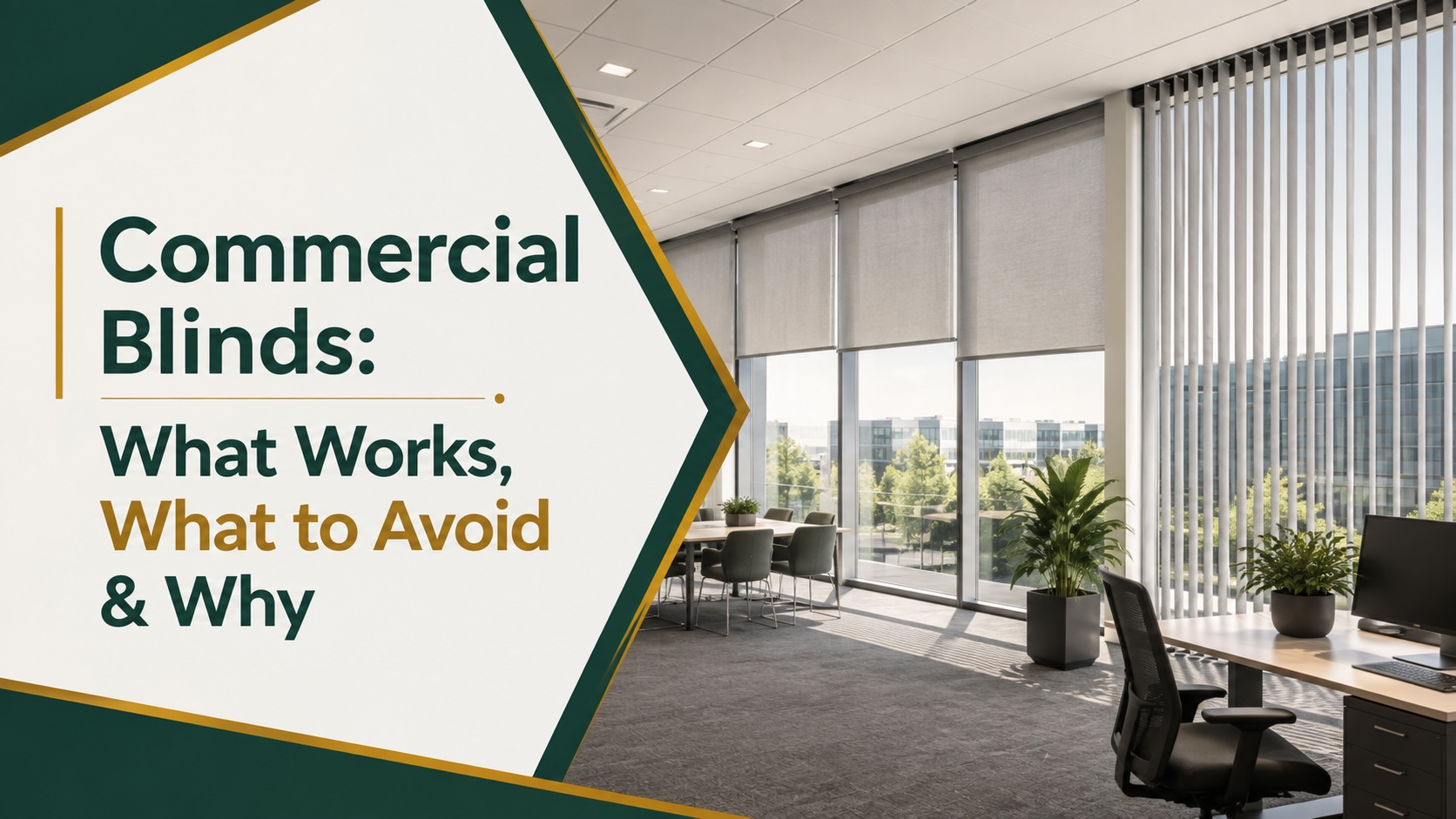
Commercial blinds need to do more than simply look suitable for an office, school, healthcare setting or other workplace. The right blind should also provide the appropriate balance of light control, privacy, safety and day-to-day practicality for the way the space is actually used.
For many commercial environments, roller blinds and vertical blinds are two of the strongest options, but they solve different problems.
Roller blinds work particularly well where you want a clean, simple finish with straightforward control over light and privacy. Depending on the fabric specification, they can be used to reduce glare, filter daylight or provide a much darker environment when required.
Vertical blinds offer a different type of control. Their adjustable louvres allow incoming light to be redirected without fully uncovering the window, which can make them especially useful in offices and other spaces where daylight and glare need to be balanced throughout the day.
The wrong choice is often not a poor-quality blind. It is simply a blind that does not match the needs of the room. A blackout blind may be unnecessary where gentle glare reduction is all that is required, while a roller blind may be less suitable where occupants regularly need directional control over sunlight.
In this guide, we look specifically at what works with commercial roller and vertical blinds, why those options work, and the situations where a different specification is likely to be the better choice.
Commercial Blinds: Quick Answer
Commercial roller blinds work best where you want clean, consistent coverage, straightforward privacy and effective dimout or blackout performance. Commercial vertical blinds are better where adjustable daylight, directional glare control and flexible privacy matter more. For offices and classrooms, dimout is often the better choice when the goal is to reduce glare while retaining useful daylight. Blackout is better reserved for rooms that need stronger privacy or greater light exclusion, such as presentation spaces.
In This Guide
Jump straight to the comparison, room-specific recommendations or the key mistakes to avoid.
Commercial Blind Basics
Commercial Roller Blinds
Commercial Vertical Blinds
Roller vs Vertical
Best Blinds by Commercial Setting
What to Avoid
- What to Avoid When Choosing Commercial Blinds
- Avoid Choosing on Appearance Alone
- Avoid Using Blackout Where Dimout Would Work Better
- Avoid Dimout Where Strong Privacy or Darkness Is Required
- Avoid Roller Blinds Where You Need Directional Light Control
- Avoid Vertical Blinds Where You Want the Cleanest Possible Finish
- Avoid Assuming Any Domestic Blind Is Automatically Suitable for Commercial Use
Quick Comparison & Final Choice
What Makes a Blind Suitable for Commercial Use?
A blind can look appropriate for a workplace without necessarily being well suited to commercial use.
For commercial spaces, the specification matters just as much as the appearance. The blind needs to suit the way the room is used and provide the right balance of safety, light control, privacy and practicality.
Key considerations include:
- Fire-retardant fabric: particularly important in environments where fire-safety requirements apply.
- Appropriate safety features: especially where chain-operated blinds are used.
- Light control: the blind should match the needs of the room, whether that means reducing glare, filtering daylight or creating a darker environment.
- Privacy: some spaces require straightforward visual screening, while others need a more adjustable balance between privacy and daylight.
- Window size: commercial buildings often include unusually wide, tall or repeated window openings.
- Consistency: where several blinds are used across the same room or building, a uniform appearance can be important.
- Suitable fabric specification: blackout and dimout fabrics perform differently and should be chosen according to what the room actually needs.
DotcomBlinds commercial roller and vertical blinds are available with fire-retardant fabrics as standard, along with child-safety features for chain operation and a Biosafe® anti-bacterial coating.
The important point is that a commercial blind should be selected for the demands of the environment, not simply because it resembles the type of blind commonly seen in offices or public buildings.
When Commercial Roller Blinds Work Best
Commercial roller blinds are one of the strongest choices where you want a clean, simple and consistent window treatment across a workplace or public-facing environment.
They work particularly well when the main priorities are:
- Straightforward control over light and privacy
- A neat appearance across multiple windows
- Dimout or blackout fabric options
- Large or unusually sized windows
- A simple blind that does not visually dominate the room
One of the main advantages of a roller blind is its simplicity. When lowered, it creates one continuous panel of fabric across the window. This can work especially well in offices, classrooms and healthcare environments where a tidy, uniform appearance is important.
Commercial roller blinds are also useful when the room has a very specific light-control requirement. A dimout fabric can reduce incoming light and glare while still allowing the room to remain relatively bright, while blackout fabric is better suited to spaces where a much higher level of light exclusion or privacy is required.
They can also be a practical option for unusually large windows. DotcomBlinds offers commercial roller blinds in a wide range of sizes, including XL options for particularly wide or tall openings.
Roller blinds are therefore at their best where the requirement is simple coverage, controlled light levels and a clean commercial finish.
Why Roller Blinds Work Well in Offices
Commercial roller blinds are particularly well suited to offices where the aim is to reduce glare without making the room unnecessarily dark.
A dimout fabric can filter incoming daylight and soften strong exterior light, which can help reduce reflections and glare on computer screens while still allowing the office to remain bright during the day.
Roller blinds also suit offices because they create a clean, uniform appearance across multiple windows. When the same fabric and colour are used throughout a workspace, the result is visually consistent and relatively unobtrusive.
They work especially well where you want:
- Reduced screen glare
- A simple, modern appearance
- Consistent coverage across several windows
- Straightforward privacy when the blind is lowered
- A choice between dimout and blackout fabric depending on the room
Blackout fabric may be more appropriate for presentation rooms, meeting rooms or other spaces where stronger light exclusion is needed, while dimout is usually the more balanced choice for general office use.
Where the priority is everyday glare reduction rather than directional control of sunlight, commercial roller blinds are often one of the most practical options.
Why Roller Blinds Work Well in Classrooms
Commercial roller blinds can work well in classrooms because they provide simple, predictable control over incoming light without adding unnecessary visual clutter.
In teaching spaces, the main requirement is often to reduce glare while keeping the room bright enough for normal use. A dimout fabric is useful where sunlight needs to be softened rather than completely blocked.
Roller blinds are also a strong option where several windows need to be treated consistently. Using the same blind style and fabric across a classroom can create a neat, uniform appearance while keeping the focus on the teaching environment rather than the window treatment.
They are particularly suitable where you want:
- Reduced glare from direct sunlight
- A simple and uncluttered appearance
- Consistent coverage across multiple windows
- Dimout fabric for everyday daylight control
- Blackout fabric where stronger light exclusion is required
Blackout may be useful in rooms where presentations, projection or other activities require a darker environment. For general classroom use, however, dimout is often the more balanced option because it controls glare while still allowing useful daylight into the space.
The key is to match the fabric to how the classroom is actually used rather than automatically choosing the darkest available option.
Why Roller Blinds Work Well in Healthcare and Privacy-Sensitive Spaces
Commercial roller blinds can be a strong choice for healthcare and other privacy-sensitive environments because they provide simple, direct coverage when required.
When lowered, the blind creates a continuous fabric barrier across the window, which can be useful where visual privacy is important. Blackout fabric can provide a higher level of privacy and prevent light from passing through the fabric itself, although some light may still enter around the edges depending on the fit.
They are particularly suitable where you want:
- Straightforward visual privacy
- A clean, uncluttered appearance
- Blackout or dimout fabric options
- Consistent blinds across multiple windows
- Commercial fabrics with fire-retardant properties
- An anti-bacterial Biosafe® coating as part of the commercial specification
Dimout fabric may still be the better option in areas where privacy is needed but useful daylight should be retained.
For rooms where the main requirement is simple coverage and a clear visual barrier, commercial roller blinds are often a more natural choice than a blind system designed primarily around adjustable directional light control.
When Roller Blinds Are Not the Best Choice
Commercial roller blinds are effective in many settings, but they are not always the best option.
They are less suitable where the main requirement is continuous, directional control of daylight. A roller blind can be raised, lowered or specified with different fabric types, but it does not allow light to be redirected in the same way as adjustable vertical louvres.
You may want to consider another option where:
- Occupants need to fine-tune the direction of incoming sunlight throughout the day
- Privacy needs to be adjusted without fully lowering the blind
- Different parts of a wide window need separate control
- A large single panel of fabric would feel too visually dominant
- The room needs more flexible daylight management rather than simple filtering or coverage
In these situations, commercial vertical blinds can often be the stronger choice because the louvres can be angled while the blind remains across the window.
The key distinction is that roller blinds are strongest for simple coverage, glare reduction and straightforward privacy, while vertical blinds offer more adjustable control over how light enters the room.
When Commercial Vertical Blinds Work Best
Commercial vertical blinds are particularly effective where the main priority is flexible control over daylight and privacy.
Unlike a roller blind, which is generally raised or lowered as one continuous panel, a vertical blind uses individual louvres that can be angled while the blind remains across the window. This makes it easier to reduce glare, redirect light or increase privacy without fully closing off the glazing.
They work especially well where you want:
- Adjustable daylight throughout the working day
- Greater control over glare direction
- Privacy without completely blocking natural light
- Coverage across wide commercial windows
- A blind that can stack to one side when fully opened
- A consistent commercial appearance across larger glazed areas
DotcomBlinds commercial vertical blinds can also be configured with different operating mechanisms and stack positions, which can help tailor the blind to the layout of the window and room.
For offices, classrooms and other commercial spaces where light conditions change during the day, vertical blinds are often strongest when fine adjustment matters more than simple open-or-closed coverage.
Why Vertical Blinds Work Well in Offices
Commercial vertical blinds can be particularly useful in offices where light conditions change throughout the day and staff need more than simple open-or-closed shading.
The adjustable louvres allow incoming daylight to be redirected rather than completely blocked. This can help reduce glare on computer screens while still keeping the workspace naturally lit.
They work especially well where you want:
- Flexible control over changing sunlight
- Adjustable privacy without fully closing off the window
- The ability to reduce glare while retaining daylight
- Good coverage across wide office windows
- Control over how much of the window is exposed at different times of day
The main advantage over a roller blind is the ability to change the angle of the louvres. This gives occupants more control over the direction and intensity of light entering the room.
For offices with wide glazing or windows exposed to strong sunlight at different times of day, vertical blinds can therefore provide a more adaptable solution than a blind that simply moves up and down.
Why Vertical Blinds Work Well for Wide Commercial Windows
Vertical blinds are particularly well suited to wide commercial windows because their construction naturally lends itself to covering broad areas of glazing.
Instead of using one large sheet of fabric, the blind is made up of individual vertical louvres suspended from a headrail. This makes the system well suited to long window runs, office façades, classrooms and other spaces with substantial glazed areas.
They work especially well where you want:
- Effective coverage across wide windows
- Adjustable light control across the full opening
- The option to retain daylight while reducing glare
- Flexible privacy throughout the day
- A blind that can stack to one side when fully opened
The louvres can also be angled without moving the entire blind out of the way, which gives vertical blinds an advantage where sunlight needs to be managed continuously.
For very wide commercial glazing, this flexibility can be more useful than a simple open-or-closed blind because it allows the window to remain covered while still giving occupants control over how much light enters the room.
When Vertical Blinds Are Not the Best Choice
Commercial vertical blinds offer excellent flexibility, but they are not the right fit for every environment.
They may be less suitable where the priority is a very clean, minimal appearance. Because vertical blinds use multiple individual louvres, they create more visible lines and moving components than a roller blind.
You may want to consider a roller blind instead where:
- You want one continuous panel of fabric
- A simple, streamlined appearance is important
- Straightforward privacy is more important than directional light control
- The room needs blackout or dimout performance without adjustable louvres
- You want the blind to have as little visual presence as possible when closed
Vertical blinds are also unnecessary where there is little need to adjust the direction of incoming light. If the main requirement is simply to reduce glare, provide privacy or darken a room, a commercial roller blind may achieve that more simply.
The main strength of vertical blinds is adjustability. If that flexibility is not important to the space, the cleaner and simpler construction of a roller blind may be the better commercial choice.
Roller vs Vertical: Which Gives Better Light Control?
Both roller and vertical blinds can manage daylight effectively, but they do it in different ways.
Roller blinds are strongest when you want straightforward control over the amount of light entering the room. With the right fabric, they can reduce glare, filter daylight or block light through the fabric itself.
Vertical blinds offer more directional control. Because the louvres can be tilted, you can change the angle of incoming light without fully opening or closing the blind.
In practical terms:
- Choose roller blinds if you want simple, consistent light reduction
- Choose dimout roller blinds if glare reduction is the main goal
- Choose blackout roller blinds where stronger light exclusion is required
- Choose vertical blinds if you want to redirect light and make finer adjustments throughout the day
For spaces where light conditions are relatively predictable, roller blinds are often the simpler solution.
For spaces where sunlight changes direction or occupants need to fine-tune light levels during the day, vertical blinds generally offer greater flexibility.
Which Is Better for Screen Glare?
Both roller and vertical blinds can help manage screen glare, but they approach the problem differently.
Dimout roller blinds are particularly effective where the aim is to soften strong incoming daylight across the whole window. They filter the light rather than blocking it completely, which can reduce reflections on computer screens while still keeping the workspace bright.
Vertical blinds offer a different advantage. Their adjustable louvres can be angled to redirect sunlight, which makes them useful where glare changes during the day or affects different parts of the room at different times.
In practical terms:
- Choose dimout roller blinds for straightforward glare reduction across the whole window
- Choose vertical blinds where you want to fine-tune the direction of incoming light
- Avoid automatically choosing blackout fabric if the main issue is glare rather than darkness
For general office use, the best option depends on whether you want simple light filtering or more adjustable control over the direction of sunlight.
Which Is Better for Privacy?
Both commercial roller and vertical blinds can provide good privacy, but they do so in different ways.
Roller blinds are the stronger choice when you want a simple, continuous visual barrier. When lowered, the fabric covers the window directly, which makes them well suited to rooms where privacy needs to be straightforward and consistent.
Vertical blinds offer more adjustable privacy. The louvres can be angled so that views into the room are restricted while some daylight is still allowed through.
In practical terms:
- Choose roller blinds where straightforward visual screening is the priority
- Choose blackout roller fabric where a higher level of privacy is required
- Choose vertical blinds where you want to balance privacy with natural light
- Avoid assuming that dimout fabric provides the same level of visual screening as blackout fabric
The better option therefore depends on whether the room needs maximum simplicity and coverage or more flexible control between privacy and daylight.
Blackout or Dimout: Which Works Best Commercially?
Blackout and dimout fabrics serve different purposes, so the better choice depends on what the room actually needs.
When Dimout Works Best
Dimout fabric is usually the stronger option where you want to reduce brightness and glare without making the room unnecessarily dark.
It works particularly well in:
- General office spaces
- Classrooms
- Workspaces with computer screens
- Rooms where daylight is still desirable
- Areas where glare control matters more than full light exclusion
The fabric filters incoming light rather than blocking it completely, which helps create a softer and more balanced level of daylight.
When Blackout Works Best
Blackout fabric is the better choice where you need a much higher level of light exclusion or privacy.
It is particularly useful in:
- Presentation rooms
- Meeting rooms used for projection
- Privacy-sensitive spaces
- Rooms where stronger light control is required
Blackout fabric prevents light from passing through the fabric itself, although some light may still enter around the edges of the blind.
What Should You Avoid?
Avoid choosing blackout simply because it sounds like the stronger specification.
If the real requirement is to reduce screen glare while retaining useful daylight, dimout will often be the more appropriate commercial choice.
Likewise, avoid choosing dimout where the room genuinely needs stronger light exclusion or privacy.
The best specification is the one that matches how the room is used, rather than the one that blocks the most light.
Best Blinds for Offices
For most office environments, the strongest choices are dimout roller blinds and vertical blinds, but for different reasons.
Dimout Roller Blinds Work Best When:
- You want a clean, modern appearance
- Screen glare is the main problem
- You want to soften daylight without making the office too dark
- You want consistent coverage across multiple windows
- Straightforward privacy is important
Dimout roller blinds are particularly effective where staff work at computer screens and the goal is to reduce harsh exterior light while keeping useful daylight in the room.
Vertical Blinds Work Best When:
- Sunlight changes direction during the day
- Staff need more adjustable control over glare
- You want to balance privacy with natural light
- The office has wide areas of glazing
- Directional light control matters more than a minimal appearance
The better option depends on the problem you are trying to solve.
If the office mainly needs simple glare reduction and a clean finish, dimout roller blinds are usually the stronger choice.
If the office needs more flexible control over changing daylight, vertical blinds are often the better fit.
Best Blinds for Schools and Classrooms
For classrooms, both commercial roller blinds and vertical blinds can work well, but the better choice depends on how the room is used.
Roller Blinds Work Best When:
- You want a simple, uncluttered appearance
- Glare reduction is the main priority
- The classroom has several windows that need a consistent look
- Dimout fabric is suitable for normal teaching
- Blackout fabric is needed for presentations or projection
- Straightforward privacy is important
For general classroom use, dimout roller blinds are often the more balanced option because they reduce harsh incoming light without unnecessarily darkening the room.
Vertical Blinds Work Best When:
- Sunlight changes noticeably during the day
- Teachers need more precise control over the direction of light
- The classroom has wide windows
- Privacy needs to be adjusted while still retaining daylight
- Flexible glare control is more important than a minimal appearance
Vertical blinds can be particularly useful where changing sun angles cause glare in different parts of the classroom because the louvres can be adjusted without fully covering or uncovering the window.
What Should You Avoid?
Avoid automatically specifying blackout blinds throughout a school simply because they provide stronger light exclusion. In many classrooms, retaining useful daylight is preferable, making dimout fabric the more appropriate choice.
Likewise, avoid choosing a basic domestic blind purely on appearance. In school environments, factors such as fire-retardant fabric and appropriate safety features should form part of the specification.
For most classrooms, the decision comes down to simple glare reduction with roller blinds versus more flexible directional light control with vertical blinds.
Best Blinds for Healthcare Settings
In healthcare environments, the strongest choice is usually the blind that gives the clearest balance of privacy, light control and a suitable commercial specification.
Roller Blinds Work Best When:
- You want straightforward visual privacy
- A clean, simple appearance is important
- Blackout or dimout fabric is needed
- Consistency across multiple windows matters
- Fire-retardant fabric is required
- An anti-bacterial Biosafe® coating is desirable as part of the commercial specification
Roller blinds are particularly well suited to rooms where privacy needs to be simple and predictable. When lowered, the blind creates one continuous fabric barrier across the window.
Vertical Blinds Work Best When:
- You want to retain daylight while increasing privacy
- The room has wide glazing
- Adjustable light control is more important than a completely uninterrupted fabric panel
- Staff need to fine-tune the louvre angle during the day
Vertical blinds can provide more flexible control where daylight still needs to enter the room but direct views should be limited.
What Should You Avoid?
Avoid treating all healthcare spaces as having the same requirements.
A consultation room, office, waiting area and privacy-sensitive treatment space may each need a different balance of daylight and screening.
Also avoid assuming that blackout fabric automatically creates a completely blackout room. It prevents light from passing through the fabric itself, but light may still enter around the edges depending on the blind and window arrangement.
For healthcare settings, roller blinds are generally strongest where straightforward privacy is the priority, while vertical blinds are useful where adjustable daylight and privacy need to work together.
Best Blinds for Meeting and Presentation Rooms
For meeting rooms and presentation spaces, commercial roller blinds with blackout fabric are often the strongest option where controlling incoming light is important.
They work particularly well when:
- Presentations or projected content are shown regularly
- Strong daylight affects screen visibility
- The room needs a higher level of privacy
- A clean, professional appearance is preferred
- Several windows need to be covered consistently
Blackout fabric prevents light from passing through the fabric itself, helping to create a darker environment when needed. However, it is important to remember that some light may still enter around the edges of the blind.
Vertical blinds can also work in meeting rooms where complete darkness is unnecessary and the main requirement is to manage changing sunlight. Their adjustable louvres allow daylight to be redirected while still keeping the room relatively bright.
What Should You Avoid?
Avoid using dimout fabric if the room regularly needs substantial light reduction for presentations. Dimout is designed to filter and soften light rather than block it.
Likewise, avoid specifying blackout blinds where the room is mainly used for ordinary meetings and daylight is usually desirable. In that situation, dimout roller blinds or vertical blinds may offer a better balance.
For dedicated presentation rooms, blackout roller blinds are usually the more appropriate choice. For general meeting rooms where flexible daylight control matters more, dimout roller or vertical blinds may be better suited.
What to Avoid When Choosing Commercial Blinds
The most common mistake with commercial blinds is choosing the product before defining what the room actually needs.
A blind may look suitable for a workplace but still be the wrong choice if it does not provide the right balance of light control, privacy or flexibility.
In particular, avoid:
- Choosing blinds on appearance alone
- Specifying blackout fabric where dimout would be more appropriate
- Using dimout where stronger privacy or light exclusion is required
- Choosing roller blinds where directional light control is important
- Choosing vertical blinds where a very clean, minimal appearance is the priority
- Assuming that any domestic blind is automatically suitable for a commercial setting
- Using the same specification throughout a building when different rooms have different requirements
The strongest commercial specification is usually the one that matches the actual function of the room.
An office with computer screens, a classroom, a consultation room and a presentation space may all benefit from different blind types or fabric choices, even if the windows themselves are similar.
Commercial blind selection therefore works best when the decision starts with what the space needs the blind to do, rather than simply which style looks most appropriate.
Avoid Choosing on Appearance Alone
A commercial blind should suit the room visually, but appearance should not be the main reason for choosing it.
A blind can look neat and professional while still being the wrong specification for the space. The more important questions are how the room is used and what the blind needs to achieve.
For example:
- A blackout roller blind may look appropriate in an office but provide more light exclusion than staff actually need.
- A dimout blind may look suitable in a presentation room but not provide enough light control.
- A roller blind may create the cleanest appearance but offer less flexibility where sunlight needs to be redirected throughout the day.
- A vertical blind may provide better daylight control but introduce more visual detail than a minimalist interior requires.
The strongest choice is therefore the one that balances appearance with function.
Start with the practical requirement, such as glare reduction, privacy, blackout or directional light control, and then choose the blind style and fabric that delivers it in a way that also suits the interior.
Avoid Using Blackout Where Dimout Would Work Better
Blackout fabric is useful when a room genuinely needs strong light exclusion, but it is not automatically the best choice simply because it blocks more light.
In many commercial spaces, especially general offices and classrooms, the aim is often to reduce glare while keeping useful daylight in the room. In that situation, dimout fabric can be the more appropriate specification.
Using blackout where dimout would be sufficient can make a room feel darker than necessary and may reduce the benefit of natural daylight during normal working hours.
Dimout is usually the better fit where:
- Screen glare is the main problem
- The room should remain bright during the day
- Complete darkness is not required
- Staff or occupants benefit from retaining some natural light
Blackout is better reserved for spaces where stronger light exclusion or privacy is genuinely needed, such as presentation rooms or other light-sensitive environments.
The key is not to choose the darkest fabric available. Choose the fabric that best matches the way the room is used.
Avoid Dimout Where Strong Privacy or Darkness Is Required
Dimout fabric is designed to filter and soften incoming light, not to provide the same level of light exclusion as blackout fabric.
That makes it a strong choice for offices, classrooms and other spaces where glare needs to be reduced while useful daylight is retained. However, it is not the right specification where the room needs a much darker environment or a higher level of privacy.
Avoid dimout where:
- Presentations or projection regularly require stronger light control
- The room needs to become significantly darker during use
- Privacy is a primary requirement
- Preventing light from passing through the fabric is important
In these situations, blackout fabric is usually the more appropriate option because it prevents light from passing through the blind fabric itself.
It is still important to distinguish blackout fabric from a completely blackout room. Depending on the blind and window arrangement, some light may remain visible around the edges.
The key is to choose dimout for filtered daylight and glare reduction, and blackout where stronger privacy or light exclusion is genuinely required.
Avoid Roller Blinds Where You Need Directional Light Control
Roller blinds are very effective for reducing, filtering or blocking incoming light, but they do not allow you to redirect that light.
This matters in commercial spaces where sunlight changes position during the day and occupants need to fine-tune how it enters the room.
A roller blind can be raised or lowered, and the fabric specification can change how much light passes through it, but the blind still acts as one continuous panel.
Avoid relying on roller blinds where:
- Sunlight regularly causes glare from different angles
- Staff need to adjust light direction throughout the day
- You want to maintain privacy while still admitting controlled daylight
- The room benefits from more graduated light adjustment
In these situations, commercial vertical blinds are often the better choice because the louvres can be tilted to alter the direction and intensity of incoming light without fully opening the blind.
Roller blinds remain one of the strongest options for straightforward light reduction, but where directional control is the priority, vertical blinds generally provide greater flexibility.
Avoid Vertical Blinds Where You Want the Cleanest Possible Finish
Vertical blinds are highly practical, but they are not always the best choice where the design priority is a very clean, minimal appearance.
Because they use multiple individual louvres, vertical blinds create more visible lines and components across the window than a roller blind.
Avoid choosing vertical blinds where:
- You want one uninterrupted panel of fabric
- The interior has a very minimal design
- The blind should have as little visual presence as possible
- Simple coverage matters more than directional light control
In these situations, a commercial roller blind will usually create the cleaner finish because the window is covered by a single continuous piece of fabric.
Vertical blinds are strongest where adjustability and flexible daylight control matter most. If those advantages are not important to the room, the simpler appearance of a roller blind may be the better fit.
Avoid Assuming Any Domestic Blind Is Automatically Suitable for Commercial Use
A blind that works well in a home is not automatically the right choice for a commercial environment.
Commercial spaces may have additional requirements around fire retardancy, safety, size, privacy and light control, so the product specification matters as much as the blind style itself.
Avoid assuming that a standard domestic blind will be suitable simply because it looks appropriate or uses the same general mechanism.
For commercial use, it is worth checking whether the blind offers:
- Fire-retardant fabric where required
- Appropriate safety features for the operating system
- Suitable sizing for larger or repeated window openings
- The right level of glare reduction, privacy or blackout
- A consistent specification across multiple rooms or windows
This is particularly important in environments such as offices, schools and healthcare settings, where the demands placed on the blind may be different from those in a typical home.
The safest approach is to choose a blind that has been specified for commercial use rather than relying on appearance alone.
Commercial Roller vs Vertical Blinds: Quick Comparison
Commercial roller and vertical blinds can both work well, but they are strongest in different situations.
| Requirement | Roller Blinds | Vertical Blinds |
|---|---|---|
| Clean appearance | Excellent | Good |
| Directional light control | Limited | Excellent |
| Screen glare control | Excellent with dimout fabric | Excellent and highly adjustable |
| Blackout option | Yes | Yes |
| Straightforward privacy | Excellent when lowered | Good |
| Adjustable privacy with daylight | Limited | Excellent |
| Wide glazing | Excellent, including XL options | Excellent |
| Minimal visual clutter | Excellent | Moderate |
| Fine daylight adjustment | Moderate | Excellent |
| Best suited to | Simple coverage, glare reduction, blackout and privacy | Flexible light control, wide glazing and adjustable privacy |
The clearest difference is in how each blind manages light.
Roller blinds are generally stronger when you want a simple, consistent solution for filtering, reducing or blocking incoming light.
Vertical blinds are generally stronger when you want to adjust the direction of that light throughout the day.
For many commercial spaces, the decision is therefore less about which blind is better overall and more about whether the room needs simple coverage or greater adjustability.
So, Which Commercial Blind Works Best?
There is no single commercial blind that is best for every environment. The right choice depends on what the room needs the blind to do.
Choose Commercial Roller Blinds When:
- You want a clean, simple appearance
- Straightforward glare reduction is the priority
- Dimout or blackout fabric is required
- Privacy needs to be direct and consistent
- You need very large size options
- Minimal visual clutter is important
Roller blinds are particularly strong where the requirement is simple coverage, effective light reduction and a neat commercial finish.
Choose Commercial Vertical Blinds When:
- You want more adjustable control over incoming daylight
- Sunlight changes direction during the day
- You need to balance privacy with natural light
- The windows are particularly wide
- Directional glare control is important
- Occupants need to fine-tune the blind rather than simply open or close it
Vertical blinds are strongest where the requirement is flexibility and directional light control.
The best choice should therefore start with the function of the room rather than the blind style itself. If you know whether the priority is glare, privacy, darkness, daylight or adjustability, choosing between roller and vertical blinds becomes much simpler.