Order Tracking
 0800 1422417

Large windows can be one of the most attractive features in a room, bringing in generous natural light and helping a space feel brighter and more open. They can also be more demanding when it comes to choosing the right blind.
As window dimensions increase, practical factors such as blind weight, maximum width, ease of operation and the strength of the blind system become increasingly important. A blind that works perfectly well on a standard window may not always be suitable for a much wider or taller opening.
The best solution will also depend on how you use the window. Some homeowners prefer a single wide blind for a clean, uninterrupted appearance, while others benefit from dividing a large window into several blinds for greater flexibility and easier operation.
Roller blinds, XL roller blinds, vertical blinds, Venetian blinds and electric blinds can all work well for large glazing in the right circumstances. The key is understanding the strengths and limitations of each option rather than choosing on appearance alone.
In this guide, we look at the best blind options for large windows, including extra-wide blinds, one blind versus multiple blinds, manual versus electric operation, measuring, installation and the construction details that matter when a blind needs to span a particularly large opening.
In This Guide
Jump to the section you need to compare blind types, sizing, operation, installation and practical considerations for large windows.
What Counts as a Large Window for Blinds?
What Should You Consider When Choosing Blinds for a Large Window?
Roller Blinds for Large Windows
Extra Wide and XL Roller Blinds
Vertical Blinds for Large Windows
Venetian Blinds for Large Windows
Electric Blinds for Large Windows
One Large Blind or Several Smaller Blinds?
When Is One Extra-Wide Roller Blind the Better Choice?
When Are Multiple Blinds Better?
Why Roller Barrel Strength Matters on Very Wide Blinds
Does Blind Fabric Matter More on Large Windows?
Blackout Blinds for Large Windows
Large Blinds for Patio and Bi-Fold Doors
Large Blinds for Floor-to-Ceiling Windows
Manual or Electric Blinds for Large Windows?
Measuring Large Windows for Blinds
Is Installing an XL Blind More Difficult?
Best Blinds for Large Windows: Quick Comparison
What Is the Maximum Width for a Roller Blind?
What Counts as a Large Window for Blinds?
There is no single width or drop that automatically makes a window “large” when choosing blinds. What matters is whether the size of the opening begins to affect the type of blind that can be used and how that blind needs to be constructed.
As a window gets wider or taller, several practical considerations become more important:
- The maximum dimensions available for the chosen blind type
- The overall weight of the blind
- The strength of the roller tube or headrail
- How easy the blind will be to raise and lower
- Whether one blind can cover the whole opening
- Whether splitting the window into several blinds would be more practical
A very wide but relatively shallow window creates different demands from a narrower window with a very long drop. This is why width and drop should always be considered together rather than looking at one measurement in isolation.
For standard roller blinds, DotcomBlinds can manufacture widths up to approximately 3.45 metres, while Premium XL roller blinds can reach up to 4.7 metres wide depending on the required drop.
Once a window begins to approach these larger dimensions, choosing the right blind is no longer just about colour and fabric. The construction, operating system and overall size limits become equally important.
What Should You Consider When Choosing Blinds for a Large Window?
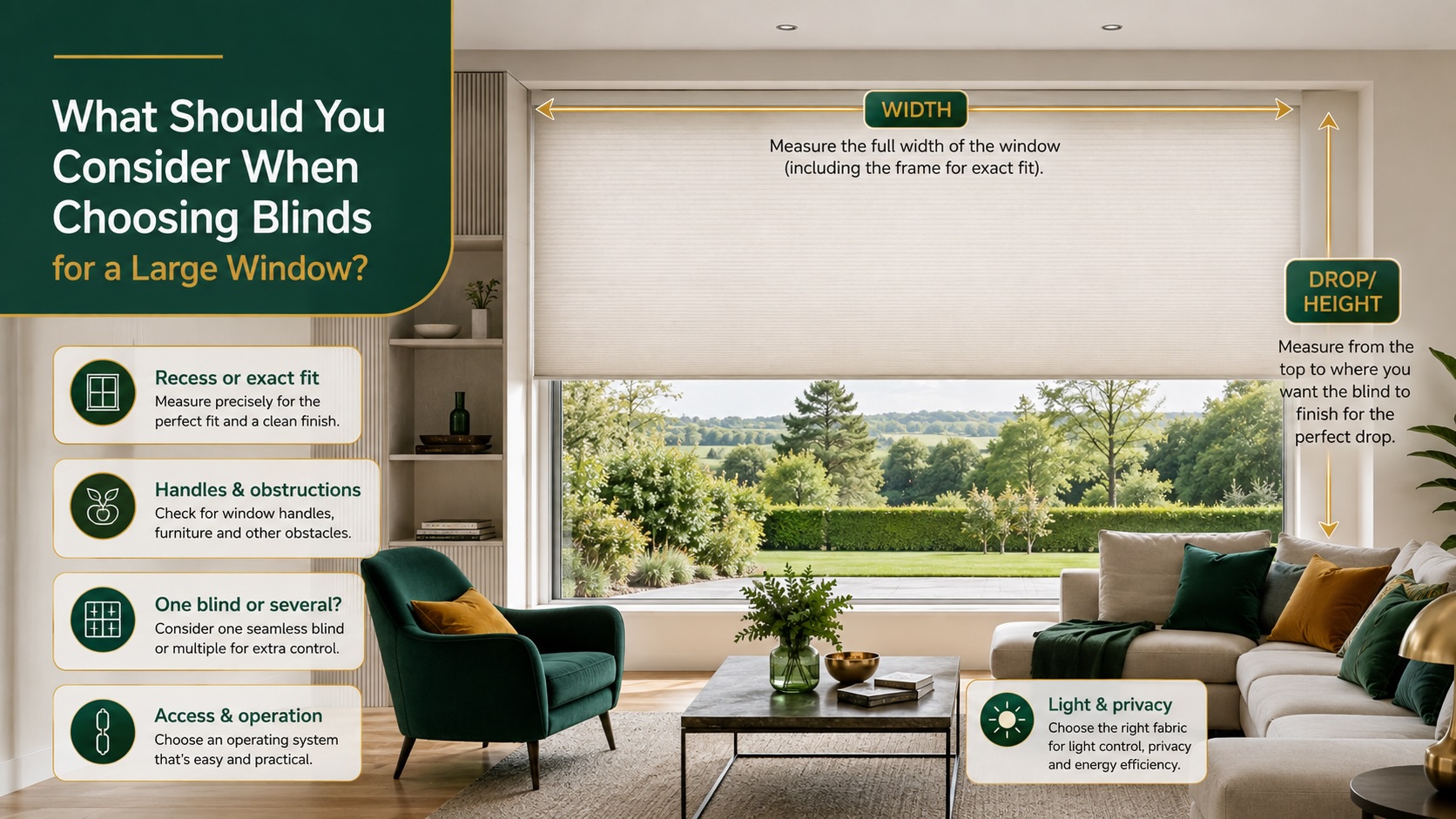
Large windows place greater demands on a blind, so it is worth looking beyond colour and style before deciding which option to choose.
Window Width and Drop
Width and drop should always be considered together. A blind may be available at a very wide width only up to a certain drop, while a narrower blind may be manufactured much taller.
This is particularly important with extra-wide roller blinds, where the overall size of the fabric affects both weight and the construction required to support it.
Blind Weight
The larger the blind, the greater the amount of fabric, slats or other material involved. This increases the overall weight and can affect how the blind operates.
For very large roller blinds, the strength and diameter of the roller tube become particularly important because the tube needs to support the additional fabric across a wider span.
Ease of Operation
Think about how often you expect to open and close the blind.
A large blind that is operated several times each day needs to be convenient to use. Depending on the size and position of the window, manual operation may be perfectly suitable, while electric operation can be worth considering for particularly large or difficult-to-reach blinds.
Light and Privacy
Large windows can bring significant amounts of daylight into a room, but they can also leave a larger area exposed when privacy is required.
Consider whether you want:
- Adjustable light throughout the day
- Strong privacy when the blind is closed
- Reduced glare
- A darker room
- Independent control over different sections of the glazing
These requirements can influence whether a roller, vertical or Venetian blind is the better fit.
One Blind or Several?
A single large blind creates a clean, continuous appearance and avoids gaps between separate blinds.
However, dividing a wide window into two or more blinds can provide greater flexibility, especially if different sections of the window need to be opened or shaded independently.
Neither approach is automatically better. The right choice depends on the dimensions of the window, how it is used and the type of blind you prefer.
Overall Appearance
A blind covering several square metres of glazing becomes a significant part of the room.
Fabric colour, texture and blind style can therefore have a much greater visual impact than they would on a small window. A neutral blind may blend quietly into the room, while a darker or more distinctive finish can turn the window into a stronger design feature.
The best blind for a large window is therefore one that works structurally and practically while also complementing the scale and style of the room.
Roller Blinds for Large Windows
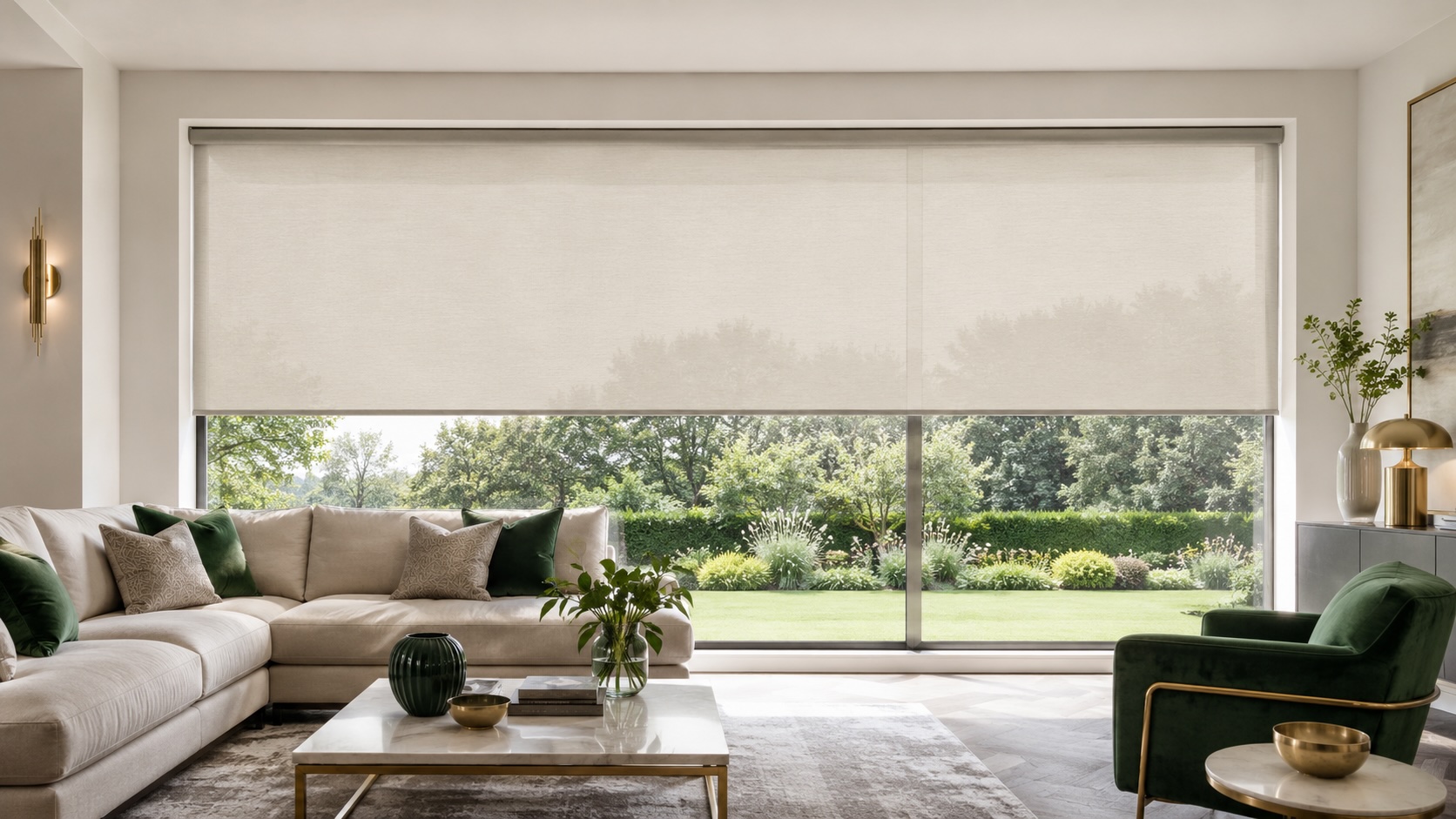
Roller blinds are one of the strongest options for large windows because their simple construction allows them to cover a broad area of glazing without introducing lots of visible components.
When lowered, the blind creates a clean, continuous panel of fabric. When raised, the fabric rolls neatly around the tube, which helps keep the window area looking relatively uncluttered.
For large windows, roller blinds offer several practical advantages:
- A simple, streamlined appearance
- A wide choice of colours and fabrics
- Good control over privacy and incoming light
- The possibility of covering a large opening with a single blind
- A compact appearance when the blind is raised
The key consideration is size. As the width and drop increase, so does the amount and weight of fabric. This places more demand on the roller tube and operating mechanism.
For that reason, a very wide roller blind should be designed specifically for the size of the opening rather than simply treated as an oversized version of a standard blind.
This is where extra-wide and XL roller blind systems become particularly useful. They are designed to accommodate larger spans and greater fabric weight while maintaining a clean single-blind appearance.
Extra Wide and XL Roller Blinds
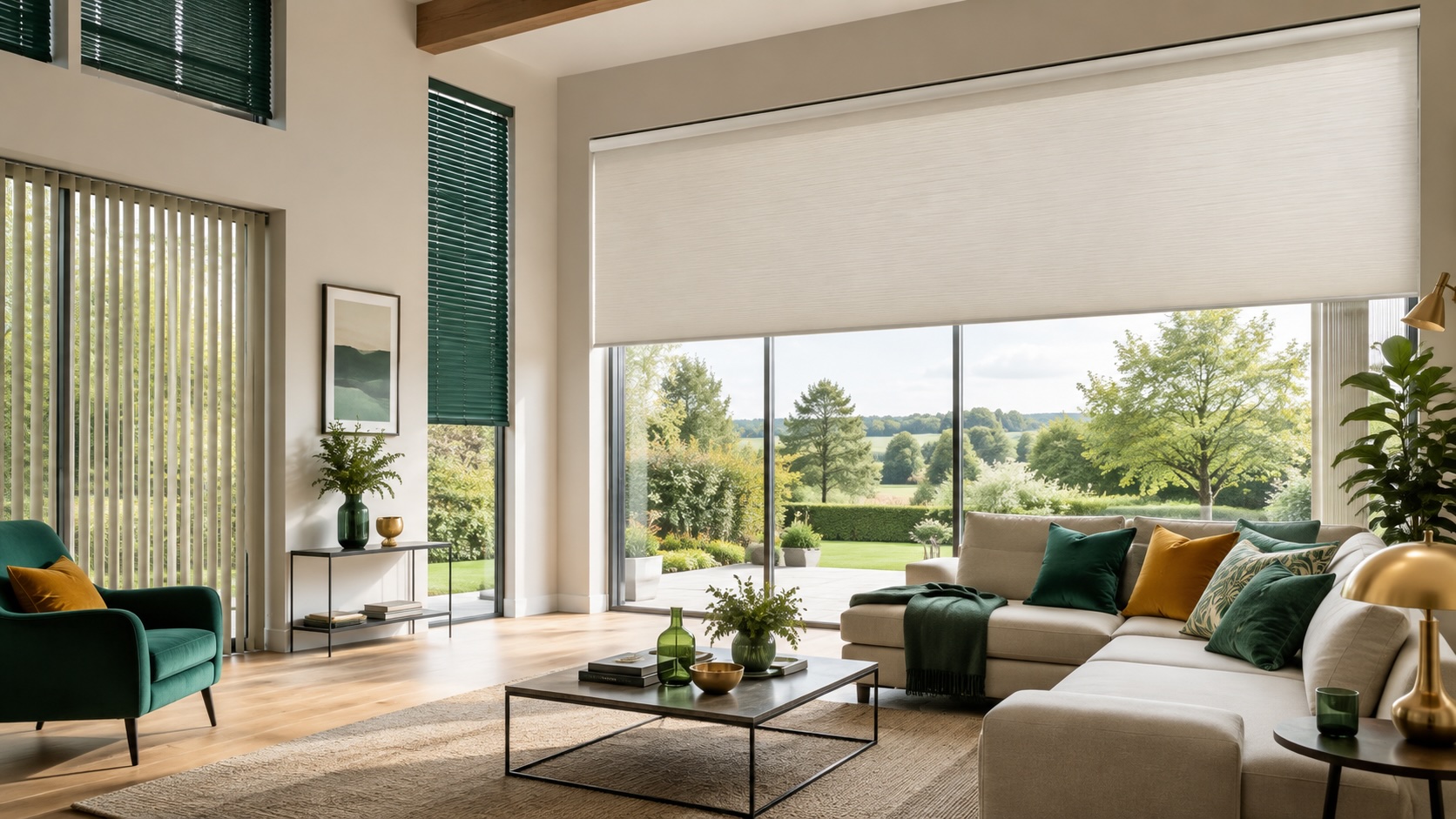
For particularly wide windows, an extra-wide or XL roller blind can make it possible to cover a large area of glazing with a single blind rather than splitting the opening into several smaller blinds.
At DotcomBlinds, standard roller blinds can be made up to approximately 3.45 metres wide, while Premium XL roller blinds can reach up to 4.7 metres wide, depending on the required drop.
The relationship between width and drop is important. The maximum possible drop generally reduces as the blind becomes wider because the total amount and weight of fabric increases.
For example, a Premium XL blind can reach a width of up to 4.7 metres with a drop of around 1.85 metres. At narrower widths, much greater drops are possible.
The construction of the roller also matters. DotcomBlinds uses metal barrels as standard and increases the barrel diameter where necessary on XL blinds to better support the additional weight of the fabric.
This is an important detail on very wide blinds because a tube that is not sufficiently rigid may bow under load.
For customers who want a clean, uninterrupted finish across a large window, an XL roller blind can therefore be one of the most practical options, provided the dimensions of the opening fall within the manufacturing limits.
Vertical Blinds for Large Windows
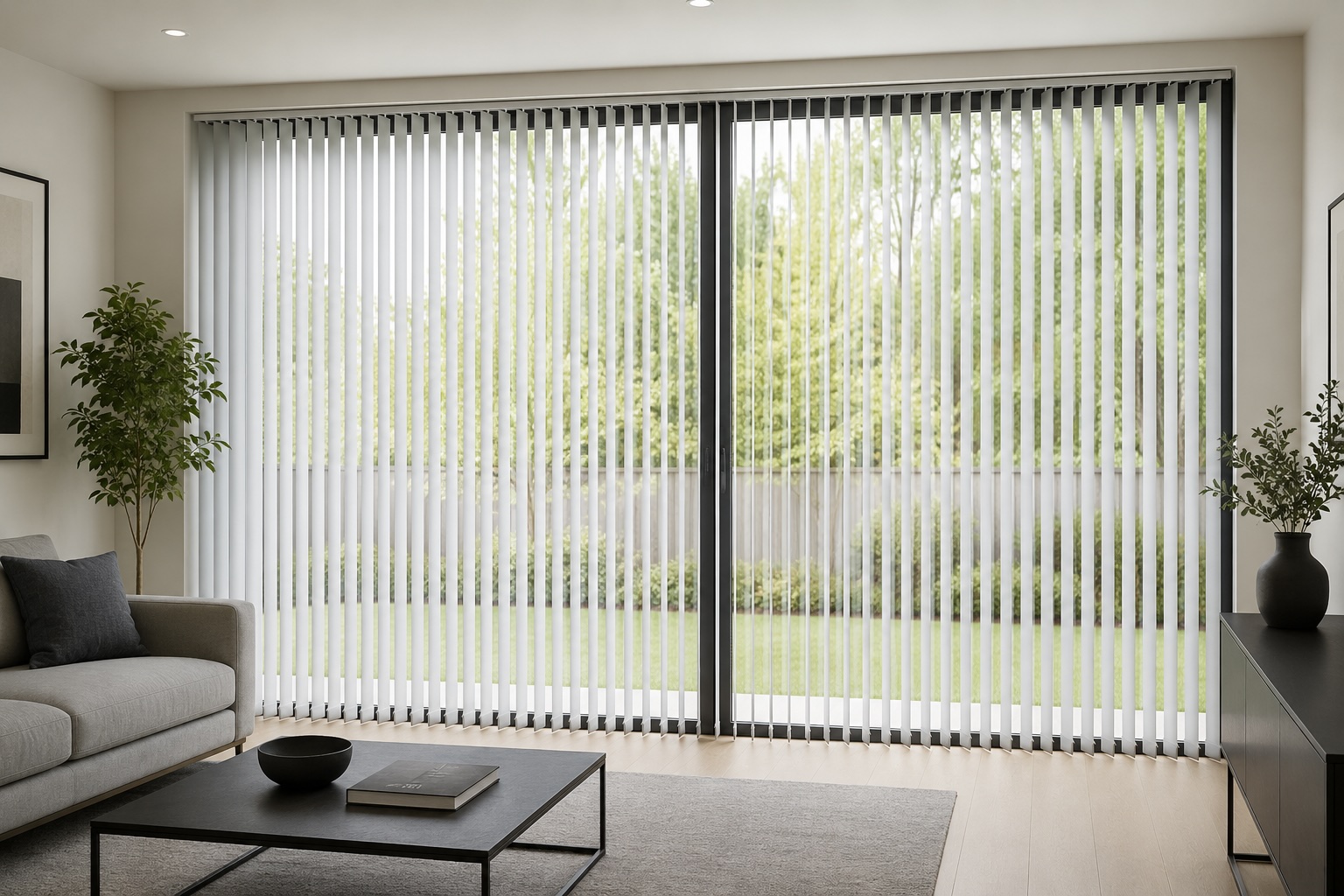
Vertical blinds are another strong option for large windows, particularly where the glazing is wide and you want flexible control over both light and privacy.
Instead of using one large sheet of fabric, vertical blinds are made from individual louvres that hang from a headrail. This makes them well suited to broader window areas because the blind is divided into multiple vertical sections rather than relying on one very wide panel.
Their main advantages include:
- Good suitability for wide windows
- Adjustable louvres for controlling light and privacy
- The ability to filter light without fully opening the blind
- A relatively neat appearance across large areas of glazing
- Practical operation on wide windows and glazed doors
The vertical orientation of the louvres can also work particularly well on large windows because it complements the height of the glazing and creates a sense of balance across a broad opening.
Another advantage is flexibility. You can tilt the louvres to reduce glare or improve privacy while still allowing some daylight into the room, rather than having to choose between fully open and fully closed.
For customers who want a practical blind for a very wide window, especially where adjustable light control is important, vertical blinds are often one of the most versatile options.
Venetian Blinds for Large Windows
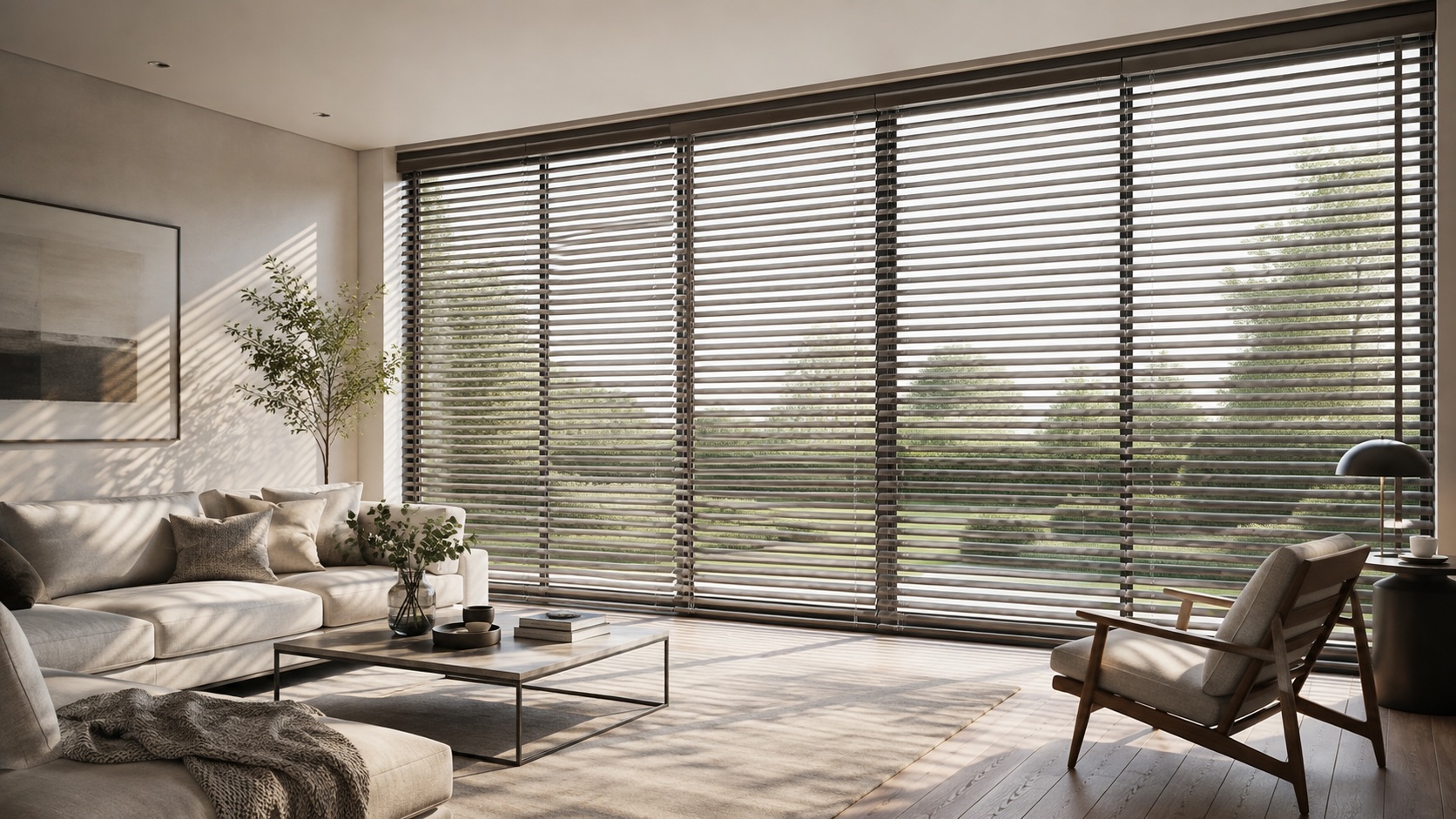
Venetian blinds can work well on larger windows when you want precise control over light and privacy.
Their main advantage is the adjustable slat system. Rather than raising the entire blind every time you want more daylight, you can simply tilt the slats to control how much light enters the room and how much privacy you retain.
For large windows, Venetian blinds can offer:
- Precise control over light levels
- Adjustable privacy throughout the day
- A structured, architectural appearance
- A wide choice of finishes, depending on the material
- The option to leave the blind lowered while still adjusting daylight
The main consideration is weight. As the blind gets wider and taller, the number of slats increases, which can make the blind heavier to raise and lower.
For particularly wide windows, it may therefore be more practical to divide the opening into two or more Venetian blinds rather than use one very large blind. This can make each blind easier to operate and also give you independent control over different sections of the window.
Venetian blinds are therefore a strong choice for large windows where adjustable light control is the priority, but the final configuration should take the overall size and weight of the blind into account.
Electric Blinds for Large Windows
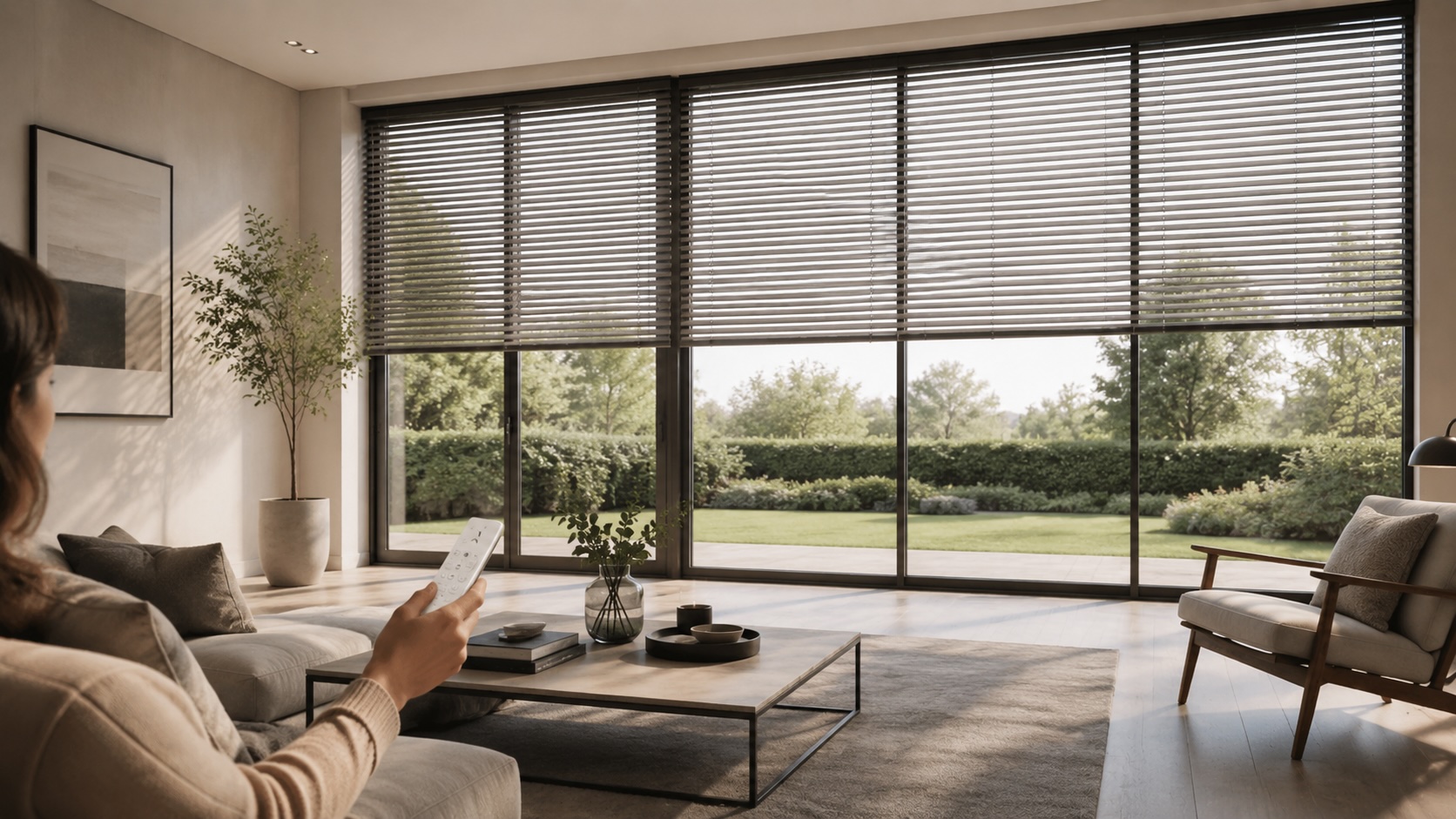
Electric blinds can be particularly useful on large windows because they remove much of the physical effort involved in operating a bigger blind.
As the size of a blind increases, so does its weight. On very wide or tall windows, motorised operation can therefore make everyday use more convenient, especially if the blind is opened and closed frequently.
Electric blinds can be worth considering where:
- The blind is particularly large or heavy
- The window is high or difficult to reach
- You want a cleaner operating system without regularly handling a cord or chain
- Several blinds need to be operated as part of the same large glazed area
- Convenience is a priority
They can also work well in rooms with large expanses of glazing where adjusting the blinds several times throughout the day would otherwise become repetitive.
Motorisation is not essential for every large window. A well-specified manual blind can still be perfectly practical. However, as the dimensions increase, electric operation often becomes a more attractive option because it simplifies day-to-day use.
For very wide windows, the important point is to choose an electric blind system that has been designed to cope with the required size and weight rather than assuming that any motorised blind will be suitable.
One Large Blind or Several Smaller Blinds?
When covering a large window, one of the most important decisions is whether to use a single wide blind or divide the glazing into two or more smaller blinds.
Both approaches can work well, but they offer different advantages.
Benefits of One Large Blind
A single blind can create a cleaner, more uninterrupted appearance across the window.
It may be the better choice if you want:
- One continuous area of fabric
- Fewer visual breaks across the glazing
- A simpler overall appearance
- One blind to operate rather than several
- Fewer gaps between separate blinds
This approach can work particularly well with roller blinds, especially where an extra-wide or XL system allows the full opening to be covered within the available size limits.
Benefits of Several Smaller Blinds
Dividing the window into two or more blinds can provide greater flexibility.
This may be useful if:
- Different sections of the glazing need independent control
- Part of the window or door is opened more often than another
- You want to manage sunlight differently across the window
- The overall opening exceeds the maximum size of a single blind
- Smaller individual blinds would be easier to handle or operate
Using multiple blinds can also make sense on large glazed doors or window-and-door combinations, where one continuous blind could interfere with how the opening is used.
The right choice therefore depends on both appearance and practicality. If a single blind can comfortably cover the window and you want the cleanest possible look, one large blind may be ideal. If flexibility and independent control matter more, several smaller blinds can be the better solution.
When Is One Extra-Wide Roller Blind the Better Choice?
A single extra-wide roller blind can be the better option when you want to cover a large window with one clean, continuous panel of fabric.
It is particularly worth considering if:
- You want to minimise visible breaks across the window
- A simple, uninterrupted appearance is important
- The full opening falls within the blind’s manufacturing limits
- You prefer operating one blind rather than several
- The window is one large glazed area rather than a combination of independently used sections
A single wide blind can create a very neat finish because there are no gaps between neighbouring blinds. This is especially attractive on broad picture windows or other large areas of glazing where you want the blind to read as one complete feature.
The main limitation is size. The blind still needs to remain within the maximum width and drop available for the system, and those two measurements need to be considered together.
Where the dimensions are suitable, an extra-wide or XL roller blind can provide a practical way to cover a large window without automatically dividing it into several smaller blinds.
When Are Multiple Blinds Better?
Several smaller blinds can be more practical than one very large blind when different parts of the window need to be controlled independently.
This may be the better approach if:
- The glazing is divided into separate window sections
- Part of the opening includes a door that is used regularly
- Different areas receive different amounts of direct sunlight
- You want to open one section while keeping another covered
- The overall width or drop exceeds the limits of a single blind
- Smaller blinds would be easier to handle and operate
Multiple blinds can also give you more flexibility throughout the day. For example, you may want to reduce glare on one side of a large window while leaving the rest open to maximise natural light.
The trade-off is appearance. Several blinds introduce more joins and visible gaps than a single continuous blind, so the finished look is less uninterrupted.
For large windows made up of several distinct panes, however, this can often be the more practical solution because each blind can correspond with an individual section of glazing.
The decision should therefore reflect how the window is actually used. If independent control is more valuable than a completely continuous look, multiple blinds may be the better choice.
Why Roller Barrel Strength Matters on Very Wide Blinds
The wider a roller blind becomes, the more important the strength of the roller barrel becomes.
A large blind carries a greater area of fabric, which means more weight is supported across the width of the tube. If that tube is not sufficiently rigid, it can begin to bow or deflect in the middle.
This can affect both the appearance of the blind and how evenly it rolls.
For extra-wide blinds, it is therefore important that the roller system is matched to the size and weight of the blind rather than simply using the same barrel as a standard-sized product.
DotcomBlinds uses metal barrels as standard and automatically increases the barrel diameter where necessary on XL roller blinds to accommodate the additional fabric weight.
This is an important construction detail because the performance of a large roller blind depends not only on the fabric and operating mechanism, but also on whether the supporting tube is strong enough for the span.
When comparing very wide roller blinds, it is worth looking beyond the maximum advertised width and considering how the blind itself has been engineered to support that size.
Does Blind Fabric Matter More on Large Windows?
Yes. On a large window, the fabric becomes a much more dominant part of the room when the blind is closed, so colour, opacity and texture deserve extra consideration.
A fabric that looks subtle on a small sample can have a much stronger visual effect when it covers several square metres of glazing.
When choosing fabric for a large roller blind, think about:
- Colour: lighter shades can help keep the room feeling open, while darker colours create a stronger visual statement.
- Light transmission: different fabrics will allow different amounts of daylight through.
- Privacy: consider how much coverage you need during the day and at night.
- Glare control: large windows can admit significant amounts of direct light, particularly in rooms with screens or televisions.
- Overall room balance: a very large blind can effectively become a wall-sized design feature when closed.
Fabric choice also affects how the blind feels visually when it is lowered. A bold colour or strong pattern can become highly prominent across a wide opening, while a neutral fabric may blend more easily into the surrounding décor.
For this reason, samples can be especially useful when choosing blinds for large windows. Viewing the fabric in the actual room allows you to see how it responds to natural light and how well it works with the surrounding colours before committing to a much larger finished blind.
Blackout Blinds for Large Windows
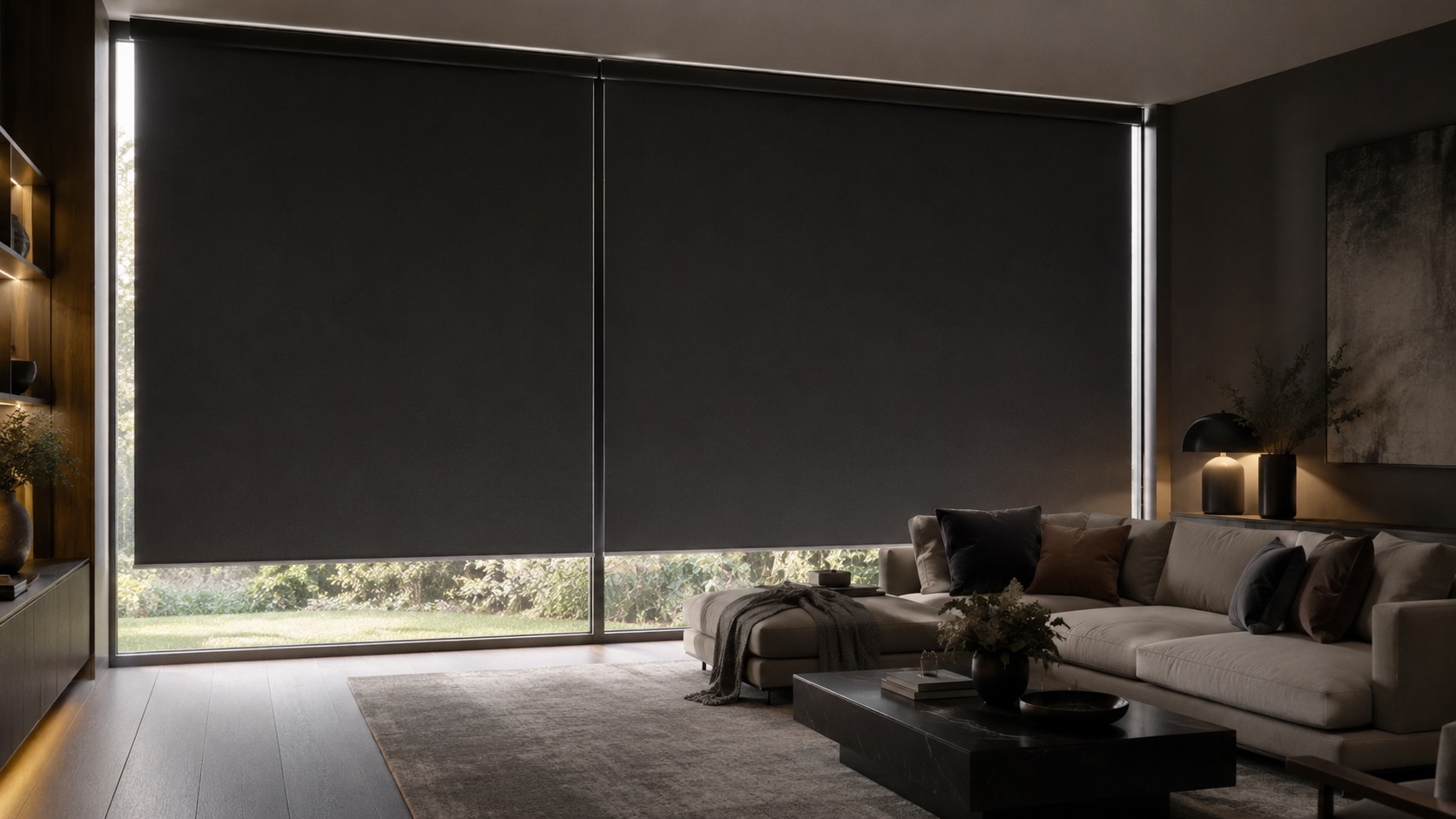
Blackout blinds can be a good option for large windows where reducing incoming light is a priority, such as in bedrooms, nurseries, media rooms or spaces affected by strong sunlight.
The important point is that blackout fabric and complete room blackout are not the same thing.
A blackout roller blind is designed to stop light passing through the fabric itself. However, depending on the fitting and blind style, some light may still enter around the edges of the blind.
On large windows, these edge gaps can become more noticeable simply because the total glazed area is greater.
If you are considering blackout blinds for a large window, think about:
- Whether the blind will be fitted inside or outside the recess
- How much light control you actually need
- Whether some edge light is acceptable
- Whether a single large blind or several smaller blinds will create the better result
- How often the blind will be raised and lowered
For customers who mainly want to reduce glare, brightness and direct sunlight, blackout fabric can be very effective.
If the aim is to make the room as dark as possible, the overall blind system and fitting method matter just as much as the fabric itself.
Large Blinds for Patio and Bi-Fold Doors
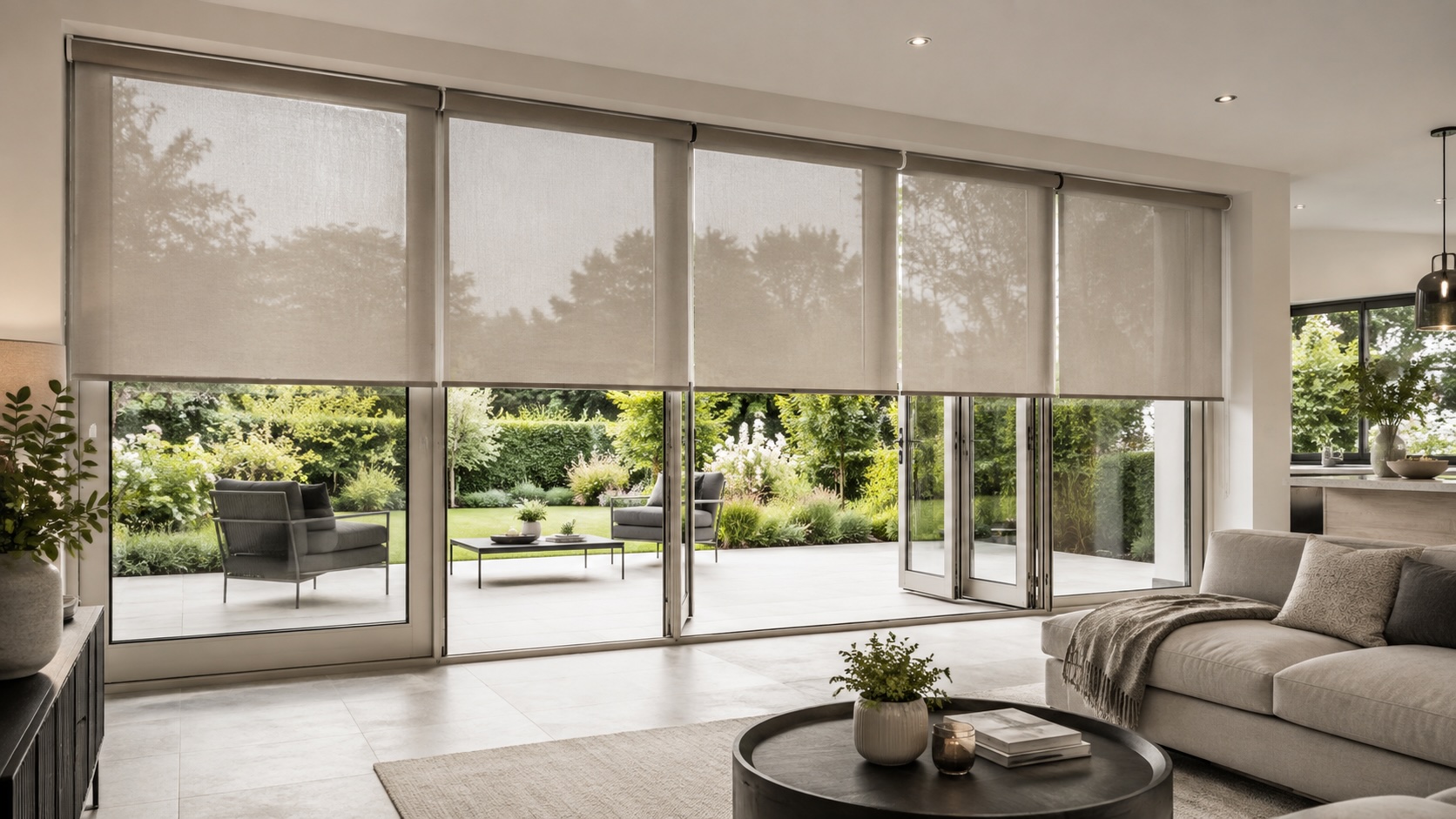
Large areas of glazing often include patio doors, sliding doors or bi-fold doors, which introduce an extra practical consideration: the blind needs to work around how the doors are opened and used.
Before choosing a blind, think about:
- How often the doors are opened
- Whether individual door panels need independent access
- The position of handles and other obstructions
- Whether one large blind would cover the full opening
- Whether several blinds would provide greater flexibility
A single wide roller blind can create a very clean appearance across a broad glazed opening, but it may be less practical if the doors are used frequently and you regularly need access to only one section.
In these situations, multiple blinds can make more sense because each section can be operated independently. This allows you to uncover the part of the glazing you need without raising the entire blind.
Vertical blinds are also worth considering for wide glazed doors because their individual louvres provide flexible light control across a broad opening.
The best option depends on how the doors function day to day. For large windows that are primarily fixed glazing, one wide blind can work very well. For frequently used doors, independent control and ease of access may be more important than achieving one uninterrupted blind across the entire opening.
Large Blinds for Floor-to-Ceiling Windows
Floor-to-ceiling windows create an impressive architectural feature, but their height and glazed area can make blind selection more demanding.
The main considerations are:
- Drop: taller windows require a blind system capable of handling the full height.
- Weight: a long drop can add considerable fabric or material weight.
- Ease of operation: high windows can make manual controls less convenient.
- Privacy: floor-to-ceiling glazing can leave a room highly exposed when the blind is open.
- Light control: large glazed areas can admit significant amounts of sunlight throughout the day.
- Appearance: because the blind covers such a large surface, its colour and finish can have a major visual impact on the room.
Roller blinds can work particularly well where you want a clean, uninterrupted finish, provided the required width and drop are within the available size limits.
For very tall windows, it is also worth considering electric operation, especially if the blind will be adjusted regularly or the controls would otherwise be difficult to reach.
Where the glazing is divided into several sections, multiple blinds may offer more flexibility. This allows different parts of the window to be shaded independently rather than covering the entire elevation at once.
The best solution will depend on the proportions of the window as much as its overall size. A tall, narrow opening presents different requirements from a floor-to-ceiling window that is both very wide and very high.
Manual or Electric Blinds for Large Windows?
Both manual and electric blinds can work well on large windows. The better option depends on the size of the blind, how accessible the window is and how often you expect to operate it.
When Manual Blinds Make Sense
Manual operation can be perfectly suitable where:
- The blind is within comfortable reach
- The blind is not excessively heavy
- You only adjust it occasionally
- You prefer a simple operating system
- Motorisation is not necessary for convenience
A well-specified manual blind can still be practical on a large window, particularly where the dimensions remain manageable.
When Electric Blinds Are Worth Considering
Electric operation becomes more attractive as the blind gets larger or harder to access.
It may be the better choice if:
- The blind is very wide or tall
- The window is positioned high up
- You expect to open and close the blind several times a day
- Several blinds need to be operated regularly
- You want to avoid manually handling a large blind
- Convenience is a priority
Motorisation can also make large blinds feel more practical in everyday use because the effort required to operate them no longer depends on the size or weight of the blind in the same way.
That does not mean every large window needs an electric blind. The key is to match the operating method to the scale and location of the window. For an accessible, reasonably sized blind, manual control may be entirely sufficient. For very large or difficult-to-reach glazing, electric operation can be a worthwhile upgrade.
Measuring Large Windows for Blinds
Accurate measuring is important for any made-to-measure blind, but it becomes even more important when the window is unusually wide or tall.
A small measuring error on a standard window may already affect the fit. On a large opening, the consequences can be more noticeable because the blind covers a much greater area and may be manufactured close to the maximum size available for that system.
When measuring a large window, pay particular attention to:
- Width and drop: measure both carefully and follow the specific instructions for your chosen blind type.
- Multiple measurement points: window openings are not always perfectly square, so checking the width and drop in more than one place can help identify variations.
- Recess or exact fitting: decide whether the blind will sit inside the recess or cover the opening from outside it.
- Handles and obstructions: check for window handles, vents, tiles, radiators or other features that could interfere with the blind.
- Access for installation: very large blinds can be heavier and more awkward to handle, so consider how easily the finished blind can be lifted into position.
- Maximum product dimensions: check that both the width and drop fall within the limits of the blind you intend to order.
For extra-wide blinds, width and drop should be considered together. A blind may be capable of reaching its maximum width only at a more limited drop, while narrower versions of the same system may accommodate considerably greater heights.
The basic measuring principles for an XL roller blind are similar to those used for a standard roller blind. The key difference is that there is less room for error when ordering a particularly large made-to-measure product.
For this reason, it is always worth checking your measurements carefully before placing the order and following the measuring guidance for the exact blind style you have chosen.
Is Installing an XL Blind More Difficult?
The basic installation process for an XL roller blind is similar to fitting a standard roller blind, but the larger size means there are a few extra practical considerations.
The main difference is weight and handling. A wider blind contains more fabric and uses a larger supporting tube, so the finished blind can be heavier and more awkward to lift into position.
When installing a large blind, it is worth considering:
- Whether you can safely lift the blind into place
- Whether a second person would make handling easier
- Whether the fixing surface is suitable for the blind’s weight
- Whether you have enough clear space to position the blind accurately
- Whether the brackets are aligned correctly before the blind is fitted
The actual fixing process itself is not fundamentally different from installing a standard roller blind. The main challenge is managing the size and weight of the product safely and accurately.
For very large blinds, having two people available can make the installation more manageable, especially when lifting the blind into the brackets.
The key point is that XL blinds are not necessarily more complicated to install, but they do require more careful handling because of their scale.
Best Blinds for Large Windows: Quick Comparison
Different blind types suit large windows for different reasons. The best choice depends on whether your priority is maximum width, flexible light control, ease of operation or a clean uninterrupted appearance.
| Blind Type | Best For | Key Advantage | Main Consideration |
|---|---|---|---|
| Roller Blinds | Large modern windows | Clean, simple appearance with a broad choice of fabrics | Maximum width and roller construction |
| XL Roller Blinds | Very wide glazing | Can cover exceptionally wide openings with a single blind | Width and drop limits need to be considered together |
| Vertical Blinds | Wide windows and glazed doors | Excellent control over light and privacy | More visible components than a roller blind |
| Venetian Blinds | Large windows where adjustable light control matters | Precise control through tilting slats | Larger blinds become heavier to raise |
| Electric Blinds | Large, high or frequently operated windows | Convenient operation | Requires a suitable motorised system |
| Multiple Blinds | Large windows divided into separate sections | Independent control over different areas | Creates joins or gaps between blinds |
There is no single blind type that is best for every large window.
If you want the cleanest possible finish across a broad opening, an extra-wide or XL roller blind is often worth considering. If flexible light adjustment is more important, vertical or Venetian blinds may be more suitable. For very large or difficult-to-reach windows, electric operation can make everyday use considerably more convenient.
The dimensions and layout of the glazing should ultimately determine which solution is most practical.
What Is the Maximum Width for a Roller Blind?
The maximum width of a roller blind depends on the specific system and the required drop.
At DotcomBlinds, standard roller blinds can be made up to approximately 3.45 metres wide, with a maximum drop of around 4.25 metres.
For larger openings, Premium XL roller blinds can reach up to 4.7 metres wide. At this maximum width, the available drop is more limited, at around 1.85 metres.
As the blind becomes narrower, a greater drop can be accommodated. For example, a Premium XL blind with a width of 1.7 metres or less can be manufactured with a drop of up to approximately 5.75 metres.
This is why maximum width and maximum drop should not be considered separately. A blind may be capable of reaching a very wide span, but only at a more restricted height.
For large windows, the safest approach is to check the exact combination of width and drop rather than relying on a single maximum-size figure.
Which Blind Is Best for a Very Large Window?
There is no single blind type that is best for every very large window. The right choice depends on the dimensions of the glazing, how you use the space and whether your priority is appearance, flexibility or ease of operation.
A simple way to narrow the options is:
- Choose an XL roller blind if you want a clean, uninterrupted finish across a very wide opening and the window falls within the available size limits.
- Choose vertical blinds if you want flexible light and privacy control across a broad area of glazing.
- Choose Venetian blinds if precise slat adjustment is important and the overall size remains practical for the blind system.
- Choose electric blinds if the window is especially large, high or difficult to reach, or if you expect to operate the blind frequently.
- Choose multiple blinds if different sections of the window need independent control or the opening is too large for a single blind.
For exceptionally large glazing, the best solution is often determined by the balance between maximum size, weight, operation and how the window is actually used.
A blind that technically fits the opening is not automatically the best option. The ideal choice should also be practical to operate, properly supported and suited to the way you want to control light and privacy throughout the day.
Final Verdict: Choosing Blinds for Large Windows
The best blind for a large window is not simply the one that can be made to the greatest width.
A good large-window solution needs to balance several factors at the same time:
- Size: the blind must fall within the available width and drop limits.
- Weight: larger blinds need suitably strong components and support.
- Construction: wide roller blinds in particular need a barrel capable of handling the span and fabric weight.
- Operation: the blind should remain practical to use day to day.
- Light and privacy: consider whether you need full coverage, adjustable slats or independent control over different sections.
- Appearance: one wide blind creates a cleaner continuous look, while multiple blinds offer greater flexibility.
- Installation: larger blinds may be heavier and more awkward to handle.
For many wide windows, roller and XL roller blinds are among the strongest options when you want a clean, uninterrupted finish. Vertical blinds can be especially useful where flexible light control is important, while Venetian blinds provide precise adjustment through their tilting slats. Electric operation is worth considering when the blind is particularly large, high or frequently used.
The most important point is to match the blind to the actual window rather than choosing by style alone.
If the dimensions, construction, operating method and way the window is used are all considered together, even very large glazing can be covered in a way that is practical, attractive and easy to live with.