Order Tracking
 0800 1422417
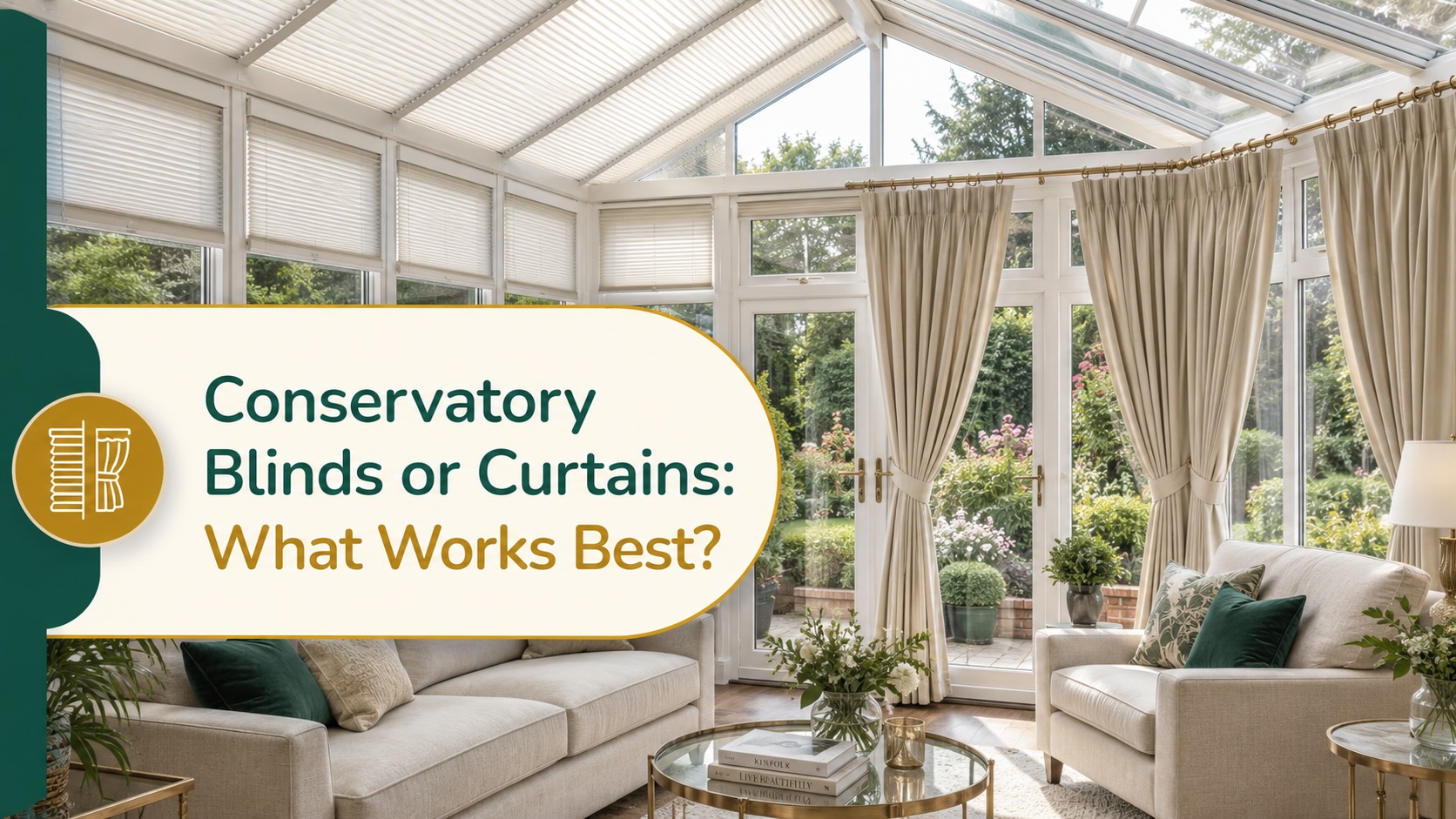
Choosing between conservatory blinds and curtains is not quite the same as choosing a window dressing for a standard living room or bedroom. A conservatory usually has more glass, stronger exposure to sunlight, less wall space and a greater risk of becoming too hot in summer or too cold in winter. That means the right choice needs to do more than simply look good.
Blinds and curtains can both work well in a conservatory, but they solve different problems. Blinds are usually the more practical option for controlling heat, glare, bright sunlight and awkward glazed areas, especially where roof windows, patio doors, bifold doors or multiple side windows are involved. Curtains, on the other hand, can bring softness, warmth, evening privacy and a more furnished feel, which can help a conservatory feel like a natural extension of the home rather than a separate glazed space.
The best answer often depends on how the room is used. A south-facing conservatory used as a daytime home office may need blinds to reduce glare and overheating. A conservatory used mainly as an evening dining or sitting room may benefit from curtains for privacy and cosiness. In many year-round conservatories, the strongest solution may be a carefully chosen combination of both.
In this guide, we compare conservatory blinds and curtains in detail, looking at heat control, glare, privacy, roof glazing, doors, practicality and interior style, so you can choose the option that works best for your space.
Why Conservatories Need a Different Approach to Window Dressings
A conservatory places very different demands on blinds or curtains compared with most rooms in the home. In a standard bedroom or living room, the window dressing may only need to provide privacy, soften the look of the room or block light at certain times. In a conservatory, the window dressing often has to work much harder.
The main reason is the amount of glass. Conservatories are designed to bring in natural light and connect the home with the garden, but that same glazing can also create problems with heat, glare and temperature control. During sunny weather, the room can warm up quickly. In cooler months, the glass can make the space feel less cosy, especially in the evening.
Glare is another common issue. Low sun can make it difficult to read, watch television, use a laptop or sit comfortably in certain parts of the room. This is especially noticeable in south-facing and west-facing conservatories, where the sunlight can be strong for long periods of the day.
Privacy also needs more thought. A conservatory may be overlooked by neighbouring gardens, side paths, roads or upper windows. During the day, some window coverings can provide privacy while still allowing light in. At night, when the lights are on indoors, that privacy requirement changes and a more opaque solution may be needed.
There are also practical fitting considerations. Conservatories often include roof glazing, angled windows, narrow frames, French doors, patio doors or bifold doors. These areas do not always suit standard curtains or off-the-shelf blinds. The right solution needs to work with the frame, the door movement, the handles and the way the room is used.
This is why the choice between blinds and curtains should start with the conservatory itself, rather than the product. The best window dressing is the one that solves the room’s main problems, whether that is overheating, glare, night-time privacy, winter comfort, style or a combination of several needs.
Quick Answer: Are Blinds or Curtains Better for a Conservatory?
For most conservatories, blinds are usually the better primary choice because they offer more practical control over heat, glare, privacy and awkward glazed areas. Conservatories often have multiple windows, large doors and sometimes roof glazing, so a flexible, made-to-measure blind system can be easier to adapt to the space than curtains alone.
That said, curtains can still work very well in the right conservatory. They are especially useful when the aim is to make the room feel softer, warmer and more like a furnished living space. Curtains can also be a strong option for evening privacy, particularly across French doors, patio doors or wider openings where there is enough room for the fabric to stack neatly at the sides.
The best choice depends on the main problem you want to solve. If the conservatory becomes too hot, too bright or difficult to use because of glare, blinds are usually the stronger option. If the priority is atmosphere, cosiness and night-time privacy, curtains may be more suitable. If the room is used throughout the year, a combination of blinds and curtains may provide the most complete solution.
In simple terms, blinds usually perform better as the main functional solution for a conservatory, while curtains are often strongest as a decorative or comfort-focused layer. The right answer is not always one or the other, but the option that matches how the conservatory is used day to day.
Conservatory Blinds: Pros and Cons
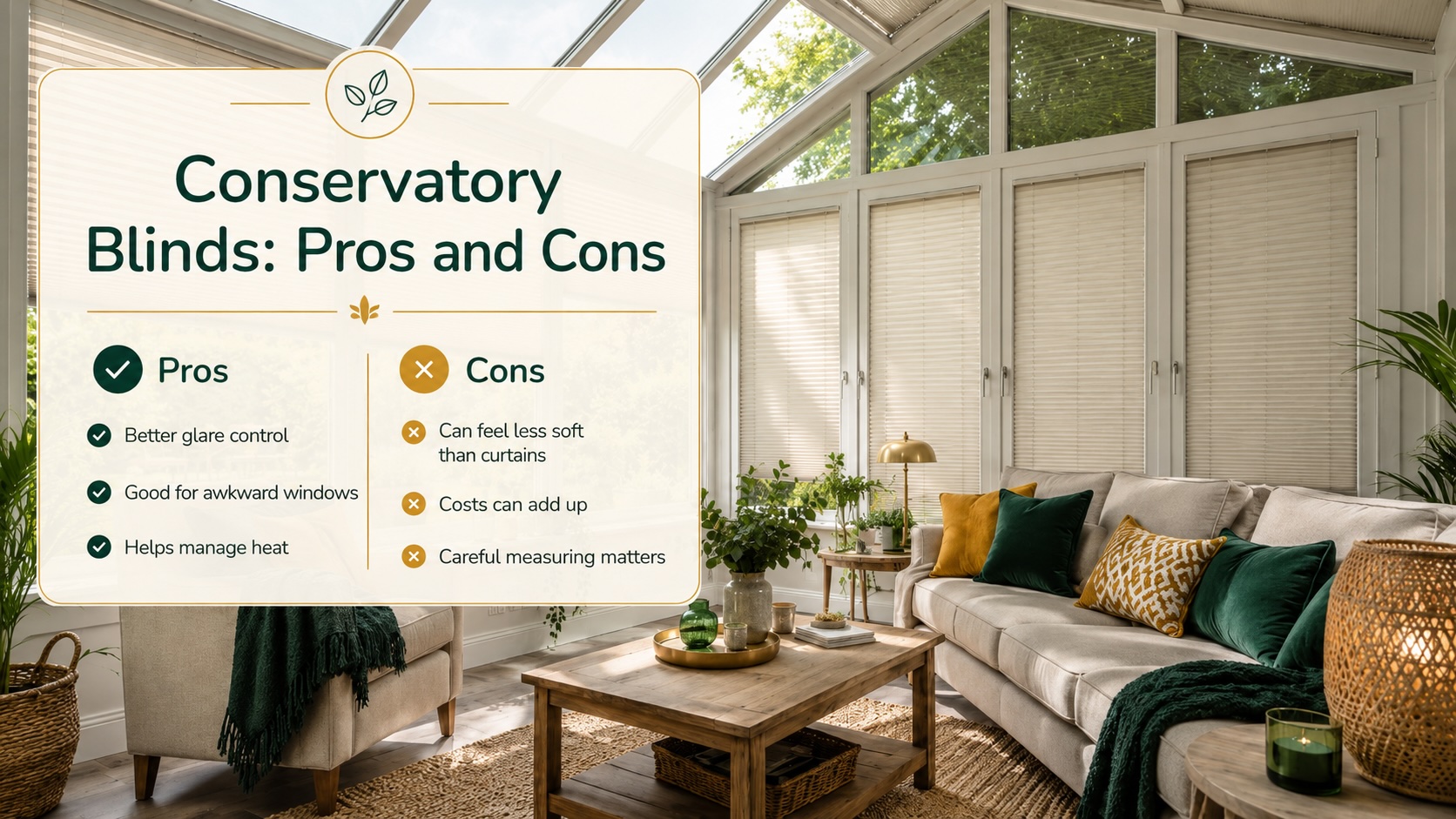
Conservatory blinds are usually chosen for practical reasons. They can be made to fit individual panes, side windows, doors and, in some cases, roof glazing, giving more control over how light and heat enter the space. This makes them particularly useful in conservatories that become too hot, too bright or difficult to use at certain times of day.
Pros of Conservatory Blinds
The biggest advantage of conservatory blinds is control. Instead of treating the whole room as one large glazed area, blinds allow you to manage different windows or sections separately. This is useful when the sun moves around the conservatory during the day, creating glare in one area while another part of the room still benefits from natural light.
Blinds are also practical where the conservatory has limited wall space. Because they sit within, on or close to the window area, they do not usually need the same amount of side stacking space as curtains. This can be especially helpful around patio doors, French doors, bifold doors and narrow frames.
Another benefit is fabric choice. Depending on the room’s main problem, conservatory blinds can be made using fabrics designed for different purposes, including glare reduction, privacy, blackout, thermal performance or solar control. For example, solar reflective blinds can help reduce heat and glare in bright conservatories, while thermal blinds may be more suitable where the room feels cold in the evening or during winter.
Blinds can also suit awkward glazing better than curtains. Roof windows, angled areas and multiple smaller panes are usually easier to dress with blinds than with curtain fabric. This is one reason blinds are often the more practical solution for conservatories with overhead glass.
From a design perspective, blinds can create a clean and modern finish. They work well in contemporary conservatories, garden rooms and glazed extensions where a neat, made-to-measure look is preferred.
Cons of Conservatory Blinds
The main drawback of conservatory blinds is that they may not always create the same softness or decorative impact as curtains. In a conservatory used as a living room or dining space, blinds alone can sometimes feel more functional than furnished, especially if the room has hard flooring, glass walls and minimal soft furnishings.
Cost can also be a consideration. A conservatory often has several individual windows, so the overall cost can be higher than dressing a single standard window. Specialist fabrics, roof blind systems or shaped blinds can also increase the price compared with simpler window treatments.
Measuring and fitting also matter more in a conservatory. Handles, vents, frame depth, opening windows and door movement all need to be considered. A blind that works well on a standard window may not be suitable for a narrow uPVC frame, a roof section or a frequently used door.
Privacy is another point to think about carefully. Some blind fabrics provide excellent daytime privacy but less privacy at night, especially if they are screen-style or semi-transparent. For a conservatory that is overlooked in the evening, an opaque blind, curtain layer or more privacy-focused fabric may be needed.
The key point is that conservatory blinds should not be chosen by appearance alone. The fabric, fitting method, window direction and how the room is used are usually just as important as the colour or style.
Conservatory Curtains: Pros and Cons
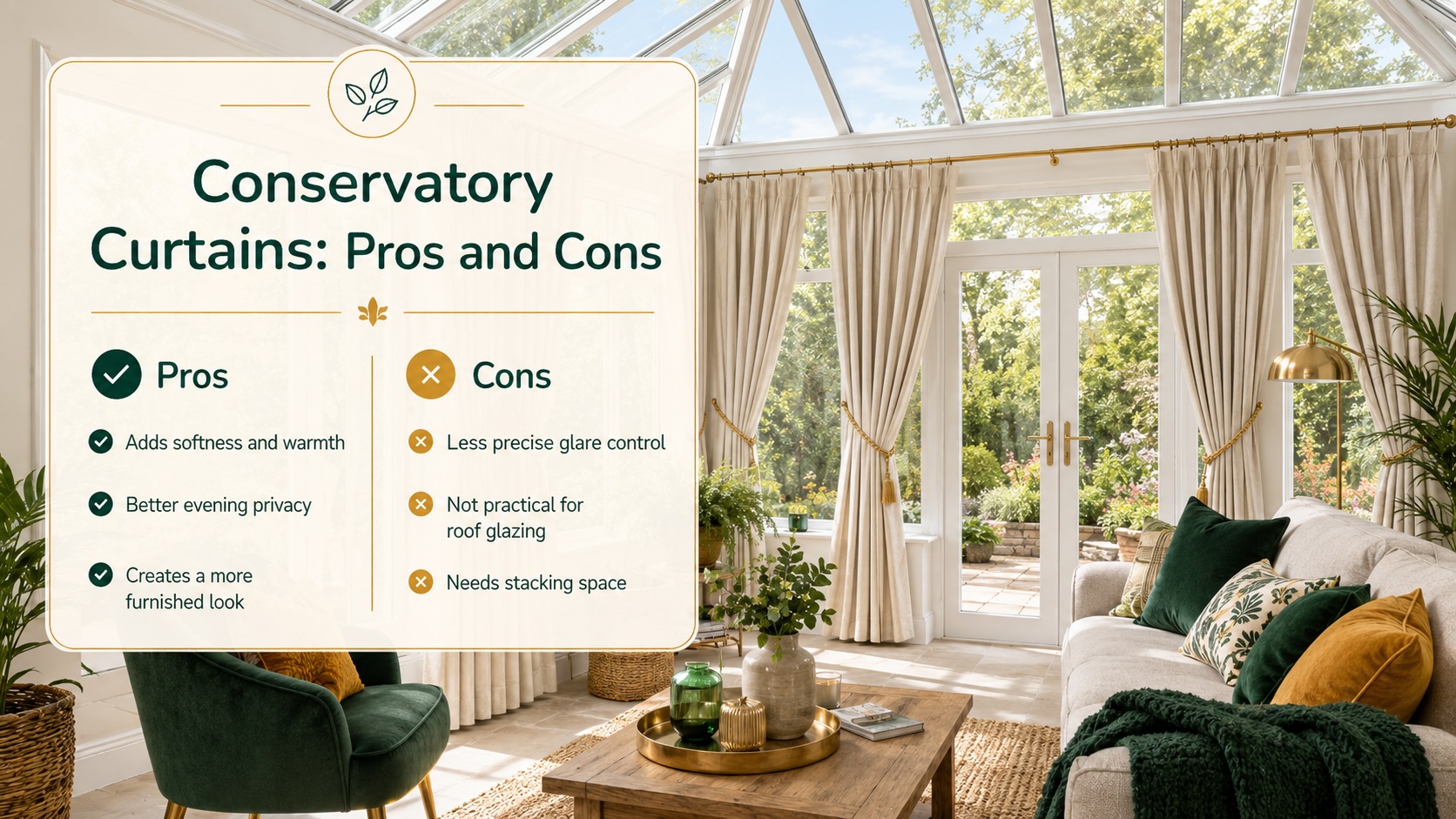
Curtains can work well in a conservatory, but they usually serve a different purpose from blinds. Where blinds are often chosen for control and practicality, curtains are more commonly chosen for softness, atmosphere, warmth and privacy. They can help a conservatory feel less like a glazed extension and more like a properly furnished room.
Pros of Conservatory Curtains
One of the main advantages of curtains is the way they soften a conservatory. Because conservatories often contain a lot of glass, hard flooring and reflective surfaces, they can sometimes feel bright but slightly stark. Curtains introduce fabric, texture and movement, which can make the space feel warmer, calmer and more connected to the rest of the home.
Curtains are also strong for evening privacy. When the lights are on indoors, some blind fabrics can become less private, especially if they are sheer, screen-style or designed to preserve an outward view during the day. A well-chosen curtain fabric can provide a more complete visual barrier in the evening, which is useful if the conservatory is overlooked by neighbouring homes, gardens or pathways.
They can also help with the feeling of warmth in cooler months. While curtains should not be treated as a complete insulation solution, a lined or heavier fabric can add a useful layer between the room and the glass. This can make the space feel more comfortable in the evening, particularly if the conservatory is used as a sitting room or dining area.
From a design point of view, curtains can make a conservatory feel more intentional. They can frame garden views, add colour or pattern, and help the room feel like a continuation of the adjoining living space. This is especially useful in traditional conservatories or in homes where the goal is to create a softer, more decorative finish.
Curtains can also work particularly well across larger door openings, provided there is enough space for the fabric to stack neatly at the sides. For French doors or patio doors, they can create a smart, familiar and comfortable look.
Cons of Conservatory Curtains
The main limitation of curtains is that they are not usually the most practical option for every part of a conservatory. They rarely work well for roof glazing, angled sections or multiple small panes, which means they may not solve the biggest heat and glare problems if those problems are coming from overhead sunlight.
Curtains also tend to offer less precise light control than blinds. In many cases, they are either open or closed. This can be fine for evening privacy, but less useful during the day when you may want to reduce glare without blocking too much natural light. Blinds are generally better for adjusting individual windows or controlling sunlight as it moves around the room.
Space is another consideration. Curtains need room to hang and stack. In a conservatory with narrow side returns, limited wall space, door handles or furniture close to the glass, curtain fabric may get in the way. This is particularly important around bifold doors, sliding doors and frequently used entrances.
Fabric fading can also be a concern. Conservatories receive high levels of sunlight, so curtain fabrics may be exposed to stronger UV and direct sun than they would be in a standard room. Lining, fabric choice and how the curtains are used can all make a difference, but it is still something to consider in bright, south-facing spaces.
Moisture and condensation should also be considered. Some conservatories are more prone to temperature swings and condensation than standard rooms. Heavier fabrics may not be ideal if the space is poorly ventilated or regularly affected by damp air.
For these reasons, curtains are often best used where their strengths are most relevant: softness, evening privacy, warmth and style. If the main challenge is heat, glare or roof glazing, blinds are usually the more technical and practical solution.
Blinds vs Curtains for Heat Control
Heat control is one of the biggest reasons homeowners compare conservatory blinds and curtains. A conservatory can warm up quickly because it contains far more glass than a standard room. When sunlight passes through the glazing, the room can trap heat, making the space uncomfortable during spring and summer.
For this specific problem, blinds are usually the stronger option. Because blinds sit close to the glass, they can help manage sunlight before it spreads further into the room. This is particularly useful with fabrics designed for solar control, such as solar reflective blinds, thermal blinds or specialist conservatory blind fabrics.
Solar reflective blinds can help reduce the amount of heat and glare entering the room, while still allowing a level of natural light. Thermal blinds can also add a layer at the window, which may help make the conservatory feel more comfortable in cooler weather. The exact performance will depend on the fabric, window direction, glazing and how the blinds are used.
Curtains can also help with temperature comfort, but usually in a different way. They are often more useful for creating a warmer, cosier feel in the evening or during colder months. A lined curtain can add softness and an extra layer between the room and the glass, which may help reduce the feeling of cold glazing.
However, curtains are not usually as effective for managing daytime solar heat gain, especially if the conservatory has roof glazing or multiple glass panels exposed to direct sun. By the time sunlight reaches a curtain set back from the glass, much of the heat may already be inside the room.
The best choice depends on the season and the main comfort problem:
- If the conservatory becomes too hot in summer, blinds are usually the better starting point.
- If the conservatory feels cold or exposed in winter, curtains or thermal blinds may be more useful.
- If the room is used all year, a combination of blinds and curtains may provide the best balance.
For example, solar reflective blinds on the main sunny windows can help manage daytime heat, while curtains across doors or larger openings can add softness and evening warmth. This layered approach can be especially effective in conservatories used as living rooms, dining rooms or year-round garden rooms.
Blinds vs Curtains for Glare and Light Control
Glare is another major issue in conservatories, especially in rooms with large side windows, roof glazing or doors facing the sun. A conservatory may feel bright and attractive at first, but if the light is too harsh, it can quickly become uncomfortable to use.
Blinds are usually more effective than curtains for controlling glare because they allow more precise adjustment. Instead of blocking the whole glazed area at once, blinds can be opened, lowered or tilted depending on where the sun is coming from. This is especially useful when sunlight moves around the room during the day.
Different blind types control glare in different ways. Solar reflective blinds help soften strong sunlight and reduce screen glare. Roller blinds offer a simple way to filter or block light depending on the fabric. Venetian blinds allow the slats to be tilted, which can redirect sunlight while still keeping some daylight in the room. Vertical blinds can work well across wider openings because the louvres can be angled to control both light and privacy.
Curtains are less precise. They are usually either open, partly drawn or fully closed. This can work well in the evening, but during the day it may mean choosing between too much glare or too little natural light. In a conservatory, where daylight is one of the main reasons for having the room, fully closing curtains can sometimes make the space feel heavier or darker than necessary.
The important distinction is that glare control is not the same as blackout. Many conservatories do not need to be made dark. They need sunlight to be softened, filtered or redirected so the room stays comfortable for reading, relaxing, working or watching television.
For this reason, blinds are usually the stronger option where daytime light control is the priority. Curtains can still play a useful role, particularly in the evening, but they rarely offer the same level of flexible glare management as well-chosen blinds.
Blinds vs Curtains for Privacy
Privacy in a conservatory can be more complicated than it first appears. Because conservatories often sit at the back or side of a property, they may be overlooked by neighbouring gardens, upper windows, side paths or shared outdoor spaces. The right window dressing needs to consider both daytime and night-time privacy, as these are not always the same thing.
Blinds can be very effective for daytime privacy, particularly where the goal is to reduce visibility into the room without blocking all natural light. Roller blinds, vertical blinds, Venetian blinds, Perfect Fit blinds and Day & Night blinds can all provide different levels of privacy depending on the fabric, opacity and how they are adjusted.
Some blind fabrics also allow a degree of outward visibility during the day. This can be useful if the conservatory looks onto a garden and you want to keep the view while making it harder for people outside to see in. However, this type of privacy is usually dependent on lighting conditions. When it is brighter outside than inside, privacy is stronger. When it is dark outside and the lights are on indoors, that privacy can reduce significantly.
Curtains are often stronger for evening privacy. A closed curtain creates a more complete visual barrier, which can be particularly useful if the conservatory is used as a dining area, sitting room or evening living space. Curtains can also make the room feel more settled at night, especially if the conservatory has a lot of exposed glass.
The trade-off is that curtains usually offer less flexible daytime control. If they are closed for privacy, they may also reduce a large amount of natural light and make the room feel more enclosed. Blinds allow more adjustment, which can be helpful during the day when you want privacy without fully closing off the space.
For many conservatories, the best privacy solution depends on when the room is used most:
- If the conservatory is mainly used during the day, blinds may provide enough privacy and better light control.
- If the conservatory is used in the evening, curtains or opaque blinds may be more suitable.
- If the room is overlooked both day and night, a layered solution may work best.
A practical approach is to use blinds for daytime privacy and glare control, then add curtains where stronger evening privacy and a softer finish are needed. This can work particularly well across large doors or the main glazed elevation of the conservatory.
Blinds vs Curtains for Conservatory Roofs
Conservatory roof glazing is one of the clearest areas where blinds usually work better than curtains. Curtains are designed to hang vertically, so they are rarely practical for overhead or angled glass. Roof blinds, on the other hand, are designed specifically to sit within or against roof glazing, helping to control sunlight from above.
This matters because roof glazing can be one of the main reasons a conservatory becomes too hot or too bright. Even if the side windows are covered, direct sunlight entering through the roof can still create glare, heat build-up and uncomfortable brightness across the room.
Roof blinds can help reduce the intensity of overhead sunlight, making the conservatory more usable during bright parts of the day. They can be especially useful in south-facing conservatories, glazed extensions and rooms used for dining, reading, relaxing or working from home.
They can also improve the overall appearance of the conservatory by creating a more finished look across the roof area. Without roof blinds, the room may still feel exposed even if the side windows are dressed.
However, roof blinds do need careful planning. Accurate measuring is important, and the right blind system will depend on the shape, pitch and structure of the conservatory roof. Roof vents, unusual angles and frame depth may all affect suitability.
In practical terms, if the main issue is sunlight entering from above, curtains will not solve the problem. Side curtains may add softness and evening privacy, but roof blinds are usually the more effective choice for managing overhead heat and glare.
For conservatories with significant roof glazing, the best approach is often to think in layers: roof blinds for overhead solar control, side blinds for glare and privacy, and curtains only where additional softness, warmth or evening coverage is needed.
Blinds vs Curtains for Conservatory Doors
Conservatory doors need slightly different thinking from standard windows. French doors, patio doors and bifold doors are used for access as well as light, so the window dressing must not interfere with handles, opening panels or day-to-day movement through the room.
Curtains can work well across conservatory doors, particularly where there is enough wall space on either side for the fabric to stack neatly when open. They can create a softer, more traditional look and are useful for evening privacy, especially if the conservatory is used as a dining room or sitting area. For wide patio doors, curtains can also help frame the garden view and make the space feel more like a finished living room.
However, curtains are not always the most practical choice for frequently used doors. If the fabric sits too close to the opening, it may get in the way when people move in and out. Heavy curtains can also feel bulky in smaller conservatories, and they may not work well where there is limited space beside the doors.
Blinds can often provide a neater solution. The best option depends on the door type:
French Doors
French doors can work well with individual blinds fitted to each door panel, provided there is enough clearance around handles and frames. No drill options such as Perfect Fit, Click Fit, Stick Fit or Twist and Fit blinds may be suitable for certain doors, depending on the frame style and product compatibility.
Patio Doors
For sliding patio doors, vertical blinds are often a practical option because the louvres can be drawn to one side and adjusted for privacy or light control. Roller blinds can also work in some cases, although the door movement, handle position and width of the opening need to be considered.
Bifold Doors
Bifold doors need the most careful planning because the panels fold and move. A blind that works on a fixed window may not be suitable if it interferes with the folding action. Frame-fitting options may work for some bifold systems, but compatibility, handle clearance and panel movement should always be checked before ordering.
In general, curtains are strongest where the goal is softness and evening coverage across a large opening. Blinds are usually stronger where the doors are used frequently, where space is tight, or where more precise control over light and glare is needed.
For many conservatories, a mixed approach works well: blinds on individual door panes for daytime practicality, with curtains added across the main opening where extra warmth, softness and night-time privacy are desired.
Best Blind Types for Conservatories
There is no single best blind for every conservatory. The right option depends on the shape of the glazing, the amount of sunlight, the level of privacy needed, and whether the room is used mainly in the day, evening or all year round.
A conservatory that overheats may need solar control. A conservatory used as an evening dining room may need privacy and warmth. A conservatory with patio doors or bifold doors may need something that does not interfere with everyday use. This is why the blind type should be chosen around the room’s practical requirements, not just the look of the fabric.
Roller Blinds
Roller blinds are a simple and versatile option for conservatory side windows and some door areas. They create a clean finish and are available in a wide range of fabric types, including light-filtering, blackout, thermal and solar reflective options.
For a sunny conservatory, a solar reflective roller blind can help reduce glare and heat build-up while still keeping the room bright. For a conservatory used in the evening, a more opaque or blackout fabric may be better for privacy.
Roller blinds are usually best for straightforward window areas where a neat, minimal look is preferred.
Pleated Blinds
Pleated blinds are often associated with conservatories because they can provide a neat, compact fit. Their slim profile can work well around conservatory frames, and they are often used where space is limited.
Depending on the fabric, pleated blinds can help with light filtering, privacy and thermal comfort. They may also suit conservatory roof areas where the correct system is available.
Pleated blinds are a good option where you want a softer look than a roller blind but still need a practical made-to-measure solution.
Perfect Fit Blinds
Perfect Fit blinds can be useful for suitable uPVC conservatory windows and doors because they fit within a frame that clips into the window bead, without drilling into the surrounding wall or window recess. This can create a tidy finish and allows the blind to move with the window or door.
They can be particularly useful where handles, door movement or limited surrounding space make traditional blinds harder to fit. However, they are not suitable for every frame, so compatibility and measuring are important.
Perfect Fit blinds are often a strong choice where the customer wants a neat, integrated finish on individual panes.
Vertical Blinds
Vertical blinds can work well across wider glazed areas, including patio doors and larger conservatory openings. Their adjustable louvres make them useful for balancing light, privacy and access.
Because the louvres can be tilted, vertical blinds allow you to soften bright sunlight without fully closing the room off. They can also be drawn to one side when the doors are in use.
They are usually best for wide openings rather than small individual panes.
Venetian Blinds
Venetian blinds offer strong light control because the slats can be tilted to redirect sunlight. This can be useful in conservatories where glare changes throughout the day.
They can suit modern conservatories and garden rooms, especially where a clean, structured look is wanted. However, they may require more cleaning than some fabric blinds because dust can settle on the slats.
Venetian blinds are best where adjustable light control is more important than softness.
Day and Night Blinds
Day and Night blinds can offer flexible privacy and light control. Their alternating sheer and opaque fabric panels allow the blind to be adjusted between a more open daytime setting and a more private closed position.
They can work well on conservatory side windows where the goal is flexible everyday control. However, they are not always the most technical option for heat reduction, so they may not be the first choice for a conservatory that overheats badly.
They are useful where privacy and light adjustment are the main priorities.
Thermal Blinds
Thermal blinds are worth considering if the conservatory feels cold, especially in the evening or during cooler months. They can add a layer at the window and help reduce the feeling of cold glass.
They may be particularly useful in conservatories used as sitting rooms, dining rooms or year-round living spaces. For summer overheating, however, solar reflective or specialist light-control fabrics may be more appropriate.
Thermal blinds are strongest where comfort in cooler weather is a major concern.
Solar Reflective Blinds
Solar reflective blinds are one of the most practical options for conservatories affected by heat, glare and strong sunlight. They are designed to help reduce solar heat gain and soften harsh brightness, making the room more comfortable during sunny weather.
They can be particularly useful for south-facing conservatories, garden rooms, glazed extensions and rooms used for working from home. Some fabrics can also preserve a level of outward view during the day.
Solar reflective blinds are best where the main issue is daytime comfort rather than complete darkness.
When Curtains Work Well in a Conservatory
Curtains are not always the most practical solution for a conservatory, but they can work very well when used for the right reasons. Their biggest strengths are softness, warmth, evening privacy and interior design. In other words, curtains are often strongest when the aim is to make the conservatory feel less like a glazed structure and more like a comfortable living space.
Curtains can be a good choice if the conservatory is used mainly as a sitting room, dining room or relaxed garden-facing space. In these settings, the room needs to feel inviting as well as functional. Fabric can soften the harder surfaces often found in conservatories, such as glass, flooring, uPVC frames and painted walls.
They are also useful where evening privacy matters. Once the lights are on inside, a conservatory can feel exposed, particularly if it is overlooked by neighbouring properties or garden areas. Curtains can provide a stronger visual barrier than many light-filtering or screen-style blinds, making the room feel more settled at night.
Curtains can also work well across larger openings, such as French doors or patio doors, where there is enough space for the fabric to draw back neatly. In this situation, they can frame the doors and garden view in a way that feels familiar and decorative, especially if the conservatory connects directly to a lounge, dining room or kitchen.
Another reason to choose curtains is winter comfort. A lined curtain can help the room feel cosier by adding a layer between the living space and the glass. This can be particularly useful in conservatories that are used in the evening or during colder months.
Curtains are usually most effective in a conservatory when:
- the room is used as a living or dining space
- evening privacy is a priority
- there is enough wall or track space for the fabric to stack
- the aim is to add softness, texture or colour
- the main glazed area is vertical rather than overhead
- the curtains are being used alongside blinds for better daytime control
The main point is that curtains should be chosen for their strengths. They are excellent for atmosphere and comfort, but less effective for roof glazing, precise glare control or heavy daytime solar control. Where those are the main issues, blinds are usually the more practical starting point.
When Blinds Are the Better Choice
Blinds are usually the better choice when the conservatory’s main challenges come from the glass itself. If the room overheats, suffers from glare, has awkward window shapes or includes roof glazing, blinds normally offer a more practical and precise solution than curtains.
This is because blinds can be fitted close to the glass and adjusted window by window. In a conservatory, that level of control matters. The sun may hit one side of the room in the morning, the roof during midday and the doors in the afternoon. With individual blinds, you can manage each area separately instead of treating the entire conservatory as one space.
Blinds are especially useful where the room is used during the day. A conservatory used as a home office, breakfast room, playroom or relaxed sitting area may need natural light without harsh glare. The right blind fabric can soften the sun, reduce brightness and make the room easier to use without fully closing it off.
They are also the stronger choice for conservatory roofs. Curtains are rarely suitable for overhead glazing, whereas roof blinds are designed to manage sunlight from above. If the roof is a major source of heat or glare, blinds are usually essential to improving comfort.
Blinds can also be more practical around doors and frames. In many conservatories, the windows and doors have handles, vents, narrow frames or limited surrounding wall space. Blinds can often be fitted neatly within or close to the frame, which helps avoid bulky fabric getting in the way of door movement or furniture placement.
Blinds are usually the better option when:
- the conservatory becomes too hot in sunny weather
- glare makes the room difficult to use
- the room has roof glazing
- the windows are awkwardly shaped or divided into several panes
- the doors are used frequently
- there is limited wall space for curtain fabric to stack
- the customer wants a neat, practical finish
- privacy and light need to be controlled at different times of day
The important point is that blinds are not only a decorative choice. In a conservatory, they are often a functional part of making the room usable. When chosen correctly, they can help control the very issues that make conservatories difficult to enjoy: too much heat, too much glare and too little flexibility.
Should You Use Both Blinds and Curtains?
In many conservatories, the best answer is not simply blinds or curtains, but a combination of both. This is especially true when the conservatory is used throughout the year or needs to perform several different jobs across the day.
Blinds and curtains solve different problems. Blinds are usually better for daytime control because they can help manage heat, glare and privacy close to the glass. Curtains are often better for evening comfort because they add softness, warmth and a stronger sense of privacy once the lights are on indoors.
A layered approach can work particularly well in a conservatory that is used as a proper living space. For example, blinds can be fitted to individual side windows to control sunlight during the day, while curtains can be added across the main doors to make the room feel cosier in the evening. This gives the room more flexibility than relying on one product to do everything.
This can be especially useful where the conservatory has competing needs:
- strong sunlight during the day, but privacy at night
- glare on screens, but a desire to keep the room bright
- large glazed doors, but limited warmth in the evening
- a practical daytime space that also needs to feel decorative
- a modern glazed structure that needs to connect visually with the rest of the home
Layering can also help avoid overcompromising. A blind chosen only for heat control may not give the soft look the room needs. A curtain chosen only for style may not solve glare or overheating. Used together, each product can do what it does best.
The key is to avoid making the window dressing too heavy. A conservatory already has a lot of visual structure from the frames and glazing, so the combination should feel considered rather than cluttered. A common approach is to use neat blinds on the individual windows and softer curtains only on the main doors or largest glazed opening.
For conservatories used occasionally, one solution may be enough. For conservatories used daily, especially as a dining room, lounge, playroom or home office, combining blinds and curtains can often provide the most practical and comfortable result.
How to Choose Between Conservatory Blinds and Curtains
The best way to choose between conservatory blinds and curtains is to start with how the room is used, rather than the product you prefer visually. Conservatories can be used in very different ways. Some are bright daytime garden rooms, some are dining spaces, some are home offices, and others are used mainly in the evening as an extra sitting room. Each use case places different demands on the window dressing.
Choose Blinds If Practical Control Is the Priority
Blinds are usually the better choice if the conservatory needs more control over heat, glare, privacy or awkward glazing. They are particularly useful where sunlight makes the room uncomfortable during the day, or where the conservatory has several separate windows that need to be managed individually.
Blinds are likely to be the better option if:
- the conservatory overheats in sunny weather
- glare makes it difficult to read, work or watch television
- the room has roof glazing
- the windows are narrow, angled or divided into multiple panes
- the doors are used frequently
- there is limited space for curtains to stack
- you want a neat, made-to-measure finish
- you need different levels of light control at different times of day
For conservatories used as home offices, breakfast rooms, playrooms or bright garden rooms, blinds are usually the strongest starting point because they help make the space more usable during daylight hours.
Choose Curtains If Comfort and Softness Are the Priority
Curtains are usually the better choice if the conservatory already works reasonably well in terms of heat and glare, but needs to feel warmer, softer or more private in the evening. They can help turn a conservatory from a bright glazed space into a more comfortable room.
Curtains may be the better option if:
- the conservatory is used mainly in the evening
- you want a softer, more furnished look
- night-time privacy is important
- there is enough wall or track space for the curtains to stack neatly
- the room connects to a lounge, kitchen or dining room
- winter cosiness matters more than summer glare control
- the main area to dress is a door or wide vertical opening
Curtains can be especially effective in conservatories used for dining or relaxing, where the goal is to create atmosphere as well as privacy.
Choose Both If the Conservatory Is Used All Year
If the conservatory is used regularly throughout the year, a layered solution may be the most practical choice. This is because no single product is always best at everything. Blinds can manage bright daylight, heat and glare, while curtains can add softness, warmth and stronger evening coverage.
A combined approach may be best if:
- the room is hot during the day but exposed at night
- you want solar control without losing a soft interior finish
- the conservatory is overlooked
- the room is used as a proper living space
- you need both daytime practicality and evening comfort
- one product alone would involve too many compromises
A good example would be solar reflective or thermal blinds on the main sunny windows, with curtains across French doors or patio doors. This gives the room practical daytime control and a more comfortable evening feel.
The most important rule is to avoid choosing based on a single factor. A conservatory window dressing should be judged by how well it supports the way the room is actually used across the whole day and across different seasons.
Expert Verdict: Conservatory Blinds or Curtains?
For most conservatories, blinds are the better primary solution because they deal more directly with the practical challenges created by glass. They can help control heat, reduce glare, manage privacy, fit awkward window shapes and work with roof glazing in a way that curtains usually cannot.
This does not mean curtains are the wrong choice. Curtains can be excellent in a conservatory when the aim is to add softness, warmth, evening privacy and a more finished interior feel. They are particularly useful where the conservatory is used as a dining room, sitting room or relaxed evening space, rather than only as a bright daytime room.
The best choice depends on the problem you are trying to solve.
If the conservatory becomes too hot, too bright or difficult to use in sunny weather, blinds are usually the stronger starting point. Solar reflective blinds, thermal blinds, roller blinds, pleated blinds, vertical blinds and Perfect Fit blinds can all be suitable depending on the window style and how the room is used.
If the conservatory already feels comfortable during the day but lacks privacy, warmth or atmosphere in the evening, curtains may be the better addition. They can help the room feel more like part of the home, especially where the conservatory connects to a lounge, dining room or kitchen.
For many year-round conservatories, the most complete answer is a layered approach. Blinds can manage the functional issues during the day, while curtains add privacy, warmth and softness later on. This is often the best option where the conservatory is used as a proper living space rather than an occasional garden room.
In simple terms, choose blinds for control, curtains for comfort, and both when the conservatory needs to work well throughout the day and across the seasons.