Order Tracking
 0800 1422417
Some rooms are naturally harder to keep comfortable. Large windows, patio doors, bifold doors, conservatories and south-facing spaces can quickly become too bright, too hot or difficult to use during sunny weather. The problem is not always the amount of daylight itself, but the combination of heat, glare and harsh direct sunlight entering through the glass.
Solar reflective blinds are designed to help manage this. Unlike a standard blind that mainly provides shade or privacy, a solar reflective blind uses specialist fabric to help reduce solar heat gain, soften bright light and cut glare, while still allowing some designs to preserve an outward view during the day. This makes them a practical option for rooms where you want better comfort without necessarily making the space feel completely dark.
They are particularly useful in spaces such as home offices, conservatories, garden rooms, living rooms, kitchens and large glazed areas where sunlight can make the room uncomfortable or affect screen visibility. However, they are not the perfect solution for every situation. Some solar reflective blinds can make a room feel dimmer, may offer limited privacy at night, and can have a more technical appearance than softer decorative fabrics.
The key is understanding what solar reflective blinds are designed to do, where they work best, and where another blind type may be more suitable. In this guide, we look at the main pros and cons of solar reflective blinds, how they compare with blackout blinds, and what to consider before choosing them for your home.
What Are Solar Reflective Blinds?
Solar reflective blinds are blinds made with specialist fabrics designed to manage sunlight more effectively than a standard decorative blind fabric. Their main purpose is to help reduce the impact of solar heat, glare and bright light entering a room through the window.
The fabric usually works by reflecting part of the sun’s energy back towards the glass, rather than allowing as much heat and light to pass directly into the room. Depending on the blind fabric, this can help make sunny rooms feel cooler, more comfortable and easier to use during bright parts of the day.
Solar reflective blinds are often used in rooms where sunlight is a recurring problem rather than an occasional inconvenience. This can include conservatories, home offices, south-facing living rooms, kitchens with large windows, patio doors, bifold doors and garden rooms. These are all spaces where standard blinds may provide shade, but may not offer enough solar control to noticeably improve comfort.
It is important to understand that solar reflective blinds are not the same as blackout blinds. A blackout blind is designed primarily to block light and improve privacy. A solar reflective blind is designed primarily to reduce heat and glare while still allowing a level of daylight into the room. Some solar screen fabrics can also allow you to see outside during the day, although the level of view-through will depend on the fabric openness and colour.
In simple terms, solar reflective blinds are best understood as a solar control solution rather than a complete light-blocking solution. They are most useful when the goal is to make a bright, sunny room more comfortable without necessarily turning it into a darkened space.
How Do Solar Reflective Blinds Work?
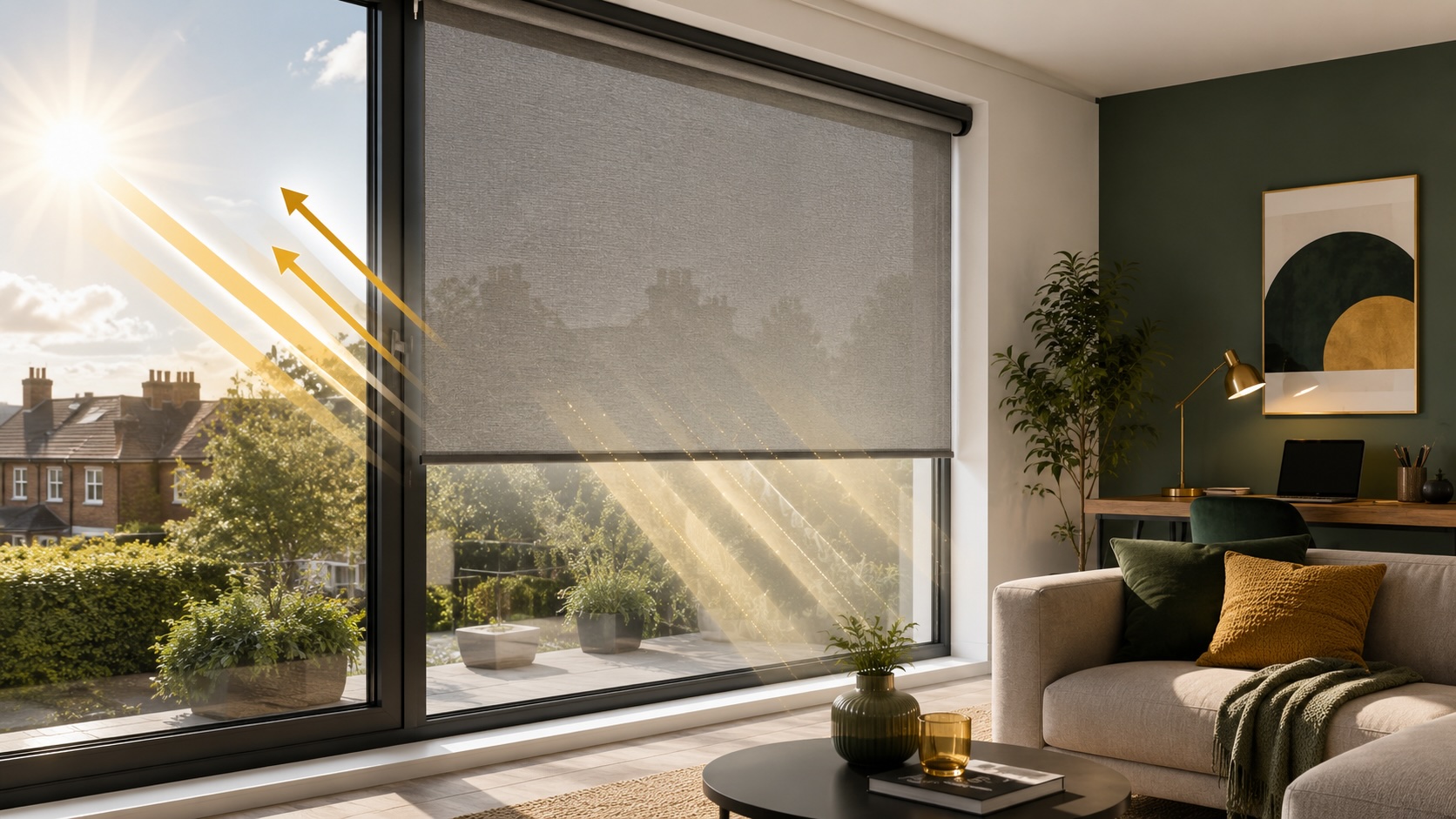
Solar reflective blinds work by using specialist fabric to control how much heat, light and glare enters the room through the glass. Instead of simply covering the window, the fabric is designed to help reflect, filter or absorb part of the sun’s energy before it has the same impact inside the room.
When sunlight reaches a window, some of that solar energy passes through the glass and warms the room. This is one reason why conservatories, garden rooms, south-facing living rooms and spaces with large glazed doors can become noticeably hotter on sunny days. Solar reflective blinds help reduce this effect by creating a technical barrier between the glass and the room.
The exact performance will depend on the blind fabric, but three factors are especially important:
Fabric Openness
The openness of the fabric affects how much light, view and privacy the blind provides. A more open fabric may allow a clearer view outside and let more natural light into the room, but it will usually offer less privacy and less glare reduction. A less open fabric will normally provide stronger glare control and more daytime privacy, but it can also make the room feel darker.
Reflective Backing or Coating
Many solar reflective fabrics use a reflective backing or coating to help bounce part of the sun’s energy back towards the window. This can be useful in rooms that become too hot during the day, particularly where there is strong direct sunlight.
Fabric Colour
Colour also affects performance. Lighter or more reflective surfaces can help with solar control, while darker internal-facing fabrics may be better at reducing visible glare. This is why choosing a solar reflective blind is not just about picking a colour that suits the room. The fabric choice should also reflect how the room is used and what problem you are trying to solve.
For best results, solar reflective blinds should usually be closed before the room has already overheated. Once heat has built up inside a space, the blind can still improve comfort, but it will generally work more effectively as a preventative layer against strong sunlight.
Quick Summary: Pros and Cons of Solar Reflective Blinds
Solar reflective blinds can be an excellent choice for rooms affected by heat, glare and strong sunlight, but they are not the right solution for every window. Their main strength is improving daytime comfort in bright spaces, especially where you want to reduce heat and glare without necessarily blocking all natural light.
However, the same features that make them useful during the day can create limitations in other situations. Some fabrics may make the room feel dimmer, view-through fabrics may not give reliable privacy at night, and more technical reflective finishes may not suit every interior style.
In practice, solar reflective blinds are usually best for rooms where heat, glare and daytime comfort are the main concerns. If the priority is total darkness, evening privacy or a softer decorative finish, another blind type, or a layered window dressing, may be more suitable.
The Pros of Solar Reflective Blinds
Solar reflective blinds are most valuable in rooms where sunlight creates a practical problem. This may be overheating, glare, fading furniture, difficulty using screens or a lack of daytime privacy. While they are not a universal replacement for every blind type, they can make a noticeable difference in the right setting.
1. They Help Keep Rooms Cooler in Summer
One of the biggest advantages of solar reflective blinds is their ability to help reduce solar heat gain. In simple terms, they help limit how much of the sun’s heat enters the room through the glass.
This is especially useful in rooms that become uncomfortable during spring and summer, such as conservatories, garden rooms, kitchens, home offices and living rooms with large windows or glazed doors. South-facing and west-facing rooms are often the strongest candidates because they receive more direct sunlight during the day.
The best results usually come from closing the blinds before the room has already overheated. Once heat has built up inside a space, it is harder for any blind to bring the temperature down quickly. Used proactively, solar reflective blinds can help maintain a more comfortable indoor environment throughout the day.
2. They Can Reduce Glare Without Blocking All Daylight
Glare is one of the most common problems in bright rooms. It can make it difficult to watch television, work on a laptop, read comfortably or use a room at certain times of day.
Solar reflective blinds help soften harsh sunlight and reduce visible glare while still allowing natural light into the space. This makes them different from blackout blinds, which are designed to block light more completely. For rooms where you want comfort without making the space feel dark, solar reflective fabrics can offer a more balanced solution.
This benefit is particularly useful in home offices, studies, living rooms, kitchens and commercial spaces where screen visibility matters.
3. They May Help Reduce Energy Costs
By helping to keep rooms cooler during sunny weather, solar reflective blinds may reduce the need for fans or air conditioning. This can support better energy efficiency, particularly in rooms that regularly overheat.
However, this should be understood in context. The level of any energy saving will depend on several factors, including the size of the window, the direction it faces, the type of glazing, the fabric chosen and how consistently the blinds are used. Solar reflective blinds should be seen as one part of a wider approach to improving indoor comfort, rather than a guaranteed way to reduce bills on their own.
In cooler months, a well-fitted blind can also add an extra layer between the room and the window, helping to reduce the feeling of cold glass. If winter insulation is the main priority, however, thermal blinds may be a more suitable choice.
4. They Help Filter Harsh Sunlight and UV Rays
Strong sunlight can gradually affect interiors, especially in rooms with large windows or prolonged exposure. Flooring, furniture, curtains, artwork and soft furnishings can all fade over time when exposed to direct sunlight.
Many solar reflective blind fabrics are designed to filter harsh sunlight and reduce UV exposure through the window. This may help protect interior finishes and furnishings, particularly in bright rooms where sunlight falls on the same areas each day.
This is not just a comfort benefit. For homes with wood flooring, luxury vinyl flooring, fabric sofas, painted furniture or statement curtains, reducing harsh direct sunlight can help preserve the appearance of the room for longer.
5. Some Fabrics Allow You to Keep the View Outside
A major advantage of certain solar reflective blinds is that they can reduce glare and brightness while still allowing you to see outside during the day. This is useful in rooms where you do not want to lose the sense of openness, such as living rooms, kitchens, garden-facing windows, patio doors and home offices.
This depends heavily on the fabric. More open solar screen fabrics usually provide better view-through, while tighter weaves provide more privacy and stronger glare control. There is always a trade-off between view, privacy and light control.
For many homes, this is where solar reflective blinds offer an advantage over blackout blinds or standard opaque roller blinds. They can make the room more comfortable without completely cutting it off from the outside.
6. They Can Improve Daytime Privacy
Solar reflective blinds can also improve privacy during the day, particularly when it is brighter outside than inside. In these conditions, some screen fabrics make it harder for people outside to see clearly into the room, while still allowing you to see out.
This can be useful for street-facing rooms, overlooked homes, ground-floor living spaces and work areas where you want to reduce visibility from outside without fully closing off the room.
However, daytime privacy should not be confused with full privacy. The effect depends on the fabric, the light conditions and the angle of view from outside. It also changes significantly at night, which is one of the main drawbacks covered later in this guide.
7. They Can Make High-Glare Rooms More Usable
Some rooms are technically bright and attractive, but difficult to use at certain times of day. A conservatory may be too hot by lunchtime. A home office may have too much glare for video calls or screen work. A kitchen with bifold doors may feel uncomfortable when the sun is low and direct.
Solar reflective blinds can make these rooms more usable by reducing the extremes of sunlight, heat and glare. They do not change the room itself, but they can make the environment feel more controlled and practical across more of the day.
This is where they are most effective: not as a decorative afterthought, but as a functional window dressing chosen to solve a specific comfort problem.
The Cons of Solar Reflective Blinds
Solar reflective blinds can be very effective in the right room, but they also have limitations. Most of these drawbacks come from the same technical features that make them useful in the first place. They filter light, manage glare and may allow view-through, but those benefits can involve compromises around brightness, privacy, appearance and suitability.
1. They Can Make Rooms Feel Dimmer
Because solar reflective blinds are designed to filter sunlight, they can make a room feel dimmer when they are closed. This is usually a benefit in very bright rooms, but it may be less welcome in spaces that already struggle with natural light.
North-facing rooms, shaded rooms, small windows and spaces with darker décor may feel flatter or duller if the fabric is too dense. This is especially noticeable on overcast days, when there is less strong sunlight for the blind to manage.
The best approach is to match the fabric to the room. A room with intense direct sunlight may suit a more protective fabric, while a room that only needs light glare control may be better with a lighter or more open fabric that preserves more daylight.
2. They Usually Offer Limited Night-Time Privacy
One of the most common misunderstandings about solar reflective blinds is privacy. Some fabrics can provide good daytime privacy because it is brighter outside than inside. At night, this effect can change.
When the lights are on indoors and it is dark outside, people outside may be able to see into the room more clearly, especially with view-through screen fabrics. This means solar reflective blinds are not always the best standalone choice for bedrooms, bathrooms or rooms where evening privacy is important.
For these spaces, a layered solution may work better. Solar reflective blinds can be used for daytime heat and glare control, while curtains, blackout blinds or a more opaque blind can provide stronger privacy in the evening.
3. Some Fabrics Can Look More Technical Than Decorative
Solar reflective blinds are designed to perform a practical job, and some fabrics have a more technical appearance than standard blind fabrics. Depending on the finish, they may look slightly metallic, reflective or foil-like from certain angles.
This can work well in modern homes, conservatories, garden rooms, offices and minimalist interiors. However, it may not be the right look for every room. In softer schemes, period homes or bedrooms, a reflective finish may feel less warm or decorative than a Roman blind, curtain or textured fabric roller blind.
That does not mean solar reflective blinds cannot look smart. It simply means the fabric choice matters. If appearance is a priority, it is worth choosing a finish that balances performance with the style of the room.
4. They May Not Be Suitable for Every Glazing Type
Solar reflective blinds work by managing sunlight and heat at the window. In some situations, particularly where reflective fabrics are fitted very close to the glass, heat can build up between the blind and the window.
This is why glazing compatibility matters. Certain types of glass, older panes, specialist glazing, large windows or high-exposure windows may need extra consideration. In some cases, trapped heat can increase the risk of thermal stress, where uneven temperature differences across the glass contribute to cracking.
This does not mean solar reflective blinds are unsuitable for most homes. It does mean that customers should follow product guidance, check suitability for their window type and avoid assuming that every solar fabric is appropriate for every pane of glass. Where there is unusual glazing, very large glass, damaged glass or previous cracking, it is sensible to seek advice before ordering.
5. They Can Cost More Than Standard Alternatives
Solar reflective blinds often cost more than basic roller blinds or standard blackout blinds because the fabric is more technical. The additional cost can be justified when the room has a clear heat or glare problem, but it may not be necessary for every window.
For example, if the main issue is simply privacy or darkness in a bedroom, a blackout blind may be a more cost-effective choice. If the main issue is winter warmth, a thermal blind may be better suited. If the room only receives occasional sun, a standard blind may be enough.
Solar reflective blinds usually make most sense where the problem is frequent, noticeable and linked to sunlight, such as overheating, glare, UV exposure or discomfort around large glazed areas.
6. They Are Not Designed to Provide Complete Blackout
Solar reflective blinds are often confused with blackout blinds, but they are not the same product. Their main purpose is to reduce heat and glare, not necessarily to block all light.
Some solar fabrics allow natural light through. Others may allow a degree of view-through. This is useful for living spaces and home offices, but less suitable where darkness is the main priority.
For bedrooms, nurseries, cinema rooms or shift workers’ rooms, blackout blinds are normally the better choice. In some cases, the best answer may be to combine blind types, using solar reflective blinds for daytime comfort and a blackout or curtain layer for darkness and privacy.
7. Their Performance Depends Heavily on the Room
Solar reflective blinds are not a one-size-fits-all solution. Their effectiveness depends on the room, window direction, glazing, blind position, fabric choice and how the blind is used.
A west-facing home office with large windows may benefit significantly from solar reflective blinds. A small north-facing bedroom with limited natural light may not. A conservatory with large glazed areas may need a more considered approach than a single window in a hallway.
This is why choosing solar reflective blinds should start with the problem you are trying to solve. If the issue is heat, glare and daytime comfort, they can be an excellent option. If the issue is darkness, evening privacy or decorative softness, another window dressing may be more appropriate.
Solar Reflective Blinds vs Blackout Blinds
Solar reflective blinds and blackout blinds are often compared because both can help control sunlight, but they are designed for different jobs. A solar reflective blind is mainly used to reduce heat, glare and harsh sunlight. A blackout blind is mainly used to block light and improve privacy.
This distinction matters because choosing the wrong type can lead to disappointment. If a room overheats during the day but you still want natural light and an outward view, a solar reflective blind may be the better fit. If the room needs darkness, privacy or better sleep conditions, a blackout blind is usually more suitable.
In practical terms, solar reflective blinds are usually better for daytime living spaces where comfort, heat and glare are the main concerns. Blackout blinds are usually better for rooms where darkness and privacy matter more than preserving natural light.
For some homes, the best solution may be to combine the two. For example, a sunny bedroom may benefit from solar reflective blinds during the day and blackout curtains or blackout blinds for night-time privacy and sleep.
Where Are Solar Reflective Blinds Most Useful?
Solar reflective blinds are most useful in rooms where sunlight creates a recurring comfort problem. They are not usually chosen simply because a window needs covering. They work best when there is a specific issue to solve, such as excess heat, glare, UV exposure, screen reflection or uncomfortable brightness.
Conservatories and Garden Rooms
Conservatories and garden rooms are among the strongest use cases for solar reflective blinds. These spaces often have large areas of glass, which means they can heat up quickly during sunny weather. Solar reflective blinds can help reduce heat build-up and glare, making the room more usable across the day.
They are especially useful where the space is used for dining, relaxing, reading or working from home. However, they should still be seen as part of a broader comfort strategy. Ventilation, window direction and roof glazing will also affect how warm the room becomes.
South-Facing and West-Facing Rooms
South-facing and west-facing rooms often receive stronger direct sunlight, especially in the warmer months. This can make the room feel bright and inviting at some times, but too hot or uncomfortable at others.
Solar reflective blinds can help soften this sunlight and reduce the intensity of the heat entering through the glass. In west-facing rooms, they can be particularly useful in the afternoon and evening, when low sun can create strong glare.
Home Offices and Study Spaces
A home office needs natural light, but not so much glare that screens become difficult to use. Solar reflective blinds are well suited to this type of space because they can reduce harsh light while helping the room remain bright enough for comfortable working.
They can also help create a more consistent environment for video calls, screen work and desk-based tasks. This makes them a practical choice for people who work near a window or use a room where the sun moves across the workspace during the day.
Living Rooms and TV Rooms
In living rooms, solar reflective blinds can help reduce glare on televisions, tablets and reflective surfaces without fully darkening the room. This can be useful in rooms that are bright during the day but still used for relaxing, reading or watching TV.
If the room is mainly used in the evening and privacy is the priority, solar reflective blinds may need to be paired with curtains or a more opaque blind.
Kitchens and Dining Areas with Large Windows
Kitchens and dining areas with large windows, patio doors or bifold doors can become uncomfortably bright at certain times of day. Solar reflective blinds can help reduce glare while still preserving a sense of openness, especially when the room looks out onto a garden.
They can be particularly useful where sunlight falls directly across worktops, dining tables or seating areas.
Patio Doors and Bifold Doors
Large glazed doors bring in a lot of natural light, but they can also increase heat and glare. Solar reflective blinds can help make these areas more comfortable while still allowing the space to feel connected to the outdoors.
For bifold doors and patio doors, the type of blind and fitting method also matters. The right solution will depend on the door style, frame depth, handle position and how often the doors are opened.
Commercial Spaces and Screen-Based Work Areas
Solar reflective blinds are also practical for commercial environments where glare and heat affect staff comfort or screen visibility. Offices, reception areas, meeting rooms, schools and clinics can all benefit from better solar control.
In these settings, the aim is usually not to darken the space, but to make it more usable throughout the working day.
Where They May Be Less Suitable
Solar reflective blinds are less likely to be the best standalone choice in rooms where darkness, decorative softness or night-time privacy are the main priorities. This can include bedrooms, bathrooms, nurseries and rooms with limited natural light.
They may still have a role in these spaces, but usually as part of a layered solution. For example, a solar reflective blind could manage daytime heat, while curtains or blackout blinds provide privacy and darkness later in the day.
How to Choose the Right Solar Reflective Blind
Choosing the right solar reflective blind is not only about picking a colour or style. The best choice depends on what the room needs to do, how much sun it receives and what level of privacy, light control and view-through you expect.
1. Start With the Main Problem
Before choosing a fabric, be clear about the issue you want the blind to solve. A room that overheats in summer may need a different fabric from a room where the main problem is glare on a laptop screen. A street-facing living room may need more privacy, while a garden-facing room may benefit from preserving the view outside.
Common reasons for choosing solar reflective blinds include:
- reducing heat in sunny rooms
- cutting glare on screens
- softening harsh direct sunlight
- helping protect interiors from fading
- improving daytime privacy
- keeping the room bright without leaving the window completely uncovered
The clearer the problem, the easier it is to choose the right fabric and blind style.
2. Consider the Direction of the Window
Window direction makes a significant difference. South-facing and west-facing windows usually receive more intense sunlight, so they often benefit most from stronger solar control. East-facing windows may need glare control in the morning, while north-facing rooms may not need a highly reflective or dense fabric unless there is a specific glare issue.
For rooms that already feel dark, avoid choosing a fabric that removes too much natural light. In these spaces, a lighter or more open fabric may be more suitable.
3. Think About Fabric Openness
Fabric openness affects how much you can see through the blind, how much daylight enters the room and how much privacy the blind provides.
As a general rule:
- a more open fabric allows more light and better outward views
- a less open fabric provides stronger glare reduction and more daytime privacy
- very dense fabrics can make the room feel noticeably dimmer
There is no single best option for every room. A home office may need stronger glare control, while a living room overlooking a garden may benefit from more view-through.
4. Check Daytime and Night-Time Privacy Expectations
Solar reflective blinds can improve daytime privacy, but this does not automatically mean they will provide privacy at night. The effect depends on the fabric and the lighting conditions.
During the day, when it is brighter outside than inside, some fabrics can make it harder for people to see in. At night, when lights are on indoors, the effect can reduce or even reverse. If evening privacy is important, consider pairing solar reflective blinds with curtains, blackout blinds or another opaque window covering.
This is especially important for bedrooms, bathrooms and overlooked ground-floor rooms.
5. Balance Performance With Appearance
Some solar reflective fabrics have a more technical appearance than standard blind fabrics. This may be ideal for conservatories, home offices, modern kitchens and commercial spaces, but it may not suit every interior.
If the room has a softer or more traditional design, consider whether the fabric finish will work with the overall style. A subtle tone, cleaner texture or layered approach may give you better balance between performance and appearance.
6. Consider the Glazing and Window Position
Solar reflective fabrics interact with light and heat at the window, so glazing type and blind position matter. This is especially relevant for large panes, specialist glazing, older glass or windows exposed to strong direct sunlight.
Where a reflective blind sits very close to the glass, heat can sometimes build up in the space between the blind and window. In certain circumstances, this may increase the risk of thermal stress. This does not make solar reflective blinds unsuitable for most homes, but it does mean product guidance and glazing suitability should be considered before ordering.
7. Decide Whether You Need a Layered Solution
Solar reflective blinds are excellent for heat and glare control, but they may not solve every window dressing need on their own. In some rooms, layering gives better performance.
For example:
- solar reflective blinds plus curtains can offer daytime glare control and night-time privacy
- solar reflective blinds plus blackout blinds can work well where a room needs both heat control and darkness
- solar reflective blinds in a conservatory can be combined with ventilation and roof shading for better overall comfort
The right solution should reflect how the room is used throughout the full day, not just during sunny hours.
Solar Reflective Blinds: Expert Verdict
Solar reflective blinds are worth considering if your main problem is heat, glare or uncomfortable sunlight during the day. They are especially useful in rooms with large windows, patio doors, bifold doors, conservatories, garden rooms and south-facing or west-facing spaces.
Their biggest advantage is that they can make bright rooms more usable without necessarily making them feel completely dark. This is where they differ from blackout blinds. A blackout blind is mainly about darkness and privacy, while a solar reflective blind is about managing sunlight, heat and glare more intelligently.
They are also a good option for home offices and living spaces where you still want natural light, but need better control over screen glare and direct sun. In these rooms, the right fabric can help create a more comfortable environment throughout the working day or during bright afternoon periods.
However, solar reflective blinds are not the right answer for every room. If your priority is full darkness, stronger evening privacy or a softer decorative finish, blackout blinds, curtains, Roman blinds or thermal blinds may be more suitable. Solar reflective fabrics can also vary significantly in appearance and performance, so the choice of fabric matters.
The most important point is to choose based on the problem you are trying to solve. For overheating, glare and daytime comfort, solar reflective blinds can be a highly practical solution. For bedrooms, bathrooms or rooms where night-time privacy is essential, they may work better as part of a layered window dressing rather than as the only blind.
For many UK homes, the best use of solar reflective blinds is targeted rather than whole-house. They are often most effective in the rooms that struggle most with direct sunlight, such as conservatories, garden-facing living rooms, glazed extensions, home offices and large door areas.