Order Tracking
 0800 1422417
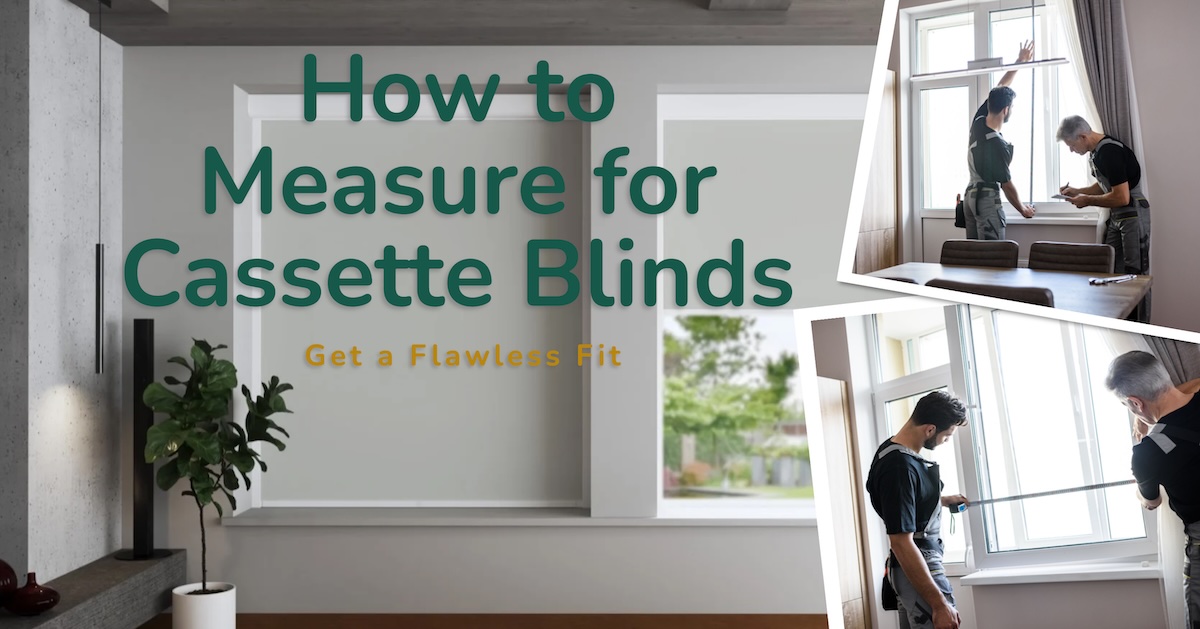
When it comes to made-to-measure blinds, cassette blinds offer one of the sleekest, most polished finishes available. With their discreet headrail that conceals both the fabric and mechanism, they deliver a clean, contemporary look that transforms any window into a design feature. But to enjoy their full effect, one thing is essential: accurate measuring.
Whether you’re fitting your cassette blinds inside the recess for a streamlined appearance, or outside the recess to maximise coverage and minimise light leakage, getting the measurements right is critical. Even a few millimetres off can affect the fit, operation, and overall finish.
In this step-by-step guide, we’ll walk you through exactly how to measure for cassette blinds—whether you’re choosing a recess fit or an exact fit—so you can order with complete confidence and enjoy a flawless installation. Let’s get started.
Why Cassette Blinds are Unique (and Why Measuring Carefully Matters!)

Cassette blinds offer a sleek, modern upgrade over standard roller blinds. What sets them apart is their distinctive headrail (or cassette) that fully encloses the blind fabric and mechanism when raised. This clever design not only creates a tidy, minimalist look but also improves light control and protects the fabric from dust and damage.
However, this smart design comes with one important requirement: accurate measuring.
Here’s why:
1. Precise Fit is Paramount
When fitting inside a window recess, the cassette itself must slot in perfectly. Even a few millimetres out can prevent the cassette from sitting flush, which may result in gaps, poor operation, or the need to reorder. There’s less tolerance for error compared to standard roller blinds, so your measurements need to be spot on.
2. Obstruction Awareness
Cassette blinds are bulkier at the top due to the housing unit. If your window has handles, air vents, or other protrusions near the glass, they can interfere with the blind’s positioning or movement. Measuring carefully ensures the cassette can be installed without clashing with these obstacles.
3. Fabric vs. Overall Width
It’s important to understand that the fabric width is narrower than the total cassette width. This is due to the end caps and operating mechanism on either side. So, if you’re aiming for full coverage (particularly for light control), you must factor in the overall cassette width—not just the visible fabric—when measuring.
In short, cassette blinds deliver a premium finish, but only when sized and fitted correctly. Getting your measurements right is the key to unlocking their full potential.
Essential Tools You’ll Need
Before you get started, it’s important to have the right tools to hand. Accurate measuring is all about precision, and the right equipment makes all the difference.
Here’s what you’ll need:
- Metal Tape Measure: A must-have for reliable results. Unlike cloth or plastic tape measures, metal ones stay rigid and won’t stretch, helping you get accurate, consistent readings.
- Pencil: Use this to lightly mark your measurements on the wall or window frame if needed. Pencil marks are easy to see and just as easy to remove.
- Paper or Notebook: Always write your measurements down clearly as you go. It’s easy to forget numbers or mix them up, especially if you’re measuring multiple windows.
- Step Stool or Ladder (if needed): If your windows are positioned higher up, make sure you can reach them safely. A secure step stool or small ladder will help you measure without stretching or straining, which could lead to errors.
Having everything ready before you start will make the process quicker, smoother, and more accurate.
General Measuring Tips for Success
Getting your measurements right is key to a perfect-fitting cassette blind. Even small miscalculations can affect how the blind operates or looks once installed. Follow these general tips to ensure your measurements are as accurate and reliable as possible:
• Measure in Millimetres (mm)
Always use millimetres for made-to-measure blinds. This provides the highest level of accuracy and helps avoid rounding errors.
• Measure in Multiple Places
Window openings are rarely perfectly square, especially in older homes. Measure the width and drop in at least three positions:
– Width: top, middle, and bottom
– Drop: left, centre, and right
• Record the Smallest Measurement (for Recess Fit)
When measuring for an inside recess fit, always use the smallest measurement you recorded. This ensures the cassette will fit snugly without rubbing or being forced into place.
• Record the Largest Measurement (for Exact Fit / Outside Recess)
If you’re fitting the blind outside the recess, use the widest or longest measurement. This ensures full coverage and avoids light seepage around the edges.
• Double-Check Everything
Measure twice—or even three times—before writing down your final numbers. It’s easy to misread the tape or record a figure incorrectly, and small errors can lead to big fitting issues.
• Identify Obstructions Early
Check around your window for anything that could interfere with the blind’s operation. This might include:
– Window handles
– Air vents
– Tiles
– Skirting boards
– Radiators or sockets
Make a note of any obstruction’s depth and position, as this will affect where the cassette can sit.
Taking the time to follow these tips will save you hassle, prevent fitting problems, and give your cassette blinds a professional, flawless finish.
Part 1: Measuring for Cassette Blinds Inside the Window Recess

Choosing an inside recess fit gives your cassette blinds a sleek, built-in appearance, with the blind sitting neatly within your window frame. It’s a popular choice for modern interiors and minimalist styling.
Understanding “Recess Fit”
On your DotcomBlinds order, you’re providing us with the exact internal measurements of your window recess. We’ll then apply a small deduction—typically between 3–5mm—to the width to ensure the blind fits comfortably within the space. This allowance prevents snagging and ensures smooth operation, even if your walls aren’t perfectly square.
✅ Check for Recess Depth & Obstructions
Before you start measuring, it’s essential to assess whether your recess is deep enough and clear of obstacles:
• Cassette Depth Requirements
Cassette blinds require a minimum recess depth to accommodate the headrail and allow the blind to operate freely.
Our cassette blinds typically need at least 70mm depth for top-fixing, or 60mm for face-fixing within the recess. This ensures proper clearance for the cassette and any window furniture.
• Window Handles & Other Obstructions
Open your window fully and measure how far any handles, latches, or vents project into the recess. If this protrusion exceeds the available depth (after accounting for the cassette), an inside recess fit may not be suitable.
Alternative options:
– Consider face-fixing the brackets further forward (if space allows)
– Choose an exact fit/outside recess installation instead
• Part-Tiled or Narrowed Recesses
If your window recess is partially tiled or features any narrowing (common in kitchens and bathrooms), measure both:
– The width above the obstruction
– The width between the obstruction (e.g., between tiles)
If the difference is more than 20–25mm, you may need to work from the narrower measurement or consider an outside recess fit.
📏 Measure the Width (Recess Width)
Using your metal tape measure, take three horizontal width measurements inside the recess:
- Across the very top
- Across the middle
- Across the very bottom
Write down each measurement, then record the smallest of the three.
👉 This is your Recess Width.
📏 Measure the Drop (Recess Drop)
Next, measure the vertical height (drop) inside the recess at three points:
- Down the left-hand side
- Down the centre
- Down the right-hand side
Again, write down all three measurements and use the smallest one.
👉 This is your Recess Drop.
Note: Your blind will typically stop just above your windowsill. Make sure your measurement allows for this, and that the blind won’t be obstructed by the sill or any other features at the base of the recess.
✅ Confirming Your Measurements
With your Recess Width and Recess Drop noted, double-check both. It’s always worth remeasuring to ensure everything is accurate.
When ordering on the DotcomBlinds website:
– Enter the exact measurements you recorded
We’ll take care of the deductions to ensure your cassette blind fits perfectly first time.
Part 2: Measuring for Cassette Blinds Outside the Window Recess (Exact Fit)

Fitting cassette blinds outside the window recess is a smart solution when your recess is too shallow, contains obstructions like handles or vents, or when you simply want a bold visual impact and superior light control. With this fitting style, the blind sits proudly on the wall, fully covering the window and more.
Understanding “Exact Fit”
On your DotcomBlinds order, you’re providing the finished size of the blind—including the cassette and end caps. We won’t make any deductions, so what you specify is what we will manufacture.
✅ Decide on Overlap
To get the best function and appearance, you’ll need to decide how much the blind should extend beyond the window recess on all sides. This overlap helps reduce light bleed and ensures full window coverage.
Recommended Overlaps:
- Top: At least 70mm (7cm) above the top of the recess
- Sides: At least 50mm (5cm) on the left and right
- Bottom: At least 70mm (7cm) below the bottom edge or windowsill
These are general guidelines and can be adjusted based on your preferences or practical constraints, such as radiators or deep sills.
📏 Measure the Width (Exact Blind Width)
Using your metal tape measure, measure the total width you’d like the blind to cover—from the far-left edge of the cassette to the far-right edge.
💡 Tip: Start with your recess width and add your chosen overlap on both sides.
Example: If your recess is 1000mm wide and you add a 50mm overlap to each side, your Exact Blind Width becomes:
1000mm + 50mm + 50mm = 1100mm
Take this measurement at multiple heights if possible to account for any unevenness in the wall. If you notice variation, use the largest width to ensure full coverage.
Important: This will be the total cassette width. The actual fabric will be narrower—typically around 35–40mm less—to allow space for the cassette mechanisms and end caps.
📏 Measure the Drop (Exact Blind Drop)
Now measure from the desired top fixing point (usually 70mm above the recess) to the bottom point where you want the blind to finish when fully lowered.
💡 Tip: Start with your recess height and add your desired overlap to both the top and bottom.
Example:
If your recess is 1200mm high and you add 70mm top and 70mm bottom overlaps, your Exact Blind Drop becomes:
1200mm + 70mm + 70mm = 1340mm
Again, measure in multiple vertical lines and use the largest value for accuracy.
⚠️ Consider Obstructions
Make sure the blind, when fully extended, won’t collide with radiators, furniture, sockets, or other fittings. If these are unavoidable, you may want to shorten the drop or choose an alternate installation height.
✅ Confirming Your Measurements
Once you’re happy with your Exact Blind Width and Exact Blind Drop, double-check both for accuracy.
When ordering on the DotcomBlinds website:
- Enter your precise width and drop as measured
- We’ll manufacture the blind to your specifications without any deductions
This ensures a flawless finish and a cassette blind that fits exactly how you envisioned.
Dealing with Specific Scenarios
While most windows follow a fairly standard shape and layout, there are situations where extra care is needed when measuring for cassette blinds. Below are some common scenarios and how to handle them.
🪟 Multiple Blinds in One Recess (e.g., Bay Windows)
Bay windows and other multi-section openings can be stunning, but measuring for cassette blinds in these areas takes precision and planning.
Key Considerations:
-
Corner Clearance Matters:
Each cassette blind has a physical width due to the cassette and end caps. If blinds meet at a corner (as they do in bay windows), you must allow for the projection of one cassette before measuring the next section. This prevents the blinds from colliding. -
Use a Spirit Level or Straight Edge:
To get this right, place a straight edge or spirit level against the intended edge of the first cassette and use it to project the blind’s path across to the next window section. Measure from the projected edge to the next return wall or glazing to get your next blind’s width. -
Measure Each Section Individually:
Treat each windowpane as a separate blind. Provide “Exact Fit” measurements for each one, factoring in cassette widths and ensuring that all blinds align correctly without obstruction.
💡 Tip: Consider sketching a diagram of the bay with your measurements clearly marked—it will help you visualise spacing and double-check corner allowances.
🌀 Unusual Window Shapes
Some windows are architectural showpieces—but can also pose challenges for fitting cassette blinds.
Arched, Angled, or Irregular Windows:
- Cassette blinds are designed for straight-edged, rectangular windows. For curved, triangular, or highly irregular shapes, cassette blinds may not be suitable.
- In some cases, a customised approach might be possible, but this will usually require specialist templating or a bespoke solution.
If you’re unsure whether cassette blinds will work for your unique window shape, the best course of action is to get in touch with the DotcomBlinds customer service team. Our experts can advise on alternatives or recommend next steps if a custom fitting is required.
Before You Click “Order”: Your Final Checklist
To avoid costly mistakes or frustrating reorders, take a moment to run through this final checklist. It’s your last step before entering your measurements and clicking “Order” on the DotcomBlinds website.
✅ Have you used a metal tape measure?
Fabric or plastic ones can stretch and result in incorrect measurements.
✅ Are all your measurements in millimetres (mm)?
Millimetres provide the most accurate results for made-to-measure blinds.
✅ Have you measured in at least three places for both width and drop?
This ensures you catch any unevenness in your window recess or wall surface.
✅ Have you taken the smallest measurement for Recess Fit?
We’ll make a small deduction from this to ensure a smooth, rub-free installation.
✅ Have you taken the largest measurement and included overlaps for Exact Fit?
This gives you full window coverage and prevents light seepage.
✅ Have you checked for and accounted for any obstructions (handles, tiles, etc.)?
Make sure there’s nothing in the way that could block or disrupt the blind.
✅ Are you clear on whether you need “Recess Fit” or “Exact Fit”?
Each fitting type affects how your blind is made—be sure you’ve selected the correct option.
✅ Have you double-checked all your figures before entering them on the DotcomBlinds website?
Taking a few extra minutes now can save you time, money, and hassle later.
Ready to Order Your Perfect Cassette Blinds?
With accurate measurements in hand, you’re one step away from transforming your windows with the sleek, stylish finish of cassette blinds. Whether you’re aiming for a minimalist look or maximum light control, getting the fit right is key—and now, you know exactly how to do it.
Explore our full range of cassette blinds at DotcomBlinds and find the perfect style for your space. Free fabric samples are available to order, so you can see and feel the quality before you commit.
Have questions or need help before placing your order? Our friendly team is here to help—just get in touch.