Order Tracking
 0800 1422417
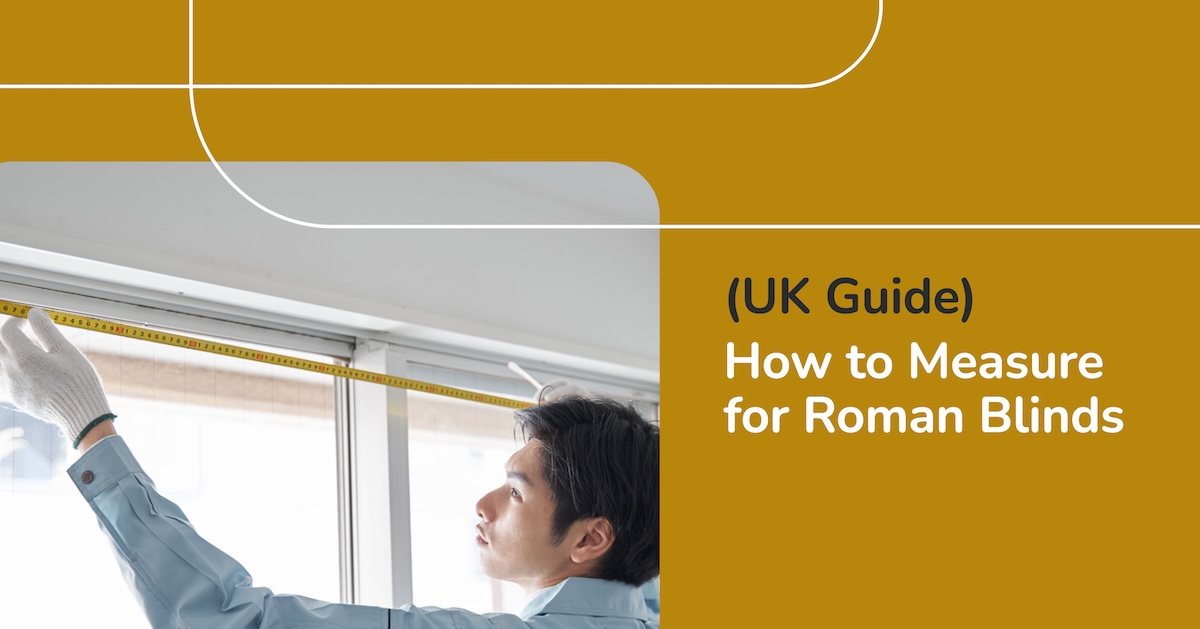
Measuring for Roman blinds doesn’t need to be stressful. Whether you’re dressing a single window or planning a full home refresh, the key to a professional-looking result is getting your measurements right the first time.
Unlike curtains, Roman blinds are made to measure and rely on precise dimensions to hang neatly and operate smoothly. A slight miscalculation could result in ill-fitting blinds, light gaps, or costly returns. That’s why taking the time to understand how and where to measure is essential.
At DotcomBlinds, we make ordering custom blinds simple. This comprehensive guide will walk you through the entire measuring process, highlight common pitfalls, and give you the confidence to measure like a pro—no guesswork, no stress.
Table of Contents
- Before You Begin: Essential Tools & Preparation
- Understanding Your Installation Options: Recess vs. Outside Recess
- Step-by-Step Measuring for Inside the Recess
- Step-by-Step Measuring for Outside the Recess
- Special Scenarios & Advanced Considerations
- Common Measuring Mistakes & How to Avoid Them
- Double-Checking Your Measurements: A Final Safeguard
- Placing Your Order with Confidence
- Important Notes & Disclaimer
Before You Begin: Essential Tools & Preparation

Before you get stuck into measuring, it’s important to have the right tools and a clear understanding of the basic principles. Accurate measurements start with good preparation—and that’s especially true for Roman blinds, where a few millimetres can make all the difference.
Tools You’ll Need:
- Steel Tape Measure
Always use a steel tape measure, never fabric or plastic ones, as those can stretch or sag and lead to inaccurate results. Choose a tape that’s at least 3 to 5 metres long so you can easily measure wider or taller windows without struggling. - Pencil
Handy for lightly marking surfaces or jotting down notes as you go. - Paper or Notepad
Keep all your measurements in one place. Always record the width first, followed by the drop (height), like so: width x drop. - Step Stool or Ladder (if needed)
For taller or hard-to-reach windows, make sure you can safely access the full height of the window. Never stretch or lean awkwardly—safety comes first. - A Helper (Optional but Recommended)
If your windows are particularly wide or tall, having someone to hold one end of the tape measure or pass you tools can make the job much easier and more accurate.
Key Principles to Understand:
- Always Measure in Millimetres (mm) or Centimetres (cm)
At DotcomBlinds, we recommend measuring in millimetres (mm) for the highest precision. Whatever you choose, be consistent throughout the entire measuring process. Mixing units is a common cause of errors. - Measure in 3 Places
Always take three separate measurements for both width and drop: one at the top, one in the middle, and one at the bottom. Window frames are rarely perfectly square, and this helps you catch any variation. - For Recess Fit: Record the Smallest Measurement
If your Roman blind is going inside the recess, write down the smallest width and drop. This ensures the blind fits neatly without catching on uneven areas. - For Outside Recess Fit: Record the Largest Measurement
If you’re mounting the blind outside the recess, use the largest measurement to ensure full coverage and a tidy finish. - Double-Check Everything
This is the golden rule. Measure twice (or even three times) to make sure your figures are accurate before placing an order. A few extra minutes now could save you a costly mistake later.
Understanding Your Installation Options: Recess vs. Outside Recess
Before measuring for your Roman blinds, it’s important to decide how you want them to sit on your window. This will determine how and where you measure. There are two main fitting styles: inside the recess and outside the recess.
A. Inside the Recess Fit (Recess Fit / Exact Fit)

Description:
This style places the Roman blind within the window opening, sitting flush against the sides of the recess. It offers a tailored, built-in look that complements the existing structure of the window.
When to Choose:
- If you want the blind to be completely housed within the window frame
- If your window recess has sufficient depth—typically at least 7–10 cm, depending on your chosen headrail—so the folds can stack without obstruction
- If the window opens outwards or has a deep sill you’d like to keep accessible
Pros:
- Clean, minimalist appearance
- Leaves window sills clear and usable
- Ideal for windows with outward-opening panes
Cons:
- May allow light to bleed around the edges
- Can obstruct window openings if recess depth is too shallow
- Fabric folds may not sit cleanly if space is restricted
B. Outside the Recess Fit (Exact Fit / Wall Mounted / Face Fixed)

Description:
This fitting style positions the Roman blind on the wall above the window, or sometimes on the window frame itself. The blind sits fully outside the recess and overlaps the window opening.
When to Choose:
- If your recess does not have enough depth to accommodate the folds
- If you want to maximise light block, as the blind will cover the window more fully
- To create the illusion of a larger window by extending the blind beyond the frame
- If your window opens inwards and needs clearance
- To hide an uneven or damaged window recess
Pros:
- Greater light control and privacy
- Helps make smaller windows appear larger
- Effectively conceals imperfections in the window area
Cons:
- May obscure attractive window mouldings or architraves
- Doesn’t offer the same integrated, built-in look as a recess fit
Step-by-Step Measuring for Inside the Recess

If you’ve chosen to fit your Roman blind inside the recess, it’s essential to follow this step-by-step process to get precise measurements. Taking the time to measure correctly will ensure your blind fits perfectly, folds neatly, and operates smoothly.
A. Measuring the Width
Start by measuring the internal width of your window recess in three different places:
- Across the top of the recess
- Across the middle of the recess
- Across the bottom of the recess
Crucial:
Record the smallest of these three measurements. This is your Recess Width.
Why?
This ensures your Roman blind fits comfortably, even if the sides of the recess are not perfectly straight.
Deductions:
You don’t need to make any adjustments yourself. At DotcomBlinds, we’ll automatically deduct around 10mm to 15mm from the width to make sure your blind fits snugly without snagging or rubbing against the sides.
✅ Do not make your own deductions. Just give us the exact smallest measurement, and we’ll do the rest.
B. Measuring the Drop (Height)
Now measure the internal height of the recess from top to bottom in three positions:
- From the top of the recess down to the sill on the left
- From the top to the sill in the centre
- From the top to the sill on the right
Crucial:
Record the smallest of these three measurements. This is your Recess Drop.
Why?
This accounts for any unevenness in the sill and ensures the blind doesn’t drag or bunch up at the bottom.
Deductions:
DotcomBlinds will typically deduct a small amount (usually 10mm to 15mm) from this drop to prevent the blind from catching on the windowsill when fully lowered.
✅ Again, do not make your own deductions. Just supply us with the smallest measurement.
C. Checking Recess Depth
To confirm that a recess fit is viable, you’ll need to measure the depth of the window recess:
-
Measure from the glass pane (or the point where the blind would sit flush against the window) to the front edge of the recess.
We recommend a minimum depth of 7cm to 10cm to accommodate the headrail and the folds of the Roman blind comfortably.
What if there isn’t enough depth?
If your recess is too shallow, the blind may protrude awkwardly or not operate correctly. In this case, we recommend switching to an outside recess fit for better performance and appearance.
Step-by-Step Measuring for Outside the Recess

Choosing an outside recess fit gives you more flexibility and control over light, privacy, and style. It’s ideal when your window recess is too shallow, uneven, or when you want to maximise coverage. Follow these steps to measure with confidence.
A. Measuring the Width
Decide Your Overlap
To ensure full coverage and minimise light bleed, it’s recommended to add at least 50mm to 100mm (or more) on each side of your window recess. Some customers go up to 150mm per side for maximum light block and visual impact. This is a matter of personal preference and room design.
Take Your Measurement
Measure the total width you want your blind to cover, including the added overlap on both sides.
✅ Crucial:
Measure the exact width you want the blind to be, from edge to edge. This is your ‘Exact Width’.
No Deductions
DotcomBlinds will make your blind to the exact width you provide. We will not make any deductions or allowances.
🔎 Important: Double-check your measurement, as the finished blind will be made to this precise width.
B. Measuring the Drop
Decide Your Starting Point
Determine where you want the top of the blind to sit. This is often:
- 50mm to 150mm above the window recess
- Just below ceiling coving or a picture rail
- Aligned with other window dressings for a cohesive look
Decide Your Finishing Point
Think about where you want the bottom of the blind to reach:
- Just above the windowsill
- Just below the sill
- All the way to the floor for a more dramatic effect
Take Your Measurement
Measure from your chosen starting point down to your chosen finishing point in a straight vertical line.
✅ Crucial:
Measure the exact drop you want the blind to be, from top to bottom. This is your ‘Exact Drop’.
No Deductions
DotcomBlinds will make your Roman blind to the exact drop you provide. No reductions will be made on your behalf.
🔎 Tip: If in doubt, go slightly longer with the drop for outside recess blinds—this gives a more elegant finish.
C. Obstructions to Consider (for Outside Recess)
Before finalising your measurements, be mindful of any obstacles in the surrounding area. These can impact the blind’s fit or functionality.
- Architraves and Mouldings:
Make sure your blind’s width includes clearance for decorative window trim. - Light Switches and Plug Sockets:
Check that the blind won’t interfere with electrical fittings when raised or lowered. - Radiators:
Ensure the blind hangs freely without catching or resting on a radiator, which can damage the fabric over time. - Furniture Placement:
Consider any furniture under or near the window that may obstruct or be obscured by the blind.
Special Scenarios & Advanced Considerations
While most Roman blind installations follow standard recess or outside-recess setups, some situations call for extra thought—or even expert guidance. Below are key considerations for more complex scenarios.
A. Bay Windows
Key Message:
Measuring for bay windows is more complex than standard windows and often requires either a professional measure or very careful DIY planning.
Tips:
- Measure each window section individually, treating every panel as its own window.
- Factor in return measurements—this refers to the depth from the front of the window to where the bay begins to angle. These affect how the blinds will meet at the corners.
- Understand that some overlap or small gaps may be unavoidable between blinds due to headrail thickness and angles.
- Highly recommended: Contact DotcomBlinds Customer Service for guidance or to arrange a professional measuring service if you’re unsure.
B. Multiple Blinds in One Recess
Why Choose This Option:
On wider windows, splitting into two or three Roman blinds can be more practical:
- Reduces the weight of each blind
- Allows for independent control of sections
How to Measure:
- Measure each section separately, based on your desired split points.
- Clearly mark and record width and drop for each blind.
Important:
There will be a small gap—typically 10mm to 20mm—between the blinds to accommodate the headrail mechanisms. This gap is unavoidable but often considered an acceptable trade-off for practicality.
C. Doors with Blinds (e.g., French Doors)
Roman blinds over doors usually require an outside recess fit, for both practicality and clearance.
Things to Consider:
- If your door opens inwards or outwards, the blind needs to clear the movement path.
- Ensure there’s enough space above the door to fit the headrail and allow for fabric stacking.
- Check that door handles won’t obstruct the blind or cause it to sit unevenly.
D. Windows with Unusual Shapes or Slopes
Roman blinds are typically made for rectangular openings. If your window has:
- Arched tops
- Angled slopes
- Triangular or circular shapes
…then Roman blinds are unlikely to be a perfect match.
Advice:
Consider alternative blind types better suited to bespoke window shapes or contact DotcomBlinds to explore possible custom solutions.
E. Measuring for Blackout or Thermal Roman Blinds
If your priority is to block light or improve insulation, the best fit is nearly always an outside recess installation.
Why?
- Extending the blind beyond the window frame reduces light bleed around the edges.
- A generous overlap helps create a tighter seal, making thermal blinds more effective at retaining heat and blackout blinds better at blocking light.
Tip:
Opt for an overlap of 100mm or more on all sides for maximum coverage.
F. Child Safety Considerations
While not related to measurement, it’s important to be aware of child safety regulations when ordering Roman blinds.
At DotcomBlinds, we fully comply with UK child safety laws, which means:
- All corded Roman blinds come with safety devices to secure cords and chains.
- Where possible, cordless or motorised options are available to eliminate the risk entirely.
If children regularly use or access the space, always mention this when ordering so we can advise the safest setup.
Common Measuring Mistakes & How to Avoid Them
Even the most careful DIYer can fall into a few common traps when measuring for Roman blinds. To help you avoid costly errors, here’s a rundown of frequent mistakes—and how to steer clear of them.
1. Using a Fabric Tape Measure
Why it’s a problem:
Fabric or plastic tape measures can stretch or sag, leading to incorrect measurements.
How to avoid it:
Always use a rigid steel tape measure for accuracy, especially when measuring longer spans.
2. Measuring Only Once
Why it’s a problem:
Windows are rarely perfectly square. Measuring in just one spot may give you a misleading result.
How to avoid it:
Measure in three places (top, middle, bottom for width; left, centre, right for drop) and record the smallest or largest as appropriate depending on your fit type.
3. Confusing Width and Drop
Why it’s a problem:
Providing measurements in the wrong order can lead to a blind that fits completely the wrong way.
How to avoid it:
Always write your measurements as Width × Drop (W x D) and double-check the order before submitting.
4. Making Your Own Deductions for Recess Fit
Why it’s a problem:
Guessing or subtracting a few millimetres might seem sensible, but it could cause the blind to be too small and leave unsightly gaps.
How to avoid it:
Do not make any deductions. Simply provide your exact smallest measurements—DotcomBlinds will make the necessary adjustments for a perfect recess fit.
5. Not Considering Obstructions
Why it’s a problem:
Handles, radiators, light switches, and architraves can all interfere with the blind’s function or appearance.
How to avoid it:
Take time to assess the area around your window. Measure with obstructions in mind and plan your installation height and width accordingly.
6. Rounding Up or Down
Why it’s a problem:
Even small rounding errors can make a big difference, especially with the precise folds of Roman blinds.
How to avoid it:
Record all measurements to the nearest millimetre (mm). Don’t estimate—precision is key.
7. Not Double-Checking Your Measurements
Why it’s a problem:
This is the most common and avoidable mistake. A single slip-up can result in a blind that doesn’t fit, delaying your project.
How to avoid it:
Take your time and measure twice—or even three times—to ensure accuracy before placing your order.
Double-Checking Your Measurements: A Final Safeguard
Before you click “Order”, take a few moments to double-check everything. It may seem simple, but this final step can prevent the most common and costly mistakes.
1. Read Aloud
Ask a friend, partner, or family member to help. Read each measurement out loud from your notes while they check it against the actual tape measure. A second pair of eyes can catch any misread or miswritten numbers.
2. Visual Check
Hold your tape measure up to the window and extend it to your recorded width and drop. Take a step back and visualise the blind at that size.
- Does it cover what you expect?
- Does the drop reach where you intended?
- Does the overlap for an outside fit feel generous enough?
This can highlight anything that might have been missed on paper.
3. Confirm Width × Drop Order
This is a common pitfall. Before submitting your measurements, always double-check the order.
✅ Remember: It’s always Width first, then Drop (W x D)
Getting this reversed can result in a blind that simply won’t fit—so it’s well worth confirming one last time.
Placing Your Order with Confidence
Once you’ve taken and double-checked your measurements, the final step is placing your order—accurately and confidently. At DotcomBlinds, we’ve designed our ordering process to be as simple and clear as possible.
DotcomBlinds’ Input Fields
When ordering your Roman blinds via the DotcomBlinds website, you’ll see clearly marked input fields for your measurements. These will typically ask for either:
- Recess Width and Drop
(If you’re fitting the blind inside the window recess) - Exact Width and Drop
(If you’re fitting the blind outside the recess, or on the wall or frame)
✅ Simply enter the measurements you’ve recorded based on your fitting style.
Do not make any deductions—DotcomBlinds will take care of this for recess fits.
Selecting Recess or Exact Fit
It’s essential to choose the correct fit option when ordering:
- Recess Fit:
Select this if your Roman blind is being installed inside the window recess. DotcomBlinds will automatically adjust the measurements slightly to ensure the blind fits comfortably within the space. - Exact Fit:
Choose this if your blind is being fitted outside the recess. The blind will be manufactured exactly to the width and drop you provide, with no deductions made.
Getting this part right ensures your blind will function properly and look exactly as intended.
Choosing Controls
After entering your measurements, you’ll also be prompted to choose your control options, such as:
- Chain Side: Left or right, depending on which side is more accessible
- Chain Colour & Length: Tailor it to match your décor and window height
These choices come after the measuring stage but are an important part of creating a blind that suits both your space and your daily use.
You’re now fully equipped to measure and order Roman blinds with total confidence. When you’re ready, you can browse our full collection and start your order here:
👉 Shop Roman Blinds at DotcomBlinds
Important Notes & Disclaimer
Manufacturing Tolerances
Please note that all made-to-measure blinds are subject to standard manufacturing tolerances, typically within ±3mm. This is a normal and accepted part of the production process and does not affect the overall performance or fit of the blind.
Disclaimer
This guide is provided for informational purposes only. While every effort has been made to ensure the information is clear and accurate, DotcomBlinds cannot be held responsible for any incorrect measurements submitted by the customer.
If you’re ever unsure about how to measure your window, it’s always better to double-check or reach out before ordering.
Need Help? Contact Our Experts
Our friendly and knowledgeable customer service team is here to assist you with any questions about measuring, fitting, or placing your order.
👉 Get in touch with DotcomBlinds here
We’re happy to help—so you can order with complete confidence.
Ready to Measure with Confidence?
With the right tools, clear instructions, and a little attention to detail, you’re more than capable of measuring for your Roman blinds like a pro. Whether you’re opting for a neat recess fit or a bold outside-recess finish, accurate measurements are the first step to transforming your space with style and precision.
Still unsure? Don’t worry—our friendly team is just a click or call away.
👉 Contact DotcomBlinds for expert advice
👉 Browse our full range of made-to-measure Roman blinds
Take the guesswork out of measuring and order with complete confidence today. Your perfect fit is just a few clicks away.