Order Tracking
 0800 1422417

Privacy is one of the main reasons people choose blinds, but not every blind provides privacy in the same way.
Some blinds are best at blocking views completely. Others are better at controlling sightlines while still allowing natural light into the room. Some work particularly well during the day but become much less effective after dark, while others are better suited to bedrooms or bathrooms where stronger privacy is needed at all times.
The right choice depends on the window and the room.
A street-facing living room may need daytime privacy without losing too much daylight. A rear bedroom may need very little privacy during the day but much stronger screening at night. A bathroom needs reliable privacy, while a home office may need to reduce overlooking and glare without making the space feel closed in.
The direction of the view also matters. Privacy from pedestrians at street level is a different problem from overlooking by neighbouring upper-floor windows.
For that reason, choosing privacy blinds is less about finding the single “most private” blind and more about balancing:
- Daytime and nighttime privacy
- Natural light
- Outside views
- Window position
- Direction of overlooking
- Blackout requirements
- Moisture and room conditions
- How much flexibility you want during the day
This guide looks at the blind types that work best for privacy, how they perform in different rooms and locations, and where layered combinations such as blinds with curtains can provide a better solution than either treatment on its own.
Table of Contents
Understanding Privacy
Best Blind Types for Privacy
Privacy by Room & Window Position
Managing Sightlines
Layered Privacy Solutions
Which Privacy Blind Works Best?
Quick Answer: What Are the Best Blinds for Privacy?
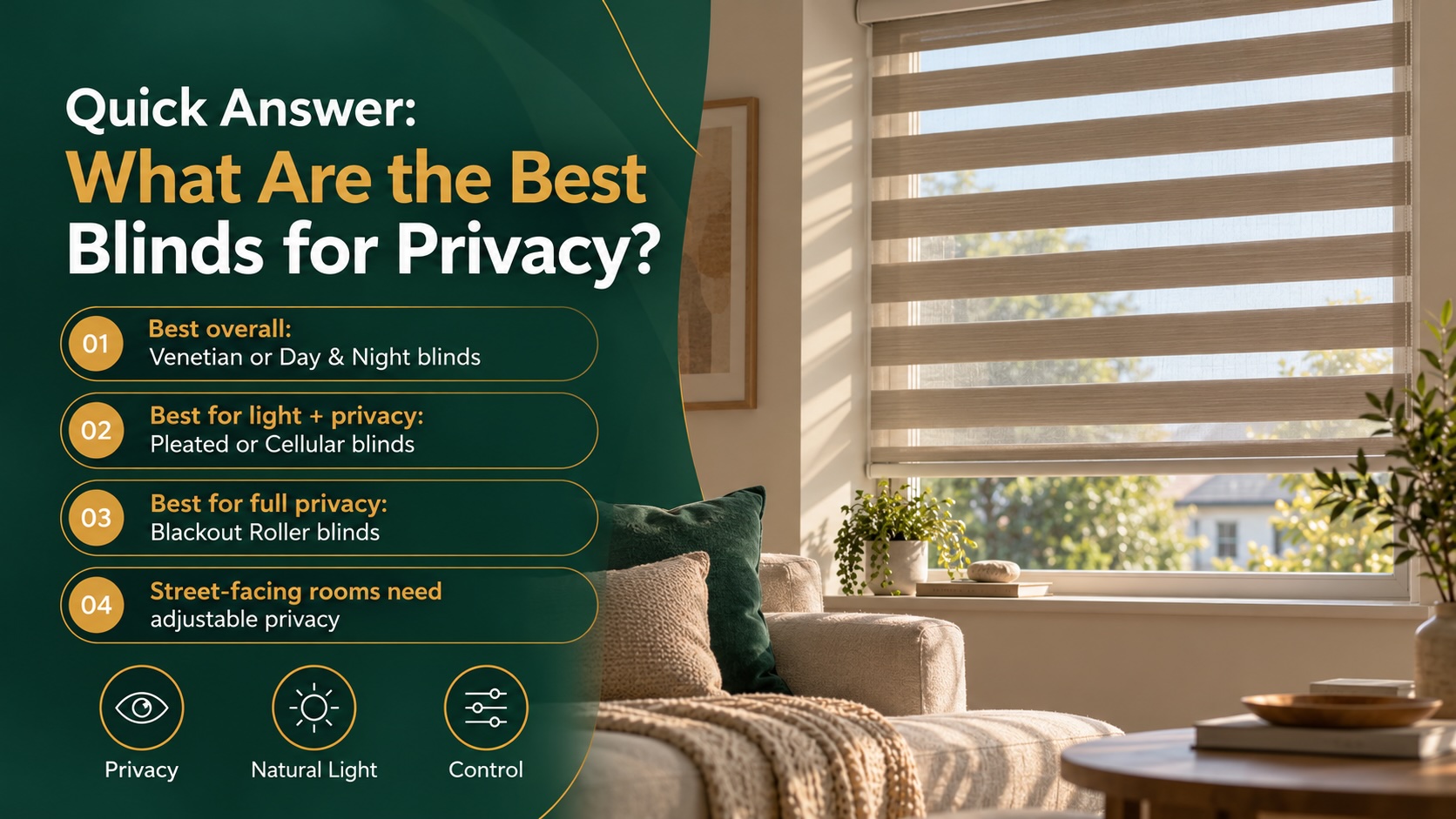
The best privacy blind depends on when you need privacy and how much natural light you want to keep.
There is no single blind type that is best in every situation.
Best All-Round Privacy Control: Venetian Blinds
Venetian blinds are one of the strongest choices where you want to balance privacy and daylight.
The slats can be tilted to:
- Restrict direct views into the room
- Reduce overlooking
- Keep some natural light entering
- Adjust privacy throughout the day
This makes them particularly useful for street-facing windows and rooms where complete closure would make the space unnecessarily dark.
Best for Complete Privacy: Roller Blinds
A roller blind provides straightforward privacy when fully lowered.
Depending on the fabric, it can offer:
- Complete visual screening
- Filtered daylight
- Blackout
- A simple, uncluttered finish
The limitation is flexibility. A roller blind is usually either open, partially lowered or fully closed, so it does not provide the same fine control over sightlines as Venetian blinds.
Best for Bedrooms: Blackout Roller, Roman or Cellular Blinds
Bedrooms often need stronger privacy at night as well as light control.
Good options include:
- Blackout roller blinds
- Blackout Roman blinds
- Cellular or honeycomb blinds with blackout fabric
These are particularly useful where the bedroom is overlooked or where privacy and darkness are both priorities.
Best for Street-Facing Windows: Venetian or Layered Treatments
Street-facing rooms often need privacy during the day without sacrificing too much natural light.
Strong options include:
- Venetian blinds
- Day and night blinds
- Sheer privacy treatments
- Blinds layered with curtains
The key is to interrupt direct sightlines while keeping the room usable during daylight hours.
Best for Bathrooms: Moisture-Resistant Roller or Venetian Blinds
Bathrooms require reliable privacy, but the blind also needs to cope with moisture.
Suitable options include:
- Aluminium Venetian blinds
- Moisture-resistant roller blinds
- Waterproof or PVC-based blinds
Best for Changing Privacy Needs: Adjustable or Layered Systems
Where privacy requirements change between daytime and evening, a more flexible solution is usually best.
This might include:
- Venetian blinds
- Day and night blinds
- Sheer blinds with a second privacy layer
- Blinds combined with curtains
Practical Takeaway
A useful way to think about privacy blinds is:
Venetian blinds: best for controlling sightlines while keeping daylight.
Roller, Roman and cellular blinds: best for stronger or complete privacy when closed.
Sheer and day/night systems: best for flexible daytime privacy.
Blind and curtain combinations: best where privacy needs change substantially between day and night.
The right choice depends less on which blind is technically the most private and more on how much privacy you need, when you need it and how much daylight you want to preserve.
What Does Privacy Actually Mean at a Window?
Privacy at a window is not always about blocking the view completely.
In many rooms, the better solution is to control what can be seen, from where and at what time of day, while keeping as much natural light as possible.
That means privacy can take several different forms.
Complete Visual Privacy
This is the simplest form.
A fully closed opaque blind prevents a clear view through the window.
This is usually the priority in:
- Bedrooms at night
- Bathrooms
- Dressing areas
- Ground-floor rooms with direct overlooking
- Rooms where complete screening is preferred
Roller, Roman, cellular and fully closed Venetian blinds can all provide this type of privacy, depending on the fabric and installation.
Daytime Privacy
Some rooms mainly need privacy during daylight hours.
This is common in:
- Street-facing living rooms
- Ground-floor home offices
- Kitchens facing a pavement
- Front bedrooms during the day
Here, the aim is often to obscure or redirect outside views without making the room feel dark.
Adjustable slats, sheer privacy fabrics and layered systems can be particularly useful.
Partial Privacy
Complete screening is not always necessary.
Sometimes the main concern is only the lower part of the window.
For example, a ground-floor room may need protection from pedestrians looking in while still benefiting from an open upper section.
In these situations, partial-window coverage can preserve significantly more daylight and outside view than closing the whole window.
Privacy From Above
Not all overlooking comes from street level.
A neighbouring upper-floor window may create a downward sightline into:
- Bedrooms
- Living rooms
- Rear extensions
- Kitchens
- Ground-floor bathrooms
The best blind position may therefore be different from the one used to block views from pedestrians.
This is where adjustable slats or top-down/bottom-up systems can be particularly useful, where available.
Privacy Without Losing the View
Some homeowners want to prevent direct views into the room while still retaining at least part of the outside view.
This generally requires a blind that can control sightlines rather than simply cover the glass.
Venetian and vertical blinds are particularly useful because the angle of the slats or louvres can be changed throughout the day.
Privacy at Night
Night-time privacy is a separate issue because the lighting conditions are reversed.
Once the room is illuminated and it is darker outside, treatments that provided reasonable privacy during daylight may become much less effective.
This is especially important with:
- Sheer fabrics
- Voiles
- Translucent materials
- Partially open slatted blinds
- Day and night blinds in their more open setting
Where night-time privacy matters, the window treatment needs to provide a stronger closed position.
Practical Takeaway
Before choosing a privacy blind, ask:
Who are you trying to block the view from?
From which direction?
At what time of day?
Do you still want natural light or an outside view?
Those answers usually determine the most suitable blind more accurately than simply choosing the product described as the most private.
Daytime Privacy vs Night-Time Privacy
A blind that provides good privacy during the day may not provide the same level of privacy after dark.
The reason is simple: privacy depends partly on the balance of light inside and outside the room.
Why Daytime Privacy Is Easier
During the day, the outdoors is usually brighter than the interior.
This can make it harder for someone outside to see clearly into the room, especially when the window is fitted with:
- Sheer or translucent fabrics
- Day and night blinds in a filtered position
- Venetian blinds with the slats angled
- Other treatments that diffuse or redirect the view
These options can work well where the aim is to keep the room bright while reducing direct visibility from outside.
Why Night-Time Privacy Is Different
At night, the lighting conditions are reversed.
If the room is illuminated and the exterior is dark, people outside may be able to see into the room much more easily.
This means that treatments which work well in daylight can become much less effective after dark.
Particular care is needed with:
- Sheer blinds
- Voiles
- Translucent fabrics
- Day and night blinds in their more open setting
- Venetian blinds left partially open
- Vertical blinds with louvres angled too far open
Sheer Does Not Mean Private at Night
Sheer fabrics are particularly good at preserving daylight and softening direct views during the day.
However, once interior lights are switched on, silhouettes and room details may become visible from outside.
If night-time privacy matters, a sheer blind should usually be paired with a more opaque second layer.
Adjustable Blinds Need a Night Position
Venetian and vertical blinds offer excellent daytime flexibility because their slats or louvres can be adjusted to control sightlines.
At night, however, they usually need to be moved into a much more closed position to provide reliable privacy.
This reduces daylight flexibility, but that matters less once natural light is no longer available.
Opaque Blinds Are More Predictable at Night
Roller, Roman and cellular blinds with opaque or blackout fabrics provide a more straightforward level of privacy after dark because they block the view through the main fabric when closed.
They are therefore often better suited to:
- Bedrooms
- Bathrooms
- Dressing areas
- Ground-floor rooms
- Heavily overlooked windows
Layering Can Solve the Day-Night Problem
One of the most effective ways to deal with changing privacy needs is to use two layers.
For example:
During the day:
Use a Venetian, sheer or day/night blind to control views while retaining daylight.
At night:
Close a curtain or opaque blind for stronger privacy.
This can provide more flexibility than asking one window treatment to do everything.
Practical Takeaway
Daytime privacy and night-time privacy should be treated as two separate requirements.
If privacy is only needed during the day, a light-filtering or adjustable blind may be enough.
If privacy is also important after dark, the window needs a fully opaque or fully closed option that does not rely on exterior daylight to obscure the view.
Privacy vs Natural Light: The Main Trade-Off
The more completely a blind blocks the view through a window, the more likely it is to reduce natural light as well.
The best privacy solution is therefore often not the blind that blocks the most, but the one that gives the right level of privacy without making the room unnecessarily dark.
Full Screening
Opaque blinds provide the strongest privacy because they cover the glass completely when closed.
Typical examples include:
- Roller blinds
- Roman blinds
- Blackout cellular blinds
- Fully closed Venetian blinds
These are useful where privacy matters more than maintaining daylight.
They work particularly well in:
- Bedrooms at night
- Bathrooms
- Dressing areas
- Heavily overlooked rooms
The trade-off is that once fully closed, natural light is reduced significantly.
Filtered Privacy
Some blinds use translucent or sheer materials to soften the view into the room while still allowing daylight through.
These can work well in:
- Street-facing living rooms
- Kitchens
- Home offices
- Ground-floor rooms used mainly during the day
The benefit is a brighter room.
The limitation is that filtered privacy is usually weaker than full screening, especially at night.
Directional Privacy
Adjustable slatted blinds can provide a useful middle ground.
Venetian and vertical blinds allow the angle of the slats or louvres to be changed so that direct sightlines are interrupted while daylight still enters the room.
This is particularly useful where the problem comes from a specific direction, such as:
- Pedestrians outside a ground-floor window
- A neighbouring property opposite
- An upper-floor window overlooking from above
Rather than covering the entire window, the blind is used to control the angle of view.
Partial Window Coverage
Sometimes only part of the window needs to be screened.
For example, a street-facing living room may mainly need privacy across the lower half of the glazing, while the upper section can remain open.
Where the blind system allows it, partial coverage can preserve much more natural light.
This can be particularly effective for:
- Ground-floor front rooms
- Kitchens
- Bathrooms with high windows
- Rooms overlooking a pavement
Think in Levels of Privacy
A useful way to approach the decision is:
Maximum privacy:
Opaque blind fully closed.
Balanced privacy and daylight:
Adjustable Venetian or vertical blind.
Daytime filtered privacy:
Sheer, translucent or day/night blind.
Targeted privacy:
Partial-window coverage or top-down/bottom-up systems where available.
Practical Takeaway
Privacy and natural light are usually a trade-off.
The strongest solution is not always to cover the entire window.
Where possible, use the blind to control sightlines rather than simply block the glass. This often provides better privacy while keeping the room brighter and more comfortable.
Venetian Blinds for Privacy
Venetian blinds are one of the strongest all-round options for privacy because they allow you to control the direction of the view rather than simply cover the window.
Their adjustable horizontal slats make them particularly useful where privacy needs change throughout the day.
Why Venetian Blinds Work Well for Privacy
The main advantage is control.
By tilting the slats, you can:
- Reduce direct views into the room
- Maintain some natural light
- Adjust privacy as the sun and outside activity change
- Respond to different overlooking angles
- Close the blind fully when stronger privacy is required
This makes Venetian blinds especially useful for street-facing rooms and windows overlooked by neighbouring properties.
Good for Street-Level Privacy
For ground-floor rooms facing a pavement or road, the slats can be angled to interrupt direct sightlines from outside while still allowing daylight into the room.
This can work well in:
- Living rooms
- Kitchens
- Home offices
- Front bedrooms used during the day
The blind does not need to be fully closed unless stronger privacy is required.
Useful Where Overlooking Comes From Above
If the main concern is a neighbouring upper-floor window, the slat angle can be adjusted differently.
The objective is to block the downward sightline while still allowing some light through.
This directional control is one of the main reasons Venetian blinds can outperform simple roller blinds where privacy is the priority.
Better Daytime Flexibility Than Full-Coverage Blinds
A roller or Roman blind often requires much more of the window to be covered before privacy improves significantly.
Venetian blinds offer more intermediate positions.
That means you can preserve:
- More daylight
- More of the outside view
- Better ventilation where the window is open
- A less enclosed feel
Night-Time Privacy Requires Fuller Closure
At night, the slats usually need to be closed more completely.
Partially open Venetian blinds can still allow views into a brightly lit room.
For bedrooms or heavily overlooked living spaces, this is worth considering.
If complete night-time privacy is especially important, Venetian blinds can also be paired with curtains.
Aluminium vs Wooden Venetian Blinds
Both can work well for privacy.
Aluminium Venetian blinds are particularly suitable where:
- Moisture resistance matters
- A slimmer profile is useful
- The room is a kitchen or bathroom
Wood or wood-effect Venetian blinds can work well in:
- Living rooms
- Bedrooms
- Home offices
The privacy principle is the same in both cases: the slat angle controls the sightline.
Practical Takeaway
Venetian blinds are one of the best choices where the aim is to balance privacy, natural light and view control.
They are particularly strong for street-facing and overlooked windows because the slats can be adjusted throughout the day rather than forcing the window into a simple open-or-closed position.
Roller Blinds for Privacy
Roller blinds are a strong choice where privacy needs to be simple, reliable and complete when required.
Unlike Venetian blinds, which manage sightlines through adjustable slats, roller blinds work mainly by covering more or less of the window.
Why Roller Blinds Work Well for Privacy
A roller blind can provide a clear level of privacy when fully lowered.
Depending on the fabric selected, it can offer:
- Complete visual screening
- Filtered daylight
- Blackout
- A clean, minimal appearance
- Straightforward operation
This makes roller blinds particularly suitable for rooms where privacy requirements are predictable.
Best for Rooms Where Full Closure Is Acceptable
Roller blinds work especially well in:
- Bedrooms
- Bathrooms
- Kitchens
- Home offices
- Rear-facing rooms
- Ground-floor windows where full screening is sometimes needed
If the room does not need constant view control throughout the day, a roller blind can be a very practical option.
Translucent Roller Blinds
A translucent fabric can allow natural light into the room while reducing clear visibility through the window.
This can work well for daytime privacy in rooms where:
- Natural light matters
- Complete blackout is unnecessary
- The window is overlooked but not heavily exposed
However, translucent fabrics should not be assumed to provide complete privacy in every lighting condition.
At night, silhouettes and interior detail may become more visible when the room is illuminated.
Blackout Roller Blinds
Blackout roller blinds provide stronger privacy because the fabric itself is opaque.
They are particularly useful in:
- Bedrooms
- Nurseries
- Media rooms
- Heavily overlooked rooms
The important distinction is that blackout refers mainly to the fabric’s ability to block light.
Small gaps can still remain:
- At the sides
- At the top
- Around the bottom bar
So blackout fabric does not automatically mean a completely sealed window.
The Main Limitation: Less Fine Control
The main disadvantage of a roller blind for privacy is that it offers less directional control than a Venetian blind.
You can:
- Leave it open
- Lower it partially
- Close it fully
But you cannot usually redirect a sightline while keeping the entire window exposed.
This can make roller blinds less flexible for street-facing living rooms where daytime privacy is needed without losing too much of the outside view.
Partial Lowering Can Still Be Useful
A roller blind does not always need to be fully closed.
If the main privacy concern is lower down the window, partially lowering the blind may be enough to interrupt the relevant sightline.
However, this depends on:
- Window height
- Direction of overlooking
- Position of the person outside
- Position of the room inside
It is therefore less precise than a slatted system.
Practical Takeaway
Roller blinds are best where privacy needs are straightforward.
They provide strong visual screening when closed, with translucent and blackout fabrics allowing different balances between light control and privacy.
For rooms where privacy needs to change constantly throughout the day, Venetian or layered systems usually provide more flexibility.
Roman Blinds for Privacy
Roman blinds are a strong option where privacy is important but the room also benefits from a softer, more tailored finish.
They work differently from Venetian blinds. Rather than adjusting slats to control the direction of the view, a Roman blind provides privacy by covering the window with fabric.
Why Roman Blinds Work Well for Privacy
When lowered, a Roman blind can provide:
- Strong visual privacy
- Good light control
- A softer appearance than a roller blind
- Lining options for additional opacity
- Blackout performance where required
This makes them particularly suitable for bedrooms, living rooms and other spaces where privacy and appearance both matter.
Best for Bedrooms and Living Rooms
Roman blinds work especially well in rooms where complete or near-complete privacy is needed at certain times of day.
Typical examples include:
- Bedrooms
- Street-facing living rooms
- Dining rooms
- Home offices
- Guest rooms
They are less flexible than Venetian blinds for fine daytime sightline control, but stronger where the aim is a clear open-or-private transition.
Lined Roman Blinds Provide Stronger Privacy
The lining makes a significant difference.
An unlined decorative fabric may allow some light or silhouettes through depending on the material.
A lined Roman blind provides a more predictable level of screening.
Options can include:
- Standard lining
- Blackout lining
- Thermal lining
- Interlining for additional body
Where privacy is the main priority, lining should be considered part of the specification rather than an optional extra.
Blackout Roman Blinds
Blackout Roman blinds can work particularly well in bedrooms.
They provide:
- Strong privacy
- Reduced light penetration
- A softer alternative to a blackout roller blind
- Better decorative integration with bedrooms and living spaces
As with roller blinds, however, blackout fabric does not necessarily eliminate every possible gap around the edge of the blind.
Good for Night-Time Privacy
Roman blinds are particularly effective after dark because a lined or opaque fabric can provide a complete visual barrier across the main glazing area.
This makes them more reliable at night than:
- Sheer blinds
- Voiles
- Partially open Venetian blinds
- Open day/night configurations
Less Flexible for Daytime Privacy
The main limitation is that Roman blinds do not offer the same directional control as slatted blinds.
To increase privacy, the blind generally has to be lowered further.
That means privacy and daylight are more directly linked.
For a heavily overlooked street-facing window, this may result in more of the glazing being covered than would be necessary with a Venetian blind.
Roman Blinds and Curtains
Roman blinds can also work well as part of a layered privacy setup.
For example:
- Roman blind for daytime screening
- Curtains for additional evening privacy
- Blackout Roman blind with decorative curtains
- Roman blind for privacy with curtains used mainly for softness and insulation
This can be particularly effective in bedrooms and living rooms.
Practical Takeaway
Roman blinds are best where strong privacy and a softer fabric finish are more important than constant fine adjustment of sightlines.
They are especially well suited to bedrooms and living rooms, particularly when lined or blackout fabrics are used.
Pleated Blinds for Privacy
Pleated blinds can work well where the aim is to combine privacy with soft natural light.
Their folded fabric construction gives them a lighter appearance than many roller or Roman blinds, and they are particularly useful in smaller windows or rooms where a bulky treatment would feel unnecessary.
Why Pleated Blinds Work Well for Privacy
Depending on the fabric, pleated blinds can provide:
- Filtered daylight
- Reduced visibility into the room
- Full privacy when closed
- Blackout options
- A compact, unobtrusive appearance
This makes them useful for rooms where privacy matters but the space still needs to feel bright.
Translucent Pleated Fabrics
Translucent pleated blinds can soften outside views while allowing daylight through.
They can work well in:
- Living rooms
- Kitchens
- Home offices
- Hallways
- Small bedrooms
- Street-facing rooms used mainly during the day
The main benefit is that the room remains naturally lit.
The limitation is the same as with other translucent treatments: privacy can reduce significantly at night when interior lights are on.
Blackout Pleated Blinds
Blackout pleated fabrics provide stronger screening when complete privacy is required.
They can be particularly useful in:
- Bedrooms
- Nurseries
- Media rooms
- Heavily overlooked rooms
As with roller blinds, the blackout quality of the fabric does not necessarily eliminate every small edge gap around the blind.
Top-Down / Bottom-Up Options
Some pleated blind systems can be positioned from both the top and bottom.
This can be especially effective for privacy because it allows you to cover only the part of the window that is overlooked.
For example:
- Lower section covered for street privacy
- Upper section left open for daylight
- Central section screened where neighbouring windows overlook directly
This can provide a better privacy-light balance than simply lowering a conventional blind from the top.
Good for Small and Awkward Windows
Pleated blinds are also useful where:
- The window is narrow
- The recess is shallow
- A compact blind is needed
- The room benefits from a lighter visual treatment
Their relatively low bulk makes them suitable for windows where a heavier Roman or wooden Venetian blind might dominate the opening.
Practical Takeaway
Pleated blinds are a strong option where you want privacy without unnecessarily blocking daylight.
Translucent fabrics work well for daytime privacy, blackout versions provide stronger screening, and top-down/bottom-up systems can be especially effective where only part of the window needs to be covered.
Cellular / Honeycomb Blinds for Privacy
Cellular blinds, sometimes called honeycomb blinds, are a strong option where privacy needs to be combined with light control and improved insulation.
Their layered cellular construction sets them apart from standard pleated blinds and can make them particularly suitable for bedrooms, overlooked rooms and spaces where thermal performance also matters.
Why Cellular Blinds Work Well for Privacy
Depending on the fabric selected, cellular blinds can provide:
- Strong visual privacy
- Softly filtered daylight
- Blackout performance
- A clean, compact appearance
- Additional insulation around the window
This makes them especially useful where one blind needs to do more than simply screen the view.
Light-Filtering Cellular Blinds
Light-filtering fabrics can reduce direct visibility while still allowing diffused daylight into the room.
They can work well in:
- Living rooms
- Home offices
- Bedrooms during the day
- Street-facing rooms
- Rooms where glare needs to be softened
The room remains brighter than it would with an opaque blind fully closed.
As with other translucent fabrics, however, night-time privacy needs to be considered carefully when interior lights are on.
Blackout Cellular Blinds
Blackout cellular blinds are better where stronger privacy and light control are required.
They can be particularly useful in:
- Bedrooms
- Nurseries
- Media rooms
- Heavily overlooked rooms
- Rooms where both privacy and thermal comfort matter
The fabric itself can provide a high level of opacity, although small edge gaps may still remain depending on how the blind is fitted.
Good for Bedrooms
Cellular blinds are particularly well suited to bedrooms because they can combine several useful functions:
- Privacy
- Blackout
- Reduced glare
- Thermal insulation
- A relatively low-bulk appearance
This makes them a practical alternative to heavier Roman blinds or layered curtain arrangements where a simpler window treatment is preferred.
Top-Down / Bottom-Up Options
Some cellular systems are available with top-down/bottom-up operation.
Where available, this can be very effective for privacy.
For example, the lower part of a street-facing window can remain covered while the upper section stays open for daylight.
This allows privacy to be targeted at the actual sightline rather than covering the entire window.
Privacy and Thermal Performance Together
The honeycomb structure creates air pockets within the blind.
This is mainly a thermal characteristic, but it can be useful in privacy-focused rooms where the blind is likely to remain closed for longer periods, particularly:
- Bedrooms
- North-facing rooms
- Older properties
- Rooms with large glazed areas
Practical Takeaway
Cellular blinds are a strong choice where you want privacy, light control and thermal performance from the same blind.
Light-filtering versions can maintain daytime brightness, while blackout fabrics provide stronger night-time privacy. Where top-down/bottom-up operation is available, they can also offer excellent control over exactly which part of the window is screened.
Vertical Blinds for Privacy
Vertical blinds are a strong privacy option for wide windows, large glazed areas and patio or French doors because their louvres can be rotated to control sightlines while still allowing daylight into the room.
Like Venetian blinds, they are most useful where privacy needs to be adjusted rather than simply switched between open and closed.
Why Vertical Blinds Work Well for Privacy
The vertical louvres can be turned to:
- Restrict direct views into the room
- Maintain natural light
- Control glare
- Adjust privacy throughout the day
- Close fully for stronger screening
This makes them particularly suitable for rooms with large expanses of glazing.
Good for Wide Windows and Doors
Vertical blinds are especially practical for:
- Patio doors
- Sliding doors
- Wide living-room windows
- Home offices
- Large rear-facing windows
- Conservatory-style spaces
Their vertical format suits broad openings better than many smaller-format blinds.
Directional Privacy
The louvres can be angled to interrupt sightlines from outside without blocking the entire window.
This can be useful where:
- A neighbouring property overlooks directly
- The room faces a garden boundary
- A large glazed door needs privacy during part of the day
- You still want some view and daylight
The amount of privacy depends on the louvre angle.
Night-Time Privacy Requires Fuller Closure
At night, the louvres normally need to be closed more completely.
Partially angled vertical blinds may still allow views into a brightly lit room, particularly through gaps between the louvres.
For bedrooms or heavily overlooked rooms, a more opaque fabric and fuller closure are preferable.
Fabric Choice Matters
Vertical blinds are available in different fabric types.
Depending on the material, they can provide:
- Light filtering
- Greater opacity
- Blackout performance
- Moisture resistance
A translucent fabric may be suitable where daytime light is important, while an opaque or blackout fabric is better where stronger privacy is required.
A Good Option for Flexible Large-Window Privacy
One advantage of vertical blinds is that they can provide privacy without covering the entire glazed area in the same way as a fully lowered roller blind.
That can make large windows feel less enclosed.
They are particularly useful where the privacy problem changes during the day and the user wants to adjust the louvre angle rather than fully close the window treatment.
Practical Takeaway
Vertical blinds are one of the best privacy options for large windows and glazed doors.
Their adjustable louvres provide good control over sightlines and daylight, while full closure offers stronger privacy when required.
Day and Night Blinds for Privacy
Day and night blinds, sometimes called zebra blinds, can be useful where privacy needs to change throughout the day.
They use alternating sheer and opaque fabric bands, allowing the blind to move between a more open, light-filtering position and a more closed, private position.
Why Day and Night Blinds Work Well for Privacy
Their main advantage is flexibility.
By adjusting the overlap between the sheer and opaque sections, you can:
- Increase or reduce visibility
- Maintain some natural light
- Add more screening when required
- Change the level of privacy without raising the blind completely
This makes them useful in rooms where privacy is needed during the day but full closure would feel unnecessarily dark.
Good for Street-Facing Rooms
Day and night blinds can work well in:
- Living rooms
- Home offices
- Front bedrooms
- Dining rooms
- Street-facing kitchens
During the day, the sheer sections can help retain daylight while reducing direct visibility.
When more privacy is needed, the opaque bands can be aligned more closely.
Night-Time Privacy Needs Care
This is where day and night blinds are often misunderstood.
In the more open position, the sheer sections can allow visibility into the room, particularly after dark when interior lighting is on.
For stronger night-time privacy, the opaque bands need to be aligned to cover the sheer sections as fully as the system allows.
Even then, performance depends on:
- Fabric opacity
- Band alignment
- Side gaps
- Installation position
They Are Not Automatically Blackout
Some day and night blinds use more opaque fabrics than others, but the blind type itself should not be assumed to provide blackout.
If blackout is important, the fabric specification needs to be checked separately.
This is particularly relevant for bedrooms.
Better for Flexible Privacy Than Complete Screening
Day and night blinds are strongest where the main aim is:
- Daytime flexibility
- Filtered light
- Adjustable screening
- A softer transition between open and closed
Where complete visual privacy is the overriding priority, a conventional opaque roller, Roman or cellular blind may provide a more straightforward solution.
Practical Takeaway
Day and night blinds are a good option where you want adjustable daytime privacy without losing too much natural light.
They are less suitable where complete privacy or blackout is required unless the fabric and closed position are specifically designed to provide it.
Sheer Blinds and Privacy Fabrics
Sheer and privacy fabrics can be useful where the main goal is to soften outside views while keeping the room bright.
They are particularly effective during the day, but they need more caution than opaque blinds because their privacy performance changes significantly with lighting conditions.
Why Sheer Fabrics Work Well During the Day
In daylight, sheer or translucent fabrics can:
- Diffuse direct views into the room
- Reduce visual detail from outside
- Preserve a high level of natural light
- Soften glare
- Keep the room feeling open
This makes them useful in:
- Street-facing living rooms
- Kitchens
- Home offices
- Dining rooms
- Ground-floor spaces used mainly during the day
They Do Not Provide Complete Privacy
Sheer fabrics are not designed to block the view completely.
Depending on the fabric and the lighting, people outside may still be able to see:
- Silhouettes
- Movement
- Shapes
- Interior lighting
- Objects close to the window
The degree of privacy varies with the weave, opacity and distance from the glass.
Night-Time Privacy Is the Main Limitation
Once it is darker outside and the room is illuminated, sheer fabrics become much less effective.
This is one of the most important limitations to understand.
A sheer blind that feels private during the day may provide very limited privacy after dark.
For rooms where evening privacy matters, it should usually be paired with a second, more opaque treatment.
Good for Layered Privacy
Sheer blinds work particularly well as part of a layered setup.
For example:
During the day:
Use the sheer blind to reduce outside visibility while maintaining daylight.
At night:
Close curtains, a blackout blind or another opaque layer for stronger privacy.
This can provide better flexibility than relying on a single blind to perform every function.
Privacy Fabrics Can Vary Considerably
Not all translucent or sheer fabrics perform in the same way.
Some are designed to provide greater daytime screening, while others prioritise:
- Maximum daylight
- Softer diffusion
- Glare reduction
- Decorative appearance
The fabric should therefore be chosen around the actual privacy requirement rather than appearance alone.
Practical Takeaway
Sheer and privacy fabrics are best for daytime privacy with maximum natural light.
They are much less reliable after dark, so where night-time privacy matters, they work best as one layer within a broader window-treatment setup rather than as the only covering.
Best Privacy Blinds for Street-Facing Windows
Street-facing windows usually need the most careful balance between privacy and natural light.
The problem is often not that the room needs to be fully hidden all day. It is that people on the pavement, road or neighbouring properties have a direct sightline into the room.
Why Street-Facing Windows Are Different
A front-facing window may be exposed to:
- Pedestrians passing close to the glass
- Parked or passing vehicles
- Neighbours opposite
- Upper-floor windows across the street
- Evening views into a brightly lit room
That makes an adjustable or layered solution particularly useful.
Venetian Blinds Are One of the Strongest Options
Venetian blinds work well because the slats can be tilted to interrupt direct street-level sightlines without fully covering the window.
This allows you to:
- Retain daylight
- Reduce direct visibility
- Adjust privacy throughout the day
- Close the slats more fully in the evening
For many front living rooms, kitchens and home offices, this is a better solution than keeping an opaque blind fully closed.
Day and Night Blinds Can Work Well During the Day
Day and night blinds can also suit street-facing rooms where the priority is filtered privacy.
They allow the user to move between:
- A more open, light-filtering position
- A more closed, private position
The main limitation is night-time privacy, when the opaque bands need to be aligned carefully.
Sheer Privacy Fabrics Can Keep the Room Bright
Sheer or translucent blinds can be useful where the room would otherwise feel too dark.
They work particularly well in:
- Front living rooms
- Dining rooms
- Home offices
However, they should not be relied on as the only privacy layer if the room is used after dark.
Partial Coverage Can Be Better Than Full Coverage
For ground-floor windows, the main privacy problem often comes from the lower part of the glazing.
Where the blind system allows it, covering only that area can:
- Block pedestrian sightlines
- Preserve the upper view
- Retain more daylight
- Keep the room feeling open
This is where top-down/bottom-up blinds or other partial-window solutions can be especially effective.
Curtains Can Add Evening Privacy
A layered setup can work very well in street-facing rooms.
For example:
Day: Venetian, sheer or day/night blind for flexible privacy.
Evening: Curtains closed for stronger screening.
This can be particularly effective in living rooms and bedrooms where the privacy requirement changes substantially after dark.
Practical Takeaway
For street-facing windows, the strongest privacy solutions are usually those that control the sightline without closing off the entire window.
Venetian blinds, day and night blinds, sheer privacy fabrics and layered blind-and-curtain combinations all work well, depending on how much natural light and night-time privacy are required.
Best Privacy Blinds for Rear-Facing Windows
Rear-facing windows often have different privacy requirements from windows at the front of the house.
There may be less concern about passers-by, but privacy can still be affected by neighbouring gardens, nearby properties and upper-floor windows looking down into the room.
Privacy May Be Less Important During the Day
In many rear-facing rooms, daytime privacy is less demanding because there is no pavement or road immediately outside.
That means the blind can often remain:
- Fully open
- Partially open
- Tilted for directional privacy
- Lowered only when needed
This can help preserve more natural light and maintain the view into the garden.
Neighbouring Properties Can Still Create Overlooking
Rear gardens do not always mean complete privacy.
Potential sightlines can come from:
- Neighbouring upper-floor windows
- Rear extensions
- Balconies
- Properties positioned at an angle
- Closely spaced gardens
Where overlooking comes from above, adjustable blinds can be useful because the slat angle can be changed to interrupt the downward view.
Venetian Blinds Work Well for Variable Privacy
Venetian blinds are a good option where privacy is only needed at certain times of day.
They allow you to:
- Keep the blind open when privacy is not an issue
- Tilt the slats when neighbouring views become noticeable
- Close the blind more fully in the evening
This flexibility can be more useful than a blind that simply moves between open and closed.
Roller and Roman Blinds Suit Evening Privacy
If privacy is mainly needed after dark, roller and Roman blinds can work very well.
They allow the window to remain largely unobstructed during the day and then provide strong screening in the evening.
This is often a good fit for:
- Rear bedrooms
- Dining rooms
- Living rooms
- Garden-facing home offices
Cellular Blinds Can Add Privacy and Insulation
Cellular blinds are also useful where the rear window is:
- Large
- Cold
- Frequently covered in the evening
- Overlooked from nearby properties
They combine privacy with improved thermal performance and can work particularly well in bedrooms.
Curtains Can Be Enough in Some Rear Rooms
A rear-facing room with little daytime overlooking may not need a privacy blind at all.
In that situation, curtains can remain open during the day and close only when privacy is needed at night.
If light control or glare reduction is also required, adding a blind can provide more flexibility.
Practical Takeaway
Rear-facing windows often need less daytime screening but stronger evening privacy.
Where overlooking is limited, roller, Roman or cellular blinds can provide privacy only when it is needed. Where neighbouring properties overlook from above, Venetian or other adjustable blinds offer better control over the direction of the view.
Privacy for Overlooked Bedrooms
Bedrooms usually need a stronger level of privacy than living rooms because privacy is often required both during the day and after dark.
The best blind therefore needs to balance daytime light with reliable night-time screening.
Blackout Roller Blinds
Blackout roller blinds are one of the simplest choices for overlooked bedrooms.
They work well where the priority is:
- Strong night-time privacy
- Reduced early-morning light
- Simple operation
- A clean, minimal finish
During the day, the blind can be raised fully to maximise light.
The limitation is that there is little intermediate privacy control once the blind is open.
Blackout Roman Blinds
Roman blinds can provide the same strong evening privacy with a softer appearance.
They are particularly suitable where the bedroom benefits from:
- A more decorative finish
- Lined fabric
- Blackout performance
- A softer feel than a roller blind
They work especially well in front bedrooms and period-style rooms.
Cellular Blinds
Cellular blinds are also a strong bedroom option because they can combine:
- Privacy
- Blackout
- Light control
- Thermal insulation
Where top-down/bottom-up operation is available, they can be particularly useful in overlooked bedrooms because part of the window can remain open for daylight while the most exposed area stays covered.
Venetian Blinds for Daytime Privacy
If the bedroom is overlooked during the day, Venetian blinds can provide better flexibility than an opaque blind.
The slats can be tilted to restrict views while still allowing light into the room.
At night, they should be closed much more fully.
For stronger privacy, they can also be paired with curtains.
Consider Where the Overlooking Comes From
A bedroom overlooked from directly opposite may need a different solution from one overlooked from above.
For example:
- Street-level or opposite windows: Venetian blinds can interrupt horizontal sightlines.
- Higher neighbouring windows: top-down/bottom-up blinds or carefully angled slats can be more effective.
- Close neighbouring windows: blackout roller, Roman or cellular blinds may be better if stronger screening is required.
Layering Can Be Particularly Effective
Bedrooms are one of the strongest cases for combining blinds and curtains.
A practical setup could be:
During the day:
Use a Venetian or light-filtering blind for privacy while retaining daylight.
At night:
Close curtains or an opaque blind for stronger screening and blackout.
This provides more flexibility than relying on a single treatment.
Practical Takeaway
For overlooked bedrooms, the strongest options are usually:
- Blackout roller blinds
- Blackout Roman blinds
- Cellular blinds
- Venetian blinds with curtains
The best choice depends on whether the main problem is daytime overlooking, night-time privacy, blackout, or all three.
Privacy for Bathrooms
Bathrooms need a higher level of privacy than most rooms, but the blind also has to cope with humidity, condensation and regular cleaning.
The strongest options are therefore those that combine reliable screening with moisture-resistant materials.
Aluminium Venetian Blinds
Aluminium Venetian blinds are a strong bathroom choice because they provide:
- Adjustable privacy
- Good control of natural light
- Moisture resistance
- Easy wipe-clean maintenance
- Compact fitting
The slats can be tilted to reduce outside views while still allowing daylight into the room.
Where complete privacy is needed, they can be closed more fully.
Moisture-Resistant Roller Blinds
Roller blinds also work well where the bathroom needs straightforward privacy.
Suitable moisture-resistant fabrics can provide:
- Full visual screening
- Filtered light
- Easy cleaning
- A simple, uncluttered finish
They are particularly practical where the window is small or positioned close to a bath, basin or shower area.
Waterproof or PVC-Based Blinds
Where humidity is particularly high, waterproof or PVC-based materials may be preferable to absorbent fabrics.
These are easier to clean and less vulnerable to repeated exposure to moisture.
Partial Privacy Can Work Well
Some bathrooms do not need the entire window covered.
If the window is positioned above eye level, partial coverage may be enough to provide privacy while keeping more daylight.
This can work particularly well where:
- The lower section is overlooked
- The upper section is naturally private
- The room benefits from maximum daylight
Avoid Fabrics That Hold Moisture
Heavy fabric blinds can be less suitable in bathrooms if the material absorbs moisture or takes a long time to dry.
That does not mean fabric blinds can never be used, but the material needs to be appropriate for the environment.
Practical Takeaway
For bathrooms, the best privacy blinds are usually those that combine strong screening, moisture resistance and easy cleaning.
Aluminium Venetian blinds and moisture-resistant roller blinds are among the most practical options, particularly where privacy and natural light both matter.
Privacy for Kitchens
Kitchen blinds often need to balance privacy, daylight and practicality more carefully than blinds in other rooms.
The window may sit above a sink or worktop, the room may need as much natural light as possible during the day, and the blind may also be exposed to moisture, cooking residue and regular cleaning.
Venetian Blinds Work Well for Adjustable Privacy
Venetian blinds are one of the strongest kitchen options where the window is overlooked.
They allow you to:
- Tilt the slats to restrict outside views
- Keep natural light entering the room
- Adjust privacy throughout the day
- Close the blind more fully when required
Aluminium Venetian blinds are particularly practical in kitchens because they are easy to wipe clean and cope well with moisture.
Roller Blinds Provide Simple Screening
Roller blinds are a good option where privacy needs are straightforward.
A suitable kitchen roller blind can provide:
- Full visual screening when lowered
- Filtered daylight with translucent fabric
- Easy operation
- A compact fit above sinks and worktops
Moisture-resistant and wipe-clean fabrics are usually more practical than heavier absorbent materials.
Pleated Blinds Can Preserve More Light
Pleated blinds can work well where the kitchen needs privacy but still benefits from a bright, lightweight window treatment.
Translucent fabrics can soften the view into the room while allowing useful natural light through.
Where top-down/bottom-up operation is available, this can be particularly effective for street-facing kitchen windows because only the exposed part of the glazing needs to be covered.
Consider the Position of the Window
The right privacy solution depends heavily on where the kitchen window is located.
For example:
- Street-facing sink window: adjustable Venetian or partial-coverage blind
- Rear garden window: roller or Roman blind may be enough if privacy is mainly needed at night
- Window overlooked from above: adjustable slats or top-down/bottom-up systems can offer better directional privacy
- Window near a hob: prioritise easy-clean, moisture-resistant materials and keep the blind clear of heat and cooking splashes
Avoid Unnecessarily Heavy Treatments
Kitchens usually benefit from lighter, more practical blinds.
Heavy fabric treatments can:
- Reduce daylight
- Hold cooking odours
- Be harder to clean
- Feel bulky around worktops
That does not rule out Roman blinds completely, but the fabric and position need to suit the environment.
Practical Takeaway
For kitchens, the strongest privacy blinds are usually those that combine adjustable screening, natural light and easy maintenance.
Venetian blinds, roller blinds and pleated blinds are particularly useful, with the best choice depending on whether the window faces the street, garden or neighbouring properties.
Privacy for Living Rooms
Living rooms often need the most balanced privacy solution because they are used throughout the day and evening.
The goal is usually not to block the window completely, but to manage daylight, outside views, street-level privacy and evening screening without making the room feel closed in.
Venetian Blinds for Flexible Daytime Privacy
Venetian blinds are particularly well suited to living rooms where the window is overlooked.
Their adjustable slats allow you to:
- Restrict direct views into the room
- Keep useful natural light
- Preserve some outside view
- Adjust privacy as conditions change
- Close the blind more fully in the evening
This makes them especially useful for front living rooms and ground-floor windows.
Day and Night Blinds for Filtered Privacy
Day and night blinds can also work well where the aim is to soften views without losing too much light.
They are useful in:
- Street-facing living rooms
- Rooms overlooked from opposite properties
- Spaces where the blind needs to remain partly closed during the day
Their main limitation is night-time privacy, when the more open sheer sections become less effective.
Sheer Blinds for Bright Rooms
Sheer or translucent privacy fabrics can help reduce direct visibility while keeping the room bright.
This can work particularly well where:
- The living room receives good daylight
- The main concern is daytime overlooking
- The room would feel too dark with an opaque blind closed
However, an additional privacy layer is usually needed after dark.
Curtains Can Complete the Setup
Living rooms are one of the strongest cases for combining blinds and curtains.
A practical setup might be:
During the day:
Use a Venetian, sheer or day/night blind to control views while retaining natural light.
In the evening:
Close the curtains for stronger privacy.
This gives the room more flexibility than relying on a single treatment.
Rear-Facing Living Rooms May Need Less Daytime Screening
If the living room faces a private garden, daytime privacy may be much less important.
In that case, a roller, Roman or cellular blind may be enough because it can remain open for most of the day and provide privacy only when needed in the evening.
Consider the View as Well as Privacy
Living rooms often have the strongest connection to the outside view.
A blind that provides privacy but removes the view completely may feel unnecessarily restrictive.
Where possible, choose a treatment that can control the specific sightline while leaving some of the window open.
Practical Takeaway
For living rooms, the best privacy solution is usually one that offers flexible daytime screening and stronger evening coverage.
Venetian blinds, day and night blinds, sheer privacy fabrics and blind-and-curtain combinations are particularly effective where the room needs privacy without sacrificing too much natural light or outside view.
Privacy for Home Offices
Home offices often need privacy without sacrificing the natural light that makes the space comfortable to work in.
The best blind should help manage outside views, screen glare and changing daylight while still keeping the room bright enough for daytime use.
Venetian Blinds Are a Strong All-Round Option
Venetian blinds work particularly well in home offices because the slats can be adjusted throughout the day.
They can help:
- Reduce direct views into the room
- Limit glare on computer screens
- Maintain natural light
- Preserve some outside view
- Adjust privacy as the sun or outside activity changes
This makes them especially useful for ground-floor offices and street-facing rooms.
Vertical Blinds Work Well on Larger Windows
For wider office windows or glazed doors, vertical blinds can provide similar directional control.
The louvres can be angled to:
- Reduce overlooking
- Control glare
- Keep some daylight
- Close more fully when stronger privacy is needed
They are particularly useful where the home office has a broad window rather than a smaller domestic opening.
Day and Night Blinds Can Provide Flexible Screening
Day and night blinds are another option where daytime privacy is the main concern.
They can help reduce direct visibility while allowing filtered light into the room.
This can work well where the office faces:
- A pavement
- A neighbouring property
- A shared access area
- Another building at a similar level
For evening use, the opaque sections need to be positioned for stronger screening.
Consider Video Calls and Background Privacy
Privacy in a home office is not only about people seeing into the room from outside.
The blind can also affect:
- Backlighting during video calls
- Reflections on screens
- The visibility of the room from outside when working after dark
- How professional the background appears
A blind that gives adjustable control can therefore be more useful than one that simply opens or closes.
Rear-Facing Offices May Need Less Privacy
If the office faces a private garden or relatively open outlook, daytime privacy may be less important.
In this case, a roller or cellular blind may be enough, particularly where the main priorities are glare control and evening screening.
Practical Takeaway
For home offices, the best privacy blinds are usually those that provide adjustable control rather than complete daytime closure.
Venetian blinds, vertical blinds and day and night blinds are particularly effective where privacy, daylight and screen glare all need to be managed together.
Privacy From Street Level
Street-level privacy is one of the most common reasons for choosing blinds, particularly in ground-floor rooms where pedestrians or passing traffic have a direct line of sight into the property.
The key is usually to block the lower and middle sightlines without covering more of the window than necessary.
Why Street-Level Overlooking Is Different
People outside are usually looking:
- Horizontally into the room
- Slightly upward through the glass
- From relatively close range
- Through the lower half of the window first
That means complete window coverage is not always necessary.
Venetian Blinds Are Particularly Effective
Venetian blinds can be angled to interrupt the direct line of sight from pavement level while still allowing daylight through the upper parts of the window.
This makes them well suited to:
- Front living rooms
- Ground-floor bedrooms
- Home offices
- Street-facing kitchens
The slats can then be adjusted as outside conditions change.
Partial Coverage Can Work Better Than Full Closure
If the main issue is pedestrians looking through the lower part of the glazing, a blind that allows partial coverage can be very effective.
This can help:
- Keep the upper window open to daylight
- Preserve more of the outside view
- Avoid making the room feel enclosed
- Provide privacy exactly where it is needed
Top-down/bottom-up systems can be particularly useful for this where available.
Sheer Privacy Fabrics Can Also Help
A sheer or translucent treatment can soften direct street-level views while keeping the room bright.
This may work well where:
- Daytime privacy is the main concern
- The room needs plenty of natural light
- Complete visual screening is unnecessary
At night, however, a second layer is usually needed.
Practical Takeaway
For street-level privacy, the strongest solutions are those that target the lower and middle sightlines without unnecessarily covering the whole window.
Venetian blinds, partial-coverage systems and sheer daytime treatments can all work well, especially when paired with a stronger evening privacy layer where required.
Privacy From Neighbours Above
Overlooking from an upper-floor window creates a different privacy problem from street-level exposure.
Instead of someone looking horizontally into the room, the sightline is often downward through the upper or middle part of the glazing.
That changes which blind positions work best.
Standard Bottom-Up Coverage May Not Be Enough
A conventional roller or Roman blind usually lowers from the top.
That means the upper section of the window is covered first, which can help with overlooking from above, but it also reduces daylight quickly.
If the concern is only a specific upper sightline, a more adjustable system can offer better control.
Venetian Blinds Can Redirect the View
Venetian blinds are useful because the slats can be angled to obstruct a downward view from neighbouring upper-storey windows.
This can help:
- Reduce overlooking
- Preserve daylight
- Keep more of the window visually open
- Adjust privacy as the sun and outside activity change
The exact slat angle will depend on the height and position of the neighbouring property.
Top-Down / Bottom-Up Blinds Can Be Particularly Effective
Where available, top-down/bottom-up pleated or cellular blinds can be a strong solution.
They allow you to cover the specific part of the window that is overlooked while leaving another section open.
For example:
- Upper section screened from neighbouring windows
- Lower section left open
- Middle section positioned to interrupt the main sightline
This can be much more efficient than fully covering the glazing.
Rear Bedrooms and Extensions Often Need This Type of Privacy
Upper-level overlooking is common around:
- Rear bedrooms
- Ground-floor extensions
- Kitchens
- Garden rooms
- Living rooms facing neighbouring houses
These spaces may not need much street-level screening, but they can still feel exposed from higher windows.
Sheer Fabrics May Not Solve the Problem Fully
Sheer fabrics can soften visibility during the day, but they do not block a specific downward sightline as effectively as an adjustable or opaque blind.
If overlooking from above is significant, a more controlled solution is usually better.
Practical Takeaway
Privacy from neighbours above is best handled by controlling the downward sightline, not simply by closing the whole window.
Venetian blinds and top-down/bottom-up pleated or cellular systems are particularly useful because they allow the most exposed part of the glazing to be screened while preserving more natural light.
Privacy Without Blocking the View
Privacy does not always require fully covering the window.
In many rooms, the better solution is to interrupt the relevant sightline while keeping as much of the outside view as possible.
This is especially useful in living rooms, kitchens and home offices where a permanently closed blind would make the space feel unnecessarily enclosed.
Venetian Blinds Offer the Most Directional Control
Venetian blinds are one of the strongest options where you want privacy without losing the view completely.
By changing the slat angle, you can:
- Restrict direct views into the room
- Keep part of the outside view
- Maintain natural light
- Adjust privacy throughout the day
This works particularly well where the overlooking comes from one main direction.
Vertical Blinds Work Well on Wider Windows
Vertical blinds provide similar control on:
- Large living-room windows
- Patio doors
- Wide glazed openings
The louvres can be angled to reduce direct visibility without closing off the whole window.
Partial-Window Coverage Can Preserve More View
Where only one part of the glazing is exposed, there is little benefit in covering the whole window.
Top-down/bottom-up systems can be useful because they allow the blind to sit exactly where privacy is needed.
For example:
- Lower section covered for street-level privacy
- Upper section open for daylight and sky views
- Upper section screened where neighbours overlook from above
- Central section covered to interrupt a specific sightline
Sheer Fabrics Can Soften Rather Than Block the View
Sheer and translucent fabrics are another option where complete privacy is unnecessary.
They can reduce visual detail from outside while still preserving a sense of openness.
The limitation is that the view is softened in both directions, and night-time privacy remains weaker.
Avoid Covering More Glass Than Necessary
A common privacy mistake is to respond to overlooking by closing the entire blind.
That works, but it can also:
- Reduce natural light
- Remove the outside view
- Make the room feel smaller
- Increase reliance on artificial lighting
Where the privacy problem comes from a specific angle, targeted screening is often a better solution.
Practical Takeaway
If you want privacy without losing the view, choose a blind that lets you control sightlines rather than simply cover the glazing.
Venetian blinds, vertical blinds and top-down/bottom-up systems are particularly effective because they allow privacy to be targeted while preserving more daylight and outside view.
Blinds and Curtains for Privacy
Sometimes the best privacy solution is not a single blind.
Combining blinds and curtains can give you more control during the day and stronger privacy at night, while also improving light control and making the room feel more complete.
Use the Blind for Daytime Privacy
During the day, the blind can manage:
- Direct sightlines
- Glare
- Natural light
- Street-level overlooking
- Views from neighbouring properties
Venetian, day and night, sheer and light-filtering blinds are particularly useful for this.
They allow the room to remain bright without leaving the window fully exposed.
Use the Curtains for Evening Privacy
At night, curtains can provide the stronger privacy layer.
Once interior lights are on, this can be especially useful in:
- Street-facing living rooms
- Front bedrooms
- Ground-floor rooms
- Large glazed areas
The blind can stay in its daytime position, while the curtains provide the more complete visual barrier.
A Strong Combination for Bedrooms
Bedrooms are one of the best places to use both.
For example:
During the day:
Use a Venetian or light-filtering blind to reduce overlooking while keeping daylight.
At night:
Close lined or blackout curtains for stronger privacy and better light control.
This also avoids having to keep a blackout blind closed during the day.
Useful for Street-Facing Living Rooms
A layered setup works particularly well where privacy needs change significantly between day and evening.
For example:
- Venetian blind for daytime sightline control
- Curtains for evening privacy
- Sheer blind for soft daytime screening
- Heavier curtains for night
This can provide a better balance than relying on one treatment for every condition.
Curtains Can Also Cover Edge Gaps
Blinds can leave small gaps around the sides or top depending on the fitting method.
Curtains can help reduce the visual impact of those gaps and provide a broader privacy layer across the whole window area.
This can be useful where the room is heavily overlooked.
The Two Treatments Do Not Need to Do the Same Job
One of the advantages of layering is that each treatment can serve a different purpose.
For example:
Blind:
Privacy + glare control + daylight management
Curtain:
Night-time privacy + blackout + softness + additional insulation
That is often more effective than trying to choose one product that does everything equally well.
Practical Takeaway
Blinds and curtains work particularly well together where privacy requirements change between day and night.
Use the blind to manage daylight and sightlines during the day, then use the curtains to provide stronger privacy after dark.
For street-facing bedrooms and living rooms, this can be one of the most flexible privacy setups available.
Sheer Blind + Blackout Blind
A dual-blind setup can work well where the same window needs soft daytime privacy and much stronger night-time screening.
Instead of asking one blind to perform both jobs, each layer is chosen for a different purpose.
Use the Sheer Blind During the Day
The sheer or translucent layer can help:
- Reduce direct views into the room
- Soften glare
- Maintain natural light
- Keep the space feeling open
- Provide a lighter level of daytime privacy
This can be particularly useful in:
- Street-facing living rooms
- Bedrooms
- Home offices
- Dining rooms
Use the Blackout Blind at Night
The blackout layer provides the stronger privacy option.
When closed, it can:
- Block clear views into the room
- Reduce light transmission
- Improve bedroom darkness
- Provide a more reliable visual barrier after dark
This is especially useful where interior lighting makes daytime privacy fabrics less effective.
Why the Combination Works
The main advantage is flexibility.
During the day, you do not need to close an opaque blind and lose natural light just to gain privacy.
At night, you do not need to rely on a sheer fabric that may become much less private once the room is illuminated.
The two layers solve different problems.
It Can Work Well in Bedrooms
Bedrooms are a particularly good use case.
A practical setup might be:
Day:
Sheer blind closed for soft privacy and daylight.
Night:
Blackout blind closed for stronger privacy and darkness.
This can be more versatile than a single blackout blind that would otherwise need to remain partly or fully closed during the day.
Check the Installation Space
A dual-blind arrangement needs enough room for both systems.
Consider:
- Recess depth
- Mounting position
- Control chains
- Bottom bars
- Clearance between the two blinds
- How easily both can be operated
If the window recess is shallow, one blind may need to be fitted outside the recess.
Practical Takeaway
A sheer blind combined with a blackout blind can provide one of the clearest day-to-night privacy solutions.
The sheer layer preserves daylight and softens outside views during the day, while the blackout layer provides stronger privacy when the room is lit after dark.
Best Overall Blind for Privacy and Natural Light
If the goal is to achieve the best balance between privacy and natural light, Venetian blinds are one of the strongest all-round choices.
Their main advantage is that they do not force you to choose between an open window and a fully covered one.
Why Venetian Blinds Stand Out
The adjustable slats allow you to:
- Interrupt direct sightlines
- Keep natural light entering
- Preserve some outside view
- Respond to street-level or upper-floor overlooking
- Increase privacy gradually rather than all at once
That makes them particularly effective in rooms where privacy requirements change during the day.
Best for Street-Facing Rooms
In a front living room, kitchen or home office, Venetian blinds can be angled to reduce visibility from outside while still allowing the room to remain bright.
This is usually more practical than keeping a roller or Roman blind fully lowered for long periods.
Better for Directional Privacy
Venetian blinds are especially useful where the privacy issue comes from a specific direction.
For example:
- Pedestrians at street level
- Neighbours directly opposite
- Upper-floor windows looking down
- A nearby property at an angle
Changing the slat position can help block that sightline without covering the whole window.
Where They Are Less Strong
Venetian blinds are not automatically the best choice where the main priority is:
- Complete blackout
- Maximum night-time privacy
- A very soft fabric finish
- Thermal insulation
In those situations, roller, Roman or cellular blinds may be stronger.
A Layered Setup Can Improve Them Further
Where a room needs flexible daytime privacy and complete night-time screening, Venetian blinds can be combined with curtains.
That gives you:
Day: adjustable slats for privacy and daylight.
Night: curtains for stronger screening.
Practical Takeaway
For most rooms where the objective is to balance privacy, daylight and view control, Venetian blinds are one of the most versatile options.
They work particularly well in street-facing and overlooked rooms because they allow privacy to be adjusted without unnecessarily blocking the entire window.
Best Blind for Complete Privacy
When complete privacy is the main priority, the strongest options are blinds that create a continuous opaque barrier across the glazing.
This usually means roller, Roman or cellular blinds with opaque or blackout fabrics.
Blackout Roller Blinds
Blackout roller blinds are one of the most straightforward choices.
When fully lowered, the fabric provides strong visual screening and is particularly useful in:
- Bedrooms
- Bathrooms
- Ground-floor rooms
- Dressing areas
- Heavily overlooked windows
They are simple, compact and easy to operate.
The main limitation is that small gaps can remain around the edges depending on how the blind is fitted.
Blackout Roman Blinds
Roman blinds can provide similarly strong privacy with a softer appearance.
They work particularly well in:
- Bedrooms
- Living rooms
- Guest rooms
- Front-facing rooms
A lined or blackout Roman blind provides a more substantial visual barrier than a sheer or translucent fabric.
Cellular Blinds
Blackout cellular blinds can also provide strong privacy while adding thermal benefits.
They are useful where privacy, insulation and light control all matter.
This makes them a good option for:
- Bedrooms
- Older properties
- Cold rooms
- Large windows
Fully Closed Venetian Blinds
Venetian blinds can also provide strong privacy when the slats are fully closed.
However, they are generally better known for adjustable privacy rather than maximum visual blocking.
Small sightlines may remain depending on:
- Slat angle
- Slat overlap
- Viewing position
- Window height
For the strongest privacy, an opaque fabric blind is usually more predictable.
Blackout Does Not Mean Completely Sealed
It is worth separating two ideas:
Blackout fabric means the fabric itself does not allow meaningful light through.
Complete room darkness depends on the whole installation.
Light or visibility can still occur around:
- Side gaps
- Top gaps
- Bottom gaps
- Recess edges
The same applies to privacy.
A blackout blind can provide very strong screening, but the installation position still matters.
Practical Takeaway
For complete privacy, the strongest options are usually:
- Blackout roller blinds
- Blackout Roman blinds
- Blackout cellular blinds
These provide a more reliable opaque barrier than sheer, translucent or partially open slatted blinds.
Where maximum privacy is required, choose an opaque fabric and make sure the blind provides good coverage across the full window.
Best Blind for Daytime Privacy
For daytime privacy, the strongest blinds are usually those that reduce direct visibility without unnecessarily darkening the room.
This is where adjustable slats, sheer fabrics and partial-window coverage perform particularly well.
Venetian Blinds
Venetian blinds are one of the best options because the slats can be angled to interrupt sightlines while still allowing daylight through.
They are especially useful for:
- Street-facing living rooms
- Ground-floor bedrooms
- Kitchens
- Home offices
- Windows overlooked from nearby properties
The slats can be adjusted throughout the day as outside activity and sunlight change.
Day and Night Blinds
Day and night blinds are also effective for daytime privacy because the sheer and opaque bands can be positioned to provide a balance between:
- Filtered light
- Reduced visibility
- Partial view
- Stronger screening when needed
They are best where daytime flexibility matters more than complete night-time privacy.
Sheer Privacy Fabrics
Sheer and translucent blinds can work well where the main priority is to keep the room bright.
They can:
- Soften direct views
- Diffuse daylight
- Reduce glare
- Make the interior less visually exposed
They are particularly useful in living rooms and home offices.
Their main limitation is that they are much less reliable after dark.
Top-Down / Bottom-Up Blinds
Where available, top-down/bottom-up pleated or cellular blinds can be especially effective for daytime privacy.
They allow you to cover only the section of the window that is overlooked.
This can help:
- Block street-level views
- Reduce overlooking from above
- Preserve more natural light
- Keep part of the outside view
Partial Privacy Is Often Enough
For many daytime situations, complete window coverage is unnecessary.
A better approach is often to identify the exact sightline that creates the privacy problem and screen only that part of the glazing.
Practical Takeaway
For daytime privacy, the strongest options are:
- Venetian blinds
- Day and night blinds
- Sheer privacy fabrics
- Top-down/bottom-up pleated or cellular blinds
The best solution is one that controls the relevant sightline while keeping as much useful daylight as possible.
Best Blind for Privacy at Night
Night-time privacy requires a stronger level of screening than daytime privacy because interior lighting can make rooms much more visible from outside.
For that reason, the best night-time privacy blinds are usually those that create a fully opaque or fully closed barrier across the window.
Blackout Roller Blinds
Blackout roller blinds are one of the most straightforward options for night-time privacy.
When fully lowered, they provide:
- Strong visual screening
- Reduced light transmission
- Simple operation
- A compact finish
They are particularly well suited to bedrooms, nurseries and other rooms where privacy and darkness are both important.
Blackout Roman Blinds
Roman blinds with blackout lining can provide similarly strong night-time privacy with a softer appearance.
They work particularly well in:
- Bedrooms
- Living rooms
- Guest rooms
- Front-facing rooms
The lining creates a more substantial barrier than a translucent or unlined fabric.
Cellular Blinds
Blackout cellular blinds are another strong option where privacy, darkness and thermal performance are all important.
They can be particularly useful in:
- Bedrooms
- Older properties
- Cold rooms
- Large windows
Fully Closed Venetian Blinds
Venetian blinds can also provide good privacy at night, but the slats need to be closed more fully than during the day.
Partially angled slats may still allow views into a brightly lit room.
The final level of privacy can also depend on:
- Slat overlap
- Viewing angle
- Window height
- How closely the blind fits the opening
Curtains Can Strengthen Night-Time Privacy
Where a room is heavily overlooked, curtains can add a second privacy layer.
This can work particularly well with:
- Venetian blinds
- Sheer blinds
- Day and night blinds
The blind manages daylight and sightlines during the day, while the curtains provide stronger evening screening.
Avoid Relying on Sheer Fabrics After Dark
Sheer and translucent blinds are much less reliable at night.
Once interior lighting is brighter than the outside environment, silhouettes and room detail may become visible.
If night-time privacy matters, there should be a more opaque layer available.
Practical Takeaway
For night-time privacy, the strongest options are usually:
- Blackout roller blinds
- Blackout Roman blinds
- Blackout cellular blinds
- Fully closed Venetian blinds
- Blind-and-curtain combinations
The key is to use a treatment that provides a fully closed, opaque position once the room is illuminated after dark.
What to Avoid When Privacy Is the Priority
Most privacy problems are not caused by choosing a completely unsuitable blind. They are usually caused by expecting one fabric, fitting position or blind type to provide more privacy than it realistically can.
Avoid Relying on Sheer Blinds for Night-Time Privacy
Sheer and translucent blinds can work very well during the day, but their privacy performance changes once the room is brighter than outside.
At night, they may allow:
- Silhouettes
- Movement
- Furniture outlines
- More interior detail than expected
If evening privacy matters, a sheer blind should usually be paired with an opaque blind or curtains.
Avoid Assuming Translucent Means Completely Private
A translucent fabric can diffuse views without blocking them completely.
Depending on lighting and distance, someone outside may still be able to make out shapes or movement.
This makes translucent blinds useful for filtered privacy, but less suitable where complete screening is essential.
Avoid Ignoring Edge Gaps
Even an opaque or blackout blind can leave small areas of visibility around:
- The sides
- The top
- The bottom
- An uneven recess
The fabric may provide complete opacity while the installation itself still allows light or limited sightlines around the edges.
Where stronger privacy is required, fitting position and coverage matter as much as fabric choice.
Avoid Choosing a Blind Based Only on Fabric
Privacy depends on the complete setup.
Consider:
- How the blind operates
- Where it is fitted
- How closely it covers the glazing
- Whether it can control specific sightlines
- The direction of overlooking
- Whether privacy is required during the day, at night or both
An excellent fabric in the wrong configuration may still provide disappointing privacy.
Avoid Ignoring Where the Overlooking Comes From
A street-level sightline and a neighbouring upper-floor window create different problems.
For example:
- Pedestrian privacy may only require lower-window screening.
- Overlooking from above may require upper or central coverage.
- Direct opposite views may favour adjustable slats.
- Night-time exposure may require full closure.
The blind should respond to the actual viewing angle.
Avoid Assuming Blackout and Privacy Are Exactly the Same
Blackout fabrics are opaque, so they are generally very effective for privacy when closed.
But blackout describes the light-blocking performance of the material, not necessarily the complete installation.
Small gaps may still remain around the blind.
Avoid Blocking More of the Window Than Necessary
Closing an opaque blind completely will provide privacy, but it may also:
- Reduce daylight unnecessarily
- Remove the outside view
- Make the room feel more enclosed
- Increase reliance on artificial lighting
Where privacy is only required from one direction, adjustable or partial-coverage blinds can often provide a better result.
Practical Takeaway
The main privacy mistakes are usually about overestimating what a blind can do in a particular position or lighting condition.
For the best result, consider the fabric, installation, sightline, time of day and amount of daylight you want to preserve together rather than treating privacy as a single product feature.
Privacy Blind Comparison Table
The table below summarises how the main blind types compare for privacy, natural light and flexibility.
| Blind Type | Daytime Privacy | Night-Time Privacy | Natural Light | View Control | Blackout Option | Best For |
|---|---|---|---|---|---|---|
| Venetian | Excellent | Good when fully closed | Excellent | Excellent | No | Street-facing and overlooked rooms |
| Roller | Good | Excellent when opaque | Good with translucent fabric | Limited | Yes | Bedrooms, bathrooms and straightforward privacy |
| Roman | Good | Excellent when lined | Moderate | Limited | Yes | Bedrooms and living rooms |
| Pleated | Good | Good to excellent depending on fabric | Excellent | Moderate | Yes | Small windows and daytime privacy |
| Cellular / Honeycomb | Good | Excellent with blackout fabric | Good | Moderate | Yes | Bedrooms and rooms needing insulation |
| Vertical | Excellent | Good when fully closed | Excellent | Excellent | Yes, depending on fabric | Wide windows and glazed doors |
| Day and Night | Excellent | Moderate to good when closed correctly | Excellent | Good | Sometimes | Flexible daytime privacy |
| Sheer / Privacy Fabric | Good | Limited | Excellent | Limited | No | Daytime privacy where natural light is the priority |
Best for Privacy and Natural Light
If preserving daylight is important, the strongest options are generally:
- Venetian blinds
- Vertical blinds
- Day and night blinds
- Pleated blinds
- Sheer privacy fabrics
These allow more light into the room than a fully closed opaque blind.
Best for Strong Night-Time Privacy
For rooms where privacy after dark is the priority, consider:
- Blackout roller blinds
- Blackout Roman blinds
- Blackout cellular blinds
- Fully closed Venetian blinds
These provide a more substantial barrier once interior lights are switched on.
Best for Controlling the View
Venetian and vertical blinds provide the most precise directional control because their slats or louvres can be adjusted without completely covering the glazing.
This makes them particularly useful where privacy is needed from a specific angle.
Practical Takeaway
No blind leads every category.
Venetian blinds provide one of the best balances of privacy, daylight and view control.
Roller, Roman and cellular blinds are stronger where complete screening is the priority.
Day and night, pleated and sheer blinds are particularly useful where daytime privacy needs to be balanced with maximum natural light.
How to Choose Privacy Blinds for Your Window
Choosing the right privacy blind starts with the window itself, not the blind type.
Before deciding between Venetian, roller, Roman, pleated, cellular or another option, look at how the window is overlooked and when privacy is actually required.
1. Who Can See Into the Window?
Start with the source of the privacy problem.
Is the window overlooked by:
- Pedestrians
- Neighbours directly opposite
- Upper-floor windows
- A shared access path
- A nearby building
- Garden users
The viewing position affects which blind works best.
2. From Which Direction Is the Window Overlooked?
Direction matters.
For example:
- Street level: lower or middle window screening may be enough
- Directly opposite: adjustable slats can work well
- From above: upper or central coverage may be more important
- From several directions: stronger full-window screening may be preferable
This is why a blind that works perfectly on one window may be less effective on another.
3. Do You Need Privacy During the Day?
If the main concern is daytime privacy, prioritise blinds that allow daylight through while controlling sightlines.
Good options include:
- Venetian blinds
- Vertical blinds
- Day and night blinds
- Sheer privacy fabrics
- Top-down/bottom-up pleated or cellular blinds
These give more flexibility than an opaque blind that needs to stay fully closed.
4. Do You Need Privacy at Night?
If the room needs privacy after dark, make sure there is a fully closed or opaque option.
This is particularly important in:
- Bedrooms
- Bathrooms
- Ground-floor living rooms
- Street-facing rooms
Blackout roller, Roman and cellular blinds are strong options.
Curtains can also provide an additional night-time privacy layer.
5. How Important Is Natural Light?
If the room depends heavily on daylight, avoid choosing a solution that requires full closure for privacy throughout the day.
Consider:
- Adjustable slats
- Translucent fabrics
- Partial-window coverage
- Layered treatments
The aim should be to block the view, not the light, wherever possible.
6. Do You Want to Keep the Outside View?
Some rooms benefit significantly from retaining a connection to the outside.
If the view matters, Venetian or vertical blinds can work well because they allow directional control.
Top-down/bottom-up systems can also preserve part of the view while screening the exposed section.
7. Is Blackout Required?
If blackout is important, particularly in a bedroom, the choice becomes more focused.
Consider:
- Blackout roller blinds
- Blackout Roman blinds
- Blackout cellular blinds
Remember that blackout fabric does not necessarily eliminate every edge gap around the blind.
8. Is the Room Humid?
For kitchens and bathrooms, privacy needs to be balanced with material suitability.
Moisture-resistant options such as:
- Aluminium Venetian blinds
- Suitable roller blinds
- Waterproof or PVC-based blinds
are generally more practical than absorbent fabrics.
9. Is the Window Street-Facing?
Street-facing windows often benefit from an adjustable rather than purely opaque solution.
Venetian blinds, day and night blinds, partial-coverage systems and layered treatments can all provide daytime privacy without keeping the room permanently dark.
10. Would Two Layers Work Better Than One?
Sometimes the best solution is not to ask one blind to do everything.
For example:
Day:
Venetian, sheer or light-filtering blind for privacy and daylight.
Night:
Curtains or a blackout blind for stronger screening.
This can provide far more flexibility in bedrooms and street-facing living rooms.
Practical Takeaway
Before choosing a privacy blind, answer four questions:
Where is the overlooking coming from?
When do you need privacy?
How much natural light do you want to keep?
Do you need full screening or only sightline control?
Once those answers are clear, the best blind type usually becomes much easier to identify.
Final Verdict: What Are the Best Blinds for Privacy?
The best privacy blind depends on whether the priority is daytime screening, night-time privacy, natural light, view control or a combination of these.
There is no single blind that performs best in every situation.
Best for Privacy and Natural Light
Venetian blinds are one of the strongest all-round choices.
Their adjustable slats allow you to control sightlines without fully covering the window, making them particularly useful for:
- Street-facing living rooms
- Kitchens
- Home offices
- Overlooked ground-floor rooms
Best for Complete Privacy
Where the priority is strong visual screening, the best options are usually:
- Blackout roller blinds
- Blackout Roman blinds
- Blackout cellular blinds
These are particularly suitable for bedrooms, bathrooms and heavily overlooked rooms.
Best for Daytime Privacy
For privacy during daylight hours, strong options include:
- Venetian blinds
- Day and night blinds
- Sheer privacy fabrics
- Top-down/bottom-up pleated or cellular blinds
These help reduce visibility while preserving more natural light.
Best for Privacy at Night
Night-time privacy requires a more opaque or fully closed treatment.
Good options include:
- Blackout roller blinds
- Blackout Roman blinds
- Blackout cellular blinds
- Fully closed Venetian blinds
- Blinds combined with curtains
Best for Street-Facing Windows
For street-facing rooms, the most effective solutions are usually those that control the sightline without unnecessarily blocking the entire window.
Venetian blinds are particularly strong here, while day and night blinds, sheer privacy fabrics and layered blind-and-curtain combinations can also work well.
Best for Bedrooms
Bedrooms often need both daytime privacy and stronger night-time screening.
Good options include:
- Blackout roller blinds
- Blackout Roman blinds
- Cellular blinds
- Venetian blinds paired with curtains
Best for Bathrooms
Privacy needs to be combined with moisture resistance.
Strong options include:
- Aluminium Venetian blinds
- Moisture-resistant roller blinds
- Waterproof or PVC-based blinds
When Blinds and Curtains Work Better Together
For some rooms, one treatment does not need to do everything.
A layered setup can provide:
Daytime:
Adjustable or light-filtering privacy.
Night-time:
Stronger screening with curtains or a blackout layer.
This is especially useful for street-facing living rooms and bedrooms.
Final Takeaway
The best privacy blind is not necessarily the one that blocks the most light.
The strongest choice is the blind that controls the specific sightline you need to manage while preserving as much natural light, outside view and flexibility as the room allows.