Order Tracking
 0800 1422417
Commercial blinds are not simply decorative window coverings. In offices, schools, healthcare settings, public buildings and other non-domestic environments, they may need to satisfy a combination of product-safety, operating-system, fire-performance and project-specific requirements.
This is where the terminology can become confusing. Terms such as compliant, certified, fire retardant and commercial grade are often used as though they mean the same thing, but they do not.
A commercial blind specification can involve several separate considerations, including:
- The safety and performance of the blind itself
- The safety of cords, chains and associated operating devices
- The fire performance of the selected fabric
- The requirements of the particular building or project
- Relevant British or European standards
- Test reports, certificates and other supporting documentation
- Additional requirements for motorised systems where applicable
The correct specification can also vary according to the type of building and who will use it. A blind specified for a general office may not necessarily have the same requirements as one intended for a school, healthcare environment or other space used by children or vulnerable people.
It is therefore important to look beyond broad claims such as “commercial compliant” and understand which standard applies, what aspect of the blind it covers and what evidence supports the specification.
In this guide, we explain the main safety standards, fire-performance requirements, certification terminology and compliance considerations relevant to commercial blinds in the UK, helping specifiers, contractors, facilities teams and commercial buyers understand what they should be looking for before placing an order.
In This Guide
Use the sections below to jump directly to the commercial blind safety, standards and compliance information you need.
1. Understanding Commercial Blind Compliance
2. Fire Performance & Fabric Standards
- Why Fire Performance Matters in Commercial Blinds
- BS 5867-2: Fire Performance for Non-Domestic Blind Fabrics
- What Do Type A, Type B and Type C Mean?
- Fire Retardant Does Not Mean Fireproof
- What Evidence Should a Commercial Blind Supplier Be Able to Provide?
- Test Report vs Certificate: What Is the Difference?
- Why You Should Check the Exact Fabric, Not Just the Blind Range
3. Requirements by Commercial Environment
4. Motorisation, Product Marking & Certification
5. Specification, Documentation & Responsibility
What Does “Commercial Blind Compliance” Actually Mean?
Commercial blind compliance is not a single certificate or approval. It is the process of making sure that the blind, its components and its specification meet the requirements that apply to the particular installation.
Several different terms are often used in commercial specifications, and understanding the difference between them is important.
Legal Requirement
A legal requirement is something that must be complied with under applicable UK legislation or product-safety rules.
Depending on the blind and operating system, this can include requirements intended to reduce hazards associated with cords, chains or other components.
Standard
A standard is a published technical document that sets out requirements, specifications or methods for assessing a product.
Standards can cover different aspects of a blind. One may deal with the safety and performance of the complete blind, while another may relate specifically to a safety device or the fire performance of the fabric.
This is why stating that a blind “meets British Standards” is not sufficiently precise on its own. The relevant standard number and the aspect of the product it covers should be identified.
Test Standard
A test standard defines the method used to assess a particular characteristic or performance requirement.
For example, a fabric may be tested using a defined procedure to determine how it behaves when exposed to a flame.
Passing a particular test does not automatically mean that every other component or characteristic of the finished blind has also been assessed.
Certification
Certification normally provides documented confirmation that a product, component or material has been assessed against specified requirements.
However, the word “certified” has limited value unless it is accompanied by information such as:
- What has been certified
- Which standard or requirement was used
- Who carried out the assessment
- Which product or fabric the certification applies to
- What performance classification was achieved
A claim that a blind is simply “certified” should therefore prompt the question: certified to what?
Test Report
A test report records the results obtained when a product or material is assessed using a particular test method.
It can provide important evidence of performance, but it should be checked carefully to confirm that it relates to the actual product, fabric or specification being supplied.
Project Specification
Commercial projects can impose requirements beyond the basic product specification.
An architect, contractor, facilities team, school, healthcare organisation or other client may specify particular standards, fire-performance classifications, operating systems or supporting documentation.
This means that a product suitable for one commercial project may not automatically satisfy another.
The key principle is that commercial blind compliance is specification-specific. A blind should be assessed against the requirements of the particular product, building, operating system and environment rather than relying on broad descriptions such as “commercial grade”, “fire retardant” or “fully certified”.
The Core UK Standard for Internal Blinds
One of the key standards to understand when specifying internal commercial blinds is BS EN 13120: Internal Blinds – Performance Requirements Including Safety.
The standard applies to a broad range of internal blind types, including:
- Roller blinds
- Venetian blinds
- Vertical blinds
- Roman blinds
- Pleated blinds
- Other internal window covering systems within its scope
Its purpose is wider than simply addressing one specific hazard. It establishes performance and safety requirements for internal blinds and their operating systems.
For a commercial buyer or specifier, the important point is that BS EN 13120 relates to the blind as a product, rather than being a fire-performance standard for the fabric.
What Does BS EN 13120 Cover?
Depending on the blind and its operating method, the standard addresses areas such as:
- Safe operation of the blind
- Mechanical performance
- Operating cords and chains
- Potential hazards created by control systems
- Safety requirements associated with components
- Requirements relevant to manually operated and powered internal blinds
Cord and chain safety is particularly important because operating loops can present a strangulation risk if they are not appropriately designed, restricted or secured.
The standard therefore works alongside more specific requirements and test methods relating to safety devices used with internal blinds.
BS EN 13120 Does Not Cover Every Aspect of Commercial Compliance
A common mistake is to assume that stating a blind complies with BS EN 13120 means every aspect of a commercial specification has been addressed.
It does not.
For example, fabric fire performance is a separate consideration and is covered by different standards and testing requirements. Likewise, a particular project may impose additional requirements depending on the building, occupants or procurement specification.
It is useful to think of BS EN 13120 as one part of the compliance picture:
Blind product and operating safety → BS EN 13120
Cord and chain safety devices → additional specific requirements and testing
Fabric fire performance → separate fire-performance standards
Project-specific requirements → determined by the individual commercial specification
This distinction matters because a genuinely well-specified commercial blind should be assessed against all of the requirements relevant to its intended use, rather than relying on a single standard number as evidence of universal compliance.
Why Looped Cords and Chains Are a Safety Issue
Operating cords and chains are an important part of blind safety because a free-hanging loop can create a strangulation hazard, particularly for young children.
For this reason, the safety of a commercial blind cannot be assessed solely by looking at the fabric, headrail or overall construction. The operating mechanism and the way any accessible cord or chain is controlled also form part of the specification.
Depending on the blind design, safety measures may include:
- Tensioning devices that keep a chain or cord secured
- Breakaway components designed to separate under specified conditions
- Cord accumulation devices such as cleats
- Systems designed to prevent accessible hazardous loops
- Alternative control mechanisms that reduce or remove free-hanging cords and chains
The correct solution depends on the design of the blind and its operating system. A safety device should therefore be treated as part of the blind system rather than as an optional accessory added simply for convenience.
Commercial Does Not Mean Child Safety Can Be Ignored
It can be tempting to associate cord and chain safety primarily with domestic blinds, but commercial buildings may also be accessible to children.
Examples include:
- Schools and nurseries
- Healthcare settings
- Libraries
- Community buildings
- Leisure facilities
- Hotels
- Waiting areas
- Offices where children may occasionally be present
The intended occupants and foreseeable use of the building should therefore form part of the risk assessment when specifying the blind.
Safety Depends on the Complete Installed System
A compliant blind mechanism can still rely on a safety component being installed and used correctly.
For example, where a tensioning device forms part of the safety system, it needs to be positioned and secured as intended. Likewise, a cord accumulation device only performs its function when the cord is properly secured after use.
This is why commercial blind safety should be considered as a combination of:
product design + control mechanism + safety device + correct specification + correct use
The next level of detail is understanding the specific standard that applies to safety devices designed to reduce strangulation hazards: BS EN 16434.
BS EN 16434: Safety Devices for Internal Blinds
While BS EN 13120 addresses the broader safety and performance of internal blinds, BS EN 16434 focuses specifically on safety devices intended to reduce strangulation hazards associated with internal blind cords and chains.
This makes it an important companion standard where a blind relies on a separate safety device as part of its operating system.
Depending on the product, this can include devices such as:
- Tensioning devices
- Breakaway devices
- Accumulation devices
- Non-tangling devices
- Inner cord stops
The purpose of these devices is to reduce the risk created by accessible loops or cords.
Why This Standard Matters
A chain or cord safety device is not simply a convenience accessory. Where it forms part of the blind’s safety system, it should be designed and tested to perform its intended function.
For a commercial specifier, this means it is not enough to ask whether a blind includes a safety device. It is also important to understand:
- What type of device is being used
- What hazard it is designed to address
- Whether it forms part of the product’s compliance strategy
- Whether it has been assessed against the appropriate requirements
Different Safety Devices Solve Different Problems
Not every safety device works in the same way.
A tensioning device is designed to keep a chain or cord under tension so that a hazardous loose loop is not created.
A breakaway device is designed to separate under specified conditions.
An accumulation device, such as a cleat, is used to keep excess cord secured and out of the way.
Other systems may be designed to prevent tangling or restrict the formation of dangerous loops.
The correct device depends on the blind design and operating system.
Compliance Depends on the Complete Configuration
A blind should be assessed as a complete system rather than as a collection of separate parts.
That means the control mechanism, safety device and method of use all need to work together as intended.
For commercial projects, the most useful question is therefore not simply:
“Does this blind have a safety device?”
It is:
“What safety system does this blind use, and which standard supports that system?”
That distinction helps move the specification away from broad safety claims and towards evidence-based compliance.
Tensioners, Cleats and Other Blind Safety Devices
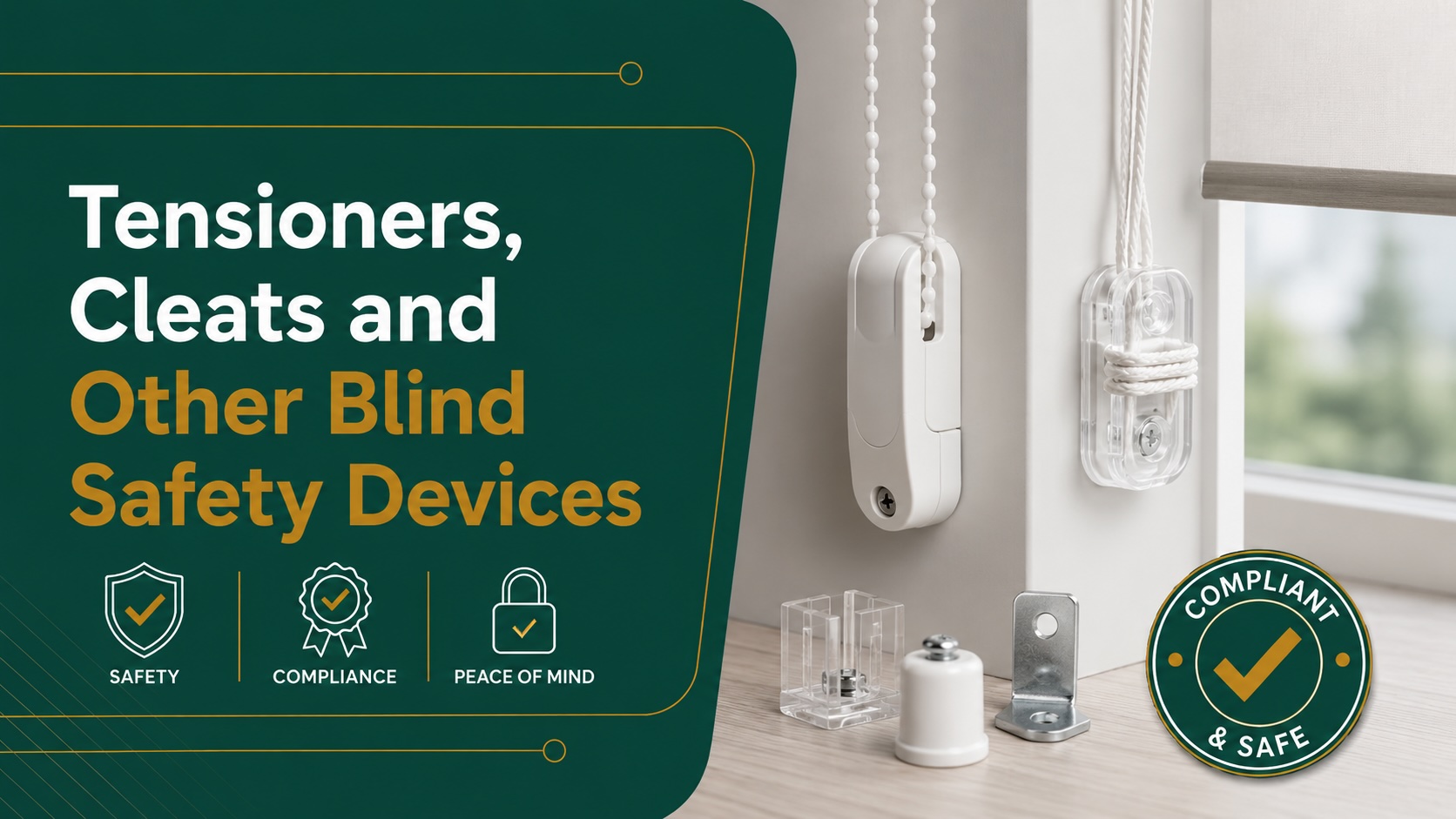
Different blind control systems use different safety devices, and each type is designed to manage a particular risk associated with cords or chains.
The important point is that these devices are not interchangeable. The correct safety solution depends on the blind mechanism and the way the control operates.
Chain Tensioners
A chain tensioner is commonly used with continuous-loop chain controls.
Its purpose is to keep the chain held under tension against the wall or window area so that it does not hang freely as an accessible loose loop.
The tensioner normally forms part of the safety arrangement for the blind and should therefore be positioned and secured correctly.
Cord Cleats
A cleat provides a fixed point around which excess operating cord can be wrapped.
When used correctly, the cord is wound securely around the cleat rather than being left hanging freely.
Cleats are particularly relevant to blind systems where excess cord needs to be accumulated after operation.
Breakaway Devices
A breakaway device is designed to separate when a specified force is applied.
Rather than keeping a loop permanently under tension, the safety principle is that the component releases under defined conditions, helping to reduce the strangulation hazard.
The design and performance of the breakaway system need to be appropriate for the particular blind mechanism.
Other Safety Systems
Depending on the blind design, other safety measures may include:
- Devices intended to prevent cords becoming tangled
- Inner cord stops
- Systems that restrict the creation of accessible loops
- Operating mechanisms designed to minimise exposed cords or chains
- Motorised controls that remove the need for a manual loop altogether
The presence of a safety device should not be viewed as a substitute for correct product specification. It forms part of the complete blind system.
Why Correct Fitting Matters
Some safety devices depend on correct positioning and secure fixing in order to perform as designed.
A tensioning device that is left loose, for example, may no longer control the chain in the intended way. Similarly, a cleat only helps manage excess cord when the cord is consistently secured around it.
For commercial projects, the specification should therefore consider not only which safety device is supplied, but also how that device forms part of the finished operating system.
This is why safety documentation and installation instructions are important components of a commercial blind specification, alongside the blind and its fabric.
Why Fire Performance Matters in Commercial Blinds
Fire performance is a separate compliance consideration from the mechanical safety of the blind itself.
A blind may be correctly specified from an operating and cord-safety perspective but still require a fabric with a defined level of fire performance for the building in which it will be installed.
This is particularly relevant in non-domestic environments such as:
- Offices
- Schools
- Healthcare buildings
- Hotels
- Care homes
- Public buildings
- Commercial premises
- Other projects where the specification includes fire-performance requirements
The key point is that blind safety and fabric fire performance are not the same thing.
A standard relating to the operation and safety of the blind does not automatically establish how the fabric will behave when exposed to flame.
Fire Performance Is Usually a Fabric Specification
For roller and vertical blinds, the fire-performance requirement will commonly relate to the selected fabric.
This means that the relevant evidence should apply to the actual fabric being specified, rather than simply to the general blind range.
For example, describing a product range as “commercial roller blinds” does not in itself demonstrate the fire performance of every fabric available within that range.
A commercial specification should therefore identify:
- The required fire-performance standard
- The classification or performance level required by the project
- The specific fabric being supplied
- The test evidence supporting that fabric
Different Buildings Can Have Different Requirements
There is no single fire-performance classification that should automatically be assumed to apply to every commercial blind installation.
The appropriate requirement can depend on factors such as:
- Building type
- Room use
- Occupancy
- Procurement specification
- Architect or contractor requirements
- Fire strategy for the project
A school, hospital, office and hotel may therefore be specified differently even where the same basic blind type is being considered.
“Fire Retardant” Needs Supporting Evidence
The phrase fire retardant should not be treated as a complete technical specification.
For commercial procurement, the more useful questions are:
- Which standard has the fabric been tested against?
- What performance level was achieved?
- Does the evidence relate to the exact fabric being ordered?
- Is that performance appropriate for the project?
This distinction helps prevent broad marketing terminology from being mistaken for documented compliance.
For non-domestic blind fabrics in the UK, one of the key standards to understand is BS 5867-2, which deals specifically with flammability requirements for fabrics used in curtains, drapes and window blinds.
BS 5867-2: Fire Performance for Non-Domestic Blind Fabrics
For commercial blind fabrics, one of the key standards to understand is BS 5867-2, which sets flammability requirements for fabrics used in non-domestic curtains, drapes and window blinds.
This standard is concerned with the fire performance of the fabric, not the operating safety of the blind mechanism.
That distinction is important because a commercial blind can involve several different standards covering different aspects of the finished product.
For example:
- BS EN 13120 relates to internal blind performance and safety
- BS EN 16434 relates to safety devices used to reduce strangulation hazards
- BS 5867-2 relates to the flammability performance of the fabric
A well-specified commercial blind may therefore need to satisfy more than one requirement.
What Does BS 5867-2 Assess?
The standard is used to assess how fabrics behave when exposed to flame under defined test conditions.
The resulting classification helps specifiers understand whether a fabric meets the required fire-performance level for the intended commercial environment.
For a roller or vertical blind, the relevant evidence should relate to the specific fabric selected, not simply to the blind mechanism or the general product range.
Why the Exact Fabric Matters
Commercial blind ranges may contain many different fabrics, colours, coatings and constructions.
It should not be assumed that every fabric within a range automatically has the same fire-performance classification.
When fire performance forms part of the project specification, the supplier should therefore be able to identify the evidence that applies to the fabric being ordered.
Fire Classification Is Project-Specific
BS 5867-2 includes different performance levels, and the appropriate level depends on the requirements of the project.
This means it is not enough simply to ask whether a fabric is “fire retardant”.
The more useful questions are:
- Which BS 5867-2 performance level applies?
- Has the selected fabric been tested to that level?
- Does the supporting documentation relate to the exact fabric being specified?
- Is that classification suitable for the building and room in question?
This is particularly important in formal commercial procurement, where the required fire performance may be defined by the architect, contractor, fire strategy or client specification.
The next distinction to understand is what the different Type A, Type B and Type C performance levels actually mean.
What Do Type A, Type B and Type C Mean?
Within the BS 5867-2 framework, fabrics can be assessed to different levels of fire performance, commonly referred to as Type A, Type B and Type C.
These classifications represent progressively more demanding performance requirements:
- Type A is the least demanding of the three levels
- Type B requires a higher level of performance
- Type C is the most demanding classification
The important point for commercial blind specification is that the highest classification is not automatically required for every installation.
Type A
Type A represents the entry level within the three classifications.
A fabric meeting Type A has demonstrated performance against the requirements associated with that level, but this should not be interpreted as meaning it will automatically satisfy a project requiring Type B or Type C.
Type B
Type B represents a more demanding level of fire performance than Type A.
It is commonly encountered in commercial specifications, but whether it is appropriate depends on the requirements established for the particular building or project.
A supplier describing a fabric as meeting BS 5867-2 should therefore ideally also identify the relevant Type classification, rather than quoting the standard number alone.
Type C
Type C represents the most demanding of the three BS 5867-2 performance levels.
However, specifying Type C simply because it is the highest classification is not necessarily the correct approach.
Commercial blind specification should follow the fire requirements established for the project rather than automatically selecting the most demanding classification available.
Why the Classification Matters
There is a significant difference between saying:
“This fabric is fire retardant.”
and stating:
“This fabric has been tested to BS 5867-2 and achieved the required Type classification.”
The second statement gives the specifier something measurable that can be checked against the project requirements.
When assessing a commercial blind fabric, it is therefore useful to establish:
- Which standard the fabric has been tested against
- Which Type classification was achieved
- Whether that classification matches the project specification
- Whether the test evidence applies to the exact fabric being supplied
Do Not Assume Type C Is Always “Better”
From a testing perspective, Type C represents a more demanding performance level. From a specification perspective, however, the correct classification is the one required for the installation.
Over-specifying a product can be just as unhelpful as under-specifying it if the decision is made without reference to the actual project requirements.
The role of the specifier is therefore not simply to find the fabric carrying the highest classification, but to ensure that the selected fabric has documented fire performance that meets the defined requirement for the building.
Fire Retardant Does Not Mean Fireproof
One of the most important distinctions in commercial blind specification is the difference between fire retardant and fireproof.
A fire-retardant fabric has been designed or treated to achieve a defined level of performance when tested against a recognised flammability standard. This can include characteristics such as resisting ignition, limiting flame spread or self-extinguishing under specified test conditions.
It does not mean that the fabric cannot burn.
Commercial blind fabrics should therefore not be described or understood as fireproof unless there is specific evidence supporting that exact claim.
What Fire Retardant Actually Means
In practical terms, a fire-retardant blind fabric should have supporting evidence showing that it has been tested against the relevant standard and achieved the required classification.
For commercial blinds, that may include information such as:
- The standard used for testing
- The Type classification achieved
- The specific fabric or fabric range covered by the evidence
- The test report or certificate supporting the claim
The term fire retardant is therefore most useful when it is connected to documented performance.
A Commercial Blind Is Not a Fire Barrier
Another important distinction is that an ordinary roller or vertical blind with fire-retardant fabric should not be confused with a specialist fire curtain or fire barrier system.
Fire curtains are engineered systems designed specifically to resist or control the spread of fire and smoke for a defined period. They operate within a completely different technical and regulatory framework.
A commercial window blind, even when fitted with a fabric that achieves a recognised fire-performance classification, does not perform the same function.
Why This Matters in Specifications
Using inaccurate terminology can create unnecessary confusion during procurement.
For example:
“Fireproof commercial blind”
is much less useful than:
“Commercial blind manufactured using fabric tested to the required BS 5867-2 classification.”
The second statement identifies measurable performance that can be checked against the project requirements.
For commercial buyers and specifiers, the key principle is simple:
Fire-retardant performance should always be tied to a recognised test standard and documented classification, rather than treated as a general claim that the blind cannot burn.
What Evidence Should a Commercial Blind Supplier Be Able to Provide?
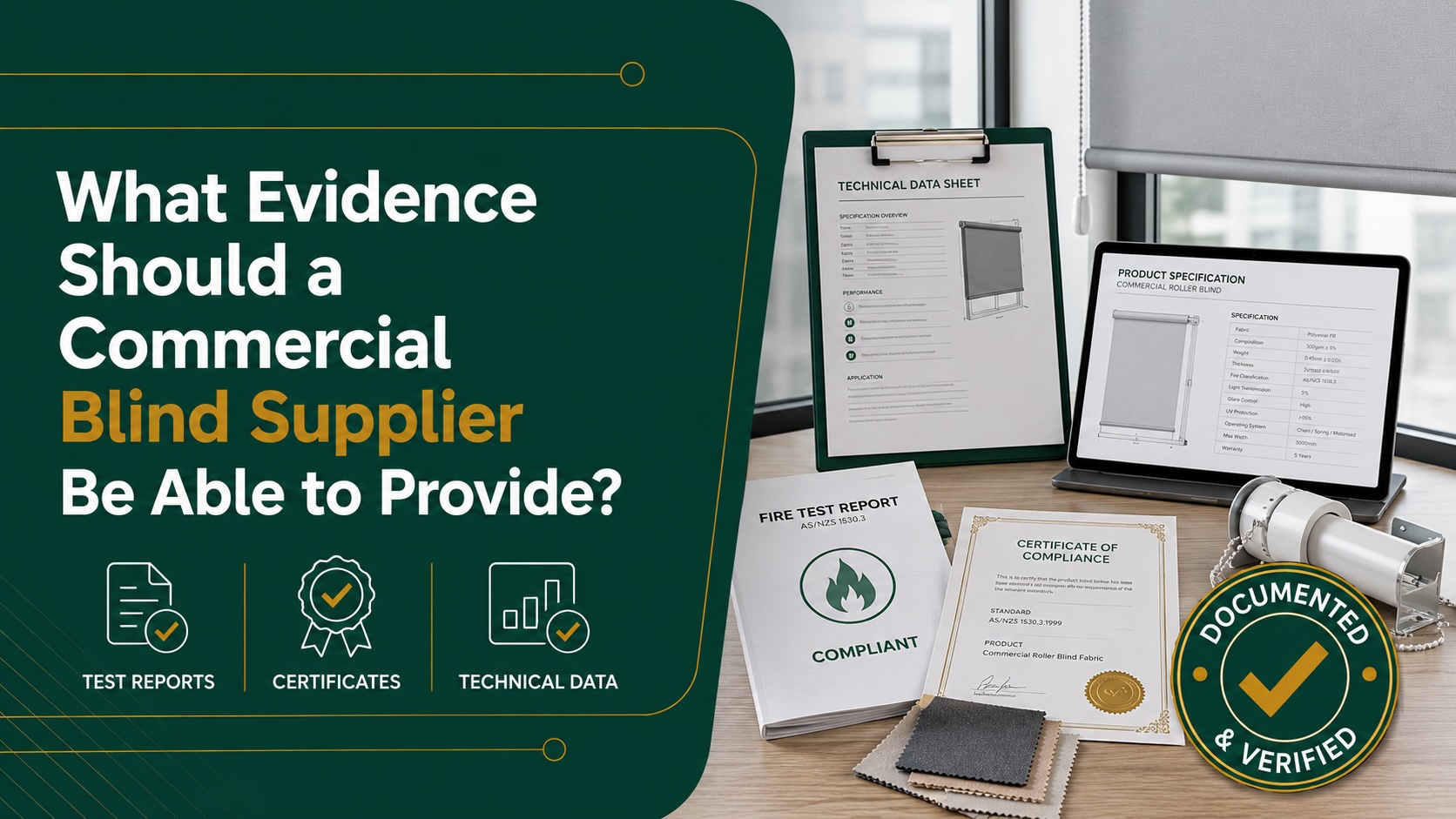
For a commercial project, broad claims such as “compliant”, “fire retardant” or “commercial grade” are less useful than documentation showing exactly what has been tested and which requirement the product satisfies.
The evidence required will depend on the project, but a commercial blind supplier may need to provide documentation such as:
- Fabric technical data sheets
- Fire-performance test reports
- Certificates relating to specific standards or classifications
- Details of the blind’s operating and safety system
- Information about cord or chain safety devices
- Product safety information
- Manufacturer specifications
- Documentation for motors and controls where blinds are electrically operated
- Installation and safety instructions
- Information required for project handover or procurement records
Not every project will require every document. The important point is that the evidence should correspond with the requirements stated in the specification.
Check What the Document Actually Covers
A certificate or test report should not be accepted simply because it contains the name of a relevant standard.
Check:
- What product or material was tested?
- Which standard was used?
- What classification or result was achieved?
- Does the document apply to the product being ordered?
- Does that result meet the requirement of the project?
For example, a fire test relating to one blind fabric does not automatically demonstrate the performance of every fabric available within the same commercial blind range.
Likewise, evidence relating to fabric flammability does not establish compliance with requirements concerning the blind’s operating chain or other safety components.
Documentation Should Match the Specification
The strongest approach is to work backwards from the commercial specification.
If a project requires a particular fabric fire classification, the supplier should be able to identify evidence supporting that classification for the specified fabric.
If an operating system requires a particular safety arrangement, the documentation should identify the mechanism and relevant safety components.
This makes the evidence traceable rather than relying on general statements about the blind range.
Ask for Evidence Before Ordering
Where certification or test documentation forms part of a formal tender, contractor specification or handover requirement, it is sensible to establish what documentation is available before the blinds are ordered.
This reduces the risk of selecting a product that performs perfectly well as a blind but does not have the evidence required by the particular project.
The objective is not to collect as many certificates as possible. It is to ensure there is appropriate evidence for each performance or compliance claim that matters to the installation.
Test Report vs Certificate: What Is the Difference?
Commercial blind documentation can include both test reports and certificates, but the two terms should not be treated as interchangeable.
Test Report
A test report records the results of a product or material being assessed against a specific test method or standard.
For a commercial blind fabric, this might show:
- Which fabric was tested
- Which standard or test method was used
- The conditions of the test
- The result achieved
- Any classification awarded
A test report therefore provides the underlying evidence of performance.
Certificate
A certificate is typically a more formal statement confirming that a product, material or system satisfies a defined requirement.
Depending on the certification scheme, it may refer to:
- A specific standard
- A stated performance classification
- A particular product or fabric range
- An independent assessment or certification body
The important point is that a certificate should still be read carefully. It should be clear what has been certified and what the scope of that certification actually covers.
Manufacturer Declaration
A manufacturer declaration is different again.
It is a statement made by the manufacturer about the conformity or performance of the product. Depending on the regulatory context, such declarations can be important, but they are not automatically the same as independent third-party certification.
This distinction matters when a project specification specifically asks for independent evidence.
Why the Difference Matters
A document should never be judged by its title alone.
For example, a certificate may apply only to one fabric family, while a test report may provide detailed evidence for the exact fabric being supplied.
The useful questions are:
- What does this document cover?
- Which product or material does it apply to?
- Which standard is referenced?
- What result or classification was achieved?
- Does that evidence satisfy the project requirement?
For commercial procurement, the aim should be to obtain the right evidence for the right requirement, rather than assuming that a document labelled “certificate” is automatically more meaningful than a detailed test report.
Why You Should Check the Exact Fabric, Not Just the Blind Range
One of the easiest mistakes to make in commercial blind specification is to assume that every fabric within a particular blind range has the same fire-performance evidence.
That should not be assumed.
A commercial roller or vertical blind range may contain multiple fabrics with different constructions, coatings, colours and finishes. The relevant test report or certificate may apply to:
- One specific fabric
- A defined fabric family
- Certain colours or finishes
- A particular construction
- A stated range of products covered by the test evidence
For this reason, it is not enough to establish that the overall blind range is described as fire retardant or commercial.
The more important question is:
Does the supporting evidence apply to the exact fabric being specified?
Why Fabric-Level Evidence Matters
Fire-performance testing relates to the material that was actually assessed.
If one fabric within a range has been tested to a particular BS 5867-2 classification, that result should not automatically be extended to another fabric unless the supporting documentation confirms that it is covered.
The same principle applies if the fabric has:
- A different coating
- A different backing
- A different weight or construction
- A different surface treatment
- Other characteristics that may affect the scope of the test evidence
Check Before the Specification Is Finalised
Where a project requires a defined fire-performance level, confirm the evidence before selecting the final fabric colour or finish.
This is especially important where the design team has already shortlisted a particular material based on appearance. A visually suitable fabric is not necessarily suitable for the technical specification.
A stronger commercial procurement process is:
- Establish the required fire-performance classification
- Identify fabrics that have suitable supporting evidence
- Confirm the evidence applies to the chosen fabric
- Select the final colour or finish from within the compliant options
The Blind Mechanism and Fabric Evidence Are Separate
It is also worth reinforcing that evidence relating to the fabric does not automatically establish compliance for every other part of the blind.
A complete commercial blind specification may therefore include separate evidence for:
- The blind and operating system
- Cord or chain safety devices
- Fabric fire performance
- Motorised components where applicable
The key principle is traceability. Each important compliance or performance claim should be connected to evidence that clearly applies to the actual product or material being supplied.
Commercial Blind Requirements in Offices
Office blinds may need to satisfy a combination of product-safety, fire-performance and project-specific requirements, but there is no single specification that applies identically to every office.
The correct requirement depends on factors such as:
- The type of building
- The room in which the blind will be installed
- The operating mechanism
- Whether the space is accessible to children or vulnerable users
- The fire strategy for the building
- Requirements set by the landlord, architect, contractor or facilities team
- Procurement or handover documentation required for the project
Product Safety Still Matters in an Office
An office environment does not remove the need to consider the safety of the blind itself.
Where blinds use cords, chains or other accessible controls, the operating system should be appropriately specified and any required safety devices should form part of the finished installation.
This can be particularly important in areas such as:
- Reception spaces
- Shared meeting rooms
- Customer-facing offices
- Buildings where children may occasionally be present
- Multi-use commercial premises
A commercial setting should therefore not be treated as an automatic exemption from cord or chain safety considerations.
Fire Performance Depends on the Project
It is also important not to assume that every office blind requires exactly the same fire classification.
The required fabric performance may be established by the building specification, fire strategy, contractor or client.
Where a fire-retardant blind fabric is specified, the project should identify:
- The required standard
- The required performance classification
- The fabric being supplied
- The evidence supporting that fabric
Simply selecting a blind described as “commercial” does not establish that these requirements have been satisfied.
Meeting Rooms and Specialist Office Areas May Differ
Different rooms within the same office building can also have different technical requirements.
For example, a general open-plan office, reception area, private meeting room and presentation space may use different blind fabrics or operating systems.
This does not necessarily mean that the safety standards change from room to room, but the overall specification may differ because of factors such as:
- Privacy requirements
- Fire-performance specification
- Blind size
- Manual or motorised operation
- Procurement requirements for particular areas
Do Not Treat “Office Blind” as a Compliance Category
The term office blind describes where the product is being used, not a single recognised technical classification.
A stronger specification identifies the individual requirements relevant to the product and project.
For example, rather than specifying:
“Commercial office roller blind, fire retardant.”
a technical specification should identify the blind type, operating system, required product-safety provisions, fabric fire-performance requirement and the evidence expected from the supplier.
This makes the specification measurable and gives everyone involved in the project a clearer basis for determining whether the finished blind meets the required standard.
Commercial Blind Requirements in Schools and Educational Buildings
Schools and other educational environments require particularly careful blind specification because children are expected to be present and may have regular access to the rooms where blinds are installed.
This makes operating-system safety, cord and chain hazards, fire performance and supporting documentation especially important.
Cord and Chain Safety Is a Priority
Where manually operated blinds use cords or chains, the control system should be specified so that accessible loops and other foreseeable strangulation hazards are appropriately managed.
Depending on the blind design, this may involve:
- Chain tensioning devices
- Breakaway systems
- Cord accumulation devices
- Alternative control arrangements
- Motorised operation where appropriate
- Other systems designed to reduce accessible cord or chain hazards
The safety device should form part of the complete blind specification rather than being treated as an optional extra.
Consider Where the Blind Will Be Used
Different parts of an educational building can present different levels of access and risk.
Examples include:
- Nurseries and early-years rooms
- Primary classrooms
- Secondary classrooms
- Libraries
- Dining areas
- Sports facilities
- Reception areas
- Staff rooms
- Offices
- Corridors and communal spaces
A blind installed in a room used by very young children may require different risk considerations from one installed in an administrative office that pupils do not normally enter.
The important point is to assess who can access the blind and its controls, rather than relying solely on the name of the room.
Fire Performance Must Also Be Specified
Educational projects may also require blind fabrics with defined fire-performance characteristics.
Where this applies, the specification should identify the required standard and classification and confirm that the selected fabric has appropriate supporting evidence.
It should not be assumed that:
“school blind” = “fire compliant blind”
or that every fabric available for a commercial blind automatically satisfies the same fire-performance requirement.
The exact fabric still needs to be checked.
Avoid Creating New Hazards Through Poor Specification
Safety should also be considered across the complete blind system.
For example, a blind may use an appropriate safety device, but that device still needs to be suitable for the control mechanism and correctly incorporated into the finished installation.
Likewise, choosing a fire-retardant fabric does not compensate for an unsafe operating system.
These are separate areas of compliance and both may need to be addressed.
Documentation Is Particularly Important
Educational projects are often subject to formal procurement and handover procedures.
Depending on the specification, the supplier may therefore be expected to provide evidence relating to:
- Blind product safety
- Cord and chain safety arrangements
- Safety devices
- Fabric fire performance
- Relevant test reports or certificates
- Installation and operating instructions
- Motorised systems where applicable
For schools and educational buildings, the strongest approach is therefore to treat safety as a complete-system requirement, covering the blind, operating mechanism, fabric, safety devices and supporting documentation.
Commercial Blind Requirements in Healthcare Buildings
Healthcare environments can place additional emphasis on safety, documented performance and suitability for the intended users.
Hospitals, clinics, treatment centres and other healthcare facilities can include a wide range of spaces, from public waiting rooms and consulting rooms to treatment areas, offices and patient accommodation. The blind specification should therefore reflect the specific environment rather than relying on a single generic “healthcare blind” requirement.
Consider Who Will Use the Space
Healthcare buildings may be used by:
- Patients
- Visitors
- Children
- Older people
- People with reduced mobility
- People who may require assistance
- Clinical and administrative staff
This makes it particularly important to consider whether cords, chains or other operating components could create an avoidable hazard.
Where the blind relies on a manual cord or chain system, the associated safety arrangement should be appropriate for the location and intended users.
Product Safety and Fire Performance Are Separate
As with other commercial environments, healthcare blind compliance can involve several distinct requirements.
These may include:
- Blind product safety
- Cord and chain safety
- Safety-device performance
- Fabric fire performance
- Motorised system requirements
- Project-specific procurement standards
- Supporting test documentation
A fabric with suitable fire-performance evidence does not establish that the blind operating system is safe.
Likewise, a blind that satisfies relevant product-safety requirements does not automatically demonstrate that the selected fabric meets the project’s fire specification.
Both areas need to be considered independently.
Some Areas May Require More Restrictive Specifications
A healthcare building can contain areas with very different risk profiles.
For example, a general administration office may not present the same considerations as:
- Patient bedrooms
- Paediatric departments
- Mental health environments
- Treatment rooms
- Waiting areas
- Residential care areas
- Spaces used by vulnerable occupants
In these locations, the project team may impose additional requirements relating to accessibility, operating systems or the elimination of potential hazards.
This is one reason why a blind suitable for one healthcare environment should not automatically be assumed to be suitable for another.
Fire-Performance Evidence Should Match the Selected Fabric
Where the project requires a particular level of fire performance, the supplier should be able to demonstrate that the actual fabric being specified has appropriate supporting evidence.
The specification should identify:
- The required fire-performance standard
- The required classification
- The selected fabric
- The evidence applicable to that fabric
The description “fire-retardant healthcare blind” is not sufficiently precise on its own.
Documentation Matters
Healthcare projects frequently involve structured procurement processes and detailed handover documentation.
Depending on the project, documentation may therefore be required for:
- Blind safety
- Safety devices
- Fabric fire performance
- Product specifications
- Motorised components
- Installation
- Operation
- Maintenance or replacement components
The safest approach is to establish these documentation requirements during specification rather than attempting to obtain them retrospectively after the blinds have been ordered.
For healthcare environments in particular, compliance should be considered in relation to the exact room, users, operating method and project requirements, rather than simply to the building category as a whole.
Commercial Blind Requirements in Care Homes and Child-Accessible Environments
Care homes and other environments used by children or vulnerable people require particularly careful consideration of blind safety.
The key issue is not simply whether the building is classed as commercial. It is whether the blind, its operating system and its controls could create a foreseeable hazard for the people using the space.
This can make cord and chain safety, operating-system design, fire performance and documented compliance especially important.
Vulnerable Users Change the Risk Profile
Locations may include:
- Residential care homes
- Assisted-living environments
- Nurseries
- Early-years settings
- Family waiting areas
- Community facilities
- Specialist education environments
- Other spaces regularly accessed by children or vulnerable adults
In these settings, a control mechanism that might be acceptable in a low-risk staff-only area may need to be reconsidered.
The specification should assess who can reach the blind controls and how the blind will be operated in day-to-day use.
Avoid Accessible Hazardous Loops
Where cords or chains are used, the operating system should be designed so that accessible hazardous loops are appropriately controlled.
Depending on the blind system, this may involve:
- Tensioning devices
- Breakaway components
- Cord accumulation devices
- Alternative control arrangements
- Motorised operation
- Other safety measures appropriate to the blind design
The objective is to reduce foreseeable strangulation risks rather than simply adding a device after the blind has been specified.
Motorisation Can Reduce Manual Cord and Chain Exposure
In some environments, motorised blinds may be considered because they can remove the need for conventional manual chain or cord controls.
However, motorisation should not automatically be treated as proof of overall compliance.
The powered system still needs to be appropriately specified, and other considerations such as electrical safety, control method, fabric fire performance and project requirements remain relevant.
Fire Performance Remains a Separate Requirement
A blind that incorporates suitable cord or chain safety measures does not automatically satisfy the fire-performance requirements of the project.
Where a fire-retardant fabric is required, the specification should still establish:
- The applicable fire-performance standard
- The required classification
- The exact fabric being supplied
- The supporting evidence for that fabric
The two areas should be treated separately:
Operating-system safety → protects against mechanical and cord-related hazards
Fabric fire performance → addresses the behaviour of the selected material when exposed to flame
Think Beyond Initial Installation
In care and child-accessible environments, ongoing use should also be considered.
Safety devices can be ineffective if they are removed, disconnected or no longer used correctly. Replacement blinds or components may also need to maintain the original safety specification.
For this reason, clear operating information and appropriate handover documentation can be particularly important.
The strongest specification is one that considers the user, the operating system, the fabric, the environment and the supporting evidence together, rather than assuming that a product described broadly as a “care home blind” or “child-safe blind” automatically satisfies every requirement.
Commercial Blind Requirements in Public Buildings
Public buildings present a broad range of blind-safety and compliance considerations because they may be used by large numbers of people with very different needs.
Examples can include:
- Libraries
- Council buildings
- Museums
- Community centres
- Courts
- Government offices
- Public reception areas
- Leisure facilities
- Transport-related buildings
- Other publicly accessible premises
Because these buildings may be used by children, older people, people with disabilities and other potentially vulnerable users, the blind specification should consider both the technical requirements of the product and the way the space is actually used.
Public Access Changes the Safety Assessment
A blind installed in a staff-only office may present a different risk profile from one positioned in a public waiting area or community room.
Where cords or chains are accessible, the specification should consider whether the operating system creates a foreseeable hazard and whether appropriate safety measures are required.
Depending on the blind design, this may include:
- Tensioning devices
- Breakaway systems
- Cord accumulation devices
- Alternative operating methods
- Motorised controls
- Other safety measures appropriate to the product
The key consideration is not simply whether the building is commercial or public, but who can access the blind and its controls.
Fire Performance May Be Part of the Building Specification
Public buildings may also have defined requirements for the fire performance of furnishing materials, including blind fabrics.
Where this applies, the specification should identify:
- The relevant fire-performance standard
- The classification required for the project
- The exact blind fabric being selected
- The supporting test evidence
A general description such as “fire-retardant public building blind” is not sufficiently specific for technical procurement.
The fabric classification should be traceable to suitable documentation.
Different Areas of the Same Building May Require Different Specifications
A single public building can contain a wide variety of spaces.
For example:
- Public reception areas
- Meeting rooms
- Staff offices
- Children’s areas
- Auditoriums
- Consultation rooms
- Storage areas
- Circulation spaces
The blind type, operating system and required performance may therefore differ between rooms.
This is another reason why commercial blind compliance should be approached at room and specification level, rather than assuming that one standard blind configuration is appropriate throughout an entire building.
Procurement and Handover Requirements
Public-sector and larger commercial projects may require formal supporting documentation before products are approved or handed over.
Depending on the specification, this may include:
- Product technical information
- Fire-performance evidence
- Safety-device information
- Relevant certificates or test reports
- Operating instructions
- Installation information
- Motor documentation where applicable
These requirements should ideally be established before the product is ordered.
For public buildings, the most reliable approach is therefore to treat blind compliance as a combination of product safety, user risk, fabric performance and documented evidence, assessed against the requirements of each particular space.
Motorised Commercial Blinds
Motorised blinds can remove the need for conventional manual cords or chains, which can reduce some of the hazards associated with looped operating controls.
However, motorisation introduces a different set of technical and compliance considerations.
A powered blind should therefore not be treated as automatically safer or more compliant simply because it is electric.
Electrical and Product Safety
Motorised blinds combine a window covering with powered components such as:
- Tubular motors
- Power supplies
- Control units
- Wall switches
- Remote controls
- Radio receivers
- Building management interfaces
- Sensors and automation components
These components need to be suitable for their intended use and incorporated into the blind system correctly.
The relevant documentation may differ depending on whether the system is mains powered, low voltage, battery powered or connected to a wider building control system.
Motorisation Does Not Replace Other Compliance Requirements
A motorised blind may eliminate a manual chain or cord, but other requirements still apply.
These can include:
- Blind product safety
- Fabric fire performance
- Electrical safety
- Appropriate product documentation
- Correct installation
- Control-system suitability
- Project-specific requirements
For example, specifying an electric roller blind does not establish whether the selected fabric satisfies the required BS 5867-2 fire-performance classification.
The mechanical and fabric requirements remain separate.
Consider the Control Method
The method used to operate the blind is also part of the specification.
A commercial motorised blind might be controlled using:
- A fixed wall switch
- A handheld remote
- A central control panel
- Timed automation
- Light or environmental sensors
- A building management system
- Another compatible automated control
The most appropriate option depends on the building and intended users.
For example, a school, healthcare facility and office may have different requirements for who should be able to operate the blinds and how controls are accessed.
Automated Movement Should Be Considered
Any powered moving product needs to be specified with its operating environment in mind.
Factors can include:
- Blind size and weight
- Motor capacity
- Frequency of operation
- Position of furniture and equipment
- Access to moving parts
- Control locations
- Automated schedules
- Interaction with other building systems
The objective is to ensure that the blind operates reliably and appropriately within the space in which it is installed.
Documentation for Motorised Blinds
Depending on the system and project, supporting documentation may include:
- Motor technical specifications
- Electrical information
- Product conformity documentation
- Control-system information
- Installation instructions
- Operating instructions
- Maintenance information
- Details of compatible accessories or automation equipment
Where a commercial project has formal handover requirements, these documents may need to be included within the completed project information.
The key principle is that motorisation changes the operating system, but it does not remove the need to assess the complete blind specification. Product safety, electrical requirements, fabric performance and project documentation should all still be considered.
Do Electric Blinds Have Additional Compliance Considerations?
Yes. Electric blinds can introduce additional compliance considerations because the blind incorporates electrical or electronic components alongside the window covering itself.
The exact requirements depend on the type of motor, power supply, control system and installation.
Different Power Systems Can Mean Different Requirements
Commercial motorised blinds may use:
- Mains-powered motors
- Low-voltage motors
- Battery-powered systems
- Rechargeable motors
- Hard-wired control systems
- Radio-controlled systems
- Building management system integration
These configurations should not automatically be treated as equivalent from a compliance perspective.
The relevant technical documentation should reflect the actual system being supplied.
Electrical Safety Needs Separate Consideration
A motorised blind may still need to satisfy the same blind and fabric requirements as a manually operated product, while also introducing electrical safety considerations.
This can include areas such as:
- Motor suitability
- Power supply compatibility
- Electrical connections
- Control equipment
- Protection of electrical components
- Installation requirements
- Safe operation of the powered system
Where electrical work forms part of the installation, it should be carried out in accordance with the requirements applicable to that work and the project.
The Motor and the Blind Should Be Considered Together
It is not sufficient to assess the motor in isolation.
The powered system includes the interaction between:
blind + motor + controls + power supply + installation
The motor must be suitable for the size, weight and operating demands of the blind.
Incorrectly matched components can affect reliability and may also undermine the intended safety and performance of the finished system.
Automated Controls Can Add Another Layer
More sophisticated commercial installations may incorporate:
- Timers
- Sun sensors
- Temperature sensors
- Centralised controls
- Group operation
- Smart-building controls
- Building management systems
Where blinds operate automatically, the specification should consider how and when movement is triggered and whether the control arrangement is appropriate for the space.
The greater the level of automation, the more important it becomes to clearly define the system and its supporting documentation.
Product Documentation Should Cover the Powered Configuration
For a motorised commercial blind, documentation may need to cover more than the blind fabric and headrail.
Depending on the system, this can include:
- Motor specifications
- Electrical characteristics
- Power-supply information
- Control-system documentation
- Installation instructions
- Operating instructions
- Product conformity information
- Relevant declarations or technical documentation
The exact documents required will depend on the product and project.
Motorisation Is Not a Shortcut to Compliance
An electric blind may remove a conventional manual chain, which can simplify one aspect of operating-system safety.
It does not remove the need to consider:
- Product safety
- Fabric fire performance
- Electrical requirements
- Correct installation
- Appropriate controls
- Supporting documentation
Motorisation should therefore be treated as an additional technical layer within the overall commercial blind specification, rather than as a standalone indication that the blind is compliant.
UKCA, CE and Product Marking
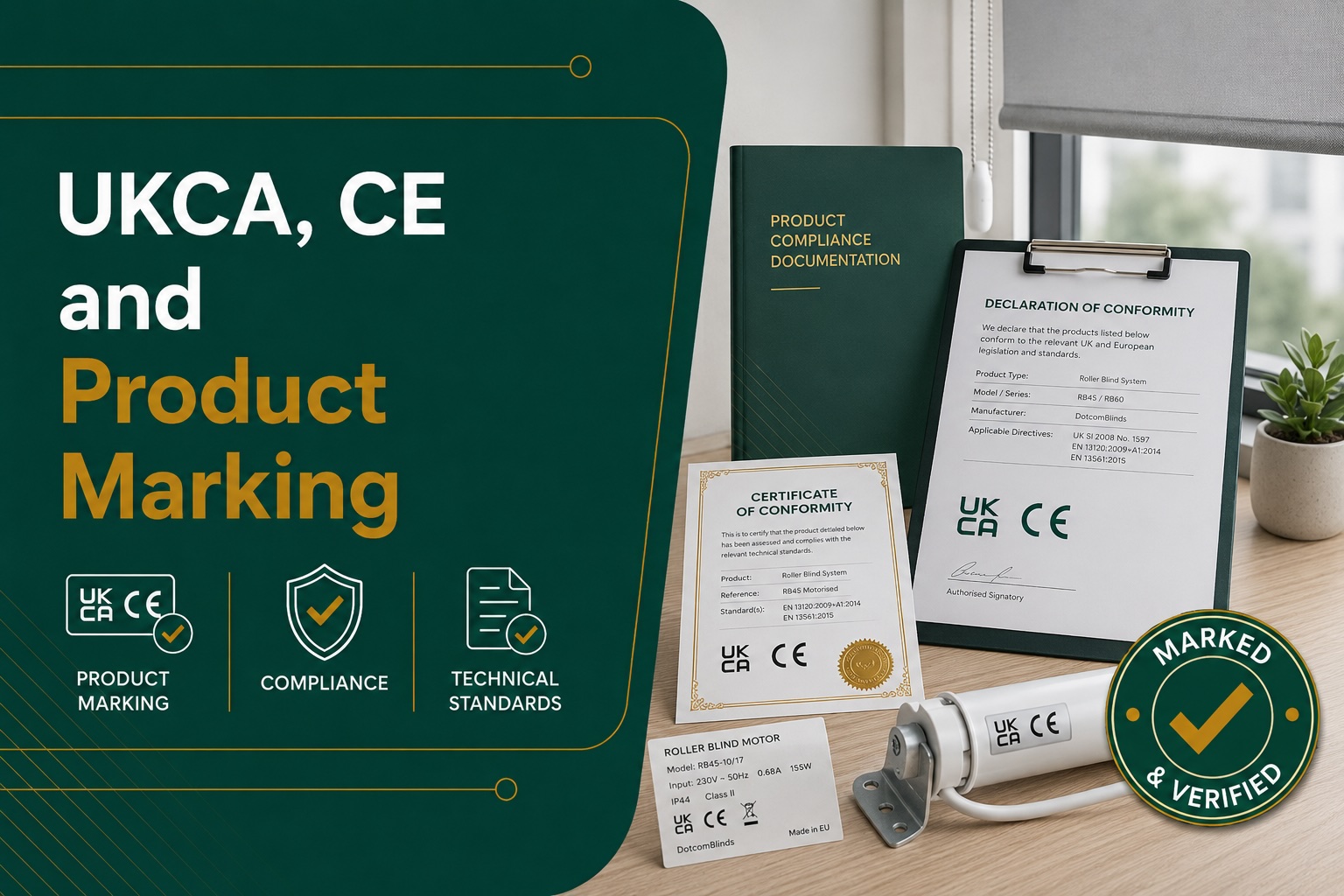
Product marking is another area where commercial blind specifications can become confusing, particularly because the UK regulatory framework has changed several times in recent years.
The most important point is that a UKCA or CE mark should not be treated as a general certificate proving that every aspect of a commercial blind is compliant.
Product marking relates to specific regulatory requirements that apply to particular products or components.
What Is UKCA Marking?
UKCA stands for UK Conformity Assessed.
It is a conformity marking used for certain products placed on the market in Great Britain where the relevant legislation requires it.
However, whether UKCA marking is required depends on the product and the legislation that applies to it.
It should not therefore be assumed that every manually operated commercial blind must simply carry a UKCA mark in order to be compliant.
What Is CE Marking?
CE marking is a conformity marking used under European product legislation.
It indicates that the manufacturer has assessed the product against applicable requirements within the relevant regulatory framework.
Again, it is important to understand what the marking actually relates to.
A CE mark on an electrical component, for example, does not automatically demonstrate:
- The fire performance of the blind fabric
- The safety of an operating chain
- Compliance with a project-specific specification
- The suitability of the complete blind for a particular building
Motorised Blinds Can Involve Additional Marking Requirements
Product marking is particularly relevant to motorised blinds because powered systems may incorporate electrical and electronic components that fall within additional regulatory requirements.
Depending on the system, this can involve areas such as:
- Electrical safety
- Electromagnetic compatibility
- Radio equipment where wireless controls are used
- Machinery-related requirements
- Other applicable product legislation
The exact requirements depend on the design and configuration of the system.
This is why motorised blind documentation should relate to the complete powered configuration, rather than simply stating that the motor itself carries a particular marking.
Product Marking and Standards Are Not the Same Thing
It is also important to distinguish between conformity marking and compliance with a technical standard.
For example:
BS EN 13120 relates to the safety and performance requirements of internal blinds.
BS 5867-2 relates to fabric fire performance.
UKCA or CE marking relates to applicable product conformity requirements.
These different elements can overlap, but they do not replace one another.
A blind carrying a conformity mark should not automatically be assumed to satisfy every requirement within a commercial project.
Check the Current Regulatory Position
Because UK product-marking rules have evolved, commercial buyers and specifiers should avoid relying on assumptions based on older guidance.
Where product marking is relevant to a project, the supplier should be able to identify:
- Which marking applies
- Which legislation or regulatory requirements are being addressed
- Which components or products the marking covers
- What supporting conformity documentation is available
The key principle is that product marking should be understood in context. It is one part of the compliance picture, not a universal approval covering the blind, fabric, operating system and project specification.
What Does “Certified Commercial Blind” Actually Mean?
The phrase “certified commercial blind” sounds reassuring, but on its own it is too vague to confirm whether a blind meets the requirements of a particular project.
There is no single certificate that automatically proves every aspect of a commercial blind is compliant.
A blind specification can involve several separate areas, including:
- Product safety
- Cord and chain safety
- Safety-device performance
- Fabric fire performance
- Electrical requirements for motorised systems
- Product conformity documentation
- Project-specific procurement requirements
A certificate may relate to only one of these areas.
Certified to What?
Whenever a supplier describes a blind as certified, the next question should be:
Certified to which standard or requirement?
Useful supporting information should identify:
- The relevant standard number
- The product, component or fabric covered
- The classification or result achieved
- The organisation that carried out the testing or assessment
- The scope of the certificate
- Whether the evidence applies to the exact specification being supplied
Without this information, the word “certified” provides very little technical detail.
A Fabric Certificate Does Not Certify the Complete Blind
For example, a certificate confirming the fire performance of a blind fabric does not automatically confirm:
- The safety of the blind mechanism
- The suitability of the chain control
- The performance of a safety device
- The conformity of an electric motor
- The suitability of the blind for a particular building
Likewise, documentation relating to the operating system does not establish the fire performance of the fabric.
Each claim needs evidence that relates specifically to that aspect of the product.
“Commercial Grade” Is Not a Standard
The same caution should be applied to phrases such as:
- Commercial grade
- Contract quality
- Fully compliant
- Safety approved
- Fire compliant
- Certified for commercial use
These terms may describe genuine product qualities, but they are not substitutes for identifying the actual technical requirement.
A stronger specification uses measurable wording, such as:
“Fabric tested to the required BS 5867-2 classification”
or
“Internal blind operating system specified in accordance with the relevant BS EN 13120 safety requirements.”
This makes the requirement easier to verify.
Certification Should Be Traceable
For commercial procurement, certification is most useful when it can be traced directly to:
the exact product + the exact requirement + the exact supporting evidence
This avoids one of the most common specification problems: assuming that a general certificate covering part of a product proves that the entire finished blind meets every requirement of the project.
The safest approach is therefore to treat the word “certified” as the beginning of a technical question, not the end of one.
Common Commercial Blind Compliance Mistakes
Commercial blind specifications can fail even when the product itself is good quality. The problem is often not the blind, but an assumption made during specification or procurement.
The following are some of the most common mistakes to avoid.
Assuming “Fire Retardant” Is Enough
The phrase fire retardant does not tell you which standard has been used, what classification has been achieved or whether the evidence applies to the exact fabric being ordered.
A stronger specification identifies:
- The relevant standard
- The required classification
- The exact fabric
- The supporting test evidence
Assuming Every Fabric in a Range Has the Same Certification
A commercial blind range may include several fabrics with different constructions, coatings and finishes.
One fabric having suitable fire-performance evidence does not automatically mean every fabric in the range has the same classification.
The documentation should always be checked against the exact material being specified.
Confusing Blind Safety With Fabric Fire Performance
These are separate areas.
A blind can meet relevant product-safety requirements while using a fabric that does not meet the required fire specification.
Likewise, a fabric can have appropriate fire-performance evidence while the blind mechanism still requires separate safety consideration.
Both need to be assessed independently.
Assuming a Domestic Specification Is Automatically Suitable
A blind suitable for a home may not automatically satisfy the documentation, fire-performance or project-specific requirements of a commercial installation.
This does not mean domestic blinds are inherently unsafe. It means commercial procurement may require additional evidence or a more tightly defined specification.
Assuming Blackout Means Fire Retardant
Blackout describes the ability of a fabric to block light.
It does not describe its fire performance.
A blackout fabric may also have fire-retardant properties, but that needs to be confirmed separately through the relevant testing and documentation.
Assuming Antibacterial Means Compliant
Antibacterial or antimicrobial treatments can be useful product features in certain environments, but they are not substitutes for blind safety or fire-performance compliance.
An antibacterial coating does not demonstrate compliance with standards relating to:
- Cord and chain safety
- Mechanical performance
- Fabric flammability
- Electrical safety
These are separate technical characteristics.
Assuming a Certificate Applies Forever
Certificates and test reports should be checked to confirm that they still relate to the current product specification.
Products can change over time, including:
- Fabric construction
- Coatings
- Components
- Manufacturing processes
- Product ranges
A document should therefore be relevant to the product currently being supplied, rather than simply being an old certificate carrying a familiar product name.
Specifying a Standard Number Without Understanding It
Including a standard number in a specification can create the appearance of technical precision, but it is only useful when the requirement is understood.
For example, BS EN 13120 and BS 5867-2 address different aspects of commercial blinds.
Simply listing both standards without identifying what each is intended to cover can lead to confusion during procurement.
The strongest specifications explain what requirement applies, which part of the blind it relates to and what evidence is needed to demonstrate compliance.
How to Specify a Commercial Blind Correctly
A strong commercial blind specification should identify the technical requirements of the installation before the product is selected.
This helps prevent situations where a blind is visually suitable but does not meet the relevant safety, fire-performance or documentation requirements.
The specification should normally consider the following areas.
Building Type
Start with the type of building in which the blind will be installed.
Examples include:
- Office
- School
- Healthcare facility
- Care home
- Hotel
- Public building
- Retail environment
- Leisure facility
The building type can influence the level of risk, the likely users and the procurement requirements.
Intended Room Use
The room itself also matters.
A staff-only office may have different requirements from a classroom, patient bedroom, reception area or public waiting room.
The specification should therefore consider who will use the space and whether children or vulnerable people are likely to have access to the blind or its controls.
Blind Type
The specification should clearly identify the blind system, for example:
- Roller blind
- Vertical blind
- Venetian blind
- Roman blind
- Other internal blind type
Different blind types can have different operating systems and safety considerations.
Operating Method
The control method should be stated clearly.
This might include:
- Chain operation
- Cord operation
- Wand operation
- Motorised operation
- Remote control
- Wall switch
- Building management system control
Where cords or chains are used, the specification should also identify the appropriate safety arrangement.
Children and Vulnerable Users
Where children or vulnerable users may be present, the operating system should be assessed carefully for foreseeable hazards.
This may influence whether the blind uses:
- A tensioned chain
- A breakaway device
- A cord accumulation device
- Another suitable safety system
- Motorisation to remove manual loops
The exact solution should be appropriate to the blind design and environment.
Required Fire-Performance Standard
If fabric fire performance forms part of the project requirements, this should be stated explicitly.
The specification should identify:
- The relevant standard
- The required classification
- The exact fabric to which the evidence applies
Using vague wording such as “fire-retardant fabric required” can create unnecessary ambiguity.
Required Product-Safety Standard
The relevant product-safety requirements should also be identified separately from the fabric specification.
This may include standards relating to:
- Internal blind performance and safety
- Cord and chain safety
- Safety devices
- Powered operation
This distinction helps prevent fire-performance evidence from being mistaken for evidence of blind safety.
Electrical Requirements
For motorised blinds, the specification should define the powered system clearly.
This can include:
- Motor type
- Power supply
- Control method
- Automation requirements
- Integration with other systems
- Required electrical documentation
The powered configuration should be considered as part of the complete blind system.
Required Documentation
Finally, the specification should identify what evidence must be provided.
Depending on the project, this may include:
- Fabric technical data
- Fire test reports
- Certificates
- Safety-device information
- Product conformity documentation
- Motor specifications
- Installation instructions
- Operating instructions
- Handover information
Defining these requirements before ordering makes procurement much clearer.
A good commercial blind specification should therefore answer four basic questions:
What product is being supplied?
What technical requirements must it meet?
What evidence demonstrates that performance?
Does the evidence apply to the exact blind configuration being ordered?
This approach makes commercial blind compliance easier to verify and reduces reliance on broad terms such as “commercial grade”, “fire retardant” or “fully compliant”.
Commercial Blind Compliance Documentation Checklist
For commercial projects, the easiest way to keep the specification clear is to separate each compliance requirement and identify the evidence that supports it.
A documentation checklist can help specifiers, contractors and facilities teams confirm that nothing important has been overlooked before the blinds are ordered or handed over.
| Document / Evidence | What It Shows | When It May Be Relevant |
|---|---|---|
| BS EN 13120 reference | Evidence relating to internal blind safety and performance requirements. | Internal commercial blinds. |
| BS EN 16434 evidence | Evidence relating to safety devices intended to reduce strangulation hazards. | Blind systems using relevant cord or chain safety devices. |
| BS 5867-2 test evidence | The tested fire performance of the specified fabric. | Projects where non-domestic fabric fire performance is specified. |
| Fabric technical data sheet | Details such as fabric construction, composition, performance characteristics and available technical classifications. | Commercial procurement and specification. |
| Fire test report or certificate | The test method, product or fabric assessed and the result or classification achieved. | Where a defined fire-performance classification is required. |
| Safety-device information | Which tensioner, breakaway device, cleat or other safety arrangement forms part of the operating system. | Cord- and chain-operated blinds. |
| Motor and control documentation | Technical information for motors, power supplies, controls and automation components. | Motorised commercial blinds. |
| Product conformity documentation | Information relating to applicable product conformity requirements. | Where required for the particular product or powered system. |
| Installation and safety instructions | How the blind and its safety components are intended to be installed and used. | Installation and project handover. |
Do Not Collect Documents Without Checking Them
Having a large technical file does not necessarily mean the specification has been properly evidenced.
Each document should be checked to confirm:
- It applies to the correct blind, component or fabric
- It references the relevant standard
- The required classification or performance has been achieved
- It is applicable to the configuration being supplied
- It satisfies the requirements set by the project
For example, a fire test report for one roller blind fabric should not be used as evidence for a different fabric unless the document confirms that both are within its scope.
Build the Documentation Around the Specification
The most efficient approach is to identify the required documentation at the same time as the technical specification.
For example:
Requirement: BS 5867-2 Type B fabric
Evidence: Relevant test report covering the selected fabric
Requirement: Safe continuous-loop chain control
Evidence: Details of the safety system and applicable supporting documentation
Requirement: Motorised operation
Evidence: Motor, control and conformity documentation applicable to the supplied configuration
This makes the compliance trail much easier to follow.
Keep Evidence for Handover
For larger commercial projects, documentation may also need to form part of the final project handover information.
Keeping the product specification and its supporting evidence together provides a clearer record of what was supplied, which requirements were specified and what documentation supported those requirements at the time of installation.
Who Is Responsible for Commercial Blind Compliance?
Commercial blind compliance is rarely the responsibility of one party alone.
Depending on the project, responsibility can be shared between the manufacturer, supplier, specifier, contractor, installer and building owner or operator.
Each party has a different role, and problems can arise when one assumes that another has already checked every requirement.
Manufacturer
The manufacturer is responsible for the design and manufacture of the blind and for providing the technical information relevant to the product.
This can include:
- Product specifications
- Safety information
- Information relating to applicable standards
- Details of operating systems and safety devices
- Technical documentation for motorised systems
- Supporting information supplied with the product
Where claims are made about compliance or performance, they should relate to the product actually being manufactured.
Supplier
The supplier should provide accurate information about the products being offered and should avoid making broader compliance claims than the available evidence supports.
For commercial projects, the supplier may also need to help identify:
- Suitable blind systems
- Appropriate fabric options
- Available fire-performance evidence
- Safety-device information
- Technical documentation
- Motor and control options
However, a supplier cannot determine every requirement of a building without knowing the project specification.
Specifier
The specifier has an important role in establishing what the project actually requires.
This may be an:
- Architect
- Interior designer
- Contractor
- Facilities manager
- Procurement team
- Consultant
- Building owner
The specification should define requirements such as the relevant safety standards, fire-performance classification, operating method and required documentation.
Simply stating “commercial compliant blinds” leaves too much open to interpretation.
Contractor
Where blinds form part of a larger construction or refurbishment project, the contractor may be responsible for ensuring that the supplied products correspond with the approved specification.
This can include checking documentation, coordinating technical requirements and ensuring that any substitutions do not change the required compliance characteristics.
If one fabric is replaced with another, for example, its fire-performance evidence may need to be checked again.
Installer
The installer has a particularly important role where safety depends on the blind being fitted in a specific way.
This may include:
- Correctly positioning tensioning devices
- Securely fixing safety components
- Installing the blind according to the manufacturer’s instructions
- Ensuring controls operate as intended
- Following any relevant electrical requirements for powered systems
A correctly specified product can be compromised by incorrect installation.
Building Owner or Operator
Once the blinds are in use, the building owner or operator may have responsibility for maintaining the safety of the environment.
This can include ensuring that:
- Safety devices are not removed
- Damaged components are replaced appropriately
- Operating systems remain functional
- Replacement blinds maintain the required specification
- Relevant documentation is retained where necessary
Compliance Is a Chain of Responsibility
The strongest way to approach commercial blind compliance is to treat it as a chain:
Requirement → Specification → Product → Evidence → Installation → Ongoing use
A weakness at any point can affect the finished installation.
For this reason, the question should not simply be “Who is responsible?” but also “Has each party fulfilled the part of the compliance process that falls within their role?”
New Blinds vs Existing Blinds
Compliance questions can differ depending on whether a project involves new blinds being supplied or existing blinds already installed in the building.
For new products, the specification can be built around current safety, performance and documentation requirements from the outset.
Existing blinds may require a different approach because the original product, control system, fabric or supporting documentation may have been supplied years earlier.
New Blinds
When new commercial blinds are being specified, the project team has the opportunity to define the required standards and evidence before ordering.
This may include:
- Blind product-safety requirements
- Cord or chain safety arrangements
- Fire-performance classification
- Motorised-system requirements
- Product conformity documentation
- Installation instructions
- Handover information
The supplier can then confirm whether the proposed blind, fabric and operating system satisfy those requirements.
This is generally the clearest way to manage compliance because the product can be selected specifically for the intended installation.
Existing Blinds
Existing blinds require more investigation.
Questions may include:
- When were the blinds installed?
- What operating system do they use?
- Are cords or chains accessible?
- Are safety devices present?
- Are those devices still correctly fitted?
- What fabric was originally supplied?
- Is fire-performance documentation available?
- Have components been replaced or modified?
- Are the blinds still being used in the same type of environment?
An older blind should not automatically be assumed to satisfy the same requirements expected of a newly specified product.
At the same time, the absence of modern documentation does not by itself prove that an existing blind is unsafe. The installation needs to be assessed in context.
Retrofitting Safety Devices
In some situations, an existing cord- or chain-operated blind may be capable of being improved through the addition or replacement of an appropriate safety device.
However, retrofitting should not be treated as a universal solution.
The safety device needs to be suitable for the blind mechanism and should be fitted in a way that achieves its intended purpose.
If the existing system cannot be made appropriately safe, replacement may be the better option.
Existing Fire-Retardant Claims Should Be Verified
Fire-performance documentation can be particularly difficult with older installations.
If an existing blind is described as fire retardant, it is useful to establish:
- Which fabric was originally supplied
- Which standard it was tested against
- What classification was achieved
- Whether supporting documentation still exists
- Whether the blind fabric has subsequently been replaced
Without this information, broad descriptions from an old specification may be difficult to verify.
Refurbishment Is a Good Time to Reassess the Specification
Commercial refurbishment projects provide an opportunity to review existing blinds rather than automatically retaining or replacing them like-for-like.
A reassessment can consider:
current users + operating-system safety + fabric performance + documentation + intended future use
This is particularly important where the use of the room has changed.
For example, a former staff office converted into a classroom or patient area may now present a different risk profile.
The key principle is that existing blinds should be assessed on the basis of their current condition, operating system, evidence and environment, rather than simply on the standards that may have applied when they were first installed.
A Technical Example: Office Roller Blind Specification
A practical way to understand commercial blind compliance is to see how the different requirements fit together in a real specification.
Consider a roller blind being specified for a commercial office meeting room.
The requirement might initially be described simply as:
“Commercial roller blind with fire-retardant fabric.”
That is not detailed enough to confirm compliance.
A stronger technical specification would break the requirement down into separate elements.
1. Blind Type
Specify the actual product:
Made-to-measure internal roller blind
This defines the basic blind system but does not yet establish the operating method, safety requirements or fabric performance.
2. Operating System
Next, identify how the blind will be controlled.
For example:
Side-chain operated roller blind
Once a chain control is specified, the safety arrangement for that control needs to be considered.
3. Cord and Chain Safety
The specification should identify the appropriate safety system for the operating chain.
Depending on the product design, this may involve a suitable tensioning or other safety device forming part of the blind system.
The relevant product-safety and safety-device requirements should be considered separately from the fabric specification.
4. Fabric Fire Performance
If the office project requires fire-retardant fabric, the specification should state the required performance rather than simply using the words “fire retardant”.
For example:
Blind fabric to achieve the BS 5867-2 classification required by the project specification.
The selected fabric should then have supporting evidence demonstrating that performance.
5. Confirm the Exact Fabric
The final colour and fabric reference should be checked against the technical documentation.
The specification should not assume that every fabric available for the roller blind has the same fire-performance evidence.
The exact material being ordered should fall within the scope of the supporting documentation.
6. Supporting Evidence
Depending on the project, the supplier may then be asked to provide:
- Product technical information
- Relevant blind safety information
- Details of the chain safety arrangement
- Fabric technical data
- Fire-performance test evidence
- Installation and operating instructions
For a larger project, some or all of this information may also form part of the handover documentation.
What the Finished Specification Might Look Like
A simplified technical specification could therefore read:
Made-to-measure internal roller blind for office meeting room. Side-chain operation with an appropriate safety system incorporated into the finished installation. Blind and operating system to satisfy applicable internal blind safety requirements. Selected fabric to meet the fire-performance classification specified for the project, with supporting test evidence applicable to the exact fabric supplied. Supplier to provide relevant technical, safety and installation documentation.
This is significantly more useful than:
“Commercial fire-retardant roller blind.”
The first specification identifies the separate areas that need to be checked and evidenced.
Why This Approach Works
The example demonstrates the central principle behind commercial blind compliance:
Do not specify a label. Specify the requirement.
“Commercial”, “fire retardant”, “certified” and “safety compliant” can all be useful descriptions, but none is sufficiently precise on its own.
A technically sound commercial blind specification identifies:
the product + the operating system + the safety requirement + the fabric performance + the evidence required
This provides a much clearer basis for procurement, approval and final handover.
Quick Reference: The Main Commercial Blind Standards
Several different standards can be relevant to commercial blinds, but they do not all cover the same thing.
The table below provides a simple reference point.
| Standard | Main Subject | Why It Matters |
|---|---|---|
| BS EN 13120 | Internal blind performance and safety | Relevant to the safety and performance requirements of internal blind systems. |
| BS EN 16434 | Safety devices for internal blinds | Covers requirements and test methods for devices intended to reduce strangulation hazards associated with cords and chains. |
| BS 5867-2 | Flammability requirements for non-domestic fabrics | Relevant where the fire performance of curtain, drape or window blind fabric is part of the commercial specification. |
| BS 5867-1 | Performance requirements for curtain and blind fabrics | Provides wider performance requirements for fabrics used for curtains, drapes and, where relevant, window blinds. |
Do Not Treat Standards as Interchangeable
A common mistake is to quote one standard as though it proves everything about the blind.
For example:
BS EN 13120 does not establish the fire classification of the fabric.
BS 5867-2 does not establish that a chain-operated blind has an appropriate safety system.
BS EN 16434 does not demonstrate the fire performance of the material.
Each standard relates to a particular aspect of the product or specification.
One Commercial Blind May Involve Several Requirements
A chain-operated roller blind using a fire-retardant fabric could potentially involve consideration of:
Blind safety and performance → BS EN 13120
Safety device performance → BS EN 16434
Fabric fire performance → BS 5867-2
Additional project requirements → as defined by the building specification
If the blind is motorised, further product and electrical conformity considerations may also apply.
The Standard Number Is Only the Starting Point
When a standard appears in a commercial specification, three additional questions should always be asked:
- What aspect of the blind does the standard cover?
- What level, classification or requirement must be achieved?
- What evidence demonstrates that the exact product being supplied meets it?
This is much more reliable than accepting a general statement that a blind is simply “British Standard compliant”.
The key principle is that commercial blind compliance is built from several specific requirements rather than one universal commercial-blind standard.
How DotcomBlinds Approaches Commercial Blind Specification
A commercial blind should be specified around the requirements of the building and project, rather than selected simply because it is described as suitable for commercial use.
DotcomBlinds approaches commercial blind specification by looking at the individual elements that determine whether a product is suitable for the intended installation.
These can include:
- Blind type
- Operating method
- Cord or chain safety requirements
- Fabric fire performance
- Room use
- User profile
- Motorisation where required
- Supporting technical documentation
Commercial-Specific Blind Options
Commercial projects can involve different operating demands from domestic installations, including larger window areas, repeated daily use and more formal procurement requirements.
For this reason, commercial blind ranges should be considered in relation to their intended environment and technical specification rather than selected purely on appearance.
Fire-Retardant Fabric Options
Where the project requires defined fire performance, the fabric specification should be checked carefully.
DotcomBlinds’ commercial roller and vertical blind ranges include fire-retardant fabric options, allowing the selected material to be matched to the requirements of the project.
The important point is still to confirm the evidence that applies to the exact fabric being selected rather than assuming that every material available for a particular blind has identical fire-performance characteristics.
Appropriate Safety Systems
For manually operated blinds, the control mechanism is part of the safety specification.
Where a cord or chain system is used, the appropriate safety arrangement should be incorporated into the finished blind system.
The correct solution depends on the blind mechanism rather than applying one safety device universally to every product.
Made-to-Measure Specification
Commercial blinds are often required for windows that do not correspond to standard retail sizes.
Made-to-measure manufacture allows the blind dimensions, control arrangement and fabric to be specified for the actual window and project.
This is particularly important where larger windows or unusual dimensions place additional demands on the blind mechanism.
Technical Information Matters
For commercial procurement, product information should extend beyond colour and dimensions.
Depending on the project, buyers may need information covering:
- Fabric characteristics
- Fire-performance evidence
- Operating systems
- Safety components
- Blind dimensions and limitations
- Motor and control options
- Installation requirements
Providing this information allows the specification to be assessed against the actual requirements of the project.
Start With the Requirement, Not the Product Label
The most reliable approach to commercial blinds is to establish the technical requirement first and then identify a product that satisfies it.
Rather than beginning with:
“We need a commercial blind.”
the better questions are:
Where will it be installed?
Who will use the room?
How should it operate?
What fire performance is required?
What safety requirements apply?
What supporting evidence does the project require?
This reflects the central principle running throughout this guide:
Commercial blind compliance is specification-specific, not label-specific.
Commercial Blind Safety & Compliance: Quick Answer
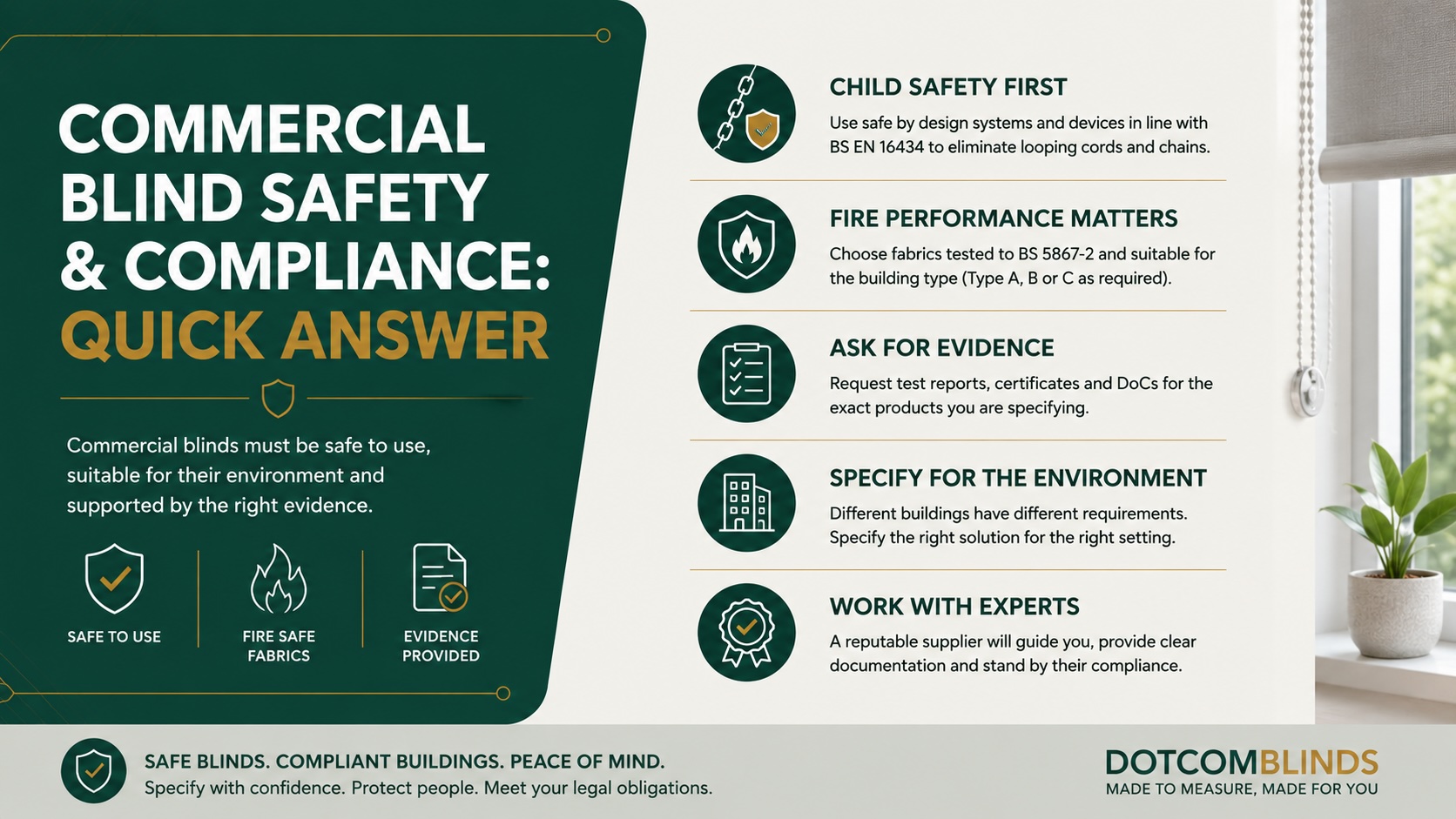
Commercial blind compliance in the UK is not based on one universal certificate or standard. It depends on the blind type, operating system, selected fabric, building environment and project specification.
For most internal commercial blind projects, the key areas to check are:
- Blind safety and performance: BS EN 13120
- Cord and chain safety devices: BS EN 16434
- Fabric fire performance: BS 5867-2
- Motorised systems: relevant electrical, product conformity and control-system requirements
- Project requirements: any additional standards, classifications or documentation specified by the architect, contractor, facilities team or client
A blind should not be considered compliant simply because it is described as:
- Commercial grade
- Fire retardant
- Child safe
- Certified
- Blackout
- Antibacterial
- UKCA or CE marked
Each of these terms can refer to a different characteristic.
The Most Important Checks
Before ordering commercial blinds, confirm:
- Which standards apply to the project
- Which fire-performance classification is required
- Whether the exact fabric has supporting test evidence
- How any cords or chains are made safe
- Whether motorised systems have the appropriate technical documentation
- Whether the supplier can provide the documentation required for procurement and handover
The simplest way to think about commercial blind compliance is:
Blind safety + operating-system safety + fabric fire performance + project requirements + supporting evidence
If any one of these areas is relevant to the project, it should be checked separately.
The Key Principle
Commercial blind compliance is specification-specific, not label-specific.
The safest approach is to identify the requirements first, then select a blind, fabric and operating system with evidence that matches those requirements.
Final Checklist Before Ordering Commercial Blinds
Before placing an order, it is worth running through a final compliance check to make sure the blind, fabric, operating system and supporting evidence all match the project requirements.
1. Confirm the Building and Room Type
Identify:
- The type of building
- The specific room or area
- Who will use the space
- Whether children or vulnerable people may have access
This helps determine the appropriate operating and safety considerations.
2. Confirm the Blind Type
Specify the exact blind system, such as:
- Roller blind
- Vertical blind
- Venetian blind
- Roman blind
- Motorised blind
Avoid relying on broad descriptions such as “commercial blind”.
3. Confirm the Operating Method
Identify whether the blind will use:
- Chain control
- Cord control
- Wand operation
- Motorisation
- Wall switch
- Remote control
- Automated or building management controls
If cords or chains are involved, confirm the appropriate safety arrangement.
4. Check Product-Safety Requirements
Establish which internal blind safety requirements apply to the product and operating system.
Where relevant, confirm how the specification addresses:
- BS EN 13120
- BS EN 16434
- Cord and chain hazards
- Safety-device requirements
5. Confirm the Fire-Performance Requirement
If the project requires fire-retardant fabric, do not stop at that description.
Confirm:
- The required standard
- The required BS 5867-2 Type classification where specified
- The exact fabric being ordered
- The supporting test evidence
6. Check the Exact Fabric
Make sure the fire-performance documentation actually applies to the selected material.
Do not assume that every colour, coating or fabric within a wider blind range is covered by the same evidence.
7. Check Motorised-System Requirements
For electric blinds, confirm:
- Motor type
- Power supply
- Control method
- Electrical requirements
- Automation requirements
- Applicable product conformity information
The motor, controls and blind should be considered as one complete system.
8. Request the Required Documentation
Depending on the project, this may include:
- Technical data sheets
- Fire test reports
- Certificates
- Safety-device information
- Motor specifications
- Product conformity documentation
- Installation instructions
- Operating instructions
Request these before ordering where they form part of the procurement requirements.
9. Check for Project-Specific Requirements
Review the architect’s, contractor’s, client’s or facilities team’s specification for any requirements beyond the general product standards.
Commercial blind requirements can vary considerably between projects.
10. Confirm What Will Be Handed Over
For larger installations, establish what documentation needs to form part of the final handover pack.
This helps create a clear record of:
what was specified + what was supplied + what evidence supported it
Final Pre-Order Question
Before approving a commercial blind order, ask:
Can every important safety, fire-performance or compliance requirement in this specification be traced to appropriate evidence for the exact blind configuration being supplied?
If the answer is yes, the specification is far more robust than one based solely on labels such as “commercial grade”, “fire retardant” or “certified”.
Final Verdict
Commercial blind compliance is not determined by a single label, certificate or product feature. It comes from matching the blind, operating system, fabric, safety provisions and supporting documentation to the requirements of the specific project.
The main areas to consider are:
- BS EN 13120 for internal blind safety and performance
- BS EN 16434 for relevant safety devices used to reduce strangulation hazards
- BS 5867-2 for the fire performance of non-domestic blind fabrics
- Additional requirements for motorised systems
- Any further standards, classifications or documentation required by the project
The most common specification errors happen when one characteristic is mistaken for overall compliance.
A fire-retardant fabric does not prove that the blind mechanism is safe. A compliant operating system does not establish the fire performance of the fabric. A blackout or antibacterial fabric does not automatically satisfy fire-safety requirements. A certificate is only meaningful when its scope matches the exact product being supplied.
For specifiers, contractors, facilities teams and commercial buyers, the most reliable approach is therefore to work from the project requirements backwards.
Identify what the installation needs to achieve, specify the appropriate standards and performance levels, select products that meet those requirements, and retain the evidence that supports them.
The central principle is:
Commercial blind compliance is specification-specific, not label-specific.
A well-specified blind should make it possible to answer three questions clearly:
- What requirements apply?
- How does the specified blind meet them?
- What evidence supports that conclusion?
When those questions can be answered confidently for the exact blind configuration being supplied, commercial procurement becomes clearer, more defensible and less reliant on vague terms such as “commercial grade”, “certified” or “fire compliant”.
Commercial Blind Safety & Compliance Resources
The following independent resources provide further technical information on the UK standards,
fire-performance requirements and blind-safety guidance discussed in this guide.
BS EN 13120: Internal Blinds – Performance Requirements Including Safety
British Standards Institution information on BS EN 13120, the standard covering performance
and safety requirements for internal blinds, including manually and electrically operated systems.
BS EN 16434: Blind Safety Devices
BSI information on the requirements and test methods for safety devices designed to protect
against strangulation hazards associated with internal blind cords and chains.
BS 5867-2: Flammability Requirements for Blind Fabrics
British Standards Institution information on BS 5867-2, which covers flammability requirements
for fabrics and fabric assemblies used in non-domestic curtains, drapes and window blinds.
GOV.UK: Child Safety and Blind Cords
Guidance from the Office for Product Safety and Standards covering the risks associated with
looped blind cords and chains and the use of devices such as tensioners and cleats.
GOV.UK: Looped Blind Cords and Chains in Healthcare Environments
Department of Health and Social Care guidance concerning the strangulation risk posed by looped
cords and chains, particularly in healthcare environments used by children and vulnerable adults.
Note: Standards and regulatory guidance can be amended over time. Commercial buyers
and specifiers should confirm the current requirements applicable to their particular project before
specifying or purchasing blinds.