Order Tracking
 0800 1422417
When people search for the best blinds for winter, the answer is usually simple: thermal blinds.
What is much less often explained is how effective they actually are.
That matters because phrases such as thermal, energy efficient and heat-saving are easy to use, but they do not tell you how much heat a blind can retain, how its performance compares with an ordinary blind, or whether a quoted percentage refers to window heat loss, household heating demand or energy bills.
The available evidence shows that blinds can make a measurable difference to heat loss through windows, particularly where the underlying glazing performs poorly. In controlled testing on traditional single-glazed windows, ordinary blinds have been shown to reduce heat loss by roughly 40% to 50%, while more insulating blind constructions have achieved reductions in the region of 50% to 60% under the test conditions.
Those are substantial figures, but they need to be understood correctly.
A 50% reduction in heat loss through a window does not mean a 50% reduction in your heating bill. Windows are only one part of a building’s overall heat loss, and actual performance depends on factors such as:
- The type of glazing
- The size of the window
- The construction of the blind
- How closely the blind fits
- Gaps around the sides, top and bottom
- The temperature difference between indoors and outdoors
- How consistently the blind is closed when heat loss is greatest
This is why two blinds both described as “thermal” can perform very differently.
In this guide, we look beyond the usual claims and focus on the numbers. We will examine heat-loss reductions, U-values, blind construction, fit, glazing type and real-world energy performance to answer a more useful question:
How much difference can thermal blinds actually make in winter?
In This Guide
Explore the evidence behind thermal blinds, including measured heat-loss reductions, U-values, glazing comparisons, fitting considerations and potential energy savings.
1. How Thermal Blinds Reduce Heat Loss
2. Understanding the Numbers
3. What Makes One Thermal Blind More Effective Than Another?
4. Thermal Blinds Compared
5. Real-World Performance & Different Glazing Types
6. Using Thermal Blinds Efficiently
7. Buying Advice, Practical Questions & Final Evidence
- Are Thermal Blinds Worth It?
- Do Thermal Blinds Cause Condensation?
- Do Thermal Blinds Work in Summer Too?
- Are Thermal Blinds Better Inside or Outside the Recess?
- Can You Use Thermal Blinds With Curtains?
- What Should You Look for When Buying Thermal Blinds?
- Be Cautious With “Up to X% Energy Saving” Claims
- Thermal Blinds: What the Research Actually Shows
- Quick Answer: Are Thermal Blinds Really Effective?
- Final Verdict: How Effective Are Thermal Blinds in Winter?
Why Do Windows Lose So Much Heat?
Windows are one of the weakest points in the thermal envelope of a building.
Even modern glazing generally insulates less effectively than a well-insulated wall, while older single-glazed windows can lose heat very quickly when the temperature outside falls.
Heat is lost through windows in several different ways.
Conduction Through the Glass
Glass conducts heat more readily than insulated walls.
When the room is warmer than outside, heat moves through the glazing towards the colder external environment.
The greater the temperature difference, the faster this process occurs.
Convection at the Window Surface
Air inside the room is warmed by the heating system.
When this warm air comes into contact with a cold window surface, it cools, becomes denser and begins to fall.
This creates a cycle of air movement around the window.
The result is not just heat loss. It can also create the familiar sensation of a cold downdraught near a window, even when there is no actual draught coming through a gap.
Radiant Heat Loss
People and objects inside a warm room also exchange radiant heat with colder surfaces.
A cold pane of glass can therefore make the area around a window feel less comfortable even if the room air temperature is relatively high.
This is one reason why improving the thermal performance of a window can make a room feel warmer without necessarily increasing the thermostat setting.
Air Leakage
Heat can also escape through gaps around poorly sealed windows.
This is different from heat moving directly through the glass.
In older windows, air leakage around the sash, frame or opening sections can increase total heat loss significantly.
A blind cannot repair a leaking window, but a well-fitted window covering can reduce some of the air movement and convection taking place immediately in front of the glass.
Why This Makes Blinds Relevant
A blind creates an additional layer between the warm room and the cold glazing.
Depending on its construction and fit, it can:
- Add thermal resistance
- Trap a layer of relatively still air
- Reduce convection close to the glass
- Reduce radiant heat exchange
- Slow the overall rate at which heat moves through the window area
The effect is particularly noticeable on windows with poor underlying insulation because there is more heat loss available to reduce in the first place.
This is why thermal blinds tend to produce their largest relative improvements on older and single-glazed windows, while the percentage improvement on high-performance double or triple glazing is usually smaller.
The next question is what a thermal blind is actually doing physically to achieve that reduction.
What Does a Thermal Blind Actually Do?
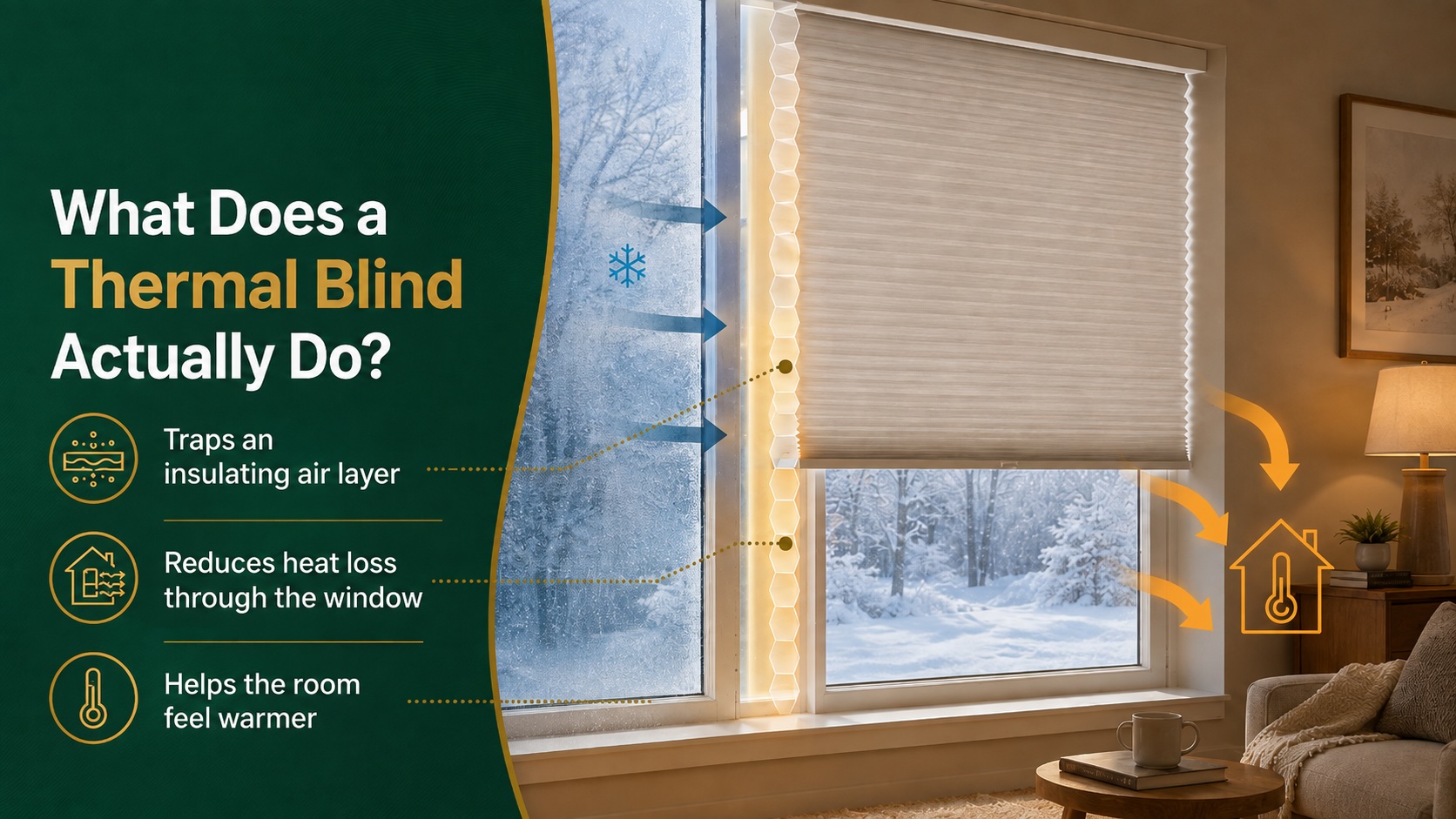
A thermal blind works by adding another insulating layer between the warm interior of the room and the colder window surface.
It does not generate heat. Its job is to slow the rate at which heat leaves the room through the window area.
The effectiveness of the blind depends mainly on three mechanisms.
1. It Adds Thermal Resistance
Every material resists heat flow to some degree.
A thin, lightweight blind adds relatively little resistance. A thicker or specially constructed thermal blind can add considerably more.
This additional resistance reduces the rate of heat transfer from the room towards the colder glazing.
The principle is similar to adding another layer of clothing in winter. The extra layer does not create heat, but it slows heat loss.
2. It Traps a Layer of Air
Air can act as an effective insulator when it is trapped and prevented from circulating freely.
When a blind is closed close to the window, a pocket of air forms between the blind and the glass.
If that air remains relatively still, it provides another barrier to heat transfer.
This is particularly important with cellular or honeycomb blinds.
Rather than relying on a single sheet of fabric, these blinds contain internal cells that trap additional pockets of air within the blind itself.
A typical cellular structure might therefore create several distinct layers:
warm room → blind fabric → trapped air cell → blind fabric → air gap → glazing
Each additional layer increases resistance to heat flow.
3. It Reduces Radiant Heat Exchange
A cold window can absorb radiant heat from warmer surfaces and occupants inside the room.
Some thermal blinds use reflective or low-emissivity surfaces designed to reduce this radiant heat transfer.
This can improve both measured thermal performance and perceived comfort near the window.
Why Cellular Construction Can Be More Effective
This is one reason cellular blinds perform well in thermal testing.
Instead of simply making the fabric thicker, the honeycomb structure creates enclosed air spaces.
Depending on the design, cellular blinds may use:
- Single cells
- Double cells
- Multiple internal layers
- Reflective internal surfaces
- Different cell depths
The principle remains the same: reduce conduction and convection by trapping relatively still air.
Why a Standard Blind Can Still Help
A blind does not have to be marketed specifically as thermal to provide some insulation.
Even a conventional roller blind can reduce heat loss when closed because it:
- Adds another material layer
- Creates an air space in front of the glass
- Reduces direct radiant exchange with the cold window
This helps explain why testing has found meaningful reductions in window heat loss even from relatively simple blinds.
A purpose-designed thermal blind can improve on this by using more insulating construction, additional layers or reflective surfaces.
The Blind and the Air Gap Work Together
It is therefore misleading to think about thermal performance purely in terms of fabric thickness.
The effective insulating system is:
glazing + air gap + blind construction + perimeter fit
Change any one of these factors and the performance can change.
A highly insulating blind with large gaps around its edges may allow substantial air circulation behind it. A moderately insulating blind fitted much more closely to the window may perform better than expected.
That is why the next question matters more than simply asking whether a blind is labelled “thermal”:
How much heat can a blind actually reduce under measured conditions?
How Much Heat Can Blinds Actually Reduce?
This is where the evidence becomes more useful than general claims about “thermal efficiency”.
Controlled testing on traditional single-glazed timber sash windows has shown that internal window coverings can produce substantial reductions in heat loss.
Under those test conditions:
- Plain blinds reduced heat loss by roughly 40% to 50%
- Insulating blinds with reflective surfaces reduced heat loss by roughly 50% to 60%
- Heavy curtains produced reductions of around 40%
- Well-fitting shutters achieved reductions in the region of 50% to 60% or more, depending on the test method
These figures show that blinds are not merely a comfort accessory. Under the right conditions, they can materially improve the thermal performance of a poorly insulated window.
A Simple Comparison
| Window Treatment | Approximate Reduction in Heat Loss |
|---|---|
| Heavy curtains | Around 40% |
| Plain blinds | Roughly 40% to 50% |
| Insulating / reflective blinds | Roughly 50% to 60% |
| Well-fitting shutters | Around 50% to 60%+ |
What These Percentages Actually Mean
This is important.
If a blind reduces heat loss through a window by 50%, it does not mean the home’s total heat loss has been reduced by 50%.
It means the heat transfer through that particular window system has been reduced under the conditions of the test.
The overall effect on the building will depend on:
- How much glazing the property has
- The U-value of the existing windows
- Heat loss through walls, roof, floor and doors
- Air leakage
- The size of the temperature difference between indoors and outdoors
- How long the blinds remain closed
Why Older Windows Show the Biggest Percentage Improvements
A single-glazed window loses heat relatively quickly.
Because the starting level of heat loss is high, adding a blind can produce a large percentage improvement.
For example, reducing heat loss by 50% through a very poor window is easier than achieving the same percentage improvement on a modern low-U-value window that is already highly insulated.
This is why thermal blinds often have the greatest impact on:
- Single glazing
- Older sash windows
- Large glazed areas
- Cold-facing rooms
- Windows with poor thermal performance
The Figures Are Real, but Context Matters
The strongest conclusion from the available testing is not that every thermal blind reduces heat loss by exactly 50% or 60%.
It is that well-chosen and well-fitted internal blinds can reduce heat transfer through windows by a substantial and measurable amount.
The exact figure depends on the glazing, blind construction and fit.
This is why comparing thermal blinds with ordinary roller blinds is so useful. It helps show how much of the benefit comes from simply adding a closed layer in front of the window, and how much additional performance comes from specialist thermal construction.
Thermal Blinds vs Ordinary Roller Blinds: What Does the Evidence Show?
One of the most useful findings from thermal window research is that even a standard blind can reduce heat loss, but purpose-designed thermal blinds can improve on that performance.
This matters because the benefit does not come from the word “thermal”. It comes from the way the blind changes heat transfer at the window.
Ordinary Roller Blinds Still Provide Insulation
A standard roller blind creates an additional layer between the room and the glass.
When closed, it can:
- Reduce direct radiant heat exchange with the cold glazing
- Create an insulating air space in front of the window
- Slow convection immediately adjacent to the glass
- Add a small amount of thermal resistance through the blind fabric itself
Controlled testing on traditional single-glazed windows has shown that plain blinds can reduce heat loss by approximately 40% to 50% under the test conditions.
That is a significant improvement for a relatively simple window covering.
What Does a Thermal Blind Add?
A purpose-designed thermal blind aims to improve on this basic effect.
Depending on the construction, it may use:
- Multiple fabric layers
- Cellular or honeycomb structures
- Reflective surfaces
- Low-emissivity materials
- More insulating fabrics
- A closer fit to the window
The strongest gains come when the blind both adds resistance and limits air movement around the glazing.
This is why an insulating blind with a reflective surface can outperform a conventional single-layer roller blind.
Indicative Comparison
| Blind Type | Typical Thermal Principle | Measured Heat-Loss Reduction in Relevant Testing |
|---|---|---|
| Ordinary roller blind | Single fabric layer plus air gap | Roughly 40% to 50% |
| Insulating / reflective blind | Additional insulation and reduced radiant heat transfer | Roughly 50% to 60% |
These percentages should not be treated as universal ratings for every blind. They were achieved under specific test conditions and on specific window types.
The Difference Can Be Smaller Than Marketing Suggests
This is an important point.
If an ordinary closed blind already reduces window heat loss substantially, the additional gain from switching to a thermal blind may be smaller than the total percentage claimed for the thermal blind itself.
For example, if:
- No blind = baseline heat loss
- Ordinary blind = 45% reduction
- Thermal blind = 58% reduction
the thermal blind is not delivering an additional 58% improvement over the ordinary blind.
It is improving the original baseline by 58%, compared with 45% for the standard blind.
The additional benefit over the ordinary blind in that simplified example would be 13 percentage points.
That distinction is often lost in marketing claims.
Fit Can Matter as Much as Fabric
A technically advanced thermal fabric can lose part of its advantage if large gaps allow warm air to circulate freely behind it.
Conversely, a relatively simple blind that fits closely to the window can perform better than expected.
This is why the real comparison is not simply:
thermal fabric vs standard fabric
It is:
blind construction + air gap + edge gaps + glazing + installation
The next section looks at one of the strongest thermal blind designs in more detail: cellular and honeycomb blinds.
Why Honeycomb and Cellular Blinds Are Particularly Effective
Honeycomb, or cellular, blinds are designed differently from a conventional single-layer roller blind.
Instead of relying on one sheet of fabric, the blind contains a series of internal pockets or cells that trap air. This structure can increase thermal resistance and reduce heat transfer through the window area.
The Importance of Trapped Air
Still air is a useful insulator.
The cells inside a honeycomb blind create enclosed air pockets that slow the movement of heat. In effect, the blind becomes a multi-layer system rather than a single fabric barrier.
A simplified heat path might look like this:
warm room → outer fabric layer → trapped air cell → inner fabric layer → air gap → glazing
Each stage adds resistance to heat flow.
Why Cellular Construction Can Outperform a Flat Blind
A standard roller blind can already improve thermal performance by creating a barrier and an air gap in front of the glass.
A cellular blind goes further by creating additional pockets of relatively still air within the blind itself.
That can help reduce:
- Conduction through the blind
- Convective air movement
- Radiant heat exchange
- Direct contact between warm room air and the cold glazing surface
The result is a structure that is inherently better suited to insulation.
Single-Cell vs Double-Cell Construction
Not all cellular blinds are built in the same way.
Some use a single row of cells. Others use double-cell or more complex structures.
In principle, additional cells can increase the amount of trapped air and the number of layers through which heat must pass.
However, it is not accurate to assume that:
double cell = exactly twice the insulation
Actual performance depends on factors such as:
- Cell size
- Fabric construction
- Total blind thickness
- Internal coatings
- Distance from the glazing
- Edge gaps
- How closely the blind fits the opening
The geometry of the blind matters as much as the number of cells.
The Blind Still Needs to Fit Well
A highly insulating honeycomb structure can lose part of its advantage if warm room air is able to circulate freely around the edges.
Large perimeter gaps allow air to move behind the blind, reach the colder glass and return to the room.
This is why thermal performance is determined by the complete system:
cellular structure + fabric + air gap + perimeter fit + glazing
Why Cellular Blinds Are Often the Strongest Blind-Only Option
From a purely thermal perspective, cellular blinds have an important advantage over many other internal blind types because their construction is designed to trap air rather than simply block light.
That does not mean every cellular blind will perform identically.
But as a category, the design gives them a stronger insulating mechanism than:
- Standard roller blinds
- Venetian blinds
- Vertical blinds
- Other single-layer window coverings
The next step is to put this into a measurable framework by looking at U-values, which are one of the main ways heat transfer through windows is quantified.
What Is a U-Value and Why Does It Matter for Blinds?
A U-value measures how quickly heat passes through a building element.
It is expressed in:
W/m²K
which means watts of heat transferred through one square metre for every one-degree temperature difference between inside and outside.
For U-values:
lower is better.
A window with a U-value of 1.4 W/m²K loses heat more slowly than a window with a U-value of 4.8 W/m²K.
Why This Matters for Thermal Blinds
When a blind is closed, it adds thermal resistance in front of the glazing.
That can reduce the effective rate at which heat passes through the complete window-and-blind system.
This makes U-value a more useful concept than vague claims such as:
- “Keeps rooms warmer”
- “Improves insulation”
- “Helps save energy”
Those statements may be true, but U-value provides a measurable way of understanding the effect.
A Simple Example
Assume a window has an original U-value of:
4.8 W/m²K
If an insulating blind arrangement reduces the effective U-value to:
2.5 W/m²K
the rate of heat transfer has been reduced substantially.
The percentage reduction in U-value would be:
(4.8 – 2.5) ÷ 4.8 × 100 = approximately 48%
In other words, under those assumed conditions, the window-and-blind combination would be losing heat at roughly half the original rate.
What Does 4.8 W/m²K Actually Mean?
Suppose the window is:
- 1.5 metres wide
- 1.2 metres high
- Area: 1.8 m²
And suppose:
- Indoor temperature: 20°C
- Outdoor temperature: 0°C
- Temperature difference: 20 K
With a U-value of 4.8 W/m²K, the heat-loss rate would be:
4.8 × 1.8 × 20 = 172.8 watts
If the effective U-value were reduced to 2.5 W/m²K, the heat-loss rate would become:
2.5 × 1.8 × 20 = 90 watts
The difference is:
82.8 watts
That is 82.8 watts less heat being lost through that window while the assumed thermal conditions remain the same.
Why U-Value Comparisons Need Context
The difficulty with thermal blinds is that there is no single universal U-value for the blind alone that can be applied to every window.
The finished performance depends on:
- The original glazing
- Window frame construction
- Blind type
- Blind position
- Air gap
- Perimeter gaps
- Fabric construction
- Temperature conditions
This is why a thermal blind can produce a larger percentage improvement on an old single-glazed window than on a modern low-U-value window.
U-Value vs R-Value
You may also encounter R-values when reading about thermal blinds.
R-value measures thermal resistance rather than heat transfer.
The relationship is broadly inverse:
Higher R-value = better insulation
Lower U-value = better insulation
In simple terms:
- U-value asks: How easily does heat pass through?
- R-value asks: How strongly does the material resist heat flow?
For UK windows, U-values are generally the more familiar measure.
The Important Point
A thermal blind is effective when it reduces the overall rate of heat transfer through the window system.
That is why the most meaningful claims are based on measured heat-loss reduction, U-value improvement or thermal resistance, rather than simply describing a product as “energy efficient”.
The next distinction is equally important: reducing heat loss through a window is not the same as reducing a home’s heating bill by the same percentage.
Heat-Loss Reduction Is Not the Same as Energy-Bill Reduction
This distinction is one of the most important in the entire thermal blinds discussion.
If testing shows that a blind reduces heat loss through a window by 50%, that does not mean the household heating bill will fall by 50%.
The reason is simple: windows are only one part of the building’s overall heat loss.
A home can also lose heat through:
- External walls
- The roof
- Floors
- Doors
- Ventilation
- Air leakage
- Thermal bridges
So a large improvement at the window can still translate into a much smaller change in total heating demand.
A Simple Example
Imagine a home where windows account for 25% of total heat loss.
If thermal blinds reduce that window heat loss by 50%, the theoretical reduction in whole-building heat loss would be:
25% × 50% = 12.5%
That is before allowing for other real-world factors such as:
- How many hours the blinds are actually closed
- Whether the heating is running during those hours
- Internal temperature settings
- Weather conditions
- Solar gain
- Draughts
- Boiler or heating-system efficiency
So even a strong thermal improvement at the window does not translate directly into the same percentage reduction in energy use.
Why Marketing Percentages Can Be Misleading
Claims such as:
“Save up to 50% on heat loss”
and
“Cut heating bills by 50%”
are not equivalent.
The first may refer only to heat transfer through the window.
The second implies a whole-home financial saving and is a much stronger claim.
Whenever you see a percentage attached to thermal blinds, the useful question is:
50% of what?
Possible answers include:
- Heat loss through the glass
- Heat loss through the complete window
- Heating demand for one room
- Whole-house heating energy
- Annual energy cost
These are completely different measurements.
Deployment Time Matters
Thermal blinds only provide their insulating benefit while they are closed.
If a blind is open for most of the heating period, its annual effect will be much smaller than its peak measured performance suggests.
For example, a blind that reduces window heat loss by 50% for eight hours overnight does not provide a 50% reduction across the full 24-hour day.
This is why user behaviour matters so much.
Better Blinds Can Still Produce Useful Savings
None of this means thermal blinds are ineffective.
It means the savings need to be interpreted correctly.
A well-performing blind can:
- Reduce heat loss during cold periods
- Improve comfort near glazing
- Reduce cold downdraughts
- Help lower heating demand
- Potentially reduce energy consumption over time
But the final financial saving depends on the building as a whole.
The More Glazing You Have, the More Important Blinds Become
A room with a small window will naturally have less heat loss through glazing than a room dominated by large panes of glass.
This means thermal blinds can be particularly valuable in:
- Bay windows
- Large bedrooms
- Garden rooms
- Full-height glazing
- Older properties with extensive single glazing
- Rooms with several external windows
The greater the proportion of heat being lost through the windows, the greater the opportunity for blinds to influence total heating demand.
The next section puts this into a practical numerical example by calculating how many watts of heat a thermal blind could potentially save through a single window.
A Worked Example: How Many Watts Could a Thermal Blind Save?
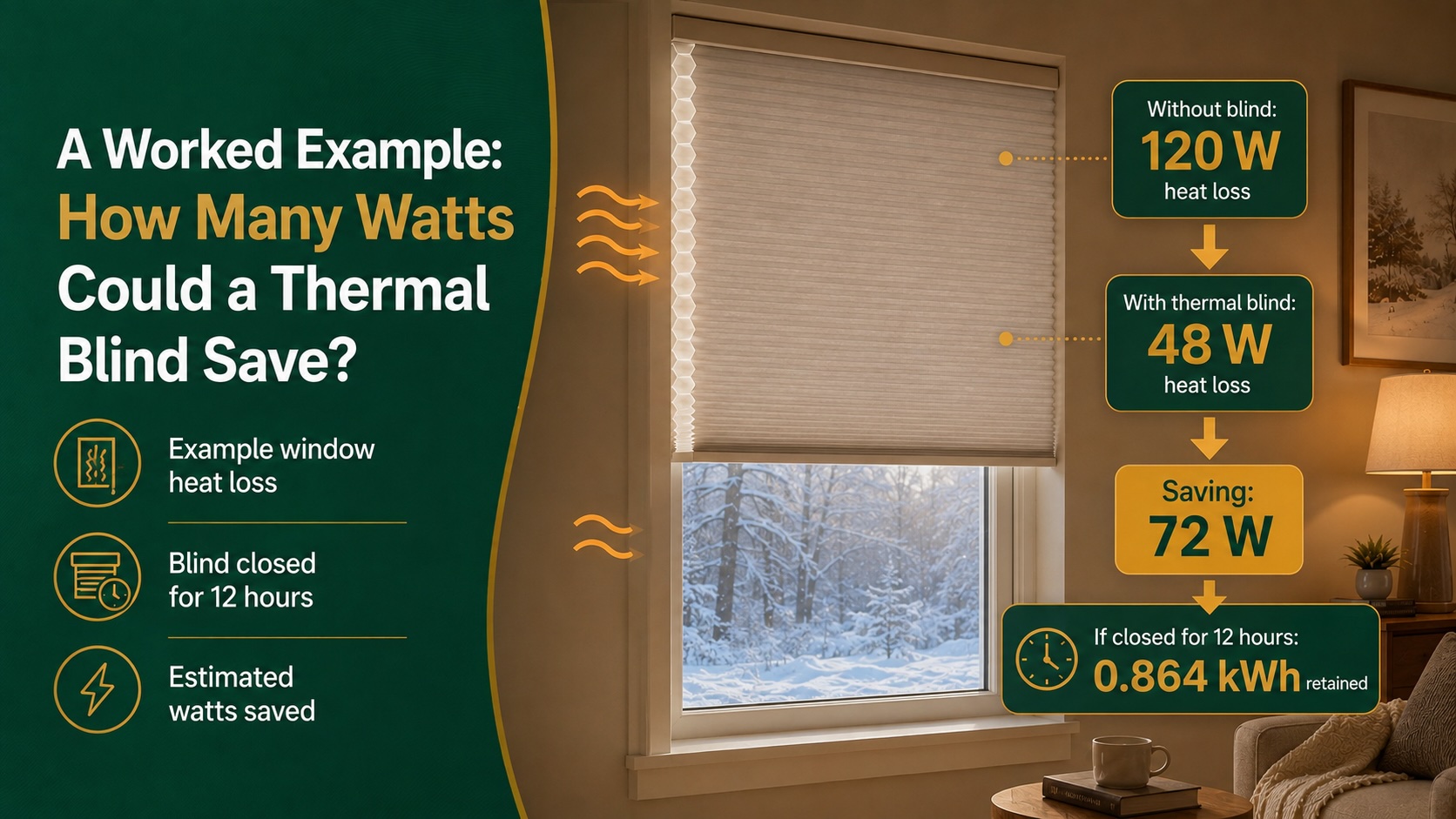
A useful way to understand thermal blind performance is to convert the improvement into watts of heat loss.
The basic formula is:
Heat loss = U-value × window area × temperature difference
This gives the rate of heat transfer in watts.
Example Window
Assume a window is:
- 1.5 m wide
- 1.2 m high
- Total area: 1.8 m²
Indoor temperature:
20°C
Outdoor temperature:
0°C
Temperature difference:
20 K
Assume the original window has a U-value of:
4.8 W/m²K
The heat loss through the window would be:
4.8 × 1.8 × 20 = 172.8 watts
So under those conditions, the window is losing heat at a rate of approximately:
173 watts
Now Add a Thermal Blind
Assume the blind reduces the effective U-value of the complete window-and-blind system to:
2.5 W/m²K
The new heat-loss rate would be:
2.5 × 1.8 × 20 = 90 watts
The reduction is therefore:
172.8 – 90 = 82.8 watts
So while the blind is closed, the assumed improvement is:
approximately 83 watts less heat loss through that window
What Does 83 Watts Mean Over Time?
Heat loss becomes energy loss when it continues over a period of time.
If the blind remains closed for 10 hours overnight:
82.8 W × 10 hours = 828 Wh
That equals:
0.828 kWh of heat retained
If the same conditions occurred every night for 30 nights:
0.828 × 30 = 24.84 kWh
So, in this simplified example, one window could avoid approximately:
24.8 kWh of heat loss over 30 nights
What About Several Windows?
If a room had four similar windows, the theoretical saving under the same conditions would be:
24.84 × 4 = 99.36 kWh over 30 nights
This begins to show why window coverings can have a meaningful effect in properties with large amounts of glazing.
The Temperature Difference Changes Everything
The calculation above assumes:
20°C inside and 0°C outside
If it is 10°C outside instead, the temperature difference falls from 20 K to 10 K.
Using the original U-value:
4.8 × 1.8 × 10 = 86.4 watts
With the thermal blind:
2.5 × 1.8 × 10 = 45 watts
Difference:
41.4 watts
That is exactly half the heat-loss reduction seen with a 20-degree temperature difference.
The colder it is outside relative to the room, the greater the rate of heat loss and therefore the greater the potential benefit of additional insulation.
Why This Is More Useful Than Saying “Saves 50%”
This calculation shows why a percentage on its own tells only part of the story.
A 50% improvement on:
- A small window
- In mild weather
- For three hours
is very different from a 50% improvement on:
- A large window
- During freezing weather
- For 12 hours overnight
The percentage may be identical, but the number of watts and kilowatt-hours saved can be dramatically different.
An Important Limitation
These calculations assume steady conditions and an effective U-value for the complete window-and-blind system.
Real buildings are more complicated. Performance will also be affected by:
- Air leakage
- Wind
- Solar gain
- Heating cycles
- Internal temperatures
- Blind fit
- Edge gaps
- Window frame performance
The figures should therefore be treated as an illustration of the physics, rather than a prediction of an exact household saving.
Even so, this method demonstrates something important: when the U-value, window area and temperature difference are known, the thermal benefit can be expressed in real units rather than vague claims.
The next factor to examine is one of the most important in real installations: how closely the blind fits the window.
Does the Fit of a Thermal Blind Matter?
Yes. The fit of a thermal blind can have a substantial effect on how well it performs.
A blind does not insulate simply because the fabric itself has thermal properties. Its performance also depends on how effectively it limits air movement between the warm room and the colder glass.
Why Gaps Reduce Performance
When there are large gaps around the edges of a blind, warm room air can move behind it.
That air then reaches the colder glazing, cools and drops, creating a convection loop.
In simplified terms:
warm room air → behind blind → cold glass → cooled air falls → returns to room
The more easily air can circulate around the blind, the less effective the insulating air layer becomes.
A Closer Fit Can Improve Thermal Performance
Research on window coverings has shown that tighter-fitting blinds can perform better than more loosely fitted versions.
This is because a closer fit helps reduce:
- Air circulation behind the blind
- Convective heat transfer
- Mixing between warm room air and cold air near the glass
This does not mean that a blind needs to create a perfect airtight seal to be useful.
It means that perimeter gaps matter.
The Main Gaps to Consider
The key areas are:
- Side gaps
- Top gap
- Bottom gap
A blind with substantial open space around all four edges will generally allow more air movement than one that sits more closely within or across the window opening.
Recess Fit vs Face Fit
There is no universal rule that one installation method is always thermally superior.
A recess-fitted blind may sit closer to the glazing, but its effectiveness will depend on how much space remains around the blind.
A face-fitted blind may provide wider coverage across the opening, but may also sit further from the glass.
What matters most is the complete geometry:
distance from glass + edge gaps + overall coverage
Why This Matters for Thermal Blind Claims
Two identical thermal blinds can perform differently if one is installed with large perimeter gaps and the other is fitted more closely.
This is one reason generic claims such as:
“reduces heat loss by 50%”
need context.
The fabric may be identical, but the installed result can vary.
Fit Can Be as Important as Fabric Choice
A highly insulating fabric cannot perform at its best if warm air is constantly circulating around it.
For that reason, the practical performance of a thermal blind depends on:
fabric performance + blind construction + installation + perimeter fit
The next section looks more closely at how much side gaps can matter, and why even small changes around the edges of a blind can affect heat transfer.
How Much Do Side Gaps Matter?
Side gaps can have a surprisingly large effect on the thermal performance of a blind because they allow warm room air to move behind the blind and come into direct contact with the colder glass.
The blind may still add some insulation, but the larger the open gaps around it, the easier it is for convection to continue.
Why Air Movement Matters
When a blind is closed, the ideal thermal arrangement is a relatively stable pocket of air between the blind and the glazing.
If warm air can easily enter from the sides, that air is cooled by the glass and begins to fall. Cooler air then exits lower down while warmer room air enters again.
This creates a continuous convective loop.
In simplified form:
warm air enters at the edge → cools against the glass → falls → escapes → warmer air replaces it
That movement carries heat towards the window.
Smaller Gaps Reduce This Circulation
The closer the blind fits to the edges of the window opening, the harder it is for room air to circulate behind it.
This helps the air trapped between blind and glass remain more stable.
That is one reason why:
- Close-fitting blinds
- Recess-mounted systems with small side clearances
- Blinds with side channels
- Cellular systems designed to limit perimeter airflow
can achieve stronger thermal performance than a similar fabric installed with large open edges.
The Effect Is Not Just at the Sides
Although side gaps are important, the complete perimeter matters.
Heat can be affected by:
- Gaps at the left and right
- Space above the blind
- Space below the blind
- The distance between the blind and the glass
A blind with small side gaps but a large open space at the bottom may still allow substantial air circulation.
There Is No Universal “Maximum Gap” Figure
It would be misleading to say that every thermal blind must be fitted within a particular number of millimetres of the frame.
The effect of a gap depends on:
- Blind type
- Window dimensions
- Distance from the glazing
- Temperature difference
- Whether the blind uses side channels
- How open the top and bottom of the cavity remain
Laboratory and modelling work on window coverings consistently shows that perimeter leakage is an important performance variable, but the exact penalty depends on the complete installation.
A Good Thermal Fabric Can Be Undermined by Poor Fit
Imagine two blinds made from the same insulating material.
Blind A fits closely across the window opening.
Blind B leaves large open gaps on both sides.
The fabric has not changed, but the installed thermal performance can.
This is why comparing thermal blinds solely by fabric specification can be misleading.
A better comparison is:
thermal resistance of the blind + amount of trapped air + perimeter leakage
Side Channels Can Improve the Principle Further
Some specialist blind systems use channels along the sides of the blind.
These can help restrict air movement and improve the separation between the room and the cold glazing.
However, side channels are not automatically necessary for a blind to provide useful insulation. They simply illustrate how reducing air movement can improve the thermal effect.
The key principle is straightforward:
The more effectively a blind limits uncontrolled airflow around its edges, the better chance it has of retaining a stable insulating air layer.
The next factor to consider is the distance between the blind and the glass, because the air gap itself also affects thermal performance.
Does the Distance Between the Blind and the Glass Matter?
Yes. The air gap between the blind and the glazing can influence thermal performance because the gap forms part of the insulating system.
The blind is not working in isolation. Its effectiveness depends on the combination of:
glass + air space + blind + edge gaps
Why the Air Gap Helps
When a blind is closed, the space between the blind and the glass can trap a layer of air.
If that air remains relatively still, it acts as an additional insulating layer and slows heat transfer from the room towards the cold glazing.
This is the same basic principle used in:
- Double glazing
- Insulated wall cavities
- Cellular blind construction
The air itself is useful only when movement is limited.
Too Much Air Movement Reduces the Benefit
A larger gap is not automatically better.
If the space between the blind and glass becomes large enough for air to circulate freely, convection can increase.
Warm room air can enter the gap, cool against the glass, fall and then move back into the room.
That weakens the insulating effect.
Too Small Is Not Automatically Best Either
It would also be inaccurate to say that the blind should always sit as close to the glass as physically possible.
The thermal behaviour depends on:
- Gap depth
- Blind type
- Window size
- Top and bottom openings
- Side leakage
- Temperature difference
- Whether the blind is cellular, flat or reflective
The ideal spacing is therefore a system-specific question rather than a single universal measurement.
What Research Shows
Laboratory and modelling work on internal window coverings has found that the distance between the shade and the glazing affects overall heat transfer.
It is one of several variables considered alongside:
- Perimeter gaps
- Shade construction
- Mounting arrangement
- Cell geometry
- Fabric properties
This is important because two blinds using the same material can produce different results if they are positioned differently relative to the window.
Cellular Blinds Add Another Air Layer
Honeycomb blinds are particularly interesting because they create trapped air in two places:
- Inside the cells of the blind
- Between the blind and the glazing
The complete thermal path may therefore look like:
warm room → blind fabric → trapped cell air → blind fabric → window air gap → glass
This creates more resistance than a simple single-layer covering.
Recess Depth Can Affect the Installation
The depth of the window recess can influence how the blind sits in relation to the glazing.
A deeper recess may allow:
- More space between blind and glass
- Different mounting positions
- Larger or smaller perimeter openings
A shallow recess may place the blind closer to the glass.
Neither arrangement is automatically superior. What matters is whether the complete installation creates a stable insulating layer without excessive air circulation around the edges.
The Practical Lesson
For winter performance, the goal is not simply:
“Get the blind as close to the glass as possible.”
It is:
Create an effective insulating layer while limiting uncontrolled air circulation around and behind the blind.
That is why spacing, fit and blind construction all need to be considered together.
The next question is another common assumption worth testing: does a thicker blind fabric automatically mean better insulation?
Does Blind Fabric Thickness Matter?
Fabric thickness can influence thermal performance, but thicker does not automatically mean warmer.
A blind’s ability to reduce heat loss depends on more than the amount of material in front of the window.
Why Thickness Alone Is a Poor Measure
A thick fabric may provide more thermal resistance than a very thin fabric, but other factors can be just as important, including:
- Fabric density
- Number of layers
- Internal air pockets
- Reflective coatings
- Emissivity
- Blind construction
- Fit around the window
- Air leakage at the edges
This means a relatively thin cellular blind can outperform a thicker flat fabric because the cellular structure traps insulating air.
Structure Is Often More Important Than Bulk
Consider two blinds:
Blind A: a thick, solid sheet of fabric
Blind B: a lighter honeycomb blind containing multiple trapped air cells
Blind A may contain more material, but Blind B can provide stronger insulation because the air cells add resistance to heat flow and reduce convection within the blind itself.
This is the same reason many insulation systems rely on trapped air rather than simply dense material.
Multiple Layers Can Help
Thermal blinds may use:
- Front and rear fabric layers
- Internal cellular structures
- Thermal backings
- Reflective layers
- Laminated constructions
Each additional layer can alter the thermal resistance of the blind.
However, the performance should ideally be judged from measured thermal data rather than simply counting layers.
Dense Fabric Is Not Always Better
A very dense fabric can still conduct heat relatively efficiently.
What matters is how resistant the complete construction is to heat transfer.
This is why R-value, U-value improvement or measured heat-loss reduction are more meaningful than fabric thickness in millimetres.
Thickness Can Still Affect Other Performance
A thicker blind fabric may also provide benefits unrelated to insulation, such as:
- Better light blocking
- More opacity
- Improved acoustic absorption
- Greater stiffness
But these properties should not be confused with thermal performance.
A blackout fabric, for example, can be thick and highly opaque without necessarily being the most effective insulating blind.
The Better Question to Ask
Instead of asking:
“How thick is the thermal blind?”
ask:
“How does the complete blind construction reduce heat transfer?”
A useful thermal specification should consider:
fabric structure + trapped air + reflective properties + fit + measured performance
The next factor is reflective backing, which can improve thermal performance by reducing radiant heat transfer between the room and the cold window.
Do Reflective Backings Make Thermal Blinds Better?
Reflective backings can improve the thermal performance of a blind because they reduce radiant heat transfer between the room and the colder window surface.
This is different from simply adding thickness.
A reflective or low-emissivity surface works by reducing the amount of infrared radiation exchanged across the air gap.
How Reflective Backings Work
Warm objects inside a room emit infrared radiation.
A cold pane of glass can absorb some of that radiant energy.
If the rear surface of the blind has a low-emissivity or reflective finish, less radiant heat is transferred towards the glazing.
The result is another layer of thermal resistance.
Why the Direction of the Reflective Surface Matters
For winter performance, the reflective surface is typically most useful when it faces the colder side of the assembly, helping reduce radiant exchange across the cavity between the blind and the glass.
This is one reason some thermal blind systems use metallic or reflective rear surfaces.
Evidence From Window Testing
Testing on traditional windows has shown that insulating blinds with reflective surfaces can outperform plain blinds.
In the relevant test conditions:
- Plain blinds produced heat-loss reductions of roughly 40% to 50%
- Insulating reflective blinds achieved reductions in the region of 50% to 60%
That does not mean every reflective-backed blind will achieve those exact figures.
The result still depends on:
- Blind construction
- Glazing type
- Distance from the glass
- Perimeter gaps
- Installation
- Temperature conditions
Reflective Does Not Automatically Mean Thermal
A shiny backing alone is not enough to guarantee strong performance.
The complete blind still needs to manage:
- Conduction
- Convection
- Radiant heat transfer
- Air movement around the edges
A reflective surface may reduce one part of the heat-transfer process, but poor fit can still allow significant convective losses.
Low-Emissivity vs Simple Reflective Finishes
It is also worth distinguishing between appearance and measured performance.
A surface can look metallic without necessarily having particularly low emissivity.
For that reason, the most useful evidence is not simply:
“silver-backed”
but measurable thermal performance for the actual blind construction.
Reflective Backings Can Also Affect Summer Performance
Reflective surfaces can also help reduce solar heat gain when used appropriately in warmer weather.
However, winter insulation and summer solar control are not exactly the same thing.
In winter, the main objective is to reduce heat leaving the room.
In summer, the objective is often to reduce solar energy entering it.
The same blind may help with both, but the mechanisms and optimal use can differ.
The next step is to compare the main blind types directly and answer the practical question most people actually ask:
Which blinds are best for keeping heat in?
Which Blinds Are Best for Keeping Heat In?
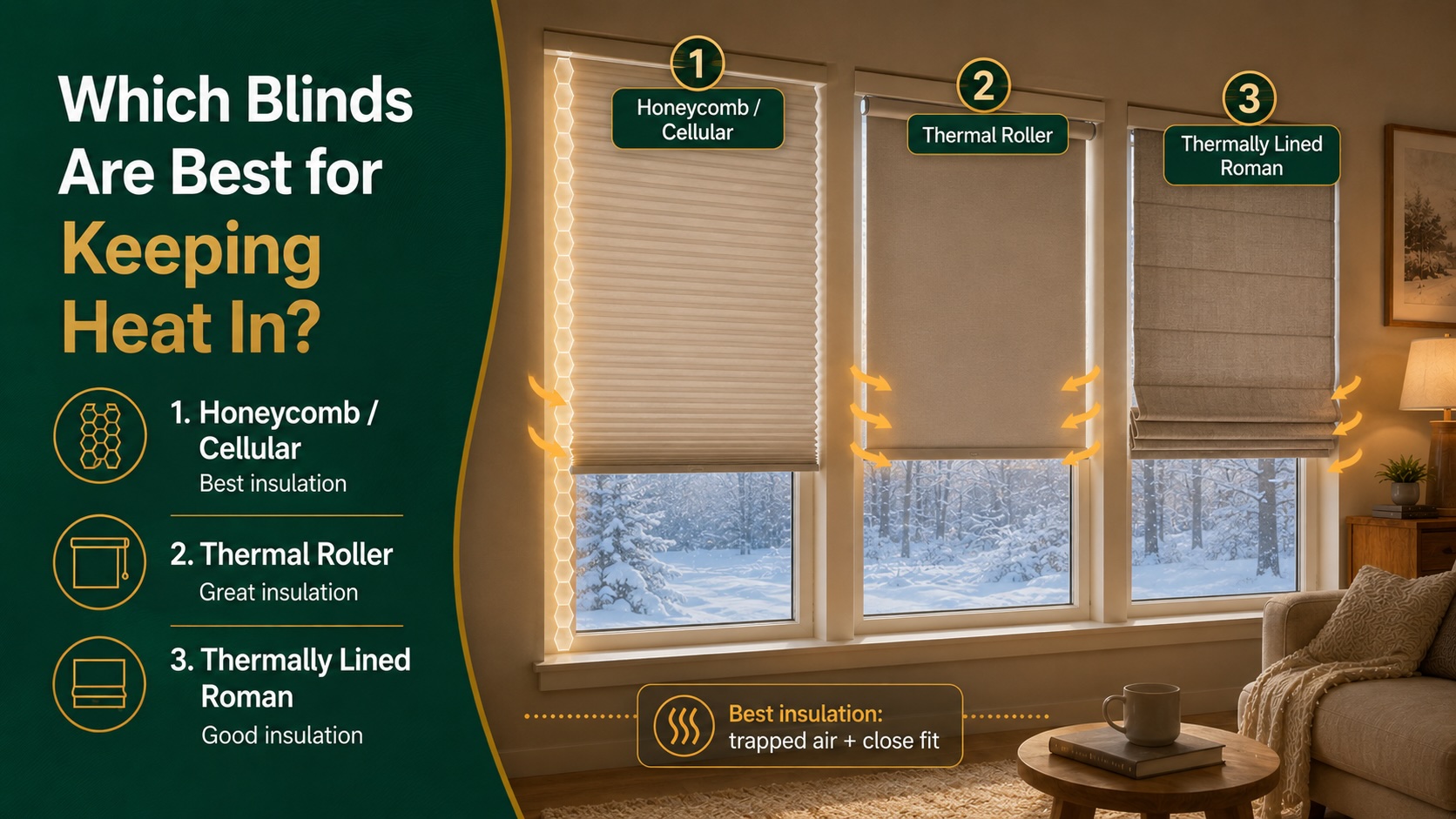
If the goal is winter insulation, not all blind types perform equally well.
The strongest options are generally those that trap air, create multiple layers and minimise uncontrolled airflow around the window.
A practical ranking looks like this:
1. Cellular or Honeycomb Blinds
These are usually the strongest blind-only option for insulation.
Their advantage comes from the internal cell structure, which traps pockets of air and adds thermal resistance.
They can also perform well when:
- Fitted closely to the window
- Used in deeper recesses
- Combined with reflective or low-emissivity surfaces
- Designed with multiple cells
The trapped-air construction is the key difference.
2. Thermal Roller Blinds
Thermal roller blinds can perform very well, particularly where they use:
- Insulating fabrics
- Reflective backings
- Multiple layers
- Close-fitting installation
They are simpler in construction than honeycomb blinds, but can still produce meaningful reductions in window heat loss.
3. Roman Blinds With Thermal Lining
Roman blinds can provide useful insulation because they often contain several layers of fabric.
A thermal lining adds more resistance and can help reduce radiant heat loss from the room.
Their performance depends heavily on:
- Fabric construction
- Lining
- Fit
- Gaps around the edges
4. Standard Roller Blinds
A normal roller blind can still make a noticeable difference.
As discussed earlier, even a plain closed blind can reduce heat transfer by creating:
- A physical barrier
- An insulating air gap
- Less direct radiant exchange with the glazing
Controlled testing on older single-glazed windows has shown reductions in the region of 40% to 50% under specific conditions.
5. Venetian Blinds
Venetian blinds can reduce some radiant heat transfer and provide a degree of insulation when closed.
However, the slatted design allows more air movement than a continuous sheet of fabric.
That makes them less effective as a winter insulation layer than:
- Cellular blinds
- Thermal roller blinds
- Heavily lined Roman blinds
6. Vertical Blinds
Vertical blinds are useful for large windows and glazed doors, but their construction is not ideal for trapping still air.
The individual vertical louvres create:
- More gaps
- More air movement
- Less continuous thermal resistance
They can still reduce direct exposure to cold glazing, but they are not normally the strongest choice where insulation is the main priority.
A Simple Comparison
| Blind Type | Winter Insulation Potential | Why |
|---|---|---|
| Cellular / Honeycomb | Very High | Trapped internal air cells add thermal resistance. |
| Thermal Roller | High | Insulating or reflective fabric with a continuous surface. |
| Thermally Lined Roman | High | Multiple fabric layers can add thermal resistance. |
| Standard Roller | Moderate | Creates a barrier and insulating air gap. |
| Venetian | Low to Moderate | Slats allow more air movement than continuous fabric. |
| Vertical | Low to Moderate | Individual louvres create more openings and airflow. |
The Best Blind Can Still Perform Poorly if It Is Badly Fitted
The ranking above assumes reasonably good installation.
A close-fitting standard roller blind may outperform a poorly fitted thermal blind with large perimeter gaps.
That is why the most important thermal combination is:
blind type + thermal construction + fit
What About Blackout Blinds?
Blackout blinds are often confused with thermal blinds because many blackout fabrics are relatively dense or have coated backings.
But blackout performance relates to light transmission, not heat transfer.
Some blackout blinds also provide strong thermal performance, but one property does not prove the other.
That is the next comparison to look at in more detail.
Thermal Blinds vs Blackout Blinds
Thermal blinds and blackout blinds are often treated as though they are the same thing, but they are designed to solve different problems.
A blackout blind is designed primarily to reduce light transmission.
A thermal blind is designed primarily to reduce heat transfer.
Some products do both, but one property does not automatically guarantee the other.
What a Blackout Blind Is Designed to Do
A blackout blind uses an opaque fabric or coating that prevents most visible light from passing through the material.
This can be useful for:
- Bedrooms
- Nurseries
- Home cinemas
- Shift workers
- Rooms with strong sunlight
The key performance characteristic is light control.
What a Thermal Blind Is Designed to Do
A thermal blind is intended to improve insulation at the window.
It may do this through:
- Cellular construction
- Multiple layers
- Thermal backing
- Reflective surfaces
- Reduced air movement
- Close-fitting installation
The objective is to slow heat transfer rather than simply block light.
Why the Two Are Often Combined
Many blackout fabrics are relatively dense or use coated backings.
That can also provide some thermal benefit.
Likewise, many thermal blinds use opaque materials and therefore provide strong room darkening.
This is why products are often marketed as:
thermal blackout blinds
But the two terms still describe different functions.
Blackout Does Not Prove Thermal Performance
A blackout blind could block virtually all visible light while still having only modest insulating performance.
For example, a thin opaque fabric may be excellent at stopping light but provide less resistance to heat transfer than a cellular blind containing trapped air.
The reverse is also possible.
A highly insulating cellular blind may provide excellent thermal performance even if the fabric is not intended to create full blackout conditions.
What Matters More for Winter?
If your priority is keeping heat in, look beyond the blackout label.
The more relevant factors are:
- Blind construction
- Thermal resistance
- Internal air cells
- Reflective backing
- Perimeter fit
- Distance from the glazing
- Measured heat-loss reduction
Blackout performance should be treated as an additional benefit rather than evidence of insulation.
Best Option for Bedrooms
For bedrooms, combining the two characteristics can make practical sense.
A well-fitted thermal blackout blind can potentially provide:
- Reduced night-time heat loss
- Better room darkening
- Improved comfort near cold glazing
- Greater privacy
This is especially useful because blinds are usually closed for long periods overnight, which is also when outside temperatures are often at their lowest.
The next comparison is with another common winter window treatment: thermal blinds vs curtains.
Thermal Blinds vs Curtains
Curtains are often assumed to be the obvious choice for winter insulation, but the evidence shows that both curtains and blinds can materially reduce window heat loss when used correctly.
The difference comes down to construction, fit and how much air movement each treatment allows around the window.
How Well Do Curtains Perform?
Testing on traditional single-glazed windows has found that heavy curtains can reduce heat loss by around 40% under the test conditions.
That is a meaningful improvement, particularly on older glazing.
Curtains work by:
- Adding another insulating fabric layer
- Creating an air space in front of the window
- Reducing radiant heat exchange with the glass
- Limiting some convective air movement
How Does That Compare With Thermal Blinds?
In comparable testing:
- Heavy curtains achieved reductions of around 40%
- Plain blinds achieved roughly 40% to 50%
- More insulating reflective blinds achieved around 50% to 60%
This suggests that a well-designed thermal blind can outperform a conventional curtain arrangement.
However, the exact result depends heavily on how each one is fitted.
Fit Can Change the Outcome
A curtain that hangs well away from the wall and leaves large gaps at the top and sides can allow warm air to circulate freely behind it.
A blind fitted closely to the window can restrict that circulation more effectively.
The reverse can also be true.
A well-fitted, floor-length curtain with:
- Good overlap
- Minimal top gaps
- Thick lining
- Close wall coverage
may perform better than a poorly fitted blind with large perimeter gaps.
Why Curtains Can Still Be Very Effective
Curtains have some useful thermal characteristics.
They can:
- Cover the entire window opening
- Extend beyond the frame
- Use several fabric layers
- Include thermal linings
- Reduce radiant chill from large areas of glazing
This makes them especially useful on wide windows and patio doors.
Can You Use Thermal Blinds and Curtains Together?
Yes.
Layering the two can increase total thermal resistance because each treatment adds another barrier between the room and the glazing.
A combined arrangement might look like:
warm room → curtain → air gap → blind → air gap → glazing
That creates several layers through which heat must pass.
The benefit will still depend on:
- How closely each layer fits
- Whether air can circulate freely
- The construction of the blind
- The curtain lining
- The underlying glazing
Which Is Better?
For pure thermal efficiency, a well-fitted cellular or specialist thermal blind can be one of the strongest blind options.
Heavy, well-fitted curtains can also perform very well.
The practical choice may depend on:
- Window size
- Available space
- Desired light control
- Room use
- Whether the treatment needs to be opened frequently
- Whether curtains and blinds can be layered
The evidence does not support the idea that curtains are automatically warmer than blinds, or that blinds are automatically superior.
The stronger conclusion is:
The best-performing window treatment is the one that combines good insulating construction with minimal uncontrolled air movement around the window.
The next comparison is with shutters, which can perform particularly well when they fit tightly within the window opening.
Thermal Blinds vs Shutters
Shutters can be very effective at reducing heat loss, particularly when they fit closely within the window opening.
Like thermal blinds, shutters improve performance by adding another layer between the room and the glazing. Their main advantage is that a well-fitted shutter can create a relatively enclosed air space and limit air movement around the window.
How Well Do Shutters Perform?
Testing on traditional single-glazed windows has found that well-fitting shutters can reduce heat loss by around 50% to 60% or more, depending on the test method and exact configuration.
That puts them in a similar performance range to some insulating blind systems.
Why Shutters Can Perform So Well
A closed shutter can provide:
- A solid additional layer
- A relatively stable air gap
- Reduced radiant exchange with the cold glazing
- Limited convection when perimeter gaps are small
This combination can make shutters particularly effective on older windows.
Thermal Blinds Can Achieve Similar Results
The evidence also shows that insulating blinds can reach comparable levels of performance.
For example:
- Plain blinds: roughly 40% to 50% reduction
- Insulating reflective blinds: roughly 50% to 60% reduction
- Well-fitting shutters: roughly 50% to 60%+ reduction
The key difference is not simply whether the window covering is a blind or a shutter.
It is how effectively the system:
- Adds insulation
- Traps air
- Restricts convection
- Reduces radiant heat transfer
- Fits around the opening
Shutters Have One Important Advantage
Shutters are rigid.
That can make it easier to maintain a consistent air gap and reduce edge movement once they are closed.
A flexible fabric blind may allow more air leakage around the perimeter unless it is particularly well fitted.
This is one reason why traditional internal shutters can perform very strongly despite having no cellular structure.
But Blinds Are Often More Flexible in Day-to-Day Use
Thermal blinds can offer practical advantages such as:
- Easier partial opening
- More compact stacking
- Greater control over daylight
- Motorisation
- Simpler use on certain window shapes and sizes
This does not make them thermally superior, but it can affect how consistently they are used.
That matters because a thermal product only provides its maximum insulating benefit when it is actually closed.
Which Is Better?
From a purely thermal perspective, the evidence does not support a simple claim that one always wins.
A well-fitted shutter can outperform a poorly fitted thermal blind.
A well-designed insulating blind can perform at a similar level to a shutter under some conditions.
The stronger conclusion is:
fit and construction matter as much as product category.
The next comparison is with double glazing, where the question changes slightly because the window itself is already providing a much stronger level of insulation.
Thermal Blinds vs Double Glazing
Thermal blinds and double glazing both reduce heat loss, but they do it in different ways.
Double glazing improves the thermal performance of the window itself. Thermal blinds add an extra insulating layer on the room side of the glazing.
That means thermal blinds should not be thought of as a substitute for good glazing. They are an additional layer that can improve performance further, particularly when closed during colder periods.
Why Double Glazing Starts From a Better Position
A single-glazed window has one pane of glass separating the warm room from the colder outside environment.
Double glazing adds:
- A second pane of glass
- A sealed cavity between the panes
- Often an inert gas such as argon
- Low-emissivity coatings in many modern units
These features reduce conduction, convection and radiant heat transfer through the window.
As a result, a modern double-glazed unit can have a much lower U-value than traditional single glazing.
Thermal Blinds Can Still Improve Double Glazing
Even when the glazing is already efficient, a closed thermal blind can add further resistance.
The complete thermal path becomes:
warm room → blind → trapped air gap → double glazing → outside
The blind can still help by:
- Reducing radiant heat exchange
- Creating another insulating air layer
- Reducing convection close to the glass
- Increasing the total thermal resistance of the window assembly
Why the Percentage Improvement Is Usually Smaller
This is an important point.
If a poor single-glazed window loses a large amount of heat, adding a blind can produce a large percentage reduction.
If a modern double-glazed window already performs well, there is less heat loss available to reduce.
For example:
- A single-glazed window might start at around 5.0 W/m²K
- A modern double-glazed window might be closer to 1.2 to 1.6 W/m²K
Adding a blind to both windows may improve performance, but the percentage change will usually be larger on the single-glazed example.
A Simple Illustration
Assume:
- Window area: 2 m²
- Indoor temperature: 20°C
- Outdoor temperature: 0°C
If a single-glazed window has a U-value of 5.0:
5.0 × 2 × 20 = 200 W
If the blind reduces the effective U-value to 2.5:
2.5 × 2 × 20 = 100 W
Reduction:
100 W
Now take a double-glazed window with a U-value of 1.4:
1.4 × 2 × 20 = 56 W
If the blind reduces the effective U-value to 1.0:
1.0 × 2 × 20 = 40 W
Reduction:
16 W
In both cases the blind helps, but the absolute and percentage gain is much larger on the poorer window.
Thermal Blinds Are Most Valuable When the Window Is the Weak Point
This is why thermal blinds tend to have the strongest impact where:
- Glazing is older
- Windows are single glazed
- The glass area is large
- Rooms feel cold close to the window
- Replacing the glazing is impractical
- Night-time heat loss is a major concern
Double Glazing and Thermal Blinds Work Together
The better way to think about the comparison is:
double glazing improves the base window
thermal blinds add another layer on top of that
The two are complementary rather than competing technologies.
For a modern double-glazed home, thermal blinds are unlikely to transform window performance as dramatically as they can on older glazing, but they can still provide useful extra insulation and improve comfort during cold nights.
The next comparison is with secondary glazing, which is another way of adding an insulating layer to an existing window.
Thermal Blinds vs Secondary Glazing
Secondary glazing is another highly effective way to reduce heat loss through an existing window.
Unlike a blind, secondary glazing becomes part of the window assembly itself by adding a second internal pane and an additional sealed or semi-sealed air space.
This usually gives it a stronger and more consistent thermal effect.
Why Secondary Glazing Performs So Well
Secondary glazing improves insulation by creating another barrier between the room and the outside.
The added pane can reduce:
- Conduction through the window
- Convective heat transfer
- Radiant heat loss
- Air movement around the original glazing
Where low-emissivity glass is used, radiant heat transfer can be reduced further.
How Does It Compare With Thermal Blinds?
Testing on older windows has shown that low-emissivity secondary glazing can reduce heat loss by more than 60% under the relevant test conditions.
That places it among the strongest retrofit options for traditional glazing.
By comparison, insulating blinds in similar research have achieved reductions in the region of 50% to 60%.
A simplified comparison is:
| Window Treatment | Approximate Heat-Loss Reduction in Relevant Testing |
|---|---|
| Plain blind | Roughly 40% to 50% |
| Insulating / reflective blind | Roughly 50% to 60% |
| Low-e secondary glazing | More than 60% |
The Main Difference Is Permanence
Secondary glazing is effective continuously because it remains in position throughout the day.
A thermal blind only provides its maximum insulating benefit when it is closed.
That distinction is important when thinking about annual energy performance.
A blind that performs extremely well for 10 hours overnight may still contribute less across a full 24-hour period than a permanent improvement to the glazing itself.
Thermal Blinds Can Still Add Value on Top
The two systems are not mutually exclusive.
A thermal blind can be used in front of secondary glazing, creating several layers:
warm room → thermal blind → air gap → secondary glazing → original glazing → outside
Each additional layer can increase total thermal resistance.
This means the best-performing setup may be a combination rather than a choice between one or the other.
Which Is the Better Option?
If the goal is maximum improvement to a poor existing window, secondary glazing will usually have the stronger advantage because it improves the window continuously.
Thermal blinds are more flexible and can be:
- Opened during sunny winter days
- Closed at night
- Used for privacy
- Combined with blackout performance
- Motorised
- Installed without permanently altering the original window
For some properties, particularly period homes or situations where replacing the original glazing is undesirable, combining secondary glazing with thermal blinds can be highly effective.
The next section looks at the difference between laboratory results and what actually happens in real homes, which is where installation, user behaviour and building condition become much more important.
Why Laboratory Results and Real Homes Are Different
Thermal blind testing is useful because it shows what a blind can achieve under controlled conditions.
Real homes are less predictable.
The performance of the same blind can change significantly depending on the window, the room, the weather and how the blind is actually used.
Window Type Makes a Big Difference
A thermal blind fitted to single glazing can produce a much larger percentage improvement than the same blind fitted to modern double or triple glazing.
That is because the starting point is different.
A poor window may lose heat quickly, leaving more scope for the blind to improve performance.
A highly insulated window already loses less heat, so the relative improvement from the blind is usually smaller.
Window Size Matters
The larger the glazed area, the more heat can potentially be lost.
A thermal blind on a small bathroom window may have only a modest effect on the room’s total heat demand.
The same type of blind fitted across:
- A bay window
- Full-height glazing
- Large bedroom windows
- Patio doors
can have a much greater impact because the treated area is larger.
Fit Changes the Result
Laboratory tests can control the distance between the blind and the glass, as well as the size of perimeter gaps.
Real installations vary.
Differences in:
- Side gaps
- Top gaps
- Bottom gaps
- Recess depth
- Mounting position
can all change how much air circulates behind the blind.
That affects the amount of heat transfer taking place.
Draughts Can Distort the Picture
A blind can reduce heat transfer through the glazing, but it cannot completely compensate for a badly draughty window.
If cold outside air is entering through gaps in the frame, the room may still lose substantial heat even when the blind is closed.
This is why draught-proofing and thermal blinds can complement each other.
They address different problems:
draught-proofing reduces uncontrolled air leakage
thermal blinds reduce heat transfer at the window
Outdoor Conditions Constantly Change
Laboratory testing can maintain a fixed temperature difference.
Real weather cannot.
During one winter evening, outside temperatures might remain at 8°C.
On another, they may fall below freezing.
Because heat loss increases as the temperature difference becomes larger, the value of additional insulation changes with the weather.
Wind can also increase air leakage around poorly sealed windows.
Solar Gain Can Work in the Opposite Direction
During a sunny winter day, sunlight entering through the glazing can provide useful heat.
If a thermal blind remains closed, it may reduce that free solar gain.
This is why thermal blinds are generally most useful when they are managed intelligently:
open when useful winter sunlight is available
close when solar gain disappears and outside temperatures fall
Heating Patterns Matter
A blind will have little effect on heating consumption during periods when the heating is already off.
Its potential energy-saving value is greatest when:
- The room is being heated
- Outside temperatures are low
- The blind is closed
- The window would otherwise be losing substantial heat
This is why overnight bedroom use can be particularly relevant.
User Behaviour May Be the Biggest Variable
A blind can perform extremely well in a laboratory and still deliver limited annual savings if it is rarely closed.
Conversely, a moderately performing blind used consistently every cold evening may provide more real-world benefit.
Actual effectiveness therefore depends on:
thermal performance × window conditions × hours deployed
This is one reason automated blinds can be interesting from an energy perspective, because they can potentially be programmed to close when heat retention is most useful.
Use Test Figures as Evidence, Not Guarantees
A laboratory result showing a 50% reduction in window heat loss demonstrates that a particular blind system can have a substantial effect under those conditions.
It should not be read as a guarantee that every home will achieve exactly the same result.
The more useful conclusion is that the underlying mechanisms are measurable, while real-world performance depends on the complete window, installation and pattern of use.
The next section looks at where the biggest gains are likely to occur: thermal blinds fitted to single-glazed windows.
Thermal Blinds on Single Glazing: Where the Biggest Gains Are Likely
Single-glazed windows are where thermal blinds are most likely to deliver the largest relative improvement.
The reason is straightforward: single glazing has very little insulating ability compared with modern double or triple glazing, so there is much more heat loss available to reduce.
Why Single Glazing Performs Poorly
A single pane of glass provides only a thin barrier between the warm room and the colder outside air.
Typical single glazing has a U-value of around:
5.0 to 5.8 W/m²K
That means it can lose heat several times faster than a modern high-performance window.
By comparison, a modern double-glazed unit may be around:
1.2 to 1.6 W/m²K
and high-performance triple glazing can be lower still.
This difference explains why thermal blinds tend to make a much more noticeable impact on older windows.
What the Research Shows
Testing on traditional single-glazed timber sash windows has found that:
- Plain blinds can reduce heat loss by roughly 40% to 50%
- Insulating or reflective blinds can reduce heat loss by roughly 50% to 60%
These are among the strongest measured percentage improvements discussed in this guide.
A Worked Example
Assume a single-glazed window has:
- Area: 2 m²
- U-value: 5.2 W/m²K
- Indoor temperature: 20°C
- Outdoor temperature: 0°C
Heat loss without a blind:
5.2 × 2 × 20 = 208 watts
Now assume an insulating blind reduces the effective heat transfer by 55%.
Remaining heat loss:
208 × 0.45 = 93.6 watts
Reduction:
114.4 watts
So under those assumed conditions, the blind could reduce heat loss through that one window by more than:
114 watts while closed
Over 10 hours:
114.4 W × 10 hours = 1.144 kWh
That begins to show why thermal blinds can be particularly valuable on older glazing.
The Difference Is Also Noticeable in Comfort
Single glazing does not just increase measured heat loss.
The internal glass surface can become very cold in winter.
This can create:
- Cold downdraughts
- Radiant chill
- Noticeably colder areas close to the window
- Greater discomfort even when the thermostat shows a reasonable room temperature
Closing a thermal blind creates another layer between the occupant and that cold surface.
Even where the room air temperature changes only slightly, the space can feel more comfortable because radiant heat loss and cold air movement near the glass are reduced.
Large Single-Glazed Windows Offer the Greatest Opportunity
The potential benefit increases with glazed area.
Thermal blinds are therefore particularly relevant to:
- Large sash windows
- Bay windows
- Period properties
- Older flats
- Listed or conservation-sensitive buildings
- Rooms with several single-glazed windows
Where replacing the original glazing is impractical or undesirable, window coverings can provide a relatively simple way to improve winter performance.
Draught-Proofing Still Matters
A thermal blind cannot fully solve a badly leaking window.
If cold air is entering through gaps in the frame, some of the room’s heat will still escape through infiltration rather than through the glass itself.
For older windows, the strongest approach can therefore be:
draught-proofing + thermal blind
The two measures address different sources of heat loss.
Single Glazing Is Where the Percentage Claims Make Most Sense
This is important when reading thermal blind marketing.
A claim based on testing against poor single glazing should not automatically be applied to modern double glazing.
The blind may still help, but the percentage improvement is likely to be lower because the starting window already performs better.
That leads directly to the next question:
Do thermal blinds still work on double-glazed windows?
Thermal Blinds on Double Glazing: Do They Still Work?
Yes. Thermal blinds can still improve the performance of double-glazed windows, but the percentage gain is usually smaller than it is with single glazing.
The reason is that double glazing has already addressed a large part of the heat-loss problem.
Why the Improvement Is Smaller
A modern double-glazed window may have a U-value in the region of:
1.2 to 1.6 W/m²K
That is already far better than traditional single glazing, which is often around:
5.0 W/m²K or higher
Because the double-glazed window is losing less heat to begin with, there is less remaining heat loss for the blind to reduce.
This does not make the blind ineffective. It simply means the starting point is already much better.
A Simple Numerical Example
Assume a double-glazed window has:
- Area: 2 m²
- U-value: 1.4 W/m²K
- Indoor temperature: 20°C
- Outdoor temperature: 0°C
Heat loss without a blind:
1.4 × 2 × 20 = 56 watts
Now assume the closed thermal blind improves the effective window performance so that the overall heat loss falls to:
40 watts
The reduction is:
16 watts
That is useful, but much smaller than the 100+ watt reduction that might be possible on a poor single-glazed window of the same size.
Thermal Blinds Can Still Improve Comfort
The benefit is not only about watts.
A thermal blind can also reduce the effect of the cold internal glass surface by:
- Reducing radiant heat exchange
- Creating a warmer interior-facing surface
- Reducing convective air movement near the window
- Making the room feel less cold near the glazing
This can improve comfort even when the measured reduction in total room heat loss is relatively modest.
Large Areas of Double Glazing Can Still Matter
The impact becomes more significant when the glazed area is large.
For example:
- Full-height windows
- Large bedroom windows
- Glazed extensions
- Patio doors
- Wide bay windows
Even a relatively modest improvement per square metre can add up across a large area of glass.
Night-Time Use Is Still Important
Thermal blinds are particularly useful overnight because:
- Outside temperatures are usually lower
- Solar gain is no longer available
- Blinds are often closed anyway
- Heat loss through the glazing continues for many hours
This makes bedrooms and living rooms with large windows obvious candidates.
The Better the Glazing, the Smaller the Relative Gain
A useful rule is:
the poorer the original window, the greater the percentage improvement a thermal blind is likely to produce
and conversely:
the better the original window, the smaller the percentage improvement is likely to be
This is why thermal blind claims based on single-glazed testing should not be assumed to apply directly to modern double glazing.
Double Glazing and Thermal Blinds Are Complementary
The correct comparison is not:
double glazing or thermal blinds
It is:
double glazing + thermal blinds
The glazing provides the permanent base level of insulation.
The blind adds another layer when it is closed.
That can still improve winter efficiency and comfort, particularly during the coldest hours of the day.
The next question is whether thermal blinds still provide worthwhile additional insulation when the starting point is even better: triple glazing.
What About Triple Glazing?
Thermal blinds can still provide additional insulation with triple glazing, but the relative improvement is usually smaller again.
Triple glazing already provides a very strong thermal barrier, so there is less remaining heat loss for an internal blind to reduce.
Why Triple Glazing Starts From a Stronger Position
A typical high-performance triple-glazed window can achieve a U-value around:
0.8 to 1.0 W/m²K
By comparison:
- Single glazing can be around 5.0 W/m²K or higher
- Modern double glazing may be around 1.2 to 1.6 W/m²K
That means triple glazing can already be several times more insulating than traditional single glazing before any blind is added.
A Simple Example
Assume a triple-glazed window has:
- Area: 2 m²
- U-value: 0.9 W/m²K
- Indoor temperature: 20°C
- Outdoor temperature: 0°C
Heat loss without a blind:
0.9 × 2 × 20 = 36 watts
Now assume a thermal blind reduces the effective heat loss to:
28 watts
Reduction:
8 watts
That is a much smaller absolute saving than the same blind might achieve on a single-glazed window.
Does That Mean Thermal Blinds Are Pointless With Triple Glazing?
No.
They can still provide useful benefits, especially:
- During very cold nights
- Across large areas of glazing
- In bedrooms and living rooms where blinds remain closed for long periods
- Where improved thermal comfort matters as much as energy saving
The blind still adds another layer between the room and the outside environment.
Comfort Can Still Improve
Even high-performance glazing has an internal surface temperature that is lower than the surrounding room surfaces during cold weather.
A thermal blind can reduce radiant heat exchange between occupants and the window area, helping the room feel more comfortable.
This is especially relevant next to:
- Large glazed doors
- Floor-to-ceiling windows
- Seating areas close to glass
- Bedrooms with extensive glazing
The Law of Diminishing Returns
Triple glazing illustrates an important principle.
Each additional layer of insulation generally produces a smaller improvement than the one before it.
Moving from:
single glazing → double glazing
can produce a very large improvement.
Moving from:
double glazing → triple glazing
provides a further improvement, but usually a smaller one.
Adding:
triple glazing → thermal blind
can still improve performance, but the incremental gain is smaller again.
Where Thermal Blinds Make the Most Sense
The practical hierarchy is therefore:
Poor single glazing: greatest potential benefit
Older or average double glazing: meaningful additional benefit
Modern high-performance double glazing: smaller but still useful improvement
Triple glazing: modest additional thermal gain, with comfort benefits still possible
This is why the effectiveness of a thermal blind should always be judged against the performance of the window it is covering.
The next section looks at another benefit that is often overlooked: why thermal blinds can make a room feel warmer even when the air temperature barely changes.
Why Thermal Blinds Can Make a Room Feel Warmer Without Raising the Air Temperature
Thermal comfort is not determined by air temperature alone.
A room can be heated to 20°C and still feel cold if you are sitting next to a large, cold window.
That happens because your body exchanges radiant heat with surrounding surfaces.
Cold Glass Can Make You Feel Colder
In winter, the inside surface of a window is often colder than:
- The walls
- The ceiling
- Furniture
- The room air
Your body radiates heat towards those colder surfaces.
The colder and larger the window, the more noticeable this can become.
This is why someone sitting beside a single-glazed window may feel uncomfortable even when the thermostat says the room is warm enough.
Thermal Blinds Create a Warmer Interior-Facing Surface
When a thermal blind is closed, you are no longer directly exposed to the cold glass surface.
Instead, the room “sees” the blind.
If the blind’s internal surface is warmer than the glazing behind it, radiant heat loss from occupants towards the window area is reduced.
This can make the room feel more comfortable without any change to the thermostat.
They Can Also Reduce Cold Downdraughts
Cold glass cools the air immediately next to it.
That air becomes denser and falls, creating a downward flow near the window.
This can feel like a draught even when the window itself is airtight.
A well-fitted blind can reduce that convective circulation by separating the room air from the cold glazing.
The result can be:
- Less cold air falling beside the window
- Fewer noticeable temperature differences near the glazing
- Greater comfort when sitting close to the window
Surface Temperature Matters
Imagine two rooms both heated to:
20°C
In Room A, the large window surface is very cold.
In Room B, the same window is covered by an insulating blind whose room-facing surface is noticeably warmer.
The air temperature may be identical, but Room B can feel warmer because the average temperature of the surfaces surrounding the occupant is higher.
This is closely related to what building scientists call mean radiant temperature.
Why This Can Matter for Heating Use
If a room feels more comfortable at a given thermostat setting, occupants may be less tempted to increase the heating.
That creates a potential secondary energy benefit.
The blind is not only reducing heat loss through the window. It may also improve comfort enough that the same indoor air temperature feels more acceptable.
This Benefit Is Strongest Near Large or Poor Windows
The comfort effect is likely to be most noticeable with:
- Single glazing
- Large windows
- Bay windows
- Full-height glazing
- Seating areas close to glass
- Bedrooms with beds positioned near windows
In these situations, thermal blinds can improve comfort even before the overall room temperature changes significantly.
The next section looks at when thermal blinds should be closed in winter to make the most of these thermal benefits.
When Should You Close Thermal Blinds in Winter?
Thermal blinds are most effective when they are closed during the periods when the temperature difference between indoors and outdoors is greatest.
In practice, that usually means late afternoon, evening and overnight.
Close Them Before the Window Becomes Very Cold
The useful moment is not necessarily bedtime.
Once the sun has gone down and outdoor temperatures begin to fall, heat starts escaping more rapidly through the glazing.
Closing thermal blinds at this point helps create the insulating layer before the window becomes significantly colder.
A practical winter routine is:
- Keep blinds open during useful daylight and solar gain
- Close them as daylight fades
- Keep them closed overnight
- Open them again when useful sunlight returns
Why Night-Time Use Matters Most
At night:
- Outdoor temperatures are usually lower
- There is no solar gain through the window
- The temperature difference between indoors and outdoors is often at its highest
- Heating systems are frequently maintaining indoor temperatures for several hours
This is when additional window insulation has the greatest opportunity to reduce heat loss.
A Simple Numerical Example
Assume a window-and-blind combination reduces heat loss by:
80 watts
If the blind is closed for only 3 hours:
80 W × 3 hours = 0.24 kWh
If it is closed for 12 hours:
80 W × 12 hours = 0.96 kWh
The blind itself has not changed.
The difference is simply how long it is being used during the period when heat loss is occurring.
Do Not Automatically Keep Thermal Blinds Closed All Day
On a sunny winter day, the window can provide useful solar gain.
Sunlight entering through the glass is converted into heat when it reaches surfaces inside the room.
Keeping an insulating blind closed can prevent some of that free energy from entering.
For a sunny south-facing window, it can therefore make sense to:
open the blind during useful sunshine → allow solar gain → close it when the sun moves away or begins to set
Orientation Matters
Different windows may benefit from different routines.
South-facing windows can receive substantial winter sunshine and may be worth opening during the day.
North-facing windows receive little direct winter solar gain, so there may be less thermal reason to keep them uncovered during very cold periods.
East- and west-facing windows fall somewhere between the two, depending on the time of day.
Occupancy Matters Too
There is little value in following a rigid schedule that does not suit how the room is used.
For example:
- Bedroom blinds may stay open during the day and close before dusk
- Living-room blinds may close once evening use begins
- A little-used spare room may benefit from remaining closed for longer during cold periods
- A home office may need daylight during working hours, even if keeping the blind closed would slightly reduce heat loss
The Best Winter Strategy
The most effective approach is not simply:
“Keep thermal blinds closed.”
It is:
Use free winter sunlight when it is available, then close the blinds when the window changes from being a potential source of heat gain to a source of heat loss.
The next question follows naturally: should thermal blinds always be opened during sunny winter days?
Should You Open Thermal Blinds During Sunny Winter Days?
Usually, yes.
On a sunny winter day, glazing can provide useful solar gain, meaning sunlight enters through the window and warms surfaces inside the room.
If a thermal blind remains closed, it can block part of that free heat.
Why Solar Gain Matters
Sunlight passing through glazing is absorbed by:
- Floors
- Walls
- Furniture
- Other internal surfaces
Those surfaces then warm the room.
This can temporarily reduce the amount of heating needed, particularly on:
- South-facing windows
- Large areas of glazing
- Clear winter days
- Rooms that receive several hours of direct sun
The Best Strategy Is Dynamic
For winter efficiency, the ideal routine is not simply:
open all day
or
closed all day
It is:
open during useful solar gain → close once the sun is no longer helping
This allows the window to act as a source of heat when conditions are favourable, then switches back to insulation when outside temperatures become the dominant factor.
South-Facing Windows
South-facing windows are usually the strongest candidates for winter solar gain.
On a clear day, keeping the blind open can allow significant sunlight into the room.
Once the sun moves away or sets, closing the blind helps reduce heat loss through the same glazing.
North-Facing Windows
North-facing windows usually receive little direct winter sunlight.
That means there may be less benefit in leaving them uncovered purely for thermal reasons during very cold weather.
If privacy and daylight are not priorities, keeping a thermal blind closed for longer periods can sometimes make more sense.
East- and West-Facing Windows
These windows can benefit from solar gain at different times of day.
- East-facing windows may receive useful morning sun
- West-facing windows may receive useful afternoon sun
The most efficient strategy is to match blind use to the actual sunlight reaching the room.
Cloudy Days Are Different
On overcast days, the benefit from solar gain is much smaller.
In those conditions, leaving the blind open may provide little thermal advantage compared with keeping it closed.
The decision then becomes a balance between:
- Daylight
- View
- Privacy
- Heat retention
Automation Can Help
Motorised blinds can potentially make this easier by responding to:
- Time of day
- Sunlight levels
- Indoor temperature
- External temperature
- Pre-set winter schedules
That matters because the thermal performance of a blind depends not only on how well it insulates, but also on whether it is actually closed at the right times.
The next section looks at this in more detail: does automation make thermal blinds more effective over the course of a winter?
Does Automation Make Thermal Blinds More Effective?
Potentially, yes.
A thermal blind only reduces heat loss while it is closed, so how consistently it is used matters almost as much as how well it performs when deployed.
This is where automation can improve real-world results.
The Problem With Manual Operation
In theory, the ideal winter routine is simple:
- Open blinds when useful solar gain is available
- Close them when sunlight fades
- Keep them closed through the coldest part of the evening and night
- Reopen them when daylight and solar gain return
In practice, people do not always follow that routine consistently.
Blinds may be:
- Left open after dark
- Closed too early on sunny days
- Forgotten in unused rooms
- Operated differently from one day to the next
That reduces the amount of time the blind is actually providing its insulating benefit.
Automation Improves Deployment
A motorised thermal blind can be programmed to respond to:
- Time of day
- Sunrise and sunset
- Indoor temperature
- External temperature
- Light levels
- Pre-set schedules
- Smart-home or building-management controls
The objective is not to make the blind itself more insulating.
It is to ensure the blind is closed when insulation is most useful and open when solar gain is beneficial.
A Simple Example
Assume a thermal blind reduces window heat loss by:
80 watts while closed
If someone remembers to close it for only 5 hours each evening:
80 W × 5 hours = 0.40 kWh
If automation keeps it closed for 12 appropriate hours:
80 W × 12 hours = 0.96 kWh
Under the same thermal conditions, the automated schedule has more than doubled the amount of heat loss avoided.
The blind has not become more efficient.
It has simply been used for longer during the period when it is useful.
Solar-Control Automation Can Improve the Strategy Further
Time-based closing is only part of the picture.
A more advanced system can potentially keep blinds open when direct winter sunshine is providing useful heat, then close them once that solar gain disappears.
That creates a more intelligent cycle:
gain free solar heat → retain that heat when conditions change
This is potentially more efficient than simply closing every blind at a fixed time regardless of weather conditions.
Automation Is More Valuable With Large Areas of Glazing
The potential benefit increases where a property has:
- Multiple large windows
- Full-height glazing
- Several rooms that are difficult to manage manually
- Windows on different orientations
- Large glazed extensions
- Commercial spaces with many blinds
In these situations, automated scheduling can remove a significant amount of inconsistent human behaviour.
Motorisation Does Not Improve the Fabric
It is important to separate two different things:
Thermal performance describes how well the closed blind reduces heat transfer.
Automation affects how often and when that thermal performance is actually used.
A poorly insulating blind does not become a high-performance thermal blind simply because it is motorised.
The strongest combination is therefore:
good thermal construction + close fit + intelligent deployment
The Real Advantage Is Consistency
This is why automation can improve annual performance even if the motorised and manual versions of the blind use exactly the same fabric.
The automated system is more likely to operate at the correct times every day.
For thermal blinds, that consistency matters.
The next question is the one most homeowners ultimately care about: can thermal blinds actually reduce heating bills?
Can Thermal Blinds Reduce Heating Bills?
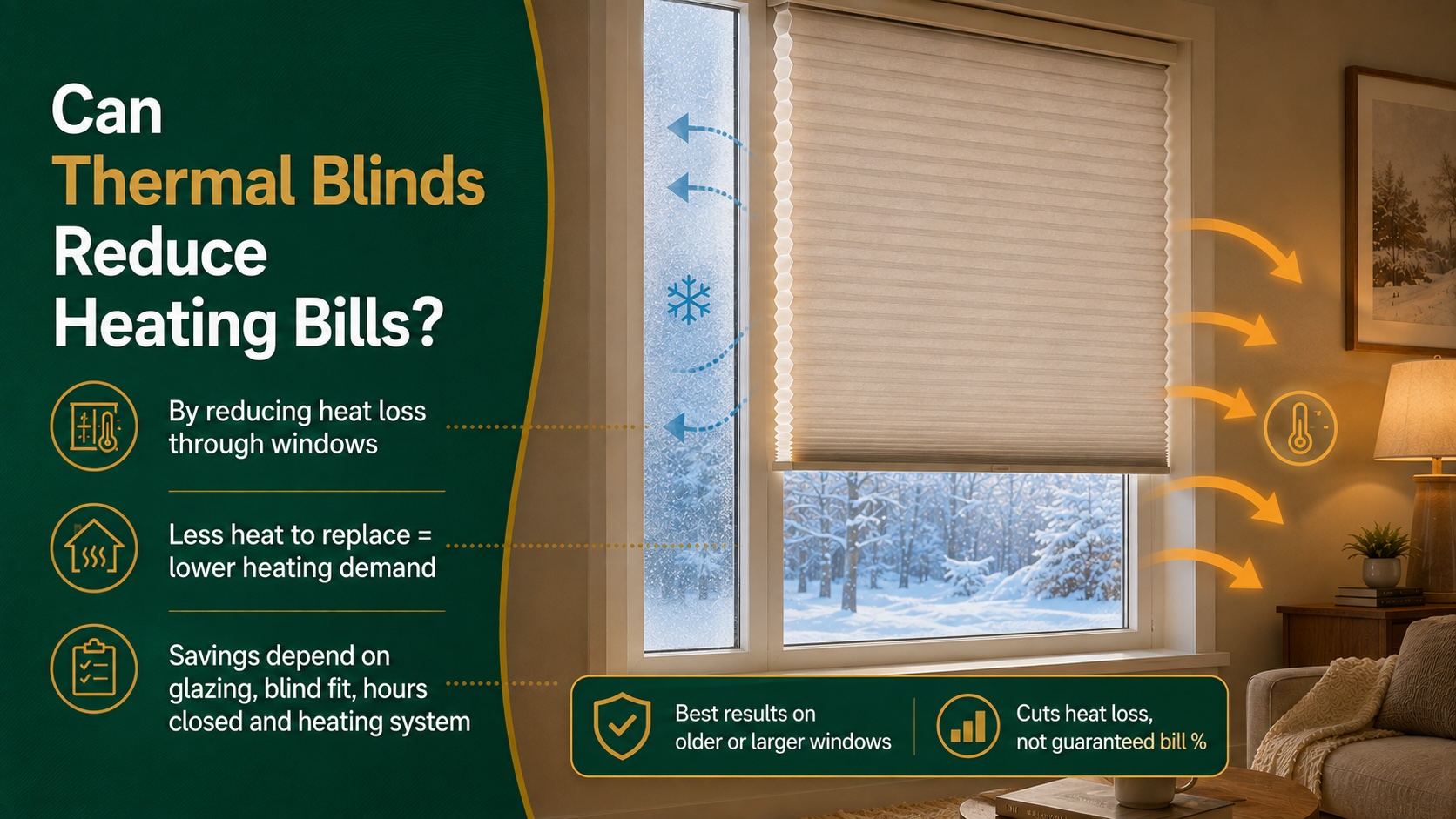
They can, but the size of the saving depends on the property, the glazing, the blind and how consistently it is used.
The important point is that thermal blinds reduce heat loss through the window area. That can reduce the amount of energy the heating system needs to replace, but it does not translate into a fixed percentage reduction in the household bill.
Why There Is No Honest Universal Percentage
Heating costs depend on far more than the windows.
They are influenced by:
- Wall insulation
- Roof insulation
- Floor construction
- Air leakage
- Window area
- Glazing type
- Heating-system efficiency
- Thermostat settings
- Outdoor temperature
- Occupancy
- Energy prices
- How long the blinds remain closed
This is why claims such as:
“Thermal blinds cut heating bills by 30%”
should always be treated cautiously unless the figure comes from a clearly defined whole-building study.
The Correct Calculation Starts With Heat Saved
A better approach is to estimate how much heat loss the blinds are preventing.
Suppose a thermal blind reduces heat loss through a window by:
80 watts
If it is closed for:
10 hours per day
then the daily heat retained is:
80 W × 10 hours = 800 Wh
or:
0.8 kWh per day
Over 30 days:
0.8 × 30 = 24 kWh
That gives a much more useful starting point than an unsupported bill-saving percentage.
From Heat Saving to Financial Saving
Once you have an estimated number of kilowatt-hours saved, you can relate that to the home’s heating system.
For direct electric heating, the relationship is relatively simple because roughly one kilowatt-hour of electricity produces around one kilowatt-hour of heat at the point of use.
For other systems, such as gas boilers or heat pumps, the calculation is different because the amount of purchased energy required to deliver one kilowatt-hour of useful heat depends on system efficiency.
Example With Several Windows
Suppose a property has:
- 8 similar windows
- Each saving an average of 0.8 kWh of heat per cold day
- Blinds used consistently for 30 winter days
Total heat retained:
0.8 × 8 × 30 = 192 kWh
That is now a meaningful amount of energy.
The financial value depends on:
- Energy source
- Heating efficiency
- Current tariff
The Biggest Savings Are Likely in the Worst-Performing Homes
Thermal blinds are most likely to have a noticeable effect on heating demand where the property has:
- Single glazing
- Large areas of glass
- Older windows
- Cold rooms
- Long heating periods
- Blinds closed every evening and overnight
The effect will usually be smaller in homes with:
- High-performance double glazing
- Triple glazing
- Small window areas
- Very short heating periods
Comfort Savings Can Matter Too
There is also an indirect effect.
If a thermal blind makes the room feel more comfortable by reducing radiant chill and cold downdraughts, occupants may be less inclined to increase the thermostat.
That behavioural effect can contribute to lower heating use, although it is difficult to predict precisely.
The Best Way to Think About It
The most defensible statement is:
Thermal blinds can reduce heating demand by lowering heat loss through windows, but the effect on bills depends on the proportion of total household heat loss that comes from those windows and how the blinds are used.
That is a much stronger and more accurate conclusion than attaching one universal saving percentage to every home.
The next section can go a step further by modelling an estimated seasonal heat saving across a typical winter period.
Worked Example: Estimated Seasonal Heat Saving
A seasonal example helps show how a relatively small reduction in heat loss per window can add up over an entire winter.
The calculation below is illustrative, but it uses the same basic heat-loss principles discussed earlier.
Example Property
Assume a home has:
- 8 windows
- Average window area: 1.8 m²
- Original window U-value: 4.8 W/m²K
- Effective window-and-blind U-value when closed: 2.5 W/m²K
- Average indoor temperature: 20°C
- Average outdoor temperature during the relevant heating period: 5°C
- Average temperature difference: 15 K
- Blinds closed for 12 hours per day
- Heating period considered: 120 days
Step 1: Heat Loss Without the Blind
For one window:
4.8 × 1.8 × 15 = 129.6 watts
For 8 windows:
129.6 × 8 = 1,036.8 watts
So the total heat-loss rate through those windows is approximately:
1.04 kW
Step 2: Heat Loss With the Thermal Blinds Closed
For one window:
2.5 × 1.8 × 15 = 67.5 watts
For 8 windows:
67.5 × 8 = 540 watts
Step 3: Heat-Loss Reduction
Difference:
1,036.8 W – 540 W = 496.8 W
So while the blinds are closed, the assumed reduction in heat loss is approximately:
497 watts
Step 4: Convert That Into Daily Energy
If the blinds remain closed for 12 hours:
0.4968 kW × 12 hours = 5.96 kWh per day
Step 5: Extend the Calculation Across the Heating Period
Over 120 days:
5.96 × 120 = 715.2 kWh
Under these assumptions, the blinds would reduce heat loss through the windows by approximately:
715 kWh over the heating period
What Does 715 kWh Mean?
That is the estimated amount of useful heat retained, not automatically 715 kWh taken off an energy bill.
The amount of purchased energy avoided depends on the heating system.
For example:
- Direct electric heating is close to a 1:1 relationship between electricity consumed and useful heat delivered
- A gas boiler needs more fuel energy than the useful heat delivered because it is not 100% efficient
- A heat pump can deliver several kWh of heat from each kWh of electricity consumed
So the same 715 kWh reduction in heat demand can have very different financial implications depending on how the home is heated.
Why the Result Can Vary Dramatically
Change any of the assumptions and the result changes.
For example:
- Better glazing reduces the starting heat loss
- Smaller windows reduce the saving
- Warmer weather reduces the temperature difference
- Fewer hours closed reduce the benefit
- Larger glazed areas increase the saving
- Poor blind fit can reduce real performance
This is why seasonal saving figures should always be treated as modelled estimates rather than guaranteed outcomes.
The Value of the Calculation
The important point is not that every home will save exactly 715 kWh.
It is that thermal blind performance can be translated into a transparent calculation:
U-value improvement × window area × temperature difference × hours used
That gives a far more meaningful basis for estimating winter performance than a generic claim such as “thermal blinds save energy”.
The next section looks at how the financial outcome changes depending on whether the home is heated by gas, direct electric heating or a heat pump.
What About Gas, Electric Heating and Heat Pumps?
The amount of heat retained by thermal blinds can be expressed in kilowatt-hours, but the cost saving depends on how that heat would otherwise have been produced.
A 500 kWh reduction in heat demand does not have the same financial value in a home heated by gas, direct electric heating or a heat pump.
Direct Electric Heating
Direct electric heaters are relatively simple to understand.
For most resistance-based systems:
1 kWh of electricity ≈ 1 kWh of heat delivered
So if thermal blinds reduce heating demand by:
500 kWh of useful heat
the electricity avoided could be approximately:
500 kWh
The financial saving can then be estimated by multiplying that figure by the current electricity unit price.
Gas Boiler
A gas boiler does not convert every kilowatt-hour of gas into useful room heat.
If a boiler operates at an average seasonal efficiency of, for example:
85%
then producing:
500 kWh of useful heat
would require approximately:
500 ÷ 0.85 = 588 kWh of gas
If thermal blinds prevent that amount of heat demand, the avoided gas consumption could therefore be around:
588 kWh
Again, the actual cost saving depends on the current tariff.
Heat Pump
Heat pumps work differently because they can deliver several kilowatt-hours of heat for each kilowatt-hour of electricity consumed.
Suppose a heat pump has an average coefficient of performance of:
3.0
That means:
1 kWh electricity → approximately 3 kWh heat
If thermal blinds reduce heat demand by:
500 kWh
the avoided electricity consumption would be approximately:
500 ÷ 3 = 167 kWh
So the same reduction in building heat loss can produce very different reductions in purchased energy.
Simple Comparison
| Heating System | Example Useful Heat Avoided | Approximate Purchased Energy Avoided |
|---|---|---|
| Direct electric heating | 500 kWh | 500 kWh electricity |
| Gas boiler at 85% efficiency | 500 kWh | 588 kWh gas |
| Heat pump with COP 3.0 | 500 kWh | 167 kWh electricity |
Why Cost Savings Cannot Be Compared From kWh Alone
Electricity usually costs more per kWh than gas, but heat pumps use electricity much more efficiently than direct electric heaters.
This means the financial value of the same thermal improvement depends on:
- Fuel type
- Heating-system efficiency
- Tariff
- Standing charges
- How the heating system is controlled
- Whether the room would otherwise have been heated
A Better Way to Estimate Your Own Saving
Once you have an estimated reduction in useful heat demand, use:
Direct electric:
Useful heat saved × electricity unit price
Gas:
Useful heat saved ÷ boiler efficiency × gas unit price
Heat pump:
Useful heat saved ÷ seasonal COP × electricity unit price
This gives a much more realistic estimate than applying one generic “heating bill saving” percentage to every household.
The Key Point
Thermal blinds reduce heat demand first.
The reduction in purchased energy and cost comes second and depends on the heating system.
That distinction matters because two otherwise identical homes can achieve the same thermal improvement at the window but experience very different financial savings.
The next section should look at the broader buying question: are thermal blinds actually worth it?
Are Thermal Blinds Worth It?
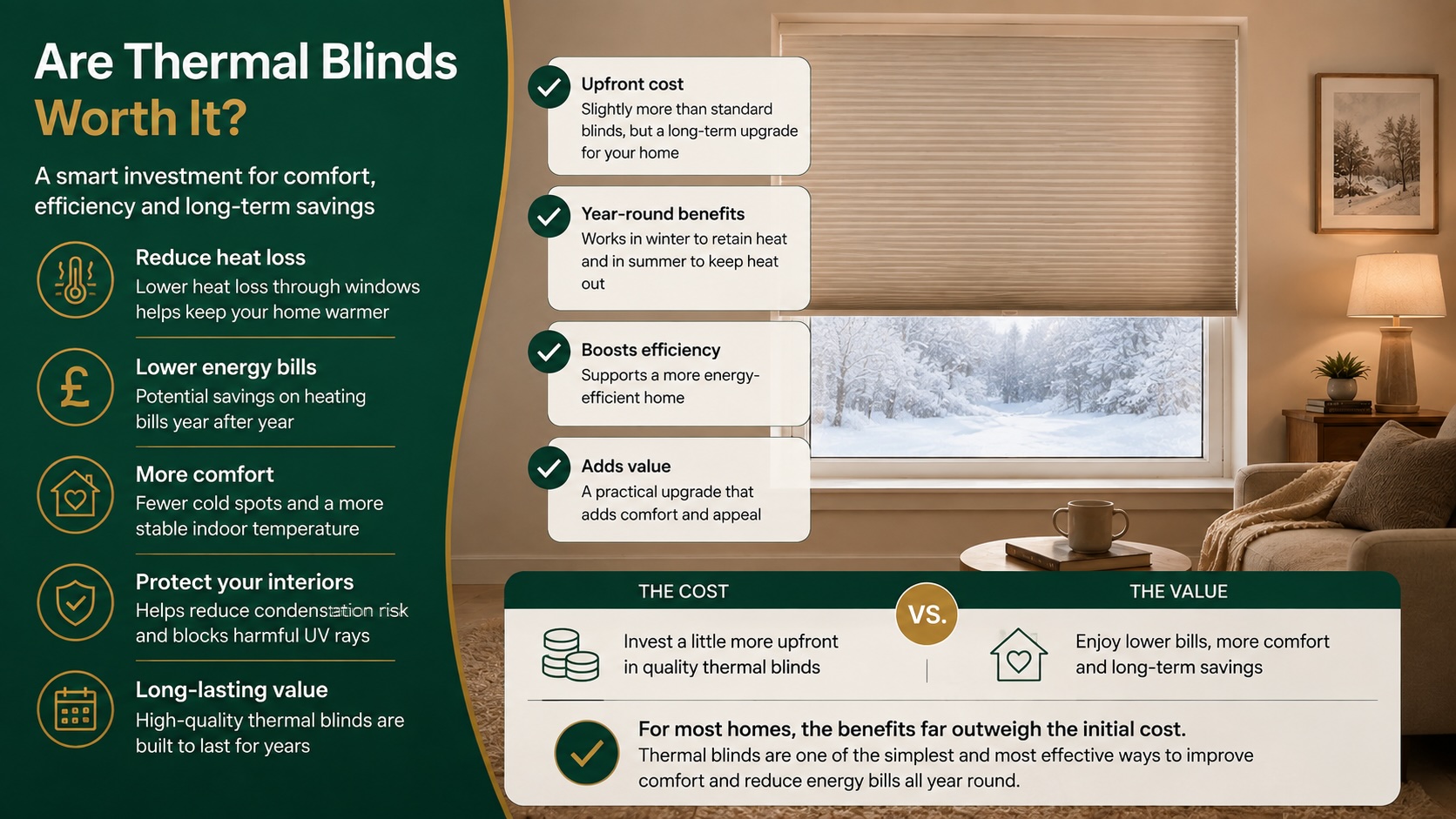
For many homes, yes. But whether thermal blinds are worth the investment depends on how much heat the windows are losing, how large the glazed area is and how consistently the blinds will be used.
They tend to offer the greatest value where the windows are the weakest part of the room.
When Thermal Blinds Are Most Worthwhile
Thermal blinds are particularly attractive where you have:
- Single glazing
- Older double glazing
- Large windows or patio doors
- Bay windows
- Cold bedrooms
- Rooms with noticeable radiant chill near the glass
- Windows that are difficult or expensive to replace
- Blinds that will remain closed for long periods overnight
In these situations, the potential reduction in window heat loss can be substantial.
Where the Benefit Is Smaller
The case is less dramatic where the property already has:
- High-performance double glazing
- Triple glazing
- Small window areas
- Very short heating periods
- Well-insulated rooms with little noticeable window-related discomfort
Thermal blinds can still help, but the return is likely to be smaller.
Cost Matters
The correct question is not simply:
“Do thermal blinds save energy?”
It is:
“Will the amount of heat retained justify the additional cost compared with the alternatives?”
That depends on:
- Purchase price
- Expected lifespan
- Number and size of windows
- Existing glazing performance
- Heating costs
- Hours of winter use
They Can Be More Attractive Than Replacing Windows
Where older windows perform poorly, replacing the glazing can provide a much larger permanent improvement.
But replacement can also be expensive or impractical.
This is particularly relevant in:
- Period properties
- Listed buildings
- Conservation areas
- Rental properties
- Homes where the existing windows are otherwise serviceable
In these situations, thermal blinds can offer a comparatively simple way to improve winter comfort and reduce heat loss without replacing the entire window.
Comfort Has Value Too
The financial calculation is only part of the decision.
A thermal blind may also reduce:
- Cold downdraughts
- Radiant chill
- Cold spots close to glazing
- Discomfort around large windows
For a bedroom or seating area next to a cold window, this improvement in comfort can be valuable even if the annual energy saving is modest.
The Strongest Case Is Usually Poor Glazing Plus Regular Use
The best-value scenario is generally:
poor-performing window + large glazed area + good blind fit + long periods closed during cold weather
The weakest case is:
high-performance glazing + small window + infrequent use
So, Are They Worth It?
If your windows are a significant source of winter heat loss, thermal blinds can be a worthwhile upgrade.
They should not be viewed as a replacement for good glazing or insulation, but as an additional layer that can reduce heat transfer and improve comfort.
The evidence is strongest where the underlying window performs poorly.
The next section looks at a common concern that often comes up with insulating window coverings: can thermal blinds increase condensation?
Do Thermal Blinds Cause Condensation?
They can contribute to condensation in some situations, but they do not create moisture.
Condensation occurs when moist air meets a surface that is cold enough for water vapour to turn into liquid.
Thermal blinds can affect that process because they change the temperature and airflow around the window.
Why the Glass Can Become Colder Behind the Blind
When a thermal blind is closed, less room heat reaches the glazing.
That is exactly what you want from an insulation point of view.
However, it can also mean that the glass behind the blind becomes colder than it would be if it were fully exposed to the warm room.
If humid indoor air reaches that colder glass, condensation may form.
The Main Risk Factors
Condensation is more likely where you have:
- Single glazing
- Older double glazing
- High indoor humidity
- Poor ventilation
- Bedrooms with doors closed overnight
- Bathrooms or kitchens nearby
- Large temperature differences between indoors and outdoors
- Very close-fitting blinds
The combination of cold glass + moisture + limited air movement is what matters.
Why Bedrooms Are a Common Example
Bedrooms can be particularly prone to condensation because people release moisture into the air through breathing overnight.
At the same time:
- The heating may be reduced
- Outdoor temperatures may be at their lowest
- The blind is usually closed for several hours
That can create ideal conditions for condensation on colder glazing.
A Better Thermal Blind Does Not Necessarily Mean More Condensation
It is not as simple as saying:
more insulation = more condensation
The outcome depends on the whole room.
For example, a well-insulated room with good ventilation and controlled humidity may experience little or no condensation even with closely fitted thermal blinds.
A poorly ventilated room with high moisture levels may develop condensation regardless of the blind type.
Ventilation Still Matters
If condensation is already a problem, the solution is usually not simply to stop using thermal blinds.
It is more useful to manage the moisture source and ventilation.
That can include:
- Using extractor fans
- Ventilating after showering or cooking
- Avoiding drying large amounts of laundry indoors without ventilation
- Keeping trickle vents open where appropriate
- Maintaining reasonable background heating
- Monitoring indoor humidity
Should You Leave a Gap Behind the Blind?
A small amount of airflow can sometimes help moisture disperse, but deliberately creating a large gap also reduces the thermal benefit of the blind.
There is therefore a trade-off between:
- Maximising insulation
- Allowing enough airflow to reduce local moisture accumulation
The best balance depends on the window and room.
Watch the Window, Not Just the Blind
If condensation starts appearing after installing thermal blinds, check:
- Whether the glass is wet in the morning
- Whether the window frame is damp
- Whether moisture is collecting at the bottom of the glazing
- Whether mould is beginning to form around reveals or seals
Persistent condensation is a sign that moisture levels, ventilation or window performance need attention.
The Key Point
Thermal blinds can make the glass behind them colder because they reduce heat flow from the room.
That can increase the chance of condensation if indoor humidity is already high and moisture reaches the cold glazing.
The next section looks at the other side of seasonal performance: do thermal blinds also help in summer?
Do Thermal Blinds Work in Summer Too?
Yes, but the way they help in summer is different from the way they help in winter.
In winter, the objective is to slow heat escaping from the room.
In summer, the objective is usually to reduce solar heat entering the room.
A thermal blind can help with both, but the physics are not identical.
Why Internal Blinds Can Reduce Summer Heat Gain
When sunlight passes through a window, it is absorbed by:
- Floors
- Furniture
- Walls
- Other internal surfaces
Those surfaces then warm the room.
A closed blind can intercept part of that solar radiation before it reaches the rest of the interior.
This can reduce:
- Solar gain
- Surface temperatures
- Glare
- Overheating near the window
Reflective Backings Can Be Particularly Useful
A blind with a reflective or low-emissivity backing can reduce the amount of radiant energy absorbed and transferred into the room.
This is especially useful on:
- South-facing windows
- West-facing windows
- Large glazed areas
- Rooms that overheat in the afternoon
The exact benefit depends on:
- Fabric colour
- Reflectivity
- Blind position
- Glazing type
- Perimeter gaps
- Window orientation
External Shading Is Usually More Effective for Summer Heat
For summer overheating, external shading has an important advantage.
It stops solar radiation before it passes through the glass.
Once sunlight has entered the glazing and reached an internal blind, some energy has already entered the building.
This is why systems such as:
- External shutters
- Awnings
- External blinds
- Brise-soleil
can be more effective for controlling solar gain than an internal blind.
Internal Thermal Blinds Still Have Value
That does not make internal thermal blinds ineffective.
They can still reduce:
- Direct solar gain
- Glare
- Surface heating
- Radiant discomfort
and they can be much easier to install and use than external shading.
The Best Summer Strategy Is Usually the Reverse of Winter
In winter:
open blinds during useful sunshine → close them when heat loss becomes dominant
In summer:
close blinds before strong sunlight reaches the window → reopen them when solar gain has reduced
Timing matters because once the room and its internal surfaces have heated up, the blind cannot instantly remove that stored heat.
Orientation Matters Again
East-facing windows may benefit from early-morning shading.
South-facing windows can receive high solar exposure around the middle of the day.
West-facing windows can be especially troublesome in late afternoon because low-angle sun can enter deeply into the room.
The blind strategy should therefore reflect the actual orientation of the window.
Thermal Blinds Can Be Useful Year-Round
This is one of their practical advantages.
A well-designed thermal blind can help:
- Reduce winter heat loss
- Improve comfort near cold glazing
- Reduce summer solar gain
- Improve glare control
- Provide privacy and light control
The next section looks at another practical question that affects performance considerably: are thermal blinds better fitted inside or outside the recess?
Are Thermal Blinds Better Inside or Outside the Recess?
There is no universal answer because thermal performance depends on how closely the blind covers the window and how much air can circulate around it.
Both recess fitting and face fitting can work well when done correctly.
Inside-the-Recess Fitting
A recess-fitted blind sits within the window opening.
Potential advantages include:
- The blind can sit relatively close to the glazing
- The air gap can be more defined
- The installation is compact
- Side gaps can be small if the blind is accurately measured
However, recess fitting can also leave:
- Gaps at the sides
- Space at the top or bottom
- Less overlap around the window opening
If those gaps are large, warm room air can circulate behind the blind and reduce the insulating effect.
Outside-the-Recess Fitting
A face-fitted blind overlaps the window recess and covers a wider area.
Potential advantages include:
- Greater coverage around the window
- Reduced direct exposure to the cold reveals
- More overlap at the sides
- Fewer visible light gaps
From a thermal perspective, that overlap can help reduce air movement around the window opening.
However, the blind may sit further away from the glass.
That means the air cavity behind it can be larger, and the final performance will depend on whether that space remains relatively stable or allows significant convection.
Which Is Better for Heat Retention?
The better option is usually the one that creates:
good coverage + small perimeter gaps + limited air circulation
That may be achieved with either fitting method.
For example:
A closely fitted recess blind can perform very well if side clearances are minimal.
A face-fitted blind with generous overlap can also perform well because it reduces exposed gaps around the opening.
The fitting method alone does not determine the result.
Fit Matters More Than the Label
A thermal blind can lose some of its advantage if it is:
- Too narrow
- Installed with large side gaps
- Positioned far from the window with open edges
- Poorly aligned
Conversely, a more conventional blind can perform better than expected if it covers the window closely and limits convection.
What About Side Channels?
Specialist systems that use side channels can reduce perimeter air movement even further.
These can help create a more enclosed cavity between the blind and the glazing.
However, they are not necessary for every installation and should not be assumed to be the only way to achieve good thermal performance.
The Practical Rule
For winter insulation, choose the fitting method that gives the best combination of:
- Close coverage
- Minimal edge gaps
- Appropriate distance from the glass
- Reliable operation
In most homes, the quality of the fit matters more than whether the blind is technically described as recess-fit or face-fit.
The next section looks at whether thermal blinds can be used together with curtains for even greater insulation.
Can You Use Thermal Blinds With Curtains?
Yes. Using thermal blinds together with curtains can improve insulation because the two treatments create multiple barriers between the warm room and the cold glazing.
A combined setup can be more effective than relying on either treatment alone, particularly on older or poorly insulated windows.
Why Layering Helps
Each additional layer can slow heat transfer.
A typical arrangement might look like:
warm room → curtain → air gap → thermal blind → air gap → glazing
This creates several separate zones of thermal resistance.
The benefit comes from a combination of:
- Extra fabric layers
- Trapped air
- Reduced radiant heat exchange
- Reduced convection near the glass
- Better overall coverage of the window opening
Curtains Can Cover the Gaps Around a Blind
One of the weaknesses of many blinds is perimeter leakage.
Even a well-fitted blind may have small gaps at the sides or bottom.
Curtains can help cover those areas because they usually extend:
- Beyond the sides of the window
- Below the sill
- Across the full width of the opening
This can reduce direct exposure to colder parts of the window and surrounding reveals.
Thermal Blinds Do the Work Close to the Glass
The blind is useful because it can create a more controlled insulating layer close to the glazing.
A cellular or thermal roller blind can:
- Trap air
- Reduce convection
- Reduce radiant heat transfer
The curtain then adds another layer on the room side.
This means the two treatments can complement each other.
The Combination Is Particularly Useful on Older Windows
Layering can be especially worthwhile where you have:
- Single glazing
- Traditional sash windows
- Large bay windows
- Draught-prone windows
- Bedrooms that feel cold overnight
- Large glazed areas
These are situations where the underlying window has more heat loss available to reduce.
Fit Still Matters
Simply adding more fabric is not enough.
Performance depends on how the two layers are arranged.
For example:
- A blind with large side gaps will still allow air movement
- Curtains that stop above a radiator may allow more convection
- Very loose curtains may not create a stable insulating cavity
- Gaps at the top can allow warm air to circulate behind the curtain
A well-fitted combination will generally perform better than a loosely fitted one.
Be Careful With Radiators
If a radiator sits directly beneath the window, long curtains can sometimes trap heat behind them.
Instead of heating the room efficiently, warm air may rise between the curtain and the cold glass.
This can increase heat transfer towards the window.
In that situation, shorter curtains, better curtain positioning or relying more heavily on the blind may make more sense.
Layering Can Improve Comfort as Well as Heat Retention
The benefit is not only about reducing measured heat loss.
Using both blinds and curtains can also:
- Reduce radiant chill
- Reduce cold downdraughts
- Make seating areas near windows feel warmer
- Improve night-time comfort
This can be particularly noticeable in bedrooms and living rooms with large windows.
Is It Worth Using Both?
If maximum winter insulation is the priority, combining a well-fitted thermal blind with suitably fitted curtains can be an effective strategy.
The strongest setup is usually:
good glazing where possible + close-fitting thermal blind + well-fitted curtains
Each layer contributes something different.
The next section looks at what buyers should actually look for when choosing a thermal blind, rather than relying on labels such as “thermal” or “energy efficient”.
What Should You Look for When Buying Thermal Blinds?
The word thermal on its own does not tell you how well a blind will perform.
If winter insulation is the priority, it is more useful to look at the blind’s construction, fit and measured thermal characteristics than at the product label.
1. Look at the Blind Construction
The design of the blind is one of the most important factors.
For example, cellular or honeycomb blinds can provide strong insulation because they trap air within the blind itself.
Other useful constructions can include:
- Multi-layer fabrics
- Thermal backings
- Reflective surfaces
- Low-emissivity layers
- Dense lined fabrics
The more effectively the blind slows conduction, convection and radiant heat transfer, the better its winter performance is likely to be.
2. Check Whether It Traps Air
Air is useful as insulation when it is relatively still.
A blind that creates:
- Internal air cells
- A stable cavity between blind and glass
- Minimal uncontrolled airflow at the edges
has a stronger thermal mechanism than a thin single-layer fabric with large gaps around it.
This is one reason honeycomb blinds perform well as a category.
3. Look at the Fit, Not Just the Fabric
A good thermal fabric can be undermined by poor installation.
Check:
- Side gaps
- Top and bottom gaps
- Overall overlap
- Recess depth
- Distance from the glazing
The aim is to reduce unnecessary air circulation behind the blind.
A closely fitted blind can perform substantially better than the same material installed with large open gaps.
4. Ask What the Thermal Claim Actually Means
If a manufacturer quotes a figure such as:
“reduces heat loss by up to 50%”
ask:
50% compared with what?
The test may refer to:
- Single glazing
- Double glazing
- The glass only
- The complete window
- A particular blind configuration
- A laboratory test rather than a whole-home energy study
Without that context, the percentage is difficult to interpret.
5. Look for Measured Data
More useful evidence can include:
- U-value improvement
- R-value
- Heat-loss reduction
- Independent thermal testing
- Clearly defined test conditions
The strongest figures explain both:
what was measured
and
how it was measured
6. Check the Glazing Used in the Test
This matters because the same blind can produce a very different percentage improvement depending on the starting window.
A result achieved on single glazing should not automatically be assumed to apply to modern double or triple glazing.
If possible, check:
- Original window U-value
- Glazing type
- Window dimensions
- Blind position
- Perimeter gaps
These details make the result much more meaningful.
7. Consider Reflective or Low-Emissivity Backings
Reflective surfaces can improve winter performance by reducing radiant heat exchange between the room and the cold glazing.
They can also help with summer solar control.
However, a reflective backing should be treated as one part of the complete design rather than proof of strong thermal performance on its own.
8. Do Not Confuse Blackout With Thermal Performance
A blackout blind may provide some useful insulation, particularly if it uses a coated or multi-layer fabric.
But blackout means:
light blocking
not:
measured thermal insulation
If winter performance is the priority, check the thermal construction separately.
9. Think About How the Blind Will Actually Be Used
The best thermal blind is of limited value if it is rarely closed.
Consider:
- Will it be closed every evening?
- Is the room used overnight?
- Would motorisation improve consistency?
- Can it be opened easily for winter solar gain?
- Is privacy likely to keep it closed for long periods anyway?
Real-world performance depends on deployment as well as laboratory performance.
10. Judge the Whole System
A strong thermal blind specification should consider:
blind construction + fabric + trapped air + fit + glazing + operating pattern
That is far more useful than simply selecting the product with the strongest-sounding thermal claim.
The next section looks at one of the biggest problems in this market: how to interpret claims such as “save up to 30%” or “reduce heat loss by 50%” without being misled by the percentage alone.
Be Cautious With “Up to X% Energy Saving” Claims
Percentage claims are common in thermal blind marketing, but the figure is only meaningful if you know exactly what was measured.
A claim such as:
“Save up to 50%”
can sound impressive, but it could refer to several completely different things.
Ask: 50% of What?
The percentage might refer to:
- Heat loss through the glass
- Heat loss through the complete window
- Heat transfer through a laboratory test panel
- Heating demand in one room
- Whole-home heating energy
- Annual energy consumption
- Financial savings on energy bills
These are not interchangeable.
A 50% reduction in window heat loss is very different from a 50% reduction in the household heating bill.
“Up To” Is Also Important
The phrase “up to” usually describes the best result achieved under a particular set of conditions.
Those conditions may include:
- A specific window type
- Single glazing
- A particular blind size
- Minimal edge gaps
- A fixed indoor/outdoor temperature difference
- The blind fully closed
- Controlled laboratory conditions
Real-world results may be lower.
Compare Like With Like
If two manufacturers quote different percentages, check whether they are measuring the same thing.
For example:
Blind A: “Reduces heat loss by 55%”
Blind B: “Improves U-value by 35%”
Those figures cannot be compared directly unless the test setup, glazing and measurement method are known.
A lower-looking number may come from a much tougher test.
Check the Baseline
The starting window matters enormously.
A blind tested on poor single glazing may achieve a very large percentage reduction because the original heat loss is high.
The same blind fitted to modern double glazing may still improve performance, but the percentage improvement will usually be lower.
That is why a strong thermal claim should ideally identify:
- The original glazing type
- The baseline U-value
- The fitted blind configuration
- The resulting U-value or heat-loss reduction
Whole-Home Savings Need Much More Evidence
Claims about actual heating bills should be treated with even more caution.
To estimate whole-home savings, you need to know:
- Total window area
- Heat loss through walls, roof and floors
- Air leakage
- Heating-system efficiency
- Indoor temperature
- Outdoor climate
- Hours the blinds are closed
- Energy tariff
Without those variables, a universal bill-saving percentage is not credible.
A Better Way to Read Thermal Claims
Instead of asking:
“What percentage does this blind save?”
ask:
- What was measured?
- What was the baseline?
- What window was used?
- How was the blind fitted?
- Was the result measured or modelled?
- Does the figure apply to window heat loss or whole-home energy use?
That turns a marketing claim into something you can actually evaluate.
The Stronger Evidence
The most useful figures are those tied to measurable building-physics data, such as:
- U-value
- R-value
- Watts of heat loss
- Percentage reduction in window heat transfer
- Kilowatt-hours saved under stated conditions
The next section can then use this framework to look at the evidence more directly: what the research actually shows about thermal blinds overall.
Thermal Blinds: What the Research Actually Shows
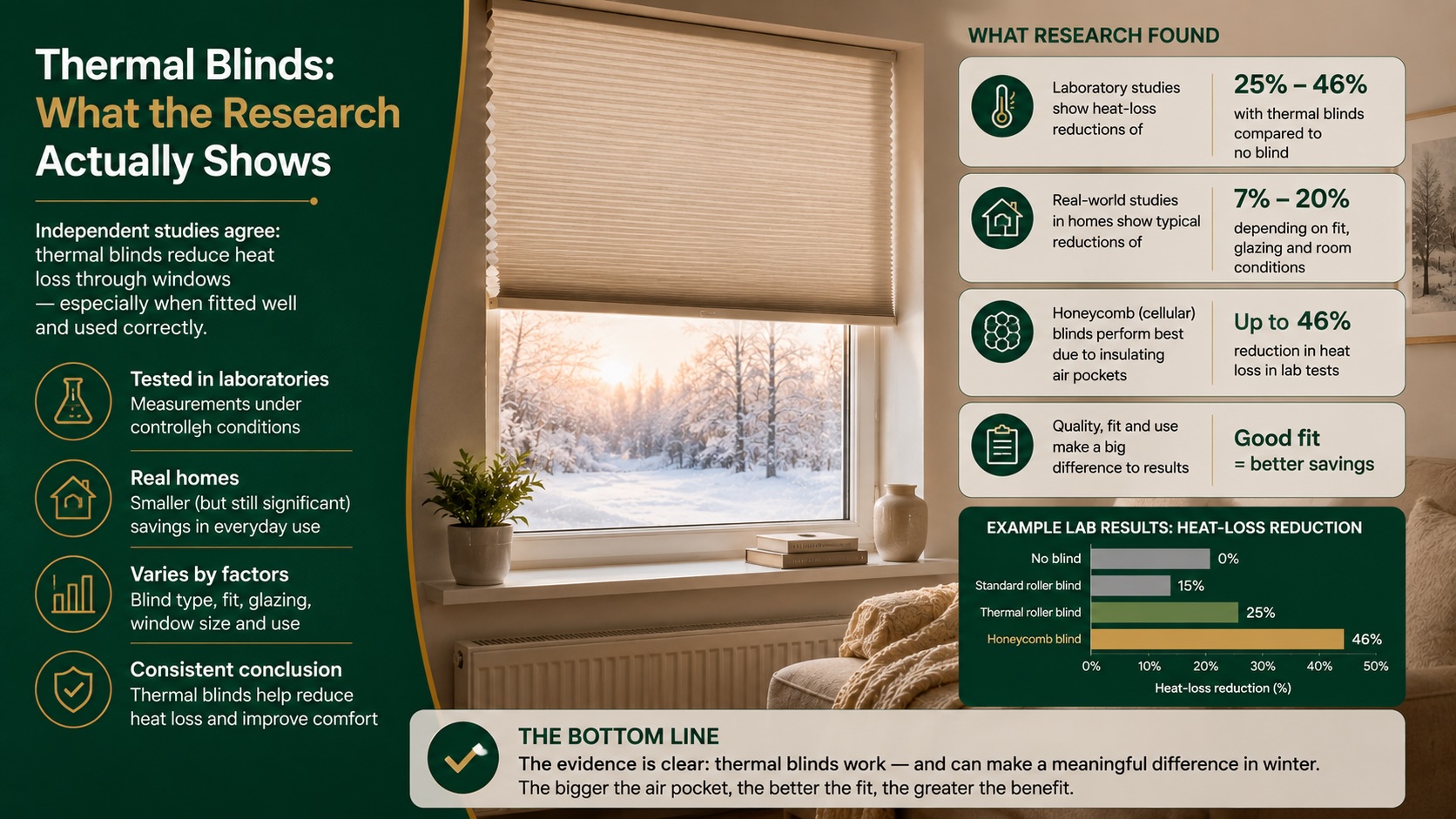
The strongest conclusion from the available evidence is that thermal blinds can produce a substantial and measurable reduction in heat loss through windows, but the result depends heavily on the window and the way the blind is installed.
The research does not support one universal percentage for every home.
It does support several clear findings.
1. Even Ordinary Blinds Can Reduce Heat Loss
Testing on traditional single-glazed windows has shown that plain blinds can reduce heat loss by roughly:
40% to 50%
under the relevant test conditions.
That means a blind does not need a highly specialised construction to provide some thermal benefit.
Simply adding a closed layer in front of the glass and creating a relatively still air space can make a meaningful difference.
2. Insulating and Reflective Blinds Can Perform Better
More insulating blind designs, particularly those using reflective surfaces or stronger insulating construction, have achieved reductions in the region of:
50% to 60%
under comparable test conditions.
This supports the idea that purpose-designed thermal blinds can outperform more basic window coverings.
3. Cellular Construction Has a Strong Thermal Mechanism
Cellular or honeycomb blinds add another insulating feature by trapping air inside the blind itself.
That gives them a stronger thermal structure than a simple flat sheet of fabric.
The performance still depends on the complete installation, but the underlying principle is sound:
more stable trapped air = greater resistance to heat transfer
4. Fit Matters
Research on internal window coverings has consistently shown that the way the blind is fitted can materially affect performance.
Important variables include:
- Side gaps
- Top and bottom gaps
- Distance from the glazing
- Overall coverage
- Amount of air circulation behind the blind
A technically strong thermal fabric can therefore underperform if it is badly fitted.
5. Single Glazing Shows the Largest Percentage Gains
Thermal blinds tend to produce the biggest relative improvement on poor-performing windows.
That is why research using traditional single glazing often produces reductions in the 40% to 60% range.
The same percentage should not automatically be applied to:
- Modern double glazing
- High-performance double glazing
- Triple glazing
The better the starting window, the smaller the relative improvement is likely to be.
6. Heat-Loss Reduction Is Not the Same as Bill Reduction
This is perhaps the most important point.
A blind reducing heat loss through a window by 50% does not mean that the home’s heating bill falls by 50%.
The actual impact on energy use depends on:
- How much of the home’s total heat loss comes through the windows
- The size of the glazed area
- Heating-system efficiency
- Outdoor temperature
- Hours the blind is closed
- The rest of the building fabric
7. Blinds Only Work Thermally When They Are Closed
A blind can have excellent laboratory performance but provide little annual benefit if it is rarely deployed.
Real-world effectiveness therefore depends on:
thermal performance × fitting quality × hours of use
This is why consistent evening and overnight use matters.
8. Comfort Can Improve as Well as Efficiency
Thermal blinds can also reduce:
- Radiant chill
- Cold downdraughts
- Discomfort near glazing
This can make a room feel warmer even when the air temperature remains unchanged.
That comfort effect is particularly relevant around large or poorly insulated windows.
The Evidence in One View
| Finding | What the Evidence Indicates |
|---|---|
| Plain blinds | Can reduce window heat loss by roughly 40% to 50% in relevant single-glazing tests. |
| Insulating / reflective blinds | Can achieve reductions in the region of 50% to 60% under comparable test conditions. |
| Cellular blinds | Benefit from trapped internal air and multi-layer construction. |
| Blind fit | Perimeter gaps and distance from the glass can materially alter performance. |
| Glazing type | The largest percentage gains are generally seen on poorer-performing glazing. |
| Energy bills | Whole-home savings are smaller than the headline window heat-loss percentage. |
The evidence therefore supports a clear conclusion:
Thermal blinds work, but the size of the benefit depends on the complete window-and-blind system rather than the product label alone.
The next section can answer the core search question directly: are thermal blinds really effective?
Quick Answer: Are Thermal Blinds Really Effective?
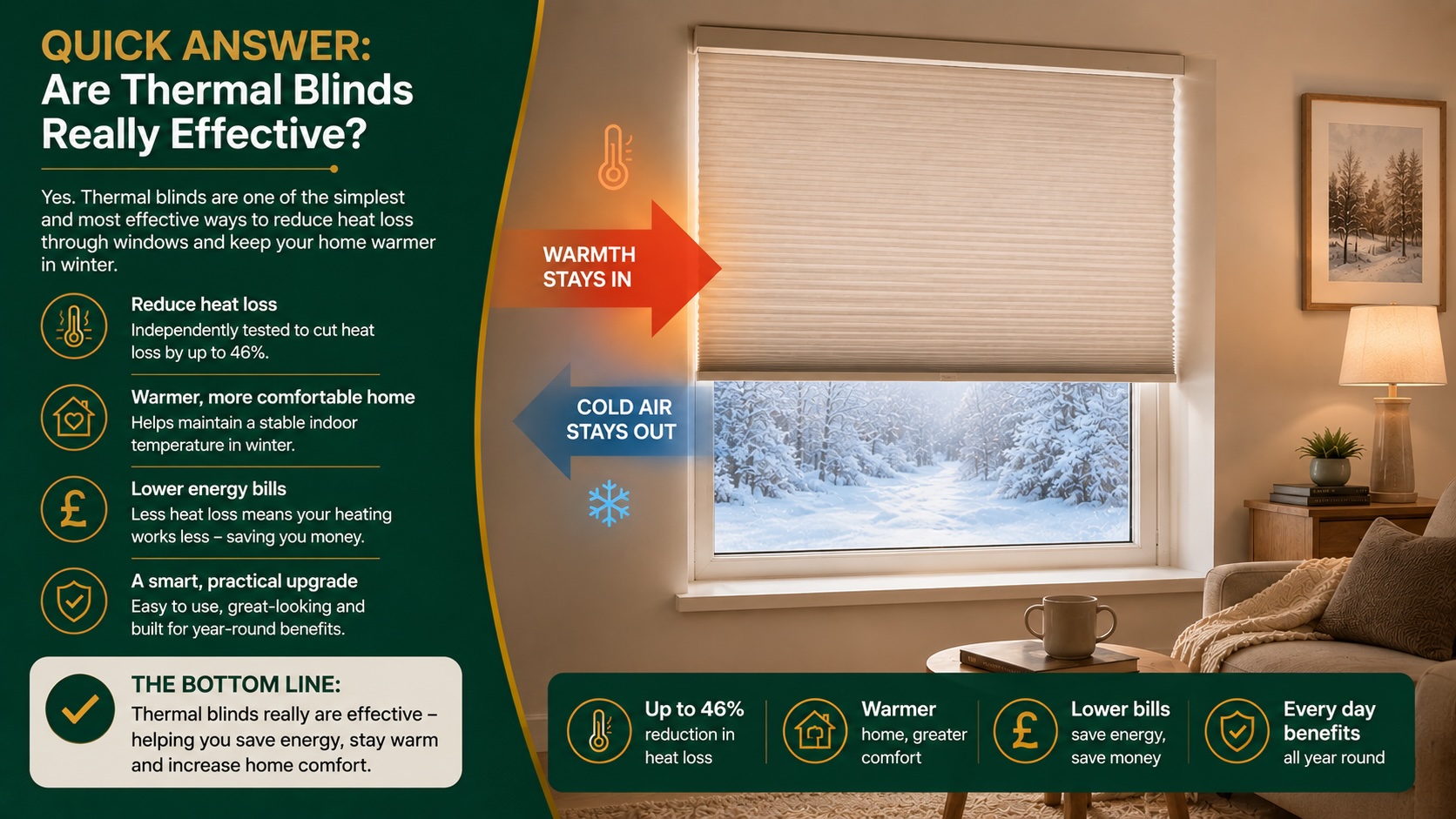
Yes. Thermal blinds can be genuinely effective at reducing heat loss through windows, especially where the glazing itself performs poorly.
The strongest evidence shows that internal blinds can make a measurable difference rather than simply creating a subjective feeling of warmth.
Under relevant test conditions on traditional single-glazed windows:
- Plain blinds reduced heat loss by roughly 40% to 50%
- Insulating or reflective blinds reduced heat loss by roughly 50% to 60%
- Better fit and reduced perimeter gaps improved performance
- Cellular or honeycomb construction can increase thermal resistance by trapping air within the blind itself
Where Thermal Blinds Work Best
The biggest gains are likely on:
- Single-glazed windows
- Older double glazing
- Large areas of glazing
- Bay windows
- Bedrooms and living rooms where blinds remain closed for long periods
- Rooms that feel noticeably cold near the glass
On modern double or triple glazing, thermal blinds can still help, but the percentage improvement is usually smaller because the window is already better insulated.
What Thermal Blinds Actually Improve
A good thermal blind can reduce:
- Conductive heat loss
- Convective air movement near the glass
- Radiant heat loss towards the cold window
- Cold downdraughts
- Discomfort when sitting near glazing
That means the benefit is not only lower heat transfer. The room can also feel warmer at the same air temperature.
Fit Is Critical
A thermal blind with large gaps around the sides may underperform.
For the strongest winter performance, look for:
- Close coverage
- Small perimeter gaps
- Good positioning relative to the glass
- Cellular, layered or reflective construction
- Consistent use during cold periods
The thermal performance of the blind and the quality of the installation should be considered together.
Do They Cut Heating Bills by 50%?
No universal claim like that is credible.
A 50% reduction in window heat loss is not the same as a 50% reduction in the home’s total heating bill.
The actual saving depends on:
- How much heat the property loses through its windows
- Glazing type
- Window area
- Heating system
- Outdoor temperature
- Hours the blinds remain closed
- Energy prices
The Practical Verdict
If your windows are a significant source of winter heat loss, thermal blinds can be one of the more effective internal window-covering upgrades.
The evidence is strongest where the existing glazing is poor and the blind is well fitted and closed consistently during cold periods.
The most accurate summary is:
Thermal blinds work, but their real performance depends on the window, the blind construction, the fit and how the blind is used.
Final Verdict: How Effective Are Thermal Blinds in Winter?
Thermal blinds are effective, but the evidence supports a more useful conclusion than simply saying they are “the best blinds for winter”.
Their performance is measurable, and under the right conditions it can be substantial.
Research on traditional single-glazed windows has shown approximately:
- 40% to 50% less heat loss with plain blinds
- 50% to 60% less heat loss with more insulating or reflective blind systems
Those figures demonstrate that a closed blind can significantly change the thermal performance of a poorly insulated window.
But they should not be interpreted as universal savings for every property.
The Window Matters as Much as the Blind
The greatest improvements are likely where the original glazing performs poorly.
A useful hierarchy is:
Single glazing → greatest potential improvement
Older double glazing → substantial opportunity
Modern double glazing → smaller additional improvement
Triple glazing → smaller again, although comfort benefits remain
The better the window already performs, the less remaining heat loss there is for the blind to reduce.
Construction Matters
A blind marketed as thermal is not automatically highly insulating.
The strongest designs generally combine several features:
- Trapped air
- Cellular or multi-layer construction
- Reflective or low-emissivity surfaces
- Good coverage of the glazing
- Limited air circulation around the edges
This is why cellular and honeycomb blinds are particularly strong from a building-physics perspective.
Fit Matters More Than Many Buyers Realise
A high-performance thermal fabric can lose part of its advantage if the blind is installed with large gaps around it.
The complete system matters:
glazing + blind construction + air gap + perimeter fit
Reducing uncontrolled air circulation behind the blind allows the insulating air layers to work more effectively.
How You Use the Blind Matters Too
Thermal blinds only provide their maximum insulating benefit while closed.
Their most useful winter routine is generally:
open during beneficial sunshine → close as solar gain disappears → keep closed during colder evening and overnight periods
Motorisation can make this easier by ensuring blinds are consistently deployed at useful times.
Do Not Confuse Heat-Loss Savings With Heating-Bill Savings
This is the most important qualification.
A thermal blind reducing window heat loss by 50% does not mean your heating bill will fall by 50%.
Whole-home energy consumption also depends on:
- Walls
- Roof
- Floors
- Doors
- Ventilation
- Draughts
- Heating-system efficiency
- Window area
- Weather
- Occupant behaviour
Thermal blinds reduce one component of the building’s heat demand.
So, Are Thermal Blinds Worth Choosing?
If winter warmth is the priority, yes, particularly where windows are a significant thermal weak point.
They make the strongest case in properties with:
- Single glazing
- Older windows
- Large glazed areas
- Cold bedrooms
- Bay windows
- Noticeable cold downdraughts
- Seating or beds positioned close to glazing
They can still add insulation to modern windows, but the incremental improvement will generally be smaller.
The Evidence-Based Answer
The most accurate conclusion is not:
“Thermal blinds are the warmest because they are thermal.”
It is:
Thermal blinds can substantially reduce heat transfer through windows because they add thermal resistance, trap air, reduce convection and limit radiant heat exchange. Controlled testing has measured reductions approaching 40% to 60% on poorly performing glazing, with the final result depending heavily on blind construction, fit, glazing type and how consistently the blind is used.
That is why the best winter blind is not simply the product carrying the strongest thermal label.
It is the blind that combines effective insulating construction with a close fit and sensible winter use.
Independent Research & Thermal Blind Resources
The following independent research and technical resources provide further information on window heat loss, thermal blinds, cellular shades, U-values, perimeter gaps and the effect of window coverings on energy performance.
Historic England: Thermal Performance of Traditional Timber Sash Windows
Detailed research measuring the thermal performance of traditional single-glazed timber sash windows and the effect of curtains, roller blinds, reflective blinds, honeycomb blinds, shutters, draught-proofing and secondary glazing.
Historic England: Energy Efficiency Research
An overview of Historic England’s research into window U-values, heat loss, air infiltration and practical measures for improving the thermal performance of traditional windows.
Historic England: Traditional Windows, Their Care, Repair and Upgrading
Technical guidance explaining conduction, convection, radiation and draught-related heat loss through traditional windows, together with ways curtains, blinds, shutters and other improvements can reduce heat loss.
Lawrence Berkeley National Laboratory: Thermal Performance of Cellular Shades
Research examining the thermal transmittance of windows fitted with cellular shades, including the influence of cell geometry, distance from the glass, perimeter gaps and mounting arrangements.
Lawrence Berkeley National Laboratory: Effect of Perimeter Gaps
Experimental research investigating how top, bottom and side gaps around internal window shading systems affect thermal transmittance and heat flow.
U.S. Department of Energy: Cellular Shades and Home Energy Performance
Research summarising controlled testing and energy modelling of cellular shades, including their effect on heating energy use compared with conventional blinds and windows without shades.
Note: Thermal performance figures vary according to glazing type, blind construction, fit, perimeter gaps, temperature conditions and how the blind is used. Test results should therefore be interpreted in the context of the window and installation tested.