Order Tracking
 0800 1422417
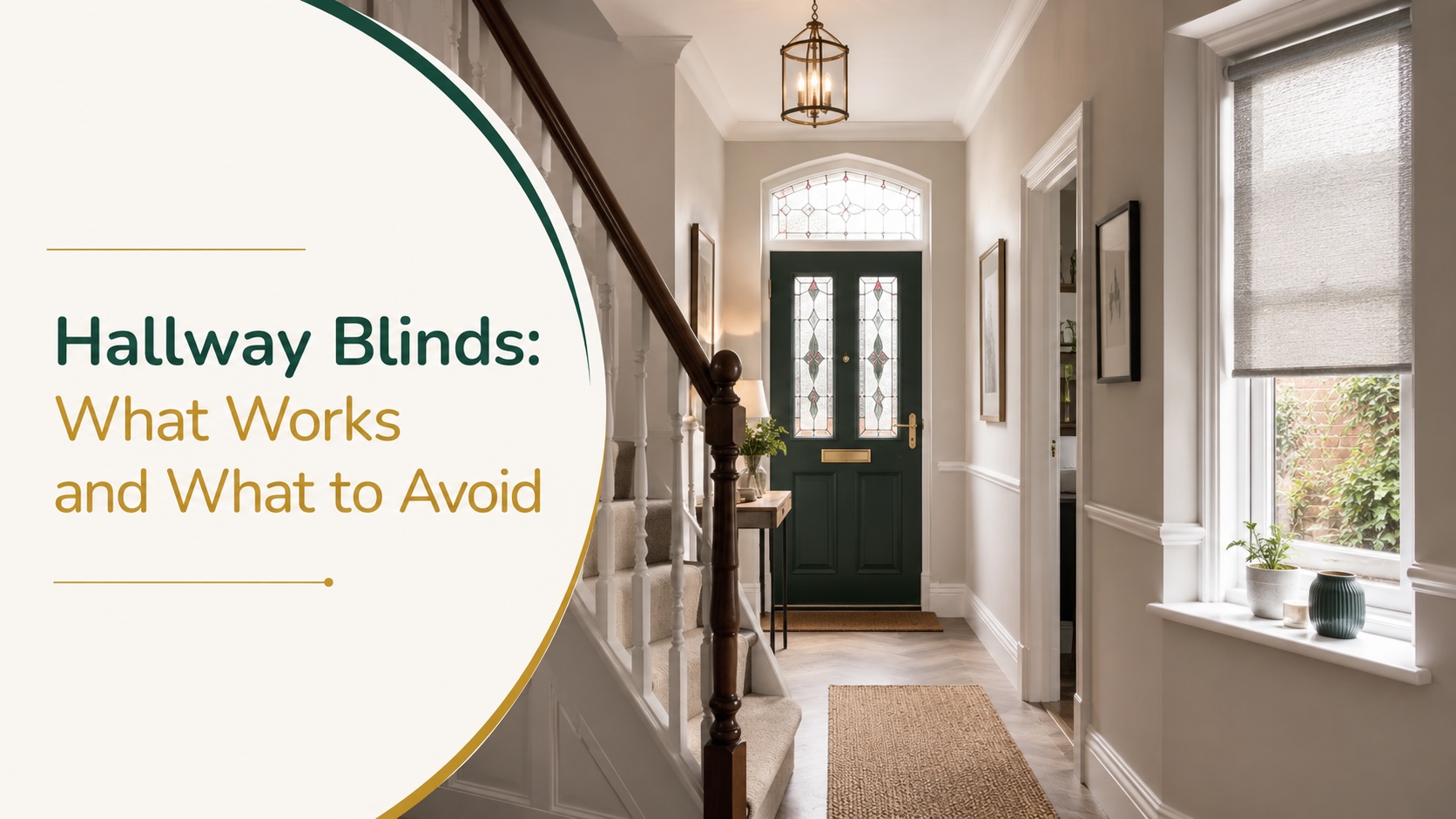
Hallways are easy to overlook when choosing blinds, but they have a very different role from rooms such as living rooms, bedrooms and kitchens.
Most hallways are not spaces where people spend long periods of time. They are transitional areas used for entering, leaving and moving between rooms. At the same time, they are often the first part of the home that guests see, so the window treatment can have a disproportionate effect on the overall impression of the space.
Hallways also tend to present a different set of practical challenges. They are often:
- Narrower than other rooms
- Less heavily furnished
- More dependent on limited natural light
- Fitted with smaller or narrower windows
- Positioned close to the front door
- More exposed to passing views from outside
This means the best blind for a hallway is not necessarily the blind you would choose for a bedroom or living room.
For example, a large vertical blind may work extremely well across wide glazing in a lounge but feel oversized on a small hallway window. A blackout blind may be ideal for a bedroom but unnecessarily darken an entrance that already struggles for daylight. By contrast, a Day & Night blind can be particularly useful where you want privacy from the street without sacrificing too much natural light.
The right hallway blind therefore needs to balance several things at once:
- Natural light
- Privacy
- Proportion
- Visual weight
- Style
- The first impression of the home
In this guide, we look at which blind styles work best in hallways, where each option has an advantage, and which styles should be used more selectively.
The aim is not to identify one blind that is universally “best”, but to match the blind to the particular characteristics of a hallway.
A compact entrance with a small street-facing window has very different requirements from a large period hallway with tall glazing, and the blind should reflect that.
In This Guide
Use the sections below to compare the best hallway blind styles, understand which options suit different spaces, and see which styles should be used more selectively.
1. Understanding Hallway Blind Requirements
2. Best Blind Styles for Hallways
- Roller Blinds: Often the Best All-Round Hallway Choice
- Roman Blinds: Best for a Warmer, More Decorative Hallway
- Day & Night Blinds: Best Where Light and Privacy Both Matter
- Venetian Blinds: Best for Precise Light and Privacy Control
- Wood Venetian Blinds: When They Work in a Hallway
- Metal Venetian Blinds: A Better Choice for Compact Modern Hallways?
- Cellular and Thermal Blinds: Useful for Cold Entrance Hallways
3. Blind Styles to Use More Selectively
4. Best Blinds by Hallway Type
5. Colour, Styling & Hallway Priorities
- What Colour Blinds Work Best in a Hallway?
- Should Hallway Blinds Match the Front Door?
- Should Hallway Blinds Match the Rest of the House?
- Best Hallway Blinds for Privacy
- Best Hallway Blinds for Maximum Natural Light
- Best Hallway Blinds for a Strong First Impression
- Best Hallway Blinds for Small Windows
Quick Answer: What Are the Best Blinds for a Hallway?
For most hallways, the strongest choices are Roller blinds, Day & Night blinds, Roman blinds and Venetian blinds.
The best option depends on what the hallway needs most.
- Roller blinds are usually the safest all-round choice because they are compact, simple and well suited to smaller windows.
- Day & Night blinds work particularly well where privacy and natural light are both important.
- Roman blinds suit hallways where the window is part of the decorative first impression and a softer look is wanted.
- Venetian blinds are useful where precise control over light and privacy matters.
Other styles can work, but they are more dependent on the size and character of the space.
For example, Vertical blinds can look out of proportion on a typical small hallway window, but they may suit a large entrance hall with wide or full-height glazing. Likewise, a blackout blind may provide maximum privacy, but it can be unnecessarily restrictive in a hallway that already receives limited daylight.
The main principle is simple:
Hallway blinds should preserve light, suit the scale of the window and provide enough privacy without visually overwhelming the space.
Why Hallway Blinds Need to Be Chosen Differently
A hallway is not used in the same way as a living room, bedroom or kitchen, so the blind should not be chosen in the same way either.
In most homes, a hallway is a transitional space. People pass through it rather than spend long periods sitting in it. That changes which features matter most.
Natural Light Is Often More Valuable
Hallways are frequently darker than other rooms because they may have:
- Fewer windows
- Smaller windows
- Limited direct sunlight
- Light coming mainly from the front door or adjoining rooms
For that reason, a blind that blocks too much daylight can make the space feel unnecessarily gloomy.
Privacy Can Still Be Important
Hallways are often close to the front of the house, so privacy may matter more than expected.
A ground-floor hallway window can give passers-by a direct view into:
- The entrance
- The staircase
- Adjacent rooms
- The main circulation space of the home
The ideal blind often needs to provide privacy without removing all of the available daylight.
Hallway Windows Are Often Smaller
Many hallway windows are relatively narrow or compact.
That makes proportion important.
A blind with a lot of visual bulk can dominate a small opening and make the hallway feel more crowded.
This is one reason simple, compact styles often work particularly well.
The Blind Has a Strong Visual Role
Although people may spend less time in the hallway, it is usually one of the first spaces seen when entering the home.
That gives the blind an important decorative role.
It can help establish whether the hallway feels:
- Modern
- Traditional
- Minimal
- Warm
- Bright
- Formal
A blind that looks perfectly acceptable in a spare bedroom may feel much more noticeable in an entrance hall.
The Best Hallway Blind Balances Several Priorities
For most hallways, the decision comes down to four main questions:
- How much natural light does the hallway receive?
- How much privacy is needed?
- How large is the window relative to the space?
- How prominent should the blind be visually?
That is why there is no single best blind for every hallway.
The right choice depends on the balance between light, privacy, proportion and first impressions.
Why Natural Light Matters More in a Hallway
Natural light is often more valuable in a hallway than in rooms with several windows or larger glazed areas.
Many hallways depend on a relatively small amount of daylight from:
- One small window
- Glazing beside or above the front door
- A stairwell window
- Light borrowed from adjoining rooms
Because the available daylight can already be limited, the wrong blind can make the space feel noticeably darker.
A Hallway Can Become Gloomy Very Quickly
In a living room, closing one blind may still leave plenty of light from other windows.
In a hallway, one blind may control the only meaningful source of daylight.
That makes the choice of blind more important.
A style that blocks a large proportion of the window, even when partially open, can reduce brightness throughout the entrance space.
This Is Why Light-Control Blinds Work Well
Hallways often benefit from blinds that allow more control than simply:
fully open or fully closed
For example:
- Day & Night blinds can provide privacy while still allowing filtered daylight through the sheer sections
- Venetian blinds allow the slats to be tilted to redirect light without fully exposing the window
- Roller blinds can be raised completely when privacy is not needed, leaving the window visually clear
These styles give the hallway more flexibility throughout the day.
Darker Fabrics Can Have a Bigger Effect Here
A dark blind can look sophisticated, but in a hallway with limited daylight it can also make the window feel smaller and the space heavier.
This does not mean dark blinds should always be avoided.
They can work well where:
- The hallway is naturally bright
- The walls are pale
- The window is relatively large
- Strong contrast is part of the interior scheme
But in a narrow or dim hallway, lighter fabrics and finishes will usually preserve a more open feel.
Privacy and Light Often Need to Work Together
The challenge is that hallway windows are frequently positioned where privacy matters most.
A window beside the front door may face directly towards:
- The pavement
- A neighbouring property
- A communal entrance
- A driveway
So leaving the window completely uncovered may not be practical.
This is why the ideal hallway blind often needs to provide privacy without sacrificing all of the available natural light.
That balance is particularly important in small entrance halls, where every source of daylight contributes to making the space feel larger and more welcoming.
Privacy Without Making the Hallway Dark
Privacy is often important in a hallway because these spaces are usually close to the front of the property.
A street-facing hallway window can give passers-by a direct view into the entrance, staircase or adjoining rooms. The challenge is that completely blocking the window may remove one of the hallway’s main sources of natural light.
That makes adjustable privacy more useful than maximum light blocking in many cases.
Why Blackout Is Often More Than You Need
A blackout blind gives excellent privacy when closed, but it also blocks almost all incoming light.
That makes sense in a bedroom, where darkness is often the objective.
In a hallway, the priorities are usually different.
You may want:
- Privacy from the street
- Daylight during the day
- A bright entrance
- A window treatment that does not make the space feel enclosed
For that reason, a full blackout solution can sometimes solve one problem while creating another.
Day & Night Blinds Are Particularly Useful Here
Day & Night blinds are well suited to hallway windows because they can balance privacy and daylight.
The alternating sheer and opaque sections allow you to adjust how much of the window is visually screened without necessarily closing it off completely.
This can be especially useful for:
- Windows beside the front door
- Ground-floor hallway windows
- Properties close to the pavement
- Hallways overlooked by neighbouring homes
They offer more flexibility than a conventional blind that is either fully open or fully closed.
Venetian Blinds Give Precise Control
Venetian blinds can also work very well where privacy needs change during the day.
By adjusting the slats, you can:
- Reduce direct views into the hallway
- Redirect daylight upwards
- Keep the window partially open visually
- Increase privacy without darkening the space completely
This makes them particularly useful for windows that face a road or neighbouring property.
Roller Blinds Work Best Where Privacy Is Simple
A standard Roller blind is less flexible because the main control is how far it is raised or lowered.
However, it can still be a good choice where:
- Privacy is only needed at certain times
- The hallway receives enough light elsewhere
- A simple, clean appearance is preferred
A lighter-coloured fabric can also feel less visually heavy when the blind is closed.
The Best Hallway Privacy Solution Is Usually Adjustable
In most hallways, the ideal blind is not the one that blocks the most.
It is the one that lets you decide how much privacy and how much daylight you want at any given time.
That is why Day & Night and Venetian blinds are particularly strong choices for hallways where privacy is important but natural light is limited.
Why Proportion Matters on Small Hallway Windows
Hallway windows are often smaller than the main windows in living rooms or bedrooms.
That makes proportion especially important.
A blind that looks balanced on a wide living-room window can feel oversized or visually heavy when reduced to a narrow hallway opening.
Smaller Windows Need Lighter Visual Treatment
On a compact window, details such as:
- Wide slats
- Large fabric folds
- Bold patterns
- Heavy headrails
- Deep stacked fabric
can become much more noticeable.
The blind may start to dominate the window rather than complement it.
This is one reason simpler styles often work particularly well in hallways.
Roller Blinds Usually Scale Well
Roller blinds have a relatively clean visual profile.
When raised, most of the fabric rolls neatly at the top of the window, leaving the opening largely unobstructed.
That makes them well suited to:
- Narrow hallway windows
- Small landing windows
- Compact entrance spaces
- Minimal interiors
They are less likely to overwhelm the proportions of the opening.
Roman Blinds Need More Care
Roman blinds can look very attractive in a hallway, especially where a softer or more decorative effect is wanted.
However, the folds create more visual weight.
On a very small window, that can make the blind feel bulky.
They tend to work best where:
- The window has enough height
- The hallway can support a more decorative treatment
- The fabric is not excessively heavy
- The blind is intended to become part of the visual character of the entrance
Vertical Blinds Can Look Out of Place on Small Openings
Vertical blinds are designed to work particularly well across wider areas of glazing.
On a small hallway window, the individual louvres can appear disproportionately large relative to the opening.
The result can feel:
- Too commercial
- Too busy
- Visually oversized
- Unnecessarily complex
That does not make Vertical blinds unsuitable for hallways generally.
They can still work well in large entrance halls or where the hallway has wide glazing.
The issue is scale, not the blind style itself.
Venetian Slat Size Also Matters
Venetian blinds can suit hallways very well because they offer precise light and privacy control.
But slat width affects the overall look.
Wider wood-effect slats create a stronger visual presence, while slimmer metal slats usually feel lighter on smaller windows.
In a narrow hallway, that difference can matter.
The Blind Should Suit the Window, Not Fight It
The best hallway blind should feel proportionate to both:
- The window
- The surrounding space
A good rule is that the smaller the window and the narrower the hallway, the more important it becomes to avoid unnecessary visual bulk.
The next section looks at one of the most reliable options for achieving that balance: Roller blinds.
Roller Blinds: Often the Best All-Round Hallway Choice
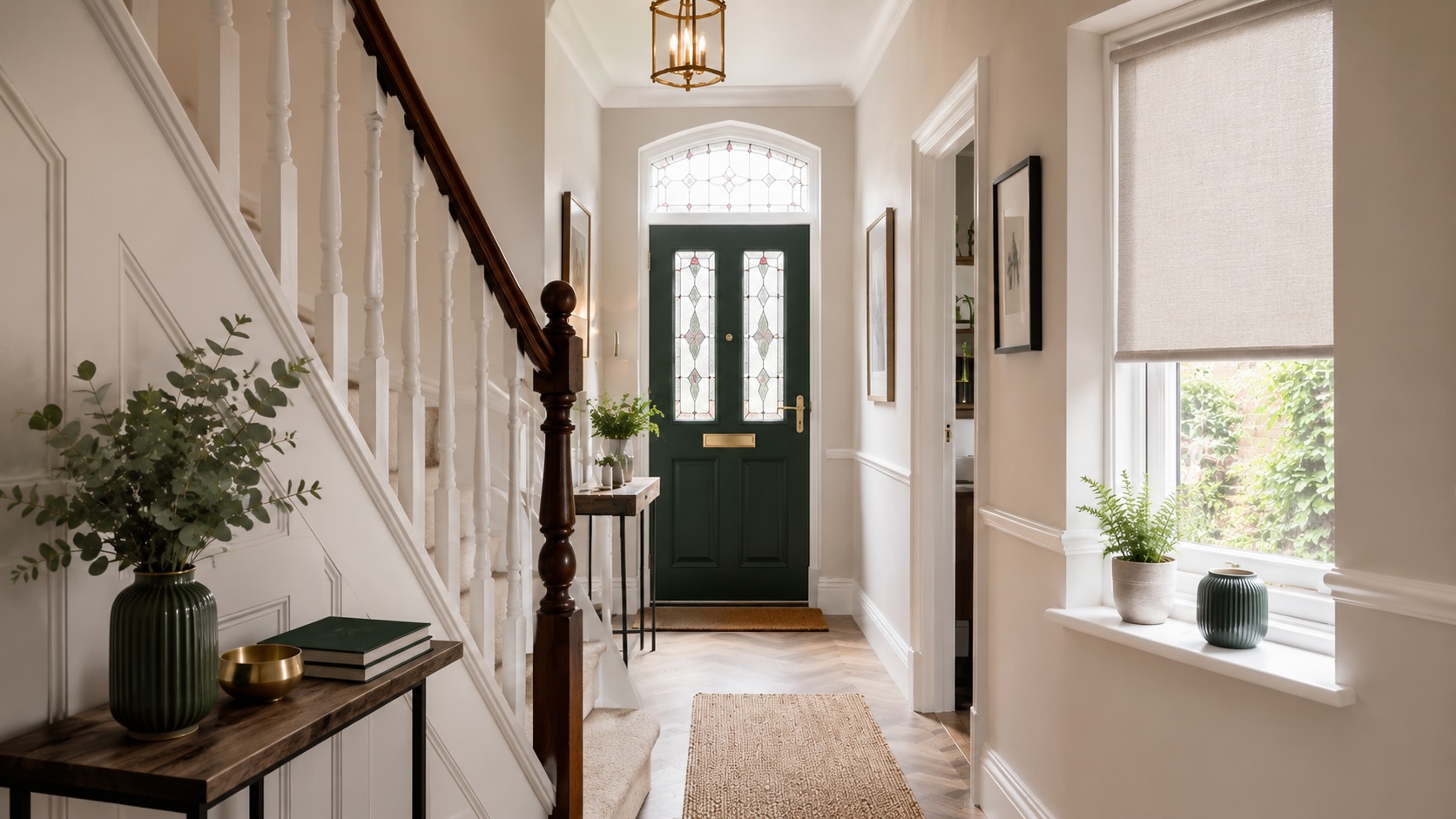
Roller blinds are one of the strongest choices for hallways because they are simple, compact and visually unobtrusive.
That combination works particularly well in a space where the window may be small, natural light may be limited and the blind should not dominate the entrance.
Why Roller Blinds Suit Hallways
A Roller blind has a clean, straightforward shape with very little visual bulk.
That makes it particularly effective in:
- Small hallways
- Narrow entrance spaces
- Compact windows
- Modern interiors
- Hallways where the window is not intended to be the main focal point
When raised, the fabric rolls neatly at the top of the window, leaving most of the glazing visible.
That helps preserve natural light, which is often especially valuable in a hallway.
They Do Not Overwhelm Small Windows
This is one of their biggest advantages.
A small hallway window can quickly look crowded if the blind has:
- Large folds
- Wide slats
- Heavy fabric
- Multiple moving sections
A Roller blind keeps the visual treatment simple.
The result is usually better proportioned to the window and less likely to make the hallway feel cramped.
They Work With a Wide Range of Interior Styles
Because the construction is so simple, much of the visual effect comes from the fabric.
A Roller blind can therefore be adapted to very different hallway styles.
For example:
- A pale neutral fabric can help keep a dark hallway feeling light
- A warm textured fabric can soften a minimalist entrance
- A darker shade can create contrast in a bright hallway
- A subtle pattern can turn a small window into a decorative detail
This flexibility is useful because hallways often need to coordinate with several parts of the home at once, including the front door, staircase, flooring and adjoining rooms.
Privacy Is Straightforward
For a street-facing hallway, a Roller blind provides complete visual screening once lowered.
The trade-off is that it does not offer the same fine control over privacy and daylight as a Venetian or Day & Night blind.
A conventional Roller blind is mainly:
open → more light and less privacy
or
closed → more privacy and less light
That makes it most suitable where privacy requirements are relatively simple.
When a Roller Blind May Feel Too Plain
The simplicity that makes Roller blinds practical can also be a limitation.
In a large or highly decorative entrance hall, a basic Roller blind may feel less substantial than:
- A Roman blind
- A Wood Venetian blind
- A more decorative fabric treatment
If the hallway window is intended to make a strong first impression, a softer or more architectural blind style may be preferable.
Best For
Roller blinds are particularly well suited to hallways where the priorities are:
small window + maximum simplicity + good daylight when open + minimal visual bulk
For many typical UK hallways, that makes them one of the safest and most versatile choices.
Roman Blinds: Best for a Warmer, More Decorative Hallway
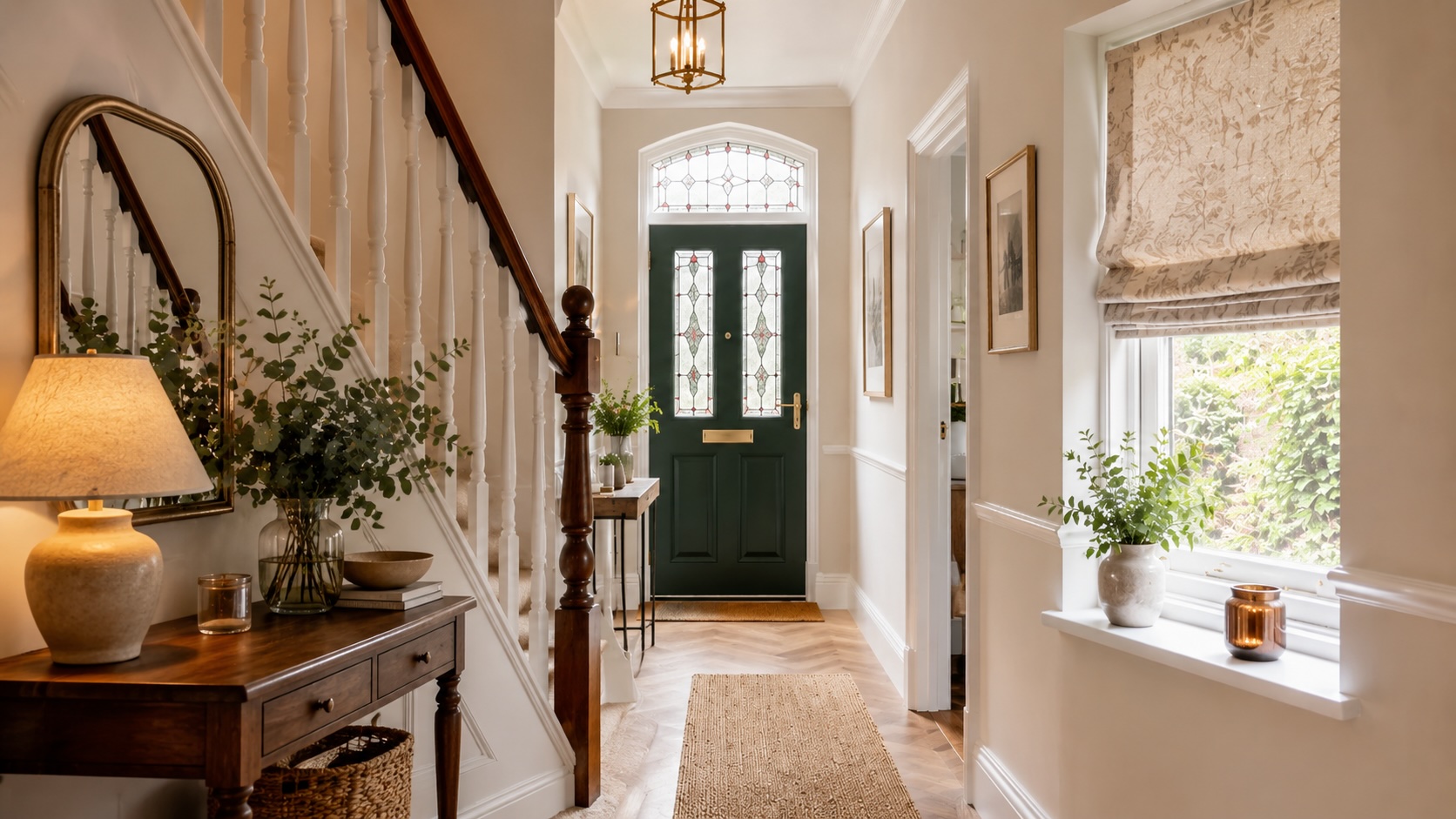
Roman blinds are a strong choice when the hallway needs to feel more decorative and considered.
Unlike the cleaner, more functional look of a Roller blind, a Roman blind introduces softness, texture and visible fabric folds, which can make an entrance feel warmer and more inviting.
Why Roman Blinds Work Well in Hallways
Hallways often contain fewer soft furnishings than living rooms or bedrooms.
There may be:
- Hard flooring
- Painted walls
- Staircases
- Doors
- Console furniture
- Mirrors
A Roman blind can help soften those harder surfaces by adding fabric and texture to the window.
This can be especially effective in:
- Traditional hallways
- Period properties
- Larger entrance halls
- Hallways with decorative furniture
- Spaces where the window should contribute more strongly to the overall interior design
They Can Strengthen the First Impression
Because the hallway is often the first interior space seen when entering the home, a Roman blind can make the window feel more deliberate and finished.
A carefully chosen fabric can help tie together:
- Wall colour
- Flooring
- Stair runners
- Furniture
- Artwork
- Front-door colour
This makes Roman blinds particularly useful where the hallway is intended to feel more like a designed room than simply a circulation space.
Pattern Can Work Particularly Well
A hallway may be one of the few places where a patterned blind can become a clear focal point without competing with large amounts of furniture.
A subtle floral, geometric or textured fabric can add interest to an otherwise simple entrance.
However, scale still matters.
On a very small window, an oversized pattern can feel too dominant.
The Main Limitation Is Visual Bulk
Roman blinds fold into horizontal sections when raised.
That creates a deeper stack of fabric than a Roller blind.
On a small or low hallway window, this can:
- Cover more of the glass
- Reduce daylight
- Make the top of the window feel heavier
- Visually shrink the opening
This is why Roman blinds tend to work better where the window has enough height and the hallway can support a more substantial treatment.
Best for Decorative Rather Than Minimal Hallways
Roman blinds are especially suitable where the aim is:
softness + texture + stronger decorative impact
They are less suitable where the main priority is:
maximum daylight + minimal visual weight
For a small, dark hallway, a simple Roller or Day & Night blind may be more practical.
For a larger or more traditional entrance, however, a Roman blind can provide the kind of warmth and character that simpler blind styles do not.
The next section looks at one of the best options for balancing two of the hallway’s most important needs: natural light and privacy.
Day & Night Blinds: Best Where Light and Privacy Both Matter
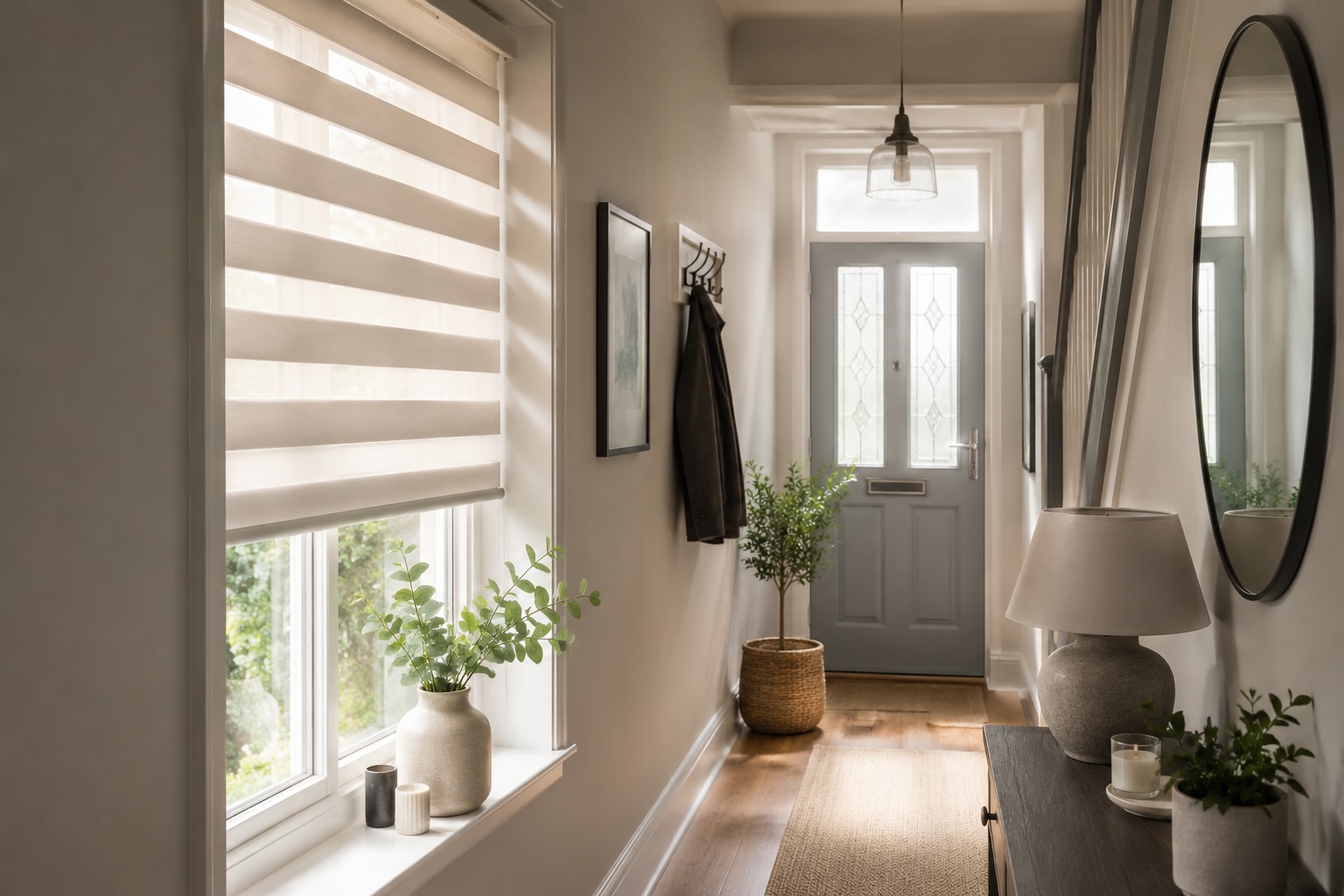
Day & Night blinds are particularly well suited to hallways because they solve one of the most common problems in this type of space: how to maintain privacy without making the entrance feel dark.
Their alternating sheer and opaque fabric bands allow much finer control than a conventional Roller blind.
Why They Suit Hallways
A hallway window often has two conflicting jobs:
- Bring useful daylight into a space that may already be dim
- Prevent passers-by from seeing directly into the home
Day & Night blinds allow the fabric layers to be aligned in different ways so you can increase privacy while still allowing filtered daylight through.
This makes them especially useful for:
- Street-facing hallway windows
- Windows close to the front door
- Ground-floor entrance spaces
- Hallways with limited natural light
- Modern interiors
Better Daytime Privacy Than a Standard Roller Blind
With a conventional Roller blind, privacy is mainly controlled by raising or lowering the fabric.
That can mean sacrificing a large amount of daylight when the blind is closed.
A Day & Night blind offers more flexibility because the sheer sections can still admit light while the opaque sections reduce direct visibility.
This can make the hallway feel brighter without leaving the window completely exposed.
They Work Particularly Well in Modern Hallways
The horizontal bands create a clean, contemporary look.
That tends to suit hallways with:
- Simple furniture
- Neutral wall colours
- Modern flooring
- Clean architectural lines
- Minimalist décor
They can also create more visual interest than a plain Roller blind without adding the softness or bulk of a Roman blind.
Consider the Horizontal Pattern
The alternating bands are visually stronger than a plain sheet of fabric.
On a very small window, the horizontal pattern can make the blind more noticeable.
That is not necessarily a disadvantage, but it means Day & Night blinds are best where you want the window to have some visual presence.
For an extremely small or simple hallway window, a plain Roller blind may feel quieter.
They Are Not Blackout Blinds
Day & Night blinds are primarily about adjustable light and privacy, not complete darkness.
That is usually an advantage in a hallway, because blackout performance is rarely the main requirement.
If total screening is needed at night, the blind can be positioned to maximise coverage, but the main reason to choose this style is its flexibility during daylight hours.
Best For
Day & Night blinds are particularly strong where the hallway needs:
daylight + privacy + contemporary styling
That makes them one of the best choices for front-facing hallways where leaving the window completely uncovered is not practical.
The next section looks at another strong option for adjustable privacy and daylight: Venetian blinds.
Venetian Blinds: Best for Precise Light and Privacy Control
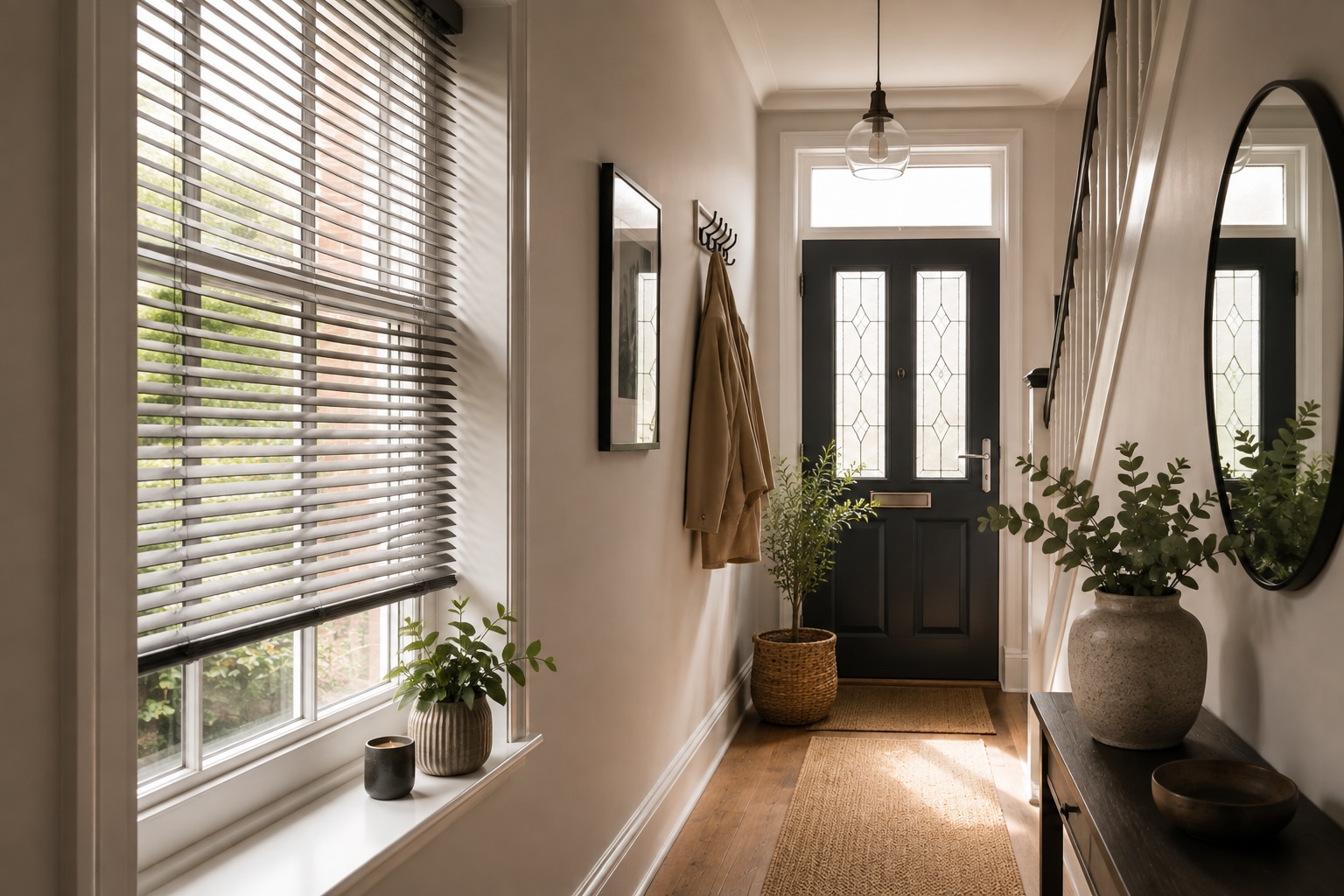
Venetian blinds are another strong hallway option because they let you control light and privacy without having to choose between fully open and fully closed.
That flexibility is particularly useful in entrance spaces where daylight is valuable but privacy from the street may still matter.
Why Venetian Blinds Suit Hallways
The adjustable slats can be tilted to change how much light enters the hallway and how direct the view is from outside.
This makes them especially useful for:
- Ground-floor hallway windows
- Street-facing entrances
- Windows beside the front door
- Narrow hallways that depend on limited daylight
Unlike a standard Roller blind, you can keep the blind lowered while still allowing light into the room.
They Can Redirect Light
Venetian slats do more than simply block or admit daylight.
By changing the angle of the slats, you can direct light:
- Upwards towards the ceiling
- Further into the hallway
- Away from direct sightlines
This can be useful where the window faces a pavement or neighbouring property.
You can reduce visibility into the hallway without making the space feel completely enclosed.
They Work Well on Smaller Windows
Venetian blinds generally have a compact shape and can suit smaller hallway windows well.
They do not create the deep folds of a Roman blind or the larger vertical sections of a Vertical blind.
That makes them a good option where the hallway needs:
control without excessive visual bulk
Metal and Wood Venetians Create Different Effects
The material makes a noticeable difference.
Metal Venetian blinds tend to feel:
- Lighter
- Cleaner
- More contemporary
- Better suited to compact spaces
Wood or wood-effect Venetian blinds tend to feel:
- Warmer
- More substantial
- More traditional
- More decorative
Both can work in hallways, but the scale and character of the space should guide the choice.
Slat Width Matters
Wider slats create a stronger visual statement.
On a large or traditional hallway window, that can look balanced.
On a very small window, wide slats may feel too heavy and reduce the sense of openness.
Narrower slats usually create a lighter appearance.
Best For
Venetian blinds are particularly well suited to hallways where the main priorities are:
adjustable privacy + controlled daylight + compact styling
They are especially useful where the hallway window is visible from outside during the day but still needs to contribute as much natural light as possible.
Wood Venetian Blinds: When They Work in a Hallway
Wood and wood-effect Venetian blinds can work very well in hallways where the aim is to create a warmer, more substantial and more traditional look.
They are particularly effective when the hallway already includes other timber elements.
Why They Can Suit Hallways
Wood Venetian blinds can coordinate naturally with:
- Timber flooring
- Wooden staircases
- Console tables
- Traditional doors
- Warm neutral colour schemes
Because hallways often contain fewer soft furnishings, the grain and colour of a wood-effect blind can add warmth without relying on fabric.
Best in Traditional or Characterful Spaces
They tend to work especially well in:
- Period homes
- Larger entrance halls
- Hallways with classic detailing
- Interiors using warm woods and neutral tones
In these settings, a wood Venetian blind can feel more integrated than a metal blind.
The Main Limitation Is Visual Weight
Wood-effect slats usually have a stronger presence than slim metal slats.
On a very small hallway window, especially in a narrow or dark space, they can feel heavy.
This is particularly true with:
- Dark finishes
- Wide slats
- Small windows
- Limited daylight
In those conditions, a lighter Roller or metal Venetian blind may feel more proportionate.
Colour Choice Matters
Light oak and pale wood tones can help keep the space feeling open.
Darker walnut or black finishes can create a more dramatic look, but they are better suited to hallways with enough natural light to support them.
Best For
Wood Venetian blinds are a strong choice where the priorities are:
warmth + character + adjustable privacy
They are less suited to very compact or poorly lit hallways where visual lightness is more important.
Metal Venetian Blinds: A Better Choice for Compact Modern Hallways?
Metal Venetian blinds can be particularly well suited to smaller, more contemporary hallways because they tend to have a lighter visual profile than wood-effect alternatives.
Their slim slats and clean lines can provide privacy and light control without making a compact window feel too heavy.
Why They Work Well in Small Hallways
Metal Venetian blinds are useful where the hallway is:
- Narrow
- Minimalist
- Modern
- Short on natural light
- Fitted with a relatively small window
The slats can be tilted to admit daylight while reducing direct views from outside, which is especially useful for street-facing entrance spaces.
They Usually Feel Lighter Than Wood Venetians
Wood-effect Venetian blinds can add warmth and character, but they also have more visual weight.
Metal slats tend to feel:
- Slimmer
- Cleaner
- Less bulky
- More architectural
That can make them easier to use on compact windows where proportion is important.
Good for Contemporary Interiors
Metal Venetians often suit hallways with:
- White or grey walls
- Modern doors
- Simple flooring
- Black or metallic hardware
- Minimal furniture
They can create a sharper, more restrained look than Roman or fabric blinds.
They Still Offer Excellent Control
Like other Venetian blinds, metal versions allow you to:
- Tilt the slats for privacy
- Redirect daylight
- Reduce direct views from outside
- Keep some natural light entering the hallway
This flexibility is one of their main advantages over a standard Roller blind.
Best For
Metal Venetian blinds are particularly strong where the priorities are:
compact styling + precise light control + modern appearance
For small contemporary hallways, they can often feel more proportionate than wider wood-effect slats.
Cellular and Thermal Blinds: Useful for Cold Entrance Hallways
Thermal or cellular blinds can be a good hallway choice where the entrance area feels noticeably colder than the rest of the home.
Hallways often sit directly beside the front door and can include external walls, glazing and draught-prone areas, so winter comfort may matter more here than in some other circulation spaces.
Why They Can Work Well
Cellular blinds use a honeycomb-style construction that traps air within the blind.
This can help reduce heat transfer at the window and make the area feel less cold.
They can be particularly useful in:
- Older properties
- Hallways with single or older double glazing
- Entrance halls with large glazed sections
- North-facing hallways
- Homes where the hallway feels noticeably colder in winter
They Also Have a Light Visual Profile
One advantage of cellular blinds is that they can provide useful insulation without looking as visually heavy as some thicker fabric treatments.
That can make them suitable for smaller hallway windows where you want:
thermal benefit + compact appearance
Light Control Still Matters
A hallway may rely heavily on its window for daylight, so the exact fabric choice matters.
If the blind is particularly opaque, it may reduce more light than necessary when closed.
Where natural light is limited, it is worth balancing thermal performance with how bright the hallway needs to remain during the day.
Best For
Thermal or cellular blinds are especially worth considering where the hallway is:
- Cold
- Close to an external entrance
- Poorly insulated around the window
- Used frequently in winter
- In need of a compact blind that does not overwhelm the space
They are less about making a decorative statement and more about adding practical comfort while keeping the window treatment visually neat.
Are Vertical Blinds Suitable for Hallways?
Vertical blinds can work in a hallway, but they are usually better suited to larger entrance spaces and wider areas of glazing than to a typical small hallway window.
Their strength is controlling light across broad windows or doors. On a compact hallway opening, that same design can feel oversized.
Why They Often Look Out of Place on Small Hallway Windows
Vertical blinds use individual hanging louvres, which create a stronger visual pattern than a simple Roller or Roman blind.
On a small window, they can make the opening feel:
- Busier
- More commercial
- Visually heavier
- Larger than the space can comfortably support
This is especially noticeable in narrow hallways where the blind is viewed from relatively close range.
Where Vertical Blinds Can Work Well
They become much more appropriate where the hallway has:
- Wide glazing
- Tall windows
- Full-height glass
- Large entrance doors
- A spacious entrance hall
- A more contemporary architectural style
In these situations, Vertical blinds can provide practical light and privacy control without looking disproportionate.
They Can Be Useful for Large Street-Facing Glazing
One advantage is that the louvres can be rotated.
This allows you to reduce direct visibility into the hallway while still allowing some daylight through.
For a large glazed entrance, that can be very useful.
The problem is not the way Vertical blinds operate. It is usually the scale of the blind relative to the window.
Small Hallway Window vs Large Entrance Hall
For a typical narrow hallway window:
Roller, Day & Night or Venetian blinds will usually feel more proportionate.
For a large modern entrance with substantial glazing:
Vertical blinds become a much more credible option.
Best For
Vertical blinds are most suitable where the hallway has:
large glazing + a need for adjustable privacy + enough physical space for the louvres to look proportionate
For the average small hallway window, however, they are usually one of the styles we would choose more selectively rather than recommend by default.
Are Curtains Better Than Blinds in a Hallway?
Usually, blinds are the more practical choice for a hallway because they take up less visual and physical space.
Curtains can work well in a large entrance hall, but in a typical narrow hallway they may feel too bulky.
Why Blinds Often Suit Hallways Better
Blinds sit within or close to the window opening, so they generally have a smaller visual footprint.
That can help a hallway feel:
- Cleaner
- Less crowded
- Brighter
- More proportionate
This is especially useful where the space already contains:
- A staircase
- Console furniture
- Coat storage
- Mirrors
- Narrow circulation areas
Curtains Can Add Too Much Visual Weight
Full-length curtains can introduce a large amount of fabric into a space that may already be tight.
On a small hallway window, they can look oversized relative to the opening.
They may also make the entrance feel more enclosed, particularly if the fabric is dark or heavily lined.
When Curtains Can Work Well
Curtains become more appropriate where the hallway is:
- Large
- Traditional
- High-ceilinged
- Architecturally decorative
- Fitted with tall or substantial windows
In those settings, curtains can add softness and grandeur.
They can also complement period features particularly well.
Blinds Usually Offer Better Control
Blinds can also provide more precise light and privacy control.
For example:
- Day & Night blinds can filter light
- Venetian blinds can redirect light
- Roller blinds can be fully raised when privacy is not needed
Curtains are generally more binary:
open or closed
That can be less useful in a hallway where you want daylight without leaving the space fully exposed.
Best Choice for Most Hallways
For the average hallway, blinds are usually the stronger choice because they combine:
compactness + light control + privacy + proportion
Curtains are more suitable where the hallway is large enough for the fabric to feel intentional rather than intrusive.
Are Blackout Blinds a Good Choice for Hallways?
Usually, blackout blinds are not the first choice for a hallway because most hallways benefit more from preserving daylight than from blocking it completely.
That does not mean blackout blinds are unsuitable. They simply solve a problem that many hallways do not have.
Why Blackout Is Often Unnecessary
Blackout blinds are designed to minimise light transmission.
That is useful in rooms where darkness is important, such as:
- Bedrooms
- Nurseries
- Home cinemas
In a hallway, the priorities are usually different.
Most hallways need:
- Natural light
- Privacy
- A sense of openness
- A welcoming entrance
A blackout blind can work against those goals if it is closed for long periods.
They Can Make a Dark Hallway Feel Darker
If the hallway already relies on one small window, closing a blackout blind can remove most of the available daylight.
That can make the space feel:
- Narrower
- Heavier
- Less welcoming
- More dependent on artificial lighting
This is particularly noticeable in entrance halls that receive little direct sun.
When Blackout Blinds Can Make Sense
There are situations where they are useful.
For example:
- The hallway window faces directly onto a busy pavement
- Privacy is more important than daylight
- The window overlooks an internal part of the home
- The hallway receives plenty of light from elsewhere
- A darker, more enclosed entrance style is intentional
In those cases, blackout can be a reasonable choice.
Consider Whether You Need Full Privacy or Adjustable Privacy
For most hallway windows, a more flexible solution is often better.
If you want privacy without losing all the daylight, consider:
- Day & Night blinds
- Venetian blinds
- Light-filtering Roller blinds
These styles allow the hallway to remain brighter while reducing direct views from outside.
Blackout Fabric Can Still Work in a Roller Blind
If you like the clean look of a Roller blind but want maximum screening at night, a blackout Roller can still be practical.
The important question is whether the hallway genuinely benefits from total light blocking.
Best For
Blackout blinds are most suitable where the priorities are:
maximum privacy + complete screening
They are less suitable where the hallway is already short on natural light.
For most hallways, blackout is best treated as a specific solution rather than the default option.
Are Very Dark Blinds a Bad Idea in a Hallway?
Not necessarily, but dark blinds need more consideration in a hallway than they might in a larger, brighter room.
Because hallways are often narrow and receive limited daylight, a very dark blind can have a stronger visual effect than expected.
Why Dark Blinds Can Feel Heavy
Dark colours absorb more light and create stronger contrast.
In a small hallway, that can make the window area feel:
- More enclosed
- More visually dominant
- Less bright
- Heavier within the overall space
If the hallway already has dark flooring, limited natural light or narrow proportions, a dark blind can intensify that effect.
When Dark Blinds Can Work Well
They can still look very good where the hallway has enough light and the overall scheme supports them.
For example, dark blinds can suit:
- Bright entrance halls
- Pale walls
- Large windows
- Modern black or anthracite hardware
- Strong contrast-led interiors
- Hallways with dark doors or stair details
In those spaces, a dark blind can feel deliberate rather than oppressive.
The Blind Type Matters Too
A dark Roller blind creates a solid block of colour when closed.
A dark Venetian blind can feel lighter because the slats can be tilted to admit light.
A dark Day & Night blind can also retain more visual flexibility because of the alternating sheer sections.
So the same colour can behave very differently depending on the blind style.
Small Windows Need More Restraint
On a very small hallway window, dark fabric can make the opening feel visually smaller.
Lighter shades are usually safer if the goal is to preserve:
brightness + openness + visual space
Best Approach
Dark blinds are not something to avoid automatically.
They work best where there is enough daylight and where the colour connects clearly with the rest of the entrance scheme.
In a dim or narrow hallway, however, lighter tones usually make the space feel more open and welcoming.
When Patterned Blinds Work, and When They Become Too Much
Patterned blinds can work particularly well in hallways because the window is often one of only a few decorative elements in the space.
A pattern can therefore add character without competing with large amounts of furniture.
Why Pattern Can Work Well in a Hallway
Hallways often have relatively simple surfaces:
- Plain walls
- Hard flooring
- Doors
- Staircases
- Mirrors
- Console tables
A patterned blind can introduce:
- Colour
- Texture
- Visual interest
- A stronger sense of personality
This can make the entrance feel more considered.
Scale Matters
The size of the pattern should suit the size of the window.
On a small hallway window, a very large pattern can become visually dominant.
Smaller or more restrained patterns usually work better where the window is compact.
Larger patterns tend to suit:
- Wider hallway windows
- Tall entrance spaces
- Larger period hallways
- Rooms with enough surrounding space for the design to breathe
Strong Patterns Can Become the Focal Point
This can be either an advantage or a problem.
If the hallway is otherwise neutral, a patterned Roman or Roller blind can become an effective focal point.
But if the space already includes:
- Patterned flooring
- Bold wallpaper
- Decorative stair runners
- Strong artwork
another prominent pattern at the window may make the entrance feel too busy.
Roman Blinds Are Particularly Good for Pattern
Roman blinds display fabric in a softer, more decorative way, which makes them a strong choice when the pattern itself is important.
Roller blinds also work well where you want the design to appear cleaner and flatter.
Day & Night and Venetian Blinds Already Have Visual Structure
These styles create their own pattern through:
- Horizontal bands
- Repeating slats
Adding very strong colour or contrast can make the overall effect busier.
In compact hallways, a simpler finish often works better.
The Best Approach
Patterned blinds work best when they have a clear role in the entrance scheme.
Use them when you want the window to become part of the decoration.
Use them more cautiously when:
- The hallway is very small
- The window is narrow
- The walls or flooring are already strongly patterned
- Natural light is limited
- The space already contains several competing visual elements
The key is proportion.
A patterned blind should add interest to the hallway, not overwhelm the window or the entrance as a whole.
Best Blinds for a Small Hallway
Small hallways benefit most from blinds that are compact, visually light and easy to integrate with limited window space.
The aim is usually to preserve as much daylight as possible while avoiding a blind that makes the window feel crowded.
1. Roller Blinds
Roller blinds are usually the strongest all-round choice for a small hallway.
They work well because they:
- Have a clean, simple profile
- Suit narrow and compact windows
- Do not introduce unnecessary visual bulk
- Can be raised fully to maximise daylight
A light or neutral fabric can also help the hallway feel more open.
2. Day & Night Blinds
Day & Night blinds are particularly useful where the small hallway window is also overlooked.
They allow you to maintain privacy without completely blocking the available daylight.
This makes them a strong option for:
- Street-facing windows
- Windows near the front door
- Ground-floor hallways
3. Metal Venetian Blinds
Metal Venetians are another good choice where the hallway is small but needs more precise light control.
Slim slats can feel more proportionate than wider wood-effect alternatives.
They also allow daylight to be redirected rather than simply blocked.
4. Roman Blinds
Roman blinds can still work, but they need more care.
They are best where the hallway has enough height and the blind is intended to add a decorative element.
On a very small window, the folded fabric can feel more substantial than necessary.
What to Avoid
In a very small hallway, use more caution with:
- Wide Vertical blinds
- Very wide Venetian slats
- Heavy Roman fabrics
- Strong blackout materials
- Oversized patterns
- Very dark colours
These can make both the window and the hallway feel smaller.
Best Overall Approach
For a small hallway, the safest priority is:
keep the blind compact, preserve daylight and avoid excessive visual weight
That is why Roller, Day & Night and slim Venetian blinds are usually the strongest options.
Best Blinds for a Narrow Hallway
A narrow hallway needs a blind that keeps the space feeling open, uncluttered and proportionate.
The main risk is choosing something visually heavy enough to make the hallway feel even tighter.
Roller Blinds
Roller blinds are usually the strongest choice.
They work well because they:
- Have a simple profile
- Suit small and narrow windows
- Do not project heavily into the space
- Can be fully raised to maximise daylight
For a narrow hallway, a light or neutral fabric will usually keep the entrance feeling brighter.
Day & Night Blinds
These can also work very well where privacy is important.
The alternating sheer and opaque bands give more control than a standard Roller blind, which is useful if the hallway window faces:
- The street
- A neighbouring property
- A communal area
They add more visual structure than a plain Roller blind, but still remain relatively compact.
Metal Venetian Blinds
Metal Venetians are a good option where the hallway needs:
precise light control + privacy + minimal visual bulk
Their slim slats usually suit narrow spaces better than wider wood-effect versions.
Roman Blinds
Roman blinds can work, but they are more decorative and visually heavier.
In a narrow hallway, they are better suited where:
- The window is reasonably tall
- The space has enough light
- The blind is intended to become a decorative focal point
Otherwise, they can make the window feel more substantial than necessary.
What to Avoid
Use caution with:
- Vertical blinds on small windows
- Wide wood Venetian slats
- Heavy Roman fabrics
- Very dark colours
- Large-scale patterns
These can make the space feel busier and narrower.
Best Overall Approach
For a narrow hallway, the strongest choices are usually:
Roller blinds for simplicity
Day & Night blinds for privacy and light
Metal Venetians for precise control
The aim is to keep the window treatment visually light enough that it supports the hallway rather than dominating it.
Best Blinds for a Dark Hallway
A dark hallway needs a blind that protects the limited natural light rather than reducing it further.
This usually means prioritising light control, pale colours and low visual weight over maximum privacy or blackout.
Day & Night Blinds
Day & Night blinds are one of the strongest choices for a dark hallway because they can provide privacy without fully closing off the window.
The sheer sections allow filtered light through, which helps the space feel brighter during the day.
They are especially useful where the hallway window is:
- Street-facing
- Close to the front door
- Overlooked
- The main source of natural light
Light-Coloured Roller Blinds
A simple Roller blind can also work very well.
When fully raised, it leaves most of the glazing clear.
When closed, a light-coloured fabric will usually feel less heavy than a dark or strongly patterned option.
Good choices include:
- Soft white
- Cream
- Pale grey
- Light beige
- Warm neutral tones
These can help the hallway retain a brighter appearance.
Venetian Blinds
Venetian blinds can be useful where you want to redirect light rather than simply block it.
By adjusting the slats, you can angle daylight further into the hallway while still reducing direct views from outside.
Metal Venetians tend to work particularly well in smaller dark hallways because their slimmer slats usually feel lighter than wider wood-effect versions.
Roman Blinds Need More Care
Roman blinds can still look attractive, but the folded fabric creates more visual weight.
In a hallway with limited daylight, a dark or heavily patterned Roman blind may make the space feel more enclosed.
If you prefer this style, lighter fabrics and simpler patterns are usually safer.
What to Avoid
In a dark hallway, use caution with:
- Blackout blinds
- Very dark fabrics
- Heavy Roman blinds
- Wide dark wood slats
- Large-scale patterns
- Blind styles that leave a large stack covering the top of the window
These can reduce either actual or perceived brightness.
Best Overall Approach
For a dark hallway, the aim is:
preserve daylight + avoid visual heaviness + add privacy only where needed
That is why Day & Night blinds, light Roller blinds and slim Venetian blinds are usually the strongest choices.
Best Blinds for a Hallway With a Large Window
A large hallway window gives you more flexibility because the blind does not need to be as visually restrained as it would on a small opening.
The main priorities usually become light control, privacy and proportion across a larger area of glazing.
Roller Blinds
Roller blinds remain a strong option because they keep the window looking clean and uncluttered.
They work especially well where the hallway has:
- Modern styling
- Large rectangular windows
- Plenty of natural light
- A preference for a simple, understated finish
A larger Roller blind can also become a stronger design feature if you choose a textured or patterned fabric.
Vertical Blinds
This is one of the situations where Vertical blinds can make much more sense.
On wide or tall glazing, the proportions are better suited to vertical louvres.
They can provide:
- Adjustable privacy
- Good light control
- Coverage across broad glazing
- A more balanced look than they would on a small hallway window
For a spacious entrance hall, Vertical blinds can therefore be a practical and proportionate choice.
Day & Night Blinds
Day & Night blinds also work well on larger hallway windows where privacy and daylight need to be balanced.
The horizontal bands create a stronger visual feature on a wide window, so they tend to suit more contemporary spaces.
They are especially useful if the hallway is overlooked but you still want to keep the entrance bright during the day.
Venetian Blinds
Venetian blinds can also suit large windows, particularly where precise control over light is important.
Wider wood-effect slats may feel more proportionate on larger glazing than they do on a compact hallway window.
Metal Venetians can create a cleaner, more modern effect.
Roman Blinds
Roman blinds can make a strong decorative statement on a larger hallway window.
They are especially effective where the entrance hall is intended to feel more formal or furnished.
A larger window gives the folds and fabric more space to work without making the blind feel too bulky.
Best Overall Approach
Large hallway windows can support more visually substantial blind styles.
Strong options include:
Roller blinds for simplicity
Vertical blinds for wide glazing
Day & Night blinds for privacy and daylight
Roman blinds for decorative impact
Venetian blinds for adjustable light control
The larger the window, the less restrictive you need to be about visual weight, which opens up styles that would feel oversized in a typical small hallway.
Best Blinds for a Hallway Beside the Front Door
A hallway window beside the front door has a slightly different role from a window deeper inside the home.
It is often highly visible from outside, so privacy becomes more important, but the window may also be one of the hallway’s main sources of daylight.
The best blind therefore needs to balance:
- Privacy
- Natural light
- A clean first impression
- Proportion to the window
Day & Night Blinds
Day & Night blinds are one of the strongest options here.
They allow you to reduce direct views into the hallway while still admitting filtered daylight through the sheer sections.
This can be particularly useful where the window faces:
- A pavement
- A driveway
- A neighbouring property
- A communal entrance
They offer more daytime flexibility than a standard Roller blind.
Venetian Blinds
Venetian blinds also work very well because the slats can be tilted to interrupt the view from outside without shutting out all the light.
They are especially useful where you want to:
- Redirect daylight
- Increase privacy during the day
- Keep the entrance feeling open
Metal Venetians suit contemporary hallways, while wood-effect options can work well in more traditional spaces.
Roller Blinds
Roller blinds are a good choice where the priority is simplicity.
They work particularly well if:
- Privacy is only needed at certain times
- The hallway already receives light from elsewhere
- You want a clean, unobtrusive look
A light-filtering fabric can be a better option than blackout where daylight is valuable.
Roman Blinds
Roman blinds can work well where the front entrance is intended to feel more decorative.
They add softness and can create a stronger first impression than a simple Roller blind.
However, they are less flexible for daytime privacy unless the blind is lowered more fully.
What to Avoid
Use more caution with:
- Heavy blackout fabrics
- Very dark blinds in already dim entrances
- Large Vertical blinds on small side windows
- Bulky treatments that overpower narrow glazing
Best Overall Approach
For a hallway window beside the front door, the strongest options are usually:
Day & Night blinds for privacy and daylight
Venetian blinds for precise control
Roller blinds for simplicity
The key is to protect the entrance from direct views without unnecessarily sacrificing one of the hallway’s most useful sources of natural light.
Best Blinds for a Period Hallway
Period hallways often have stronger architectural character than modern entrance spaces, so the blind should feel sympathetic to features such as:
- Traditional doors
- Timber staircases
- Decorative mouldings
- Original flooring
- Higher ceilings
- Deeper window reveals
The aim is usually to choose a blind that adds warmth and character without looking too contemporary or visually out of place.
Roman Blinds
Roman blinds are one of the strongest choices for a period hallway because they introduce fabric, softness and a more traditional decorative feel.
They work particularly well where the hallway includes:
- Patterned wallpaper
- Traditional paint colours
- Decorative lighting
- Antique or classic furniture
- Period architectural details
A Roman blind can also become part of the entrance’s overall design rather than simply acting as a practical window covering.
Wood Venetian Blinds
Wood or wood-effect Venetian blinds are another natural fit.
They can complement:
- Timber floors
- Wooden staircases
- Traditional internal doors
- Warm neutral colour schemes
Their stronger visual presence tends to suit period interiors better than very minimal blinds.
Lighter wood tones can keep the hallway feeling bright, while darker finishes create a more formal look where there is enough natural light.
Roller Blinds Can Still Work
A Roller blind should not be ruled out simply because the property is traditional.
A plain or textured fabric in a sympathetic colour can work well where the hallway needs a cleaner look.
It may be particularly suitable if:
- The window is small
- Natural light is limited
- The period detailing elsewhere is already visually strong
In that situation, a simple blind can prevent the entrance from becoming overly decorative.
Day & Night Blinds Need More Consideration
Day & Night blinds can work in a period property, but their horizontal banded appearance is more contemporary.
They tend to suit hallways where traditional architecture has been combined with modern interiors.
For a strongly historic or classic scheme, a Roman or Wood Venetian blind may feel more natural.
Avoid Choosing “Traditional” at the Expense of Proportion
A period hallway does not automatically need a heavy blind.
If the window is very small or the entrance is narrow, a large Roman fold or very wide wood slats can still overwhelm the opening.
The best approach is to balance:
character + proportion + natural light
Best Overall Approach
For a period hallway, the strongest options are usually:
Roman blinds for softness and decoration
Wood Venetian blinds for warmth and architectural character
Roller blinds for a simpler traditional scheme
The blind should support the period feel of the entrance without making the hallway darker or visually heavier than it needs to be.
Best Blinds for a Modern Hallway
Modern hallways usually benefit from blinds with clean lines, controlled visual weight and simple operation.
The goal is often to keep the entrance feeling open and uncluttered while still providing enough privacy and light control.
Roller Blinds
Roller blinds are one of the strongest choices for a modern hallway.
Their simple shape works well with:
- Minimal interiors
- Neutral walls
- Contemporary doors
- Clean flooring
- Simple architectural detailing
They are also particularly effective on smaller windows because they do not introduce unnecessary bulk.
Day & Night Blinds
Day & Night blinds are well suited to contemporary hallways because their alternating horizontal bands create a more structured, modern appearance.
They are especially useful where:
- The hallway is overlooked
- Privacy matters during the day
- Natural light still needs to be preserved
They provide more visual interest than a plain Roller blind while keeping the overall look controlled.
Metal Venetian Blinds
Metal Venetian blinds are another strong option for modern entrances.
Their slim slats work well with contemporary finishes and can coordinate naturally with:
- Black door furniture
- Chrome details
- Aluminium frames
- Grey or white colour schemes
They also offer precise light and privacy control without feeling too heavy.
Wood Venetian Blinds
Wood-effect Venetians can still work in a modern hallway, particularly where the scheme uses warmer materials.
For example, they can complement:
- Oak flooring
- Timber furniture
- Natural textures
- Warm neutral walls
The look is more substantial than metal Venetians, so they tend to suit larger or brighter entrances better.
Roman Blinds
Roman blinds can also be used in modern hallways, especially where the aim is to soften an otherwise minimalist space.
A plain textured fabric can add warmth without making the design feel traditional.
Best Overall Approach
For a modern hallway, the strongest options are usually:
Roller blinds for minimalism
Day & Night blinds for contemporary privacy control
Metal Venetian blinds for precise light control
Wood Venetian blinds where warmth is needed
The key is to keep the blind visually disciplined so that it complements the architecture rather than competing with it.
What Colour Blinds Work Best in a Hallway?
Colour has a particularly strong effect in a hallway because the space is often narrow, relatively enclosed and dependent on limited natural light.
The best blind colour should therefore support the hallway’s brightness, proportions and overall entrance scheme.
Light Colours Are Usually the Safest Choice
For many hallways, lighter blinds work particularly well because they help keep the window area feeling open.
Useful options include:
- Soft white
- Cream
- Pale grey
- Beige
- Light taupe
- Natural linen tones
These colours are especially suitable where the hallway is:
- Narrow
- Dark
- North-facing
- Fitted with a small window
- Already using darker flooring or furniture
A lighter blind can help prevent the window from becoming a visually heavy feature.
Warm Neutrals Can Make the Entrance Feel More Inviting
Hallways can sometimes feel quite functional because they contain fewer soft furnishings than other rooms.
Warm neutral blind colours can soften the space without reducing too much brightness.
Good examples include:
- Warm beige
- Oatmeal
- Soft stone
- Light greige
- Pale natural wood tones
These work particularly well with timber flooring, staircases and traditional interiors.
Dark Colours Can Create Strong Contrast
Black, charcoal, deep green and darker wood tones can look very effective in the right hallway.
They work best where:
- The hallway receives plenty of natural light
- The walls are pale
- The window is reasonably large
- The front door or staircase already uses darker details
- A more dramatic interior is intended
In a small or dim hallway, however, a dark blind can make the window feel visually smaller.
Match the Undertone, Not Necessarily the Exact Colour
The blind does not need to match the walls exactly.
It is often better to coordinate the undertones across:
- Wall colour
- Flooring
- Front door
- Staircase
- Furniture
- Metal finishes
For example, a warm beige blind may work better with oak flooring and cream walls than a cool grey blind, even if grey is technically more neutral.
Use Colour to Decide Whether the Blind Should Blend In or Stand Out
There are two valid approaches.
Blend in:
Choose a blind close to the wall colour so the window treatment feels quieter.
Stand out:
Choose a contrasting colour so the blind becomes a deliberate design feature.
In a very small hallway, blending in is often the safer option.
In a larger entrance hall, contrast can work much more confidently.
Best Overall Approach
For most hallways:
light neutrals maximise brightness
warm neutrals add softness
dark colours work best where there is enough light and space
The key is to choose a colour that supports the entrance rather than making the hallway feel darker or more enclosed.
Should Hallway Blinds Match the Front Door?
Not necessarily.
The blind and front door should feel like they belong in the same entrance scheme, but they do not need to be the same colour or material.
In many hallways, an exact match can actually feel too deliberate.
Coordinate Rather Than Copy
A better approach is to look at the wider entrance palette.
Consider:
- Front-door colour
- Flooring
- Staircase
- Wall colour
- Console furniture
- Door handles and metal finishes
The blind should sit comfortably within that combination.
When Matching Can Work
Matching the blind closely to the front door can work where the entrance has a strong, simple colour scheme.
For example:
- Charcoal door + charcoal Venetian blind
- Warm oak door + pale wood Venetian blind
- Soft green door + muted green Roller blind
This can make the entrance feel cohesive.
Contrast Can Work Just as Well
In many cases, contrast is more effective.
A dark front door with a light neutral blind can keep the hallway bright while still allowing the door to remain the main focal point.
Likewise, a pale front door can work with a darker blind if the hallway has enough natural light.
Think About Which Element Should Lead
The front door is usually the stronger architectural feature.
The blind should often support it rather than compete with it.
In a small hallway, that usually means keeping the blind:
- Simpler
- Lighter
- Less visually dominant
In a larger entrance hall, the blind can take on more decorative weight.
Best Overall Approach
Do not ask:
“Should the blind match the front door exactly?”
Ask:
“Do the blind, front door, flooring and staircase feel like part of the same scheme?”
That creates a more natural and considered entrance.
Should Hallway Blinds Match the Rest of the House?
They do not need to match every other blind in the home exactly, but some visual connection usually helps the hallway feel part of the wider interior.
Because the hallway links several rooms together, it often works best when the blind acts as a bridge between different spaces rather than as a completely separate design decision.
Consistency Can Make the Home Feel More Cohesive
Using similar colours, materials or blind styles throughout the home can create a stronger sense of continuity.
For example:
- Roller blinds in several rooms with different but related fabrics
- Wood-effect Venetians repeated across ground-floor spaces
- Similar neutral colours used in the hallway and adjoining rooms
This can make the transition between spaces feel more natural.
Exact Matching Is Not Necessary
The hallway has its own practical requirements.
A blind that works well in a living room may not be the best choice for a small entrance window.
For example:
- A large Roman blind may suit the lounge
- A compact Roller blind may suit the hallway better
- A Vertical blind used on patio doors may feel oversized on a narrow hall window
The styles can differ while still sharing:
- Similar colours
- Similar materials
- Similar undertones
- A consistent level of formality
Use the Hallway as a Transition Space
The hallway can connect different parts of the home visually.
If one adjoining room is traditional and another more contemporary, the hallway blind can sit somewhere between the two.
A simple neutral Roller or Venetian blind can work particularly well in this role because it does not force the entrance too strongly in one direction.
Ground-Floor Consistency Often Matters Most
If the hallway opens directly into:
- A living room
- Dining room
- Kitchen
- Open-plan space
it can help to consider how the blind looks from those adjoining areas.
You do not need to repeat the same product, but the overall palette should feel intentional.
Best Overall Approach
The strongest design is usually:
coordinated, not identical
Choose a hallway blind that suits the space first, then make sure its colour, material or overall style connects naturally with the rest of the home.
That keeps the entrance feeling cohesive without forcing a blind style into the hallway simply because it has been used elsewhere.
Best Hallway Blinds for Privacy
Privacy is often a key requirement in a hallway, especially when the window faces a pavement, driveway, neighbouring property or communal area.
The best blind is usually one that reduces direct views into the home without unnecessarily sacrificing daylight.
1. Day & Night Blinds
Day & Night blinds are one of the strongest choices for hallway privacy.
Their alternating sheer and opaque sections allow you to reduce visibility from outside while still letting filtered light into the hallway.
They are particularly useful for:
- Street-facing windows
- Ground-floor hallways
- Windows beside the front door
- Entrances with limited natural light
This balance between privacy and daylight is what makes them especially suitable.
2. Venetian Blinds
Venetian blinds are another excellent option.
By tilting the slats, you can:
- Interrupt direct sightlines
- Redirect daylight
- Keep the window partially open visually
- Increase privacy without fully darkening the hallway
Metal Venetians tend to suit more compact modern spaces, while wood-effect versions can work well in larger or more traditional hallways.
3. Roller Blinds
Roller blinds provide straightforward privacy when lowered.
They work best where privacy is needed mainly:
- In the evening
- At certain times of day
- When the hallway is not heavily overlooked
The main limitation is that they offer less fine control than Day & Night or Venetian blinds.
What About Blackout Blinds?
Blackout blinds provide maximum screening, but that level of privacy is often more than a hallway needs.
They can be useful where:
- The window faces directly onto a busy pavement
- The hallway gives a clear view into adjoining rooms
- Complete screening is a priority
But they can also remove too much daylight from an already dim entrance.
Best Overall Approach
For most hallways, the strongest privacy choices are:
Day & Night blinds for privacy with daylight
Venetian blinds for precise control
Roller blinds for simple full screening
The best solution is usually the one that protects the home from direct views without making the hallway feel unnecessarily dark.
Best Hallway Blinds for Maximum Natural Light
If natural light is the main priority, the best hallway blinds are the styles that allow you to control privacy without covering more of the window than necessary.
This is especially important in hallways that rely on one small window or glazing near the front door.
1. Day & Night Blinds
Day & Night blinds are one of the strongest options because the sheer sections can admit filtered daylight while the opaque sections provide privacy.
They are particularly useful where the hallway is overlooked but you do not want to lose too much light.
Best for:
- Street-facing hallways
- Windows beside the front door
- Dark entrance spaces
- Modern interiors
2. Venetian Blinds
Venetian blinds are also very effective for daylight control.
By adjusting the angle of the slats, you can direct light into the hallway while reducing direct views from outside.
This makes them useful where you want to:
- Preserve brightness
- Redirect sunlight
- Maintain privacy
- Avoid fully opening the blind
Metal Venetians usually feel lighter on smaller windows, while wood-effect versions can work well where the hallway is larger or more traditional.
3. Roller Blinds
A standard Roller blind works well where privacy is not needed continuously.
When fully raised, it leaves most of the glazing clear, which can maximise the amount of daylight entering the hallway.
A pale, light-filtering fabric can also help the space feel brighter when the blind is lowered.
Avoid Unnecessarily Heavy Options
If daylight is limited, use more caution with:
- Blackout fabrics
- Very dark blind colours
- Heavy Roman blinds
- Wide dark Venetian slats
- Blind styles that leave a large stack covering the top of the window
These can reduce either actual light or the perception of brightness.
Best Overall Approach
For maximum natural light, the strongest choices are usually:
Day & Night blinds for filtered privacy
Venetian blinds for directional control
Roller blinds for maximum clear glazing when open
In a hallway, preserving daylight is often more important than achieving complete light blocking, so the best blind is usually the one that gives you the most control with the least visual obstruction.
Best Hallway Blinds for a Strong First Impression
The hallway is often the first interior space people see when entering a home, so the blind can play a bigger decorative role here than its relatively small size might suggest.
The best choice depends on whether you want the window to blend quietly into the entrance or become part of the design.
Roman Blinds
Roman blinds are one of the strongest choices when the goal is to create a more polished, decorative first impression.
They can add:
- Softness
- Texture
- Pattern
- Colour
- A more furnished feel
This is particularly effective in hallways that otherwise contain mostly hard surfaces such as flooring, doors and staircases.
Wood Venetian Blinds
Wood or wood-effect Venetian blinds can create a strong sense of warmth and quality.
They work particularly well where the entrance already includes:
- Timber flooring
- Wooden staircases
- Traditional doors
- Natural furniture
Their stronger visual presence can make the window feel more intentional.
Day & Night Blinds
For a more contemporary entrance, Day & Night blinds can make a strong first impression without feeling overly decorative.
The alternating bands give the window a structured, modern appearance while still providing useful control over privacy and light.
They work especially well in:
- Modern hallways
- Neutral interiors
- Minimalist entrance spaces
- Street-facing windows
Roller Blinds
Roller blinds are the better choice where the first impression should be clean and understated.
A simple Roller blind can support the overall hallway design without becoming the focal point.
This works particularly well where the entrance already has strong features such as:
- Statement flooring
- Bold wall colour
- Artwork
- Decorative lighting
- A distinctive front door
Pattern Can Be Used Strategically
If the hallway itself is relatively simple, a patterned Roller or Roman blind can become a useful focal point.
If the hallway already has strong wallpaper, patterned flooring or decorative stair runners, a quieter blind is usually better.
Best Overall Approach
For a strong first impression:
Roman blinds work best for softness and decoration
Wood Venetians work best for warmth and character
Day & Night blinds work best for a contemporary statement
Roller blinds work best for understated simplicity
The key is to decide whether the blind should be noticed immediately or simply make the rest of the hallway look better.
Best Hallway Blinds for Small Windows
Small hallway windows need blinds that feel proportionate to the opening and do not cover more glass than necessary.
The strongest options are usually those with a compact profile, simple lines and minimal visual bulk.
Roller Blinds
Roller blinds are usually the safest choice for a small hallway window.
They work well because they:
- Sit neatly at the top of the window
- Leave most of the glazing clear when raised
- Do not overwhelm narrow openings
- Work with both plain and patterned fabrics
They are particularly effective where the hallway already feels compact and the blind should remain visually quiet.
Metal Venetian Blinds
Metal Venetian blinds can also work very well on smaller windows.
Their slim slats tend to feel lighter than wider wood-effect alternatives, while still allowing:
- Privacy
- Light control
- Directional adjustment
They are a strong choice for contemporary or minimalist hallways.
Day & Night Blinds
Day & Night blinds can suit small windows where privacy is important but natural light still needs to be preserved.
The main consideration is visual scale.
The alternating horizontal bands create a stronger pattern than a plain Roller blind, so on an extremely narrow window they can become more noticeable.
Roman Blinds
Roman blinds can work on small windows, but they are more dependent on proportion.
The fabric folds create more visual depth and can cover more of the top of the window when raised.
They are better suited where:
- The window has enough height
- The hallway is decorative
- The blind is intended to become a feature
What Usually Works Less Well
Use more caution with:
- Vertical blinds
- Very wide wood Venetian slats
- Heavy Roman fabrics
- Oversized patterns
- Very dark fabrics
These can make a small window feel even smaller.
Best Overall Approach
For a small hallway window, the strongest choices are usually:
Roller blinds for simplicity
Metal Venetian blinds for adjustable control
Day & Night blinds where privacy and daylight need to work together
The smaller the window, the more important it becomes to choose a blind that supports the proportions rather than competing with them.
Hallway Blind Styles Ranked
There is no single blind that is perfect for every hallway, but some styles are better suited to the typical combination of small windows, limited daylight, privacy needs and narrow proportions.
The table below gives a practical overview.
| Blind Type | Hallway Suitability | Best For | Main Limitation |
|---|---|---|---|
| Roller | Excellent | Small windows, simple interiors, maximum clear glazing when raised | Less flexible for daytime privacy than Day & Night or Venetian blinds |
| Day & Night | Excellent | Privacy with daylight, street-facing hallways, modern interiors | Horizontal bands can look busy on very small windows |
| Roman | Very Good | Decorative entrances, period hallways, adding softness and texture | Fabric folds create more visual bulk and can cover more glazing when raised |
| Metal Venetian | Very Good | Small modern hallways, precise light and privacy control | Repeated slats create a busier look than a plain Roller blind |
| Wood Venetian | Good | Traditional interiors, timber flooring, warmer entrance schemes | Wider slats can feel heavy on small or dark windows |
| Cellular / Thermal | Good | Cold entrance areas, compact windows, improving winter comfort | Usually chosen more for function than decorative impact |
| Vertical | Situational | Large entrance halls, wide or full-height glazing | Often looks oversized on typical small hallway windows |
| Blackout Roller | Situational | Maximum privacy or complete screening | Can remove too much daylight from an already dark hallway |
Best Overall Choice
For a typical hallway, Roller blinds are the strongest all-round option because they are compact, simple and easy to scale to smaller windows.
Where privacy and daylight are equally important, Day & Night blinds are often the better choice.
For more decorative entrances, Roman blinds and Wood Venetian blinds add more character.
The styles that require the most caution are Vertical blinds and blackout blinds, not because they are poor products, but because their strengths are often less relevant to the proportions and lighting conditions found in a typical hallway.
Common Hallway Blind Mistakes
The biggest mistakes with hallway blinds usually come from treating the space like any other room.
Hallways have their own priorities, especially limited daylight, smaller windows, narrow proportions and first impressions.
Choosing a Blind That Is Too Visually Heavy
A blind with large folds, wide slats or strong visual structure can overwhelm a small hallway window.
This is especially true in narrow spaces where the blind is viewed from close range.
More compact styles such as Roller, Day & Night and slim Venetian blinds usually feel better proportioned.
Blocking the Hallway’s Main Source of Daylight
Many hallways rely on one small window or glazing near the front door.
Choosing a blind that removes too much light can make the entire entrance feel darker.
This is why blackout fabrics and very dense treatments should be used selectively.
Choosing Vertical Blinds for a Small Window
Vertical blinds are excellent for wide glazing, but on a small hallway window they can look disproportionate.
The louvres can feel oversized and visually busy.
They are better reserved for:
- Large entrance halls
- Wide windows
- Full-height glazing
Using Blackout When It Is Not Needed
Blackout is useful where complete privacy or darkness is required.
In most hallways, however, the priority is usually:
privacy without sacrificing daylight
Day & Night or Venetian blinds are often better suited to that balance.
Choosing Very Dark Colours in an Already Dim Hallway
Dark blinds can work well in bright spaces, but they can make a small or poorly lit hallway feel heavier.
If the hallway is already dark, lighter neutrals usually preserve a more open appearance.
Ignoring the Scale of the Window
The blind should suit the window itself, not just the style of the home.
A blind that looks appropriate in a large living room can feel oversized on a narrow entrance window.
Scale matters with:
- Slat width
- Pattern size
- Fabric folds
- Blind depth
- Visual weight
Prioritising Style Over Privacy
A hallway may be decorative, but it is also often directly exposed to outside views.
A blind that looks attractive but offers little privacy may not be practical for:
- Street-facing windows
- Windows beside the front door
- Ground-floor entrances
The best hallway blind should support both appearance and use.
Forgetting the Hallway Is the First Impression
The hallway may not be the most-used room in the house, but it is often the first one seen.
A blind that feels mismatched, oversized or overly functional can affect the overall entrance more than expected.
Best Overall Approach
Avoid choosing a hallway blind based on the blind style alone.
Instead, assess:
window size + natural light + privacy + hallway width + overall entrance style
The strongest hallway blind is usually the one that feels almost effortless within the space rather than the one that attracts the most attention.
What Blind Styles Should You Avoid in a Hallway?
There are no blind styles that are universally unsuitable for hallways, but some should be used more selectively because they can conflict with the typical characteristics of the space.
The main issues are usually scale, light loss and visual weight.
Vertical Blinds on Small Hallway Windows
Vertical blinds are often the least suitable option for a typical compact hallway window.
Their individual louvres are better proportioned to:
- Wide glazing
- Tall windows
- Large entrance halls
- Full-height glass
On a small opening, they can feel oversized and unnecessarily dominant.
They become much more appropriate once the glazing is large enough to justify the format.
Heavy Roman Blinds in Very Small Hallways
Roman blinds can look excellent in a hallway, but heavier fabrics and deep folds need enough space.
In a small or dark entrance, they can:
- Cover more of the glazing when raised
- Add visual bulk
- Make the window feel smaller
- Reduce the sense of openness
A lighter Roman fabric can still work, but the proportions need to be right.
Blackout Blinds Where Daylight Is Limited
Blackout is useful where complete screening is genuinely needed.
In many hallways, however, the window is too valuable as a source of daylight to block unnecessarily.
If privacy is the real concern, a Day & Night or Venetian blind may give a better balance.
Very Dark Blinds in Already Dark Spaces
Dark colours are not inherently wrong, but they can intensify the enclosed feeling of a narrow or poorly lit hallway.
Use them more carefully where:
- The window is small
- Natural light is weak
- The walls are already dark
- The flooring is visually heavy
Lighter tones usually make these spaces feel more open.
Oversized Patterns on Small Windows
A bold pattern can make a strong first impression, but scale is important.
If the pattern is much larger than the window itself, the blind can overwhelm the opening.
Smaller patterns or quieter textures tend to work better on compact hallway windows.
Very Wide Venetian Slats
Wide wood-effect slats can look substantial and attractive in a larger entrance, but they may feel heavy on a very narrow window.
Slimmer slats are usually more proportionate in compact spaces.
The Better Way to Think About “Avoid”
The key is not to create a blacklist.
Instead, ask whether the blind is appropriate for:
the size of the window + the amount of daylight + the width of the hallway + the level of privacy required
A Vertical blind may be the wrong choice for a 60 cm hallway window but an excellent choice for a large glazed entrance.
A dark Roman blind may overwhelm a narrow hallway but look perfectly balanced in a spacious period entrance.
The style itself is rarely the problem. The mismatch between the blind and the hallway is.
Which DotcomBlinds Blinds Work Best in Hallways?
For most hallways, the strongest DotcomBlinds options are Roller, Day & Night, Roman and Venetian blinds, with the best choice depending on the size of the window, the available natural light and how much privacy is needed.
Roller Blinds
Roller blinds are the most versatile option for a typical hallway.
They work particularly well where:
- The window is small
- The hallway is narrow
- A clean, simple appearance is preferred
- Maximum daylight is wanted when the blind is raised
Their compact design makes them easy to integrate without overpowering the entrance.
Day & Night Blinds
Day & Night blinds are especially useful for street-facing hallways.
They are a strong choice where the hallway needs:
- Daytime privacy
- Filtered natural light
- A contemporary look
- More control than a standard Roller blind
This combination makes them particularly suitable for windows close to the front door.
Roman Blinds
Roman blinds are better suited to hallways where the window should contribute more strongly to the interior design.
They can add:
- Texture
- Softness
- Colour
- Pattern
They work especially well in traditional or more decorative entrance halls.
On very small windows, however, the fabric folds can feel heavier than a simpler Roller blind.
Metal Venetian Blinds
Metal Venetian blinds are useful where precise control over light and privacy matters.
Their slimmer appearance makes them especially suitable for:
- Compact hallways
- Modern interiors
- Small windows
- Street-facing entrances
They can provide privacy without completely shutting out daylight.
Wood Venetian Blinds
Wood and wood-effect Venetian blinds bring more warmth and visual weight.
They are particularly suitable where the hallway includes:
- Timber flooring
- Wooden stairs
- Traditional doors
- Warm neutral interiors
They tend to work best where the window and hallway are large enough to support the stronger visual presence.
Thermal Blinds
Thermal options can be worth considering where the entrance area feels noticeably cold, particularly around older glazing or external doors.
They are most relevant when winter comfort is an important part of the brief.
Vertical Blinds
Vertical blinds should be considered more selectively.
They are generally better suited to:
- Large entrance halls
- Wide glazing
- Tall windows
- Full-height glass
For a typical small hallway window, a Roller, Venetian or Day & Night blind will usually feel more proportionate.
Best Overall DotcomBlinds Choice
For most hallways:
Roller blinds are the strongest all-round choice.
Day & Night blinds are best where privacy and daylight need to work together.
Roman blinds are best where the entrance should feel more decorative.
Venetian blinds are best where adjustable privacy and light control matter most.
The best result comes from choosing the blind style around the hallway itself rather than simply selecting the same blind used elsewhere in the home.
Best Hallway Blind by Situation
The best hallway blind depends less on the room label and more on the specific problem the window needs to solve.
A small, dark hallway has very different requirements from a large entrance with wide glazing.
The table below gives a practical starting point.
| Hallway Situation | Best Blind to Consider | Why It Works |
|---|---|---|
| Small hallway window | Roller blind | Compact, simple and unlikely to overwhelm the opening. |
| Hallway needs privacy and daylight | Day & Night blind | Allows filtered light while reducing direct views from outside. |
| Modern hallway | Roller or Metal Venetian | Clean lines and low visual weight suit contemporary interiors. |
| Traditional or period hallway | Roman or Wood Venetian | Adds softness, warmth and character to the entrance. |
| Very dark hallway | Light Roller or Day & Night | Helps preserve limited daylight and keeps the space feeling lighter. |
| Street-facing hallway | Day & Night or Venetian | Provides adjustable privacy without automatically blocking all light. |
| Cold entrance hallway | Thermal or Cellular blind | Adds an insulating layer where winter comfort is a priority. |
| Large or wide hallway glazing | Roller or Vertical blind | Larger glazing gives these styles enough scale to look proportionate. |
| Strong decorative first impression | Roman blind | Fabric, texture and pattern can turn the window into a deliberate feature. |
The Main Pattern
For most typical hallways:
Roller blinds are the safest all-round choice.
Day & Night blinds are strongest where privacy and daylight need to be balanced.
Venetian blinds are useful where precise control matters.
Roman blinds are better where the entrance should feel more decorative.
Vertical blinds are usually best reserved for larger glazing rather than the typical small hallway window.
The right blind should solve the specific hallway problem first, then support the overall interior style.
Final Verdict: What Works and What to Avoid
The best hallway blinds are not simply the styles that look attractive in isolation. They are the ones that suit the scale, light levels, privacy needs and visual role of the hallway itself.
For most homes, the strongest choices are:
- Roller blinds for simplicity, compactness and smaller windows
- Day & Night blinds for balancing privacy with natural light
- Venetian blinds for precise control over light and visibility
- Roman blinds for a softer, more decorative entrance
Other blind styles can still work, but they need to be matched more carefully to the space.
What Usually Works Best
Typical hallways benefit from blinds that:
- Keep visual bulk low
- Preserve as much daylight as possible
- Feel proportionate to smaller windows
- Provide privacy without making the space unnecessarily dark
- Support the first impression of the home
This is why compact and adjustable blind styles tend to perform so well in hallways.
What to Use More Selectively
Some styles are better suited to particular hallway types.
Vertical blinds can work well with large or full-height glazing, but often feel oversized on a small window.
Blackout blinds provide maximum screening, but can remove too much natural light from a dim entrance.
Dark fabrics and wide slats can look impressive in a bright, spacious hallway, but may feel heavy in a narrow or poorly lit one.
Large patterns can create a strong focal point, but need enough window area and surrounding space to feel balanced.
The Hallway Is Different From Other Rooms
This is the key point.
A bedroom blind may prioritise darkness.
A living-room blind may prioritise comfort and flexible light control.
A kitchen blind may be chosen around moisture and practicality.
The hallway is different because it combines:
limited use + limited natural light + privacy + small-scale windows + first impressions
That combination should shape the blind choice.
The Best Hallway Blind Is the One That Fits the Space
For the average hallway, a Roller blind is the safest all-round recommendation.
If privacy and daylight are more important, choose Day & Night or Venetian blinds.
If the entrance needs more character, Roman or Wood Venetian blinds can make a stronger visual statement.
The central rule is simple:
Choose the blind around the hallway, not around the blind.
A well-chosen hallway blind should feel proportionate, preserve useful light and support the entrance without making the space feel darker, busier or smaller than it really is.