Order Tracking
 0800 1422417
Small rooms are not necessarily difficult to furnish, but they are much less forgiving when it comes to window treatments.
Blinds and curtains cannot physically make a room larger, but they can influence how spacious it feels. The right window treatment can help a room appear brighter, taller, wider and less visually cluttered, while the wrong one can make the same space feel heavier or more enclosed.
The effect comes from several factors working together, including:
- How much of the window remains visible
- How much natural light enters the room
- Whether the blind or curtain creates strong vertical or horizontal lines
- How closely the colour relates to the surrounding walls
- How much fabric or material is visually present
- Whether the pattern is calm or busy
- How much contrast the window treatment introduces
This is why the answer is not simply to choose white blinds or avoid dark curtains.
A plain Roller blind, for example, can make a compact room feel more open because it keeps the window visually simple and leaves much of the glazing exposed when raised. A floor-length curtain can create a different effect by making the window appear taller and drawing the eye upwards. Venetian blinds can help control light without completely closing off the window, while a heavily patterned Roman blind may become a strong focal point and make a small opening feel more dominant.
Colour also matters, but again, context is more important than rules.
A light blind can help maintain brightness, but a high-contrast white blind against a dark wall may visually break up the space. A darker blind that closely matches the window frame or surrounding scheme can sometimes feel more integrated and less intrusive.
The same applies to pattern and fabric. Plain and low-contrast treatments usually create less visual noise, while larger patterns, deep textures and heavy folds add more visual weight. That does not make them unsuitable, but they need to be used more carefully in compact rooms.
In this guide, we look at which blinds and curtains have the greatest potential to make a room feel more spacious, how colour and fabric affect the result, and which styles work best depending on whether you want to make the room appear brighter, wider, taller or simply less cluttered.
In This Guide
Explore how different blinds, curtains, colours, fabrics and design choices can influence how spacious, bright, wide or tall a room feels.
1. How Window Treatments Affect Perceived Space
2. Best Blind Types for Making Rooms Feel Larger
- Roller Blinds: One of the Best Choices for Making a Room Feel Larger
- Roman Blinds: Can They Make a Room Look Bigger?
- Venetian Blinds: Can Horizontal Slats Make a Room Look Wider?
- Metal Venetian Blinds for Small Rooms
- Wood Venetian Blinds: When Do They Make a Room Feel Smaller?
- Day & Night Blinds: Good for Keeping Small Rooms Bright?
- Vertical Blinds: Can Vertical Lines Make a Room Look Taller?
- Pleated and Cellular Blinds: Do Their Slim Profiles Help?
- Blackout Blinds: Do They Make Rooms Look Smaller?
3. Curtains and Perceived Room Size
- Can Curtains Make a Small Room Look Bigger?
- Floor-Length Curtains vs Short Curtains: Which Makes a Room Look Bigger?
- Can Curtains Make a Ceiling Look Higher?
- Can Curtains Make a Window Look Wider?
- Eyelet, Pencil Pleat or Wave Curtains: Which Look Best in a Small Room?
- How Much Curtain Fullness Is Too Much in a Small Room?
- Are Sheer Curtains Good for Making Rooms Feel Bigger?
- Do Heavy Curtains Make a Room Look Smaller?
4. Colour Choices for Small Rooms
5. Pattern, Fabric and Texture
6. Visual Lines, Scale and Window Proportion
7. Best Window Treatments by Room and Situation
- Best Blinds to Make a Small Living Room Look Bigger
- Best Curtains to Make a Small Living Room Look Bigger
- Best Blinds for a Small Bedroom
- Best Window Treatments for a Small Home Office
- Best Blinds for a Narrow Room
- Best Window Treatments for a Room With a Low Ceiling
- Best Blinds for a Small Room With a Large Window
- Best Blinds for a Small Room With a Small Window
8. Blinds vs Curtains
9. Mistakes That Can Make a Room Feel Smaller
Quick Answer: Which Blinds and Curtains Make a Room Look Bigger?
The window treatments with the greatest potential to make a room feel larger are usually those that preserve natural light, minimise visual bulk and avoid unnecessary contrast.
For blinds, the strongest options are typically:
- Roller blinds, because they are visually simple and compact
- Day & Night blinds, where privacy is needed without losing too much daylight
- Metal Venetian blinds, particularly in smaller contemporary rooms
- Light or tonal Roman blinds, where a softer decorative finish is preferred
For curtains, full-length curtains can be especially effective because they create a strong vertical line and can make the window appear taller. Sheer or lightweight curtains can also help maintain brightness and reduce visual heaviness.
Colour Matters, but Contrast Matters Too
Light colours such as:
- White
- Off-white
- Cream
- Pale grey
- Beige
- Soft natural tones
can help maintain a brighter, more open appearance.
However, the most effective colour is not always the palest one.
A blind or curtain that sits close to the wall colour can create better visual continuity than one that strongly contrasts with its surroundings.
Plain Usually Works Better Than Busy
If the goal is to make a small room feel more spacious, plain fabrics and subtle textures are usually easier to work with than large, high-contrast patterns.
Strong patterns attract the eye and make the window treatment more visually dominant.
That can be effective in a larger room, but in a compact space it may introduce unnecessary visual clutter.
The Best Choice Depends on What You Want to Change
Different window treatments influence the room in different ways.
To make the room feel brighter:
Choose Roller blinds, Day & Night blinds or sheer curtains.
To make the ceiling appear higher:
Use full-length curtains that emphasise the vertical dimension of the wall.
To make the room feel less cluttered:
Choose a simple blind with a plain or low-contrast finish.
To make the window appear larger:
Curtains can be particularly effective because they can visually extend beyond the actual width and height of the window.
The key principle is that making a room look bigger is usually about controlling light, scale, contrast and visual weight rather than choosing one specific blind or curtain style.
How Can Blinds or Curtains Make a Room Look Bigger?
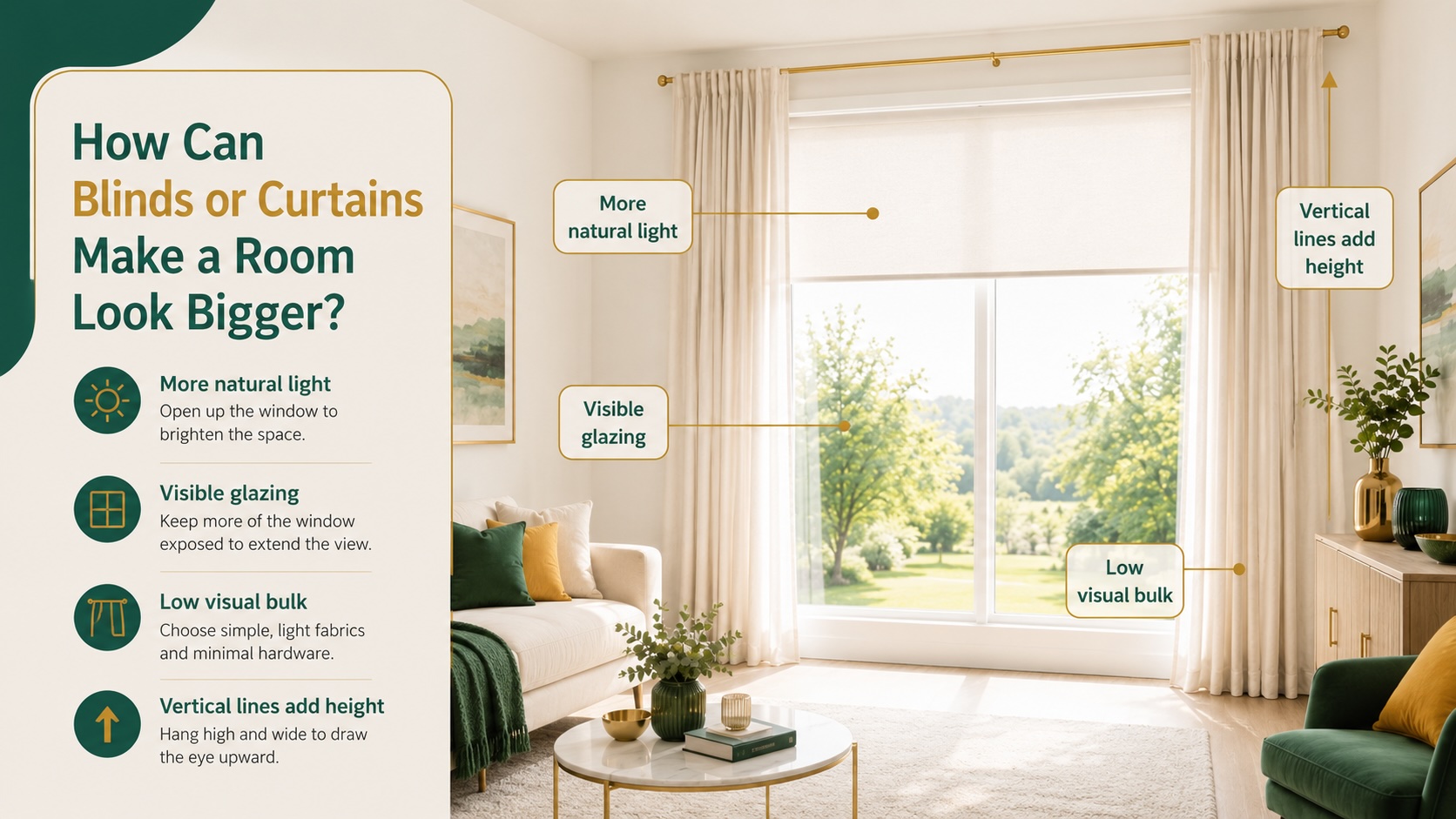
Blinds and curtains influence the way a room is perceived by changing the amount of visible glass, the direction of visual lines, the level of natural light and the amount of visual weight around the window.
The effect is psychological rather than physical, but it can still be significant.
More Visible Glass Can Make the Room Feel More Open
A window creates a visual connection with the outside.
When more of that glazing remains visible, the room can feel less enclosed because the eye is not stopped by a large area of fabric or material.
This is one reason compact blinds can work so well in smaller spaces. A Roller blind, for example, can leave most of the window exposed when raised.
Curtains can achieve something similar when they sit predominantly to the sides of the glazing rather than covering it.
Natural Light Can Increase the Sense of Space
Brighter rooms often feel more open than darker rooms.
Window treatments that allow useful daylight into the room can therefore contribute to a greater sense of space.
This does not mean the blind or curtain must always be fully open. Styles such as Venetian and Day & Night blinds can allow light to enter while still providing a degree of privacy.
The important point is to avoid blocking more light than the room actually needs.
Vertical Lines Can Emphasise Height
Strong vertical lines encourage the eye to travel upwards.
This is one reason long curtains can be effective in rooms with low ceilings. A continuous curtain running towards the floor can make the wall feel taller than a shorter treatment that visually stops halfway down it.
Vertical blinds can create a similar directional effect, although their suitability depends heavily on the size of the window.
Horizontal Lines Can Emphasise Width
Horizontal elements can draw attention across the room.
Venetian slats and Day & Night blinds naturally introduce horizontal lines, which can help emphasise the width of a window.
However, this effect needs some restraint. Strong, high-contrast horizontal patterns can also create visual busyness.
Low Visual Weight Helps Reduce Clutter
Some window treatments occupy more visual space than others.
A plain Roller blind has relatively little visual complexity. A heavily patterned Roman blind with deep folds has considerably more.
Neither is inherently better, but in a small room, reducing unnecessary visual weight can make the overall interior feel calmer and more spacious.
Colour Continuity Can Make Walls Feel Less Interrupted
When a blind or curtain is close in tone to the surrounding wall, the eye encounters fewer strong visual breaks.
This can make the window treatment recede into the overall scheme.
By contrast, a strongly contrasting blind creates a clear boundary around the window and makes that area more visually prominent.
The Main Principle
The most effective window treatments for making a room feel larger usually do some combination of the following:
preserve daylight + expose useful glazing + reduce visual bulk + create appropriate vertical or horizontal lines + avoid unnecessary contrast
The exact balance depends on whether the goal is to make the room feel brighter, wider, taller or simply less cluttered.
Is Making a Room Look Bigger the Same as Making It Look Brighter?
Not exactly.
Brightness and perceived size are closely related, but they are not the same thing. A brighter room often feels more open, but a room can be bright and still feel visually cramped if the window treatment is bulky, heavily patterned or strongly contrasted against the walls.
Brightness Is Only One Part of the Effect
Natural light can make a room feel more spacious because it reduces shadow and helps surfaces feel more open.
This is why blinds that preserve daylight, such as Roller, Venetian and Day & Night blinds, can work well in smaller rooms.
However, brightness alone does not determine whether the room feels larger.
For example, a pale Roman blind may reflect light well but still occupy a significant amount of visual space because of its fabric folds. A plain darker Roller blind may introduce less visual bulk, especially when raised.
Visual Weight Can Matter as Much as Colour
A room can feel smaller when the window treatment dominates the wall.
This can happen with:
- Heavy fabrics
- Deep folds
- Large patterns
- Thick slats
- Strong colour contrast
A lighter treatment is not automatically better if it still adds considerable visual mass.
More Light Does Not Always Mean More Space
A very bright blind or curtain can actually make the window area more prominent if it contrasts sharply with the surrounding walls.
For example, a brilliant white blind against a dark wall creates a strong visual boundary around the window.
A slightly darker blind that sits closer to the wall colour may create more continuity and feel less intrusive.
You Need to Consider the Overall Room
The most successful approach usually combines several factors:
brightness + visible glazing + low visual bulk + suitable colour contrast + proportion
If the room is already very bright, the priority may be reducing visual clutter rather than increasing light.
If the room is naturally dark, preserving as much daylight as possible becomes more important.
The Key Difference
A brighter room usually feels more open.
A room that looks bigger, however, usually benefits from a broader combination of:
light, proportion, visual continuity and reduced clutter
That is why choosing blinds and curtains purely by colour can be misleading.
Should You Make the Window Look Larger or the Room Look Larger?
They are closely connected, but they are not the same goal.
Sometimes the best way to make a room feel more spacious is to make the window itself appear larger. In other cases, it is better to make the window treatment visually recede so the room feels calmer and less divided.
Making the Window Look Larger
Curtains are particularly effective at changing the perceived size of a window because they are not restricted to the exact dimensions of the glass.
A curtain treatment can visually extend:
- Higher than the top of the window
- Wider than the window opening
- Further towards the floor
This can make a relatively modest window appear taller or broader than it actually is.
A larger-looking window can then contribute to a stronger sense of space in the room.
Making the Room Look Larger
Blinds often influence spaciousness in a different way.
Because they usually sit much closer to the window itself, they tend to preserve the original proportions of the opening rather than visually enlarging it.
Their strength is usually in:
- Reducing visual clutter
- Keeping the treatment compact
- Preserving useful daylight
- Leaving more glazing visible
- Creating a cleaner transition between window and wall
This is why a simple Roller blind can be highly effective in a very small room, even though it does not make the window itself look physically larger.
Curtains Can Change Perceived Architecture
Curtains can be used to alter how the eye reads the wall.
For example, a narrow window can appear wider when the overall curtain treatment occupies more horizontal space than the glass alone.
Likewise, a relatively short window can appear taller when the curtain creates a continuous vertical line towards the floor.
This makes curtains particularly useful when the proportions of the window are part of the problem.
Blinds Can Make the Window Feel Less Dominant
In some small rooms, enlarging the visual presence of the window is not necessary.
A compact blind that sits quietly within the overall design may work better.
If the blind is close in colour to the surrounding wall and does not introduce a large amount of fabric, pattern or contrast, the eye is less likely to stop at the window treatment.
The room can therefore feel more visually continuous.
Which Approach Is Better?
If the room has a small or awkwardly proportioned window, using curtains to make the opening appear taller or wider can be effective.
If the room is simply small and visually crowded, a compact blind may be the better option because it introduces less material into the space.
The distinction is useful:
Curtains can help change the perceived dimensions of the window.
Blinds are often better at reducing the visual footprint of the window treatment itself.
Both approaches can make a room feel larger, but they achieve the effect in different ways.
Roller Blinds: One of the Best Choices for Making a Room Feel Larger
Roller blinds are one of the strongest choices for small rooms because they combine low visual weight, simple lines and a compact appearance.
They do not make the room physically larger, but they can help the window area feel less cluttered and allow more attention to remain on the room itself.
Why Roller Blinds Work Well in Small Rooms
A Roller blind is essentially a single flat piece of fabric.
That simplicity matters.
Compared with window treatments that introduce folds, multiple slats or large amounts of fabric, a Roller blind creates relatively little visual complexity.
This can help a small room feel calmer and less crowded.
They Can Leave More of the Window Exposed
When raised, a Roller blind occupies relatively little visual space at the top of the window.
That can leave a large proportion of the glazing visible, which helps preserve:
- Natural light
- Views outside
- The visual depth created by the window
For a small room, keeping as much useful glazing visible as possible can be more important than choosing a particular colour.
Plain Fabrics Usually Work Best
If the aim is to make the room feel more spacious, a plain or subtly textured Roller blind is usually easier to integrate than a strongly patterned one.
Low-contrast fabrics tend to recede visually.
Large motifs, bold geometric designs or very strong colour contrasts can make the blind become a focal point instead.
That is not necessarily undesirable, but it is less likely to create a quiet, spacious effect.
Colour Can Help the Blind Recede
Roller blinds in colours close to the surrounding wall can create a more continuous appearance.
For example:
- Warm white with warm white walls
- Pale grey with soft grey walls
- Beige or linen tones with neutral interiors
This reduces the visual break between the wall and the window treatment.
A high-contrast Roller blind can still work, but it will generally draw more attention to the window.
Dark Roller Blinds Are Not Automatically Wrong
A dark Roller blind does not automatically make a room feel smaller.
In a bright room with large windows, dark window frames or a deliberate monochrome scheme, a darker blind can look very controlled.
The issue is more likely to arise when several factors combine, such as:
small window + limited daylight + dark blind + strong contrast
In that situation, the blind may become visually dominant.
Best Use
Roller blinds are particularly effective where the goal is to:
reduce visual clutter + preserve glazing + maintain simple lines + keep the window treatment unobtrusive
For a very small room, that combination makes them one of the safest and most versatile blind styles.
Roman Blinds: Can They Make a Room Look Bigger?
Roman blinds can work well in smaller rooms, but they need more careful consideration than Roller blinds because they introduce more fabric, more folds and more visual depth around the window.
They are therefore better suited to rooms where you want to balance spaciousness with a softer, more decorative look.
Why Roman Blinds Can Still Work in Small Rooms
Roman blinds can help a room feel larger when they are kept visually restrained.
The strongest choices are usually:
- Light or mid-tone colours
- Plain fabrics
- Subtle textures
- Low-contrast patterns
- Fabrics that coordinate closely with the wall colour
These choices allow the blind to contribute warmth without becoming the dominant feature in the room.
Fabric Folds Add Visual Weight
Unlike a Roller blind, a Roman blind forms horizontal folds as it is raised.
Those folds create texture and depth, which can make the window treatment feel more substantial.
In a large room, this can add richness.
In a compact room, however, too much fabric can make the window area feel heavier.
This is especially noticeable if the blind uses:
- A dark fabric
- A large pattern
- A thick texture
- Strong contrast with the wall
The Stack Can Reduce Visible Glass
A Roman blind also occupies more space at the top of the window when raised.
That matters in a small room because reducing the visible area of the glazing can also reduce the sense of openness.
This does not mean Roman blinds should be avoided.
It simply means they tend to work best where the window has enough height and the room receives sufficient daylight.
Roman Blinds Are Strongest Where Style Matters
A Roman blind can be the better choice when the aim is not only to make the room feel larger, but also to make it feel warmer, softer or more finished.
They are particularly effective in:
- Bedrooms
- Traditional living rooms
- Period interiors
- Rooms with simple furnishings that can support a more decorative window treatment
Plain Usually Works Better Than Busy
If spaciousness is the priority, a plain Roman blind usually has an advantage over a strongly patterned one.
A busy print creates more visual activity and draws attention towards the window.
A plain or subtly textured blind tends to sit more quietly within the room.
Best Use
Roman blinds are a good choice when you want:
softness + decoration + controlled visual weight
For the smallest rooms, Roller blinds will usually feel lighter.
But where the room can support a little more fabric, a carefully chosen Roman blind can still make the space feel refined without making it feel crowded.
Venetian Blinds: Can Horizontal Slats Make a Room Look Wider?
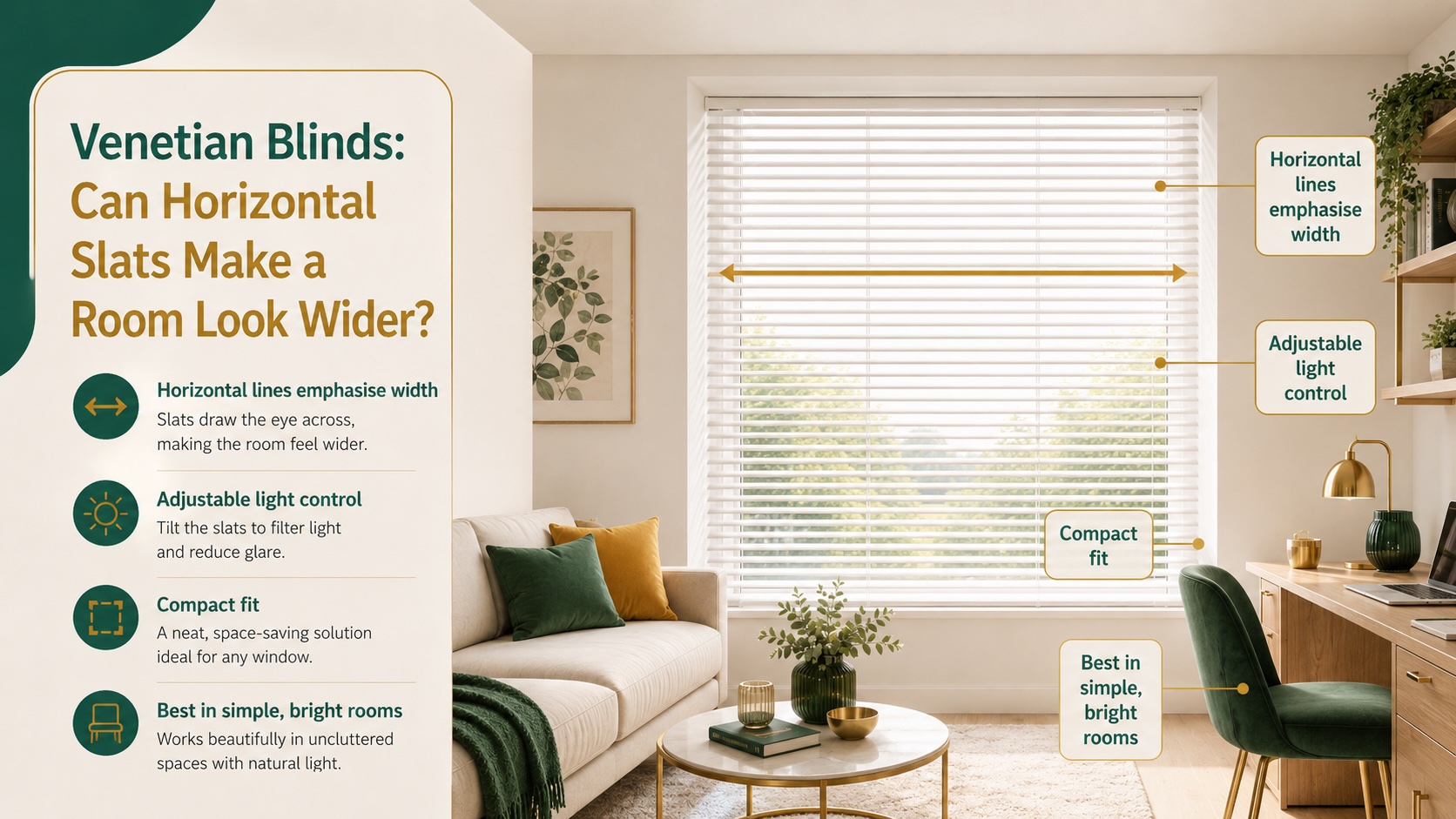
Venetian blinds can work particularly well in smaller rooms because they combine precise light control with a relatively compact profile.
Their horizontal slats also introduce a strong directional line across the window, which can help emphasise width.
Horizontal Lines Can Influence Perceived Width
The eye naturally follows repeated lines.
With Venetian blinds, the horizontal slats create a visual emphasis from side to side rather than top to bottom.
This can make the window feel broader, which may help a narrow room feel slightly more balanced.
The effect is subtle, but it is one reason Venetian blinds can suit rooms where width is more of a concern than height.
Light Control Is a Major Advantage
One of the strongest benefits of Venetian blinds is that the slats can be tilted rather than simply opened or closed.
This means you can maintain:
- Natural daylight
- A degree of privacy
- Some visibility through the window
- Directional control over incoming light
That flexibility is valuable in small rooms because it helps avoid the all-or-nothing effect of completely closing an opaque blind.
Slimmer Slats Usually Feel Lighter
The visual impact depends heavily on slat width and material.
Slimmer slats, particularly in metal Venetian blinds, tend to feel lighter and less dominant.
Wider wood or wood-effect slats create a stronger architectural presence and may feel heavier in a very compact room.
This does not make wider slats unsuitable, but the room and window need enough scale to support them.
Colour Still Matters
Pale Venetian blinds can help maintain a light, open appearance.
Common choices include:
- White
- Off-white
- Pale grey
- Soft metallic finishes
- Light neutral tones
Dark Venetian blinds can also work well in bright rooms or where they coordinate with dark window frames.
Again, contrast is often more important than the colour itself.
Repeated Slats Can Add Visual Busyness
Venetian blinds are not as visually quiet as a plain Roller blind.
The repeated horizontal lines create more detail across the window.
In a very small or already busy room, that extra structure can make the window treatment more noticeable.
This is why they tend to work best when the surrounding décor is relatively simple.
Best Use
Venetian blinds are particularly effective where the goal is to:
control daylight + maintain privacy + emphasise width + keep the window treatment relatively compact
They are one of the strongest choices for small rooms where flexibility matters as much as visual simplicity.
Metal Venetian Blinds for Small Rooms
Metal Venetian blinds are often better suited to compact rooms than heavier wood-effect alternatives because they usually have a slimmer, lighter visual profile.
That makes them particularly useful where the room already feels narrow, busy or short on natural light.
Why Metal Venetian Blinds Can Feel Less Heavy
The slats are typically thinner and visually more delicate than broad wooden slats.
This helps reduce the amount of visual mass around the window and can make the treatment feel more integrated with the architecture rather than added on top of it.
In smaller rooms, that restraint can be valuable.
They Work Well With Modern Interiors
Metal Venetian blinds tend to suit:
- Minimalist rooms
- Contemporary home offices
- Modern bedrooms
- Compact kitchens
- Small living spaces with clean lines
Their appearance is more structured than a Roller blind, but still relatively light.
They Allow Precise Daylight Control
Because the slats can be tilted, you can adjust how much light enters without fully opening the blind.
That can help maintain brightness throughout the day while still giving some privacy.
For a small room, this can be more useful than a fully opaque blind that needs to be either open or closed.
Light Finishes Usually Support a More Spacious Look
Pale finishes can help the blind recede visually.
White, soft grey, cream and subtle metallic tones are often easier to integrate into compact interiors.
Darker metal blinds can still work, especially where they coordinate with:
- Dark window frames
- Black hardware
- Monochrome schemes
- Strong contemporary interiors
The effect depends more on contrast and surrounding light than on the colour alone.
When They May Not Be the Best Choice
Metal Venetian blinds introduce repeated horizontal lines.
In a room that already contains:
- Busy wallpaper
- Strong shelving
- Patterned flooring
- Lots of decorative objects
the extra visual structure can make the window area feel more active.
In that situation, a plain Roller blind may create a calmer effect.
Best Use
Metal Venetian blinds are particularly effective where the aim is to:
keep the window treatment visually light + control daylight precisely + maintain privacy + suit a modern small room
For compact contemporary spaces, they are one of the strongest alternatives to a Roller blind.
Wood Venetian Blinds: When Do They Make a Room Feel Smaller?
Wood Venetian blinds can add warmth and character to a room, but they usually have more visual weight than metal Venetian blinds or Roller blinds.
In a small room, that extra presence can either enhance the space or make the window feel heavier, depending on the colour, slat width and overall interior.
Why Wood Venetian Blinds Can Feel Heavier
Wood and wood-effect slats tend to look more substantial.
That stronger structure can be attractive in:
- Traditional interiors
- Rooms with timber flooring
- Spaces with wooden furniture
- Warm neutral colour schemes
But in a very compact room, wide slats and darker finishes can dominate a small window.
This is particularly noticeable where the room already has limited daylight.
Dark Wood Can Increase Visual Weight
Deep walnut, dark oak or almost-black finishes create more contrast and absorb more visual attention.
They can still work well if the room has:
- Large windows
- Good natural light
- Pale walls
- Dark window frames
- A deliberately dramatic scheme
But in a small, dim room, they can make the window area feel more enclosed.
Light Wood Finishes Can Work Very Well
Pale oak, white, cream and light neutral finishes can create a much softer effect.
They retain the warmth and structure of a wood Venetian blind while reducing the sense of heaviness.
This makes them easier to use in smaller rooms.
Slat Width Matters
Wider slats create stronger horizontal lines and a bolder architectural look.
That can work well on larger windows.
On a very small window, however, wide slats may feel out of proportion.
Narrower slats generally create a lighter appearance and may suit compact spaces better.
They Can Still Help With Light and Privacy
Like all Venetian blinds, wood Venetian blinds can be tilted to control:
- Daylight
- Glare
- Privacy
- Views through the window
This flexibility helps prevent the room from becoming unnecessarily dark.
Best Use
Wood Venetian blinds are a good choice where the room has enough light and the aim is to combine:
warmth + privacy + horizontal structure + a more substantial decorative finish
For the smallest or darkest rooms, lighter finishes and more restrained slat widths are usually the safer option.
Day & Night Blinds: Good for Keeping Small Rooms Bright?
Day & Night blinds can be a strong option for smaller rooms because they allow more flexibility between privacy and natural light than a fully opaque blind.
That matters because small rooms often feel more cramped when the window has to remain completely covered during the day.
Why They Can Help a Room Feel More Open
Day & Night blinds use alternating sheer and opaque horizontal sections.
By adjusting the alignment of the fabric, you can allow more light into the room while still reducing direct views from outside.
That can be particularly useful in:
- Ground-floor rooms
- Street-facing rooms
- Small bedrooms
- Compact home offices
- Rooms where privacy is needed during daylight hours
Instead of choosing between fully open and fully closed, the blind can create an intermediate position.
Preserving Daylight Is Their Main Strength
For a small room, daylight is often more valuable than complete screening during the day.
A Day & Night blind can help maintain a brighter interior while still offering more privacy than an uncovered window.
This can make the room feel less enclosed.
The Horizontal Bands Affect the Look
The alternating bands create repeated horizontal lines across the window.
That can help emphasise width, which may be useful in a narrow room.
However, there is also a trade-off.
The pattern is more visually active than a plain Roller blind, so in a very small or already busy room it may draw more attention to the window.
Colour Choice Still Matters
Lighter and lower-contrast fabrics usually create a softer effect.
Good options for compact spaces often include:
- White
- Cream
- Pale grey
- Beige
- Soft neutral tones
A darker Day & Night blind can still work well, but it will generally have a stronger visual presence.
Better for Some Small Rooms Than Others
Day & Night blinds are especially useful where the room needs privacy during the day.
If privacy is not important and the priority is maximum simplicity, a plain Roller blind may create a quieter look.
If precise directional control is more important, Venetian blinds may be the stronger choice.
Best Use
Day & Night blinds work particularly well where the aim is to:
preserve daylight + maintain daytime privacy + keep the room feeling bright + avoid the all-or-nothing effect of an opaque blind
For small rooms that face a street or neighbouring property, that balance can make them one of the most practical options.
Vertical Blinds: Can Vertical Lines Make a Room Look Taller?
Vertical blinds can help emphasise the height of a room because their long, repeated louvres naturally draw the eye upwards and downwards.
That makes them quite different from Venetian or Day & Night blinds, which introduce horizontal lines instead.
Why Vertical Lines Can Help
Strong vertical lines can make a wall feel taller by encouraging the eye to travel from floor to ceiling.
Vertical blinds can therefore work well where the aim is to emphasise height, especially on:
- Tall windows
- Patio doors
- Wide glazed areas
- Full-height glazing
- Rooms with strong contemporary architecture
They can be particularly effective when the glazing itself is already a major visual feature.
They Work Best on Larger Windows
Vertical blinds usually make more sense on large expanses of glass than on very small windows.
On wide glazing, the repeated louvres feel proportionate and can enhance the room’s vertical structure.
On a small window, the same effect can become visually busy and make the blind feel oversized.
They Can Preserve Useful Daylight
Vertical louvres can be rotated to control light rather than simply being fully opened or closed.
That allows the room to retain some natural light while still reducing glare or direct views.
In a smaller room, this flexibility can help avoid the enclosed feeling that comes from completely blocking the window.
Colour and Fabric Matter
Light-coloured Vertical blinds usually create a softer, more spacious effect.
Suitable options include:
- White
- Cream
- Pale grey
- Beige
- Soft neutral tones
A darker Vertical blind can create a much stronger architectural statement, but it also has greater visual presence.
They Are Not Automatically the Best Choice for Small Rooms
Although vertical lines can emphasise height, that does not mean Vertical blinds are always the best option where space is limited.
The overall amount of material matters too.
A compact Roller blind may still create a lighter, less intrusive effect on a small window.
Vertical blinds are strongest where the window itself is large enough to justify the format.
Best Use
Vertical blinds are particularly effective where the aim is to:
emphasise height + control light across wide glazing + maintain privacy + create a strong vertical rhythm
They can help a room feel taller, but they are usually most successful on larger windows rather than compact openings.
Pleated and Cellular Blinds: Do Their Slim Profiles Help?
Pleated and cellular blinds can work well in smaller rooms because they usually have a clean, compact appearance and do not introduce the same visual bulk as heavier fabric treatments.
Their main advantage is that they tend to sit closely to the window, helping the room feel tidy and uncluttered.
Why a Slim Profile Matters
In a small room, every additional layer around the window adds visual weight.
A blind with a relatively slim profile can help by keeping the treatment contained within the window area rather than making it feel like a dominant feature.
This can be particularly useful where:
- The window is small
- The room is narrow
- Furniture sits close to the window
- The overall interior is minimalist
- Preserving a clean sightline matters
Pleated Fabric Creates Texture Without Heavy Folds
Pleated blinds introduce repeated folds, but these are generally much finer than the deeper folds of a Roman blind.
That gives the window some texture without creating the same sense of fabric volume.
In a compact room, this can offer a useful middle ground between a completely flat Roller blind and a more decorative Roman blind.
Cellular Blinds Can Add Depth Without Looking Bulky
Cellular blinds use a structured honeycomb-style construction.
Although the fabric has more depth than a simple Roller blind, the overall appearance can still remain relatively restrained.
Light-coloured cellular fabrics can be particularly effective where you want the window to feel soft rather than stark.
Light Colours Usually Work Best for Spaciousness
For a room that already feels small, pale shades tend to keep the blind visually lighter.
Good options include:
- Soft white
- Cream
- Pale grey
- Beige
- Light neutral tones
A colour close to the surrounding walls can also help the blind recede rather than becoming a separate visual block.
The Pleats Add More Visual Detail Than a Roller Blind
The trade-off is that pleated and cellular blinds introduce repeated horizontal lines.
That means they are not quite as visually simple as a plain Roller blind.
In a room that already contains strong pattern or texture, the extra structure may make the window feel busier.
Best Use
Pleated and cellular blinds work best where the aim is to:
keep the window treatment compact + add subtle texture + reduce visual bulk + maintain a clean appearance
They can be particularly effective in small contemporary rooms where a Roller blind feels too plain, but a heavier fabric blind would add too much visual weight.
Blackout Blinds: Do They Make Rooms Look Smaller?
Blackout blinds do not automatically make a room look smaller, but they can do so when they remove too much natural light from an already compact space.
The key issue is not the blackout fabric itself. It is how much daylight is being blocked and how visually dominant the blind becomes when closed.
When Blackout Blinds Can Make a Room Feel Smaller
A blackout blind can make a small room feel more enclosed when:
- The window is the main source of natural light
- The blind remains closed for long periods during the day
- The fabric is very dark
- The room already has limited daylight
- The blind strongly contrasts with the surrounding walls
In these conditions, the reduction in light can have a greater effect than the colour or style of the blind alone.
A Blackout Roller Blind Can Still Work Well
A blackout Roller blind can still be a very good choice in a small room because Roller blinds have a relatively simple, compact profile.
When raised, much of the glazing remains visible and the room can still benefit from natural light.
This means a pale or tonal blackout Roller blind can provide:
privacy and darkness when needed + a clean, unobtrusive appearance during the day
That can make it more suitable for a small bedroom than a heavier blackout curtain.
Colour Makes a Difference
A blackout blind does not need to look dark.
Blackout refers to how the fabric controls light, not necessarily its visible colour.
Light shades such as:
- White
- Cream
- Pale grey
- Beige
- Soft neutrals
can still create a lighter visual effect even when the fabric itself provides strong light blocking.
Bedrooms Need a Different Balance
In a bedroom, darkness may be more important than making the room look as large as possible.
That means a blackout blind can still be the right choice even if it slightly reduces the sense of openness when closed.
The priority should be the room’s function first.
Best Use
Blackout blinds work best in small rooms where:
darkness is genuinely needed + the blind can be opened during the day + the design remains visually simple
They are not inherently unsuitable for small spaces. The main risk comes from keeping an opaque blind closed in a room that already relies heavily on limited daylight.
Can Curtains Make a Small Room Look Bigger?
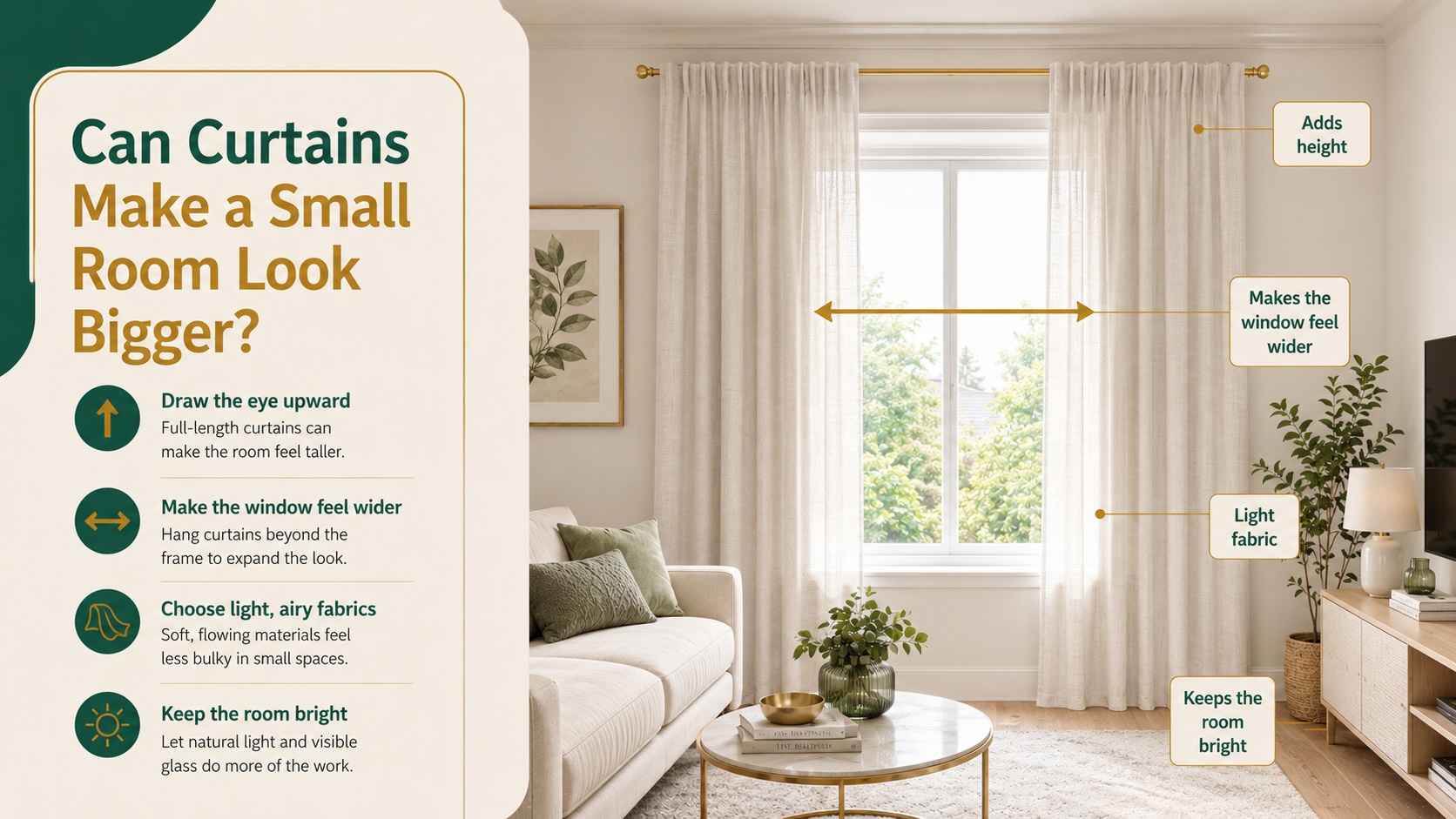
Yes. Curtains can make a small room feel larger, and in some situations they can have a stronger visual effect than blinds because they can change the perceived height and width of the window itself.
The key is to use them in a way that adds length and continuity rather than bulk.
Curtains Can Make a Window Look Taller
Long curtains create a strong vertical line.
When the fabric visually extends towards the floor, the eye follows that line downwards and upwards, which can make the wall and window feel taller.
This is one reason full-length curtains often work better than short curtains when the goal is to increase the sense of height.
They Can Also Make a Window Look Wider
Curtains do not have to visually stop at the exact edges of the glazing.
When the overall curtain treatment extends beyond the width of the window, the window area can appear broader than it really is.
This can be particularly useful where a small room has a narrow window.
Keeping More Glass Visible Helps
The effect is strongest when the curtains do not cover large areas of glazing while open.
More visible glass usually means:
- More natural light
- A stronger view outside
- Less visual obstruction
- A greater sense of depth
A generous curtain that permanently covers much of a small window can have the opposite effect.
Fabric Weight Matters
Curtains introduce more material than most blinds, so fabric choice becomes important.
Lighter or visually softer fabrics usually create less bulk.
Heavy fabrics with deep folds can make a small room feel more enclosed, particularly where the window is already modest.
That does not mean heavy curtains should never be used. They simply need enough room and light around them.
Tonal Colours Can Create Continuity
Curtains close in colour to the surrounding walls tend to blend into the room more easily.
This can reduce the number of strong visual boundaries and make the wall feel more continuous.
Strongly contrasting curtains make the window a more prominent feature, which may be desirable decoratively but is not always the best approach where maximum spaciousness is the priority.
Curtains and Blinds Create Space Differently
This is an important distinction.
A compact blind generally makes a small room feel larger by reducing the visual footprint of the window treatment.
Curtains can make a room feel larger by altering the perceived proportions of the window and wall.
Both approaches can work.
Best Use
Curtains are particularly effective where the aim is to:
make the window appear taller + create stronger vertical lines + visually broaden a narrow window + add softness without sacrificing too much daylight
For a small room, the most successful curtains are usually those that enhance the architecture without introducing unnecessary visual weight.
Floor-Length Curtains vs Short Curtains: Which Makes a Room Look Bigger?
If the goal is to make a room appear taller and more spacious, floor-length curtains usually have the advantage over short curtains.
The main reason is visual continuity.
Floor-Length Curtains Create a Stronger Vertical Line
A curtain that extends down towards the floor creates one continuous vertical element.
That can encourage the eye to travel from top to bottom rather than stopping at the windowsill.
In a small room, this can make the wall feel taller and the window treatment feel more integrated with the architecture.
Short Curtains Can Emphasise the Actual Window Size
Short curtains often end at or just below the sill.
That creates a clear horizontal stopping point and can draw attention to the exact dimensions of the window.
On a small window, this may make the opening feel more obviously compact.
By contrast, a longer curtain can visually extend beyond the window itself.
Full-Length Does Not Mean Heavy
The benefit comes from the length and vertical line, not from using a large amount of fabric.
A full-length curtain in a relatively simple fabric can feel much lighter than a shorter curtain with heavy folds, strong pattern or excessive fullness.
For small rooms, this distinction is important.
Colour Can Strengthen the Effect
Floor-length curtains that sit close in tone to the wall can create a more seamless vertical surface.
For example:
- Warm beige curtains with beige walls
- Soft grey curtains with pale grey walls
- Off-white curtains with neutral walls
This can help the curtains visually recede while still adding height.
A high-contrast curtain will create a stronger frame around the window, which may reduce the sense of continuity.
Short Curtains Still Have a Place
Short curtains are not automatically wrong.
They can make sense where:
- Furniture sits directly below the window
- A radiator limits available curtain length
- The room style deliberately suits café-style or sill-length curtains
- Practicality matters more than perceived height
But if the specific aim is to make the room feel larger, full-length curtains usually offer more visual advantage.
Best Use
Floor-length curtains are particularly effective where the aim is to:
make the wall feel taller + emphasise vertical lines + visually enlarge the window + create a more continuous look
In most small rooms, that makes them a stronger choice than short curtains when spaciousness is the priority.
Can Curtains Make a Ceiling Look Higher?
Yes. Curtains can help a ceiling appear higher because they create strong vertical lines that influence how the eye reads the wall.
The effect is usually strongest when the curtain treatment visually connects the upper part of the wall with the floor.
Why Vertical Lines Matter
The eye tends to follow the direction of long uninterrupted lines.
A curtain that runs vertically through much of the wall height can therefore make the room feel taller than one that visually stops around the window itself.
This is one reason full-length curtains are often effective in rooms with lower ceilings.
The Higher the Visual Starting Point, the Taller the Wall Can Feel
When the top of the curtain treatment sits visually higher than the window opening, the eye may perceive the window area as taller than it really is.
That can reduce the emphasis on the actual height of the window and shift attention towards the full wall height.
The effect is architectural rather than physical, but in a compact room it can make a noticeable difference.
Floor-Length Curtains Strengthen the Effect
Curtains that continue to the floor create a much more complete vertical line than short curtains.
That continuity helps avoid visually cutting the wall into separate sections.
In rooms where the ceiling already feels low, this can make the overall space feel more elongated.
Colour Continuity Can Help
Curtains close in tone to the wall can strengthen the effect because they create fewer visual interruptions.
For example:
- Pale grey curtains with pale grey walls
- Warm neutral curtains with beige walls
- Soft white curtains with off-white walls
The curtain still adds structure, but it does not create such a strong contrast boundary.
Pattern Direction Matters Too
A subtle vertical stripe can reinforce height by encouraging the eye to travel upwards.
However, strong contrasting stripes can become visually dominant.
If the room is already small, a restrained pattern is usually safer than a bold one.
Heavy Curtains Can Reduce the Benefit
Long curtains do not automatically make a ceiling feel higher.
If the fabric is very bulky, dark or heavily patterned, the additional visual weight can counteract some of the vertical effect.
The strongest combination for a small room is usually:
full length + relatively simple fabric + controlled fullness + tonal colour
Best Use
Curtains are particularly effective for low-ceiling rooms when the aim is to:
emphasise vertical lines + make the window appear taller + reduce horizontal visual breaks + create a stronger floor-to-ceiling connection
The important point is not simply that the curtain is long, but that the overall treatment encourages the eye to read the wall vertically.
Can Curtains Make a Window Look Wider?
Yes. Curtains can make a window appear wider because the overall treatment can extend beyond the actual edges of the glass.
This changes how the eye reads the opening and can make a narrow window feel more substantial.
Why Width Matters
A small or narrow window can make a wall feel broken up and visually confined.
By allowing the curtain treatment to occupy more horizontal space, the window area can appear broader and more balanced within the room.
This can be particularly effective in:
- Narrow living rooms
- Small bedrooms
- Rooms with tall but slim windows
- Spaces where the window feels undersized for the wall
Curtains Can Visually Extend Beyond the Glass
Unlike most blinds, curtains are not visually restricted to the dimensions of the window opening.
This means the overall curtain treatment can create the impression of a wider architectural feature.
The eye may read the curtain area as part of the window, rather than focusing only on the glass itself.
Keeping the Glass Clear Helps
The effect is strongest when the curtains do not cover too much of the glazing while open.
That allows the room to retain:
- More daylight
- A wider visible window area
- A stronger view outside
- Greater visual depth
If too much fabric sits across the glass, the window can actually appear narrower.
Fullness Needs Restraint
A very full curtain treatment can add width, but it can also add significant visual bulk.
In a small room, excessive fabric can make the wall feel heavier.
The aim is to create the impression of a wider window without making the curtain itself dominate the room.
Colour Can Help the Treatment Feel Broader
Curtains close in tone to the wall can visually merge with the surrounding surface.
This can make the full curtain area feel like part of the architecture rather than a separate object.
A strongly contrasting curtain will create a more defined frame, which can be attractive but also more visually dominant.
Best Use
Curtains are particularly effective where the aim is to:
make a narrow window appear wider + preserve visible glazing + create a broader visual frame + improve the balance of the wall
This is one area where curtains can have a clear advantage over blinds, because they can alter the perceived width of the window rather than simply following its existing dimensions.
Eyelet, Pencil Pleat or Wave Curtains: Which Look Best in a Small Room?
Curtain heading style can influence how heavy, structured or streamlined a window treatment appears.
In a small room, that matters because some headings create cleaner vertical lines, while others introduce more folds and visual detail.
Wave Curtains: Usually the Cleanest Look
Wave curtains tend to create smooth, regular folds with a relatively controlled appearance.
That makes them particularly well suited to:
- Modern interiors
- Small living rooms
- Compact bedrooms
- Rooms where visual simplicity matters
The folds are consistent and structured, so the curtain tends to look calmer than more gathered styles.
For a small room, this can help reduce visual clutter.
Eyelet Curtains: Simple but More Defined
Eyelet curtains also create relatively regular folds.
Their appearance is usually clean and contemporary, but the large eyelets themselves become part of the visual design.
That can work well where the room already has:
- Metal finishes
- Simple furniture
- Modern styling
They can still make a room feel spacious, especially when the fabric is plain and the curtains are full length.
However, the heading is slightly more visually noticeable than a very minimal wave treatment.
Pencil Pleat Curtains: More Traditional and More Textured
Pencil pleat curtains create a tighter, more gathered heading.
That can add softness and character, but it also introduces more visual activity.
In a small room, this may make the top of the window feel busier, particularly if combined with:
- Heavy fabric
- Strong pattern
- Dark colour
- Generous fullness
They can still work well in traditional interiors, but they are not usually the first choice where the main aim is to create a streamlined, spacious appearance.
The Heading Should Match the Fabric
The effect of the heading cannot be separated completely from the fabric.
A wave curtain in a heavy dark textile can still feel substantial.
A pencil pleat curtain in a light, plain fabric may still look relatively soft and unobtrusive.
For small spaces, the strongest combinations are usually those that keep both the heading and the fabric visually restrained.
Which Is Best?
If making the room feel larger is the priority:
Wave curtains are often the strongest choice for a clean, modern effect.
Eyelet curtains can also work very well where a slightly more defined contemporary look is wanted.
Pencil pleat curtains suit more traditional rooms, but generally introduce greater visual detail.
The broader principle is that a simple, regular curtain heading tends to work better in a small room than one with dense gathering or excessive fabric at the top of the window.
How Much Curtain Fullness Is Too Much in a Small Room?
Curtain fullness affects how rich and substantial the fabric looks, but in a small room, too much fullness can add unnecessary bulk, depth and visual weight around the window.
The aim is to create enough fabric for the curtains to hang attractively without making the treatment feel oversized for the room.
Why More Fabric Is Not Always Better
Full curtains can look luxurious, but every additional fold adds volume.
In a compact space, that can make the window area feel heavier and reduce the sense of openness.
This is particularly noticeable where the curtains are:
- Made from thick fabric
- Dark in colour
- Strongly patterned
- Used on a small window
- Combined with other window treatments
Excess Fullness Can Reduce Visible Glass
When curtains are open, the fabric gathers at the sides of the window.
The larger this stack becomes, the more likely it is to cover part of the glazing.
That matters in a small room because visible glass helps preserve natural light and visual depth.
If the curtains occupy too much of the window even when open, they can make the opening appear narrower.
Fabric Weight Changes the Effect
The same amount of fullness can look very different depending on the fabric.
A lightweight curtain with soft folds may still feel relatively airy.
A heavy velvet or densely woven fabric with the same amount of fullness can look much more substantial.
This means fullness should always be considered alongside:
- Fabric weight
- Texture
- Colour
- Pattern
- Window size
More Fullness Can Work in Larger Small Rooms
Not every compact room needs extremely restrained curtains.
A room with:
- A large window
- High ceilings
- Plenty of natural light
- Simple furniture
may be able to accommodate fuller curtains without feeling crowded.
The problem is usually not fullness on its own, but fullness combined with limited space and visual complexity.
Keep the Overall Treatment Proportionate
If spaciousness is the priority, the curtain should complement the scale of the window rather than overwhelm it.
A more restrained treatment usually works better where:
- The room is very narrow
- The window is small
- The walls are already busy
- The curtains are dark or heavily textured
Best Approach
For a small room, the strongest curtain treatment is usually one that provides:
enough fullness for attractive folds + a manageable side stack + plenty of visible glazing + limited visual bulk
The most expensive or luxurious-looking option is not necessarily the one with the most fabric. In a compact room, proportion is usually more important than volume.
Are Sheer Curtains Good for Making Rooms Feel Bigger?
Yes. Sheer curtains can be particularly effective in small rooms because they soften the window without blocking as much natural light as heavier curtains.
Their main advantage is that they add privacy, texture and softness while allowing the room to remain bright and visually open.
Why Sheer Curtains Can Help
Small rooms often feel more spacious when there is plenty of daylight and a visible connection to the outside.
Sheer curtains can support both.
They diffuse incoming light rather than fully blocking it, which can help reduce harsh glare while maintaining brightness.
This makes them especially useful in:
- Small living rooms
- Compact bedrooms
- Home offices
- Street-facing rooms
- Rooms that feel dark or enclosed
They Add Less Visual Weight
Compared with heavy curtains, sheer fabrics usually feel lighter and less dominant.
They move softly, allow some light through and do not create the same dense block of fabric at the window.
That can help the room feel less cluttered.
Sheers Can Make the Window Feel Larger
When used as full-length curtains, sheers can also create long vertical lines.
This can help:
- Emphasise height
- Make the window appear taller
- Create a stronger floor-to-ceiling effect
Because the fabric remains visually light, this vertical effect can be achieved without adding too much bulk.
They Can Preserve the View
Depending on the weave and light conditions, sheer curtains can maintain some visual connection with the outside.
That can add a sense of depth because the eye is not stopped by a completely opaque surface.
This is particularly useful in small rooms where every sense of openness helps.
Privacy Is the Main Limitation
Sheer curtains should not be treated as a complete privacy solution in all conditions.
During the day, they can reduce direct views into the room.
At night, when the interior is illuminated and it is darker outside, privacy can be much more limited.
For rooms requiring stronger privacy, sheers may need to be combined with another window treatment.
Layering Needs Care in Small Rooms
A sheer curtain combined with another curtain or blind can provide excellent flexibility.
However, every additional layer also increases visual mass.
In a very small room, a simple sheer treatment may create a more spacious effect than a heavily layered window.
Best Use
Sheer curtains work particularly well where the aim is to:
maintain brightness + soften the window + create vertical lines + reduce visual heaviness
They are one of the strongest curtain options for making a small room feel lighter and more open, provided their privacy limitations suit the space.
Do Heavy Curtains Make a Room Look Smaller?
Heavy curtains can make a room feel smaller, particularly when the space is already compact, dark or visually busy.
The main issue is visual weight. Thick fabrics, deep folds and dark colours create a stronger presence around the window and can make that part of the room feel more enclosed.
Why Heavy Fabrics Can Reduce the Sense of Space
Dense curtain fabrics tend to:
- Create deeper folds
- Form a larger stack when open
- Cover more of the wall and glazing
- Absorb more visual attention
- Add more texture and depth
In a small room, all of this can make the window treatment feel more dominant.
Dark Heavy Curtains Have the Strongest Effect
A heavy curtain in a deep colour usually has more visual impact than a pale lightweight curtain.
This is especially true where:
- The room has limited natural light
- The walls are also dark
- The window is small
- The curtain strongly contrasts with its surroundings
In that situation, the curtains can make the room feel more enclosed.
Heavy Curtains Can Still Work
They are not automatically unsuitable for small rooms.
A compact room with:
- A large window
- High ceilings
- Pale walls
- Plenty of natural light
- Minimal furniture
may be able to support a heavier curtain without feeling cramped.
The effect depends on the whole scheme.
Texture Matters as Much as Weight
Velvet, thick jacquards and heavily woven fabrics create a richer, more tactile appearance.
That can add warmth and depth, but it also increases visual complexity.
If spaciousness is the priority, smoother or more lightly textured fabrics usually feel less imposing.
Full-Length Can Still Be Better Than Short
Even a heavier curtain may retain some of the advantages of a full-length treatment.
The vertical line can still help emphasise height.
The challenge is to balance that benefit against the additional bulk of the fabric.
Best Use
Heavy curtains are better suited where the goal is:
richness + warmth + stronger decorative impact
If the main aim is to make a small room feel larger, lighter fabrics are usually the safer choice.
The issue is not simply whether the curtain is heavy, but whether the room has enough light, scale and simplicity to support that visual weight.
What Colour Blinds Make a Room Look Bigger?
Colour can influence how large a room feels, but there is no single shade that automatically makes every space appear bigger.
The most reliable approach is usually to choose colours that maintain brightness, reduce harsh contrast and help the blind sit comfortably within the overall scheme.
Light Colours Are Usually the Safest Choice
Pale blinds generally work well in small rooms because they reflect more light visually and tend to feel less dominant.
Common options include:
- White
- Off-white
- Cream
- Pale grey
- Beige
- Soft taupe
- Light natural tones
These colours are especially useful where the room already receives limited daylight.
Tonal Continuity Can Matter More Than Absolute Colour
A blind does not need to be white to make a room feel more spacious.
If the walls are warm beige, a similar neutral blind may create more visual continuity than a bright white one.
Likewise, a soft grey blind can work very well against pale grey walls.
The key is often to avoid creating a strong visual interruption.
High Contrast Can Make the Window More Prominent
A dark blind against a very pale wall creates a strong boundary around the window.
That can be attractive, but it also makes the blind more visually noticeable.
If the goal is to make the room feel calmer and less divided, a lower-contrast combination is usually more effective.
Warm and Cool Colours Behave Differently
Warm neutrals such as cream, beige and soft taupe tend to create a softer, more inviting feel.
Cooler shades such as pale grey and soft blue-grey can feel cleaner and more contemporary.
Neither automatically makes a room look larger.
The better choice is usually the one that works with the room’s existing wall colour, flooring and natural light.
Dark Blinds Can Still Work
Dark blinds are not automatically unsuitable for small rooms.
They can work well where:
- The room has large windows
- There is plenty of natural light
- The window frames are dark
- The overall scheme is monochrome
- The blind is intended to create a deliberate architectural feature
The main risk comes when dark colour is combined with limited daylight and a small window.
Best Approach
If making the room feel larger is the priority, choose a blind colour that helps create:
brightness + continuity + low visual contrast
In many small rooms, that means pale or mid-tone neutrals that sit relatively close to the surrounding wall colour.
Should Blinds Match the Wall Colour to Make a Room Look Bigger?
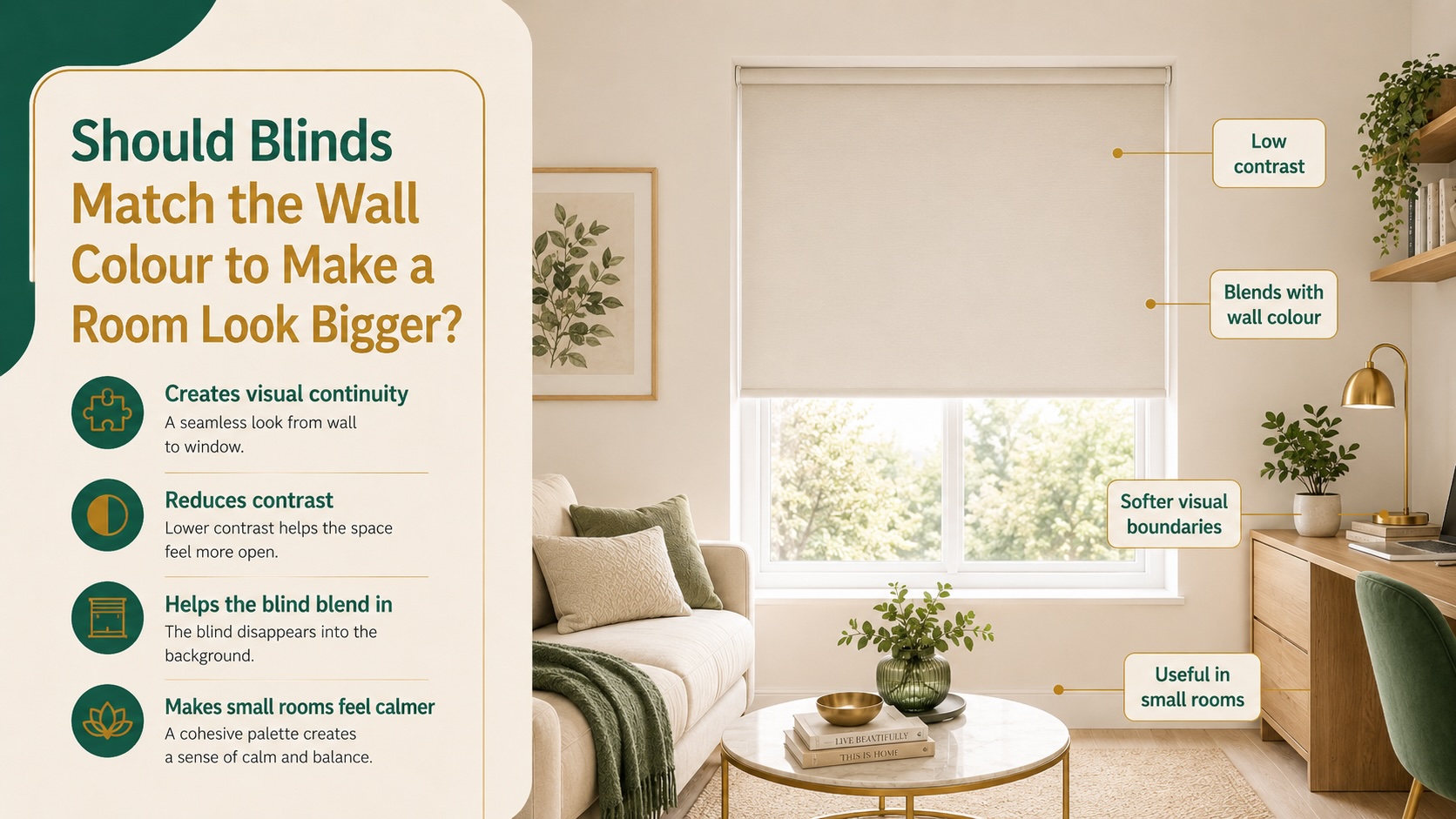
They do not have to match exactly, but choosing a blind that sits close to the wall colour can help a small room feel more continuous and less visually broken up.
The principle is simple: the fewer strong colour boundaries the eye encounters, the calmer and more open the room can feel.
Tonal Matching Can Reduce Visual Interruptions
If the blind and wall are similar in tone, the window treatment is less likely to stand out as a separate block.
For example:
- Warm white blind with warm white walls
- Soft grey blind with pale grey walls
- Beige blind with neutral walls
- Light taupe blind with similar earthy tones
This can make the window area feel more integrated into the room.
Exact Matching Is Not Necessary
Trying to match the wall colour perfectly is not essential.
A slight tonal variation often works just as well and can prevent the room from feeling flat.
The aim is usually coordination rather than duplication.
Contrast Creates a Stronger Focal Point
A dark blind against a pale wall, or a bright white blind against a deep wall colour, creates a clear visual boundary.
That may be desirable if you want the window to become a feature.
But if the priority is making the room feel larger, strong contrast can make the space feel more segmented.
Consider the Window Frame Too
The best choice may also depend on the colour of the frame.
A blind that coordinates with dark frames can sometimes look more integrated than one chosen only to match the wall.
This is especially true in contemporary interiors with black or anthracite window frames.
Tonal Schemes Usually Work Best in Small Rooms
Where spaciousness is the main goal, low-contrast combinations are generally easier to use.
That does not mean every element has to be pale.
A mid-tone blind can still work very well if it sits comfortably within the room’s overall palette.
Best Approach
If you want blinds to help a room feel bigger, aim for:
similar undertones + moderate contrast + visual continuity
Matching the wall exactly is optional.
What matters more is avoiding a colour combination that makes the blind feel disconnected from the rest of the room.
Do White Blinds Always Make a Room Look Bigger?
No. White blinds can help a room feel brighter and lighter, but they do not automatically make every space look larger.
Their effect depends on contrast, blind style, window size and the surrounding colour scheme.
White Can Help Maintain Brightness
White and off-white blinds usually feel visually light and can work particularly well in rooms that already have pale walls and good natural light.
They are often a safe choice for:
- Small bedrooms
- Compact living rooms
- Home offices
- Narrow rooms
- Spaces with limited natural light
In these settings, white can help keep the window area feeling clean and unobtrusive.
Strong Contrast Can Have the Opposite Effect
A bright white blind against a very dark wall creates a strong visual break.
That contrast can make the window treatment more noticeable and divide the wall into separate visual areas.
If the aim is maximum continuity, a softer neutral that sits closer to the wall colour may actually work better.
The Blind Style Still Matters
A white blind can still look visually heavy if the style itself introduces a lot of material or structure.
For example:
- A white Roman blind still has fabric folds
- A white Wood Venetian blind still has substantial slats
- A white Day & Night blind still creates repeated horizontal bands
By contrast, a mid-tone Roller blind may feel lighter simply because the design is flatter and less visually complex.
Warm White vs Brilliant White
The undertone of white matters.
Brilliant white can feel stark in a room with warm beige, cream or natural wood tones.
A warmer white or soft ivory may integrate more naturally and create better visual continuity.
Similarly, a cooler white may work better in rooms with grey, blue or black finishes.
White Is Most Effective When It Belongs to the Scheme
White blinds tend to work best when they coordinate with other elements such as:
- Window frames
- Skirting boards
- Doors
- Ceilings
- Wall colour
- Furniture
This makes the blind feel intentional rather than isolated.
Best Approach
White blinds can be excellent for making a small room feel lighter and more open, but they are not a universal solution.
The strongest result usually comes from choosing a shade that creates:
brightness + low visual weight + sensible contrast + harmony with the surrounding room
In some interiors, that will be white. In others, a soft grey, beige, cream or another tonal neutral may create a more spacious effect.
Can Dark Blinds Work in a Small Room?
Yes. Dark blinds can work in a small room, but they need to be used more carefully because they create a stronger visual presence than pale or tonal blinds.
The key issue is not simply that dark colours make rooms feel smaller. What matters is how much contrast they create, how much natural light the room receives and how visually heavy the blind style already is.
Dark Blinds Can Add Definition
In some interiors, a dark blind can actually make the window feel more intentional and structured.
This can work well where the room has:
- Large windows
- Plenty of natural light
- Pale walls
- Dark window frames
- Black or charcoal hardware
- A strong monochrome or contemporary scheme
In these cases, the dark blind can feel coordinated rather than oppressive.
Contrast Is the Main Consideration
A dark blind against a very pale wall will create a strong boundary around the window.
That can make the blind more noticeable and visually break up the wall.
If the room is already small, this extra contrast can make the window treatment feel more dominant.
By contrast, a dark blind paired with dark window frames or a similarly deep wall tone may feel much more integrated.
Blind Type Matters
A dark Roller blind usually has a simpler visual profile than a dark Roman or Wood Venetian blind.
This means the colour itself may be strong, but the overall treatment can still feel relatively controlled.
A dark blind becomes more visually heavy when combined with:
- Deep fabric folds
- Wide slats
- Strong pattern
- Heavy texture
- Limited daylight
Dark Does Not Mean No Daylight
If the blind can be opened or adjusted during the day, a dark colour does not necessarily reduce the room’s brightness all the time.
For example, a dark Venetian blind can still be tilted to admit light.
A dark Roller blind can be raised fully when privacy is not needed.
The practical effect therefore depends on how the blind is used as well as how it looks.
When Dark Blinds Are More Risky
Use more caution where the room has:
- A very small window
- Limited natural light
- Dark walls and flooring
- Low ceilings
- A lot of existing visual clutter
In this type of space, a dark blind may add too much visual weight.
Best Approach
Dark blinds can work in small rooms when they are used deliberately.
The strongest combination is usually:
good daylight + controlled contrast + simple blind style + coordination with other dark elements
If the room is already dim or visually heavy, a lighter or more tonal blind will usually create a more spacious effect.
What Colour Curtains Make a Room Look Bigger?
Curtain colour can influence how spacious a room feels, but the most effective choice usually depends on how closely the curtains relate to the walls, how much natural light the room receives and how visually heavy the fabric is.
Light Colours Are Usually the Safest Option
Pale curtains tend to feel less dominant and can help maintain a brighter appearance.
Good choices for smaller rooms often include:
- White
- Off-white
- Cream
- Pale grey
- Beige
- Soft taupe
- Light natural shades
These colours are particularly useful where the room already has limited daylight.
Tonal Curtains Can Create More Continuity
Curtains that are similar in tone to the walls can help the room feel less visually divided.
For example:
- Warm beige curtains with beige walls
- Pale grey curtains with soft grey walls
- Off-white curtains with cream walls
This creates a more continuous vertical surface and can help the curtains visually recede.
Strong Contrast Makes the Window More Prominent
Dark curtains against pale walls create a much stronger frame around the window.
That can be attractive, but it also draws more attention to the window treatment.
If the aim is to make the room feel larger, lower-contrast combinations are usually easier to work with.
Warm and Cool Colours Affect the Mood Differently
Warm neutrals such as cream, sand and soft beige can make a room feel softer and more inviting.
Cooler shades such as pale grey or blue-grey can create a cleaner, more contemporary effect.
Neither automatically makes the room look larger.
The best choice is usually the one that coordinates with the room’s existing undertones.
Dark Curtains Can Still Work
Dark curtains are not automatically unsuitable for small rooms.
They can work well where:
- The room has large windows
- Natural light is strong
- Walls are pale
- The curtains are full length
- The overall scheme deliberately uses strong contrast
In these cases, the vertical line of the curtains can still help emphasise height.
Best Approach
If the goal is to make the room feel more spacious, choose curtain colours that support:
brightness + continuity + vertical flow + controlled contrast
In most small rooms, pale or tonal curtains are the safest choice, but the relationship between the curtain and the wall is usually more important than the colour alone.
Should Curtains Match the Walls?
Curtains do not need to match the walls exactly, but using a similar tone or closely related colour can help a small room feel more continuous and less visually fragmented.
This is especially useful where the aim is to make the room appear larger.
Tonal Matching Creates a More Seamless Look
When the curtains sit close to the wall colour, the transition between wall and fabric is softer.
This can make the curtains feel more like part of the architecture rather than a separate decorative feature.
For example:
- Soft grey curtains with pale grey walls
- Warm beige curtains with neutral walls
- Cream curtains with off-white walls
- Muted green curtains with similarly toned walls
The colours do not need to be identical. A close tonal relationship is usually enough.
Exact Matching Can Look Flat
Matching the curtains perfectly to the walls can work, but it is not always necessary.
A slight variation in shade or texture can add depth without creating too much contrast.
This can be particularly effective where the room has a simple colour palette and you want the window treatment to feel integrated rather than invisible.
Strong Contrast Makes the Window More Dominant
If the curtains are much darker or brighter than the walls, they create a stronger frame around the window.
That can be useful if the window is intended to be a focal point.
However, in a compact room, strong contrast can also make the space feel more segmented.
Where spaciousness is the priority, lower contrast usually gives a calmer result.
Pattern Can Change the Effect
Even if the curtain colour is similar to the wall, a strong pattern can make the treatment stand out.
A plain or subtly textured curtain usually creates greater visual continuity than one with a large contrasting print.
This is why colour and pattern should be considered together.
Texture Can Add Interest Without Breaking Continuity
If you want the curtains to sit close to the wall colour without the room feeling too uniform, texture can help.
For example:
- Linen-look fabric
- Fine woven texture
- Soft slub finish
- Subtle tonal weave
These can add interest while preserving the same overall colour family.
Best Approach
If making the room feel larger is the priority, aim for:
similar colour family + low contrast + subtle texture + visual continuity
Curtains do not have to disappear into the walls completely.
They simply need to avoid creating an unnecessarily strong visual break.
Plain vs Patterned Blinds: Which Makes a Room Look Bigger?
If the aim is to make a room feel larger, plain or low-contrast blinds are usually the safer choice.
They create less visual activity, which can help the window treatment recede into the room rather than becoming a dominant feature.
Why Plain Blinds Often Work Better
A plain blind presents one relatively continuous surface.
That can help reduce:
- Visual clutter
- Strong focal points
- Competing shapes
- Unnecessary contrast
In a small room, this simplicity can make the overall space feel calmer and more open.
Pattern Draws Attention to the Window
Patterned blinds naturally attract the eye.
The stronger the pattern, the more the blind becomes part of the room’s visual focus.
This can be desirable if the window is intended to be decorative, but it is less useful where the priority is making the room feel larger.
Large Patterns Can Feel Overpowering
Bold geometric shapes, oversized florals or strong contrasting motifs can dominate a small window.
If the window itself is modest, a very large pattern can make the blind feel out of proportion with the surrounding wall.
This can make the room feel busier.
Small Patterns Are Not Automatically Better
A small-scale pattern can be easier to use, but that does not mean every small pattern creates a spacious effect.
A dense repeated design with lots of contrast can still feel visually noisy.
The more important factor is usually:
pattern scale + colour contrast + density
rather than pattern size alone.
Subtle Patterns Can Work Well
Pattern does not have to be avoided entirely.
A blind with:
- Tonal stripes
- Fine geometric detail
- Soft botanical motifs
- Low-contrast woven effects
can add interest without making the room feel cluttered.
This is particularly effective where the rest of the interior is relatively simple.
Pattern Can Also Influence Perceived Shape
Directional patterns can subtly affect how the window is read.
For example:
- Vertical lines may emphasise height
- Horizontal lines may emphasise width
But the effect is usually strongest when the pattern is restrained rather than highly contrasting.
Best Approach
If spaciousness is the main priority, choose:
plain fabric + subtle texture + low contrast
If you want pattern, keep it proportionate to the size of the window and the visual complexity of the room.
The key is not necessarily to avoid pattern, but to avoid making the blind the busiest element in an already small space.
Do Small Patterns Work Better Than Large Patterns in Small Rooms?
Not always.
Smaller patterns are often easier to use in compact rooms because they are usually more proportionate to the window and surrounding space. However, pattern density and contrast matter just as much as pattern size.
Why Large Patterns Can Be Difficult
A large-scale design can dominate a small blind or curtain because only a few parts of the pattern may be visible at once.
This can make the window treatment feel:
- More visually prominent
- Heavier
- Less integrated with the wall
- Out of scale with the room
Bold florals and oversized geometric designs are the most obvious examples.
Small Patterns Can Still Feel Busy
A very small pattern can also create visual noise if it is densely repeated or highly contrasting.
For example, a tightly packed black-and-white print may feel much busier than a large, softly coloured botanical design.
This is why small does not automatically mean subtle.
Contrast Is Often More Important Than Scale
Low-contrast patterns tend to recede more easily.
A pattern using several shades from the same colour family will usually feel calmer than one combining very dark and very light colours.
For a small room, this can make a significant difference.
Match the Pattern to the Window
The size of the window matters too.
A narrow blind may suit:
- Fine stripes
- Small botanical motifs
- Subtle geometrics
- Tonal textures
A larger window gives more room for a broader repeat without the pattern feeling compressed.
Directional Patterns Can Help
Pattern direction can also influence perception.
Vertical lines can reinforce height, while horizontal lines can emphasise width.
Used carefully, this can support the room’s proportions rather than simply decorate the window.
Best Approach
For most small rooms, the safest pattern is:
moderate or small scale + low contrast + plenty of visual breathing space
The goal is not necessarily to choose the smallest possible pattern.
It is to choose one that feels proportionate, calm and compatible with the size of the room.
What Curtain Fabrics Make a Room Feel More Spacious?
Curtain fabric can have a significant effect on how heavy or open a room feels.
If the aim is to make a small room appear more spacious, fabrics that look light, smooth and visually restrained are usually the strongest choice.
Lightweight Fabrics Usually Feel Less Dominant
Lightweight curtains tend to create softer folds and less visual bulk than very dense fabrics.
Good options include:
- Linen-look fabrics
- Light cotton blends
- Voiles and sheers
- Fine woven fabrics
- Smooth plain fabrics
These materials can soften the window without making it feel heavily dressed.
Linen-Look Fabrics Work Particularly Well
Linen-look curtains can be effective in smaller rooms because they combine texture with a relatively relaxed appearance.
They add some visual interest, but the texture is usually subtle enough not to overwhelm the space.
This makes them a good choice where a completely plain fabric would feel too minimal.
Sheer Fabrics Help Preserve Light
Sheer curtains are among the strongest options where brightness is important.
They allow daylight to filter through and can help maintain a visual connection with the outside.
That can make the room feel less enclosed.
Their main limitation is privacy, particularly after dark, so they are often best suited to rooms where complete screening is not always required.
Smooth Fabrics Create a Cleaner Look
Smooth, plain fabrics can make a curtain treatment feel visually quieter.
They are especially effective in modern or minimalist rooms where the goal is to reduce competing textures and patterns.
The simpler the surface, the less attention the curtain tends to demand.
Heavy Texture Adds Visual Weight
Highly textured fabrics can be attractive, but they create more depth and shadow.
Examples include:
- Heavy velvet
- Thick chenille
- Deeply woven fabrics
- Strong jacquards
- Highly raised textures
In a small room, these fabrics can make the curtains feel more substantial and visually closer to the viewer.
Fabric Should Work With the Colour
A lightweight fabric in a very dark, high-contrast colour can still have a strong presence.
Likewise, a pale curtain in a very heavy fabric can still feel bulky.
The most spacious effect usually comes from combining:
lighter visual weight + restrained texture + suitable colour + controlled fullness
Best Approach
For most small rooms, the strongest curtain fabrics are those that add softness without creating excessive mass.
A good rule is:
lightweight or medium-weight fabric + subtle texture + relatively smooth surface + low visual contrast
This allows the curtains to contribute to the room without making the window treatment feel larger than the space itself.
Does Fabric Texture Make a Room Look Smaller?
Not necessarily. Texture can add depth and character to a room without making it feel smaller, but heavily textured fabrics usually have more visual weight than smoother ones.
In compact spaces, the key is to distinguish between subtle texture and texture that becomes a dominant feature.
Subtle Texture Can Add Interest Without Adding Clutter
A lightly woven or linen-look fabric can stop curtains or blinds from feeling flat while still maintaining a calm appearance.
Examples include:
- Fine weaves
- Linen-look finishes
- Soft slub textures
- Tonal woven effects
- Very subtle jacquards
These can work particularly well in neutral interiors where some texture is needed to prevent the room from feeling too plain.
Heavy Texture Creates More Depth and Shadow
Thicker, more tactile fabrics create stronger highlights and shadows across the surface.
That can make the treatment feel more substantial.
Examples include:
- Velvet
- Chenille
- Chunky woven fabrics
- Deep embossed textures
- Heavy jacquards
In a small room, this additional depth can increase the visual presence of the window treatment.
Texture and Colour Work Together
A heavily textured curtain in a dark colour will usually feel more dominant than the same texture in a pale neutral.
Likewise, a light-coloured curtain with subtle texture can remain visually quiet even though the surface is not completely smooth.
This is why texture should never be considered in isolation.
Texture Can Be Useful in Tonal Schemes
If the curtains closely match the wall colour, texture can actually be very useful.
It allows the window treatment to remain within the same colour family while still adding depth.
For example, pale beige walls with slightly textured beige curtains can maintain visual continuity without looking flat.
Blind Texture Matters Too
The same principle applies to blinds.
A smooth Roller blind will generally create the quietest visual effect.
A textured Roller or Roman blind can add interest, but stronger woven surfaces make the blind more noticeable.
In a very small room, this may be desirable if the rest of the interior is simple, but less so if there is already a lot of pattern and detail.
Best Approach
If the goal is to make the room feel larger, the safest choice is usually:
subtle texture + low contrast + restrained colour + simple overall design
Texture itself is not the problem.
What tends to make a room feel smaller is too much visual depth, contrast and detail concentrated around the window.
Do Shiny or Reflective Fabrics Make a Room Feel Bigger?
Sometimes, but the effect is usually more subtle than people expect.
Reflective fabrics can bounce a small amount of light around the window area, which may help a room feel brighter. However, shine alone does not make a room look larger.
A Slight Sheen Can Help With Brightness
Fabrics with a soft sheen can reflect more light than very matte, dense materials.
This can work well in:
- Rooms with limited daylight
- Small bedrooms
- Compact living rooms
- Interiors with pale walls
- Spaces where a little extra light reflection is useful
The effect is generally strongest when the fabric is also light in colour.
Too Much Shine Can Draw Attention to the Window
Highly reflective or glossy fabrics behave differently.
Instead of visually receding, they can become a focal point because they catch highlights and reflections throughout the day.
In a small room, that can increase visual activity rather than reduce it.
Soft Sheen Usually Works Better Than High Gloss
For spaciousness, fabrics with a restrained finish are usually more successful.
Examples might include:
- Soft satin-effect fabrics
- Lightly lustrous weaves
- Subtle metallic threads
- Smooth fabrics with a gentle sheen
These can add light without becoming overly decorative.
Matte Fabrics Can Still Be Better
A matte fabric may actually create a more spacious effect if it is:
- Plain
- Tonal with the wall
- Light in colour
- Relatively smooth
- Visually unobtrusive
This is because reducing visual clutter is often more important than increasing reflection.
Colour and Texture Still Matter More
A shiny dark curtain with heavy folds can feel much more substantial than a pale matte curtain.
Likewise, a subtle reflective finish will not compensate for:
- Very heavy fabric
- Strong pattern
- Excessive fullness
- High contrast with the wall
The whole treatment has to work together.
Best Approach
If you want to use reflective fabric in a small room, aim for:
soft sheen + restrained texture + light or tonal colour + limited visual contrast
A subtle lustre can help the window feel brighter, but highly glossy fabrics are more likely to attract attention than make the room feel larger.
Do Vertical Stripes Make a Room Look Taller?
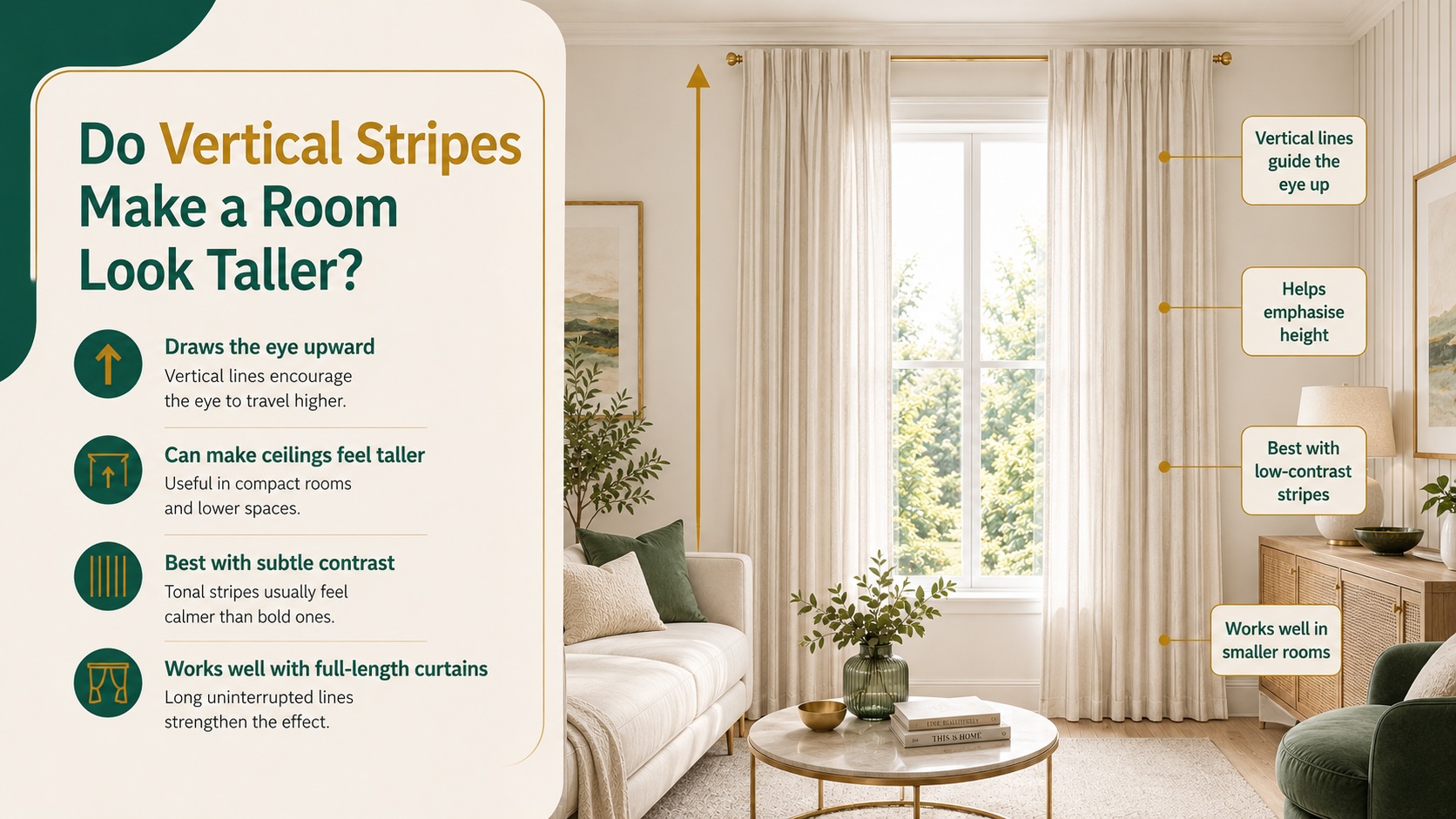
Vertical stripes can help a room appear taller because they encourage the eye to travel upwards rather than across the wall.
This effect can work on both curtains and blinds, although it is usually more noticeable with curtains because the fabric can extend through a much greater part of the wall height.
Why Vertical Stripes Can Increase the Sense of Height
The eye naturally follows the direction of repeated lines.
A vertical stripe therefore creates a visual route from lower to higher parts of the room.
This can be particularly useful in:
- Rooms with low ceilings
- Small bedrooms
- Compact living rooms
- Narrow spaces
- Rooms with relatively short windows
The effect is not dramatic enough to transform the proportions completely, but it can help reinforce height.
Full-Length Curtains Strengthen the Effect
Vertical stripes are most effective when combined with floor-length curtains.
The longer uninterrupted line gives the eye more distance to follow.
A vertically striped curtain that ends at the windowsill will usually have less impact because the line stops much sooner.
Low-Contrast Stripes Usually Work Best
Strong black-and-white or highly contrasting stripes can become visually dominant.
In a small room, that may create more visual activity than desired.
Subtle tonal stripes usually create a more spacious effect because they reinforce height without turning the window into the main focal point.
Examples include:
- Cream and off-white
- Pale grey and soft grey
- Beige and taupe
- Tonal blue
- Fine woven vertical textures
Stripe Width Matters
Very broad stripes can feel bold and architectural.
Fine or medium-width stripes are generally easier to integrate into a small room.
Again, the aim is not simply to create the strongest vertical line possible. It is to reinforce height without adding excessive pattern.
Vertical Blinds Create a Similar Effect
Vertical blinds naturally introduce repeated upright lines.
On large windows or patio doors, this can help emphasise room height.
However, the size of the glazing still matters. On a very small window, the blind may feel too substantial even though the lines themselves are vertical.
Best Approach
If you want to use stripes to make a room feel taller, the strongest combination is usually:
vertical direction + full-length treatment + restrained contrast + proportionate stripe width
Vertical stripes can be useful, but they work best as part of the overall design rather than as a standalone trick.
Do Horizontal Stripes Make a Room Look Wider?
Horizontal stripes can help emphasise width because they encourage the eye to move from side to side across the window.
This can be useful in narrow rooms or spaces where the window itself feels too tall and slim.
Why Horizontal Lines Can Increase the Sense of Width
Repeated horizontal lines create a visual direction across the room.
On blinds, this effect can come naturally from:
- Venetian slats
- Day & Night bands
- Horizontal stripe patterns
On curtains, a striped fabric can create a similar effect, although curtains are generally more strongly associated with vertical emphasis because of their overall shape.
The Effect Is Usually Subtle
Horizontal stripes will not dramatically transform a narrow room, but they can help make the window feel broader.
This can be useful where the aim is to rebalance proportions rather than simply add decoration.
Contrast Matters
Strong, high-contrast horizontal stripes can easily become visually dominant.
In a small room, this can introduce too much activity and make the window treatment feel busier.
A more restrained approach usually works better.
For example:
- Tonal stripes
- Soft neutral bands
- Fine horizontal textures
- Low-contrast woven patterns
These can reinforce width without overwhelming the room.
Venetian and Day & Night Blinds Already Create Horizontal Structure
You do not necessarily need a striped fabric to get the effect.
Venetian blinds naturally create repeated horizontal lines through their slats.
Day & Night blinds do the same with alternating sheer and opaque sections.
This means the blind type itself can influence perceived width even when the material is plain.
Too Many Horizontal Lines Can Make a Room Feel Busy
There is a trade-off.
A room that already contains:
- Horizontal shelving
- Strong dado rails
- Patterned flooring
- Low furniture
- Busy wall decoration
may not benefit from adding even more horizontal emphasis at the window.
In that case, a plain Roller blind or full-length curtain may create a calmer result.
Best Approach
If the goal is to make a room feel wider, horizontal lines can help, but they are most effective when they are:
subtle + proportionate + low contrast + supported by a relatively simple interior
The aim should be to guide the eye across the space without making the window treatment itself feel overly busy.
Should Small Rooms Have Small-Scale Blinds and Curtains?
Usually, yes. Smaller rooms tend to benefit from window treatments that are proportionate to the window and the surrounding space.
This does not mean every element has to be physically tiny, but oversized slats, deep folds, heavy fabrics and very large patterns can make a compact room feel more crowded.
Scale Affects Visual Weight
A blind or curtain can dominate a room when its individual elements feel too large for the space.
Examples include:
- Very wide Venetian slats on a small window
- Deep Roman blind folds
- Large curtain headings
- Oversized eyelets
- Bold, large-scale patterns
- Excessively full curtains
Each of these can increase the visual presence of the window treatment.
Smaller-Scale Details Usually Feel Lighter
More restrained proportions can help the treatment sit more naturally within the room.
This can include:
- Slimmer Venetian slats
- Simpler curtain headings
- Moderate curtain fullness
- Smaller or lower-contrast patterns
- Compact blind profiles
The result is often a calmer and less cluttered appearance.
But Bigger Can Sometimes Be Better
There are exceptions.
A small room with a large window may actually suit a more substantial treatment because the glazing itself provides enough scale.
Likewise, full-length curtains can be physically large but still help a small room feel taller because they create a strong vertical line.
So the rule is not simply “small room = small treatment”.
Think About Proportion, Not Just Size
A useful way to judge the treatment is to compare it with:
- The size of the window
- The height of the ceiling
- The amount of wall space
- The scale of the furniture
- The amount of natural light
A blind or curtain should feel like it belongs to the architecture rather than overpowering it.
Best Approach
For compact rooms, the safest strategy is usually:
moderate scale + low visual bulk + controlled pattern + proportionate details
The aim is not to make the window treatment insignificant.
It is to ensure that it supports the room rather than becoming one of the largest visual elements within it.
Does Showing More of the Window Make a Room Look Bigger?
Often, yes. Keeping more of the glazing visible can make a room feel more open because the eye has a stronger visual connection to the outside and the window admits more natural light.
This is one of the most important principles in choosing window treatments for a small room.
Visible Glass Creates More Visual Depth
A window does more than bring in light.
It also extends the visual field beyond the walls of the room.
When more of the glass remains exposed, the eye can travel further, which can make the room feel less enclosed.
This is particularly helpful in:
- Small living rooms
- Compact bedrooms
- Narrow rooms
- Home offices
- Rooms with only one window
Compact Blinds Can Help Preserve Glazing
Some blind styles naturally leave more of the window visible when open.
Roller blinds are a good example because they form a relatively compact roll at the top of the window.
Metal Venetian blinds can also work well because the slats can be tilted or raised, depending on how much light and privacy are needed.
Curtains Can Preserve Glass Too
Curtains can also keep glazing clear if the fabric sits mostly to the sides when open.
This is important because a very bulky curtain stack can cover a noticeable portion of the window even when the curtains are not drawn.
In a small room, that lost glazing can make a difference.
Privacy Can Complicate the Decision
Some rooms cannot leave the window fully exposed because privacy is important.
In these cases, the goal should usually be to preserve as much light and visibility as practical rather than simply keeping the window uncovered.
This is where Day & Night or Venetian blinds can be useful because they allow some privacy without completely closing off the window.
Large Window Treatments Can Reduce the Effect
A blind or curtain can visually reduce the window if it covers a significant part of the glass even when open.
Examples include:
- Deep Roman blind stacks
- Very full curtains
- Heavy side panels
- Large fabric folds
- Multiple layered treatments
The treatment may still look attractive, but it can make the actual glazed area feel smaller.
Best Approach
If the aim is to make a room feel larger, try to preserve:
visible glazing + natural light + outside views + low visual obstruction
In many small rooms, keeping more of the window visible has a stronger effect than simply choosing a pale colour.
Best Blinds to Make a Small Living Room Look Bigger
A small living room usually benefits from blinds that keep the window area bright, simple and visually uncluttered.
Because living rooms are used throughout the day, the best choice is often one that preserves natural light while still giving enough privacy and glare control.
Roller Blinds
Roller blinds are one of the strongest all-round choices.
They work particularly well because they:
- Have a simple, flat appearance
- Create relatively little visual bulk
- Leave much of the glazing visible when raised
- Work well in plain, tonal fabrics
For a compact living room, a Roller blind close in colour to the surrounding wall can help the window feel integrated rather than visually separate.
Day & Night Blinds
Day & Night blinds are useful where the living room faces a street or neighbouring property.
They can help maintain:
- Daylight
- Privacy
- A degree of outside visibility
- A relatively open feeling
This makes them a strong option where a standard opaque blind might otherwise need to remain closed.
Metal Venetian Blinds
Metal Venetian blinds are also well suited to small living rooms.
Their slim slats allow precise control over light and privacy without adding the visual weight of heavier wood-effect alternatives.
They work particularly well in modern or minimalist interiors.
Roman Blinds
Roman blinds can still work, especially where the room needs softness or a more decorative finish.
However, they introduce more fabric and a deeper stack at the top of the window, so they are usually best where the room has enough natural light and the window is not too small.
What Usually Works Less Well
Use more caution with:
- Very dark blinds in already dim rooms
- Strong high-contrast patterns
- Heavy Roman fabrics
- Wide dark Venetian slats
- Window treatments that cover a large proportion of the glass
These choices can make the window area feel more visually dominant.
Best Overall Choice
For most small living rooms, the strongest options are:
Roller blinds for simplicity
Day & Night blinds for privacy with daylight
Metal Venetian blinds for precise light control
The overall goal should be to keep the treatment visually restrained while allowing the window to contribute as much light and depth as possible.
Best Curtains to Make a Small Living Room Look Bigger
Curtains can work very well in a small living room, especially when the aim is to make the window appear taller or wider rather than simply keeping the treatment compact.
The strongest options are usually those that create long vertical lines without adding too much fabric bulk.
Full-Length Curtains
Full-length curtains are generally the best choice if you want to increase the sense of height.
They create a continuous vertical line through more of the wall and can make the window feel taller than it really is.
This is especially useful in:
- Living rooms with low ceilings
- Rooms with relatively short windows
- Narrow spaces
- Small rooms where the wall feels visually broken up
Tonal Curtains
Curtains that sit close to the wall colour can help create a more continuous appearance.
Good combinations might include:
- Cream curtains with warm neutral walls
- Pale grey curtains with soft grey walls
- Beige curtains with similar natural tones
This reduces strong visual boundaries and helps the fabric recede into the room.
Lightweight Fabrics
Lighter fabrics usually work better than very heavy ones when spaciousness is the priority.
Good choices include:
- Linen-look fabrics
- Light woven fabrics
- Smooth plain fabrics
- Sheers or voiles where privacy allows
These can add softness without making the window feel heavily dressed.
Wave Curtains
Where available, wave curtains can be particularly effective in modern small living rooms.
Their regular folds create a controlled, streamlined appearance and generally introduce less visual clutter than more heavily gathered headings.
Sheer Curtains
Sheers can help keep the room bright while still softening the window.
They are particularly useful where the living room has:
- Limited daylight
- A pleasant outside view
- A need for daytime screening rather than complete privacy
Their main limitation is privacy after dark.
Keep the Window Visually Open
One of the most important considerations is how much glazing remains visible when the curtains are open.
A very large curtain stack can cover part of the window and reduce both daylight and perceived width.
For small living rooms, the strongest result usually comes from curtains that frame the window without swallowing it.
Best Overall Choice
For most small living rooms, the most effective curtain combination is:
full length + light or tonal colour + restrained fullness + relatively lightweight fabric
This can help the room feel taller, brighter and more visually continuous without making the window treatment feel oversized.
Best Blinds for a Small Bedroom
A small bedroom needs a slightly different balance from a living room because privacy and light control often matter more, particularly at night.
The best blind should help the room feel open during the day without compromising the function of the bedroom.
Roller Blinds
Roller blinds are one of the strongest choices for small bedrooms because they combine a compact profile with straightforward light control.
They work particularly well in:
- Small bedrooms with limited wall space
- Minimalist interiors
- Rooms where the window should remain visually simple
- Bedrooms where a blackout fabric is needed
A plain Roller blind in a light or tonal colour can keep the window treatment visually quiet while still providing privacy.
Blackout Roller Blinds
Blackout can still be appropriate in a small bedroom.
The main consideration is how the blind looks and behaves during the day.
A blackout Roller blind is often a good compromise because it can provide darkness at night while remaining compact and allowing the glazing to be exposed when raised.
A pale blackout fabric can be especially useful where the room is already small or dim.
Day & Night Blinds
Day & Night blinds can be useful in bedrooms that need daytime privacy.
They allow more flexibility than a fully opaque blind and can help preserve natural light during the day.
This can be particularly helpful for:
- Ground-floor bedrooms
- Street-facing rooms
- Overlooked windows
Their horizontal bands create more visual detail than a plain Roller blind, so they are best used where the rest of the room is relatively simple.
Venetian Blinds
Venetian blinds can also work well where adjustable privacy is important.
Metal Venetian blinds are particularly suitable for compact modern bedrooms because they usually have a lighter visual profile than wider wood-effect slats.
Roman Blinds
Roman blinds can add softness and warmth, which often suits bedrooms well.
However, they create more fabric volume and a deeper stack at the top of the window.
In a very small bedroom, this can reduce visible glazing and make the window treatment feel heavier.
They work best where the room has enough light and the blind is intended to contribute more strongly to the décor.
Best Overall Choice
For most small bedrooms, the strongest options are:
Roller blinds for simplicity and compactness
Blackout Roller blinds where darkness is important
Day & Night blinds for daytime privacy
Metal Venetian blinds for adjustable light control
The key is to preserve as much daylight and visible glazing as possible during the day while still meeting the privacy and darkness requirements of the bedroom.
Best Window Treatments for a Small Home Office
A small home office benefits from window treatments that keep the space bright, visually calm and easy to work in throughout the day.
Unlike a bedroom, the priority is usually not darkness. Instead, the window treatment needs to manage daylight, glare, privacy and visual clutter without making the room feel more enclosed.
Roller Blinds
Roller blinds are one of the strongest choices for a compact home office because they have a simple, unobtrusive appearance.
They work particularly well where:
- Desk space is limited
- The window is small
- The room has a minimalist layout
- You want maximum visible glazing when the blind is raised
A plain Roller blind in a light or tonal colour can help the window recede into the room rather than compete with desks, shelving and screens.
Day & Night Blinds
Day & Night blinds can be especially useful where the office faces a street or neighbouring property.
They allow you to balance:
- Privacy
- Natural light
- Screen comfort
- Daytime visibility
This can help avoid having to close an opaque blind completely while working.
Venetian Blinds
Venetian blinds are particularly useful in home offices because the slats allow directional control over daylight.
This can help reduce strong sunlight on a computer screen while still allowing the room to remain bright.
Metal Venetian blinds are often the better fit for very small offices because their slimmer profile usually feels less visually heavy.
Sheer Curtains
Sheer curtains can work well where privacy is less demanding and the aim is to soften strong daylight without losing brightness.
They can make a small office feel more comfortable and less enclosed while maintaining a lighter visual appearance than heavier curtains.
Roman Blinds
Roman blinds can suit home offices where the room is also intended to feel decorative or more residential.
However, they add more fabric and visual weight, so they are usually better where the window is reasonably generous and the room receives good natural light.
Avoid Unnecessary Darkness
Very dark blinds or heavy blackout curtains may make a compact office feel more enclosed, particularly if they remain closed during working hours.
Blackout may still be useful where screen glare is severe, but adjustable light control is often more practical for daytime use.
Best Overall Choice
For most small home offices, the strongest options are:
Roller blinds for simplicity
Venetian blinds for precise daylight control
Day & Night blinds for privacy with natural light
The key is to keep the room bright enough to feel open while giving enough control over glare and privacy to make the workspace comfortable.
Best Blinds for a Narrow Room
A narrow room benefits from window treatments that help reduce visual clutter and, where possible, reinforce the sense of width.
The strongest choices are usually those with a compact profile and clear horizontal structure.
Roller Blinds
Roller blinds are a safe choice because they keep the window treatment simple.
Their flat surface adds very little visual bulk, which is useful in rooms where furniture, doorways and walls already sit close together.
A Roller blind in a colour close to the wall can help the window recede rather than becoming another strong visual break.
Venetian Blinds
Venetian blinds can work particularly well in narrow rooms because their horizontal slats naturally emphasise width.
They also allow fine control over daylight, helping the room remain bright without needing to fully uncover the window.
Metal Venetian blinds are often the better option where the room is very compact because their slimmer slats usually feel lighter than wider wood-effect alternatives.
Day & Night Blinds
Day & Night blinds also introduce horizontal bands, which can help reinforce width.
They are especially useful where the room needs daytime privacy but still benefits from as much light as possible.
The only caution is visual busyness. In a narrow room with lots of other horizontal lines, a plain Roller blind may create a calmer result.
Roman Blinds
Roman blinds can work, but they add more depth and fabric at the window.
In a very narrow room, that extra visual weight may be less helpful unless the blind is light in colour and relatively simple.
Curtains Need Care
Curtains can still work in a narrow room, particularly if they are full length and visually light.
However, bulky side stacks or very heavy fabrics can make the room feel more enclosed.
If curtains are used, tonal colours and restrained fullness are usually safer.
Best Overall Choice
For most narrow rooms, the strongest options are:
Roller blinds for simplicity
Metal Venetian blinds for horizontal emphasis and light control
Day & Night blinds for privacy while maintaining brightness
The key is to avoid treatments that project too much visual weight into an already restricted space.
Best Window Treatments for a Room With a Low Ceiling
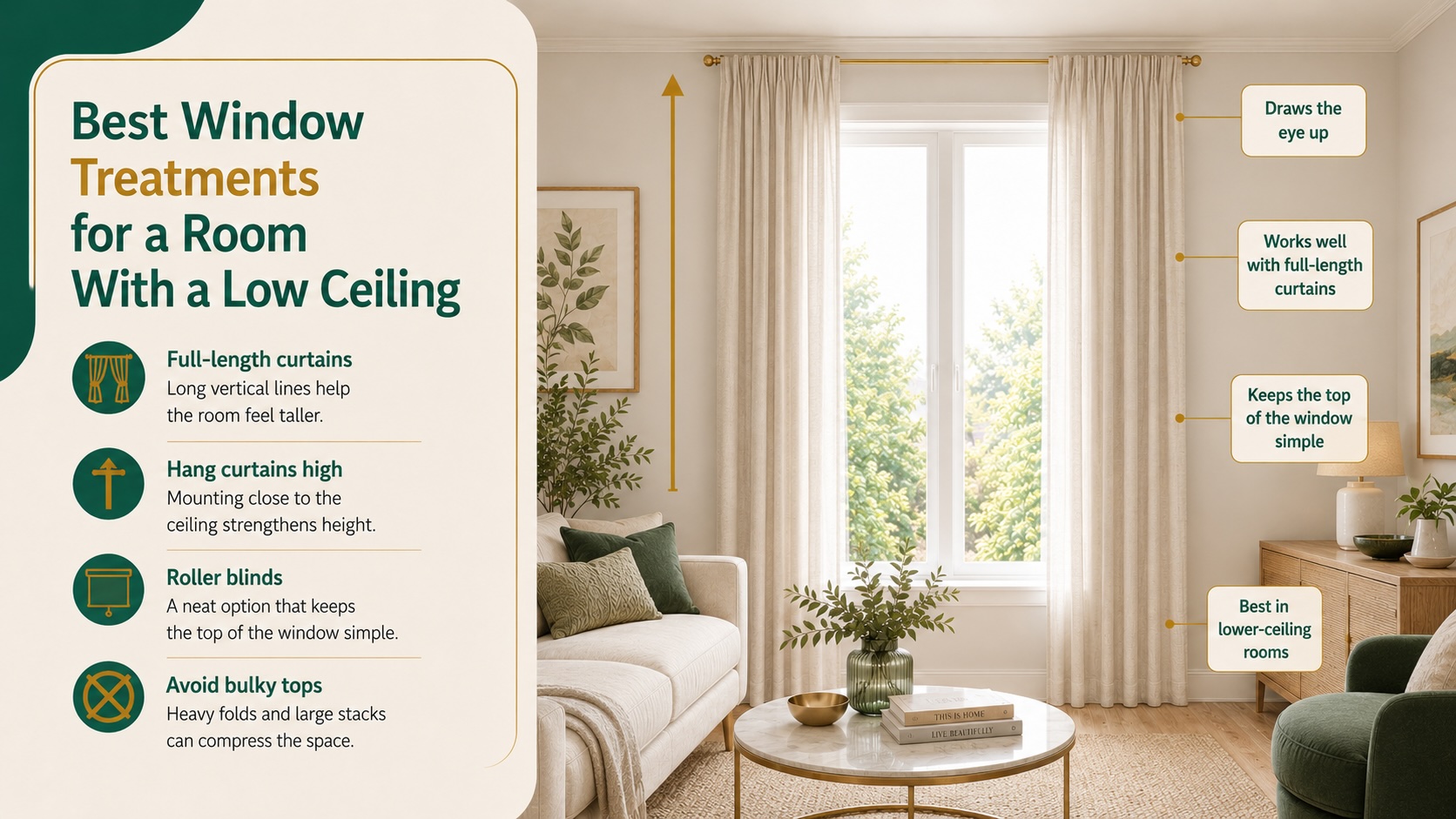
A room with a low ceiling benefits from window treatments that help draw the eye upwards rather than across the space.
The aim is to strengthen vertical lines, reduce visual bulk and avoid treatments that make the top of the room feel crowded.
Full-Length Curtains
Full-length curtains are usually one of the strongest choices because they create a long vertical line.
This can make the wall feel taller, particularly when the curtain treatment visually begins higher than the top of the window and continues towards the floor.
The effect works best with:
- Plain fabrics
- Subtle vertical textures
- Tonal colours
- Controlled fullness
Vertical Blinds
Vertical blinds can also help reinforce height because the louvres naturally run from top to bottom.
They are most effective on:
- Tall windows
- Patio doors
- Wide glazing
- Full-height glass
On a very small window, however, they can feel oversized and may add more visual weight than benefit.
Roller Blinds
Roller blinds are another strong option because they keep the top of the window visually simple.
They do not create the same height-enhancing effect as long curtains, but they avoid heavy folds or large stacks that can make a low ceiling feel more compressed.
Roman Blinds Need More Care
Roman blinds can still work, but their folded stack creates more visual activity near the top of the window.
In a room with a low ceiling, this can make the upper part of the wall feel busier.
If using Roman blinds, lighter fabrics and relatively simple designs are usually more effective.
Avoid Strong Horizontal Emphasis
Very wide horizontal stripes or dominant horizontal patterns can draw attention across the room rather than upwards.
This does not mean Venetian or Day & Night blinds are unsuitable, but if ceiling height is the main concern, strong vertical cues may be more helpful.
Colour Can Support Height
Curtains or blinds close in tone to the wall can help create a more continuous vertical surface.
This reduces strong colour breaks that might visually divide the wall.
Best Overall Choice
For rooms with low ceilings, the strongest options are usually:
full-length curtains for maximum vertical emphasis
Roller blinds for a clean, low-bulk treatment
Vertical blinds where the glazing is large enough to suit them
The key is to encourage the eye to travel upwards while keeping the top of the window as visually uncluttered as possible.
Best Blinds for a Small Room With a Large Window
A small room with a large window is often easier to make feel spacious than a small room with a small window because the glazing already provides light, depth and a stronger visual connection to the outside.
The main goal is usually to avoid covering too much of that advantage.
Roller Blinds
Roller blinds are one of the strongest choices because they keep the treatment simple and allow much of the glass to remain visible when raised.
They are particularly effective where the window is already a major feature and does not need additional visual complexity.
Day & Night Blinds
Day & Night blinds can work very well where the large window creates privacy concerns.
They allow filtered daylight to remain in the room while reducing direct views from outside.
This can be especially useful in:
- Ground-floor living rooms
- Street-facing spaces
- Bedrooms with large glazing
- Modern extensions
Venetian Blinds
Venetian blinds can also suit large windows, particularly where directional light control matters.
The repeated horizontal slats can emphasise width, which may help the room feel broader.
Metal Venetian blinds usually feel lighter, while wood-effect versions create a stronger visual statement.
Vertical Blinds
Large glazing is one of the situations where Vertical blinds can make particular sense.
Their proportions are better suited to:
- Wide windows
- Patio doors
- Tall glazing
- Full-height glass
The vertical louvres can help reinforce height while still allowing adjustable light control.
Roman Blinds Need More Care
A Roman blind across a large window can introduce a significant amount of fabric.
That can look attractive, but it also creates more visual weight.
If the room itself is small, a large Roman blind may dominate the space unless the fabric is simple and relatively light in tone.
Do Not Waste the Window
The biggest mistake in this type of room is choosing a treatment that permanently covers too much glazing.
A large window is already doing much of the work by bringing in daylight and creating visual depth.
The blind should generally support that rather than compete with it.
Best Overall Choice
For a small room with a large window, the strongest options are usually:
Roller blinds for simplicity
Day & Night blinds for privacy with daylight
Venetian blinds for adjustable light control
Vertical blinds where the glazing is particularly wide or tall
The key is to let the size of the window remain an asset.
Best Blinds for a Small Room With a Small Window
A small room with a small window is one of the more challenging situations because both daylight and visible glazing are already limited.
The blind should therefore do as little as possible to make the window feel smaller.
Roller Blinds
Roller blinds are usually one of the strongest choices because they have a compact profile and can leave most of the glazing visible when raised.
A plain Roller blind in a light or tonal colour can help reduce visual clutter and keep the window treatment from becoming too dominant.
Metal Venetian Blinds
Metal Venetian blinds can also work well because the slimmer slats feel relatively light and allow precise control over daylight and privacy.
They are particularly useful where the window faces a street or neighbouring property.
Day & Night Blinds
Day & Night blinds can be helpful where privacy is needed during the day, but the room cannot afford to lose too much natural light.
Their main limitation is visual complexity. On a very small window, the repeated bands can become quite noticeable.
Roman Blinds Need More Care
Roman blinds can still work, but the fabric stack at the top of the window can cover a meaningful proportion of the glazing.
In a small room with a small window, that can reduce both daylight and the sense of openness.
If a Roman blind is chosen, a light colour and relatively simple fabric usually works best.
Avoid Excessive Visual Weight
Use more caution with:
- Wide wood Venetian slats
- Heavy Roman fabrics
- Strong patterns
- Very dark blinds
- Bulky layered treatments
- Large decorative details
These can make a small opening feel even more restricted.
Colour Should Support the Window
Light or tonal shades are generally the safest because they help the blind sit quietly within the surrounding wall.
A high-contrast blind can make the window treatment more obvious and emphasise the small dimensions of the opening.
Best Overall Choice
For a small room with a small window, the strongest options are usually:
Roller blinds for minimum visual bulk
Metal Venetian blinds for adjustable control
Day & Night blinds where daytime privacy is important
The main principle is to preserve as much of the window as possible. In this situation, visible glazing and natural light usually matter more than decorative impact.
Blinds vs Curtains: Which Makes a Room Look Bigger?
Both can make a room feel larger, but they usually do it in different ways.
Blinds are generally better at reducing visual bulk, while curtains are better at changing the perceived height and width of the window.
Why Blinds Often Work Well in Very Small Rooms
Blinds usually sit closely to the window and occupy less visual and physical space than curtains.
This can help a small room feel:
- Cleaner
- Less cluttered
- More open
- More focused on the glazing itself
Roller blinds are especially effective because they introduce very little visual complexity.
Metal Venetian and Day & Night blinds can also work well where adjustable privacy and light control are important.
Why Curtains Can Create a Bigger Architectural Effect
Curtains can influence the apparent dimensions of the window because they can visually extend beyond the glass.
They can help make a window appear:
- Taller
- Wider
- More substantial
- Better proportioned to the wall
Full-length curtains are particularly effective where ceiling height is an issue.
Blinds Usually Win for Compactness
If the room is very small and the priority is to minimise visual weight, blinds usually have the advantage.
They work especially well where:
- The window is small
- Wall space is limited
- Furniture sits close to the window
- The room already contains lots of visual detail
Curtains Usually Win for Perceived Height
If the room feels low or the window itself looks undersized, curtains may be more effective.
Long vertical fabric can make the wall feel taller, while a broader curtain treatment can make the window appear wider.
Natural Light Matters With Both
Neither treatment will help a room feel larger if it permanently blocks a significant amount of glazing.
The important point is how much of the window remains visible when the treatment is open.
A compact blind can preserve a large amount of glass, while well-proportioned curtains can frame the window without covering too much of it.
The Best Choice Depends on the Problem
If your main goal is:
Reduce clutter: Roller blind
Maintain privacy and daylight: Day & Night or Venetian blind
Make the ceiling feel higher: Full-length curtains
Make a narrow window look wider: Curtains
Keep a tiny window visually simple: Compact blind
Add softness while retaining spaciousness: Lightweight tonal curtains
Best Overall Approach
There is no universal winner.
For the smallest rooms, blinds often have the advantage because of their compactness.
For rooms where the window proportions or ceiling height are the main issue, curtains can create a stronger illusion of additional height or width.
The best option is therefore the one that addresses the specific reason the room feels small.
Are Blinds Better Than Curtains for Very Small Rooms?
Often, yes. In very small rooms, blinds usually have an advantage because they are more compact, occupy less visual space and sit closer to the window.
That can make the room feel less crowded.
Why Blinds Often Work Better
Blinds usually require less fabric and create less bulk than curtains.
This is especially helpful where:
- The window is small
- Furniture sits close to the wall
- Floor space is limited
- The room already contains a lot of visual detail
- Natural light is limited
A simple Roller blind can be particularly effective because it leaves the surrounding wall and floor visually clear.
Curtains Can Take Up More Visual Space
Curtains add fabric to both sides of the window and can extend towards the floor.
That can be beneficial when you want to make the window appear taller or wider, but in a very compact room the extra material can also make the space feel more enclosed.
The effect is strongest with:
- Heavy fabrics
- Deep folds
- Strong patterns
- Dark colours
- Large curtain stacks
Blinds Can Preserve More Useful Space
In a very small room, the area around the window may also be needed for:
- Desks
- Bedside furniture
- Storage
- Radiators
- Seating
A blind keeps the window treatment contained more closely within the opening.
This can make the overall room feel more practical and less crowded.
Curtains Still Have an Advantage in Some Small Rooms
There are situations where curtains may still be the better choice.
For example, if the room has:
- A low ceiling
- A narrow window
- A need for more softness
- A large amount of clear wall space
full-length curtains can help the room feel taller and make the window appear more substantial.
So very small does not automatically mean curtains should be avoided.
Best Blind Types for Very Small Rooms
The strongest options are usually:
Roller blinds for minimum visual bulk
Metal Venetian blinds for precise light control
Day & Night blinds where privacy and daylight need to work together
A simple, light or tonal finish usually helps keep the treatment unobtrusive.
Best Overall Approach
For very small rooms, blinds generally have the edge because they offer:
compactness + low visual weight + more visible wall and floor area + good control of daylight
Curtains can still work, but they need to earn their place by adding something useful, such as extra perceived height or a softer decorative effect.
Should You Use Blinds and Curtains Together in a Small Room?
They can work together, but layering blinds and curtains adds more fabric, more structure and more visual weight, so it needs to be handled carefully in a small room.
The combination is most effective when each layer has a clear purpose.
Why Layering Can Work
Using a blind with curtains can provide a useful balance of:
- Daytime privacy
- Light control
- Softness
- Decorative impact
- Evening screening
For example, a simple Roller blind can handle privacy and light control, while full-length curtains can add height and softness.
The Risk Is Visual Overload
A small room can quickly feel crowded if the window has:
- A blind
- Full curtains
- Heavy fabric
- Strong pattern
- Decorative poles
- Tiebacks
- Pelmets or additional layers
The more elements are added, the more attention the window treatment demands.
If the goal is to make the room feel larger, the layering should stay visually restrained.
Use One Layer as the Main Feature
A good approach is to let one treatment do most of the visual work.
For example:
- Plain Roller blind + tonal full-length curtains
- Venetian blind + simple curtains
- Day & Night blind + very restrained side curtains
This helps avoid competition between the two layers.
Colour Should Be Coordinated
Layered treatments usually work better in small rooms when the colours sit within the same palette.
A high-contrast blind combined with high-contrast curtains can make the window feel much busier.
Tonal or closely related colours tend to create a calmer result.
Keep Fabric Weight Under Control
If the blind already has strong visual structure, the curtains should usually be simpler.
Likewise, if the curtains are decorative, the blind should probably stay plain and unobtrusive.
This prevents the treatment becoming too heavy overall.
When Layering Works Best
Blinds and curtains together are most successful in small rooms where:
- The window is reasonably large
- There is good natural light
- The rest of the room is relatively simple
- Privacy and softness are both important
Best Approach
Layering can make a small room look sophisticated, but restraint matters.
The strongest combination is usually:
simple blind + light or tonal curtains + limited pattern + controlled fullness
If the window is very small or the room is already visually busy, one well-chosen treatment will often make the space feel larger than two.
Common Window Dressing Mistakes That Can Make a Room Look Smaller
Even a well-chosen blind or curtain can work against a small room if the overall treatment adds too much visual weight, blocks useful daylight or feels out of proportion with the window.
The most common mistakes are usually about scale, contrast and unnecessary complexity.
Blocking Too Much of the Glazing
Natural light and visible glass are two of the strongest assets in a small room.
A blind or curtain that permanently covers a large part of the window can reduce both.
This can happen with:
- Deep Roman blind stacks
- Very full curtains
- Heavy side panels
- Layered treatments
- Bulky headings
The more glazing that remains visible, the more open the room can feel.
Choosing Too Much Fabric
Excessive curtain fullness can make a small window feel overwhelmed.
More fabric means:
- Deeper folds
- Larger side stacks
- More visual weight
In compact rooms, restraint usually works better than volume.
Using Strong Contrast Without a Reason
A very dark blind against pale walls, or bright curtains against a muted room, creates a strong visual break.
That can make the window treatment more dominant and divide the wall into separate areas.
If spaciousness is the priority, tonal or lower-contrast combinations are usually easier to work with.
Choosing a Pattern That Is Too Busy
Pattern is not inherently unsuitable for small rooms, but high-contrast or densely repeated designs can create visual noise.
The blind or curtain can become the busiest element in the room.
Plain fabrics, subtle textures and low-contrast patterns usually create a calmer effect.
Making the Treatment Too Heavy for the Window
Large folds, wide slats and substantial fabrics can feel out of scale on a small window.
The issue is not simply the room size. The treatment also needs to suit the dimensions of the opening itself.
Keeping Opaque Blinds Closed During the Day
A blackout or fully opaque blind may be useful at night, but keeping it closed throughout the day can make a small room feel unnecessarily enclosed.
Where daytime privacy matters, adjustable options such as Venetian or Day & Night blinds may preserve more useful light.
Over-Layering the Window
Blind + sheer + curtain + pelmet may provide flexibility, but it also adds substantial visual mass.
In a small room, one or two carefully chosen layers are usually enough.
Ignoring the Room’s Existing Visual Detail
A room with patterned wallpaper, busy flooring, shelving and decorative furniture may not benefit from an equally busy window treatment.
The more detailed the room already is, the simpler the blind or curtain usually needs to be.
Assuming Light Colours Solve Everything
A pale blind can still make a room feel crowded if it is:
- Bulky
- Heavily textured
- Strongly patterned
- Oversized for the window
Colour is only one part of the overall effect.
Best Approach
To make a small room feel more spacious, avoid combining too many of the following:
bulk + blocked glazing + high contrast + heavy pattern + excessive layering
A simpler treatment that preserves light and feels proportionate to the window will usually create a stronger sense of space.
Do Busy Blinds Make a Small Room Look Smaller?
They can.
Busy blinds do not physically reduce the room, but they can increase visual noise, making the window treatment feel more dominant and the room more crowded.
What Makes a Blind Look Busy?
A blind tends to feel visually busy when several elements compete for attention at once, such as:
- Strong pattern
- High-contrast colours
- Repeated geometric shapes
- Multiple colours
- Heavy texture
- Bold horizontal or vertical lines
The smaller the room, the more noticeable these elements can become.
Pattern Is Not the Problem on Its Own
A patterned blind can still work well in a compact room if the design is relatively restrained.
For example, a subtle botanical pattern using similar shades may feel much calmer than a small geometric print with strong black-and-white contrast.
The important factors are:
contrast + pattern density + scale + surrounding décor
Busy Rooms Need Quieter Blinds
If the room already contains:
- Patterned wallpaper
- Decorative flooring
- Open shelving
- Artwork
- Strong furniture colours
- Multiple textures
a visually active blind can make the space feel even more crowded.
In that situation, a plain Roller blind or a simple tonal Venetian blind may provide better balance.
A Simple Room Can Support More Pattern
The reverse is also true.
A compact room with plain walls, simple furniture and a restrained colour palette may be able to accommodate a patterned Roman or Roller blind without feeling cramped.
The blind can then become the main decorative feature.
Repeated Slats and Bands Also Add Detail
A blind does not need printed fabric to feel visually busy.
Venetian blinds create repeated horizontal slats, while Day & Night blinds introduce alternating bands.
These styles can still work very well in small rooms, but they add more visual structure than a plain Roller blind.
Best Approach
If the main goal is to make a small room feel larger, the safest combination is usually:
plain or low-contrast fabric + restrained texture + limited colour variation
Pattern can still be used, but it works best when the rest of the room gives it enough visual breathing space.
Can Too Many Layers Around a Window Make the Room Feel Cluttered?
Yes. Layering can make a window look more finished, but in a small room, too many elements can quickly add bulk, visual weight and unnecessary complexity.
The issue is not layering itself. It is whether each additional layer has a clear purpose.
What Counts as Layering?
A layered window treatment might combine:
- A blind
- Sheer curtains
- Full curtains
- A pelmet
- Decorative poles or tracks
- Tiebacks
- Additional fabric detailing
Individually, these elements can work well. Together, they can make a compact window feel heavily dressed.
More Layers Mean More Visual Mass
Each layer adds another surface, texture or line around the window.
In a large room, that can create richness and depth.
In a small room, it can make the window treatment feel disproportionately important and reduce the amount of visual breathing space.
Layering Can Also Cover More Glazing
Multiple treatments can reduce the visible area of the window.
For example, a blind may occupy part of the top of the glazing while curtains stack at the sides.
If the room already has a small window, losing even more visible glass can reduce natural light and make the opening feel smaller.
Use Layering Where It Solves a Problem
Layering makes most sense when each treatment performs a different role.
For example:
Roller blind + full-length curtains
The blind provides privacy and light control while the curtains add softness and vertical emphasis.
Venetian blind + simple curtains
The blind controls daylight while the curtains create a more decorative finish.
Sheer curtain + main curtain
The sheer provides daytime screening while the main curtain offers stronger privacy when required.
These combinations have a clear reason for existing.
Avoid Making Every Layer Decorative
A small room can become visually busy if both the blind and curtains use:
- Strong patterns
- Contrasting colours
- Heavy textures
- Decorative detailing
It is usually better for one layer to remain relatively quiet.
If the curtains are the feature, keep the blind simple.
If the blind is patterned or strongly textured, use more restrained curtains.
Sometimes One Treatment Is Better
Where the room is very small, the window is modest or natural light is limited, a single well-chosen blind or curtain may create a stronger sense of space than a layered treatment.
More does not automatically mean better.
Best Approach
For compact rooms, layering works best when it remains:
simple + functional + tonal + proportionate
If adding another window treatment does not improve privacy, light control or the visual proportions of the window, it may simply be adding clutter.
Blinds and Curtains Ranked for Making a Room Look Bigger
Different window treatments influence perceived space in different ways. Some reduce visual clutter, some preserve more daylight, and others can make the window itself appear taller or wider.
The table below gives a practical comparison.
| Window Treatment | Spaciousness Potential | Best For | Main Limitation |
|---|---|---|---|
| Roller Blind | Excellent | Small rooms, simple interiors, preserving visible glazing | Less decorative than fabric-heavy options |
| Day & Night Blind | Very Good | Privacy with daylight, street-facing rooms | Horizontal bands add more visual detail |
| Metal Venetian Blind | Very Good | Compact rooms, precise light control, modern interiors | Repeated slats can feel busy |
| Roman Blind | Good | Softness, bedrooms, decorative small rooms | Fabric folds and stack add visual weight |
| Wood Venetian Blind | Good | Warm interiors, traditional schemes, larger windows | Wide or dark slats can feel heavy |
| Vertical Blind | Situational | Wide glazing, patio doors, emphasising height | Can feel oversized on small windows |
| Floor-Length Curtains | Excellent | Making windows feel taller, low ceilings | Too much fullness can add bulk |
| Sheer Curtains | Very Good | Brightness, softness, maintaining an outside connection | Limited privacy after dark |
| Heavy Curtains | Situational | Warmth, richness, larger or brighter rooms | Can make compact rooms feel more enclosed |
Best Overall Choices
For reducing visual clutter, Roller blinds are usually the strongest option.
For balancing privacy and daylight, Day & Night blinds and Venetian blinds work particularly well.
For making a room feel taller, full-length curtains are often the most effective choice.
For preserving brightness while softening the window, sheer curtains are especially useful.
The important point is that different treatments create spaciousness in different ways. The best option depends on whether the room needs to feel brighter, taller, wider or simply less visually crowded.
Best Window Treatment by Goal
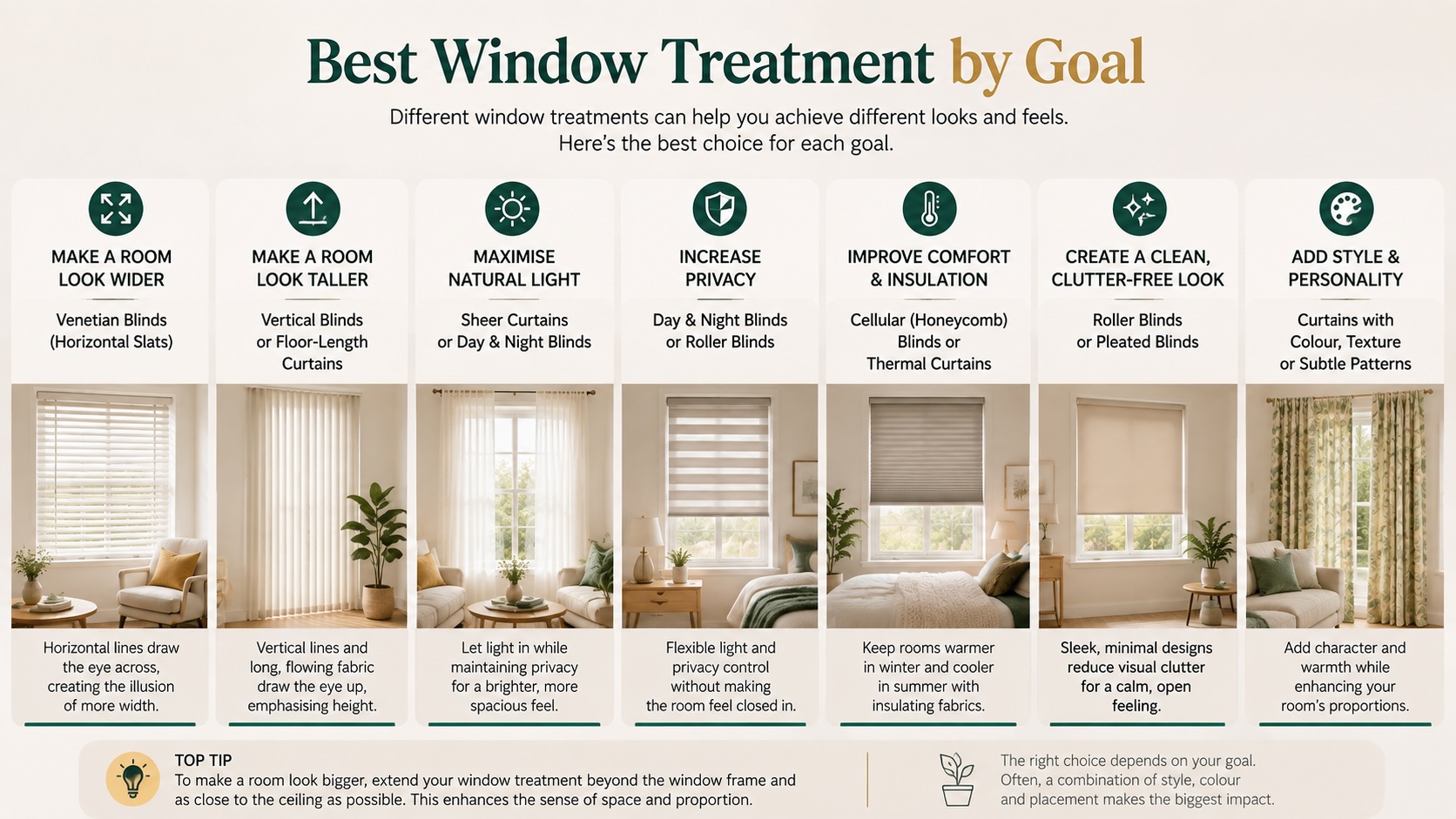
The best way to choose blinds or curtains for a small room is to start with the specific visual problem you want to solve.
A treatment that helps a room feel taller may not be the same one that makes it feel wider or brighter.
| Goal | Strong Options | Why They Help |
|---|---|---|
| Make the room feel brighter | Roller blinds, Day & Night blinds, sheer curtains | They can preserve useful daylight without adding excessive visual weight. |
| Make the ceiling appear higher | Full-length curtains, subtle vertical stripes, Vertical blinds on suitable glazing | Long vertical lines encourage the eye to travel upwards. |
| Make the window appear wider | Curtains, Venetian blinds, Day & Night blinds | Curtains can visually extend beyond the glass, while horizontal slats or bands can reinforce width. |
| Reduce visual clutter | Plain Roller blinds, tonal blinds, simple wave curtains | Simple surfaces and restrained detailing create fewer visual interruptions. |
| Preserve privacy without making the room dark | Day & Night blinds, Venetian blinds, sheer curtains where suitable | They offer more flexible screening than a fully opaque treatment. |
| Create more visual continuity | Blinds or curtains close to the wall colour | Lower contrast helps the treatment blend into the surrounding wall. |
| Make a tiny window feel less dominant | Plain Roller blind, slim Metal Venetian blind | A compact treatment avoids drawing excessive attention to the size of the opening. |
| Make a narrow window appear larger | Full-length curtains extending visually beyond the window | Curtains can alter the perceived dimensions of the window rather than simply following them. |
Think About the Problem Before the Product
A common mistake is to start by asking which blind or curtain is “best” for a small room.
A better question is:
What is making the room feel small?
If the room is dark, prioritise daylight.
If the ceiling feels low, strengthen vertical lines.
If the room feels cluttered, simplify the window treatment.
If the window looks undersized, curtains may be able to alter its perceived proportions.
Best Overall Approach
The most successful small-room window treatments usually combine several principles at once:
preserve light + maintain visible glazing + control visual weight + use scale and colour deliberately
Once the specific problem has been identified, choosing the right blind or curtain becomes much easier.
Which DotcomBlinds Blinds and Curtains Work Best for Small Rooms?
For small rooms, the strongest DotcomBlinds options are generally those that help preserve daylight, minimise visual bulk and keep the window treatment proportionate to the space.
The best choice depends on whether the priority is simplicity, privacy, light control, softness or perceived height.
Roller Blinds
Roller blinds are one of the strongest all-round choices for compact rooms.
They work particularly well where you want:
- A simple, uncluttered appearance
- Minimal visual weight
- Plenty of visible glazing when raised
- A plain or tonal finish that blends into the room
For very small rooms, this is often the safest option.
Day & Night Blinds
Day & Night blinds are useful where privacy is important but the room still needs natural light.
They are particularly suitable for:
- Street-facing rooms
- Ground-floor bedrooms
- Small home offices
- Living rooms that are overlooked
Their alternating sheer and opaque sections allow more flexibility than a standard opaque blind.
Metal Venetian Blinds
Metal Venetian blinds are a strong choice for small modern rooms.
Their slim slats help keep the overall treatment relatively light, while the adjustable angle gives precise control over daylight and privacy.
They are particularly useful where glare or changing light levels are an issue.
Wood Venetian Blinds
Wood and wood-effect Venetian blinds can also work, but they need a little more care in compact spaces.
Lighter finishes usually create a softer effect, while very wide or dark slats can add more visual weight.
They are best suited to small rooms that still have enough natural light to support a stronger window treatment.
Roman Blinds
Roman blinds are a good choice where the room needs more softness and decorative character.
They can work especially well in bedrooms or traditional interiors, but the folds and fabric stack make them visually heavier than Roller blinds.
For small rooms, simpler fabrics and lower-contrast colours usually work best.
Blackout Blinds
Where darkness is important, particularly in bedrooms, a blackout Roller blind can provide a good balance.
The blind can remain compact during the day while still giving strong light control when closed.
A pale or tonal blackout fabric can also help avoid making the window feel unnecessarily heavy.
Curtains
Curtains can be especially useful where the aim is to make the room feel taller or make the window appear larger.
For compact rooms, the strongest options are usually:
- Full-length curtains
- Tonal colours
- Relatively lightweight fabrics
- Restrained fullness
- Simple headings
Curtains can have a bigger visual effect than blinds, so proportion matters more.
Best DotcomBlinds Choice by Priority
For minimum visual clutter: Roller blinds
For privacy with daylight: Day & Night blinds
For precise light control: Metal Venetian blinds
For warmth and softness: Roman blinds
For bedroom darkness: Blackout Roller blinds
For making the room feel taller: Full-length curtains
The most effective choice is usually the treatment that solves the room’s main problem without adding unnecessary bulk or contrast.
Final Verdict: Which Blinds and Curtains Make Rooms Look Bigger?
Blinds and curtains cannot physically increase the size of a room, but they can change how large, bright and open the space feels.
The strongest results usually come from combining four principles:
preserve natural light + keep useful glazing visible + reduce unnecessary visual weight + use colour and scale to create continuity
Best Blinds for Making a Room Feel Larger
For most small rooms, Roller blinds are one of the strongest all-round choices.
Their simple shape, compact profile and ability to leave much of the glazing visible when raised make them particularly effective where the priority is reducing visual clutter.
Day & Night blinds are especially useful where privacy and daylight need to work together, while Metal Venetian blinds offer precise control over incoming light without adding too much bulk.
Roman and Wood Venetian blinds can also work, but they usually introduce more visual weight and need to be chosen more carefully in very compact spaces.
Best Curtains for Making a Room Feel Larger
Curtains can be more effective than blinds where the aim is to change the perceived proportions of the window.
Full-length curtains can help a room feel taller by creating long vertical lines.
Curtains can also make a narrow window appear wider by visually extending beyond the glass.
For the most spacious effect, lighter or tonal fabrics with restrained fullness usually work best.
Colour Matters, but It Is Not the Whole Story
Pale colours are often useful, but white is not automatically the best choice.
A blind or curtain that sits close to the wall colour can create greater visual continuity than a very light treatment that strongly contrasts with its surroundings.
The most important factor is often the relationship between the window treatment and the rest of the room.
Plain Is Usually Safer Than Busy
Plain fabrics and subtle textures tend to create less visual noise.
Patterns can still work, but strong contrast, dense repeats and oversized motifs can make a small window feel more dominant.
If pattern is used, it should feel proportionate to both the window and the room.
Match the Treatment to the Problem
If the room feels dark, prioritise daylight.
If the ceiling feels low, emphasise vertical lines.
If the room feels narrow, horizontal structure can help reinforce width.
If the room feels cluttered, simplify the window treatment.
If the window itself feels too small, curtains may be able to make it appear taller or wider.
The Main Rule
There is no single blind or curtain that makes every room look bigger.
The best window treatment is the one that removes the particular visual limitation making the room feel small.
In practice, that usually means choosing a treatment that is:
simple, proportionate, light-aware and visually integrated with the room.