Order Tracking
 0800 1422417
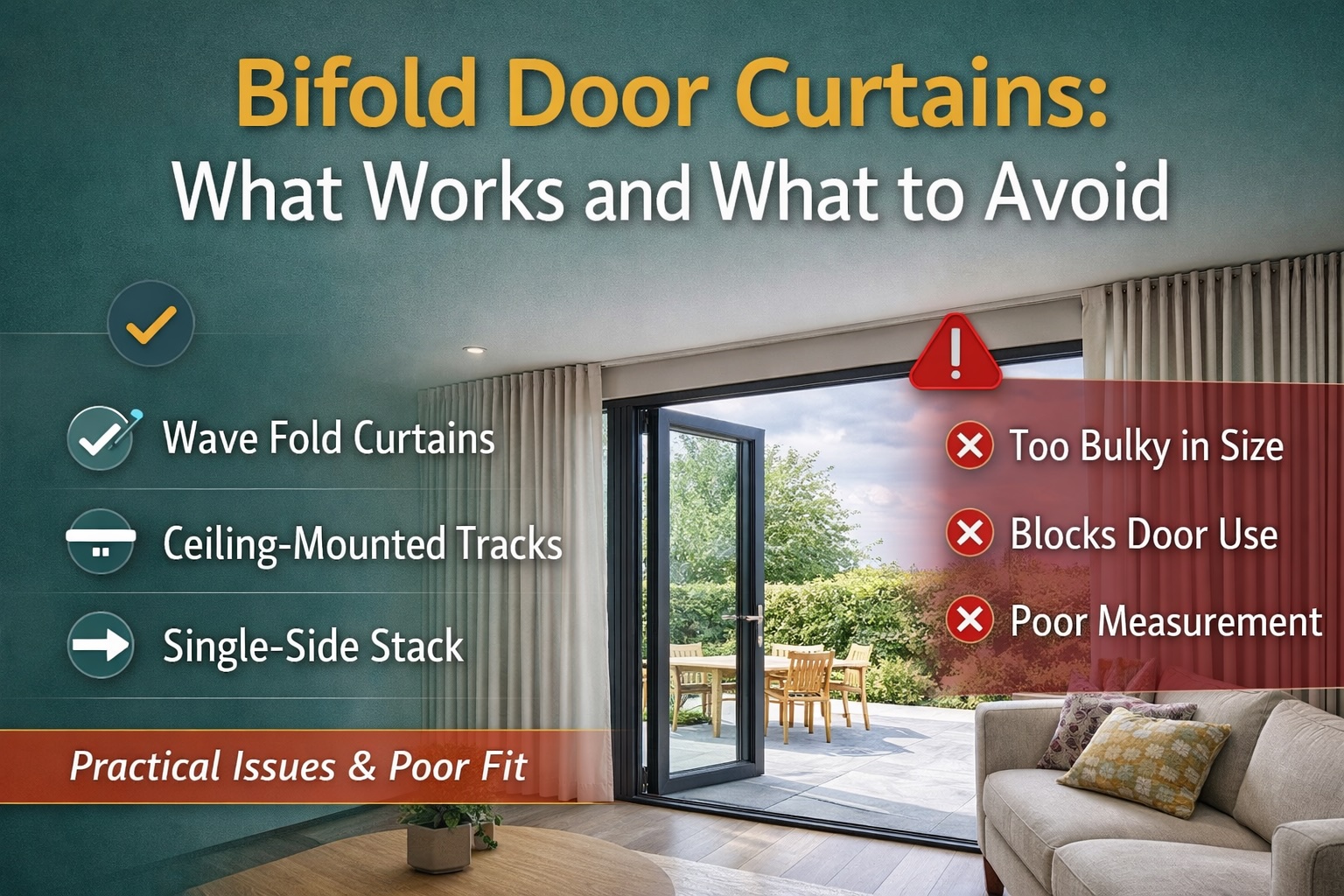
Bifold doors have become a defining feature of modern UK homes, particularly in kitchen extensions and open-plan living spaces. Their appeal is obvious. Large expanses of glass maximise natural light, create a strong connection to the garden, and give homes a clean, contemporary feel.
However, this design choice introduces a practical challenge that many homeowners underestimate.
Unlike standard windows or patio doors, bifold doors are engineered to fully open and stack neatly to one side. This creates a conflict when it comes to window dressings. While homeowners often want curtains to add warmth, improve insulation, and soften the harder lines of aluminium or uPVC frames, the reality is that not all curtain styles are suitable for this type of opening.
Common issues include bulky fabric blocking a significant portion of the glass when open, tracks interfering with door operation, and poor installation leading to long-term usability problems. In many cases, what looks good in theory becomes frustrating in day-to-day use.
This is where experience matters.
At DotcomBlinds, we have helped thousands of UK customers find the right solution for complex glazing, including bifold doors. With a 4.6 out of 5 rating on Feefo based on over 1,500 verified reviews, our approach is grounded in practical performance, not just aesthetics.
In this guide, we break down what actually works when it comes to bifold door curtains, what to avoid, and when an alternative solution may be the better option.
Are Curtains Actually Suitable for Bifold Doors?
Before looking at styles and specifications, it is important to address a more fundamental question: are curtains the right solution for bifold doors at all?
The answer is not a simple yes or no. Curtains can work well, but only when the layout, usage, and expectations are aligned. This is where many homeowners make costly mistakes, choosing curtains based on appearance without fully considering how bifold doors function in practice.
When Curtains Can Work Well
Curtains are a suitable option for bifold doors when the space allows for both functionality and stack-back clearance. In particular:
- Doors are mostly closed in the evening
Curtains are typically drawn at night for privacy and insulation, so frequent opening and closing is less of a concern. - There is sufficient wall space for stack-back
To fully clear the glass, curtains need room to sit when open. Without this, they will permanently block part of the view. - The priority is warmth and comfort
In larger rooms, especially those with tiled or hard flooring, curtains help create a more comfortable, less “cold” environment. - The doors are not the primary access point
If bifolds are used occasionally rather than as a main thoroughfare, curtains are far less disruptive.
When Curtains Are Likely to Cause Problems
In many modern homes, bifold doors are used daily, particularly in kitchen-diners leading to the garden. In these cases, curtains often become impractical:
- Frequent opening and closing of doors
Curtains need to be drawn fully clear each time, which quickly becomes inconvenient. - Limited wall space at one or both sides
Without adequate stack-back room, a portion of the glass will always remain covered. - Requirement for full, unobstructed opening
One of the main benefits of bifold doors is the ability to open up an entire wall. Curtains can compromise this. - Handles and hardware protruding into the room
These can catch on fabric, leading to wear over time and poor usability.
A Practical Framing
Curtains are best viewed as a lifestyle choice rather than a default solution for bifold doors.
If your priority is:
- Softness
- Insulation
- Visual impact
then curtains can be an effective option when designed correctly.
If your priority is:
- Ease of use
- Clean operation
- Maximising the opening
then alternative bifold door window treatments, such as fitted blinds, are often the more practical route.
Understanding this distinction early helps avoid choosing a solution that looks right on paper but does not perform in everyday use.
Why Homeowners Still Choose Curtains for Bifold Doors
Despite the practical considerations, curtains remain a popular choice for bifold doors. When specified correctly, they offer benefits that alternative bifold door window treatments cannot fully replicate, particularly in terms of comfort and interior styling.
Thermal Performance on Large Glass Areas
One of the most common reasons homeowners choose bifold door curtains is to improve insulation.
Large glazed areas are a known weak point for heat retention, especially during colder months. Even with modern double or triple glazing, heat loss can still occur across wide spans of glass. Well-chosen thermal curtains for large glass doors act as an additional barrier, helping to reduce draughts and retain warmth in the room.
Heavier fabrics, thermal linings, and full-height coverage all contribute to improved performance. While curtains will not replace the efficiency of the glazing itself, they can make a noticeable difference in overall comfort, particularly in rooms that feel cold in the evening.
Acoustic Control in Open-Plan Spaces
Open-plan layouts, often paired with bifold doors, can suffer from poor acoustics.
Hard surfaces such as glass, tiled flooring, and plastered walls reflect sound, creating echo and a lack of sound absorption. Curtains introduce a soft surface that helps to dampen this effect.
In practical terms, this means:
- Less echo in kitchen-diners
- Improved clarity when talking or watching television
- A generally more comfortable, less “empty” sound profile
This is a benefit that is often overlooked during the design stage but becomes noticeable once the space is in use.
Visual Balance and Interior Design
Bifold doors tend to have a strong, architectural look, particularly when framed in aluminium. While this works well in modern designs, it can sometimes feel visually “hard” or minimal, especially in larger spaces.
Curtains provide contrast by:
- Adding texture and softness
- Introducing colour and layering
- Creating a more balanced transition between indoor and outdoor elements
Floor-to-ceiling curtains, in particular, can help frame the doors and make the space feel more finished, rather than purely functional.
Flexibility in Light and Privacy
Curtains also offer a more flexible approach to light control compared to some alternatives.
Depending on fabric choice, homeowners can:
- Use sheer curtains during the day to maintain light while adding privacy
- Switch to heavier curtains in the evening for full coverage
This layered approach allows for a more adaptable living space, particularly in rooms that serve multiple purposes throughout the day.
While curtains are not always the most practical solution for bifold doors, these benefits explain why they remain a strong consideration, particularly where comfort and aesthetics are a priority.
What Works: The Best Curtain Solutions for Bifold Doors

If you decide that curtains are the right choice, the difference between a solution that works and one that frustrates daily use comes down to specification and installation.
Bifold doors require curtain systems that prioritise smooth operation, minimal bulk, and compatibility with the door mechanics. The following approaches consistently deliver the best results.
Wave Fold Curtains (The Recommended Standard)
Wave fold curtains are widely considered the most effective option for bifold doors.
Unlike traditional headings, the wave system uses a specialist track that creates a uniform, continuous ripple. This offers several practical advantages:
- Smooth, consistent movement across wide spans
- Reduced bulk when stacked back, preserving more of the glass area
- A clean, contemporary appearance suited to modern interiors
For wider openings, particularly 3 metres and above, wave curtains provide a level of control and uniformity that other styles struggle to achieve.
Ceiling-Mounted Curtain Tracks
Mounting the track to the ceiling rather than the wall is a key detail that is often overlooked.
Benefits include:
- No interference with the door frame or opening mechanism
- A full floor-to-ceiling finish, enhancing the sense of height
- A cleaner, more integrated appearance
Ceiling-mounted systems are particularly effective in extensions where bifold doors sit directly beneath the lintel, leaving little room for wall-mounted alternatives.
Single-Side Stack (Aligned with Door Operation)
Most bifold doors are designed to stack to one side when opened. Curtains should follow the same logic.
A single-sided draw typically works better than splitting curtains in the middle because:
- It keeps the opening area clearer
- It reduces unnecessary fabric overlap
- It aligns with how the doors are actually used
This approach also simplifies operation, especially in high-traffic areas such as kitchen-diners.
Sheer Curtains for Daytime Use
Sheer fabrics are an effective way to retain the core benefit of bifold doors, natural light, while still introducing a level of privacy.
They allow:
- Light diffusion without blocking the view
- A softer visual effect during the day
- Reduced glare in bright, south-facing rooms
Sheers can also be paired with heavier curtains if additional insulation or privacy is required in the evening, creating a more flexible solution.
High-Quality, Slimline Curtain Tracks
The track system is just as important as the fabric.
For bifold doors, this means:
- Metal tracks over plastic for strength and durability
- Systems designed to handle wide spans and heavier fabrics
- Smooth-glide carriers to ensure consistent operation over time
Lower-quality tracks are prone to sagging and friction, particularly across widths of 4 metres or more. This quickly turns what should be a simple, fluid movement into a daily frustration.
Fabric Choice: Balance Between Weight and Practicality
While heavier fabrics improve insulation, they also increase bulk and stack-back requirements.
A balanced approach is usually best:
- Medium-weight fabrics for usability
- Thermal linings where insulation is a priority
- Avoiding excessively thick materials unless space allows
When these elements are combined correctly, curtains can complement bifold doors without compromising their functionality. The key is to design the system around how the doors operate, not just how the curtains look.
What to Avoid: Common Mistakes with Bifold Door Curtains

While the right curtain setup can work well, most issues arise from avoidable specification errors. These mistakes typically only become apparent after installation, when day-to-day use exposes the limitations.
Understanding what to avoid is just as important as knowing what works.
Underestimating Stack-Back (The Most Common Issue)
Stack-back refers to the space curtains occupy when fully open.
With bifold doors, this is critical. If not properly planned, curtains can block a significant portion of the glass even when drawn back.
In practical terms:
- Standard curtains can take up 20–30% of the total width
- Heavier fabrics increase this further
- Limited wall space makes full clearance impossible
This directly undermines one of the main reasons for installing bifold doors in the first place, maximising light and opening.
Eyelet and Tab-Top Curtain Headings
These styles are often chosen for aesthetics but perform poorly over large spans.
Key issues include:
- Friction along the pole, especially over widths of 3m+
- Uneven movement and bunching
- Requirement for bulky curtain poles, which can interfere with door clearance
For bifold doors, smooth operation is essential. These heading types rarely deliver it.
Low-Quality or Lightweight Curtain Tracks
Curtain tracks are often treated as an afterthought, but they are a critical component.
Common problems with cheaper systems:
- Sagging in the centre over time
- Increased resistance when opening and closing
- Reduced lifespan under heavier fabric loads
For wide bifold openings, a heavy-duty, load-bearing track is not optional. It is a requirement.
Ignoring Door Hardware and Clearance
Bifold doors include handles, hinges, and frame elements that project into the room.
If these are not accounted for:
- Curtains can catch or drag on handles
- Fabric may wear prematurely
- Daily operation becomes awkward
This is particularly important when curtains are installed too close to the frame or without sufficient projection.
Overly Long Curtains (“Puddling”)
Puddling, where excess fabric rests on the floor, is often used for visual effect in low-traffic spaces. However, it is not suitable for bifold doors.
In high-use areas:
- It becomes a trip hazard
- Fabric collects dirt and wears quickly
- Curtains are more difficult to operate cleanly
A precise floor-length finish, with minimal clearance, is far more practical.
Misaligned Opening Direction
A more subtle but common mistake is installing curtains that do not align with how the bifold doors open.
For example:
- Doors stack to the right, but curtains split in the middle
- Curtains obstruct the main access point
This creates unnecessary friction in everyday use. Curtains should always be designed to work with the door configuration, not against it.
Avoiding these issues is less about choosing premium products and more about making informed decisions at the planning stage. Most problems with bifold door curtains are predictable, and therefore preventable, when the system is designed with real usage in mind.
Technical Considerations: Measurement and Installation
Getting bifold door curtains right is largely determined at the planning stage. Accurate measurement, correct hardware selection, and a clear understanding of how the doors operate will prevent most long-term issues.
This is where many installations fail, not because of the product itself, but because key technical details were overlooked.
Measuring Width and Drop Correctly
With bifold doors, measurement goes beyond simply matching the width of the frame.
- Track width should extend beyond the door opening
This allows curtains to stack fully clear of the glass where possible. - Consider wall return space on one or both sides
Without this, even well-designed curtains will permanently cover part of the glazing. - Drop should be measured from track position to floor level
Particularly important with ceiling-mounted tracks to ensure a clean, full-height finish.
Even small inaccuracies at this stage can result in poor alignment and reduced usability.
Understanding Stack-Back Requirements
Stack-back is one of the most important calculations for bifold door curtains.
As a general guide:
- Lightweight fabrics: approximately 15–20% of the total track width
- Medium to heavy fabrics: approximately 20–30% or more
For example:
- A 4m-wide opening may require 0.8m to 1.2m of stack-back space
If this space is not available, you will need to accept that some of the glass will remain covered when the curtains are open.
Choosing the Right Curtain Track Strength
The wider the opening, the greater the load placed on the track.
Key considerations:
- Use metal, heavy-duty curtain tracks for spans above 3m
- Ensure the system is rated for the combined weight of fabric and lining
- Check fixing points, particularly with ceiling-mounted installations
Inadequate tracks will sag over time, affecting both appearance and functionality.
Clearance from the Door Frame and Handles
Curtains need to sit far enough forward to avoid contact with:
- Door handles
- Hinges and folding sections
- Frame projections
This is typically achieved through:
- Track projection brackets (for wall mounting)
- Correct positioning in ceiling installations
Failing to allow for this clearance leads to snagging and long-term wear.
Floor Clearance and Practical Finishing
While visual finish is important, practicality should take priority in high-traffic areas.
Best practice:
- Curtains should sit just above the floor or lightly touch it
- Avoid excess fabric that can interfere with movement
This ensures:
- Easier operation
- Reduced wear over time
- A safer, more practical setup for everyday use
Installation Alignment with Door Operation
Before finalising installation, it is essential to consider how the doors will be used in practice.
- Which side do the doors stack to?
- Where is the main access point?
- Will curtains be opened and closed daily?
The curtain system should be designed to support these patterns, not work against them.
Careful planning at this stage ensures that bifold door curtains not only look right, but function reliably over time. In most cases, the difference between a successful installation and a frustrating one comes down to these technical details.
Curtains vs Blinds for Bifold Doors: Which Is More Practical?
At this stage, it becomes easier to evaluate whether curtains are the right long-term solution, or whether an alternative approach may be more suitable.
While curtains offer clear benefits in terms of softness and insulation, fitted blind systems are often designed specifically to overcome the practical limitations of bifold doors.
The comparison below highlights the key differences.
| Feature | Curtains (Wave / Track Systems) | Perfect Fit / Click Fit Blinds |
|---|---|---|
| Space Efficiency | Requires stack-back space, which can reduce the visible glass area when open. | No stack-back required, as the blind sits neatly within the frame. |
| Door Operation | Independent of the doors, so curtains need to be drawn clear manually. | Moves with the door, allowing smooth operation without obstruction. |
| Insulation | High when paired with thermal linings and heavier fabrics. | Moderate, with improved performance from thermal or honeycomb options. |
| Light Control | Broad and diffused, depending on the fabric and lining chosen. | More precise control, particularly with slatted or layered blind designs. |
| Daily Practicality | Moderate, especially where bifold doors are used frequently. | High, as the system is designed for regular day-to-day door use. |
| Aesthetic Style | Soft, layered, and available in both contemporary and more traditional finishes. | Clean, minimal, and more architectural in appearance. |
Key Takeaways
- Curtains are best suited to spaces where:
- Doors are not opened constantly
- There is enough wall space for stack-back
- The priority is comfort, insulation, and interior styling
- Blinds are typically the better option where:
- Bifold doors are used frequently
- Full opening functionality needs to be preserved
- A cleaner, more integrated look is preferred
From a purely practical standpoint, fitted systems such as Perfect Fit or Click Fit blinds are often more aligned with how bifold doors are used in modern homes. However, they do not replicate the same level of softness or thermal layering that curtains can provide.
This comparison is not about one solution being universally better, but about choosing the option that best matches how the space is actually used.
When Curtains Aren’t the Right Solution
While curtains can work well in the right setting, there are many situations where they are simply not the most practical option for bifold doors.
This typically comes down to how the doors are used on a daily basis. In modern homes, particularly open-plan kitchen-diners, bifold doors are often a primary access point to the garden. In these cases, curtains can quickly become an obstruction rather than a solution.
Signs Curtains May Not Be Suitable
You are likely to encounter issues with bifold door curtains if:
- The doors are opened and closed frequently
Constantly drawing curtains back and forth becomes inconvenient over time. - There is limited wall space for stack-back
Curtains will permanently cover part of the glass, reducing light and visibility. - You want a fully open, unobstructed aperture
Curtains cannot disappear completely, even with optimal design. - Ease of use is a priority
Particularly in family homes where quick, simple operation matters.
In these scenarios, it is worth considering alternatives that are designed specifically for bifold systems.
A More Practical Alternative: Fitted Blinds
Fitted blind systems, such as Perfect Fit and Click Fit blinds, are engineered to work with the door rather than around it.
Unlike curtains, these blinds:
- Attach directly to the door frame
- Move with each panel as it opens and closes
- Require no additional wall space
This eliminates the need for stack-back and ensures the full width of the doors remains usable at all times.
They are particularly effective in:
- High-traffic kitchen-diners
- Garden-facing living spaces
- Homes where bifold doors are used daily
Maintaining Thermal Performance Without Curtains
For homeowners considering curtains primarily for insulation, there are still effective alternatives.
Thermal honeycomb blinds are designed to trap air within their cellular structure, helping to reduce heat loss through large glass areas. While they may not provide the same visual softness as curtains, they offer a more practical solution where usability is a priority.
A Balanced Approach
In some cases, a combination can work well:
- Fitted blinds for everyday use
- Curtains for added softness and evening insulation
However, this requires careful planning to avoid overcrowding the space or interfering with door operation.
Ultimately, the decision comes down to how you use your bifold doors.
If your priority is uninterrupted access and ease of use, fitted blinds are often the more effective solution. If your focus is on comfort, insulation, and visual impact, curtains can still play a role, provided they are specified correctly.
Conclusion: Choosing the Right Solution for Your Bifold Doors
Bifold door curtains can work well, but they are not a default solution. Their success depends on how well they are matched to the space, the door configuration, and how the room is used day to day.
When designed correctly, curtains offer clear advantages:
- Improved thermal comfort across large glazed areas
- Better acoustic balance in open-plan spaces
- A softer, more finished interior aesthetic
However, these benefits come with trade-offs. Curtains require space for stack-back, careful alignment with the door mechanism, and the right track system to ensure smooth operation. Without this, they can quickly become impractical.
For many modern homes, particularly where bifold doors are used frequently, fitted blind systems provide a more functional alternative. Solutions such as Perfect Fit or Click Fit blinds are designed to integrate directly with the door, maintaining full usability without obstruction.
A Practical Way to Decide
- Choose curtains if your priority is:
- Warmth and insulation
- Interior styling and softness
- Occasional rather than constant door use
- Consider fitted blinds if your priority is:
- Ease of operation
- Maximising the door opening
- A clean, minimal finish
In some cases, a combined approach can deliver the best of both, provided the system is carefully planned.
At DotcomBlinds, we specialise in helping customers navigate these decisions with confidence. Whether you are considering bifold door curtains or exploring more practical alternatives, the key is choosing a solution that works not just visually, but in everyday use.