Order Tracking
 0800 1422417
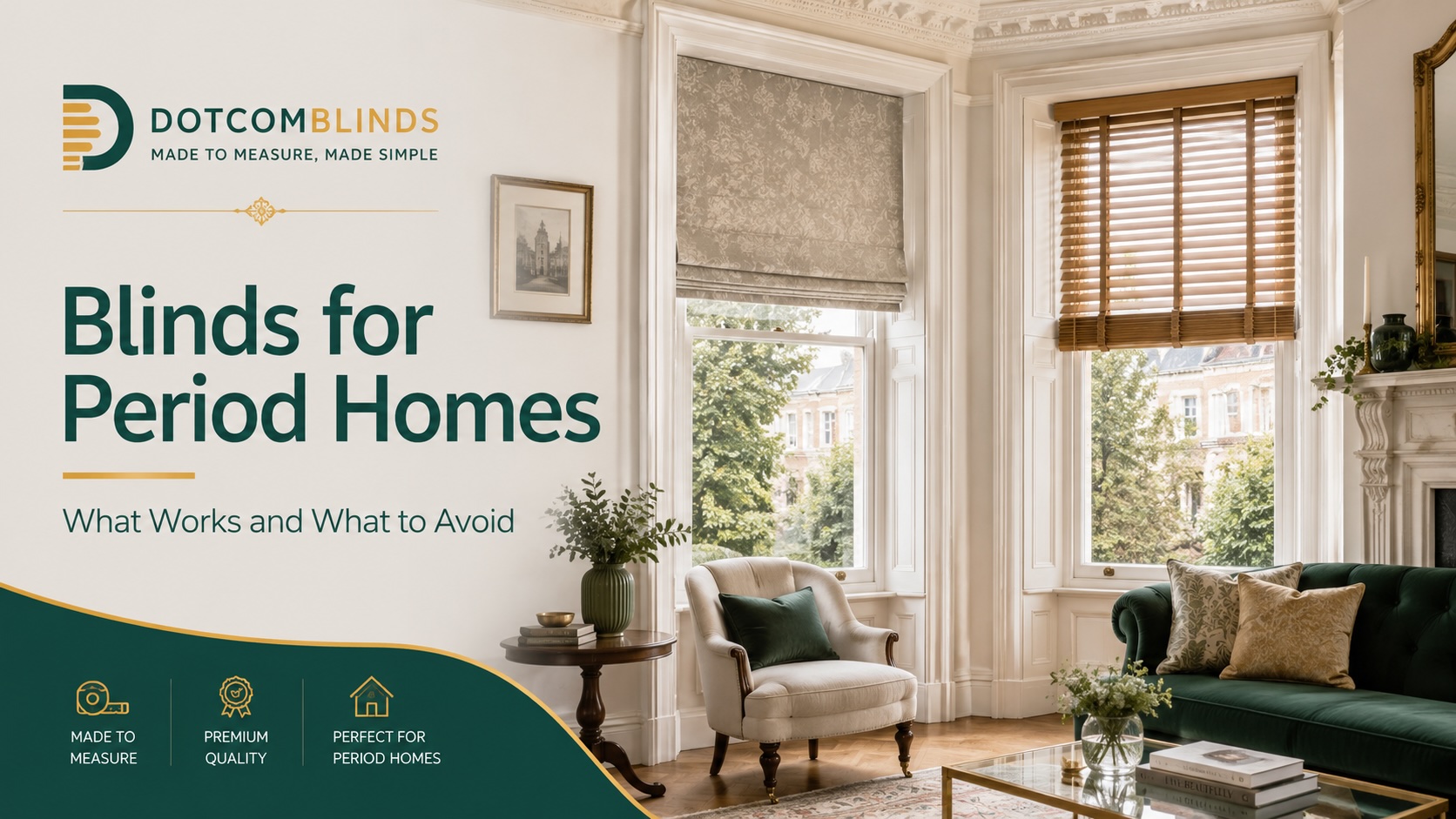
Period homes often feature windows with character, proportion and craftsmanship that are difficult to replicate. Tall sash windows, deep reveals, bay formations, original timber frames and decorative architraves can all become important focal points within the room.
Choosing blinds for these windows requires more care than simply selecting a style that suits the décor. The blind must work with the way the window opens, fit around handles and catches, respect the proportions of the frame and avoid hiding original details unnecessarily.
The wrong choice can restrict sash movement, reduce daylight, place too much weight on fragile timber or introduce bulky hardware that feels out of place. A well-planned made-to-measure blind, by contrast, can provide privacy, light control and a more comfortable room while allowing the architecture to remain visible.
In this guide, we explain which blinds work best in period homes, how to approach sash windows, bays and uneven recesses, and the common design and measuring mistakes that can lead to a poor result.
Blinds for Period Homes: The Quick Answer
Blinds can work very well in period homes when they are chosen around the window rather than the age of the property alone. The most important factors are how the window opens, the depth and shape of the recess, the condition of the frame, nearby handles or catches and whether original details should remain visible.
Roman blinds are often a strong choice for living rooms, bedrooms and dining rooms because they add softness and suit more traditional interiors. Wooden Venetian blinds can complement timber features and provide flexible light control, while roller blinds offer a simpler, more discreet option where the priority is practicality.
For bay windows, separate blinds for each section usually work better than one large blind. For sash windows, the blind must be positioned so it does not obstruct the moving parts or restrict access to the catches.
Inside-recess fitting can create a neat finish where the opening is deep and reasonably square. Outside-recess fitting may be more suitable where the walls are uneven, the recess is shallow or the blind needs to clear handles, secondary glazing or sash movement.
The best result will usually come from made-to-measure blinds that suit the exact proportions and operation of the window, rather than forcing a standard product into an irregular period opening.
What Makes Period Windows Different?
Period windows often differ from modern windows in their proportions, construction and condition. These differences can affect which blinds will fit properly, how they should be installed and whether the window can still open and close freely.
Tall sash windows are one of the most recognisable features in many Georgian, Victorian and Edwardian homes. Their height creates strong vertical proportions, but the moving sashes, catches and cords can limit where a blind can be positioned.
Deep recesses are also common, although they are not always square. Older plasterwork may vary from one side to the other, which can make inside-recess fitting more difficult and increase the risk of uneven gaps.
Original timber frames may include decorative mouldings, narrow glazing bars or repaired sections that need careful handling. Fixings should be positioned where the surface is stable, without damaging fragile or visually important joinery.
Bay windows add further complexity because each section may sit at a different angle. Blinds must be measured individually and positioned so neighbouring products do not collide when raised, lowered or tilted.
Other common features include:
- Projecting handles and sash catches
- Secondary glazing fitted within the reveal
- Uneven window sills
- Shallow fixing areas
- Decorative architraves
- Radiators positioned beneath the window
- Limited clearance around shutters or panelling
These details mean that two windows of a similar size may require very different blind solutions. The condition, shape and operation of the window should always be assessed before choosing the blind style.
Start with the Window, Not the Blind
The safest way to choose blinds for a period home is to assess the window before deciding on a product. Original windows often have moving parts, uneven surfaces and decorative features that can affect both fitting and everyday use.
Begin by opening and closing the window fully. On sash windows, check whether both the upper and lower sections move, where the catches sit and whether sash cords or handles project into the recess. A blind that looks suitable when the window is closed may restrict movement once the sash is opened.
Next, inspect the recess and frame. Older plasterwork is not always square, and the width may vary between the top, middle and bottom. The recess depth should also be checked to confirm whether there is enough space for the blind, brackets and operating mechanism.
You should also identify any features that need to remain accessible, including:
- Window handles and locks
- Sash catches and cords
- Secondary glazing
- Ventilation openings
- Shutters or internal panelling
- Decorative architraves
- Radiators beneath the window
The condition of the fixing surface matters as well. Original timber may be strong enough to support a blind, but repaired, split or softened sections should not be treated in the same way as sound joinery.
Only once these details are understood should the blind type and fitting position be selected. This reduces the risk of ordering a product that hides important features, restricts the window or cannot be fixed securely.
Inside-Recess or Outside-Recess Fitting?
The fitting position can have a significant effect on how well a blind works in a period home. Inside-recess fitting usually creates a neater, more contained appearance, while outside-recess fitting can provide better clearance and coverage where the opening is uneven or obstructed.
Inside-Recess Fitting
An inside-recess blind sits within the window opening. This can work well where the recess is deep enough, reasonably square and free from projecting handles or catches.
It is often a good choice when the original architrave or surrounding mouldings should remain visible. The blind feels integrated with the window rather than covering the wider wall area.
However, period recesses are not always uniform. Variations in width, uneven plasterwork and limited depth can make the blind harder to fit accurately. Light gaps may also become more noticeable where the sides of the reveal are irregular.
Inside-recess fitting may be unsuitable where the blind would interfere with sash movement, secondary glazing or window hardware.
Outside-Recess Fitting
An outside-recess blind is fitted to the wall or architrave above and around the window. This can provide more flexibility where the recess is shallow, uneven or occupied by moving parts.
It can also improve light coverage because the blind extends beyond the edges of the opening. On a narrow period window, a wider outside-recess blind may make the window appear more substantial.
Outside fitting is often useful where:
- Window handles project into the recess
- Secondary glazing reduces the available depth
- The sash needs unrestricted movement
- The reveal is noticeably uneven
- Greater room darkening is required
- The original frame should remain unobstructed
The main consideration is proportion. A blind that extends too far beyond the window can hide decorative architraves or feel oversized. The final position should provide enough clearance without overwhelming the original architecture.
The best fitting method depends on the window structure, not simply the preferred appearance. Testing the window movement and measuring the recess in several places should come before the final decision.
The Best Blind Types for Period Homes
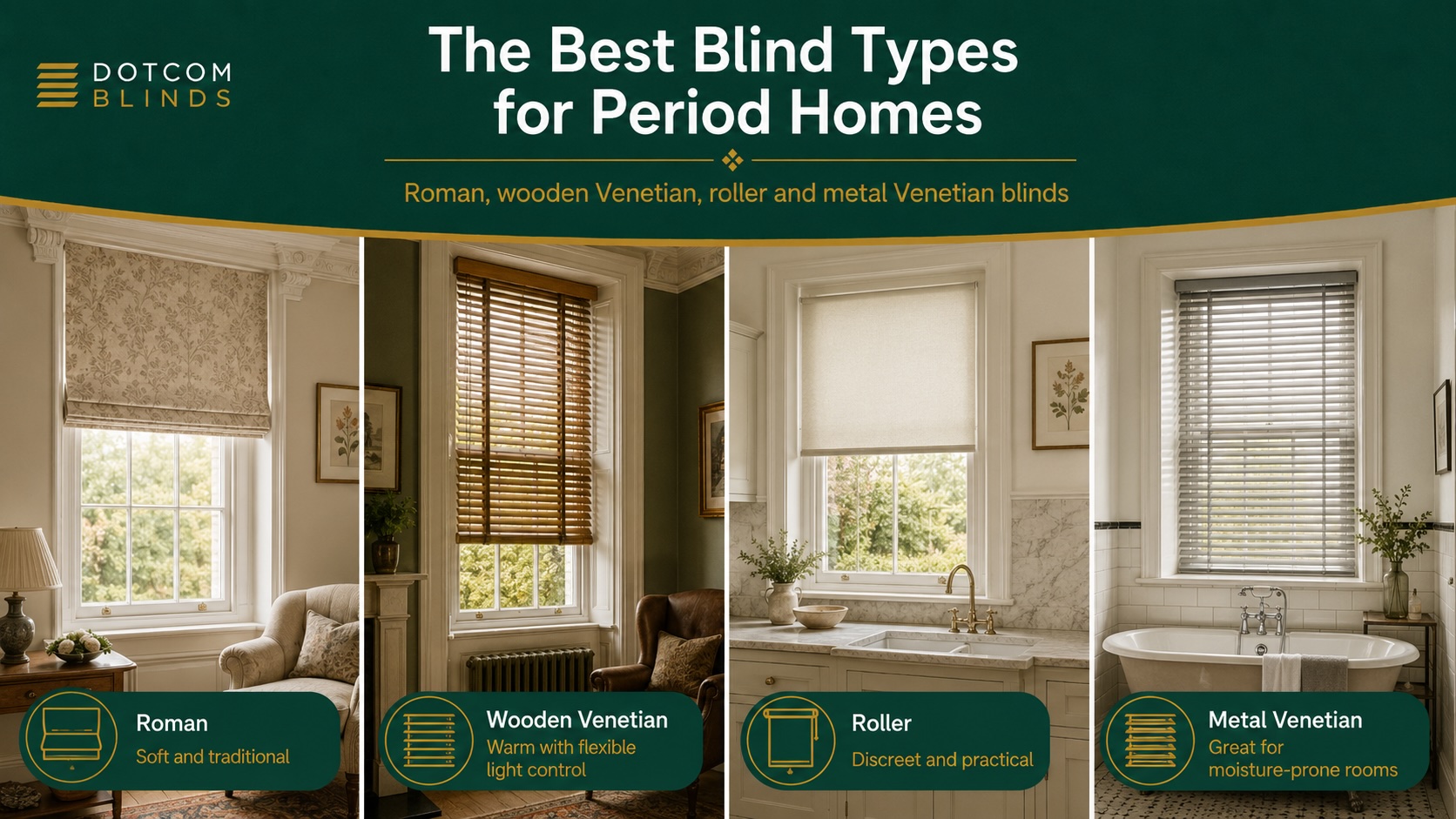
The best blind for a period home should suit the window’s proportions, movement and surrounding details while still providing the level of privacy, light control and insulation the room needs.
Roman Blinds
Roman blinds are often one of the strongest choices for period interiors. Their soft folds complement traditional rooms and can introduce colour, pattern and texture without looking overly modern.
They work particularly well in:
- Living rooms
- Bedrooms
- Dining rooms
- Tall sash windows
- Rooms with decorative fabrics or period furniture
The main consideration is the fabric stack at the top. On shorter windows, a deep stack can cover part of the glass and reduce daylight. Heavier linings can also add bulk, so the blind should be measured and positioned carefully.
Wooden Venetian Blinds
Wooden Venetian blinds can suit period homes where warmth, structure and adjustable light control are important. They work especially well alongside timber floors, traditional joinery and neutral colour schemes.
They are often suitable for:
- Studies
- Living rooms
- Bedrooms
- Tall sash windows
- Rooms with exposed or stained wood
The main drawbacks are weight and depth. Wide blinds can become heavy, and deep slats may look bulky in a shallow recess. Real wood is also less suitable for rooms with high humidity.
Roller Blinds
Roller blinds are a practical and understated choice. Their simple profile allows period window features to remain visible and can work well where the room already contains strong architectural detail.
They are often a good option for:
- Kitchens
- Bathrooms
- Utility rooms
- Windows with secondary glazing
- Rooms where space is limited
- Tall or narrow sash windows
A plain or lightly textured fabric will usually sit more comfortably in a traditional interior than a glossy or highly technical-looking finish. The brackets and control mechanism should also remain proportionate to the window.
Metal Venetian Blinds
Metal Venetian blinds can provide precise light control and are easier to manage in moisture-prone rooms than wooden blinds. They may suit period kitchens, bathrooms, home offices or interiors that combine original features with more contemporary decoration.
Muted finishes generally work better than bright metallic colours in strongly traditional rooms. The slat width should also be considered, as very narrow or highly reflective slats can look more modern than intended.
Vertical Blinds
Vertical blinds are usually less natural for small sash windows or highly decorative period rooms, but they can still be useful for wide openings, large bays or modern extensions attached to older properties.
They work best where the glazing is broad and the room already has a cleaner, more contemporary style. On narrow or tall period windows, they can feel visually heavy and may hide too much of the frame.
Day and Night Blinds
Day and night blinds provide flexible privacy and light control, but their striped appearance is distinctly contemporary. They can work in period homes that have been modernised internally, although they may feel out of place in rooms with strongly traditional decoration.
They are better suited to simple, restrained interiors than rooms with ornate mouldings, patterned wallpaper or richly traditional furnishings.
No-Drill and Click-Fit Blinds
No-drill and click-fit blinds can be useful where the homeowner wants to avoid permanent fixings. However, compatibility depends on the window construction.
Many older timber sash windows will not support the same clip-in systems used on modern uPVC frames. Secondary glazing, unusual bead depths and irregular frames can also prevent a secure fit.
These products should therefore be selected only after checking the exact window system rather than assuming that every no-drill blind will work in a period property.
For most period homes, Roman blinds, wooden Venetian blinds and discreet roller blinds offer the strongest balance of character, practicality and proportion. The right choice still depends on the individual window and the room in which it is fitted.
Best Blinds for Sash Windows
Sash windows are a defining feature of many period homes, but their moving panels, catches and cords can make blind fitting more complex. The blind must provide privacy and light control without restricting how the window opens or obscuring important original details.
Begin by checking whether both the upper and lower sashes move. Some windows are opened mainly from the bottom, while others also rely on the upper sash for ventilation. The blind position should allow the window to operate fully without catching on fabric, slats or control chains.
Roman blinds can work particularly well on sash windows because they complement the tall proportions and softer character of period interiors. An outside-recess fit may be preferable where the recess is shallow, the window hardware projects or the fabric stack would otherwise cover too much of the glass.
Roller blinds are another practical option. Their compact profile makes them suitable for narrow or tall sash windows, and they can often be positioned to preserve more of the original frame. A plain or lightly textured fabric usually works best where the aim is to keep the treatment discreet.
Wooden Venetian blinds can also suit sash windows, especially where adjustable privacy is important. However, the weight of the blind, slat depth and available recess space should all be checked carefully. On larger windows, a heavy blind may require a stronger fixing surface than the original timber or plaster can safely provide.
Whichever style is chosen, avoid placing brackets where they obstruct sash cords, catches or locks. The blind should also be easy to raise when the window needs to be opened fully.
For many sash windows, the strongest solution is a made-to-measure blind fitted either just inside a deep, unobstructed recess or outside the recess where greater clearance is needed.
Best Blinds for Bay Windows in Period Homes
Bay windows are a defining feature in many Victorian and Edwardian properties, but their angles and multiple sections make them more difficult to dress than a standard flat window. The blinds need to work together visually while still allowing each part of the bay to open and operate independently.
In most cases, separate blinds for each window section are more practical than one large blind across the entire bay. This allows the blinds to follow the shape of the bay, reduces strain on the fixings and gives better control over privacy and daylight.
Each section should be measured individually. Even where the windows appear symmetrical, older bays can vary slightly in width, height and angle. These differences can affect how neighbouring blinds meet and whether the brackets or bottom rails collide.
Roman blinds can create a softer, more traditional look, particularly in living rooms and bedrooms. However, the fabric stacks need enough space at the top, and the folds should not overlap awkwardly where the sections meet.
Roller blinds are often a cleaner option where space is limited. Their compact profile helps preserve the shape of the bay and can reduce visual bulk across several adjoining windows.
Wooden or metal Venetian blinds provide flexible light control and can work well where the individual sections are wide enough to support them. The slats must be positioned carefully so the blinds do not clash at the bay angles.
Important checks include:
- Whether each window opens independently
- How far handles and catches project
- The angle between each bay section
- Whether neighbouring blinds will touch
- The depth available for brackets and mechanisms
- How much daylight the blind stacks will cover
- Whether curtains will also be used around the bay
For most period bay windows, the strongest result comes from matching made-to-measure blinds fitted separately to each section, with careful allowance for the angles and the movement of the windows.
Best Blinds for Tall Period Windows
Tall windows are a defining feature of many Georgian, Victorian and Edwardian homes. The blind should preserve their vertical proportions rather than visually shortening the opening or covering too much of the glass.
Roman blinds can work well because their soft folds suit traditional interiors and give the window a more decorative finish. However, the fabric stack at the top can become substantial on very tall windows, especially with heavier linings. Fitting the blind outside the recess may help keep more of the glass visible when raised.
Roller blinds are often a more practical choice where the window is especially tall. Their compact roll takes up less space at the top and helps maintain a cleaner line. A plain, textured or softly patterned fabric can sit comfortably within a period interior without competing with the architecture.
Wooden Venetian blinds can also suit tall windows, particularly where adjustable privacy is important. Their main limitation is weight. A large blind can place considerable strain on the brackets and may be harder to raise regularly, so the fixing surface and operating mechanism need careful consideration.
The proportions of the pattern should also be checked. Small repeats can look overly busy across a long drop, while large motifs may be cut off or distorted by Roman folds. Vertical stripes and elongated designs can reinforce the height of the window when used with restraint.
For tall period windows, it is important to consider:
- The weight of the finished blind
- How much glass is covered when the blind is raised
- Whether the control can be reached comfortably
- The strength of the fixing surface
- The scale of any pattern
- Whether the sash can still open fully
- Whether a single blind is practical across the full drop
The strongest result usually comes from a made-to-measure Roman or roller blind that follows the window’s proportions without adding excessive bulk.
Blinds for Original Timber Windows
Original timber windows are an important feature in many period homes, but they need careful consideration when blinds are being fitted. The aim is to add privacy and light control without damaging fragile joinery, hiding attractive details or placing too much weight on the frame.
Begin by checking the condition of the timber. Sound, well-maintained sections may provide a suitable fixing point, while split, softened or previously repaired areas should be avoided. Painted surfaces can also conceal deterioration, so the bracket position should be assessed carefully rather than chosen for convenience alone.
The blind mechanism must remain clear of sash cords, catches, locks and glazing bars. On sliding sash windows, brackets fitted too close to moving parts can interfere with operation or make maintenance more difficult.
The style of blind should also suit the depth and strength of the frame. Wooden Venetian blinds may complement original timber, but larger products can be heavy and may require a stronger fixing surface. Roller blinds are generally lighter and can provide a more discreet treatment where preserving the joinery is the priority.
Colour should be considered in relation to the timber finish. A close imitation of the wood is not always necessary and can look mismatched if the tone is slightly wrong. Warm neutrals, off-whites, muted greens and soft greys often complement both painted and stained frames without competing with them.
Where possible, the blind should be positioned so that decorative mouldings, architraves and glazing details remain visible. An outside-recess fit may be preferable if the recess is shallow, the frame is fragile or the blind would otherwise obstruct the window.
Careful measuring and secure fixing are especially important with original timber windows. The blind should feel like a considered addition to the window, not something that compromises its operation or character.
Blinds for Windows with Secondary Glazing
Secondary glazing can improve comfort in a period home, but it often reduces the depth available within the window recess. This can affect where the blind is fitted, how easily the window can be opened and whether handles or catches remain accessible.
Begin by checking how far the secondary glazing projects into the room. Some systems sit close to the original frame, while others occupy a significant part of the recess. The blind brackets, mechanism and fabric or slats all need enough space to operate without touching the glazing.
An inside-recess blind may still be possible where the reveal is deep and the secondary glazing leaves sufficient clearance. However, an outside-recess fit is often more practical because it keeps the blind clear of the glazing and preserves access for opening, cleaning and maintenance.
Roller blinds are usually one of the strongest options because their profile is compact and they create less visual bulk. Roman blinds can also work, although the fabric stack may cover more of the glass when raised. Wooden Venetian blinds may be less suitable where recess depth is limited, as the slats and headrail require more space.
Important points to check include:
- Whether the secondary glazing slides, hinges or lifts out
- How far handles and catches project
- Whether the blind will obstruct ventilation
- Access for cleaning both glazing layers
- The depth available for brackets and mechanisms
- Whether condensation forms within the window area
- Whether a no-drill system is compatible with the glazing frame
The blind should not make the secondary glazing harder to use. In many cases, a made-to-measure roller blind fitted outside the recess provides the cleanest and most practical result.
Blinds for Listed Buildings and Conservation Areas
Internal blinds are often less visually sensitive than external changes, but listed buildings and properties in conservation areas can still require additional care. The main concern is whether the installation affects historic fabric, original joinery or the external appearance of the property.
Before fitting a blind, check whether the window, shutters, panelling or surrounding mouldings form part of the building’s protected character. Drilling into original timber, stone or decorative plasterwork may be inappropriate, particularly where the material is fragile or historically significant.
The blind design should also avoid obscuring important architectural details unnecessarily. A bulky headrail, oversized cassette or poorly positioned outside-recess blind can hide original architraves and alter the way the window is read within the room.
Points to consider include:
- Whether the property is listed
- Whether the window is original
- Whether the proposed fixing point is historic fabric
- Whether internal shutters or panelling are present
- Whether the blind changes the external appearance when viewed from outside
- Whether the installation can be reversed without significant damage
- Whether alternative fixing positions are available
Where there is uncertainty, it is sensible to check with the local planning authority or conservation officer before drilling or making permanent alterations. This is especially important where original windows, shutters or decorative features are involved.
A carefully positioned made-to-measure blind can usually provide privacy and light control without compromising the character of the room. The priority should be to use the least intrusive fixing method that still allows the blind to operate safely and securely.
How to Match Blinds to Period Interior Styles
The most suitable blind should complement the architecture and decoration of the room without turning the interior into a historical pastiche. Period homes often contain a mixture of original features, later alterations and modern furnishings, so the blind should respond to the room as it exists today.
Georgian Interiors
Georgian interiors tend to suit restrained colours, balanced proportions and relatively simple patterns. Roman blinds in plain fabrics, fine stripes or subtle geometrics can work well, particularly when the folds are kept neat and the blind does not obscure decorative architraves.
Wooden Venetian blinds can also suit Georgian rooms, especially where symmetry, painted joinery and timber flooring are important parts of the scheme. Warm off-whites, stone shades and muted greys usually feel more natural than stark white or highly saturated colours.
Victorian Interiors
Victorian rooms can support richer colours, deeper textures and more decorative patterns. Roman blinds in botanical prints, damasks or textured weaves can add character without overwhelming the window.
Deep green, burgundy, navy, ochre and warm neutral tones can work particularly well where they connect with wallpaper, upholstery or original timber. Care should still be taken with pattern scale, especially on narrow sash windows where large motifs may be interrupted by the blind folds.
Edwardian Interiors
Edwardian interiors often feel lighter and less heavily decorated than Victorian schemes. Soft neutrals, pale blues, muted greens and delicate botanical patterns can complement the period without making the room feel formal.
Roman and roller blinds are both suitable. A lightly textured roller blind can work well where the room has been modernised, while a softer Roman blind may better suit spaces with decorative fireplaces, picture rails or traditional furniture.
Arts and Crafts Interiors
Arts and Crafts homes often benefit from natural textures, muted colours and pattern inspired by plants, craftsmanship and traditional materials.
Linen-look fabrics, warm timber tones, olive green, rust and deep blue can work well. Patterned Roman blinds may feel particularly appropriate, provided the repeat is scaled to the window and the design remains visible when the blind is raised.
Period Homes with Contemporary Interiors
Many period homes combine original architecture with modern furniture, simple colour schemes and cleaner finishes. In these spaces, the blind does not need to imitate a historical style.
Plain roller blinds, muted metal Venetian blinds or simple Roman blinds can create a more contemporary contrast while allowing the sash windows, cornices or fireplaces to remain the main period features. Darker colours can also work well where the room has a deliberately modern look.
The strongest result usually comes from choosing one or two elements from the period architecture and reflecting them subtly through colour, texture or proportion. The blind should feel connected to the room without competing with its original features.
Choosing Colours for Blinds in Period Homes
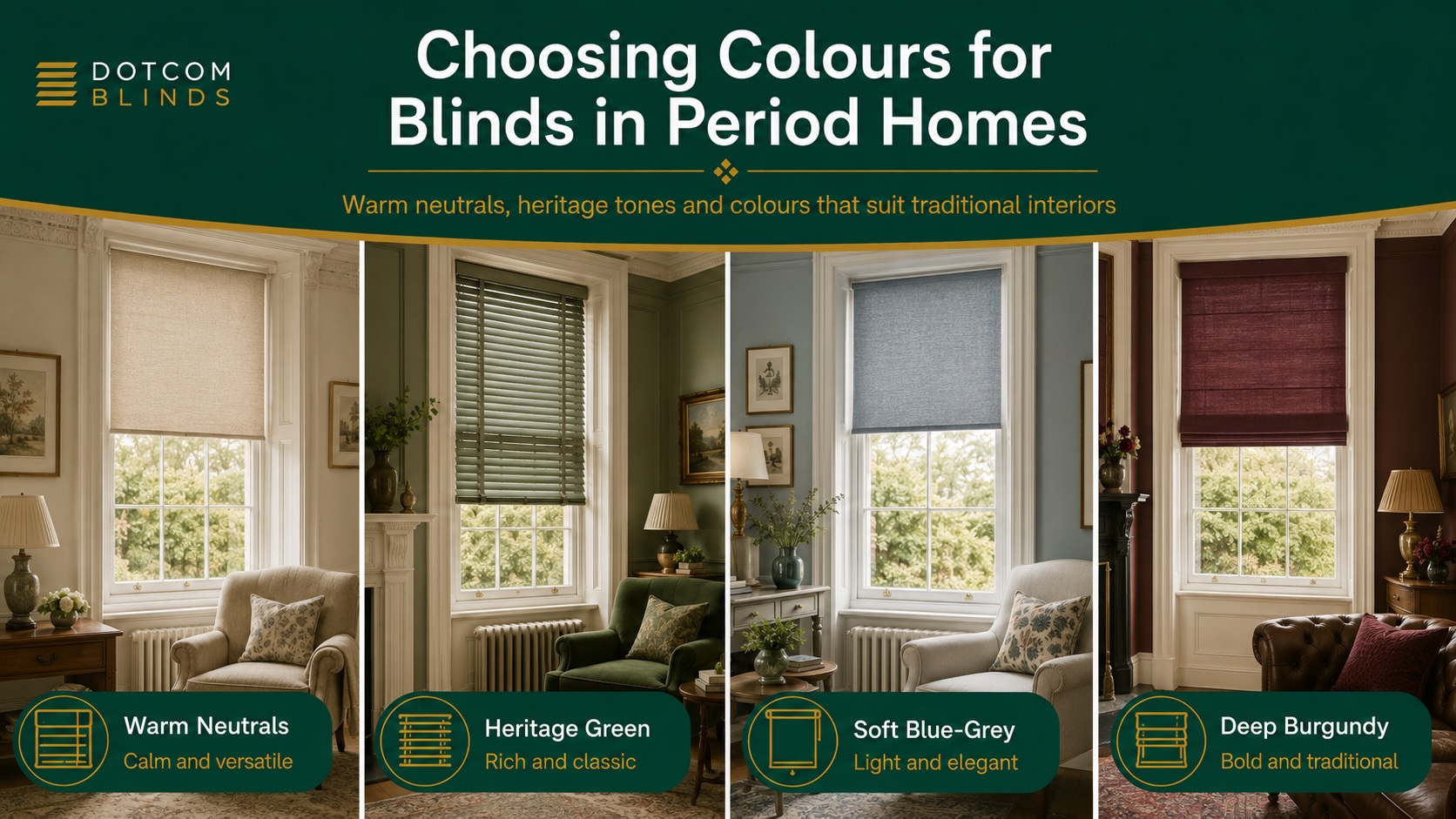
Colour can determine whether a blind feels integrated with a period interior or visually disconnected from it. The strongest choice usually responds to the window frame, wall colour, flooring and existing furnishings rather than relying on a generic “heritage” shade.
Blend with the Walls
Choosing a blind in a colour close to the wall can create a calm, cohesive finish. This works particularly well where the original window frame, architrave or mouldings should remain the main feature.
Warm off-whites, soft stone, muted beige and pale grey are often easier to combine with older interiors than a stark brilliant white.
Complement Original Timber
Where the room includes stained timber windows, floorboards or joinery, the blind does not need to match the wood exactly. A slightly different timber tone can look more intentional than an imperfect imitation.
Warm neutrals, muted greens, soft taupes and earthy shades can complement natural wood without competing with it.
Use Deeper Heritage-Inspired Colours
Period homes can support richer colours, particularly in Victorian and Arts and Crafts interiors. Deep green, navy, burgundy, rust and ochre can add depth and help the blind feel more substantial.
These colours work best when they are repeated elsewhere in the room through upholstery, wallpaper, artwork or decorative accessories.
Introduce Contemporary Contrast
A period home with a modern interior can support stronger contrast. Charcoal, black, deep blue or a dark neutral blind can frame the window and create a cleaner, more contemporary look.
The contrast should still feel proportionate to the window. A very dark blind on a small or narrow opening can become visually dominant if the surrounding room is otherwise light.
Consider the View from Outside
The reverse side of the blind may be visible from the street, particularly on tall sash windows. Where several front-facing windows are dressed differently, the exterior can look inconsistent.
Using a coordinated backing or similar external-facing colour can create a more considered appearance across the façade.
The best blind colour should support the architecture rather than compete with it. In most period homes, slightly softened tones tend to sit more comfortably than very bright whites or highly saturated colours.
Plain or Patterned Blinds?
Both plain and patterned blinds can work well in period homes, but the right choice depends on how much visual detail is already present in the room and how prominent the window should become.
Plain Blinds
Plain blinds are often the safer option where the room already includes decorative wallpaper, ornate plasterwork, patterned upholstery or detailed timber features.
They allow the architecture to remain the main focus and can help a busy room feel more balanced. Texture can still add interest, so linen-look fabrics, subtle weaves and softly mottled finishes are often more effective than completely flat materials.
Plain blinds are especially useful where:
- The window has decorative architraves
- The walls already carry pattern
- The room contains several strong colours
- The blind needs to remain visually discreet
- Multiple bay sections need a consistent treatment
Patterned Blinds
Patterned blinds can add character and work particularly well in rooms with simpler walls or more restrained furnishings.
Botanical prints, fine stripes, small geometrics and traditional motifs can all suit period interiors. The pattern should reflect the scale of the window and remain readable when the blind is raised or folded.
Roman blinds are particularly suited to patterned fabrics because they display more of the material when lowered. However, the folds can interrupt the design, so large motifs and wide repeats need careful positioning.
Patterned blinds can work well where:
- The blind is intended to become a feature
- The room has plain walls
- The design connects with upholstery or soft furnishings
- The pattern scale suits the window width
- Several blinds can be aligned consistently across a bay
Pattern Scale Matters
The size of the repeat is often more important than whether the fabric is plain or patterned.
A large design may be cropped awkwardly on a narrow sash window, while a very small repeat can look busy across a tall blind. Medium-scale patterns are often the most versatile, particularly when the full motif remains visible within the blind width.
For bay windows, pattern alignment should be considered across each separate blind. Small differences in drop or angle can make a repeated design appear inconsistent if this is not planned before ordering.
The strongest choice is usually the one that balances the blind with the wider room. Plain fabrics support detailed interiors, while carefully scaled patterns can give simpler period rooms more character.
The Best Fabrics for Period-Style Blinds
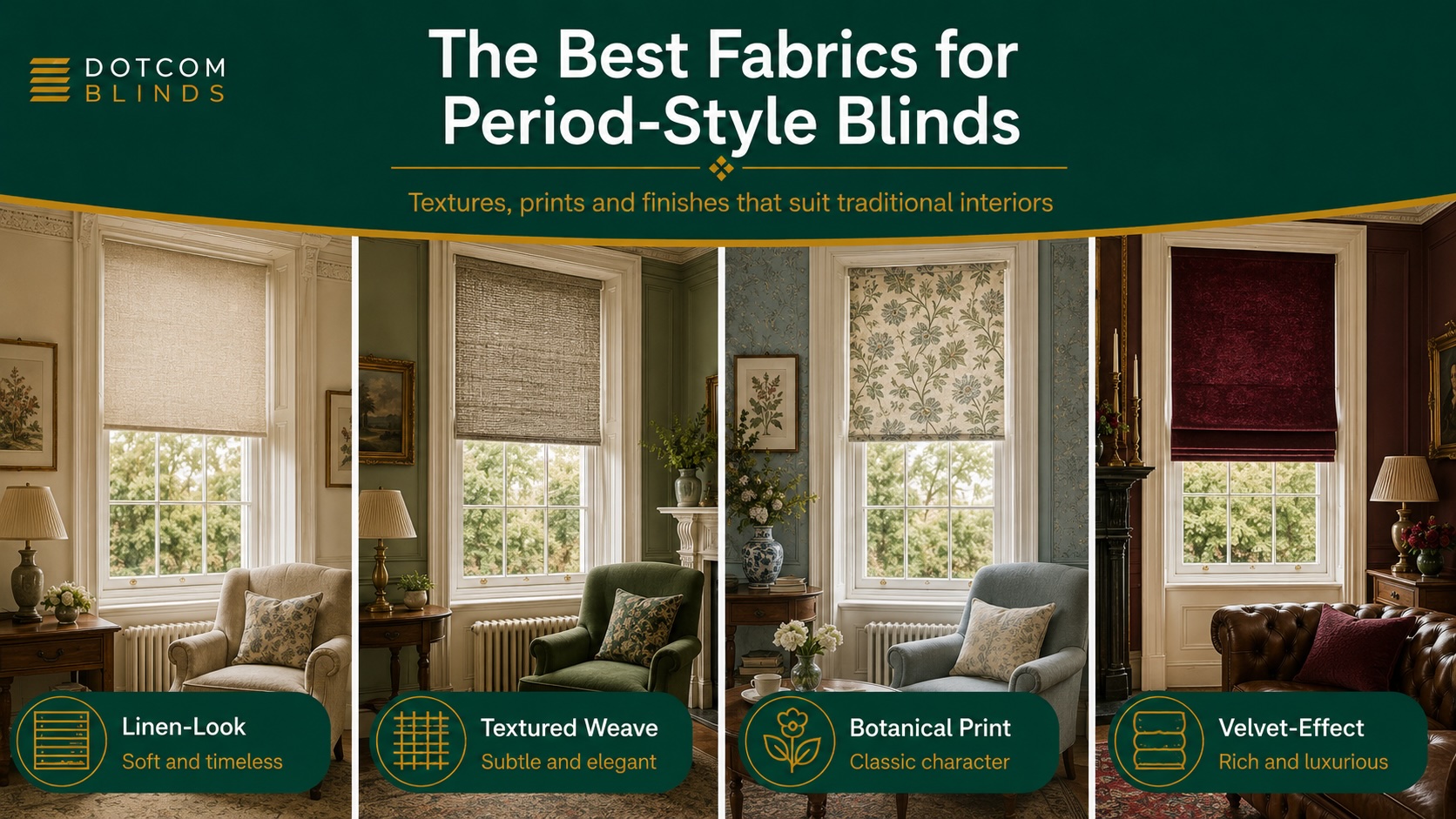
Fabric choice has a major influence on whether a blind feels appropriate in a period home. The best materials usually combine practical performance with texture, colour and pattern that complement the architecture rather than overpower it.
Linen-Look Fabrics
Linen-look fabrics are a strong choice for many period interiors because they introduce texture without feeling overly formal. Their softer, natural appearance works particularly well in Georgian, Edwardian, country and Arts and Crafts schemes.
They are well suited to Roman blinds in living rooms, bedrooms and dining rooms, especially where the room already includes timber floors, traditional furniture or muted wall colours.
Cotton and Cotton-Blend Fabrics
Cotton and cotton-blend fabrics offer a useful balance between softness and structure. They are available in a wide range of plains, stripes, botanicals and traditional prints, making them suitable for both restrained and decorative interiors.
They work particularly well for Roman blinds, where the fabric needs enough body to fold neatly without appearing too stiff.
Textured Weaves
Textured weaves can add depth while keeping the blind visually quiet. This is useful in rooms that already contain patterned wallpaper, ornate mouldings or detailed upholstery.
Subtle texture can make a plain blind feel more considered without drawing attention away from the original window and surrounding joinery.
Botanical and Traditional Prints
Botanical patterns, small florals and heritage-inspired motifs can suit period homes very well, particularly in Victorian, Edwardian and Arts and Crafts interiors.
The scale of the pattern should suit the blind width. Large repeats may be cropped awkwardly on narrow sash windows, while very small patterns can appear busy across a tall drop.
Velvet-Look and Heavier Fabrics
Velvet-look and other heavier fabrics can add richness in bedrooms, dining rooms and formal living spaces. They are especially effective where deeper colours and a more luxurious finish suit the room.
However, heavier fabrics create a larger stack when a Roman blind is raised. The added weight also means the headrail and fixing surface must be suitable for the finished blind.
Blackout Linings
Blackout lining can improve room darkening in bedrooms and nurseries while also giving Roman blinds more structure.
The final performance depends on the fit and coverage as well as the lining itself. Light may still enter around the edges, particularly with an inside-recess installation.
Thermal Linings and Performance Fabrics
Thermal linings and specialist fabrics can add another layer at the window, which may be useful in older properties with draughts or less efficient glazing.
Their effectiveness depends on the fabric, lining, blind coverage and underlying condition of the window. Thicker linings also increase the weight and bulk of the blind, so this should be considered before ordering.
Moisture-Suitable Fabrics
In kitchens, bathrooms and utility rooms, practicality should take priority over traditional appearance alone. Moisture-resistant roller fabrics are generally more suitable than absorbent Roman blind materials in areas exposed to humidity, splashes or cooking residue.
For most living spaces in period homes, linen-look fabrics, cotton blends and textured weaves offer the strongest balance of character and practicality. Heavier, patterned or performance fabrics can also work well when they are matched carefully to the room and window.
Privacy and Light Control in Period Homes
Period windows are often tall, street-facing and positioned close to pavements or neighbouring properties. This can make privacy important, but covering too much of the glass can reduce one of the window’s main strengths: natural light.
The most effective blind should allow privacy and daylight to be adjusted separately where possible.
Adjustable Slatted Blinds
Wooden and metal Venetian blinds are useful where flexible privacy is required. The slats can be tilted to limit direct views into the room while still allowing daylight to enter.
This makes them particularly suitable for:
- Front-facing living rooms
- Ground-floor bedrooms
- Home offices
- Tall sash windows
- Rooms overlooked from the street
The slat angle can also help manage glare without fully lowering the blind.
Roman and Roller Blinds
Roman and roller blinds provide a simpler form of control. They can be raised fully during the day and lowered when privacy is needed, but they do not offer the same intermediate adjustment as slatted blinds.
In overlooked rooms, a lighter or partially translucent roller fabric may provide daytime screening while maintaining brightness. However, privacy can reduce after dark when the room is illuminated.
Layering Blinds with Curtains
Combining a blind with curtains can provide greater flexibility. The blind can manage daylight and daytime privacy, while the curtains add evening coverage, softness and further room darkening.
This approach works particularly well in bedrooms, living rooms and bay windows where the architecture can support a layered treatment without feeling overcrowded.
Avoiding Excessive Coverage
A blind that is too wide, too dark or permanently lowered can hide attractive glazing bars and make a period room feel enclosed. Where privacy is only needed at lower level, adjustable slats or a carefully positioned blind may preserve more of the upper window.
The best solution should respond to how the room is used throughout the day. In many period homes, flexible control is more valuable than complete coverage at all times.
Blackout Blinds for Period Bedrooms
Blackout blinds can be a useful addition to period bedrooms, particularly where tall sash windows, street lighting or early morning sun make room darkening difficult. The main challenge is achieving good coverage without hiding the proportions and character of the window.
A blackout roller blind is often the most practical option because it has a compact profile and can cover the opening without adding much visual bulk. Roman blinds with blackout lining can also work well where a softer, more traditional finish is preferred.
The fitting position has a significant effect on performance. An inside-recess blind can look neat, but light may still enter around the edges, especially where the reveal is uneven. An outside-recess blind can provide broader coverage and reduce visible light gaps, although it should be sized carefully so it does not overwhelm decorative architraves.
For sash windows, check that the blind does not obstruct catches, cords or the movement of either sash. The blind should also be easy to raise fully when the window needs to be opened.
Important considerations include:
- The depth and shape of the recess
- The amount of light entering around the edges
- The position of sash catches and handles
- Whether the blind will be layered with curtains
- The weight of blackout lining on Roman blinds
- The strength of the fixing surface
- The appearance of the blind from outside
Blackout blinds can significantly reduce incoming light, but complete darkness depends on the fabric, fit and installation. In many period bedrooms, a blackout blind combined with lined curtains provides the strongest balance of room darkening, privacy and traditional character.
Thermal Blinds in Older Properties
Older homes can be more prone to draughts, heat loss and cold surfaces around the window, particularly where the glazing is original or the frames no longer seal as tightly as they once did. A thermal blind can add another layer at the window and may help the room feel more comfortable.
Roman blinds with thermal lining can work well in bedrooms, living rooms and dining rooms where a softer, more traditional appearance is preferred. Roller blinds made with thermal or insulating fabrics offer a neater, more compact option and may be easier to use on tall sash windows or where recess space is limited.
The fitting position is important. A blind that sits close to the window and covers the opening well will generally provide more benefit than one with large gaps around the edges. An outside-recess blind may offer broader coverage, especially where the reveal is uneven, although it should remain proportionate to the window and surrounding mouldings.
Thermal performance can also be affected by:
- Gaps at the sides and bottom of the blind
- The depth and condition of the recess
- Whether the window is single or secondary glazed
- The thickness of the blind fabric or lining
- How often the blind is lowered
- Whether curtains are used as an additional layer
Thermal blinds should not be treated as a substitute for repairing draughts, damaged seals or deteriorated window frames. Their main role is to add an extra layer of coverage and help reduce the feeling of cold around the window.
In many period homes, the strongest result comes from combining a well-fitted blind with curtains, particularly in rooms where warmth, privacy and traditional character are all important.
Blinds Above Radiators
Radiators are commonly positioned beneath windows in period homes, particularly below sash windows. This can affect the most suitable blind type, fitting position and finished drop.
A blind that sits entirely within or immediately in front of the window is usually less disruptive to heat circulation than full-length curtains. Roller blinds, Roman blinds and Venetian blinds can all work, provided they stop clear of the radiator and do not interfere with thermostatic controls.
Roman blinds need particular attention because the folded fabric can become bulky when raised, while a long drop may sit too close to the heat source when lowered. Heavier linings may also retain more warmth around the window area.
Roller blinds are often a practical choice because they have a compact profile and can finish neatly above the radiator. Wooden or metal Venetian blinds can also work well, although the bottom rail and slats should remain clear of the radiator casing.
Important points to check include:
- The distance between the window sill and radiator
- Whether the radiator projects beyond the sill
- Access to valves and thermostatic controls
- The blind’s finished drop
- The effect of heat on the chosen fabric or material
- Whether the blind can be raised easily for ventilation
- Whether furniture limits access to the control mechanism
The blind should not rest directly against the radiator or obstruct airflow into the room. Where clearance is limited, a made-to-measure roller blind fitted within the recess may provide the neatest and most practical solution.
Blinds for Period Kitchens and Bathrooms
Period kitchens and bathrooms often combine original windows with rooms that have higher levels of moisture, condensation, heat and everyday wear. In these spaces, the blind material needs to be practical as well as visually suitable.
Blinds for Period Kitchens
Roller blinds are often one of the strongest options for kitchens because they are compact, easy to operate and available in fabrics that are easier to maintain than heavier decorative materials.
Metal Venetian blinds can also work well where adjustable light control is useful. Their slimmer profile may suit sash windows and smaller openings, particularly where the room has a mix of traditional and contemporary finishes.
Roman blinds can still be used in some kitchens, but they are usually better positioned away from sinks, hobs and areas exposed to cooking residue. Absorbent fabrics may require more maintenance and can be less suitable in rooms with frequent steam or splashes.
Important kitchen considerations include:
- Distance from the hob and open flames
- Exposure to steam and grease
- Proximity to sinks and worktops
- Ease of cleaning
- Access to window handles
- The need to preserve daylight
- Whether the blind will interfere with ventilation
Blinds for Period Bathrooms
Bathrooms require greater attention to humidity and ventilation. Moisture-resistant roller blinds and suitable metal Venetian blinds are often more practical than untreated wooden blinds or heavy fabric Roman blinds.
Privacy is usually a priority, particularly on ground-floor or street-facing windows. A suitable blind should provide coverage without obstructing the opening of the window or any extractor ventilation.
Check:
- How close the blind will sit to the bath, shower or basin
- Whether condensation regularly forms on the glass
- Whether the window opens for ventilation
- How quickly the material will dry
- Whether the blind mechanism is suitable for a humid room
- Whether the frame can support the chosen fixing
In both kitchens and bathrooms, the strongest choice is usually a made-to-measure blind that respects the period window while using a material suited to the room’s conditions. Practical performance should take priority over selecting a fabric purely because it looks traditional.
Blinds to Approach with Caution in Period Homes
Some blind styles and fitting systems can work in period properties, but they need more careful consideration because their proportions, weight or appearance may conflict with the window or surrounding architecture.
This does not mean they should always be avoided. The issue is whether the product suits the individual window, room and fixing conditions.
Oversized Cassettes and Bulky Headrails
Large cassettes can hide decorative architraves, reduce visible glass area and make a narrow sash window feel top-heavy.
They may still be suitable where blackout performance or integrated hardware is the priority, but the cassette size should remain proportionate to the window.
Very Glossy or Highly Technical Fabrics
Brightly reflective, metallic or heavily technical-looking fabrics can feel out of place in a room with traditional plasterwork, timber joinery or period furniture.
Muted, textured or softly finished materials usually sit more comfortably within older interiors.
Heavy Wooden Blinds on Fragile Frames
Wooden Venetian blinds can suit period homes well, but large blinds may be heavy. Fitting them to weakened timber, damaged plaster or narrow architraves can create practical problems.
The fixing surface should be checked before ordering, particularly on wide or tall windows.
One Large Blind Across a Bay
A single blind across an entire bay can hide the shape of the window, limit access and place unnecessary strain on the fittings.
Separate made-to-measure blinds for each section usually provide better control, cleaner alignment and easier operation.
Very Deep Slats in Shallow Recesses
Deep Venetian slats can project beyond a shallow reveal, interfere with handles or look too substantial for a narrow sash window.
The headrail, slat depth and operating clearance should all be checked before choosing the product.
Bright White Finishes Against Aged Interiors
A brilliant white blind can look harsh against warm plaster, cream paint, stained timber or aged decorative finishes.
Soft white, ivory, stone and other warmer neutrals often create a more natural transition.
Strongly Contemporary Day and Night Designs
Day and night blinds can provide useful privacy control, but their striped appearance may dominate a traditional room.
They tend to work better in period homes with modernised interiors than in highly decorative Victorian or Georgian schemes.
No-Drill Systems Assumed to Fit Every Window
Many no-drill blinds are designed around modern uPVC window profiles. Older timber frames, unusual bead depths and secondary glazing may not provide a compatible fixing point.
Compatibility should be checked against the actual window rather than assumed from the property type.
The main risk is choosing a blind based on appearance alone. In a period home, the product must also suit the window depth, frame strength, movement, hardware and architectural detail.
Common Mistakes to Avoid
Period windows often expose planning and measuring errors more clearly than modern, standardised openings. A blind may look suitable in isolation but still fail in practice if it obstructs the window, hides original details or relies on an unsuitable fixing point.
One of the most common mistakes is ordering before testing how the window opens. On sash windows, the blind may interfere with catches, cords or the movement of the upper and lower panels. Handles and locks can also project further into the recess than expected.
Another frequent issue is assuming the recess is square. Older plasterwork and timber frames often vary in width and height, so a single measurement can lead to a blind that catches, sits unevenly or leaves inconsistent gaps.
Other common mistakes include:
- Measuring only once rather than at several points
- Ignoring the depth required for brackets, slats or a cassette
- Drilling into weak, repaired or decorative timber without checking the fixing surface
- Choosing a blind that hides original architraves or mouldings
- Fitting one large blind across an entire bay
- Selecting a heavy blind for a fragile frame or wall
- Allowing Roman blind folds to cover too much of the glass
- Overlooking secondary glazing or projecting handles
- Using deep Venetian slats in a shallow recess
- Assuming a no-drill system will fit an older timber window
- Prioritising style over ventilation, access and everyday operation
- Ignoring a radiator or thermostatic control beneath the window
- Choosing a modern cassette or headrail that dominates a narrow sash window
- Ordering matching blinds for a bay without measuring each section separately
The safest approach is to assess the window as a working structure before choosing the blind. The window should still open, close, ventilate and remain accessible once the blind is fitted.
How to Measure Period Windows for Blinds
Measuring period windows requires more care than measuring a modern, standardised opening. Uneven plasterwork, repaired timber, projecting hardware and irregular bay angles can all affect the finished fit.
Begin by identifying the window type and testing every moving part. Open and close each sash, casement or secondary glazing panel and note any catches, handles, cords or locks that project into the recess.
Next, decide whether the blind will sit inside or outside the recess. This choice affects every measurement that follows, so it should be confirmed before ordering.
For an inside-recess blind:
- Measure the width at the top, middle and bottom.
- Measure the height at the left, centre and right.
- Record the narrowest width and shortest height.
- Check the full recess depth.
- Allow for handles, catches, glazing bars and secondary glazing.
- Confirm that the blind and brackets will not restrict window movement.
For an outside-recess blind:
- Measure the full area you want the blind to cover.
- Allow enough overlap at the sides to improve privacy and light control.
- Check that the blind will not hide decorative architraves or mouldings unnecessarily.
- Confirm the fixing surface is sound.
- Check the finished drop against radiators, sills and furniture.
Bay windows should be measured one section at a time. Record each width, height and angle separately, even where the bay appears symmetrical. The position of brackets and neighbouring blinds should also be checked so the products do not collide.
Before ordering, confirm:
- The window still opens fully
- The fixing surface is stable
- The blind mechanism has enough clearance
- Handles and catches remain accessible
- Secondary glazing can still be opened or removed
- Radiators and thermostatic controls remain unobstructed
- Each measurement has been checked more than once
Made-to-measure blinds are especially valuable in period homes because small irregularities can have a noticeable effect on fit and operation.
When Made-to-Measure Blinds Are Particularly Important
Made-to-measure blinds are especially valuable in period homes because older windows rarely follow modern standard dimensions. Even small differences in width, height, recess depth or frame alignment can affect how well a blind fits and operates.
Standard-sized blinds may leave uneven gaps, cover too much of the window or require awkward adjustments during installation. On a period window, these problems are often more noticeable because the opening itself may already be irregular.
Made-to-measure sizing is particularly useful for:
- Tall sash windows
- Narrow windows
- Uneven recesses
- Bay windows with different angles
- Windows with secondary glazing
- Shallow reveals
- Decorative architraves
- Original timber frames
- Windows above radiators
- Openings with projecting handles or catches
The blind width, drop, bracket position and control side can all be selected around the actual window rather than adapted from a fixed size.
This is especially important in bay windows, where each section may differ slightly. Separate made-to-measure blinds can be produced to suit the individual widths and angles, reducing the risk of collisions between neighbouring products.
Made-to-measure blinds also give greater control over proportion. A Roman blind can be sized to avoid an excessively bulky stack, while a roller blind can be positioned to preserve more visible glass. On Venetian blinds, the slat size and overall weight can be considered alongside the window depth and fixing surface.
In a period home, the main advantage is not simply a neater appearance. Accurate sizing helps protect window movement, preserve original details and reduce the need for compromises during installation.
Period Home Blind Selection Checklist
Before ordering blinds for a period property, check that the chosen product works with the window’s structure, movement and surrounding features.
- Does the blind allow every sash, casement or secondary glazing panel to open fully?
- Is the recess deep enough for the brackets, mechanism and blind material?
- Has the window been measured at several points?
- Are the walls, reveal and frame reasonably square?
- Will handles, catches, cords or locks remain accessible?
- Does the blind hide decorative architraves, mouldings or original timber unnecessarily?
- Is the fixing surface strong enough for the blind’s weight?
- Is there a radiator or thermostatic control beneath the window?
- Does the room require blackout, moisture resistance or adjustable privacy?
- Will the blind look proportionate to the height and width of the window?
- Would one blind or several separate blinds work better?
- Is drilling acceptable, or does the window require a less intrusive fitting method?
- Does the blind colour complement the walls, timber and wider interior?
- Will the blind preserve enough daylight when raised?
- Is the chosen material suitable for the room’s moisture, heat and maintenance requirements?
A blind is likely to work well when it respects the window’s proportions, remains easy to operate and provides the required privacy and light control without compromising original features.
Why Choose DotcomBlinds for Period Home Blinds?
DotcomBlinds offers made-to-measure blinds designed around the exact dimensions and practical requirements of each window. This is particularly valuable in period homes, where sash windows, bays, uneven recesses and original timber frames often make standard sizes unsuitable.
Customers can choose from a wide range of blind styles, including Roman, roller, wooden Venetian, metal Venetian and other made-to-measure options suited to different rooms and levels of light control.
Free samples are available, allowing colours, textures and finishes to be compared against existing timber, wall colours, flooring and period features before ordering. This can help avoid choosing a fabric or finish that looks too modern, too bright or out of scale with the room.
The online ordering process is supported by measuring guidance and an experienced customer service team. This is useful where the window has unusual proportions, secondary glazing, projecting handles or limited recess depth.
DotcomBlinds is independently rated 4.6 out of 5 on Feefo, based on more than 1,500 verified reviews. For period properties, the main benefit is the ability to combine precise sizing, suitable materials and practical support so the finished blind works with the window rather than against it.
Final Verdict: What Blinds Work Best in Period Homes?
There is no single blind style that suits every period property. The best choice depends on the window’s construction, proportions, movement, recess depth and the way the room is used.
Roman blinds are often the strongest option where softness, pattern and a more traditional finish are priorities. They work particularly well in bedrooms, living rooms and dining rooms, although the fabric stack and finished weight need to be considered carefully.
Wooden Venetian blinds can complement original timber and provide flexible privacy and light control. They are most suitable where the recess is deep enough and the fixing surface can support the blind’s weight.
Roller blinds are often the most practical choice for tall sash windows, secondary glazing, kitchens, bathrooms and spaces where a discreet profile is important. Their compact mechanism can help preserve more of the original window and surrounding detail.
Metal Venetian blinds can work well in moisture-prone rooms or period homes with a more contemporary interior. Day and night blinds, vertical blinds and bulky cassette systems should be chosen more cautiously, particularly in rooms with strongly traditional features.
For bay windows, separate made-to-measure blinds for each section usually provide the best fit, operation and visual balance. Where the recess is uneven, shallow or restricted by handles and sash movement, an outside-recess fit may be more practical than fitting within the opening.
The most reliable approach is to start with the window itself. Check how it opens, where the blind can be fixed safely and which original details should remain visible. A well-chosen made-to-measure blind should improve privacy, light control and comfort without compromising the character or function of the period window.
Frequently Asked Questions About Blinds for Period Homes
Practical guidance on choosing, fitting and measuring blinds for sash windows, bays, original timber frames and other period features.