Order Tracking
 0800 1422417
Small windows can be deceptively difficult to dress. Curtains that are too heavy, too narrow or fitted too close to the frame can make the opening feel smaller, block valuable daylight or overwhelm the surrounding wall. Chosen carefully, however, curtains can improve the proportions of a small window, add softness and help the room feel more complete.
The best approach depends on more than the window size alone. The height and width of the opening, available wall space, nearby furniture, radiators and the amount of privacy or room darkening required will all affect the right curtain style.
In this guide, we explain how to choose curtains for small windows, including the most suitable lengths, headings, fabrics and colours, as well as practical measuring advice and ideas for making a small window appear larger.
Curtains for Small Windows: The Quick Answer
Curtains can work very well on small windows when the proportions, fabric and fitting position are carefully considered. The aim is to frame the window without adding unnecessary bulk or blocking too much daylight.
In many rooms, fitting the curtain pole or track slightly above and beyond the window frame helps the opening appear taller and wider. Full-length curtains can create a more elegant, elongated look, while sill-length or apron-length curtains may be more practical where radiators, desks or other furniture sit beneath the window.
Lighter fabrics, restrained patterns and controlled fullness usually work best where space is limited. Heavier or blackout-lined curtains can still be suitable, particularly in bedrooms, but they need enough room to stack back without covering too much of the glass.
The best curtain style will depend on the shape of the window, the surrounding wall space and the room’s practical needs. Small windows benefit from accurate measuring, as even minor sizing errors can make the finished treatment look cramped or out of proportion.
What Counts as a Small Window?
A small window is not defined by one fixed measurement. In practice, the term can describe several different window types, each of which presents its own design and fitting considerations.
A narrow window may have enough height for full-length curtains but limited wall space for the fabric to stack at the sides. A short window may sit high on the wall or above a radiator, desk or other furniture, making curtain length more important than width.
Small square windows can be difficult to balance because overly full curtains may dominate the opening. High-level windows often need a practical treatment that provides privacy or light control without drawing too much attention to the limited window area.
The size of the room also matters. A window that appears proportionate in a compact bedroom may look undersized in a larger living space. Similarly, a small window with generous wall space around it offers more curtain options than one fitted tightly into a corner or beneath a sloping ceiling.
It is therefore more useful to consider the window’s shape, position and surrounding space than to focus on dimensions alone. These factors will determine whether full-length curtains, shorter curtains, a single panel or another style will create the best result.
Are Curtains a Good Choice for Small Windows?
Curtains can be an excellent choice for small windows when they are selected and fitted in proportion to the space. They add softness, colour and texture while also helping with privacy, light control and room darkening.
One of their main advantages is the ability to change how the window is perceived. Hanging curtains above the frame and allowing them to extend beyond the sides can make a small window appear taller and wider. Full-length curtains can also give a short window more visual presence, particularly in bedrooms and living rooms.
However, curtains are not always the most practical option. They may feel bulky where there is very little wall space, where the window sits close to a corner or where a radiator, sink or worktop limits the available drop. In these situations, a lighter curtain style or a made-to-measure blind may provide a cleaner result.
The amount of daylight should also be considered. If the curtain stack covers a large proportion of the glass when open, the room may feel darker. Choosing a suitable pole or track width can help the fabric sit clear of the window and preserve more natural light.
The best decision depends on the room, the position of the window and what the treatment needs to achieve. Curtains work particularly well where softness and visual height are priorities, while more compact window coverings may suit spaces where practical clearance is limited.
The Best Curtain Styles for Small Windows
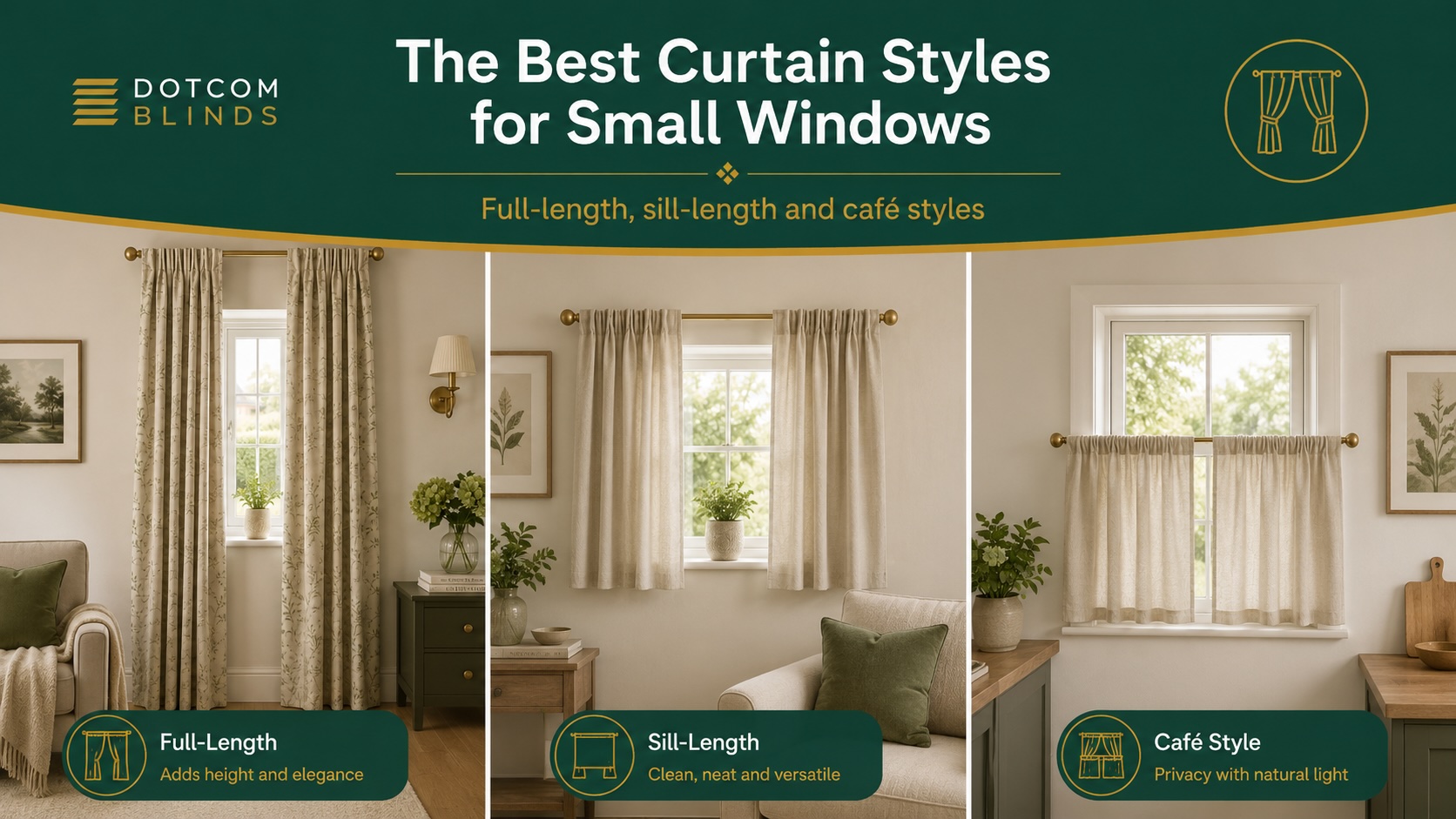
The best curtain style for a small window depends on the shape of the opening, the available wall space and what sits beneath it. The aim is to create a balanced treatment that improves the window’s proportions without adding unnecessary bulk.
Full-Length Curtains
Full-length curtains can make a short or narrow window appear taller and more substantial. They work particularly well in bedrooms and living rooms, especially when the pole or track is fitted above the frame.
This style is most effective where the floor area beneath the window is clear and there is enough space for the curtains to hang properly.
Sill-Length Curtains
Sill-length curtains finish close to the window sill and can be useful where a radiator, desk or item of furniture sits below the window.
They reduce fabric bulk and keep the treatment compact, although the finished length needs to be measured carefully to avoid looking too short or awkward.
Apron-Length Curtains
Apron-length curtains finish below the sill but above the floor. They offer more coverage than sill-length curtains while remaining practical in rooms where full-length curtains would obstruct furniture or heating.
This can be a useful compromise for small bedroom, dining room or home-office windows.
Café Curtains
Café curtains cover the lower part of the window while leaving the upper section open. They are well suited to kitchens, bathrooms and street-facing rooms where privacy is needed without sacrificing too much daylight.
They can also make a small window feel lighter and less enclosed than a full curtain treatment.
Single-Panel Curtains
A single curtain panel can work well on a very narrow window or one positioned close to a corner. It takes up less space than a pair of curtains and can be drawn neatly to one side.
The panel should still be wide enough to cover the window properly when closed and should stack on the side with the greatest available wall space.
A Pair of Curtains
A traditional pair of curtains creates a balanced, symmetrical appearance. This is often the best choice where the window is centred and there is enough space on both sides for the fabric to stack back.
For smaller windows, the fullness and fabric weight should be controlled so the curtains do not dominate the surrounding wall.
There is no single curtain style that suits every small window. Full-length curtains are often best for improving visual height, while shorter or single-panel styles may be more practical where space is restricted.
Full-Length or Short Curtains for Small Windows?
Full-length curtains are often assumed to suit only large windows, but they can work particularly well on small windows when the aim is to create greater visual height. By extending from above the frame towards the floor, they draw the eye vertically and can make a short window feel more substantial.
This approach is especially effective in bedrooms and living rooms where the wall beneath the window is clear. Fitting the pole or track above the frame can strengthen the effect, while allowing the curtains to extend beyond the sides helps the opening appear wider.
Short curtains may be the more practical choice where a radiator, desk, worktop or piece of furniture sits beneath the window. Sill-length and apron-length styles reduce fabric bulk and keep the treatment contained within the available space.
However, short curtains need to be proportioned carefully. Curtains that finish at an awkward point can make the window look even smaller or create a visually broken line across the wall. The final drop should relate clearly to the sill, radiator or furniture below.
The choice should therefore be based on the room layout rather than the window size alone. Full-length curtains are usually better for improving proportion and creating a more polished finish, while shorter curtains are best where practical clearance takes priority.
How to Make a Small Window Look Bigger with Curtains
Curtains can change the perceived proportions of a small window when the pole or track, curtain length and fabric are planned carefully. The aim is to create a larger visual frame around the opening rather than drawing attention to its exact dimensions.
Fitting the curtain pole or track above the window frame can make the opening appear taller. The higher position encourages the eye to follow the vertical line of the curtains, particularly when full-length panels are used.
Extending the hardware beyond both sides of the frame can also make the window feel wider. This allows the curtains to stack away from the glass when open, exposing more of the window and admitting more daylight.
Full-length curtains are often the most effective choice where the area beneath the window is clear. They create an uninterrupted vertical line from the heading towards the floor, helping a short window feel better proportioned within the room.
Fabric choice also matters. Lightweight or medium-weight materials tend to create less visual bulk, while controlled fullness prevents the curtains from overwhelming the opening. Very heavy fabrics or deep, crowded folds can make a small window feel enclosed.
Colour can support the effect. Curtains in a shade close to the wall colour create a more continuous surface, while subtle vertical stripes or elongated patterns can emphasise height. Large, high-contrast designs may draw attention back to the limited width of the window.
The strongest approach is usually to fit the curtains slightly higher and wider than the frame, keep the fabric proportionate and ensure the open curtains do not cover valuable glass area.
Should Curtains Be Wider Than a Small Window?
In most cases, curtains should extend beyond the width of a small window rather than finishing directly at the frame. A wider pole or track allows the curtains to stack away from the glass when open, which can help the window appear larger and preserve more natural light.
If the hardware is only as wide as the window, the open curtains may cover a significant part of the glass. This can make the opening feel narrower and reduce daylight, particularly where the window is already small.
The extra width should still remain proportionate to the wall. Extending the pole or track too far can make a compact window look disconnected from the curtain treatment, especially in a small room or where the window sits close to a corner.
You should also consider how much space the chosen fabric will occupy when stacked. Heavier curtains, blackout linings and fuller headings generally require more wall space than lightweight fabrics or flatter folds.
Measure the full planned pole or track width rather than the window alone. The aim is to create enough side space for the curtains to sit clear of the glass without making the installation feel oversized or unbalanced.
How High Should Curtains Be Hung Above a Small Window?
Hanging curtains above the window frame can make a small window appear taller and give the treatment a more balanced presence within the room. The higher position creates a stronger vertical line, particularly when paired with full-length curtains.
The ideal height depends on the space between the top of the window and the ceiling. In rooms with standard proportions, placing the pole or track above the frame usually creates a cleaner result than fixing it immediately against the window. Where ceiling height allows, fitting the curtains closer to the ceiling can make both the window and the room feel taller.
The position should still look intentional. Leaving a very large gap between the window and the curtain heading can make the treatment appear disconnected, especially if the curtains are short. Full-length curtains usually handle a higher fitting position more effectively because they create an uninterrupted line towards the floor.
Ceiling-mounted tracks can be useful where there is limited wall space above the window or where a streamlined finish is preferred. They also work well in compact rooms where reducing visible hardware helps keep the scheme uncluttered.
Before fitting, check for coving, vents, window handles and any other obstructions. The final position should improve the window’s proportions while allowing the curtains to open and close freely.
The Best Curtain Headings for Small Windows

The curtain heading affects how much fabric gathers at the top, how the curtains stack when open and how visually substantial the treatment appears. For a small window, the best heading is usually one that creates controlled folds without adding unnecessary bulk.
Wave Curtains
Wave curtains create smooth, evenly spaced folds and a clean contemporary finish. They work particularly well with tracks and can help a small window feel less cluttered.
Because the folds are regular and controlled, wave curtains often stack more neatly than fuller traditional headings. They are a strong option where the available wall space is limited.
Pencil Pleat Curtains
Pencil pleat curtains are versatile and can be used with either a pole or track. The gathered heading creates a familiar, traditional appearance and allows some flexibility when adjusting the finished width.
On a small window, the fullness should be carefully controlled. Too much gathering can make the heading look crowded and increase the size of the curtain stack.
Pinch Pleat Curtains
Pinch pleat curtains create a tailored and structured finish. They can make a small window feel more polished, particularly in bedrooms, dining rooms and traditional interiors.
However, the fixed pleats are more decorative and visually substantial than a simple wave heading. They work best where there is enough space around the window for the curtains to sit comfortably.
Eyelet Curtains
Eyelet curtains are simple to operate and create broad, even folds. They can suit small windows where a visible pole forms part of the design.
The folds usually project further forward and can take up more space when open, so eyelets may be less suitable where stack-back space is very limited.
Tab-Top Curtains
Tab-top curtains create a relaxed and informal look. They can work on small windows in casual interiors, but the visible loops may add visual detail around an already compact opening.
They are generally less suitable where a streamlined or tailored finish is required.
For most small windows, wave, pencil pleat and carefully proportioned pinch pleat headings provide the strongest balance of appearance and practicality. The final choice should reflect the available space, curtain fabric and wider style of the room.
The Best Curtain Fabrics for Small Windows
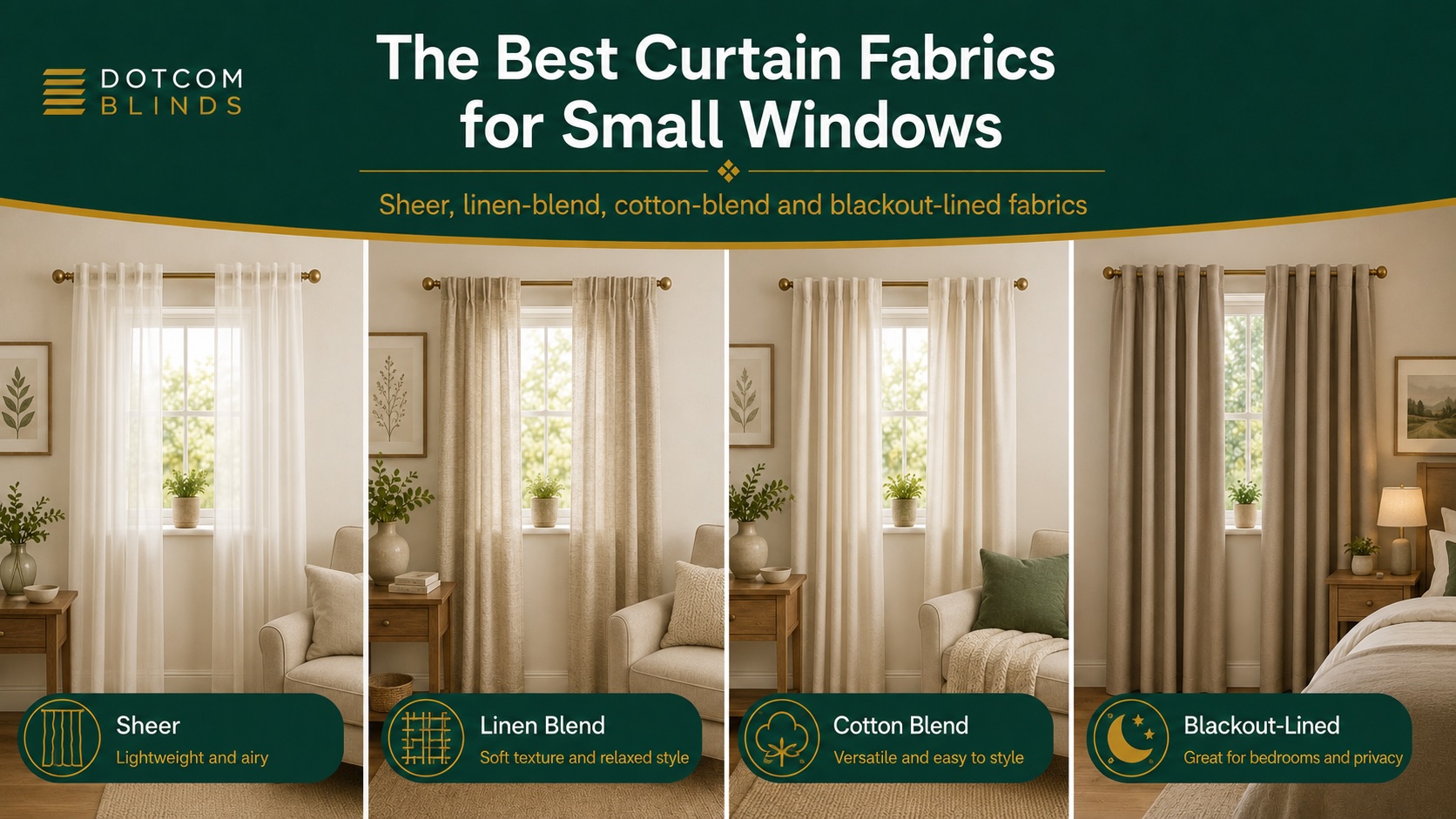
Fabric choice has a significant effect on how a small window looks and functions. The right material should provide the required privacy, light control and finish without creating more bulk than the space can comfortably accommodate.
Lightweight Fabrics
Lightweight fabrics are often a strong choice for small windows because they hang softly and allow the treatment to feel less dominant. They can help preserve natural light and create a more relaxed appearance, particularly in living rooms, kitchens and compact bedrooms.
However, very light fabrics may offer limited privacy or room darkening unless they are lined.
Linen-Look Fabrics
Linen-look curtains add texture without appearing overly heavy. Their natural, slightly relaxed finish works well in contemporary, country and neutral interiors.
They are particularly effective where the aim is to soften the window while keeping the overall treatment understated.
Cotton and Cotton-Blend Fabrics
Cotton and cotton-blend fabrics provide a practical balance between structure and softness. They are available in a wide range of colours, textures and patterns, making them suitable for both traditional and modern rooms.
The final effect will depend on the weight of the fabric and whether a lining is added.
Velvet and Heavier Fabrics
Velvet and other heavier materials can work on small windows where a richer, more substantial look is required. They are often best suited to bedrooms, dining rooms or formal interiors.
Their main limitation is bulk. Thick fabrics and deeper linings create a larger stack when open, which can cover more of the glass and make the window feel narrower.
Sheer Fabrics
Sheer curtains are useful where maintaining daylight is a priority. They soften the window and provide a degree of daytime screening without adding much visual weight.
They offer limited privacy after dark, so they may need to be paired with another curtain layer or a blind where greater coverage is required.
Blackout-Lined Fabrics
Blackout-lined curtains can be suitable for small bedroom windows, particularly where outside light is disruptive. The lining increases thickness, so the pole or track should provide enough width for the curtains to stack away from the glass.
The effectiveness of blackout curtains depends on the overall fit and coverage, not only the fabric itself.
For most small windows, lightweight or medium-weight fabrics provide the best balance between appearance and practicality. Heavier materials can still work, but they need careful measuring and sufficient stack-back space.
Plain or Patterned Curtains for Small Windows?
Fabric choice has a significant effect on how a small window looks and functions. The right material should provide the required privacy, light control and finish without creating more bulk than the space can comfortably accommodate.
Lightweight Fabrics
Lightweight fabrics are often a strong choice for small windows because they hang softly and allow the treatment to feel less dominant. They can help preserve natural light and create a more relaxed appearance, particularly in living rooms, kitchens and compact bedrooms.
However, very light fabrics may offer limited privacy or room darkening unless they are lined.
Linen-Look Fabrics
Linen-look curtains add texture without appearing overly heavy. Their natural, slightly relaxed finish works well in contemporary, country and neutral interiors.
They are particularly effective where the aim is to soften the window while keeping the overall treatment understated.
Cotton and Cotton-Blend Fabrics
Cotton and cotton-blend fabrics provide a practical balance between structure and softness. They are available in a wide range of colours, textures and patterns, making them suitable for both traditional and modern rooms.
The final effect will depend on the weight of the fabric and whether a lining is added.
Velvet and Heavier Fabrics
Velvet and other heavier materials can work on small windows where a richer, more substantial look is required. They are often best suited to bedrooms, dining rooms or formal interiors.
Their main limitation is bulk. Thick fabrics and deeper linings create a larger stack when open, which can cover more of the glass and make the window feel narrower.
Sheer Fabrics
Sheer curtains are useful where maintaining daylight is a priority. They soften the window and provide a degree of daytime screening without adding much visual weight.
They offer limited privacy after dark, so they may need to be paired with another curtain layer or a blind where greater coverage is required.
Blackout-Lined Fabrics
Blackout-lined curtains can be suitable for small bedroom windows, particularly where outside light is disruptive. The lining increases thickness, so the pole or track should provide enough width for the curtains to stack away from the glass.
The effectiveness of blackout curtains depends on the overall fit and coverage, not only the fabric itself.
For most small windows, lightweight or medium-weight fabrics provide the best balance between appearance and practicality. Heavier materials can still work, but they need careful measuring and sufficient stack-back space.
Choosing Curtain Colours for a Small Window
Curtain colour can change how large, bright or prominent a small window appears. The best choice depends on whether you want the curtains to blend into the room or make the window a stronger focal point.
Light and Neutral Colours
White, cream, beige, pale grey and other soft neutrals can help a small window feel lighter and less enclosed. They reflect more natural light and usually create less visual weight than darker shades.
This approach works particularly well in compact rooms where maintaining brightness is important.
Tonal Curtains
Choosing curtains in a colour close to the wall can make the window treatment feel more integrated. The reduced contrast creates a smoother visual line and can help the wall appear less divided.
Tonal schemes are especially effective with full-length curtains, where the fabric becomes part of the wider room rather than drawing attention to the exact size of the window.
Dark Curtains
Dark colours can still work on small windows, particularly where the room has enough natural light or the curtains are intended to create contrast.
Deep green, navy, charcoal or burgundy can add depth and make the window feel more substantial. However, heavy fabrics in dark colours may dominate a compact opening, so the heading, fullness and surrounding décor should remain balanced.
Accent Colours
A small window can also become a deliberate feature through colour. Curtains in a stronger accent shade can connect with cushions, upholstery, artwork or other furnishings and help the room feel more coordinated.
The key is to repeat the colour elsewhere so the curtains do not appear isolated.
There is no rule that small windows must use pale curtains. Light and tonal colours tend to create the most open appearance, while darker or bolder shades can work well when the rest of the room supports them.
Can You Use Blackout Curtains on Small Windows?
Blackout curtains can work well on small windows, particularly in bedrooms, nurseries and other rooms where reducing outside light is important. The main challenge is managing the additional fabric thickness without making the window feel crowded.
The curtain pole or track should usually extend beyond the window frame so the curtains can cover the sides properly when closed and stack away from the glass when open. This helps reduce light entering around the edges while preserving more daylight during the day.
The lining is more important than the face fabric colour. A pale curtain with a suitable blackout lining can provide better room darkening than a dark curtain without one. The overall result will also depend on how closely the curtains fit around the top, sides and bottom of the window.
Full-length blackout curtains can make a small window appear taller while providing broader coverage. However, sill-length or apron-length curtains may be more practical where a radiator, desk or furniture sits beneath the window.
Because blackout linings add weight and bulk, the heading should be chosen carefully. Wave or controlled pencil pleat curtains may create a neater stack than deeper, fuller styles where wall space is limited.
Blackout curtains can significantly reduce incoming light, but complete darkness may still be affected by gaps around the curtain edges and the position of the track or pole. Accurate measuring and generous coverage are therefore essential.
Sheer Curtains for Small Windows
Sheer curtains can be a strong choice for small windows where preserving daylight is more important than achieving complete privacy or room darkening. Their lightweight appearance softens the window without adding the visual bulk of a heavier curtain fabric.
They are particularly useful in compact living rooms, kitchens, home offices and other spaces where natural light needs to be maintained. When fitted slightly wider than the window, sheer curtains can frame the opening while allowing much of the glass to remain visible.
Sheers can also help a small window feel less harsh or exposed. The fabric diffuses direct sunlight and creates a softer transition between the window and the surrounding wall, which can make the treatment feel more considered without dominating the room.
Privacy is more limited, especially after dark when the room is illuminated. In spaces where greater coverage is required, sheer curtains can be layered with lined curtains or paired with a blind. This provides flexible light control during the day and stronger privacy in the evening.
The heading should remain relatively simple so the fabric does not gather too heavily around the window. Wave headings and lightly gathered pencil pleats often create a neat finish, while very full sheers may cover too much of the glass when open.
For small windows, the strongest result usually comes from using a soft, lightweight sheer with controlled fullness and enough track or pole width to keep the fabric clear of the window during the day.
Curtains for Small Bedroom Windows
Curtains for small bedroom windows need to balance room darkening, privacy and proportion without making the window feel crowded. The best result usually comes from choosing a style that extends beyond the frame while keeping the fabric weight and fullness under control.
Full-length curtains can be particularly effective because they create a stronger vertical line and help a short window appear taller. This works well where the area beneath the window is clear and the curtains can hang without obstruction.
Where a radiator, desk or bed sits below the window, sill-length or apron-length curtains may be more practical. The finished drop should relate clearly to the furniture or radiator rather than stopping at an arbitrary point.
Blackout lining is often useful in bedrooms, but it adds thickness. The pole or track should therefore extend far enough beyond the window for the curtains to stack away from the glass when open. This helps preserve daylight and avoids making the opening feel narrower.
The position of the bed should also be considered. Curtains should not bunch behind a headboard, interfere with bedside furniture or become difficult to operate. On very narrow windows, a single panel may sometimes provide a cleaner result than a traditional pair.
For small bedroom windows, the strongest combination is usually accurate made-to-measure sizing, controlled fullness and a heading that keeps the curtain stack compact.
Curtains for Small Living Room Windows
Curtains can help a small living room window feel more substantial, provided the treatment does not block too much daylight or dominate the surrounding wall. The strongest approach is usually to use the curtains to improve the window’s proportions while keeping the overall scheme visually light.
Full-length curtains often work well because they create height and give the window a more finished appearance. Fitting the pole or track above the frame and extending it beyond both sides can make the opening appear larger and allow the curtains to stack away from the glass.
Fabric weight should be considered carefully. Lightweight or medium-weight curtains usually provide enough softness without creating excessive bulk. Heavier fabrics can still work in larger living rooms, but they need sufficient wall space at the sides so the open curtains do not cover much of the window.
The curtain colour should connect with the wider room. Tonal fabrics can help the treatment blend into the wall, while a stronger accent colour can make the window a deliberate focal point. Where the room already contains pattern, texture may be more effective than a bold print.
If the living room contains windows of different sizes, it is often better to coordinate the curtains through fabric, colour and heading rather than trying to make every treatment identical. This creates consistency while allowing each window to be dressed according to its proportions and position.
For small living room windows, the best result usually comes from combining full-length curtains, controlled fullness and a pole or track wide enough to preserve as much natural light as possible.
Curtains for Small Kitchen Windows
Curtains can work well on small kitchen windows, but practicality should take priority over appearance alone. Heat, steam, cooking residue and splashes can all affect the fabric, particularly where the window is close to a sink, hob or food preparation area.
Shorter curtain styles are usually the most suitable. Sill-length curtains keep the fabric clear of worktops and appliances, while café curtains provide privacy across the lower part of the window without blocking too much daylight.
Lightweight, easy-care fabrics are generally preferable to heavy or heavily lined materials. They create less bulk, dry more quickly and are easier to maintain in a room where moisture and cooking residue may be present.
The position of the window should guide the choice. Where it sits above a sink, the curtain should finish well clear of taps and standing water. Near a hob, curtains may be unsuitable because loose fabric should not be positioned close to heat or an open flame.
A simple heading can help keep the treatment compact. Light pencil pleats or a neat track system often work better than deep folds or heavy decorative headings.
In some kitchens, a made-to-measure blind may be more practical than curtains, particularly where the window is tightly positioned between units or directly above a worktop. Curtains remain a good option where there is enough clearance and the aim is to add softness without reducing usability.
Curtains for Small Bathroom Windows
Curtains can be used on small bathroom windows, but the fabric and fitting position need to suit a room where moisture and condensation are common. The treatment should provide privacy without restricting ventilation or sitting too close to wet areas.
Shorter styles are usually the most practical. Sill-length curtains or café curtains can provide coverage while keeping the fabric away from the floor, bath and basin. Café curtains are particularly useful where privacy is needed at lower level but daylight from the upper part of the window should be preserved.
Lightweight, quick-drying fabrics are generally more suitable than heavy or deeply lined materials. Thick curtains can retain moisture for longer and may be harder to keep fresh in a compact bathroom.
The window position is also important. Curtains should not sit where they are likely to be splashed regularly, and they should not obstruct the opening of the window or any extractor ventilation. Good airflow helps reduce moisture around both the window and fabric.
Where the bathroom is especially small, poorly ventilated or prone to high levels of condensation, a moisture-resistant blind may be a more practical option. Curtains work best where there is enough clearance, reliable ventilation and a need for a softer decorative finish.
Small Windows Above Radiators
Small windows positioned above radiators need careful curtain planning because the wrong length can restrict heat circulation, create unnecessary bulk and make the window area feel crowded.
Full-length curtains are not always the best option in this situation. When closed, they can trap warm air behind the fabric and reduce how effectively heat moves into the room. They may also sit too close to the radiator, particularly where the unit projects significantly from the wall.
Sill-length or apron-length curtains are often more practical. They provide privacy and decoration while keeping the fabric clear of the radiator. The finished drop should leave enough space for warm air to circulate without the curtains appearing awkwardly short.
The pole or track should usually extend beyond the window frame so the curtains can stack away from the glass and radiator when open. This helps preserve daylight and prevents the fabric from bunching directly above the heat source.
Fabric weight also matters. Lightweight or medium-weight materials are generally easier to manage than heavy, deeply lined curtains. Where blackout or thermal performance is required, the increased thickness should be balanced against the available space.
Check the position of thermostatic controls before ordering. The curtains should not cover valves or make them difficult to access. Where space is especially limited, a made-to-measure blind may provide a cleaner alternative while leaving the radiator unobstructed.
Small Windows in Awkward Positions
Small windows are often difficult to dress because of where they are positioned rather than their dimensions alone. A window close to a corner, beneath a sloping ceiling or partly blocked by furniture may leave limited space for a conventional pair of curtains.
For windows close to a corner, a single curtain panel can be more practical than two panels. The curtain can stack on the side with the greatest amount of wall space, helping to keep more of the glass clear when open.
High-level windows may suit shorter curtains or a simple track fitted close to the ceiling. The treatment should remain easy to operate and should not make the window appear disconnected from the rest of the room.
Where a window sits beneath a sloping ceiling, the curtain hardware must be positioned carefully so the fabric can hang evenly. A track may offer more flexibility than a decorative pole, particularly where there is limited room for brackets or finials.
Windows behind desks, beds or other furniture may require a shorter drop or a single-panel design to avoid the fabric bunching or becoming difficult to use. The furniture position should be considered before the curtains are measured, rather than treated as a separate issue after installation.
Off-centre windows can also benefit from a wider curtain treatment that creates a more balanced visual frame. However, the hardware should not be extended so far that the curtains appear unrelated to the window itself.
Made-to-measure curtains are especially useful for awkward positions because the width, drop, heading and opening direction can be adapted to the available space.
Curtain Pole or Track for a Small Window?
Both curtain poles and tracks can work well on small windows, but the better option depends on the available space, the chosen heading and the overall style of the room.
Curtain Poles
Curtain poles are more decorative and work well where the hardware is intended to form part of the design. They are suitable for eyelet, pencil pleat and pinch pleat curtains, provided there is enough room for the brackets and finials.
On a small window, the pole should usually extend beyond the frame so the curtains can stack away from the glass. However, very large finials or heavy poles can look disproportionate, especially where the window sits close to a corner or within a compact room.
Curtain Tracks
Curtain tracks create a more discreet finish and are often better where space is limited. They can be fitted close to the ceiling, which may help the window appear taller, and they usually allow the curtains to move smoothly across the opening.
Tracks are also useful where the curtains need to sit neatly within a restricted area or where a more streamlined appearance is preferred. A ceiling-mounted track can be particularly effective in rooms with little wall space above the window.
The right choice depends on the curtain heading and the available clearance. A pole may suit a more decorative scheme, while a track is often the stronger option where the priority is keeping the treatment compact and visually uncluttered.
How to Measure Curtains for a Small Window
Measuring curtains for a small window requires careful planning because even minor errors can make the finished treatment look cramped, uneven or out of proportion.
Begin by deciding where the curtain pole or track will sit. In most cases, it should be fitted outside the window recess and extend beyond the frame so the curtains can stack away from the glass when open.
Measure the full width of the planned pole or track rather than the width of the window alone. This determines the finished curtain width and helps ensure the treatment has enough fullness without becoming unnecessarily bulky.
Next, choose the curtain drop. Measure from the pole or track to the intended finishing point, whether that is the sill, below the sill or just above the floor. Check for radiators, desks, worktops and other furniture that may affect the length.
Take measurements in more than one place, particularly for the drop. Window frames, floors and ceilings are not always perfectly level, so relying on a single measurement can result in an uneven finish.
Before ordering, confirm:
- The pole or track position
- The full finished width
- The required curtain drop
- The available stack-back space
- Any radiators, handles or furniture beneath the window
- The chosen heading and how it affects the finished length
- Whether the wall or ceiling can support the hardware and fabric weight
Small windows leave less room for adjustment, so accurate made-to-measure sizing is particularly important.
Common Measuring Mistakes
Small windows leave little room for error, so mistakes that might be less noticeable on a larger opening can become immediately obvious.
One of the most common problems is measuring only the glass or window frame. Curtains are usually fitted to a pole or track that extends beyond the opening, so the full planned hardware width should be measured instead.
Another mistake is allowing too little stack-back space. If the curtains cannot sit clear of the glass when open, they may block valuable daylight and make the window appear narrower.
The finished drop also needs careful consideration. Sill-length curtains that stop too high can look undersized, while apron-length curtains that finish at an arbitrary point may disrupt the proportions of the wall. Full-length curtains should be measured from the correct point on the pole or track, taking the heading into account.
Other common errors include:
- Forgetting to account for radiators, desks or furniture beneath the window
- Measuring the drop in only one place
- Assuming the window, floor or ceiling is perfectly level
- Choosing too much curtain fullness for the available wall space
- Fitting the pole or track too close to the frame
- Ignoring the size of brackets, finials or track components
- Ordering before deciding on the heading style
- Failing to check whether the fixing surface can support the hardware
A final measurement check should be completed only after the pole or track position, heading, curtain length and stack-back requirements have all been decided.
Common Design Mistakes with Small-Window Curtains
Curtains can improve the proportions of a small window, but the wrong design choices can make the opening feel narrower, shorter or more visually crowded.
One common mistake is choosing fabric that is too heavy for the available space. Thick materials, deep linings and generous fullness can create a large stack when open, covering too much of the glass and reducing natural light.
Hanging the pole or track too low can also emphasise the limited height of the window. Positioning the hardware above the frame often creates a stronger vertical line and helps the opening feel taller.
Other frequent design mistakes include:
- Fitting the pole or track only as wide as the window
- Choosing oversized patterns that are cut off across narrow panels
- Using too much fullness for the wall space
- Selecting a heading that creates excessive bulk
- Choosing short curtains where full-length curtains would improve proportion
- Using full-length curtains where a radiator or furniture makes them impractical
- Allowing the open curtains to cover too much of the glass
- Choosing a colour that feels disconnected from the wider room
- Treating every small window in the same way
The strongest design usually comes from balancing appearance with function. The curtains should frame the window, preserve as much daylight as possible and suit the proportions of both the opening and the room.
Curtains or Blinds for Small Windows?
Both curtains and blinds can work well on small windows, but they solve different practical and design problems. The better option depends on the room, available wall space and the level of privacy, light control and visual softness required.
Curtains are often the stronger choice where the aim is to make a small window feel taller or more substantial. Fitting them above and beyond the frame can improve the perceived proportions of the opening, while the fabric adds colour, texture and a softer finish.
Blinds are usually more compact. Because they sit within or close to the window, they take up less wall space and can preserve more of the surrounding area. This makes them useful for windows close to corners, above worktops or radiators, or in rooms where curtain stack-back would block too much glass.
The room itself should guide the decision. Curtains often suit bedrooms and living rooms, where softness and room darkening are important. Blinds may be more practical in kitchens, bathrooms, home offices and other spaces where moisture, limited clearance or precise light control matters.
A combination of curtains and blinds can also work where space allows. The blind can manage privacy and daylight close to the glass, while the curtains provide decoration, warmth and additional coverage.
The best choice should be based on how the window needs to function rather than its size alone. Curtains are generally better for improving visual height and adding softness, while blinds offer a neater, more space-efficient solution.
Small-Window Curtain Ideas by Interior Style
The most suitable curtains for a small window should complement the wider room rather than being chosen in isolation. The fabric, heading, colour and length can all be adjusted to suit different interior styles without overwhelming the window.
Contemporary Interiors
Plain curtains with a clean wave heading work well in contemporary rooms. Neutral colours, soft greys, muted greens and warm beige tones help keep the treatment streamlined.
A discreet track fitted above the window can create a neat finish and improve the sense of height without adding unnecessary visual detail.
Traditional Interiors
Pencil pleat or pinch pleat curtains are well suited to traditional rooms. Subtle patterns, textured fabrics and classic colours can add character while keeping the small window proportionate.
Where space allows, full-length curtains can give the opening a more substantial and formal appearance.
Minimalist Interiors
Minimalist rooms usually benefit from tonal curtains that sit close to the wall colour. This reduces contrast and helps the window treatment blend into the wider scheme.
A simple track, restrained fullness and lightweight fabric will usually create the cleanest result.
Country-Style Interiors
Linen-look fabrics, small botanical prints and softly textured materials can work well in country-inspired rooms. Café curtains may also suit kitchens, breakfast rooms and informal spaces where privacy is needed without blocking too much daylight.
Patterns should remain proportionate to the curtain width so the design does not feel crowded.
Luxury Interiors
A small window can still support a richer treatment when the surrounding room has enough scale. Velvet, deeper colours and tailored pinch pleats can add depth and create a more polished finish.
The fabric should be carefully measured to avoid excessive fullness or a bulky curtain stack. Full-length curtains can help give the window greater presence, even when the opening itself is relatively small.
The strongest result comes from adapting the curtain treatment to both the window and the room style. A small window does not need to be visually understated, but every design element should remain proportionate to the available space.
Practical Decision Checklist
Before choosing curtains for a small window, consider how the treatment will affect both the opening and the wider room.
- Is there enough wall space for the curtains to stack away from the glass?
- Would full-length curtains improve the apparent height of the window?
- Is a radiator, desk, worktop or piece of furniture positioned beneath it?
- Does the room need privacy, room darkening, decoration or a combination of these?
- Is the chosen fabric light enough for the available space?
- Will the curtains block too much daylight when open?
- Does the heading create more bulk than the window can comfortably support?
- Is the pole or track wide enough to extend beyond the frame?
- Has the full pole or track width been measured rather than only the window?
- Does the curtain colour complement the surrounding wall and furnishings?
- Would a single panel work better than a pair?
- Would a blind provide a cleaner solution where space is especially limited?
If the curtains can hang neatly, preserve daylight and suit the room’s practical needs, they are likely to work well. Where the window is tightly positioned or the surrounding space is restricted, a lighter fabric, simpler heading or made-to-measure blind may be the better choice.
Why Made-to-Measure Curtains Work Well for Small Windows
Made-to-measure curtains are particularly useful for small windows because the proportions need to be more precise. On a compact opening, excess width, an awkward drop or too much fullness is more noticeable and can make the treatment feel bulky.
With made-to-measure curtains, the finished width can be specified to suit the full pole or track rather than relying on a standard size. This helps create enough fullness for the curtains to hang properly without producing an unnecessarily large stack when open.
The drop can also be tailored to the room. Curtains can finish at the sill, below the sill or close to the floor, depending on the position of radiators, furniture and the overall look you want to achieve.
You can also choose a heading that suits the available wall space. A more streamlined heading may work better where stack-back is limited, while a tailored pleat can give a small window greater presence where there is enough room.
Fabric and lining choices can be adapted to the purpose of the room. A lighter fabric may help preserve daylight, while blackout lining may be more appropriate for a bedroom.
The result is a curtain treatment that feels proportionate to the window rather than adapted from a standard size. This is especially valuable for narrow windows, short windows and openings in awkward positions.
Why Choose DotcomBlinds for Made-to-Measure Curtains?
DotcomBlinds offers made-to-measure curtains produced to suit the exact width, drop and style requirements of your window. This can be especially useful for small windows, where standard curtain sizes may create too much fabric, an awkward length or an unbalanced finish.
Customers can choose from a wide range of fabrics, colours and curtain styles to suit different rooms and interior schemes. Free samples are available, making it easier to compare fabric colours and textures against walls, flooring, furniture and existing window treatments before ordering.
The online ordering process is designed to make selecting and measuring made-to-measure curtains straightforward, while support is available from an experienced team where additional guidance is needed.
DotcomBlinds is also independently rated 4.6 out of 5 on Feefo, based on more than 1,500 verified reviews. For small or awkwardly positioned windows, this combination of accurate sizing, fabric choice and customer support can help create a curtain treatment that looks proportionate and works properly within the available space.
Frequently Asked Questions About Curtains for Small Windows
Find practical answers about curtain length, style, measuring, colour and fitting for small windows.