Order Tracking
 0800 1422417
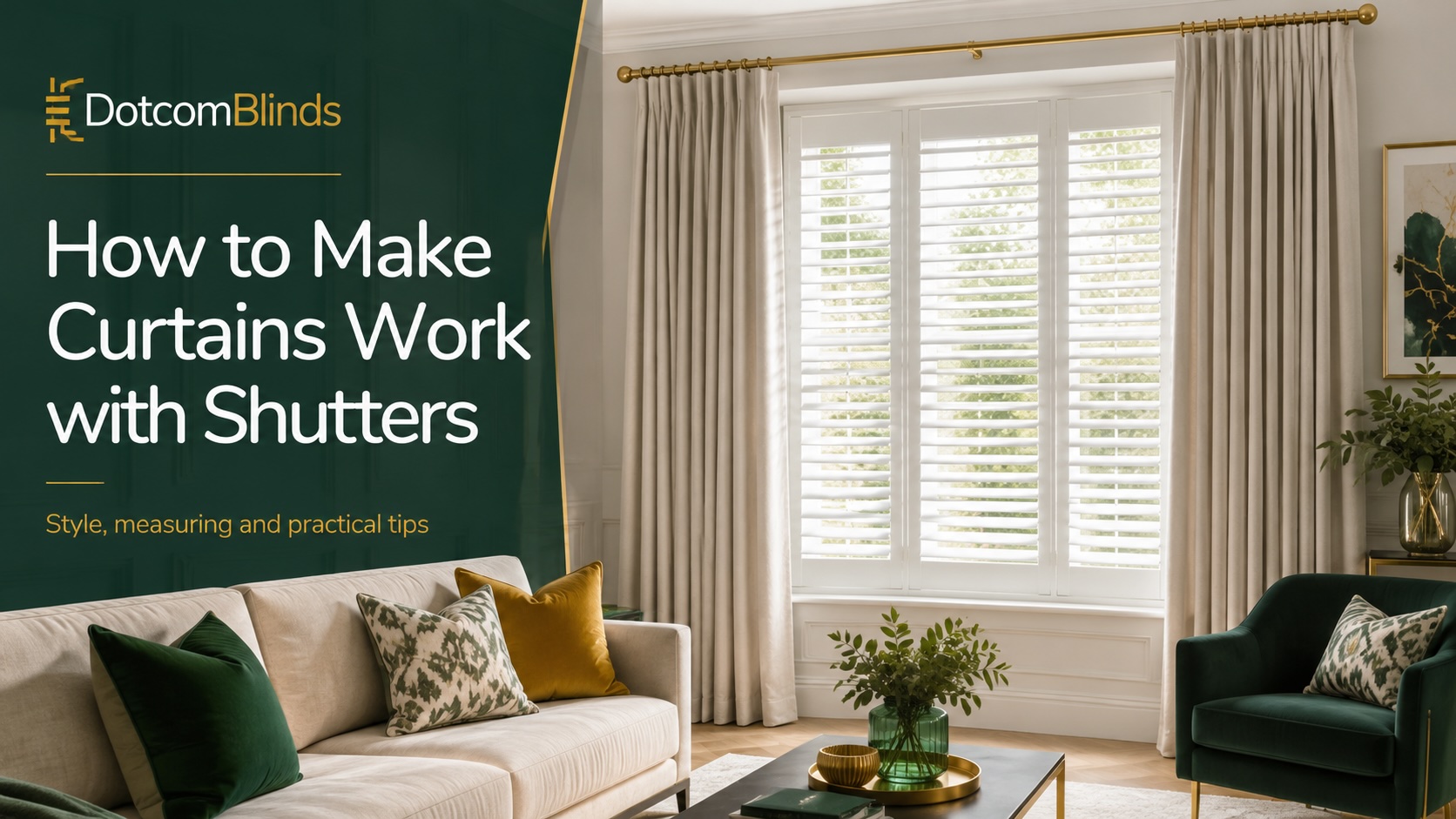
Curtains and shutters can work extremely well together, combining the clean, structured appearance of shutters with the softness, colour and texture of fabric. Shutters are useful for controlling privacy and daylight close to the window, while curtains can make the room feel warmer, more comfortable and more complete.
The key is to plan the two window treatments so they complement rather than obstruct one another. The curtain pole or track must sit far enough forward to allow the shutter panels to open properly, while the curtain width, heading and fabric should suit both the window and the surrounding room.
In this guide, we explain how to make curtains work with shutters, including the best curtain styles, suitable fabrics, measuring considerations and common installation mistakes to avoid.
Curtains with Shutters: The Quick Answer
Curtains can work very well with shutters, provided there is enough clearance for both window treatments to operate properly. The curtain pole or track should sit far enough in front of the window to allow the shutter panels to open fully without catching on the fabric.
In most rooms, shutters provide practical control over privacy and daylight, while curtains add softness, colour, texture and an extra layer of coverage. Full-length curtains often create the most balanced finish, particularly in living rooms and bedrooms, although shorter curtains may be more practical where radiators or furniture sit beneath the window.
For the best result, measure the full projection of the open shutter panels before choosing the curtain hardware. You should also allow enough space at either side of the window for the curtains to stack back without blocking light or restricting access to the shutters.
Why Combine Curtains and Shutters?
Shutters and curtains serve different purposes, which is why they can work so effectively together. Shutters sit close to the window and allow you to adjust privacy and daylight throughout the day, while curtains introduce a softer decorative layer that can make the room feel more comfortable and complete.
One of the main advantages of adding curtains is visual balance. Shutters have a clean, structured appearance, but in some interiors they can feel slightly stark on their own. Curtains soften the straight lines around the window and give you more freedom to introduce colour, pattern and texture.
Curtains can also provide additional practical benefits. A suitable lining may help improve room darkening in bedrooms, while heavier or thermal-lined fabrics can add another layer between the room and the window. The effect will depend on the fabric, fit and installation, but well-fitted curtains can make the window area feel more enclosed.
Combining the two also gives you greater flexibility. During the day, the curtains can remain open while the shutters manage privacy and glare. In the evening, the curtains can be closed to create a warmer, more private atmosphere.
Do You Need Curtains If You Already Have Shutters?
You do not necessarily need curtains if you already have shutters. In many rooms, shutters provide enough privacy, light control and visual structure on their own. However, curtains can still be a worthwhile addition where you want a softer appearance, more decorative flexibility or an extra layer of coverage.
Curtains are particularly useful when shutters make the room feel too stark or formal. Fabric can soften the hard lines around the window and introduce colour, pattern or texture that connects the window treatment with the rest of the interior.
They can also be helpful in bedrooms, where shutters alone may not block all incoming light. Adding blackout-lined curtains can reduce light entering around the edges of the shutter panels and create a darker sleeping environment, although the final result will depend on the curtain fit and installation.
In living rooms and larger bedrooms, full-length curtains can make the window feel more substantial and complete. By contrast, shutters alone may be the better option in compact rooms, minimalist interiors or windows with limited wall space around them.
The decision should therefore be based on what the room needs. If the shutters already provide the right balance of privacy, light control and style, curtains may be unnecessary. If the window needs more softness, warmth, darkness or visual impact, adding curtains can improve both the practical and decorative result.
Check How the Shutters Open Before Choosing Curtains
Before choosing curtains, check exactly how the shutter panels open and how far they project into the room. This will determine where the curtain pole or track can be positioned and whether the curtains will interfere with normal use.
Open every shutter panel fully and look for any part that extends beyond the window recess. Hinges, handles, catches and folding panels can all increase the clearance required. It is important to measure the furthest point reached by the open shutters rather than relying only on the depth of the frame.
You should also consider the direction in which the panels fold. Some shutters fold neatly against the sides of the window, while others extend further into the room when opened. Where several panels fold together, the combined depth can be greater than expected.
The curtain hardware must sit far enough forward to prevent the fabric from catching on the shutters. There should also be enough space for the curtains to hang naturally without being pushed out of shape by handles or open panels.
Testing the full opening movement before measuring for curtains helps prevent one of the most common problems with this combination: installing attractive curtains that make the shutters difficult to open or use.
Curtain Pole or Track: Which Works Best with Shutters?
Both curtain poles and tracks can work with shutters, but the best option depends on the available clearance, the width of the window and the style you want to achieve.
A curtain pole is often the most decorative choice. It works particularly well in traditional or character-led interiors where the pole, brackets and finials form part of the overall design. Poles can be paired with eyelet, pencil pleat or pinch pleat curtains, provided the brackets project far enough from the wall to clear the shutter panels.
Curtain tracks usually create a cleaner and more discreet finish. They can be especially useful where the curtains need to sit close to the ceiling, span a wide window or follow the shape of a bay. A ceiling-fixed track may also provide more flexibility where wall-mounted brackets would sit too close to the shutters.
Whichever option you choose, projection is more important than appearance alone. The pole or track must hold the curtains far enough forward to allow every shutter panel to open fully without touching the fabric.
You should also consider how easily the curtains will move. Tracks generally provide smooth operation across wider windows, while poles may require additional brackets for support. However, extra centre brackets can affect how freely curtains pass across the full width, so the planned opening arrangement should be considered before installation.
For many standard windows, either option can work well. The correct choice is the one that provides sufficient shutter clearance, supports the curtain weight and suits the intended heading and room style.
How Far Should Curtains Sit in Front of Shutters?
There is no single distance that works for every window because shutter frames, hinges, handles and folding panels vary in depth. The curtains need to sit far enough forward to clear the shutters at their widest point when fully open.
Start by opening every shutter panel and measuring how far the outermost part projects from the wall. Use the furthest point, which may be a handle, hinge or folded group of panels rather than the shutter frame itself.
The curtain pole or track should then be positioned beyond this point, with a little extra clearance for the curtain folds. This prevents the fabric from rubbing against the shutters, being pushed out of shape or restricting how the panels move.
The amount of additional space required will depend on the curtain heading and fabric. Deep pleats, eyelets and heavier materials usually need more room than flatter headings or lightweight fabrics. Full curtains can also move slightly as they are opened and closed, so an installation that only just clears the shutters may still cause problems in daily use.
Before fixing the brackets or track, hold the proposed curtain position in place and test the shutters through their full opening movement. This is more reliable than choosing a standard bracket depth without checking the individual window.
Should Curtains Sit Inside or Outside the Window Recess?
When shutters are already fitted within the window opening, curtains will usually need to sit outside the recess. This gives the shutter panels enough room to open and allows the curtains to frame the entire window without competing for the same space.
Fitting curtains outside the recess can also make the window appear wider and taller. Positioning the pole or track above the window and extending it beyond each side allows the curtains to stack back away from the glass, helping to preserve natural light when they are open.
An inside-recess curtain installation is rarely practical when shutters occupy the same area. There may not be enough depth for both treatments, and the curtain fabric could obstruct the shutter panels, hinges or handles. Even where the recess is unusually deep, the two treatments can look crowded and become difficult to operate.
Ceiling-mounted curtains can be a useful alternative where there is limited wall space above the window or where the shutters project further into the room. This approach can create a clean, full-height finish while providing greater control over the distance between the curtains and shutters.
Whatever position you choose, check that the curtain hardware clears the shutters at every stage of their movement and that there is enough space at the sides for the curtains to sit neatly when open.
The Best Curtain Headings to Use with Shutters
The best curtain heading for shutters is one that suits the room while leaving enough space for the shutter panels to open freely. Some headings sit closer to the pole or track, while others create deeper folds that need more clearance.
Wave curtains are a strong option for contemporary interiors. Their smooth, evenly spaced folds create a clean finish and tend to sit neatly when open. They work particularly well with curtain tracks and can help balance the structured appearance of shutters without adding too much visual weight.
Pencil pleat curtains offer a more traditional and flexible look. They can be used with either a pole or track and allow the fullness to be adjusted during installation. However, the gathered heading can become bulky, so it is important to check that the curtains will still clear the shutters.
Pinch pleat curtains create a tailored, formal appearance. The structured pleats hold their shape well and can complement both traditional and modern shutters. As the folds are more defined, they may require slightly more space in front of the window.
Eyelet curtains are simple to operate and create broad, even folds. They require a visible curtain pole and enough forward projection to prevent the folds from touching the shutters. The depth of the eyelets and fabric should be considered carefully where space is limited.
The right heading will depend on the available clearance, the curtain fabric and the style of the room. Before ordering, check the depth of the heading and how the curtains will stack when open, rather than choosing based on appearance alone.
Full-Length or Sill-Length Curtains?
Full-length curtains are usually the strongest choice when combining curtains with shutters. They create a more complete, intentional finish and help soften the structured lines of the shutters, particularly in living rooms, bedrooms and dining spaces.
Floor-length curtains can also make the window appear taller, especially when the pole or track is fitted above the window frame. For a clean result, the curtains can finish just above the floor, lightly touch it or create a small break, depending on the preferred style.
Sill-length or apron-length curtains may be more practical where a radiator, desk, window seat or other furniture sits beneath the window. They can also suit smaller rooms where full-length curtains would take up too much visual or physical space.
The main consideration is whether the chosen length allows both treatments to work properly. Curtains should not restrict airflow from a radiator, become trapped behind furniture or make it difficult to reach the shutter panels.
Where possible, full-length curtains tend to give the most balanced and polished result. Shorter curtains should be chosen when the room layout or heating arrangement makes them the more practical option.
How Wide Should Curtains Be Around Shutters?
Curtains need enough width to look full when closed, but they also need enough space to stack neatly at either side of the window when open. This is particularly important with shutters because poorly planned curtains can block part of the window or make the shutter panels harder to access.
The curtain pole or track should usually extend beyond the window opening so the fabric can sit clear of the glass and shutters. The exact extension will depend on the window width, the curtain heading, the fabric thickness and the available wall space on each side.
Fullness also affects the final appearance. Curtains that are too narrow can look flat and underfilled, while very full curtains may create bulky stacks that overlap the window. Heavier fabrics, deep pleats and eyelet headings generally take up more space when open than lighter fabrics or flatter heading styles.
Before ordering, measure the full width of the planned pole or track rather than measuring only the window. You should also check how much side space is available once the shutters are fully open.
Made-to-measure curtains are particularly useful in this situation because the width can be specified to suit the installation. This helps achieve the right balance between attractive fullness, practical stack-back and unrestricted shutter movement.
Choosing Curtain Colours to Complement Shutters
Curtain colours should complement the shutters and the wider room rather than being chosen in isolation. As shutters already create a strong architectural feature, the curtains can either blend with them for a calm look or introduce contrast for greater visual impact.
A tonal approach works well in understated interiors. White, cream or pale grey shutters can be paired with curtains in similar neutral shades to create a cohesive finish. Using a slightly warmer or deeper tone helps prevent the window from looking flat while keeping the overall scheme restrained.
For a softer contrast, consider muted greens, blues, taupes or warm greys. These colours can add depth without competing with the shutters. They are particularly effective where the shutters are white or off-white and the room already uses natural materials or neutral furnishings.
Stronger colours can make the curtains the main decorative feature. Deep green, navy, rust or rich gold can frame the window effectively, especially when the shutters remain neutral. In this case, the curtain colour should connect with another element in the room, such as upholstery, cushions, artwork or a rug.
Patterned curtains can also work, but the design should take the lines of the shutters into account. Large or busy patterns may compete with the horizontal louvres and panel frames, while simpler designs often create a more balanced result.
The most successful colour combinations usually reflect the wider interior scheme. Matching the curtains to the room as a whole will create a more considered finish than trying to match the shutters exactly.
Plain or Patterned Curtains with Shutters?
Both plain and patterned curtains can work with shutters, but the right choice depends on how prominent the shutters already are and how much visual detail is present elsewhere in the room.
Plain curtains are often the safer option because shutters already introduce strong horizontal and vertical lines. A solid colour allows the fabric to soften the window without competing with the louvres, frames and panels. This approach works particularly well in contemporary, minimalist or neutral interiors.
Texture can prevent plain curtains from feeling too simple. Linen-look fabrics, subtle weaves and softly brushed finishes add depth while keeping the overall design restrained. Tonal fabrics can also create interest without relying on a visible pattern.
Patterned curtains can be effective when the shutters are a neutral colour and the rest of the room needs more personality. Botanical prints, subtle geometrics and traditional motifs can all work, provided the scale of the pattern suits the size of the window and the surrounding space.
Large patterns tend to suit wider windows and full-length curtains, where there is enough fabric to show the design properly. Smaller or more detailed patterns may work better in compact rooms, although very busy fabrics can make a layered window treatment feel crowded.
The shutters, curtains and wider interior should be considered as one scheme. Where the room already includes patterned wallpaper, rugs or upholstery, plain curtains may create better balance. In a simpler room, patterned curtains can become the feature that brings the space together.
The Best Curtain Fabrics to Pair with Shutters
The best curtain fabric depends on the look you want to achieve and the practical needs of the room. Because shutters already create a structured finish, curtain fabric is often used to introduce softness, texture and a greater sense of warmth.
Linen-look fabrics are a versatile choice for relaxed and contemporary interiors. Their visible texture softens the clean lines of the shutters without making the window feel overly formal. They work particularly well in living rooms, dining rooms and bedrooms with a neutral or natural colour scheme.
Cotton and cotton-blend fabrics offer a balanced option for many rooms. They are available in a wide range of colours and patterns and can create either a casual or more tailored appearance, depending on the curtain heading and lining.
Velvet and other heavier fabrics can add depth and a more luxurious finish. They are particularly effective in larger rooms or bedrooms where the curtains are intended to create greater visual impact. However, heavier materials need suitable support and can require more space when stacked open.
Sheer or lightweight fabrics can soften the window without adding too much weight. They are useful where the main aim is decorative layering rather than room darkening, although they will provide limited additional privacy when used alone.
Blackout-lined curtains are often the most practical choice for bedrooms. Shutters can reduce incoming light, but light may still enter around the frame and panel edges. A well-fitted blackout lining can provide an additional layer of room darkening.
Thermal-lined curtains may also be considered where the window feels cold or draughty. Their effectiveness will depend on the fabric, lining, curtain coverage and installation, so the curtains should extend far enough around the window to reduce exposed gaps.
Whichever fabric you choose, consider how much space it will take up when open. Thick, heavily lined curtains create a larger stack than lightweight fabrics and may need a wider pole or track to sit clear of the shutters.
Can You Use Sheer Curtains with Shutters?
Sheer curtains can work well with shutters when the aim is to soften the window rather than add significant darkness or privacy. Their lightweight appearance balances the structured lines of the shutter panels and can make the room feel less formal.
During the day, sheer curtains can diffuse bright light when the shutters are open. This creates a softer atmosphere without fully covering the window or making the room feel enclosed. They can be particularly effective in living rooms, dining rooms and other spaces where maintaining natural light is important.
Sheers also add movement and texture. This can be useful in modern interiors where shutters alone may appear too rigid, or in larger rooms where the window needs a more decorative finish.
However, sheer curtains offer limited privacy at night, especially when the room is illuminated. In most cases, the shutters will remain the main source of privacy, while the sheers provide a lighter decorative layer.
The curtain track or pole still needs to sit far enough forward for the shutter panels to open freely. Lightweight fabric requires less stack-back space than heavy curtains, but the folds should not rest against handles, hinges or open panels.
For greater flexibility, sheer curtains can also be combined with a second, heavier curtain layer. This allows the sheers to filter daylight during the day while lined curtains provide more privacy, warmth or room darkening in the evening.
Blackout Curtains with Shutters in Bedrooms
Blackout curtains can be a useful addition to shutters in bedrooms, particularly where reducing early morning light or outside illumination is a priority. Shutters can limit incoming light, but small gaps around the frame, hinges and panel edges may still allow some light into the room.
A blackout lining adds a second layer of coverage across the full window area. For the best result, the curtains should extend beyond the sides of the window and sit high enough above it to reduce light entering around the edges. Full-length curtains can also help create a more enclosed finish.
The curtain pole or track must project far enough into the room to clear the shutters when they are fully open. Blackout-lined fabrics are usually thicker than standard curtains, so they need more space to hang and stack back without touching the shutter panels.
Colour alone does not determine whether a curtain provides effective room darkening. A pale fabric with a suitable blackout lining can perform better than a dark unlined fabric. The fit, coverage and positioning of the curtains are equally important.
Although blackout curtains can significantly reduce incoming light, complete darkness may still depend on the individual window, installation and any remaining gaps. Careful measuring and wider curtain coverage will generally produce the strongest result.
Café-Style Shutters with Curtains
Café-style shutters cover the lower part of the window while leaving the upper section open. This makes them particularly well suited to curtains, as each treatment can serve a clear purpose without making the window feel overly layered.
The shutters provide privacy at street level while allowing daylight to enter through the uncovered upper section. Curtains can then be left open during the day and closed in the evening when greater privacy, warmth or room darkening is needed.
Full-length curtains often create the most balanced result with café-style shutters. They frame the entire window, soften the horizontal line created by the top of the shutters and make the treatment feel more intentional. This can work especially well in living rooms, bedrooms and front-facing rooms.
Sheer curtains are another option where the priority is softening daylight rather than blocking it. They can cover the full window while the café-style shutters continue to provide privacy across the lower section.
As with full-height shutters, the pole or track must sit far enough forward for the shutter panels to open without catching the fabric. The curtains should also have enough space to stack back at the sides so they do not block the uncovered upper part of the window during the day.
Bay Windows: Combining Curtains and Shutters
Bay windows can look particularly impressive with shutters and curtains, but they require more careful planning than a standard flat window. The angles of the bay, the number of shutter panels and the available space for curtain stacking can all affect how well the two treatments work together.
Start by opening every shutter panel fully and checking how far each section projects into the room. Do not assume that every part of the bay opens in the same way. Side panels may fold at a different angle from the centre panels, and handles or hinges can create additional clearance requirements.
A shaped or multi-section curtain track is often the most practical option because it can follow the angles of the bay more closely than a straight pole. This helps the curtains move smoothly around the window while maintaining enough distance from the shutters.
You should also consider where the curtains will sit when open. Bay windows often have limited wall space at the sides, so the fabric may stack partly within the bay. If the curtains are too full or the fabric is too heavy, they may block light or make the shutters difficult to reach.
Where space is restricted, lighter fabrics or a less bulky heading can help reduce the stack-back. Ceiling-mounted tracks may also provide a cleaner finish and greater flexibility over the curtain position.
Accurate measuring is especially important in a bay window. Check the width, height, angles and shutter projection at several points before choosing the curtain hardware or ordering the curtains.
Curtains and Shutters for Different Interior Styles
Curtains and shutters can suit a wide range of interiors, but the combination works best when the fabric, heading and installation reflect the wider style of the room.
In a contemporary interior, white or neutral shutters pair well with plain wave curtains in a restrained colour. A ceiling-mounted track and full-length drop can create a clean, streamlined finish with minimal visual clutter.
Traditional rooms may suit pencil pleat or pinch pleat curtains in heavier fabrics. Warm neutrals, subtle patterns and classic textures can soften the shutters while complementing period features, decorative furniture and layered interiors.
For a country-inspired scheme, consider linen-look curtains, botanical prints or muted natural colours. These fabrics can balance the structured appearance of the shutters and introduce a more relaxed, lived-in feel.
In a luxury interior, full-height curtains in velvet or another substantial fabric can add depth and drama. A tailored heading, generous fullness and carefully considered floor length will help the window feel more polished.
Minimalist rooms usually benefit from a tonal approach. Curtains in a colour close to the walls or shutters can add softness without becoming the main focal point. Lightweight fabrics and simple headings are often the most suitable choices.
The shutters and curtains do not need to match exactly, but they should feel connected to the rest of the room. Repeating colours, textures or materials elsewhere in the space will help the window treatment look intentional rather than added as an afterthought.
Common Mistakes When Pairing Curtains with Shutters
One of the most common mistakes is fitting the curtain pole or track too close to the window. If the hardware does not project far enough, the shutter panels may catch on the fabric, restrict movement or push the curtains out of shape.
Another frequent issue is measuring the shutter frame without checking how far the panels extend when fully open. Handles, hinges and folded panels can project further into the room than expected, so the complete opening movement should always be tested before installation.
Insufficient stack-back space can also reduce the effectiveness of the combination. Curtains that sit partly across the window when open may block natural light and make the shutters harder to reach. Extending the pole or track beyond the window can help, provided there is enough wall space.
Choosing fabric without considering its bulk can create similar problems. Heavy, lined curtains and deep headings require more room than lightweight fabrics. A style that looks suitable when closed may form a much larger stack when opened.
Other common mistakes include:
- Allowing full-length curtains to cover a radiator
- Using curtain hardware that cannot support the fabric weight
- Choosing colours or patterns that compete with prominent shutters
- Installing curtains before checking whether every shutter panel can open
- Measuring only the glass or recess rather than the full curtain area
- Assuming shutters alone will provide complete bedroom darkness
- Selecting ready-made curtains that look too narrow or underfilled
Careful measuring and testing can prevent most of these problems. The curtains should enhance the appearance and performance of the window without making the shutters more difficult to use.
Measuring for Curtains Around Existing Shutters
Measuring for curtains around existing shutters requires more than recording the width and height of the window. You also need to account for how the shutter panels open, how far they project into the room and where the curtains will sit when drawn back.
Begin by opening every shutter panel fully. Measure from the wall to the furthest projecting point, including handles, hinges and folded panels. This will help determine how far forward the curtain pole or track needs to sit.
Next, decide where the pole or track will be fitted. Measure the full planned width rather than the window alone, allowing enough space on both sides for the curtains to stack back without covering the shutters or reducing natural light.
You should then measure the required curtain drop. Depending on the intended finish, this may run from the pole or track to just above the floor, to the window sill or to a point below the sill. Check for radiators, furniture, window seats and other features that could affect the final length.
It is also important to measure in several places. Floors, ceilings and window frames are not always perfectly level, particularly in older properties. Using multiple measurements can help avoid curtains that appear uneven once installed.
Before ordering, confirm the following:
- Every shutter panel can open fully
- The curtain hardware provides enough forward clearance
- There is sufficient stack-back space on both sides
- The curtain drop suits the room layout
- Radiators and furniture will not be obstructed
- The wall or ceiling can support the chosen hardware and fabric weight
Accurate measuring is especially important with made-to-measure curtains, as the finished dimensions will be produced specifically for the planned installation.
When Curtains and Shutters May Not Work Well Together
Curtains and shutters are not always the best combination. In smaller rooms or around tightly fitted windows, adding another layer can make the space feel crowded and may limit how easily the shutters can be used.
Limited clearance is one of the main concerns. If the shutter panels project far into the room and there is not enough space to position a curtain pole or track beyond them, the fabric may catch on the panels or prevent them from opening fully.
Restricted wall space can also be a problem. Curtains need somewhere to stack when open, and narrow areas beside the window may leave too much fabric covering the glass. This can reduce daylight and make the shutters harder to reach.
Other situations where the combination may be less suitable include:
- Radiators positioned directly beneath the window
- Furniture that prevents full-length curtains from hanging properly
- Small windows that could be overwhelmed by multiple treatments
- Deep shutter frames with limited room for projecting brackets
- Bay windows with very tight angles
- Minimalist interiors where the additional fabric would feel unnecessary
In these cases, shutters alone may provide the cleanest and most practical solution. Alternatively, lightweight curtains, sheers or a less bulky heading may offer some softness without taking up as much space.
The most important consideration is whether both treatments can operate properly. Curtains should improve the appearance or performance of the window rather than making the shutters difficult to access or use.
Curtains with Shutters: Practical Decision Checklist
Before ordering curtains for a window with shutters, work through the following checks:
- Can every shutter panel open fully without touching the proposed curtain position?
- Does the curtain pole or track project far enough beyond the handles, hinges and folded panels?
- Is there enough wall space for the curtains to stack back without blocking the window?
- Will the curtains interfere with a radiator, window seat, desk or other furniture?
- Does the chosen heading suit the available clearance?
- Will the fabric become too bulky when the curtains are open?
- Do you need the curtains primarily for decoration, privacy, room darkening or additional insulation?
- Does the curtain colour or pattern complement the shutters and the wider room?
- Have you measured the full pole or track width rather than only the window recess?
- Is the intended curtain drop practical for the room?
- Can the wall or ceiling support the hardware and curtain weight?
- Have you checked the measurements at several points?
If the curtains can hang and operate without restricting the shutters, the combination is likely to work well. Where space is limited, a lighter fabric, simpler heading or ceiling-mounted track may provide a more practical solution.
Why Made-to-Measure Curtains Work Particularly Well with Shutters
Made-to-measure curtains are particularly well suited to windows with shutters because they can be produced around the exact dimensions and practical requirements of the installation.
This matters because shutters can affect the position, width and projection of the curtain pole or track. Standard curtain sizes may not provide the right drop, fullness or stack-back, especially where the hardware needs to extend beyond the window to keep the shutter panels accessible.
With made-to-measure curtains, you can specify a width that creates enough fullness when closed without producing an unnecessarily bulky stack when open. The drop can also be tailored to the room, whether the curtains need to finish just above the floor, below the sill or at another practical point.
You can also choose a heading that suits the available clearance and the type of hardware being used. This makes it easier to balance the appearance of the curtains with the space needed for the shutters to operate properly.
Fabric and lining choices can be matched to the room’s purpose. For example, blackout-lined curtains may be suitable for a bedroom, while a lighter fabric may work better where the main aim is to soften the appearance of the shutters.
The result is a window treatment that feels properly planned rather than adapted around fixed curtain dimensions. This can be especially valuable for wide windows, bays, unusual proportions and rooms where wall space is limited.
Why Choose DotcomBlinds for Made-to-Measure Curtains?
DotcomBlinds offers made-to-measure curtains designed around the dimensions, style and practical needs of your window. This can be particularly useful when curtains need to work alongside existing shutters, where accurate sizing and suitable fabric choices are essential.
The online ordering process makes it straightforward to select your preferred fabric, measurements and curtain options. Free samples are also available, allowing you to compare colours and textures against the shutters, walls and furnishings before placing an order.
DotcomBlinds combines online convenience with the knowledge of an experienced team that understands made-to-measure window treatments. Customer service is central to the business, with support available to help customers make suitable choices for their homes.
This focus is reflected in an Independent Service Rating of 4.6 out of 5 on Feefo, based on more than 1,500 verified reviews. For homeowners looking to add curtains around existing shutters, DotcomBlinds provides a practical way to order curtains made specifically for the space.
Final Verdict: Do Curtains Work with Shutters?
Curtains and shutters can work very effectively together when each treatment has a clear role and enough space to operate properly. Shutters provide precise control over daylight and privacy close to the window, while curtains add softness, colour, texture and an additional layer of coverage.
The most important consideration is clearance. The curtain pole or track must sit far enough forward for every shutter panel to open fully, while the curtains need sufficient space to hang naturally and stack back without blocking the window.
For most living rooms and bedrooms, full-length made-to-measure curtains create the most balanced result. The fabric, heading and lining can then be selected according to whether the priority is decoration, room darkening, warmth or a combination of these benefits.
Measure around the movement of the shutters rather than relying on the window dimensions alone. When the installation is properly planned, curtains can complement shutters without restricting their operation, creating a window treatment that is both practical and visually complete.