Order Tracking
 0800 1422417

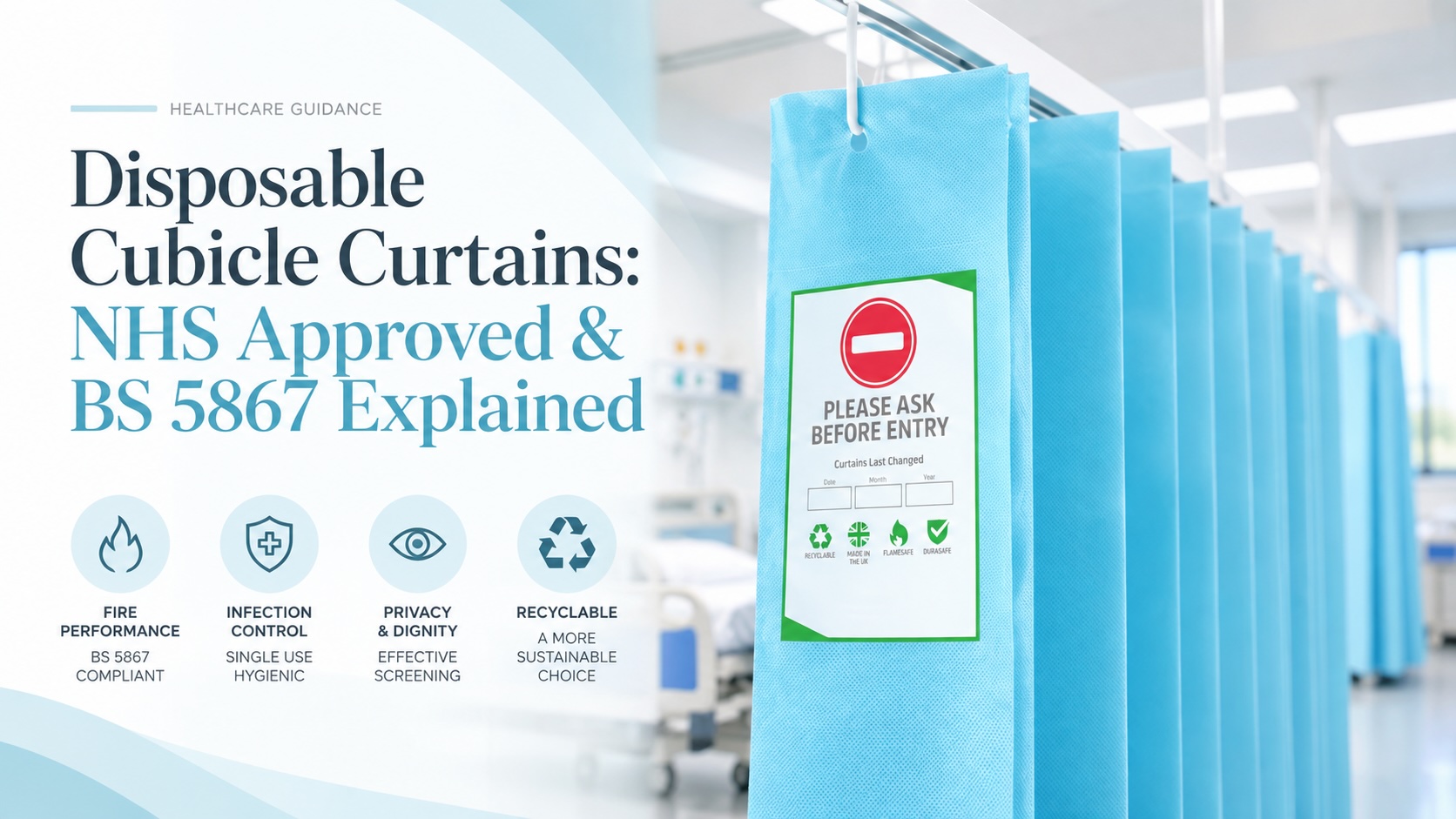
Disposable cubicle curtains are widely used in hospitals, GP surgeries, clinics and other healthcare environments where privacy, hygiene, fire safety and ease of replacement all matter.
Unlike conventional washable curtains, disposable cubicle curtains are designed to be removed and replaced quickly, helping healthcare teams manage privacy screening without the time and cost associated with regular laundering.
For procurement teams, facilities managers and healthcare providers, the most important considerations are not simply colour or price. The curtain needs to meet the practical demands of a clinical environment.
That includes:
- Appropriate fire-retardant performance
- Suitability for healthcare settings
- Antibacterial fabric treatment where specified
- Easy installation and removal
- Compatibility with existing cubicle tracks
- Clear replacement and auditing procedures
- Suitable dimensions and coverage
- Practical disposal or recycling arrangements
Two terms that frequently appear when buying disposable cubicle curtains are “NHS Approved” and “BS 5867 Part 2 Type C”.
They refer to different aspects of the product and should not be treated as interchangeable.
This guide explains what they mean, what to look for when specifying disposable cubicle curtains, and how to assess the main technical features before purchasing for a hospital, clinic, GP surgery or other healthcare environment.
Disposable Cubicle Curtain Guide
Use the sections below to find the technical, healthcare and procurement information most relevant to your requirements.
1. Fire Safety & BS 5867
2. NHS & Healthcare Suitability
3. Infection Control & Hygiene
4. Material, Size & Construction
5. Hooks, Eyelets & Track Compatibility
6. Recycling & Reusable Alternatives
Quick Answer: What Should You Look for in a Disposable Cubicle Curtain?
When specifying disposable cubicle curtains for a hospital, GP surgery, clinic or other healthcare setting, focus on the technical requirements first.
A suitable curtain should typically offer:
- BS 5867 Part 2 Type C fire-retardant performance
- Suitability for healthcare environments
- Antibacterial fabric treatment where specified
- Quick installation and removal
- Compatibility with the existing cubicle track
- Clear auditing or replacement labelling
- Appropriate curtain dimensions
- Reliable privacy coverage
- A practical disposal or recycling route
For many healthcare buyers, the key starting points are fire performance, infection-control suitability and track compatibility.
The curtain should also be easy for staff to replace without unnecessary disruption, particularly in busy clinical areas where turnaround time matters.
A good specification therefore combines:
fire safety + hygiene support + easy replacement + correct sizing + track compatibility
Once those points are confirmed, features such as colour, hook format and pack quantity can be considered.
What Is BS 5867?
BS 5867 is the British Standard that covers performance requirements for fabrics used for curtains, drapes and window blinds.
For disposable cubicle curtains, the most relevant section is BS 5867 Part 2, which deals with the flammability performance of curtain and blind fabrics used in non-domestic environments.
What Does BS 5867 Part 2 Cover?
BS 5867 Part 2 assesses how curtain fabric behaves when exposed to a flame under defined test conditions.
This is particularly relevant in environments such as:
- Hospitals
- GP surgeries
- Clinics
- Care facilities
- Schools
- Hotels
- Other commercial and public buildings
The purpose is to establish whether the fabric meets a specified level of fire-retardant performance.
What Are Type A, Type B and Type C?
BS 5867 Part 2 includes different performance categories:
- Type A
- Type B
- Type C
Of these, Type C is the most demanding classification.
This makes Type C particularly relevant where a higher level of fire performance is required, including many healthcare and contract environments.
Why Does This Matter for Disposable Cubicle Curtains?
Disposable cubicle curtains are large hanging textile surfaces positioned around beds, treatment bays and clinical areas.
Their fire performance is therefore an important part of the overall specification.
When a disposable cubicle curtain is described as meeting BS 5867 Part 2 Type C, it means the fabric has been tested and specified to meet the highest performance category within this part of the standard.
For healthcare buyers, this is one of the key technical specifications to check when comparing disposable cubicle curtains.
What Does BS 5867 Part 2 Type C Mean?
BS 5867 Part 2 Type C is the most demanding flammability classification within this part of the standard.
For disposable cubicle curtains used in healthcare environments, this is an important specification because it indicates that the fabric has been designed and tested to meet a high level of fire-retardant performance.
Why Type C Is Important in Healthcare
Hospitals, clinics and other medical environments contain large amounts of fabric and soft furnishings, often in close proximity to patients, treatment areas and electrical equipment.
Cubicle curtains can also cover a relatively large surface area, so their behaviour in a fire situation matters.
Type C performance is therefore particularly relevant in higher-risk non-domestic settings where a stronger level of fire performance is expected.
What Buyers Should Check
When comparing disposable cubicle curtains, buyers should look for a clear statement that the product is:
Flame-retardant to BS 5867 Part 2 Type C
This should form part of the technical specification rather than being treated as a general marketing claim.
Type C Does Not Replace Other Requirements
BS 5867 Part 2 Type C relates specifically to the fire performance of the curtain fabric.
It does not by itself confirm:
- Infection-control suitability
- Antibacterial treatment
- Track compatibility
- Curtain size
- NHS suitability
- Recycling arrangements
These are separate considerations that should also be checked when specifying disposable cubicle curtains for healthcare use.
The Practical Takeaway
For hospitals, GP surgeries and clinics, BS 5867 Part 2 Type C is one of the key technical standards to look for when assessing disposable cubicle curtains.
It confirms a high level of flammability performance, but it should be considered alongside the other practical and healthcare-specific features of the product.
Why Type C Matters in Hospitals and Healthcare Settings
Fire performance is particularly important in healthcare environments because cubicle curtains are used extensively around beds, treatment bays and examination areas.
Unlike a small decorative curtain, a hospital cubicle curtain can represent a substantial area of hanging fabric within an occupied clinical space.
Healthcare Environments Have Different Fire-Safety Priorities
Hospitals and other healthcare buildings may contain:
- Patients with limited mobility
- People receiving treatment who may need assistance to evacuate
- Medical and electrical equipment
- Multiple adjoining treatment or bed spaces
- Large quantities of furnishings and textiles
For this reason, the fire performance of materials used throughout the building needs careful consideration.
Cubicle Curtains Form Part of the Overall Fire-Safety Specification
A disposable cubicle curtain may primarily be purchased for privacy and infection-control purposes, but the fabric itself must also be appropriate for the environment in which it is installed.
Specifying a curtain to BS 5867 Part 2 Type C provides a clear technical benchmark for its flammability performance.
This allows facilities and procurement teams to compare products against a defined standard rather than relying on general descriptions such as “flame retardant”.
Why “Flame Retardant” Alone Is Not Enough
A supplier may describe a curtain as flame retardant, but healthcare buyers should look for the actual standard and classification behind that statement.
There is a significant difference between:
“Flame retardant”
and:
“Flame-retardant to BS 5867 Part 2 Type C”
The second provides a defined performance specification that can be included in procurement documentation.
Type C Should Be Checked Alongside the Rest of the Specification
Fire performance is only one part of choosing a healthcare cubicle curtain.
Procurement teams should also confirm:
- Curtain dimensions
- Material and weight
- Track compatibility
- Installation method
- Antibacterial treatment where required
- Replacement and auditing arrangements
- Disposal or recycling procedure
The practical point is that BS 5867 Part 2 Type C gives healthcare buyers a clear fire-performance specification to look for when comparing disposable cubicle curtains.
What Does “NHS Approved” Mean for Disposable Cubicle Curtains?
The phrase “NHS Approved” is commonly used by suppliers to indicate that a disposable cubicle curtain is suitable for use in NHS and other healthcare environments.
For buyers, however, it is important to understand that this is not the same thing as a British Standard classification.
“NHS Approved” and BS 5867 Are Different
A product described as NHS Approved is being presented as suitable for healthcare use.
By contrast, BS 5867 Part 2 Type C is a defined fire-performance standard.
That distinction matters because the two terms refer to different aspects of the curtain:
- NHS Approved relates to healthcare suitability
- BS 5867 Part 2 Type C relates to flammability performance
A strong healthcare specification should therefore consider both.
What Healthcare Buyers Should Look For
Rather than relying on the phrase “NHS Approved” alone, procurement and facilities teams should also check the underlying product specification.
That includes:
- Fire-retardant performance
- Fabric construction
- Antibacterial treatment where specified
- Curtain dimensions
- Track compatibility
- Ease of replacement
- Self-auditing or change labels
- Disposal or recycling arrangements
Why This Distinction Matters
Healthcare buyers may need to evidence why a particular product is suitable for use in a clinical environment.
A clearly documented technical specification is therefore more useful than a broad approval statement on its own.
For example, a disposable cubicle curtain may be described as NHS Approved while also carrying a separate specification for BS 5867 Part 2 Type C fire performance.
Practical Takeaway
When reviewing disposable cubicle curtains, treat “NHS Approved” as a healthcare suitability claim and BS 5867 Part 2 Type C as the fire-performance standard.
Both can be relevant, but they should not be treated as interchangeable.
Are Disposable Cubicle Curtains Required by the NHS?
Disposable cubicle curtains are widely used in NHS hospitals and other healthcare environments, but they are not universally required in every clinical setting.
Healthcare organisations may use different approaches depending on the type of facility, local infection-prevention policies, cleaning procedures and procurement requirements.
Disposable and Washable Curtains Can Both Be Used
Some healthcare facilities use disposable curtains, while others continue to use washable fabric curtains.
The choice may depend on factors such as:
- Infection-control procedures
- Frequency of curtain changes
- Availability of laundering services
- Cost of removal and replacement
- Clinical risk within the area
- Sustainability policies
- Existing cubicle track systems
Why Disposable Curtains Are Common in Healthcare
Disposable curtains can simplify the process of replacing privacy screens because they do not need to be removed, transported, laundered and returned to the same area.
Instead, the used curtain can be removed and replaced with a clean one.
This can be particularly useful in:
- Hospital wards
- Isolation areas
- Treatment bays
- Emergency departments
- GP surgeries
- Outpatient clinics
Local Policies Still Matter
NHS trusts and other healthcare organisations may have their own requirements covering:
- How often curtains should be changed
- When contaminated curtains must be replaced
- Which fire-performance standard is required
- Whether antibacterial treatment is specified
- How used curtains should be disposed of
- Whether recyclable products can enter a recycling stream
Procurement teams should therefore check the requirements of the individual organisation rather than assuming that one specification applies across every NHS facility.
Practical Takeaway
Disposable cubicle curtains are a common and practical healthcare solution, but they are not a universal NHS requirement.
The correct product should meet the fire, hygiene, operational and procurement requirements set for the particular healthcare environment in which it will be used.
Why Disposable Cubicle Curtains Are Used in Infection-Control Environments
Disposable cubicle curtains are commonly used in healthcare settings because they can support routine infection-control procedures and rapid curtain replacement.
Their main advantage is operational simplicity.
Quick Removal and Replacement
If a curtain becomes soiled, contaminated or reaches its scheduled replacement date, it can be removed and replaced without sending it for laundering.
This can help reduce disruption in busy clinical areas such as:
- Hospital wards
- Treatment bays
- Emergency departments
- GP surgeries
- Outpatient clinics
- Examination rooms
No Laundry Cycle
Reusable curtains usually need to be:
- Removed
- Bagged
- Transported
- Laundered
- Returned
- Rehung
Disposable curtains avoid that process.
This can simplify curtain management where frequent replacement is required.
Useful for Scheduled Change Programmes
Healthcare organisations may operate planned curtain-change schedules alongside replacement after visible contamination or specific clinical events.
Disposable curtains can support these programmes because they are designed to be changed quickly.
Where a curtain also includes a self-auditing label, staff can more easily track installation or replacement dates.
Antibacterial Treatment Can Add Another Layer of Support
Some disposable cubicle curtains are manufactured with an antibacterial treatment.
This does not replace normal infection-control procedures, but it can form part of the overall product specification for healthcare use.
Disposable Does Not Mean Maintenance-Free
Although there are no laundry requirements, curtains still need to be:
- Inspected
- Replaced when required
- Changed if contaminated
- Managed in line with local infection-control procedures
- Disposed of correctly after use
Practical Takeaway
Disposable cubicle curtains are widely used in healthcare because they can make replacement, auditing and day-to-day curtain management simpler.
They should be viewed as one part of a wider infection-control system rather than as a standalone infection-prevention measure.
What Does Antibacterial Fabric Mean?
Some disposable cubicle curtains are manufactured with an antibacterial treatment built into the fabric.
For healthcare buyers, this can be a useful additional feature, particularly in environments where hygiene and regular replacement are important.
Antibacterial Treatment Is Part of the Fabric Specification
An antibacterial treatment is designed to inhibit bacterial growth on the treated material.
In practical terms, this means the treatment forms part of the curtain’s material specification rather than being something applied later during use.
It Does Not Replace Cleaning or Replacement Procedures
Antibacterial fabric should not be treated as a substitute for:
- Routine hygiene procedures
- Scheduled curtain changes
- Replacement after contamination
- Local infection-control policies
The curtain still needs to be managed in line with the healthcare organisation’s own procedures.
Why It Can Be Useful in Healthcare
In clinical environments, curtains are frequently touched and sit close to patients, staff and treatment areas.
An antibacterial treatment can therefore be a useful supporting feature alongside:
- Regular replacement
- Good hand hygiene
- Cleaning procedures
- Appropriate disposal
- Clear auditing of curtain changes
Biosafe® Antibacterial Treatment
The DotcomBlinds disposable cubicle curtain range uses a Biosafe® antibacterial treatment within the fabric.
This is part of the overall healthcare specification alongside the curtain’s fire-retardant performance, lightweight polypropylene construction and replaceable design.
Practical Takeaway
An antibacterial disposable cubicle curtain should be seen as one part of a wider infection-control approach.
It can support hygiene management, but it does not remove the need for correct handling, replacement and local clinical procedures.
What Is a Self-Auditing Label?
A self-auditing label is a simple way to help staff track when a disposable cubicle curtain was installed and when it may need to be replaced.
In busy healthcare environments, this can make curtain-change programmes easier to manage and document.
What Information Can It Help Record?
Depending on the label design and local procedure, it may be used to record or identify:
- Installation date
- Replacement date
- Planned change interval
- Ward or treatment area
- Other internal audit information
The exact way it is used will depend on the healthcare organisation’s own process.
Why It Is Useful
Disposable cubicle curtains may be changed because of:
- Routine replacement schedules
- Visible soiling
- Contamination
- Local infection-control requirements
- Ward or bay turnover
A self-auditing label gives staff a quick visual reference without relying entirely on separate records.
Useful for Facilities and Infection-Control Teams
This can help with:
- Routine inspection
- Planned replacement
- Internal auditing
- Consistent curtain management across multiple rooms or bays
The DotcomBlinds disposable cubicle curtain range includes a self-auditing label as part of the product specification.
Practical Takeaway
A self-auditing label is a small feature, but it can make disposable cubicle curtains easier to manage in practice.
For larger healthcare sites in particular, it can support a clearer and more consistent curtain-replacement process.
What Material Should a Disposable Cubicle Curtain Be Made From?
Disposable cubicle curtains are typically designed to be lightweight, durable and easy to replace.
For healthcare use, the material needs to balance practical handling with the performance required for the environment.
Polypropylene Is a Common Choice
The DotcomBlinds disposable cubicle curtain range is made from 110gsm polypropylene.
This gives the curtain a lightweight construction while still being suitable for repeated handling during installation, use and replacement.
Why Material Weight Matters
The fabric needs to be light enough for staff to:
- Handle easily
- Install quickly
- Remove without unnecessary effort
- Store efficiently before use
At the same time, it needs enough strength to function reliably as a privacy curtain in a busy healthcare setting.
Recyclability Is Also Part of the Specification
The DotcomBlinds range is designed without unnecessary plastic parts and is described as 100% recyclable.
This is particularly relevant where healthcare buyers are also considering the waste implications of disposable products.
Material Should Be Assessed Alongside Other Features
The fabric itself is only one part of the specification.
Healthcare buyers should also check:
- Fire-retardant performance
- Antibacterial treatment
- Curtain dimensions
- Pleating
- Hook or eyelet format
- Track compatibility
- Auditing features
Practical Takeaway
For disposable cubicle curtains, the material should provide:
low weight + sufficient durability + easy handling + compatibility with the required healthcare specification
In the DotcomBlinds range, that is achieved using 110gsm polypropylene.
Disposable Curtain Size: Why 7500mm x 2000mm Is Common
Disposable cubicle curtains are often supplied in a standardised size so they can be used across multiple bays and healthcare settings without needing individual made-to-measure production.
The DotcomBlinds range is supplied at 7500mm wide x 2000mm drop.
Why Standard Sizing Helps
A standard curtain size can make procurement and stock management simpler, especially across larger healthcare sites.
It can help facilities teams:
- Hold replacement stock more easily
- Standardise purchases across wards or treatment areas
- Replace curtains quickly
- Reduce the need for bespoke ordering
Width Matters for Coverage
The 7500mm width allows the curtain to gather along the cubicle track rather than hanging completely flat.
This is important because the curtain needs enough fullness to provide practical privacy coverage around the bay.
The exact amount of gathering will depend on:
- Track length
- Hook spacing
- Cubicle layout
- How the curtain is installed
Drop Matters for Privacy and Clearance
The 2000mm drop is designed to provide substantial visual screening while still allowing the curtain to hang correctly within a healthcare cubicle environment.
Before ordering, buyers should check:
- Track height
- Required floor clearance
- Whether the curtain length suits the existing cubicle system
- Whether any local specification requires a particular drop
Always Check the Existing Track
Even where a curtain is supplied in a standard size, the existing cubicle system should still be checked before purchase.
Important points include:
- Total track length
- Number of curtains required
- Glider or hook type
- Height from track to floor
- Whether the curtain will need to turn around corners
Practical Takeaway
A 7500mm x 2000mm disposable cubicle curtain offers a practical standard size for many healthcare applications, but the existing track dimensions and installation requirements should always be confirmed before ordering.
Pleated vs Flat Disposable Cubicle Curtains
Disposable cubicle curtains can be supplied in different constructions, but permanently pleated curtains are particularly practical in healthcare environments because they are designed to gather consistently along the cubicle track.
The DotcomBlinds disposable range is permanently pleated as part of the manufacturing process.
What Does Permanently Pleated Mean?
The fabric is formed into regular folds before the curtain is installed.
This means the curtain naturally gathers rather than relying on staff to create an even arrangement during fitting.
Why Pleating Matters
Permanent pleating can help with:
- Faster installation
- More consistent gathering
- Easier handling
- Neater appearance
- Predictable coverage along the track
This can be especially useful where curtains are changed regularly across multiple bays.
How Is This Different From a Flat Curtain?
A flat disposable curtain has little or no pre-formed structure in the fabric.
Once installed, the gathering depends more heavily on the positioning of the hooks or gliders.
A permanently pleated curtain retains a more consistent fold pattern, which can make replacement more straightforward.
Pleating Also Affects Storage and Handling
Because the curtain is already formed into folds, staff can generally handle it as a more organised fabric section rather than managing a completely flat 7.5 metre-wide panel.
For hospitals and clinics carrying out frequent curtain changes, this can make installation less cumbersome.
Practical Takeaway
For healthcare environments where disposable curtains need to be replaced quickly and consistently, permanent pleating provides a simple operational advantage.
It helps the curtain gather correctly along the track and can make installation and replacement more predictable.
Hooked vs Eyelet Disposable Cubicle Curtains
Disposable cubicle curtains can be supplied in different fixing formats, and the two main options in the DotcomBlinds range are eyelet curtains and curtains supplied with hooks already attached.
The right choice depends on how your existing cubicle track system is set up and how quickly you need replacement curtains to be installed.
Eyelet Disposable Curtains
Eyelet curtains are designed for use with compatible cubicle hooks or gliders.
This can be a practical option where:
- The site already has suitable hooks in place
- Hooks are reused as part of the existing maintenance process
- Facilities teams are familiar with the current track system
- Replacement curtains are installed by staff who can attach them quickly
Disposable Curtains With Hooks Attached
Pre-hooked curtains arrive with the hooks already fitted.
This can reduce installation time because staff do not need to attach the hooks individually before fitting the curtain to the track.
They can be particularly useful where:
- Rapid replacement is important
- Large numbers of curtains are being changed
- Facilities teams want to minimise preparation time
- The replacement process needs to be as simple as possible
Why the Difference Matters
The curtain itself may meet the same fire, material and healthcare requirements, but the fixing format can make a significant difference operationally.
For a busy hospital or clinic, pre-hooked curtains can make scheduled changes faster.
For organisations that already have an established hook-and-glider system, eyelet curtains may be perfectly suitable.
Check Track Compatibility Before Ordering
Before choosing either format, confirm:
- The type of cubicle track installed
- The glider design
- Hook shape and size
- Hook spacing
- Whether the existing hooks are intended to be reused
Do not assume that every disposable cubicle curtain will work with every track system.
Practical Takeaway
Choose eyelet disposable curtains if you already have a compatible hook system in place.
Choose pre-hooked disposable curtains if you want to reduce installation time and simplify replacement.
The key is to match the curtain format to the existing cubicle track and maintenance process.
Will Disposable Curtains Fit Existing Cubicle Tracks?
Disposable cubicle curtains can often be used with existing cubicle track systems, but compatibility should always be checked before ordering.
The most important point is that the curtain fixing method must match the hooks, gliders or carriers already installed in the track.
What Should You Check?
Before purchasing replacement disposable curtains, confirm:
- The type of cubicle track installed
- The glider or carrier design
- The hook shape and size
- The spacing between attachment points
- Whether hooks are reusable
- Whether the curtain is supplied pre-hooked or as an eyelet version
Why Track Compatibility Matters
A curtain can meet the required fire and healthcare specification but still be unsuitable if the fixing system does not match the existing track.
Using the wrong hook or glider can lead to:
- Difficult installation
- Poor movement along the track
- Incorrect curtain spacing
- Unnecessary replacement of otherwise usable track components
Eyelet and Pre-Hooked Versions
Where compatible, eyelet curtains can be used with existing hooks or gliders.
Pre-hooked curtains can simplify replacement by reducing the amount of preparation needed before fitting.
The best option depends on the way the existing cubicle system has been set up.
Check the Track Condition Too
Compatibility is not only about hook type.
It is also worth checking whether the existing track:
- Moves freely
- Has damaged gliders
- Has missing carriers
- Needs maintenance
- Has enough attachment points for the replacement curtain
Practical Takeaway
Do not assume that a disposable cubicle curtain is universally compatible.
Before ordering, confirm the track type, glider system and fixing method so the replacement curtain can be installed correctly and moved smoothly along the cubicle track.
Are Disposable Cubicle Curtains Recyclable?
Some disposable cubicle curtains are designed with recyclability in mind, but whether a used healthcare curtain can actually enter a recycling stream depends on both its material construction and how it has been used.
The DotcomBlinds disposable cubicle curtain range is made from 100% recyclable polypropylene and is designed without unnecessary plastic parts.
Why Material Construction Matters
A curtain made from a single recyclable material is generally easier to process than one that combines several different components.
Removing additional plastic parts, such as separate eyelets, can help simplify the product construction and reduce unnecessary material use.
Recyclable Does Not Always Mean Recycled
This is particularly important in healthcare environments.
A curtain may be technically recyclable as a product, but once used it may be subject to local waste-management and infection-control procedures.
For example, a used curtain that has been contaminated may need to follow a specific healthcare waste route rather than ordinary recycling.
What Healthcare Buyers Should Check
Before treating disposable curtains as part of a recycling programme, confirm:
- The curtain material
- Whether any non-recyclable components are attached
- Local healthcare waste procedures
- Whether contaminated curtains can enter a recycling stream
- Whether a suitable recycling route is available
Why This Matters for Procurement
Sustainability claims should be considered alongside the practical realities of healthcare waste handling.
For procurement teams, the most useful question is not simply:
“Is the curtain recyclable?”
but:
“Can this curtain be recycled within our own waste-management process?”
Practical Takeaway
Disposable cubicle curtains made from recyclable polypropylene can offer a simpler material construction, but actual recycling depends on the condition of the used curtain and the healthcare organisation’s waste-management procedures.
Disposable vs Washable Cubicle Curtains
Healthcare organisations may use either disposable or washable cubicle curtains, and each approach has different operational implications.
The better choice depends on factors such as infection-control procedures, laundering facilities, replacement frequency, staffing and waste-management policies.
Disposable Cubicle Curtains
Disposable curtains are designed to be removed and replaced rather than laundered and rehung.
Potential advantages include:
- Quick replacement
- No laundry cycle
- Less handling between removal and reinstallation
- Easier stock management
- Simple scheduled change programmes
- Reduced downtime when a curtain needs replacing
They can be particularly practical in busy wards, treatment areas and clinics where rapid replacement matters.
Washable Cubicle Curtains
Washable curtains are designed to be removed, cleaned and returned to service.
This requires a process for:
- Taking curtains down
- Bagging and transporting them
- Laundering
- Drying
- Returning them to the correct area
- Rehanging them
For organisations with established laundry systems, reusable curtains may remain a practical option.
Infection-Control Considerations
Both disposable and washable curtains still need to be managed according to local infection-control procedures.
The main difference is what happens after removal.
A disposable curtain is taken out of service and replaced.
A washable curtain enters a cleaning and re-use process.
Neither approach removes the need for:
- Routine inspection
- Replacement or laundering when required
- Clear change procedures
- Appropriate handling after contamination
Cost Considerations
Disposable curtains can remove laundry and reinstallation costs, but they require ongoing replacement purchases.
Washable curtains may have a higher initial cost and ongoing laundering expenses, but they are designed for repeated use.
The true cost comparison depends on factors such as:
- Frequency of curtain changes
- Laundry charges
- Staff time
- Transport
- Storage
- Replacement rates
- Waste disposal
Sustainability Considerations
Neither option should automatically be described as the more sustainable choice.
Disposable curtains generate replacement material, although recyclable construction can reduce the material impact where a suitable recycling route exists.
Washable curtains are reused, but laundering also involves:
- Water
- Energy
- Detergent
- Transport
- Handling
The better environmental option will depend on the full system used by the healthcare organisation.
| Consideration | Disposable Curtains | Washable Curtains |
|---|---|---|
| Replacement | Quick removal and replacement | Removal, laundering and rehanging |
| Laundry | Not required | Required |
| Re-use | No | Yes |
| Change Auditing | Can be straightforward | Depends on local process |
| Storage | Clean replacement stock required | Clean and used stock may need managing |
| Waste | Curtain disposed of after use | Less frequent product disposal |
| Operational Simplicity | Generally high | More process-intensive |
Disposable curtains are often chosen where speed and operational simplicity matter, while washable curtains may suit healthcare organisations with an established laundry and re-use process.
Practical Takeaway
Disposable cubicle curtains are often chosen where speed, simplicity and predictable replacement are important.
Washable curtains may suit organisations with an established laundry and re-use system.
The right choice depends on the healthcare organisation’s operational, infection-control, cost and sustainability requirements.
Disposable Cubicle Curtain Specification Checklist
When purchasing disposable cubicle curtains for a hospital, GP surgery, clinic or other healthcare environment, the most reliable approach is to compare products against a clear technical specification.
Fire Performance
Check that the curtain states a recognised fire-performance standard.
For higher-risk healthcare and contract environments, look for:
BS 5867 Part 2 Type C
Avoid relying on a general phrase such as “flame retardant” without the underlying classification.
Healthcare Suitability
Check whether the curtain is specifically intended for use in:
- Hospitals
- GP surgeries
- Clinics
- Treatment rooms
- Other healthcare environments
If the product is described as NHS Approved, treat this as a healthcare-suitability claim and review it alongside the technical specification.
Material
Confirm:
- Fabric type
- Fabric weight
- Whether the material is disposable
- Whether the construction is recyclable
For example, a lightweight polypropylene curtain can make handling and replacement easier.
Antibacterial Treatment
If antibacterial performance is required, check:
- Whether the treatment is built into the fabric
- The name of the treatment
- Whether it forms part of the stated product specification
This should sit alongside, not replace, normal infection-control procedures.
Curtain Dimensions
Confirm both:
- Width
- Drop
Also check whether the supplied size suits:
- Track length
- Required privacy coverage
- Track height
- Floor clearance
Pleating
If permanent pleating is important, confirm that the curtain is supplied pre-pleated.
This can help with:
- Faster installation
- More consistent gathering
- Easier handling
- Neater appearance
Hook or Eyelet Format
Check whether you need:
- Eyelet curtains for use with existing compatible hooks
- Curtains supplied with hooks already attached
The choice should match the existing cubicle track system.
Track Compatibility
Confirm:
- Track type
- Glider or carrier design
- Hook size and shape
- Hook spacing
- Whether existing hooks can be reused
Do not assume universal compatibility.
Self-Auditing Label
If the organisation uses planned curtain-change schedules, a self-auditing label can help staff record and monitor replacement dates.
This can be particularly useful across larger estates.
Pack Quantity
Check how many curtains are included per pack.
This matters for:
- Stock planning
- Ward-level storage
- Bulk purchasing
- Replacement schedules
Colour
Colour is usually secondary to performance, but it may still matter for:
- Ward identification
- Interior consistency
- Patient environment
- Existing colour schemes
Recycling and Disposal
Check both:
- Whether the product itself is recyclable
- Whether your organisation has a suitable route for recycling used healthcare curtains
A recyclable curtain may still need to enter a different waste stream if contaminated.
Lead Time and Availability
For healthcare environments, availability can be operationally important.
Check:
- Stock levels
- Dispatch times
- Bulk availability
- Replacement lead times
Practical Takeaway
A good disposable cubicle curtain specification should cover:
fire performance + healthcare suitability + material + antibacterial treatment + size + fixing method + track compatibility + auditing + disposal + supply availability
That makes product comparison much more reliable than choosing on price alone.
DotcomBlinds Disposable Cubicle Curtain Specification
The DotcomBlinds disposable cubicle curtain range is designed for healthcare and other clinical environments where fire performance, hygiene support, quick replacement and straightforward installation are important.
The main specification is:
| Specification | DotcomBlinds Range |
|---|---|
| Fire Performance | BS 5867 Part 2 Type C |
| Healthcare Suitability | NHS Approved |
| Material | 110gsm polypropylene |
| Antibacterial Treatment | Biosafe® antibacterial formula |
| Curtain Size | 7500mm x 2000mm |
| Pack Size | 5 curtains |
| Pleating | Permanently pleated |
| Fixing Options | Eyelet or pre-hooked versions |
| Audit Feature | Self-auditing label |
| Colours | Sky Blue, Light Blue, Cream, Mint and Grey |
| Manufacture | Made in the UK |
| Recyclability | 100% recyclable polypropylene construction |
Available Colour and Fixing Options
The range is available in:
- Sky Blue
- Light Blue
- Cream
- Mint
- Grey
Each colour is available either as an eyelet curtain or as a version supplied with hooks already attached.
Who Is the Range Suitable For?
The specification makes the range suitable for use in:
- Hospitals
- GP surgeries
- Clinics
- Treatment rooms
- Healthcare facilities
- Other settings using cubicle-track privacy curtains
Practical Takeaway
For healthcare buyers looking for a clearly specified disposable cubicle curtain, the DotcomBlinds range combines:
BS 5867 Part 2 Type C fire performance + antibacterial treatment + standard healthcare sizing + permanent pleating + eyelet or pre-hooked installation + self-auditing labels + recyclable polypropylene construction.
Final Buying Checklist for Disposable Cubicle Curtains
Before ordering disposable cubicle curtains for a hospital, GP surgery, clinic or other healthcare environment, work through the following checklist.
1. Confirm the Fire Standard
Check that the curtain clearly states the required fire-performance classification.
For higher-risk healthcare and contract environments, look for:
BS 5867 Part 2 Type C
Do not rely on a general “flame retardant” description alone.
2. Confirm Healthcare Suitability
Check that the curtain is intended for use in healthcare or clinical settings.
If the product is described as NHS Approved, review that alongside the rest of the technical specification.
3. Check the Material
Confirm:
- Fabric type
- Fabric weight
- Whether the material is disposable
- Whether it is recyclable
- Whether unnecessary plastic components are avoided
4. Check Antibacterial Treatment
If antibacterial treatment is required, confirm that it forms part of the product specification.
Also check that local infection-control procedures still cover replacement, handling and disposal.
5. Confirm the Curtain Size
Check both:
- Width
- Drop
Make sure the size suits:
- Track length
- Required coverage
- Track height
- Floor clearance
- Cubicle layout
6. Check Pleating
If permanently pleated curtains are preferred, confirm that this is part of the construction.
This can make installation and handling easier.
7. Choose Eyelet or Pre-Hooked
Decide whether you need:
- Eyelet curtains for use with compatible existing hooks
- Curtains with hooks already attached
The best option depends on your current cubicle track system and how replacements are managed.
8. Confirm Track Compatibility
Before ordering, check:
- Track type
- Glider or carrier design
- Hook shape
- Hook spacing
- Whether existing hooks can be reused
9. Check Auditing Features
If curtain changes are monitored, look for a self-auditing label or another clear method of recording installation and replacement dates.
10. Confirm Pack Quantity
Check how many curtains are included per pack so you can plan:
- Ward-level stock
- Replacement cycles
- Bulk purchasing
- Storage
11. Check Colour Requirements
Colour may be needed for:
- Ward consistency
- Interior schemes
- Area identification
- Patient-facing environments
12. Review Recycling and Disposal
Check:
- Whether the product itself is recyclable
- Whether contaminated curtains can enter your recycling stream
- What local healthcare waste procedures require
13. Check Availability and Lead Time
For healthcare sites, stock availability can be just as important as specification.
Confirm:
- Dispatch time
- Bulk availability
- Replacement stock
- Lead time for repeat orders
Final Check
Before placing an order, make sure you are satisfied with:
fire performance + healthcare suitability + material + antibacterial treatment + dimensions + fixing method + track compatibility + auditing + disposal + availability
That gives procurement teams a clear technical basis for comparing disposable cubicle curtains and helps avoid specification errors before installation.