Order Tracking
 0800 1422417

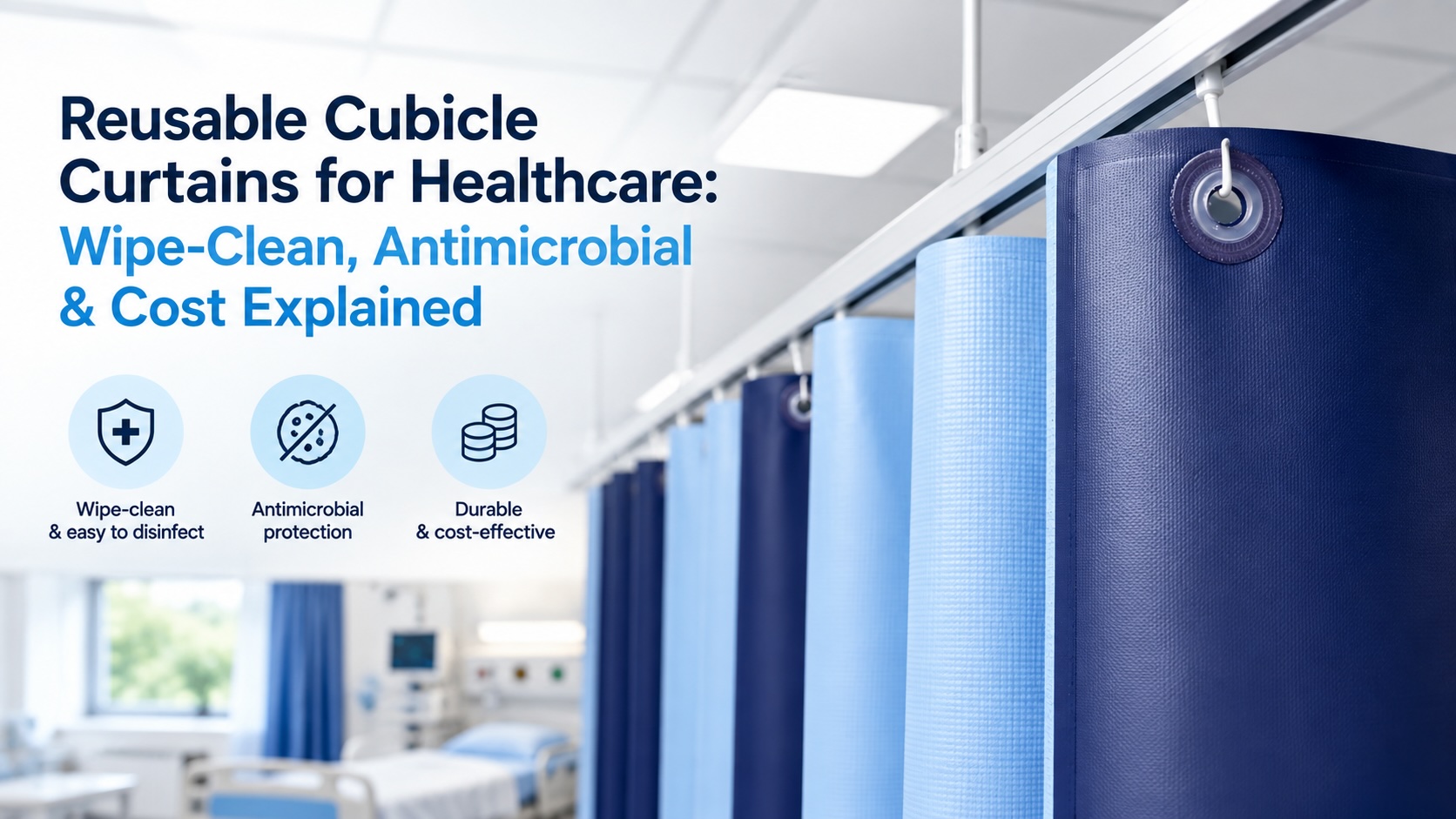
Reusable cubicle curtains are designed for healthcare environments where privacy, hygiene, durability and operational efficiency all need to work together.
Unlike disposable cubicle curtains, reusable healthcare curtains are intended to remain in service for longer periods and be cleaned in place rather than routinely removed, laundered and replaced.
The Stericurtain reusable curtain range uses a PVC-laminated polyester fabric with a waterproof, wipe-clean surface, allowing staff to clean the curtain in situ using standard hospital detergents. It also incorporates Biosafe® antimicrobial treatment and is designed for repeated use in clinical settings.
For healthcare procurement teams, facilities managers and infection-control staff, the main considerations are:
- Wipe-clean construction
- Antimicrobial treatment
- Waterproof surface
- Fire-retardant performance
- Ease of in-situ cleaning
- Track compatibility
- Durability
- Long-term cost
- Waste reduction
- Curtain size and fit
- Warranty and service life
This guide explains how reusable cubicle curtains differ from disposable options, what technical features matter most, and how to assess whether a wipe-clean reusable curtain is the right choice for a hospital, clinic, GP surgery or other healthcare facility.
Reusable Cubicle Curtain Guide
Use the sections below to find the technical, cleaning, cost and procurement information most relevant to your healthcare setting.
1. Wipe-Clean Construction & Cleaning
2. Antimicrobial & High-Touch Features
3. Material, Waterproofing & Durability
4. Cost & Lifecycle
5. Waste & Sustainability
6. Size & Track Compatibility
7. Reusable vs Disposable
8. Procurement & Final Specification
Quick Answer: What Is a Reusable Healthcare Cubicle Curtain?
A reusable healthcare cubicle curtain is a privacy curtain designed for repeated use in hospitals, clinics, GP surgeries and other medical settings.
Instead of being removed and discarded after use, it is intended to remain in service and be cleaned in place.
The Stericurtain reusable curtain is designed with a waterproof, wipe-clean surface that can be sanitised in situ using standard hospital detergents.
What Makes It Different?
A reusable wipe-clean cubicle curtain is designed to offer:
- Repeated use
- In-situ cleaning
- Waterproof construction
- Antimicrobial treatment
- No routine laundering requirement
- Reduced need for curtain replacement
- Long-term service in healthcare environments
Why Healthcare Facilities Use Them
The main advantage is operational.
Staff can clean the curtain where it hangs rather than removing it, sending it for laundering and reinstalling it later.
This can help reduce:
- Curtain handling
- Laundry requirements
- Replacement frequency
- Downtime during cleaning
- Ongoing single-use curtain waste
What Should Buyers Check?
When choosing a reusable healthcare curtain, confirm:
- The material
- Whether it is fully wipe-clean
- Antimicrobial treatment
- Fire-retardant performance
- Track compatibility
- Curtain size
- Cleaning requirements
- Expected service life
- Warranty
- Long-term cost
The key difference is simple:
A reusable cubicle curtain is designed to stay in service and be cleaned in place, rather than repeatedly removed, laundered or replaced.
What Is a Wipe-Clean Cubicle Curtain?
A wipe-clean cubicle curtain is designed with a non-absorbent, waterproof surface that can be cleaned while the curtain remains installed on the track.
Instead of removing the curtain for laundering, staff can clean the surface in situ using suitable hospital detergents.
How Is It Different From a Traditional Fabric Curtain?
Traditional textile cubicle curtains usually need to be:
- Removed from the track
- Collected for laundering
- Washed and dried
- Returned to the clinical area
- Rehung
A wipe-clean curtain is designed to avoid that routine laundry cycle.
Why the Surface Construction Matters
The Stericurtain reusable curtain uses a PVC-laminated polyester fabric, giving it a waterproof surface that can be wiped down rather than absorbing moisture into the material.
That makes it suitable for repeated cleaning in healthcare environments.
What Are the Main Benefits?
A wipe-clean cubicle curtain can help provide:
- In-situ cleaning
- Reduced laundry requirements
- Faster turnaround after cleaning
- Less handling during routine maintenance
- Longer service life than single-use curtains
- A consistent privacy screen without frequent removal
Does Wipe-Clean Mean Maintenance-Free?
No.
The curtain still needs to be:
- Cleaned at appropriate intervals
- Wiped after contamination
- Inspected for damage
- Maintained in line with local healthcare procedures
- Replaced if it becomes damaged or no longer suitable for use
Practical Takeaway
A wipe-clean cubicle curtain is designed to stay in place and be cleaned repeatedly, making it a practical option for healthcare environments that want to reduce laundry handling and repeated curtain replacement.
Why In-Situ Cleaning Matters in Healthcare
In-situ cleaning allows a reusable cubicle curtain to be cleaned while it remains installed on the track.
For healthcare facilities, this can simplify routine cleaning and reduce the operational work involved in removing, transporting and rehanging curtains.
Reduced Handling
Every time a conventional curtain is removed for laundering, it has to be:
- Taken down
- Handled by staff
- Transported
- Cleaned
- Returned
- Reinstalled
A wipe-clean reusable curtain reduces the need for that repeated handling cycle.
Faster Bed or Bay Turnaround
Because the curtain can be cleaned where it hangs, the privacy screen can remain available during routine maintenance.
This can help reduce delays when:
- A bed space is being prepared
- A treatment bay is being cleaned
- A room needs to be returned to use quickly
- Curtains require surface cleaning between uses
No Routine Laundry Cycle
A reusable wipe-clean curtain does not need to enter a conventional laundry process after every cleaning event.
This can reduce:
- Laundry handling
- Transport to and from laundry facilities
- Rehanging time
- Dependence on clean replacement stock during routine cleaning
Easier Routine Surface Cleaning
A waterproof surface makes it possible to clean visible contamination directly from the curtain.
This is particularly useful in environments where the curtain is a high-contact surface and may need regular attention.
Supports a More Predictable Cleaning Process
Because the curtain stays in place, cleaning can be incorporated into a facility’s regular surface-cleaning procedures rather than treated as a separate laundry task.
That can make the process more consistent across:
- Hospital wards
- Treatment bays
- Clinics
- GP surgeries
- Examination areas
Practical Takeaway
The main advantage of in-situ cleaning is operational:
less removal + less handling + no routine laundry cycle + faster return to use
For busy healthcare settings, that can make reusable wipe-clean cubicle curtains easier to manage day to day.
How Should a Reusable Cubicle Curtain Be Cleaned?
A reusable wipe-clean cubicle curtain is designed to be cleaned in situ while it remains installed on the track.
The Stericurtain reusable curtain has a waterproof PVC-laminated surface that can be wiped using standard hospital detergents, removing surface contamination without requiring the curtain to be taken down for laundering.
Clean the Curtain Where It Hangs
The main advantage of this construction is that staff can clean the curtain as part of the surrounding clinical area.
This avoids the need to:
- Remove the curtain from the track
- Send it for laundering
- Store a replacement curtain during cleaning
- Rehang the curtain afterwards
Pay Particular Attention to High-Touch Areas
Areas used to open and close the curtain are likely to receive the most frequent hand contact.
These areas should therefore form an important part of routine cleaning.
Stericurtain includes designated Touch Point areas, providing an obvious wipeable location for handling the curtain.
Deal With Visible Contamination Promptly
The waterproof surface allows visible contamination, including bodily fluids, to be wiped from the curtain rather than absorbed into a conventional textile fabric.
Cleaning should follow the healthcare facility’s established procedures for the type of contamination involved.
Use Suitable Healthcare Cleaning Products
The curtain is designed for cleaning with standard hospital detergents.
Healthcare facilities should follow the cleaning product instructions and their own infection-control procedures when determining:
- Which detergent or cleaning product to use
- How frequently the curtain should be cleaned
- How visible contamination should be handled
- Whether additional cleaning is required in higher-risk clinical areas
Inspect the Curtain While Cleaning
Routine cleaning also provides an opportunity to check the curtain for:
- Surface damage
- Tears
- Damaged attachment points
- Excessive wear
- Any area that can no longer be cleaned effectively
A reusable curtain should remain in good physical condition throughout its service life.
Practical Takeaway
The principle is straightforward:
keep the curtain installed + clean the waterproof surface in situ + concentrate on high-touch areas + follow the facility’s established cleaning procedures.
This avoids the routine removal and laundry cycle associated with conventional washable cubicle curtains.
What Does Antimicrobial Mean on a Reusable Cubicle Curtain?
An antimicrobial reusable cubicle curtain is designed with a treatment that helps inhibit the growth of microorganisms on the curtain surface.
For healthcare environments, this can be a useful supporting feature because cubicle curtains are frequently touched and sit close to patients, staff and treatment areas.
Antimicrobial Treatment Is Built Into the Curtain
The Stericurtain reusable curtain incorporates Biosafe® antimicrobial treatment as part of its construction.
This means the antimicrobial property is part of the curtain material rather than something that needs to be reapplied during routine cleaning.
Antimicrobial Is Not the Same as Disinfection
An antimicrobial treatment helps support hygiene, but it does not replace normal cleaning.
The curtain still needs to be:
- Wiped regularly
- Cleaned after contamination
- Maintained according to local procedures
- Inspected for wear or damage
Routine surface cleaning remains essential.
Why It Matters on a High-Touch Surface
Cubicle curtains are commonly handled when patients or staff:
- Open the curtain
- Close the curtain
- Move between treatment spaces
- Create or remove privacy around a bed or examination area
Because of this repeated contact, antimicrobial treatment can add an extra layer of support alongside in-situ cleaning.
Best Used as Part of a Wider Cleaning Process
The strongest approach is to combine:
- Antimicrobial material
- Waterproof wipe-clean construction
- Routine surface cleaning
- Defined high-touch areas
- Appropriate local cleaning procedures
Practical Takeaway
Antimicrobial treatment should be viewed as an additional hygiene feature, not a substitute for cleaning.
On a reusable healthcare cubicle curtain, its value comes from working alongside the wipe-clean surface and regular in-situ cleaning process.
What Are Touch Point Areas?
Touch Point areas are designated sections of a reusable cubicle curtain intended to be used when opening and closing the curtain.
The Stericurtain reusable curtain includes contrasting Toscana Navy Touch Points, giving patients and staff a clear place to handle the curtain.
Why Touch Points Matter
Cubicle curtains are high-contact surfaces.
Without a designated handling area, people may grip different parts of the curtain throughout the day, spreading contact across a much larger surface.
A defined Touch Point helps concentrate routine handling in a more predictable location.
Easier to Clean
Because the Touch Point is clearly identifiable, staff can pay particular attention to it during routine cleaning.
This can make it easier to incorporate the curtain into regular high-touch surface cleaning.
Supports Consistent Handling
A visible handling area can also encourage more consistent use.
Instead of pulling the curtain from any convenient part of the fabric, users have an obvious place to grip.
Particularly Useful in Busy Clinical Areas
Touch Points can be especially practical in:
- Hospital wards
- Treatment bays
- Examination rooms
- GP surgeries
- Outpatient clinics
- Other areas where curtains are opened and closed frequently
Practical Takeaway
Touch Point areas provide a defined, wipeable handling zone on the curtain.
They do not replace routine cleaning, but they can make high-contact areas easier to identify, use and maintain.
What Material Are Reusable Healthcare Curtains Made From?
Reusable healthcare cubicle curtains need a material that can withstand repeated cleaning, regular handling and long-term use in a clinical environment.
The Stericurtain reusable curtain is made from 100% polyester with a PVC-laminated surface.
Why Use PVC-Laminated Polyester?
This construction combines a durable polyester base with a smooth, waterproof surface.
In practical terms, this gives the curtain several useful characteristics:
- Waterproof construction
- Wipe-clean surface
- Resistance to moisture absorption
- Suitability for repeated in-situ cleaning
- Greater durability than lightweight single-use curtain materials
Waterproof Construction Is Important
Traditional textile fabrics can absorb moisture and contamination into the fibres.
A PVC-laminated surface is non-absorbent, allowing liquids and surface contamination to be removed by wiping rather than soaking into the curtain.
This is particularly useful in clinical environments where regular surface cleaning is required.
Designed for Repeated Use
Because the curtain is intended to remain in service rather than be discarded after a short period, the material needs to tolerate:
- Frequent opening and closing
- Routine wiping
- Regular contact
- Repeated cleaning with suitable hospital detergents
The construction is therefore substantially different from the lightweight polypropylene commonly used for disposable cubicle curtains.
Material and Fire Performance
The Stericurtain material is also specified as flame retardant to BS 5867 Part 2 Type C, making fire performance part of the overall curtain specification as well as durability and hygiene.
Practical Takeaway
The material specification can be summarised as:
100% polyester + PVC-laminated surface + waterproof construction + wipe-clean performance + reusable durability
For healthcare buyers, this combination is what allows the curtain to remain installed and be cleaned repeatedly rather than routinely removed for laundering or replacement.
Why Waterproof Construction Matters
Waterproof construction is one of the main features that distinguishes a reusable wipe-clean cubicle curtain from a conventional textile curtain.
A waterproof surface allows the curtain to be cleaned repeatedly without moisture being absorbed into the fabric.
Helps With In-Situ Cleaning
Because the surface does not readily absorb liquids, staff can wipe the curtain while it remains installed.
This supports a simpler cleaning process in:
- Hospital wards
- Treatment bays
- GP surgeries
- Clinics
- Examination rooms
Useful Where Bodily Fluids May Be Present
In healthcare environments, curtains may occasionally come into contact with splashes, spills or bodily fluids.
A waterproof surface makes it easier to remove contamination from the curtain rather than allowing it to soak into the material.
Reduces the Need for Laundry
Traditional fabric curtains may need to be removed for laundering when they become contaminated.
A waterproof reusable curtain is designed to be cleaned in place, which can reduce:
- Curtain removal
- Laundry handling
- Transport
- Rehanging
- Replacement during cleaning
Supports Repeated Cleaning
Reusable curtains are intended to remain in service over a longer period.
Their surface therefore needs to tolerate repeated wiping with suitable hospital cleaning products without becoming unsuitable for use.
Practical Takeaway
Waterproof construction supports the main operating principle of a reusable healthcare curtain:
keep it installed + clean it in place + avoid unnecessary absorption into the fabric
That can make the curtain easier to maintain in busy clinical environments.
Durability: What Should Healthcare Buyers Look For?
Reusable cubicle curtains are intended to remain in service for longer periods, so durability is a key part of the specification.
The material needs to cope with regular handling, repeated wiping and everyday use in a busy healthcare environment without quickly deteriorating.
Resistance to Tearing and Damage
A reusable curtain should be robust enough to tolerate:
- Frequent opening and closing
- Repeated contact from patients and staff
- Routine cleaning
- Movement along the cubicle track
- Ongoing use over an extended period
The Stericurtain reusable curtain is made from a durable polyester PVC-laminated fabric designed for repeated use.
Surface Durability Matters
Because the curtain is cleaned in situ, the wipe-clean surface needs to remain suitable for regular cleaning.
Healthcare buyers should consider whether the material can continue to provide:
- A smooth wipeable surface
- Waterproof performance
- Consistent appearance
- Reliable day-to-day use
Check the Attachment Points
The curtain should also remain secure where it connects to the cubicle track.
Important areas include:
- Hooks
- Gliders
- Attachment points
- Seams
- Reinforced sections
These areas can receive repeated mechanical stress during use.
Long-Term Appearance
Durability is not only about whether the curtain still functions.
It should also continue to look suitable for a patient-facing environment.
That means avoiding materials that quickly become:
- Torn
- Stained
- Misshapen
- Difficult to clean
- Poorly draped
Warranty Can Be a Useful Indicator
The Stericurtain reusable curtain is supplied with a lifetime warranty, which supports its positioning as a long-term alternative to regularly replaced curtains.
For procurement teams, warranty terms can be useful when comparing:
- Expected service life
- Replacement risk
- Long-term cost
- Supplier support
Practical Takeaway
When assessing durability, look beyond the initial purchase price.
A reusable healthcare curtain should offer:
strong material construction + reliable attachment points + resistance to repeated cleaning + long service life + suitable warranty cover
For long-term procurement, these factors can be just as important as the curtain’s hygiene and fire-performance features.
Do Reusable Cubicle Curtains Need to Be Flame Retardant?
Yes. Fire performance remains an important part of the specification for reusable cubicle curtains used in hospitals, clinics and other healthcare environments.
Reusable curtains are still large hanging fabric surfaces, so they need to be suitable for use in non-domestic clinical settings.
BS 5867 Part 2 Type C
The Stericurtain reusable curtain is specified as flame retardant to BS 5867 Part 2 Type C.
This gives healthcare buyers a defined fire-performance benchmark rather than relying on a general statement such as “flame retardant”.
Why Fire Performance Still Matters
Reusable curtains may stay in service for long periods, so their fire-performance characteristics need to remain part of the procurement decision alongside:
- Cleaning
- Antimicrobial treatment
- Waterproof construction
- Durability
- Track compatibility
- Service life
Fire Performance Is Only One Part of the Specification
BS 5867 Part 2 Type C relates specifically to the curtain’s flammability performance.
It does not replace the need to check:
- Cleaning suitability
- Material construction
- Antimicrobial properties
- Curtain dimensions
- Track compatibility
- Warranty
- Maintenance requirements
Practical Takeaway
For reusable healthcare cubicle curtains, fire performance should be treated as a core technical requirement alongside hygiene, cleanability and durability.
A clearly stated BS 5867 Part 2 Type C specification gives procurement teams a defined standard to look for when comparing products.
Are Reusable Cubicle Curtains Cheaper Over Time?
Reusable cubicle curtains can offer a lower long-term cost than repeatedly replacing disposable curtains, but the correct comparison is total cost of ownership, not simply the initial purchase price.
A reusable curtain will usually cost more upfront, but it is designed to remain in service for a much longer period.
What Costs Should Be Compared?
A proper cost comparison should include:
- Initial curtain purchase
- Cleaning
- Staff time
- Curtain removal and refitting
- Laundry costs
- Replacement frequency
- Waste disposal
- Storage of replacement stock
- Expected service life
Looking only at the purchase price can give a misleading picture.
How Reusable Curtains Can Reduce Ongoing Costs
A wipe-clean reusable curtain can reduce several recurring costs because it is designed to stay in place and be cleaned in situ.
This can help reduce:
- Repeated curtain purchases
- Laundry charges
- Curtain removal and rehanging
- Transport to and from laundry facilities
- Disposal of single-use curtains
- The need to hold large quantities of replacement stock
The Importance of Service Life
The longer a reusable curtain remains serviceable, the more its initial cost can be spread across its working life.
That is why durability, cleaning resistance and warranty should all be considered as part of the financial assessment.
The Stericurtain range is designed as a long-term reusable product and is supplied with a lifetime warranty.
Potential Savings
The Stericurtain specification states potential savings of up to 76% compared with the recurring costs associated with disposable curtains and laundry services.
Actual savings will depend on factors such as:
- How frequently curtains are currently replaced
- Local laundry costs
- Staff labour
- Waste disposal charges
- Number of beds or treatment bays
- How long the reusable curtain remains in service
Practical Takeaway
Reusable cubicle curtains can be more cost-effective where:
replacement frequency is high + laundry costs are significant + curtains remain in service for a long period
For procurement teams, the most useful comparison is not:
“Which curtain costs less to buy?”
but:
“Which curtain costs less to operate over its full service life?”
How to Calculate the Cost of a Reusable Cubicle Curtain
The best way to compare reusable and disposable cubicle curtains is to calculate the annual or multi-year cost per bed space, bay or treatment area.
This gives a more useful result than comparing the purchase price of one curtain.
Reusable Curtain Cost
For a reusable curtain, include:
- Initial purchase cost
- Cleaning labour
- Cleaning products
- Maintenance
- Replacement if damaged
- Any track or fitting costs
- Expected service life
A simple calculation is:
Annual reusable curtain cost = purchase cost ÷ expected service life + annual cleaning and maintenance costs
If the curtain remains in service for several years, the initial purchase cost is spread across that period.
Disposable Curtain Cost
For disposable curtains, include:
- Cost per curtain
- Number of replacements each year
- Staff time to remove and fit replacements
- Waste disposal costs
- Storage of replacement stock
A simple calculation is:
Annual disposable curtain cost = curtain cost × annual replacement frequency + fitting labour + disposal
If You Currently Use Washable Curtains
For washable curtains, include:
- Initial curtain cost
- Removal labour
- Laundry charges
- Transport
- Rehanging labour
- Temporary replacement stock
- Replacement due to wear or staining
These costs can add up even where the curtain itself is reused many times.
Example of the Comparison
A procurement team could compare the options over three or five years:
| Cost Area | Reusable Wipe-Clean | Disposable | Washable |
|---|---|---|---|
| Initial Cost | Higher | Lower per curtain | Higher than disposable |
| Replacement Frequency | Low | Regular | Lower, subject to wear |
| Laundry | Not routinely required | Not required | Required |
| Cleaning | In situ | Replacement rather than cleaning | Laundry process |
| Waste Disposal | Low replacement volume | Recurring | Occasional |
Calculate Cost Per Year, Not Cost Per Curtain
The most useful procurement figure is usually:
total cost over the chosen period ÷ number of years ÷ number of bed spaces or bays
This makes it easier to compare products with very different purchase prices and replacement cycles.
Practical Takeaway
When assessing reusable cubicle curtains, calculate:
purchase + cleaning + labour + maintenance + replacement + disposal
over the expected service life.
That provides a much clearer picture of long-term value than comparing unit prices alone.
Reusable vs Disposable Curtains: What About Waste?
Waste is one of the clearest operational differences between reusable and disposable cubicle curtains.
A reusable curtain is designed to remain in service for a much longer period, while a disposable curtain is removed and replaced when it reaches the end of its use cycle.
Reusable Curtains Reduce Replacement Volume
Because reusable curtains are cleaned in situ and used repeatedly, fewer curtains need to be purchased and discarded over time.
This can reduce:
- The volume of single-use curtain waste
- Storage requirements for replacement stock
- Packaging associated with repeated replacements
- Disposal activity linked to frequent curtain changes
Disposable Curtains Still Have a Role
Disposable curtains can be useful where rapid replacement is operationally important or where a facility prefers a single-use model.
However, this creates a recurring waste stream that must be managed.
Cleaning Also Has an Environmental Cost
Reusable curtains are not impact-free.
Their lifecycle still involves:
- Cleaning products
- Staff time
- Water used during cleaning
- Manufacturing impact
- Eventual replacement
A realistic sustainability assessment should therefore consider the whole service life rather than simply whether a curtain is reusable or disposable.
Longer Service Life Can Improve Resource Efficiency
The main environmental advantage of a durable reusable curtain is that the same product remains in use for longer.
If it withstands repeated cleaning and normal day-to-day use, fewer replacement products are required over the same period.
Practical Takeaway
From a waste perspective, reusable wipe-clean cubicle curtains can help reduce the volume of single-use curtain material entering the waste stream.
The most useful comparison is:
replacement frequency + product lifespan + cleaning requirements + disposal volume
rather than simply assuming that one curtain type is automatically the more sustainable option.
Can Reusable Cubicle Curtains Help With Healthcare Sustainability Targets?
Reusable cubicle curtains can support healthcare sustainability goals by reducing the number of curtains that need to be replaced and disposed of over time.
The main sustainability benefit comes from extending product life and reducing recurring single-use waste.
Fewer Curtain Replacements
A reusable curtain is designed to remain in service and be cleaned repeatedly.
Compared with a disposable model, this can reduce:
- The number of replacement curtains purchased
- Packaging associated with replacement stock
- Storage requirements
- Waste generated from routine curtain changes
Reduced Dependence on Laundry
Wipe-clean reusable curtains are also designed to avoid the routine laundry cycle associated with traditional washable textile curtains.
This can reduce the need for:
- Collection
- Transport
- Laundering
- Drying
- Return logistics
- Rehanging
For healthcare facilities looking at resource use across their estates, this can be relevant alongside waste reduction.
Longer Product Life Matters
The sustainability value of a reusable curtain depends heavily on how long it remains in service.
A durable curtain that withstands repeated cleaning can spread the environmental impact of manufacture across a longer working life.
That makes:
- Material durability
- Cleaning resistance
- Surface performance
- Warranty
- Replacement frequency
important parts of the sustainability assessment.
Sustainability Should Be Measured Across the Full Lifecycle
A useful procurement assessment should consider:
- Initial manufacture
- Transport
- Cleaning requirements
- Expected service life
- Replacement frequency
- Waste disposal
- Whether any parts need separate processing at end of life
This provides a more realistic picture than looking at one factor in isolation.
Practical Takeaway
Reusable wipe-clean cubicle curtains can support healthcare sustainability objectives where they help reduce:
single-use waste + replacement frequency + laundry requirements + associated handling
Their real value comes from staying in service longer and reducing the number of curtain changes required over time.
What Sizes Are Reusable Cubicle Curtains Available In?
Reusable cubicle curtains need to suit the length and layout of the existing track, so size is an important part of the specification.
The Stericurtain reusable range is available in three listed sizes:
The different widths allow the curtain to be matched more closely to the size of the cubicle, treatment bay or privacy area.
Why Width Matters
The curtain needs enough width to provide suitable coverage along the track while still allowing it to draw smoothly.
When choosing a size, consider:
- Total track length
- Number of bends or corners
- Required overlap
- Whether one or more curtains will be used
- How much gathering is needed
Check the Drop
The 2000 dimension represents the curtain drop in the available size options.
Before ordering, confirm that the drop suits:
- Track height
- Required privacy coverage
- Floor clearance
- Existing cubicle layout
Larger Bays May Need More Than One Curtain
For longer track systems, it may be more practical to use multiple curtains rather than one very large panel.
This can make the system easier to operate and may improve access to different sections of the cubicle.
Practical Takeaway
Choose the curtain size based on the actual track layout and required coverage, rather than the bed or treatment bay dimensions alone.
Before ordering, confirm the final product dimensions and units against the current product specification.
Will Reusable Curtains Fit Existing Cubicle Tracks?
Reusable cubicle curtains can often be fitted to existing healthcare cubicle track systems, but compatibility should be checked before ordering.
The Stericurtain reusable curtain is designed to work with the DotcomBlinds cubicle track range.
What Should You Check?
Before ordering, confirm:
- Track type
- Glider or carrier design
- Hook or attachment method
- Track condition
- Curtain width
- Number of attachment points
- Whether the existing layout uses one or multiple curtain sections
Why Compatibility Matters
A reusable curtain may be suitable in terms of material, hygiene and fire performance, but it still needs to operate correctly on the installed track.
Poor compatibility can lead to:
- Difficult movement
- Incorrect hanging
- Excessive strain on attachment points
- Uneven curtain spacing
- Reduced ease of use
Check the Track Condition
It is also worth inspecting the existing track itself.
Look for:
- Damaged gliders
- Missing carriers
- Stiff movement
- Bent sections
- Worn attachment points
A reusable curtain is intended for longer-term service, so the track should be in good enough condition to support regular use.
Existing Track vs New Track
If the current track is compatible and in good condition, the reusable curtain may be fitted without replacing the whole system.
If compatibility is uncertain, it may be better to match the curtain with a track system designed for it.
Practical Takeaway
Do not assume that every reusable cubicle curtain will fit every healthcare track.
Before purchase, confirm the track type, attachment system and curtain dimensions so the curtain can move smoothly and remain secure in daily use.
Reusable vs Disposable Cubicle Curtains: Which Operating Model Suits Your Facility?
Reusable and disposable cubicle curtains can both work well in healthcare environments, but they suit different operational priorities.
The best choice depends on how the facility manages cleaning, replacement, waste, labour and long-term cost.
Reusable Wipe-Clean Curtains
Reusable curtains are designed to remain installed and be cleaned in situ.
They can be particularly suitable where the priority is:
- Reducing single-use waste
- Avoiding routine laundry
- Lowering replacement frequency
- Keeping curtains in service for longer
- Cleaning high-touch surfaces in place
- Managing long-term operating costs
Disposable Curtains
Disposable curtains are designed to be removed and replaced when required.
They can be particularly suitable where the priority is:
- Fast complete replacement
- Simple stock-based curtain changes
- No in-situ cleaning requirement
- No laundering
- Straightforward scheduled replacement programmes
Quick Comparison
| Requirement | Reusable Wipe-Clean | Disposable |
|---|---|---|
| In-situ cleaning | Yes | No |
| Routine laundry | Not routinely required | Not required |
| Replacement frequency | Lower | Regular |
| Single-use waste | Lower | Higher |
| Rapid full curtain replacement | Less central to the operating model | A key advantage |
| Long service life | Yes | No |
| Initial purchase cost | Typically higher | Typically lower per curtain |
Which Model Is Better?
There is no single answer for every healthcare facility.
Reusable curtains may make more sense where:
- Curtains are changed frequently
- Waste reduction is important
- In-situ cleaning fits existing procedures
- Long-term cost matters
- Laundry is undesirable
Disposable curtains may make more sense where:
- Fast replacement is preferred
- Cleaning in place is not practical
- The facility already uses a stock-based replacement programme
- Short-term flexibility is more important than long service life
Practical Takeaway
The decision is less about which curtain type is universally better and more about which operating model suits the facility.
A useful way to think about it is:
Reusable = clean and retain
Disposable = remove and replace
The right choice depends on which process works best for the healthcare environment.
Reusable Cubicle Curtain Procurement Checklist
When specifying reusable cubicle curtains for a hospital, clinic, GP surgery or other healthcare environment, it is useful to compare products against a consistent technical checklist.
Fire Performance
Check that the curtain clearly states the required fire-retardant standard.
For healthcare applications, look for a defined specification such as:
BS 5867 Part 2 Type C
This gives procurement teams a recognised benchmark rather than relying on a general “flame retardant” description.
Material Construction
Confirm the curtain material and surface construction.
For a wipe-clean reusable curtain, useful features include:
- Durable polyester base
- PVC-laminated surface
- Waterproof construction
- Suitability for repeated cleaning
- Resistance to regular handling
Wipe-Clean Capability
Check that the curtain is specifically designed for in-situ cleaning.
Confirm:
- Whether it can remain installed during cleaning
- Which cleaning products are suitable
- Whether the surface is waterproof
- Whether repeated wiping is supported by the material specification
Antimicrobial Treatment
If antimicrobial performance is required, confirm:
- Whether an antimicrobial agent is incorporated into the material
- The treatment used
- Whether the antimicrobial property forms part of the stated product specification
Antimicrobial treatment should support, not replace, routine cleaning.
High-Touch Areas
Where available, designated Touch Point areas can help provide:
- A clear place to open and close the curtain
- Easier identification of high-contact surfaces
- More consistent cleaning of frequently handled areas
Curtain Dimensions
Confirm:
- Width
- Drop
- Required coverage
- Track length
- Number of curtains needed
The chosen size should suit the actual cubicle layout rather than being selected from the bed-space dimensions alone.
Track Compatibility
Check:
- Track manufacturer or type
- Glider or carrier system
- Attachment method
- Number of fixing points
- Whether the existing track is suitable for the curtain
Do not assume universal compatibility.
Durability
For a reusable product, consider:
- Tear resistance
- Surface wear
- Repeated cleaning
- Attachment-point strength
- Expected service life
- Appearance over time
A reusable curtain only delivers long-term value if it remains serviceable.
Warranty
Check the warranty and what it covers.
A strong warranty can be particularly useful when evaluating a curtain intended for long-term use.
The Stericurtain reusable curtain is supplied with a lifetime warranty.
Cleaning Requirements
Confirm the practical cleaning process before purchase.
That should include:
- Approved cleaning products
- In-situ cleaning method
- Frequency of routine cleaning
- Management of visible contamination
- Inspection for damage
Lifecycle Cost
Compare more than the initial purchase price.
Include:
- Purchase cost
- Cleaning labour
- Cleaning products
- Maintenance
- Replacement
- Disposal
- Expected service life
For reusable products, cost per year of service is usually more meaningful than unit cost.
Sustainability and Waste
Consider:
- Expected curtain lifespan
- Replacement frequency
- Reduction in single-use curtain waste
- Laundry avoidance
- End-of-life disposal requirements
Practical Takeaway
A strong reusable cubicle curtain specification should cover:
fire performance + material + waterproofing + wipe-clean capability + antimicrobial treatment + dimensions + track compatibility + durability + warranty + cleaning + lifecycle cost
That gives healthcare procurement teams a much clearer basis for comparing reusable curtain systems.
Stericurtain Reusable Curtain Specification
The Stericurtain reusable curtain range is designed for healthcare environments that need a durable, wipe-clean privacy curtain that can remain in service for repeated use.
The main specification is:
| Specification | Stericurtain Reusable Curtain |
|---|---|
| Material | 100% polyester PVC-laminated fabric |
| Surface | Waterproof and wipe-clean |
| Antimicrobial Treatment | Biosafe® antimicrobial agent |
| Fire Performance | BS 5867 Part 2 Type C |
| Cleaning Method | Designed for in-situ cleaning using standard hospital detergents |
| Touch Points | Toscana Navy designated handling areas |
| Main Curtain Colour | Sky Blue |
| Warranty | Lifetime warranty |
| Track Compatibility | Designed to fit the DotcomBlinds Cubicle Track range |
| Available Sizes | 3000 x 2000, 5000 x 2000 and 7000 x 2000 |
Main Operational Benefits
The specification is designed around four main healthcare requirements:
- Cleanability: waterproof surface for in-situ wiping
- Hygiene support: Biosafe® antimicrobial treatment and designated Touch Points
- Durability: reusable PVC-laminated polyester construction
- Fire performance: BS 5867 Part 2 Type C
Where It Can Be Used
The range is suitable for healthcare settings such as:
- Hospital wards
- Treatment bays
- GP surgeries
- Clinics
- Examination areas
- Other facilities using cubicle-track privacy curtains
Practical Takeaway
The Stericurtain specification can be summarised as:
reusable + waterproof + wipe-clean + antimicrobial + BS 5867 Part 2 Type C + lifetime warranty
For healthcare buyers, this makes it a distinctly different operating model from both disposable curtains and conventional laundered textile curtains.
Final Buying Checklist for Reusable Cubicle Curtains
Before ordering reusable cubicle curtains for a hospital, clinic, GP surgery or other healthcare setting, work through the following checklist.
1. Confirm the Cleaning Method
Check that the curtain is designed for the cleaning process used by your facility.
For a wipe-clean system, confirm:
- Whether it can remain installed during cleaning
- Which detergents are suitable
- Whether the surface is waterproof
- How visible contamination should be handled
2. Check the Material
Confirm the curtain construction.
For a reusable wipe-clean curtain, useful features include:
- Durable polyester base
- PVC-laminated surface
- Waterproof construction
- Suitability for repeated wiping
3. Confirm Antimicrobial Treatment
If antimicrobial performance is required, check:
- Which treatment is used
- Whether it is incorporated into the curtain material
- Whether it forms part of the product specification
4. Check Fire Performance
Confirm that the curtain states the required fire-retardant standard.
For healthcare applications, a specification such as:
BS 5867 Part 2 Type C
provides a clear technical benchmark.
5. Check High-Touch Areas
If the curtain includes designated Touch Points, consider how these will fit into the facility’s cleaning procedures.
Clearly defined handling areas can make frequently touched sections easier to identify and clean.
6. Confirm the Curtain Size
Check:
- Width
- Drop
- Track length
- Required coverage
- Number of curtains needed
The curtain should suit the actual cubicle layout.
7. Confirm Track Compatibility
Before ordering, check:
- Track type
- Glider or carrier design
- Attachment method
- Number of fixing points
- Existing track condition
Do not assume that every reusable curtain will fit every cubicle track.
8. Consider Durability
Because the curtain is intended for repeated use, assess:
- Resistance to tearing
- Surface durability
- Repeated cleaning performance
- Attachment-point strength
- Expected service life
9. Check the Warranty
Review the warranty and what it covers.
For a long-term reusable product, warranty protection can be an important part of the procurement decision.
10. Calculate Lifecycle Cost
Do not compare reusable curtains with disposable alternatives on purchase price alone.
Consider:
- Initial purchase
- Cleaning
- Labour
- Maintenance
- Replacement
- Disposal
- Expected service life
Cost per year of use is usually more meaningful than unit price.
11. Review Sustainability
Consider:
- Replacement frequency
- Single-use waste reduction
- Laundry avoidance
- Product lifespan
- End-of-life disposal
12. Confirm Availability and Supply
For larger healthcare sites, also check:
- Stock availability
- Lead times
- Replacement availability
- Multiple size options
- Supplier support
Final Check
Before placing an order, make sure you are satisfied with:
cleaning method + material + waterproof construction + antimicrobial treatment + fire performance + size + track compatibility + durability + warranty + lifecycle cost
For reusable healthcare cubicle curtains, the strongest specification is one that works not only at installation, but throughout the product’s full service life.